
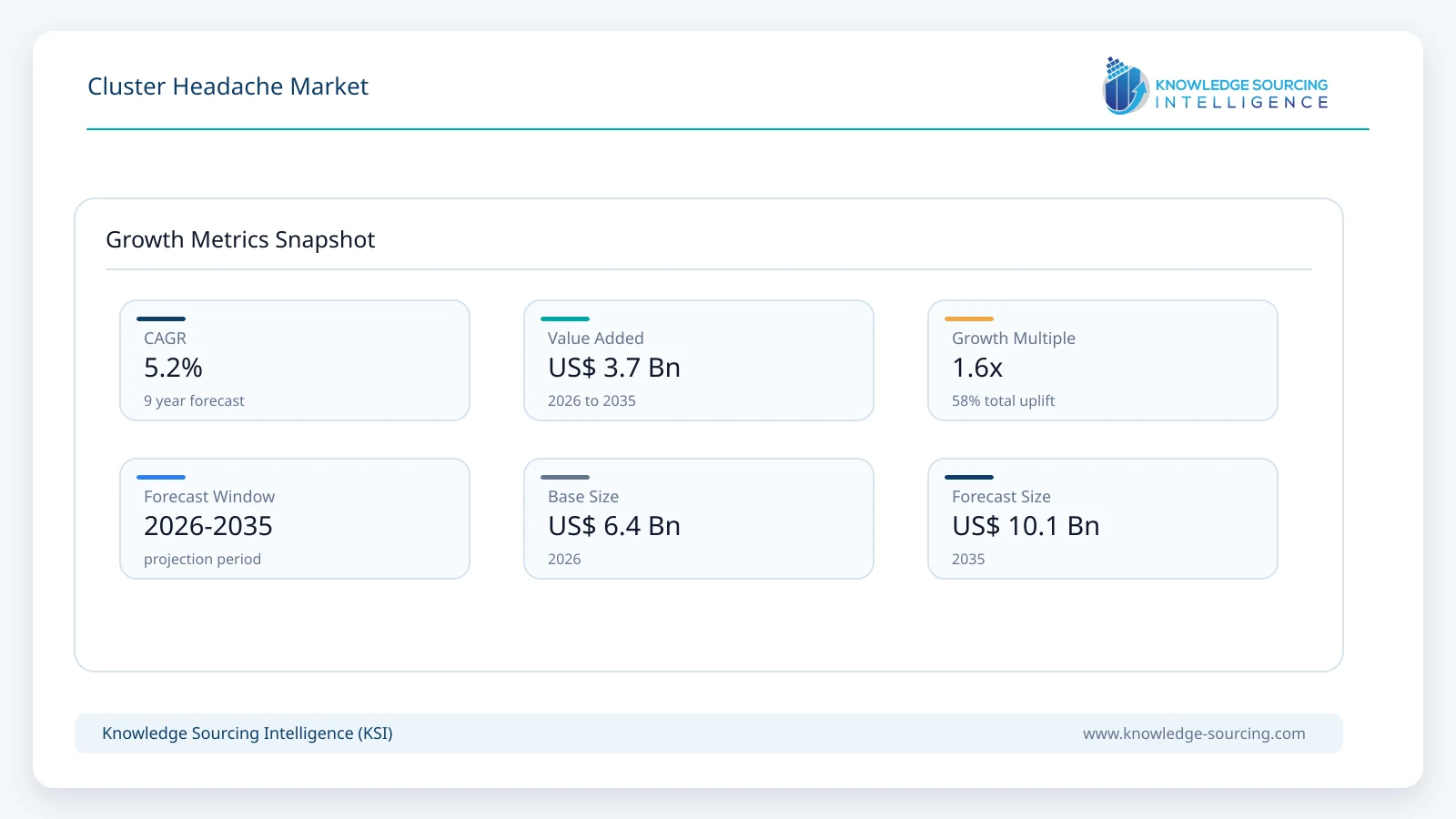
The Cluster Headache Market is expected to grow from USD 6.38 billion in 2026 at a 5.2% CAGR to USD 10.05 billion in 2035.
Highlights:
- 1Increasing recognition of cluster headache severity is expanding specialist consultations, which increases demand for earlier intervention.
- 2Adoption of CGRP-targeting therapies is improving preventive treatment selection, which increases interest in mechanism-driven products.
- 3Neuromodulation technologies are reducing dependence on repeated drug administration, which supports non-pharmacological treatment demand.
- 4Guideline support for oxygen, verapamil, and selected biologics is strengthening standardized treatment pathways, which improves therapy utilization.
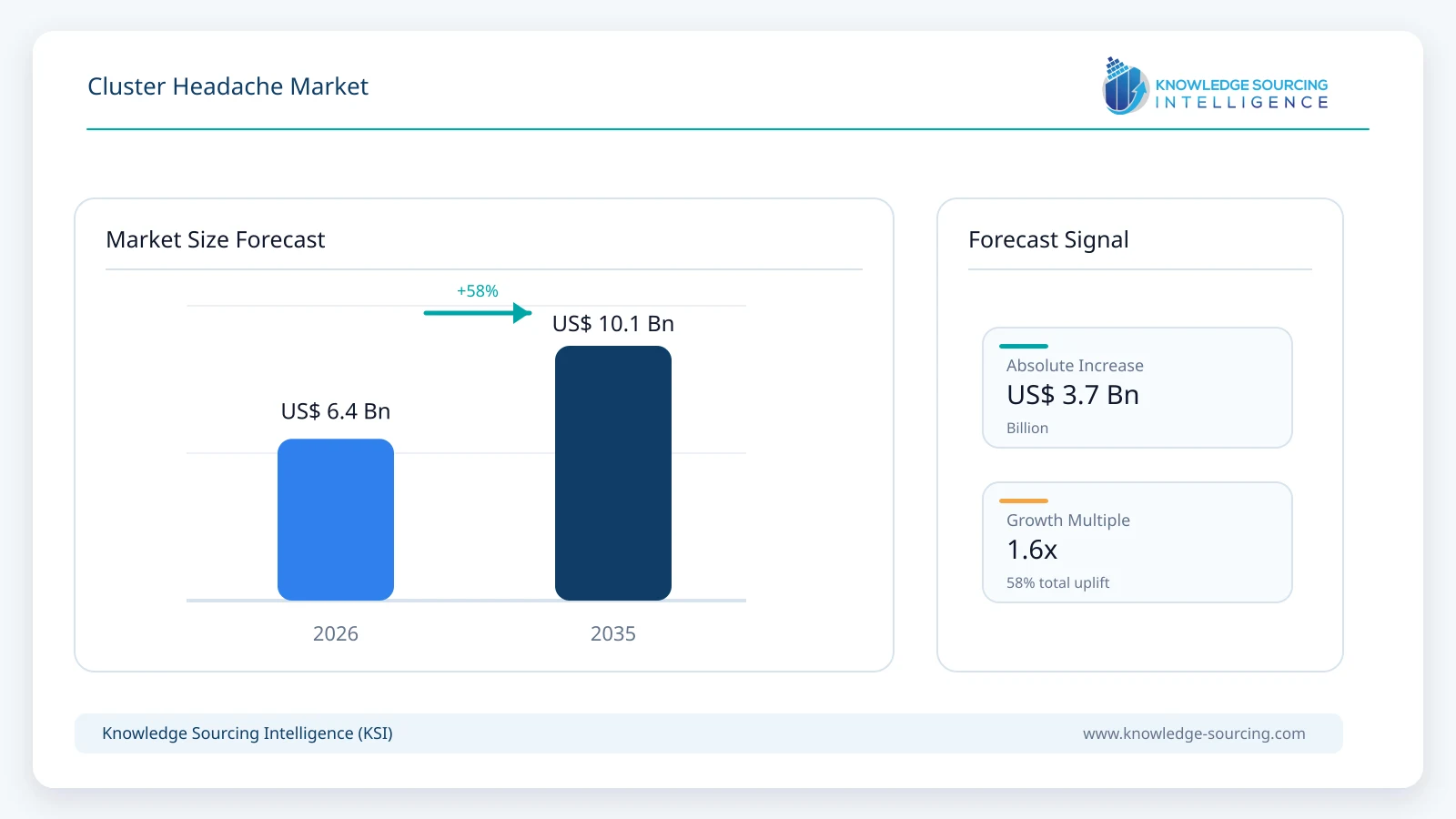
Cluster headache represents a specialized neurological treatment segment where demand depends on reducing recurrent attacks that significantly impair patient quality of life. The market includes acute treatments, preventive therapies, bridge interventions, and neuromodulation technologies.
Clinical demand is increasing because diagnosis rates are improving and specialist headache centers are expanding access to advanced treatment pathways. This trend places greater emphasis on therapies that demonstrate durable efficacy while minimizing treatment burden.
Regulatory agencies continue evaluating therapies through indication-specific evidence requirements because episodic and chronic cluster headache populations respond differently to treatment. This distinction influences development strategies and commercial positioning.
The market remains strategically important because severe disease burden creates demand for rapid symptom relief, long-term prevention, and alternatives to repeated pharmacological exposure.
Market Dynamics
Market Drivers
Growing Adoption of CGRP-Targeted Therapies: Preventive treatment remains a major unmet need in cluster headache management. Demand is increasing for therapies that directly address neurovascular signaling because conventional preventive regimens often require extensive monitoring. Clinical validation of galcanezumab in episodic cluster headache strengthens physician confidence. This shift is encouraging earlier preventive intervention. The outcome is greater interest in biologic treatment pathways.
Expansion of Neuromodulation-Based Treatment: Neuromodulation provides a non-drug treatment alternative. Demand is increasing because patients seek therapies that avoid systemic adverse effects. Medication limitations create treatment gaps in refractory populations. Manufacturers are expanding evidence generation and regulatory clearances. The result is a broader consideration of device-based management.
Improved Clinical Recognition: Accurate diagnosis determines treatment access. Awareness is increasing among neurologists because disease burden receives greater clinical attention. Historical underdiagnosis delays therapy initiation. Healthcare systems are supporting specialist referral pathways. The outcome is rising utilization of approved interventions.
Guideline-Based Treatment Standardization: Clinical guidelines define treatment expectations. Adoption is increasing because physicians require evidence-backed management frameworks. Variability in care limits treatment consistency. Healthcare providers are aligning practices with guideline recommendations.
Market Restraints
Limited approved therapies for chronic cluster headache restrict treatment options.
High biologic and device costs create reimbursement challenges.
Small patient populations reduce commercial incentives for large-scale development programs.
Market Opportunities
Expansion of Precision Neurology: Disease heterogeneity creates demand for targeted interventions. Research is increasing around pathway-specific mechanisms because patient responses vary substantially. Existing treatment limitations create differentiation opportunities. Sponsors are investing in biomarker-informed development. The outcome is a more personalized treatment landscape.
Growth of Home-Based Neuromodulation: Portable devices improve treatment accessibility. Demand is increasing because patients require rapid intervention outside clinical settings. Frequent attacks limit dependence on facility-based care. Manufacturers are developing user-friendly technologies.
Real-World Evidence Generation: Payers require outcome validation. Evidence collection is increasing because reimbursement decisions increasingly depend on demonstrated value. Clinical trial populations may not capture long-term treatment patterns. Companies are expanding post-market studies. The outcome is stronger market access potential.
Emerging Combination Treatment Strategies: Many patients require multiple interventions. Interest is increasing in integrated treatment pathways because acute and preventive needs coexist. Single-modality approaches often provide incomplete control. Providers are adopting combination management strategies. The result is expanded utilization across treatment categories.
Disease & Epidemiology Analysis
Cluster headache remains a rare neurological disorder characterized by recurrent unilateral attacks associated with autonomic symptoms. Episodic disease accounts for the majority of diagnosed cases, which creates substantial demand for preventive interventions during active cluster periods.
Diagnosis rates are improving because awareness among neurologists and headache specialists continues expanding. Delayed diagnosis remains common because symptoms overlap with other headache disorders. Healthcare providers are increasing referral activity to specialty centers. The outcome is greater treatment initiation at earlier disease stages.
Chronic cluster headache represents a smaller patient population but generates disproportionate healthcare utilization because attacks persist without extended remission periods. Therapeutic limitations remain significant in this segment. Developers are exploring alternative mechanisms and neuromodulation approaches. The result is continued pipeline interest despite development complexity.
Treatment Guidelines Landscape
Treatment Category | Guideline Position |
High-flow Oxygen | Strong recommendation for acute attacks |
Subcutaneous Sumatriptan | Strong recommendation for acute treatment |
Verapamil | First-line preventive therapy |
Corticosteroids | Bridge therapy for transitional control |
Market Segmentation
By Treatment Type
Preventive treatment represents the most strategically important segment because reducing attack frequency lowers long-term disease burden. Demand is increasing for biologics and targeted therapies because conventional preventives require monitoring and dose adjustments. Treatment limitations create interest in novel mechanisms. Manufacturers are expanding preventive portfolios. The outcome is greater emphasis on durable disease control.
By Disease Type
Episodic cluster headache generates substantial treatment demand because patients require rapid suppression of recurring attack cycles. Recognition is increasing due to improved engagement with specialists. Disease recurrence creates repeated intervention needs. Healthcare providers are adopting guideline-based preventive strategies. The result is stronger utilization of approved therapies.
By End User
Specialty clinics represent a critical treatment channel because cluster headache management often requires neurological expertise. Patient referrals are increasing as diagnostic awareness improves. Complex treatment selection requires specialist oversight. Healthcare systems are expanding dedicated headache services. The outcome is a greater concentration of advanced therapies within a specialty setting.
Regional Analysis
North America Market Analysis
North America remains the leading innovation center because regulatory approvals, specialist infrastructure, and commercial neurology investment support advanced treatment adoption. Demand is increasing for biologics and neuromodulation technologies because patients seek alternatives to conventional preventive therapies. High disease awareness supports diagnosis rates. Reimbursement scrutiny creates pressure for demonstrated clinical value. Manufacturers are expanding evidence generation to strengthen payer engagement. The result is continued leadership in the adoption of novel cluster headache interventions.
Europe Market Analysis
Europe maintains a strong evidence-based treatment environment because guideline-driven care influences prescribing decisions. Demand is increasing for validated preventive therapies because clinicians rely heavily on comparative efficacy data. Healthcare budget constraints create access variability across countries. Companies are pursuing targeted market access strategies. The outcome is a gradual expansion of advanced therapy utilization supported by clinical guidance.
Asia Pacific Market Analysis
Asia-Pacific represents a developing opportunity because the neurological care infrastructure continues to expand. Demand is increasing as awareness of primary headache disorders improves. Specialist shortages limit diagnosis in several markets. Healthcare systems are strengthening neurology capabilities. The outcome is progressive growth in treatment penetration and future commercial potential.
Rest of the World
Emerging markets remain underpenetrated because diagnostic capacity and specialist access vary considerably. Awareness is increasing through professional education initiatives. Limited reimbursement restricts the adoption of premium therapies. Healthcare providers are expanding headache management services. The result is a gradual improvement in treatment accessibility.
Regulatory Landscape
Regulatory agencies require indication-specific evidence because episodic and chronic cluster headache populations demonstrate different clinical characteristics. This framework places significant emphasis on attack frequency reduction, patient-reported outcomes, and long-term safety.
Device regulation continues evolving because neuromodulation technologies are expanding their role in neurological disease management. Developers are generating additional evidence to support broader utilization. Regulatory authorities remain focused on demonstrating durable benefit. The outcome is the increased importance of post-market clinical validation.
Guideline integration increasingly influences regulatory and reimbursement discussions because validated treatment pathways provide benchmarks for clinical value. This environment favors therapies supported by robust evidence. Sponsors are aligning development strategies with guideline priorities.
Pipeline Analysis
Pipeline activity focuses on CGRP biology, neuromodulation, and targeted neurological interventions. Development interest persists because a substantial unmet need remains in chronic cluster headache management. Existing therapies provide incomplete disease control for many patients. Companies are exploring differentiated mechanisms. The outcome is a diverse innovation landscape.
Galcanezumab established proof of concept for CGRP-directed treatment in episodic cluster headache. This validation increases interest in pathway-focused research. Clinical development challenges remain significant because patient recruitment is difficult. Sponsors are pursuing focused development strategies. The result is selective but sustained pipeline investment.
Neuromodulation remains an important area of innovation because device-based approaches offer non-pharmacological treatment alternatives. Technology developers are refining usability and treatment protocols. Demand for home-based management continues to increase. The outcome is expanding commercial relevance for neuromodulation platforms.
Reimbursement Landscape
Reimbursement remains a major determinant of treatment access because cluster headache therapies often involve high costs. Demand is increasing for value-based evidence because payers require a demonstration of reduced healthcare burden. Coverage variability creates access disparities. Manufacturers are supporting the generation of health-economic evidence. The outcome is growing emphasis on outcomes-based reimbursement discussions.
Neuromodulation and biologic therapies face heightened scrutiny because acquisition costs exceed those of traditional therapies. Real-world evidence increasingly supports reimbursement negotiations. Stakeholders are seeking long-term cost offsets through reduced attack frequency. The result is a gradual improvement in access where clinical value is clearly demonstrated.
Competitive Landscape
Medtronic
Medtronic remains differentiated through extensive neuromodulation expertise. Demand for device-based neurological therapies is increasing because patients require alternatives to chronic pharmacological exposure. Clinical complexity supports the adoption of advanced stimulation technologies. The company continues investing in innovation and evidence generation.
GlaxoSmithKline plc
GlaxoSmithKline remains strategically distinct through its neuroscience capabilities and global commercial infrastructure. The company maintains relevance in neurological disease management because its broad research capabilities support future therapeutic expansion. Demand is shifting toward targeted neurological interventions. Portfolio optimization remains a strategic priority.
Eli Lilly and Company
Eli Lilly occupies a leading position through Emgality (galcanezumab), one of the most visible targeted therapies associated with episodic cluster headache management. Demand is increasing for CGRP-focused interventions because preventive disease control remains a major clinical objective.
Pfizer Inc.
Pfizer leverages extensive neurological and pain-management capabilities. Demand for effective headache management continues to increase because disease burden remains substantial. Portfolio diversification supports long-term opportunity evaluation. Strategic partnerships remain important for innovation access.
electroCore, Inc.
electroCore remains strategically differentiated through gammaCore, a non-invasive vagus nerve stimulation platform. Demand is increasing for drug-free treatment alternatives because patients seek rapid and portable interventions. Regulatory clearances support commercial expansion.
Grünenthal GmbH
Grünenthal maintains strategic differentiation through pain-management expertise. Demand is increasing for therapies that address severe neurological pain conditions. Clinical experience in pain medicine supports treatment development opportunities. The company continues evaluating specialty-care growth pathways.
Key Developments
October 2025: UNSW researchers received $4.7 million from the Medical Research Future Fund (MRFF) for four initiatives to improve patient care, including testing new treatments for cluster headaches and chronic pain management, improving access to pediatric care for children in regional areas, and investigating causes of pregnancy loss for those undergoing reproductive treatment.
May 2025: The FDA approved Amneal's Brekiya (dihydroergotamine mesylate) injection as the first and only dihydroergotamine (DHE) autoinjector for the acute treatment of migraine with or without aura and cluster headaches in adults.
Strategic Insights and Future Market Outlook
The cluster headache market is transitioning from symptomatic management toward mechanism-driven intervention. Demand is increasing for therapies that modify disease activity because patients and physicians seek durable reductions in attack burden. This transition favors biologics, neuromodulation technologies, and precision treatment approaches.
Clinical development strategies increasingly focus on clearly defined patient populations because treatment response differs between episodic and chronic disease. Regulatory expectations reinforce this segmentation. Sponsors are concentrating resources on differentiated evidence generation. The outcome is a more specialized competitive environment.
Future growth depends on expanding access to effective preventive therapies while improving reimbursement support for advanced interventions. Neuromodulation adoption is increasing because non-drug alternatives address persistent unmet needs. Continued innovation in targeted neurology supports long-term market evolution.
Cluster headache remains a highly specialized treatment area where clinical need exceeds currently available options. Ongoing advances in CGRP-targeted therapies, neuromodulation platforms, and evidence-based care pathways position the market for continued therapeutic innovation throughout the forecast period.
Cluster Headache Market Scope:
| Report Metric | Details |
|---|---|
| Total Market Size in 2026 | USD 6.38 billion |
| Total Market Size in 2035 | USD 10.05 billion |
| Forecast Unit | USD Billion |
| Growth Rate | 5.2% |
| Study Period | 2021 to 2035 |
| Historical Data | 2021 to 2024 |
| Base Year | 2025 |
| Forecast Period | 2026 – 2035 |
| Segmentation | Treatment Type, Drug Class, Disease Type, Geography |
| Companies |
|
Market Segmentation
By Geography
Key Countries Analysis
Regulatory & Policy Landscape
Table of Contents
1. EXECUTIVE SUMMARY
1.1 Market Overview
1.2 Key Findings
1.3 Cluster Headache Market Snapshot
1.4 Key Growth Drivers
1.5 Key Challenges
1.6 Emerging Opportunities
1.7 Analyst Recommendations
2. DISEASE & EPIDEMIOLOGY ANALYSIS
2.1 Overview of Cluster Headache
2.1.1 Definition and Clinical Characteristics
2.1.2 Disease Burden and Unmet Needs
2.1.3 Pathophysiology and Disease Mechanisms
2.2 Classification of Cluster Headache
2.2.1 Episodic Cluster Headache
2.2.2 Chronic Cluster Headache
2.3 Risk Factors and Disease Triggers
2.4 Diagnosis and Patient Journey
2.4.1 Diagnostic Criteria
2.4.2 Differential Diagnosis
2.4.3 Time to Diagnosis and Treatment Challenges
2.5 Epidemiology Analysis
2.5.1 Historical and Forecast Patient Population
2.5.2 Prevalence Analysis
2.5.3 Incidence Analysis
2.5.4 Diagnosed Patient Population
2.5.5 Treated Patient Population
2.5.6 Gender-wise Epidemiology
2.5.7 Age-wise Epidemiology
2.5.8 Episodic Cluster Headache Population
2.5.9 Chronic Cluster Headache Population
3. MARKET DYNAMICS
3.1 Market Drivers
3.1.1 Increasing Disease Awareness
3.1.2 Growing Diagnosis Rates
3.1.3 Availability of Targeted Therapies
3.1.4 Advancements in Neuromodulation Technologies
3.2 Market Restraints
3.2.1 Underdiagnosis and Misdiagnosis
3.2.2 Limited Approved Treatment Options
3.2.3 Reimbursement Challenges
3.3 Market Opportunities
3.3.1 CGRP-Targeted Therapies
3.3.2 Non-Invasive Neuromodulation
3.3.3 Expansion in Emerging Markets
3.4 Market Challenges
3.5 Porter's Five Forces Analysis
3.6 PESTLE Analysis
3.7 Value Chain Analysis
4. COMMERCIAL & MARKET ACCESS
4.1 Treatment Adoption Trends
4.2 Pricing Analysis
4.3 Reimbursement Landscape
4.4 Market Access Challenges
4.5 Stakeholder Analysis
4.6 Healthcare Infrastructure Assessment
4.7 Patient Assistance Programs
5. INNOVATION & PIPELINE LANDSCAPE
5.1 Innovation Overview
5.2 Emerging Technologies
5.2.1 CGRP-Based Therapeutics
5.2.2 Neuromodulation Devices
5.2.3 Precision Medicine Approaches
5.3 Pipeline Landscape by Development Stage
5.3.1 Phase I Pipeline Candidates
5.3.2 Phase II Pipeline Candidates
5.3.3 Phase III Pipeline Candidates
5.4 Pipeline Analysis by Mechanism of Action
5.5 Pipeline Analysis by Modality
5.5.1 Monoclonal Antibodies
5.5.2 Small Molecules
5.5.3 Medical Devices
5.5.4 Neuromodulation Technologies
5.6 Clinical Trial Landscape
5.7 Patent Analysis
5.8 Recent Developments and Strategic Activities
6. TREATMENT LANDSCAPE
6.1 Current Treatment Algorithm
6.2 Acute Treatment Landscape
6.2.1 Oxygen Therapy
6.2.2 Triptans
6.2.3 Other Acute Therapies
6.3 Preventive Treatment Landscape
6.3.1 Calcium Channel Blockers
6.3.2 Corticosteroids
6.3.3 CGRP Monoclonal Antibodies
6.3.4 Other Preventive Therapies
6.4 Neuromodulation Treatment Landscape
6.5 Comparative Assessment of Available Therapies
6.6 Unmet Clinical Needs
7. GLOBAL CLUSTER HEADACHE MARKET FORECAST REPORT SIZE & FORECAST
7.1 Market Overview
7.2 Historical Market Size Analysis (2021–2025)
7.3 Forecast Market Size Analysis (2026–2035)
7.4 Absolute Dollar Opportunity Analysis
7.5 Market Attractiveness Analysis
8. GLOBAL CLUSTER HEADACHE MARKET FORECAST REPORT SEGMENTATION
8.1 By Treatment Type
8.1.1 Acute Treatment
8.1.2 Preventive Treatment
8.1.3 Bridge Treatment
8.2 By Drug Class
8.2.1 Triptans
8.2.2 CGRP Monoclonal Antibodies
8.2.3 Calcium Channel Blockers
8.2.4 Corticosteroids
8.2.5 Others
8.3 By Disease Type
8.3.1 Episodic Cluster Headache
8.3.2 Chronic Cluster Headache
8.4 By Route of Administration
8.4.1 Injectable
8.4.2 Oral
8.4.3 Intranasal
8.5 By End User
8.5.1 Hospitals
8.5.2 Specialty Clinics
8.5.3 Homecare Settings
8.5.4 Others
8.6 By Distribution Channel
8.6.1 Hospital Pharmacies
8.6.2 Retail Pharmacies
8.6.3 Online Pharmacies
9. GEOGRAPHICAL ANALYSIS
9.1 North America
9.1.1 Market Size and Forecast
9.1.2 Demand Drivers
9.1.3 Regional Regulatory Overview
9.1.4 Competitive Intensity
9.2 Europe
9.2.1 Market Size and Forecast
9.2.2 Demand Drivers
9.2.3 Regional Regulatory Overview
9.2.4 Competitive Intensity
9.3 Asia-Pacific
9.3.1 Market Size and Forecast
9.3.2 Demand Drivers
9.3.3 Regional Regulatory Overview
9.3.4 Competitive Intensity
9.4 Latin America
9.4.1 Market Size and Forecast
9.4.2 Demand Drivers
9.4.3 Regional Regulatory Overview
9.4.4 Competitive Intensity
9.5 Middle East & Africa
9.5.1 Market Size and Forecast
9.5.2 Demand Drivers
9.5.3 Regional Regulatory Overview
9.5.4 Competitive Intensity
10. KEY COUNTRIES ANALYSIS
10.1 United States
10.1.1 Market Size and Forecast
10.1.2 Epidemiology Analysis
10.1.3 Regulatory Framework
10.1.4 Reimbursement Landscape
10.1.5 Key Companies and Products Presence
10.2 Canada
10.3 Germany
10.4 United Kingdom
10.5 France
10.6 Italy
10.7 Spain
10.8 China
10.9 Japan
10.10 India
10.11 South Korea
10.12 Australia
10.13 Brazil
10.14 Mexico
10.15 Saudi Arabia
10.16 South Africa
11. REGULATORY & POLICY LANDSCAPE
11.1 Global Regulatory Overview
11.2 United States Regulatory Framework (FDA)
11.3 Europe Regulatory Framework (EMA)
11.4 Japan Regulatory Framework (PMDA)
11.5 India Regulatory Framework (CDSCO)
11.6 China Regulatory Framework (NMPA)
11.7 Medical Device Regulatory Considerations
11.8 Market Authorization Pathways
11.9 Reimbursement and Health Technology Assessment Trends
12. COMPETITIVE LANDSCAPE
12.1 Market Share Analysis
12.2 Competitive Benchmarking
12.3 Product Portfolio Assessment
12.4 Pipeline Competitiveness Analysis
12.5 Strategic Developments
12.5.1 Partnerships and Collaborations
12.5.2 Licensing Agreements
12.5.3 Acquisitions and Mergers
12.5.4 Regulatory Milestones
13. COMPANY PROFILES
13.1 GlaxoSmithKline plc
13.1.1 Company Overview
13.1.2 Approved Products Relevant to Cluster Headache Management
13.1.3 Key Indications
13.1.4 Verified Pipeline Assets
13.1.5 Strategic Outlook
13.2 Medtronic
13.2.1 Company Overview
13.2.2 Neuromodulation Portfolio
13.2.3 Key Indications
13.2.4 Verified Pipeline and Innovation Activities
13.2.5 Strategic Outlook
13.3 Eli Lilly and Company
13.3.1 Company Overview
13.3.2 Emgality (galcanezumab)
13.3.3 Key Indications
13.3.4 Verified Pipeline Assets
13.3.5 Strategic Outlook
13.4 electroCore, Inc.
13.4.1 Company Overview
13.4.2 gammaCore
13.4.3 Key Indications
13.4.4 Verified Pipeline and Technology Development
13.4.5 Strategic Outlook
13.5 Pfizer Inc.
13.5.1 Company Overview
13.5.2 Approved Products Relevant to Headache Management
13.5.3 Key Indications
13.5.4 Verified Pipeline Assets
13.5.5 Strategic Outlook
13.6 Grünenthal GmbH
13.6.1 Company Overview
13.6.2 Pain Management Portfolio
13.6.3 Key Indications
13.6.4 Verified Pipeline Assets
13.6.5 Strategic Outlook
13.7 Viatris Inc.
13.7.1 Company Overview
13.7.2 Headache and Pain Management Portfolio
13.7.3 Key Indications
13.7.4 Verified Pipeline Assets
13.7.5 Strategic Outlook
13.8 Autonomic Technologies Inc.
13.8.1 Company Overview
13.8.2 Cluster Headache Neuromodulation Technology Portfolio
13.8.3 Key Indications
13.8.4 Verified Development Programs
13.8.5 Strategic Outlook
13.9 Zosano Pharma Corp.
13.9.1 Company Overview
13.9.2 Migraine and Headache Technology Portfolio
13.9.3 Key Indications
13.9.4 Verified Development Programs
13.9.5 Strategic Outlook
13.10 Bausch Health Companies Inc.
13.10.1 Company Overview
13.10.2 Neurology and Pain Management Portfolio
13.10.3 Key Indications
13.10.4 Verified Pipeline Assets
13.10.5 Strategic Outlook
14. FUTURE OUTLOOK
14.1 Market Outlook Through 2035
14.2 Future Treatment Paradigm
14.3 Emerging Technologies Impact
14.4 Pipeline Commercialization Outlook
14.5 Investment Opportunities
14.6 Key Success Factors
15. METHODOLOGY
15.1 Research Objectives
15.2 Study Assumptions
15.3 Data Collection Methodology
15.4 Epidemiology Modeling Approach
15.5 Market Forecasting Methodology
15.6 Data Validation and Triangulation
15.7 Abbreviations and Definitions
15.8 Disclaimer and Scope Limitations
Navigate
Trusted by the world's leading organizations











