
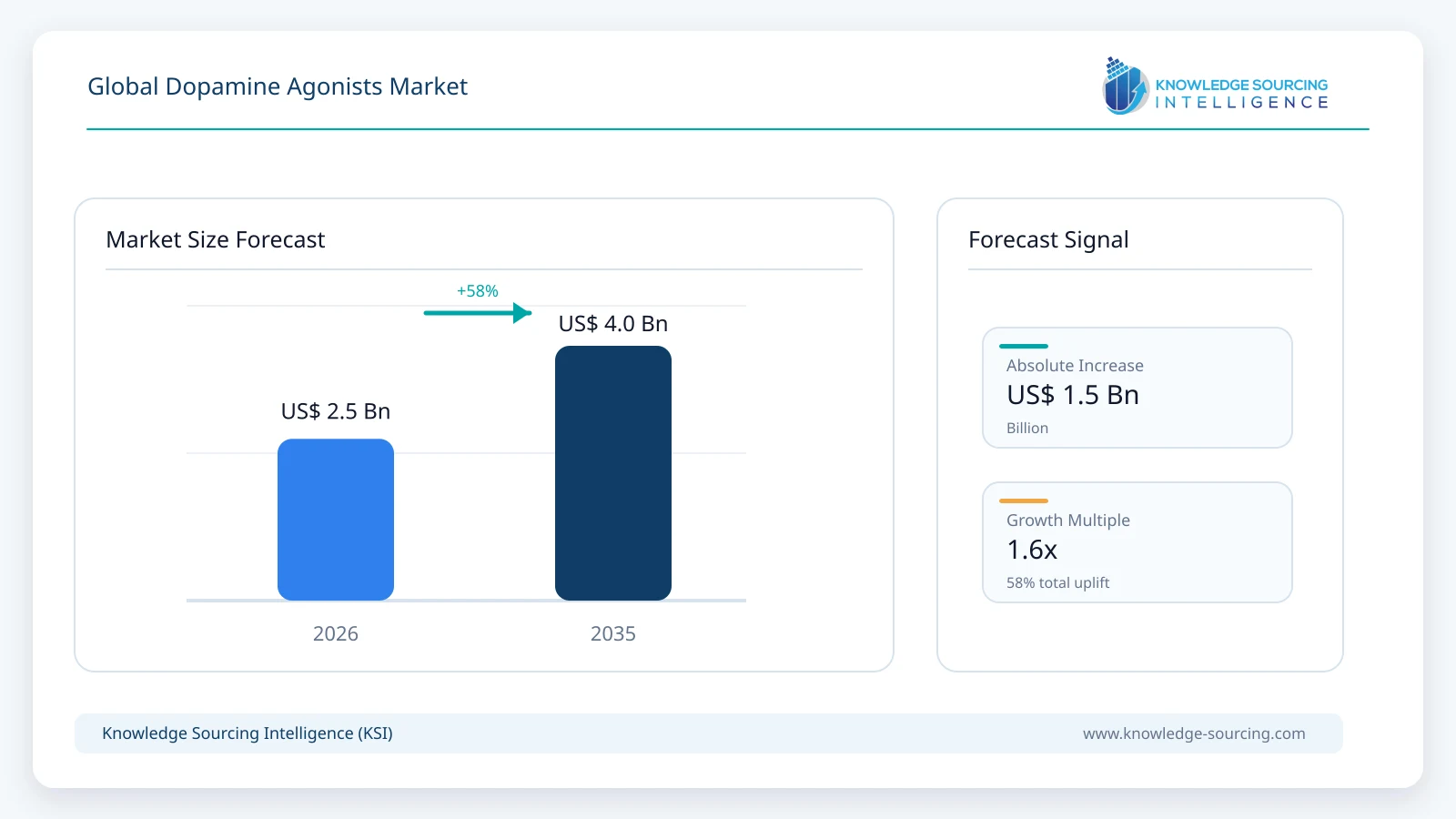
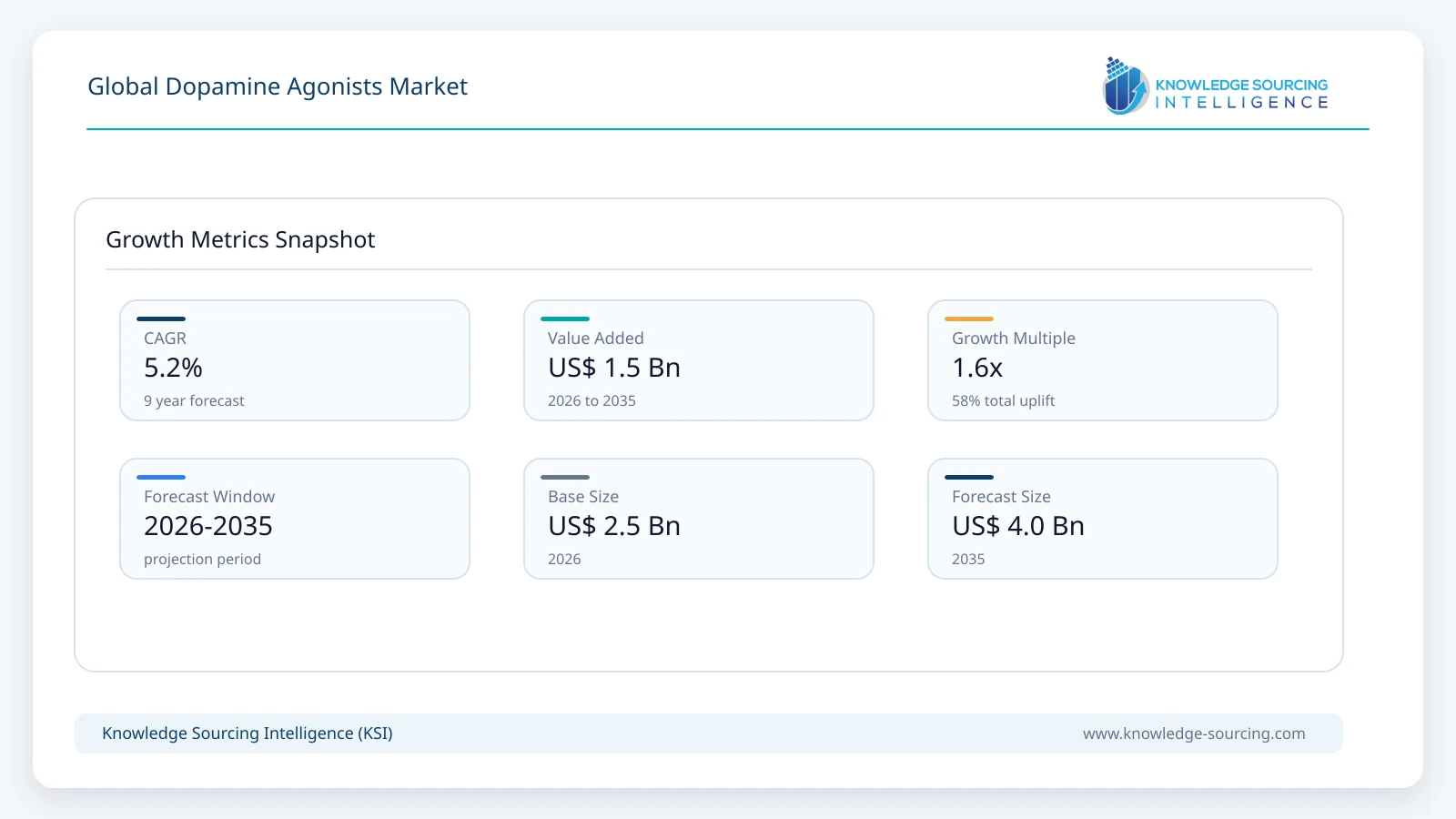
The Global Dopamine Agonists Market is projected to grow at a CAGR of 5.2% the forecast period, increasing from USD 2.52 billion in 2026 to USD 3.97 billion by 2035.
Highlights:
- 1Population aging is increasing Parkinson’s disease prevalence, which is expanding long-term dopamine agonist prescription demand.
- 2Movement-disorder specialists are shifting toward non-ergot therapies because fibrosis-associated risks continue limiting ergot-derived utilization.
- 3Continuous dopaminergic delivery systems are gaining adoption because motor fluctuations increasingly require sustained receptor stimulation.
- 4Hyperprolactinemia treatment demand remains stable because dopamine agonists continue serving as first-line pharmacological intervention.
Dopamine agonists stimulate dopamine receptors directly because endogenous dopamine production declines in multiple neurological and endocrine disorders. Parkinson’s disease generates sustained prescription demand because symptom progression continuously increases therapeutic dependency. Demand is shifting toward receptor-selective therapies because clinicians increasingly balance efficacy with psychiatric, cardiovascular, and sleep-related safety considerations. This shift is changing prescribing behavior across both specialist neurology and movement-disorder centers.
The market depends heavily on chronic treatment persistence because abrupt dopaminergic withdrawal often worsens motor symptoms and functional outcomes. Non-ergot dopamine agonists are replacing historical treatment approaches because fibrosis-related concerns continue constraining ergot-derived utilization. Regulatory oversight remains significant because impulse-control disorders, hallucinations, and excessive daytime sleepiness continue influencing long-term pharmacovigilance requirements. This environment supports therapies capable of demonstrating sustained efficacy with manageable safety profiles.
Market Dynamics
Market Drivers
Rising Parkinson’s Disease Burden: Parkinson’s disease remains the primary demand driver because dopaminergic dysfunction directly contributes to progressive motor impairment. Diagnosis rates are increasing as neurological screening capabilities continue expanding across aging populations. Treatment dependency therefore continues strengthening across major healthcare systems. This dynamic supports sustained dopamine agonist utilization.
Expansion of Non-Ergot Dopamine Agonists: Treatment selection increasingly prioritizes safety because long-term exposure risks continue influencing prescribing decisions. Physicians are shifting toward pramipexole, ropinirole, rotigotine, and apomorphine while reducing dependence on older ergot-derived products. Safety-driven substitution therefore continues reshaping prescription patterns. This transition strengthens demand for differentiated non-ergot portfolios.
Increasing Adoption of Continuous Dopaminergic Delivery: Motor fluctuations remain a major treatment challenge because intermittent receptor stimulation frequently produces inconsistent symptom control. Clinicians are adopting transdermal and rescue-based delivery approaches while attempting to stabilize therapeutic response. Formulation innovation therefore increasingly influences market competitiveness. This evolution supports premium neurological products.
Growth in Restless Legs Syndrome Treatment: Restless Legs Syndrome continues generating therapeutic demand because sleep disruption substantially affects quality of life. Dopamine agonists are maintaining frontline utilization while treatment awareness continues expanding. Prescription volumes therefore remain supported beyond Parkinson’s disease populations.
Market Restraints
Generic competition limits pricing flexibility because multiple dopamine agonists have established generic availability.
Neuropsychiatric adverse events constrain treatment persistence because hallucinations and impulse-control disorders continue affecting long-term utilization.
Levodopa remains the dominant Parkinson’s disease therapy because superior symptomatic efficacy influences treatment sequencing.
Market Opportunities
Expansion of Transdermal Therapies: Medication adherence remains a challenge because neurological disease progression frequently complicates dosing compliance. Clinicians are adopting transdermal treatment approaches while patients increasingly seek simplified administration pathways. Rotigotine utilization therefore continues to benefit from convenience-driven demand. This trend supports differentiated delivery technologies.
Advanced OFF-Episode Management: Motor fluctuation prevalence increases as Parkinson’s disease progresses because dopaminergic responsiveness becomes less predictable. Rescue therapies are gaining clinical importance while physicians continue focusing on rapid symptom control. Apomorphine-based interventions therefore remain strategically relevant. This niche supports specialty neurology expansion.
Endocrinology-Based Dopamine Agonist Demand: Hyperprolactinemia treatment remains dependent on dopamine receptor stimulation because prolactin suppression directly responds to dopaminergic activity. Diagnosis rates are increasing as endocrine monitoring expands across reproductive health pathways. Demand therefore remains stable beyond neurology-focused indications. This diversification broadens commercial resilience.
Long-Acting Formulation Development: Treatment persistence influences neurological outcomes because inconsistent exposure often reduces symptom control. Manufacturers are developing extended-release and continuous-delivery products while attempting to improve adherence. Innovation therefore increasingly focuses on formulation optimization. This approach strengthens lifecycle management opportunities.
Government Regulations
Regulatory Authority | Regulatory Focus | Market Impact |
FDA | Drug approvals and safety monitoring | Supports neurological therapy commercialization |
EMA | Centralized approval pathway | Enables broader European market access |
PMDA | Neurology drug evaluation | Accelerates Japanese treatment adoption |
NMPA | Drug registration and review | Expands access in China |
CDSCO | Product approval and compliance | Supports neurological treatment availability in India |
Market Segmentation
By Molecule
Molecule-level competition increasingly reflects differences in delivery systems and receptor selectivity because efficacy alone no longer determines prescribing preference. Pramipexole and ropinirole maintain broad utilization while generic accessibility continues supporting prescription volume. Rotigotine is gaining strategic relevance because transdermal administration improves treatment continuity. Apomorphine remains specialized because OFF-episode management requires rapid symptom control. This segmentation increasingly links demand to functional treatment differentiation.
By Drug Type
Drug-type segmentation reflects evolving safety preferences because fibrosis concerns continue reducing dependence on ergot-derived therapies. Non-ergot dopamine agonists are expanding utilization while movement-disorder specialists increasingly prioritize long-term tolerability. Ergot-derived therapies maintain relevance within selected endocrine indications because prolactin suppression remains clinically effective. This transition strengthens the commercial dominance of newer-generation dopamine agonists.
By Indication
Parkinson’s disease remains the largest indication because progressive neurodegeneration creates chronic treatment dependency. Restless Legs Syndrome continues generating prescription demand while sleep-related symptom burden remains clinically significant. Hyperprolactinemia maintains endocrine utilization because dopamine agonists remain first-line pharmacological therapy. This indication diversity supports market stability despite neurological treatment competition.
Regional Analysis
North America
North America maintains substantial dopamine agonist demand because Parkinson’s disease diagnosis rates remain comparatively high. Neurology specialists are increasingly emphasizing treatment personalization while advanced movement-disorder centers continue expanding access to differentiated therapies. Generic availability creates pricing pressure because payers prioritize cost containment across chronic neurological treatments. Manufacturers are responding through formulation innovation while transdermal and rescue-based therapies continue strengthening specialty positioning. This structure favors products capable of demonstrating adherence benefits and sustained symptom control. Parkinson’s disease prevalence continues increasing as the population ages, which reinforces long-term prescription demand. Clinical decision-making increasingly incorporates tolerability because psychiatric and sleep-related adverse events influence treatment persistence. The resulting market remains focused on balancing efficacy, adherence, and safety.
Europe
Europe supports significant dopamine agonist utilization because public healthcare systems maintain broad neurological treatment access. Demand is shifting toward evidence-supported therapies while reimbursement authorities continue emphasizing cost-effectiveness evaluation. Generic competition constrains premium pricing because national procurement frameworks prioritize affordability. Manufacturers are strengthening clinical differentiation strategies while long-acting formulations continue receiving attention. Parkinson’s disease management increasingly focuses on quality-of-life outcomes because long-term disease burden affects healthcare utilization. This environment supports stable demand with selective adoption of specialty products.
Asia Pacific
Asia Pacific is expanding as a dopamine agonist market because neurological diagnosis rates continue improving across major economies. Healthcare infrastructure investment is increasing specialist access while awareness initiatives continue supporting earlier disease identification. Demand is shifting toward branded neurological therapies because urban treatment centers increasingly adopt advanced management protocols. Pricing sensitivity remains significant because reimbursement expansion varies substantially across countries. Manufacturers are strengthening regional commercialization strategies while regulatory reforms continue improving approval pathways. This combination supports sustained treatment adoption growth.
Rest of the World
Emerging healthcare systems continue expanding neurological care access because untreated Parkinson’s disease populations remain substantial. Generic dopamine agonists dominate utilization because affordability strongly influences prescribing behavior. Demand is increasing as specialist availability improves while healthcare modernization programs continue supporting chronic disease management. Premium formulations remain selectively adopted because reimbursement limitations constrain widespread uptake. This structure supports gradual market development rather than rapid specialty expansion.
Regulatory Landscape
Dopamine agonists remain subject to extensive pharmacovigilance oversight because long-term neurological exposure continues generating safety-monitoring requirements. Regulatory agencies increasingly evaluate neuropsychiatric adverse events while post-marketing surveillance programs continue influencing label management. This scrutiny affects treatment positioning because safety perceptions directly influence prescribing decisions.
Non-ergot dopamine agonists benefit from stronger long-term utilization because fibrosis-related concerns continue limiting broader ergot-derived expansion. Regulatory frameworks increasingly emphasize risk-benefit evaluation while manufacturers continue generating long-term safety evidence. This environment favors therapies with established clinical experience and differentiated delivery technologies.
Pipeline Analysis
Pipeline development increasingly focuses on delivery optimization because receptor stimulation mechanisms remain clinically validated. Companies are exploring continuous dopaminergic stimulation strategies while attempting to reduce motor fluctuations and adherence barriers. Innovation therefore concentrates on formulation enhancement rather than entirely new therapeutic categories.
Research programs continue evaluating receptor selectivity because adverse-event reduction remains a major unmet need. D1 and D5 receptor-targeting approaches are attracting attention while next-generation dopaminergic therapies continue advancing through neurological development pathways. This focus reflects demand for efficacy preservation alongside safety improvement.
Competitive Landscape
AbbVie
AbbVie remains strategically distinct because its Parkinson’s disease presence extends through advanced neurological treatment infrastructure and movement-disorder engagement. Demand is shifting toward comprehensive disease management because progressive symptom burden increasingly requires combination treatment strategies. The company benefits from specialist relationships while neurological care pathways continue evolving toward integrated treatment models. This positioning supports long-term relevance within Parkinson’s disease management.
UCB
UCB maintains competitive relevance because NEUPRO provides continuous dopaminergic stimulation through transdermal delivery. Demand is increasing for adherence-focused treatment approaches because dosing complexity frequently affects long-term persistence. Physicians are adopting rotigotine across multiple disease stages while treatment flexibility continues supporting utilization. This differentiation strengthens UCB’s neurological market position.
Abbott Laboratories
Abbott Laboratories maintains historical relevance within dopamine agonist treatment pathways because cabergoline utilization remains established in endocrine disorders. Demand persists where prolactin suppression remains clinically necessary because dopamine receptor activation continues providing effective endocrine control. This position supports continued therapeutic visibility.
Pfizer
Pfizer retains historical involvement through bromocriptine-associated therapeutic areas because endocrine and neurological applications continue supporting residual demand. Treatment utilization increasingly reflects niche positioning because newer agents provide broader safety advantages. This environment limits expansion but preserves selective relevance.
GSK
GSK remains associated with ropinirole commercialization because Parkinson’s disease and Restless Legs Syndrome continue generating prescription demand. Generic availability constrains branded growth because payer systems emphasize affordability. Clinical familiarity nevertheless sustains utilization. This dynamic reinforces long-term molecule stability.
Boehringer Ingelheim
Boehringer Ingelheim maintains neurological visibility through pramipexole-associated commercialization history. Demand continues where physicians prioritize established efficacy because extensive clinical experience supports treatment confidence. The molecule’s broad recognition sustains prescription volume despite competitive pressure. This positioning preserves neurological relevance.
Lundbeck
Lundbeck benefits from CNS specialization because neurological treatment expertise increasingly influences competitive positioning. Demand is shifting toward integrated neurological care because disease complexity continues expanding specialist involvement. The company’s neuroscience focus supports participation in evolving movement-disorder treatment ecosystems. This specialization strengthens strategic flexibility.
Supernus Pharmaceuticals
Supernus Pharmaceuticals remains strategically positioned within CNS therapeutics because neurological disease management continues generating specialty treatment demand. The company is expanding its neuroscience footprint while movement-disorder opportunities continue attracting commercial interest. This direction supports future participation in Parkinson’s disease-related markets.
Key Developments
April 2026: Johnson & Johnson announced that the U.S. Food and Drug Administration (FDA) has approved a supplemental New Drug Application (sNDA) based on long-term data evaluating the safety and efficacy of CAPLYTA® (lumateperone) for the prevention of relapse in schizophrenia.
February 2026: Vanda Pharmaceuticals Inc. announced that the U.S. Food and Drug Administration (FDA) has approved BYSANTI™ (milsaperidone) tablets, a first line therapy for the acute treatment of manic or mixed episodes associated with bipolar I disorder and for the treatment of schizophrenia in adults.
Strategic Insights and Future Market Outlook
The dopamine agonist market increasingly depends on formulation differentiation because receptor-stimulation mechanisms are clinically established across major indications. Demand is shifting toward therapies capable of improving adherence while reducing fluctuation-related symptom variability. This transition favors continuous-delivery systems and patient-centric treatment models.
Neurological disease burden continues expanding because aging populations are increasing Parkinson’s disease prevalence globally. Treatment pathways are becoming more individualized while clinicians increasingly balance efficacy against neuropsychiatric and cardiovascular safety concerns. These pressures support long-term utilization of differentiated non-ergot therapies.
Future competition increasingly centers on treatment persistence because chronic disease management requires sustained patient engagement. Manufacturers are strengthening lifecycle management strategies while healthcare systems continue emphasizing functional outcomes. This environment supports innovation focused on delivery optimization, safety enhancement, and adherence improvement.
The Global Dopamine Agonists Market remains driven by chronic neurological disease management, expanding Parkinson’s disease prevalence, and increasing demand for continuous dopaminergic stimulation. Treatment adoption continues shifting toward differentiated formulations because long-term symptom control increasingly depends on persistence, tolerability, and individualized therapeutic delivery rather than receptor activation alone.
Global Dopamine Agonists Market Scope:
| Report Metric | Details |
|---|---|
| Total Market Size in 2026 | USD 2.52 billion |
| Total Market Size in 2035 | USD 3.97 billion |
| Forecast Unit | USD Billion |
| Growth Rate | 5.2% |
| Study Period | 2021 to 2035 |
| Historical Data | 2021 to 2024 |
| Base Year | 2025 |
| Forecast Period | 2026 – 2035 |
| Segmentation | Molecule, Drug Type, Indication, Geography |
| Companies |
|
Market Segmentation
By Geography
Key Countries Analysis
Table of Contents
1. EXECUTIVE SUMMARY
1.1 Strategic Overview
1.1.1 Dopamine Agonists Market Definition and Scope
1.1.2 Key Commercial Insights
1.1.3 Key Clinical Insights
1.1.4 Major Regulatory Developments
1.1.5 Innovation and Pipeline Highlights
1.1.6 Strategic Opportunities and Risks
1.2 Market Snapshot
1.2.1 Global Revenue Overview
1.2.2 Prescription Volume Overview
1.2.3 Treated Patient Overview
1.2.4 Forecast Summary
1.3 Executive Conclusions
1.3.1 Market Evolution Outlook
1.3.2 Competitive Positioning Summary
1.3.3 Future Innovation Outlook
2. DISEASE & PATIENT POPULATION INTELLIGENCE
2.1 Disease Landscape Overview
2.1.1 Parkinson’s Disease
2.1.2 Restless Legs Syndrome (RLS)
2.1.3 Hyperprolactinemia
2.1.4 Acromegaly
2.1.5 Pituitary Adenomas
2.1.6 Off-Label and Emerging Indications
2.2 Epidemiology Assessment
2.2.1 Global Disease Prevalence
2.2.2 Global Disease Incidence
2.2.3 Disease Burden Analysis
2.2.4 Mortality and Morbidity Assessment
2.3 Patient Funnel Modeling
2.3.1 Total Disease Population
2.3.2 Diagnosed Population
2.3.3 Pharmacologically Treated Population
2.3.4 Dopamine Agonist Eligible Population
2.3.5 Advanced Therapy Eligible Population
2.4 Parkinson’s Disease Patient Segmentation
2.4.1 Early-Stage Parkinson’s Disease
2.4.2 Moderate Parkinson’s Disease
2.4.3 Advanced Parkinson’s Disease
2.4.4 Motor Fluctuation Population
2.4.5 Dyskinesia-Prone Population
2.5 Hyperprolactinemia Patient Segmentation
2.5.1 Prolactinoma Patients
2.5.2 Idiopathic Hyperprolactinemia
2.5.3 Drug-Induced Hyperprolactinemia
2.6 Biomarker and Clinical Parameter Analysis
2.6.1 Serum Prolactin Levels
2.6.2 Dopaminergic Functional Assessments
2.6.3 UPDRS-Based Disease Assessment
2.6.4 MRI-Based Pituitary Assessment
2.7 Comorbidity Assessment
2.7.1 Depression
2.7.2 Cognitive Impairment
2.7.3 Cardiovascular Disorders
2.7.4 Sleep Disorders
2.7.5 Anxiety Disorders
2.8 Treatment Journey Mapping
2.8.1 Diagnosis Pathway
2.8.2 First-Line Therapy Selection
2.8.3 Combination Therapy Utilization
2.8.4 Advanced Disease Management
2.8.5 Therapy Switching Patterns
3. PHARMACOLOGICAL & MECHANISTIC LANDSCAPE
3.1 Dopamine Agonist Drug-Class Overview
3.1.1 Historical Evolution of Dopamine Agonists
3.1.2 Current Treatment Paradigm
3.1.3 Future Therapeutic Direction
3.2 Dopamine Receptor Biology
3.2.1 D1 Receptor Pathway
3.2.2 D2 Receptor Pathway
3.2.3 D3 Receptor Pathway
3.2.4 D4 Receptor Pathway
3.2.5 D5 Receptor Pathway
3.3 Mechanism of Action Landscape
3.3.1 Ergot-Derived Dopamine Agonists
3.3.1.1 Cabergoline
3.3.1.2 Bromocriptine
3.3.2 Non-Ergot Dopamine Agonists
3.3.2.1 Pramipexole
3.3.2.2 Ropinirole
3.3.2.3 Rotigotine
3.3.2.4 Apomorphine
3.4 Biological Pathway Assessment
3.4.1 Nigrostriatal Pathway
3.4.2 Mesolimbic Pathway
3.4.3 Mesocortical Pathway
3.4.4 Tuberoinfundibular Pathway
3.5 Mechanism Benchmarking
3.5.1 Dopamine Agonists vs Levodopa
3.5.2 Dopamine Agonists vs MAO-B Inhibitors
3.5.3 Dopamine Agonists vs COMT Inhibitors
3.5.4 Dopamine Agonists vs Adenosine A2A Antagonists
3.6 Pharmacokinetic and Pharmacodynamic Assessment
3.6.1 Oral Formulations
3.6.2 Transdermal Formulations
3.6.3 Injectable Formulations
3.6.4 Continuous Infusion Systems
4. CLINICAL OUTCOMES & EVIDENCE BENCHMARKING
4.1 Clinical Endpoint Framework
4.1.1 Parkinson’s Disease Endpoints
4.1.1.1 Unified Parkinson’s Disease Rating Scale (UPDRS)
4.1.1.2 OFF-Time Reduction
4.1.1.3 Motor Function Improvement
4.1.2 Hyperprolactinemia Endpoints
4.1.2.1 Prolactin Normalization
4.1.2.2 Tumor Volume Reduction
4.1.3 Restless Legs Syndrome Endpoints
4.1.3.1 IRLS Score Improvement
4.1.3.2 Sleep Quality Improvement
4.2 Landmark Clinical Trial Assessment
4.2.1 Cabergoline Clinical Development Program
4.2.2 Bromocriptine Clinical Evidence Base
4.2.3 Pramipexole Clinical Development Program
4.2.4 Ropinirole Clinical Development Program
4.2.5 Rotigotine Clinical Development Program
4.2.6 Apomorphine Clinical Development Program
4.3 Head-to-Head Comparative Evidence
4.3.1 Pramipexole vs Ropinirole
4.3.2 Rotigotine vs Oral Dopamine Agonists
4.3.3 Cabergoline vs Bromocriptine
4.3.4 Dopamine Agonists vs Levodopa
4.4 Safety and Tolerability Benchmarking
4.4.1 Impulse Control Disorders
4.4.2 Orthostatic Hypotension
4.4.3 Hallucinations and Psychosis
4.4.4 Cardiac Valve Disorders
4.4.5 Excessive Daytime Sleepiness
4.4.6 Augmentation Risk in RLS
4.5 Real-World Evidence Assessment
4.5.1 Registry-Based Evidence
4.5.2 Claims Database Analysis
4.5.3 Long-Term Persistence Data
4.5.4 Treatment Adherence Assessment
5. PIPELINE & INNOVATION LANDSCAPE
5.1 Pipeline Overview
5.1.1 Pipeline by Development Phase
5.1.2 Pipeline by Indication
5.1.3 Pipeline by Route of Administration
5.2 Preclinical Pipeline Assessment
5.3 Phase I Pipeline Assessment
5.4 Phase II Pipeline Assessment
5.5 Phase III Pipeline Assessment
5.6 Emerging Dopaminergic Therapies
5.6.1 D1/D5 Receptor Agonists
5.6.2 Extended-Release Dopamine Agonists
5.6.3 Continuous Dopaminergic Delivery Platforms
5.6.4 Device-Assisted Dopamine Delivery Systems
5.7 Innovation Benchmarking
5.7.1 Novel Receptor Selectivity Profiles
5.7.2 Long-Acting Formulations
5.7.3 Digital Therapeutic Integration
5.8 Probability of Success Modeling
5.8.1 Preclinical to Phase I Transition
5.8.2 Phase I to Phase II Transition
5.8.3 Phase II to Phase III Transition
5.8.4 Phase III to Approval Transition
5.9 Expected Launch Timeline Assessment
6. REGULATORY & MARKET ACCESS INTELLIGENCE
6.1 Global Regulatory Framework
6.1.1 FDA Regulatory Landscape
6.1.2 EMA Regulatory Landscape
6.1.3 PMDA Regulatory Landscape
6.1.4 NMPA Regulatory Landscape
6.1.5 CDSCO Regulatory Landscape
6.2 Historical Approval Trends
6.3 Post-Marketing Safety Surveillance
6.4 Reimbursement Intelligence
6.4.1 Public Reimbursement Systems
6.4.2 Private Reimbursement Systems
6.4.3 HTA Evaluation Trends
6.5 Pricing and Market Access Assessment
6.5.1 Generic Competition Impact
6.5.2 Brand Sustainability Strategies
6.5.3 Cost-Effectiveness Analysis
7. MARKET SIZE, UTILIZATION & FORECAST
7.1 Market Modeling Methodology
7.2 Revenue Analysis (USD)
7.2.1 Historical Revenue
7.2.2 Current Revenue
7.2.3 Forecast Revenue
7.3 Prescription Volume Analysis
7.3.1 Historical Rx Volume
7.3.2 Current Rx Volume
7.3.3 Forecast Rx Volume
7.4 Treated Patient Analysis
7.5 Adoption Curve Modeling
7.6 Pricing Analysis
7.7 Forecast Assumptions
7.7.1 Epidemiology Assumptions
7.7.2 Clinical Assumptions
7.7.3 Regulatory Assumptions
7.7.4 Commercial Assumptions
8. SEGMENTATION ANALYSIS
8.1 By Molecule
8.1.1 Cabergoline
8.1.2 Bromocriptine
8.1.3 Pramipexole
8.1.4 Ropinirole
8.1.5 Rotigotine
8.1.6 Apomorphine
8.2 By Drug Type
8.2.1 Ergot-Derived Dopamine Agonists
8.2.2 Non-Ergot Dopamine Agonists
8.3 By Indication
8.3.1 Parkinson’s Disease
8.3.2 Restless Legs Syndrome
8.3.3 Hyperprolactinemia
8.3.4 Acromegaly
8.3.5 Other Indications
8.4 By Route of Administration
8.4.1 Oral
8.4.2 Transdermal
8.4.3 Injectable
9. GEOGRAPHIC INTELLIGENCE
9.1 North America
9.1.1 Market Size
9.1.2 Adoption Trends
9.1.3 Regulatory Environment
9.1.4 Pricing Dynamics
9.2 Europe
9.2.1 Market Size
9.2.2 Adoption Trends
9.2.3 Regulatory Environment
9.2.4 Pricing Dynamics
9.3 Asia-Pacific
9.3.1 Market Size
9.3.2 Adoption Trends
9.3.3 Regulatory Environment
9.3.4 Pricing Dynamics
9.4 Latin America
9.4.1 Market Size
9.4.2 Adoption Trends
9.4.3 Regulatory Environment
9.4.4 Pricing Dynamics
9.5 Middle East & Africa
9.5.1 Market Size
9.5.2 Adoption Trends
9.5.3 Regulatory Environment
9.5.4 Pricing Dynamics
10. KEY COUNTRIES ANALYSIS
10.1 United States
10.2 Canada
10.3 Germany
10.4 United Kingdom
10.5 France
10.6 Italy
10.7 Spain
10.8 China
10.9 Japan
10.10 India
10.11 South Korea
10.12 Australia
10.13 Brazil
10.14 Mexico
10.15 Saudi Arabia
10.16 South Africa
11. COMPETITIVE LANDSCAPE
11.1 Market Share Assessment
11.1.1 Company-Level Market Share
11.1.2 Molecule-Level Market Share
11.2 Competitive Benchmarking
11.2.1 Clinical Efficacy
11.2.2 Safety and Tolerability
11.2.3 Pricing
11.2.4 Prescription Adoption
11.3 Strategic Activity Assessment
11.3.1 Licensing Agreements
11.3.2 Partnerships and Collaborations
11.3.3 Mergers and Acquisitions
11.4 Company Profiles and Molecule Mapping
11.4.1 AbbVie
11.4.2 UCB
11.4.3 Abbott Laboratories
11.4.4 Pfizer
11.4.5 GSK
11.4.6 Boehringer Ingelheim
11.4.7 Lundbeck
11.4.8 Supernus Pharmaceuticals
12. DRUG-LEVEL COMMERCIAL INTELLIGENCE
12.1 Dostinex (Cabergoline)
12.1.1 Brand and Generic Overview
12.1.2 Developer and Commercial Rights
12.1.3 Mechanism of Action
12.1.4 Clinical Performance
12.1.5 Pricing and Access
12.1.6 Sales Performance
12.1.7 Lifecycle Management
12.1.8 Forecast Assessment
12.2 Parlodel (Bromocriptine)
12.2.1 Product Overview
12.2.2 Commercial Positioning
12.2.3 Clinical Benchmarking
12.2.4 Pricing and Access
12.2.5 Sales Performance
12.2.6 Forecast Outlook
12.3 Mirapex/Mirapexin (Pramipexole)
12.3.1 Product Overview
12.3.2 Mechanism and Receptor Selectivity
12.3.3 Clinical Evidence
12.3.4 Pricing and Access
12.3.5 Commercial Performance
12.3.6 Forecast Outlook
12.4 Requip (Ropinirole)
12.4.1 Product Overview
12.4.2 Clinical Performance
12.4.3 Commercial Evolution
12.4.4 Pricing Analysis
12.4.5 Lifecycle Strategy
12.5 Neupro (Rotigotine)
12.5.1 Product Overview
12.5.2 Transdermal Delivery Advantage
12.5.3 Clinical Benchmarking
12.5.4 Pricing and Reimbursement
12.5.5 Sales Analysis
12.5.6 Forecast Outlook
12.6 Apokyn (Apomorphine)
12.6.1 Product Overview
12.6.2 Mechanism of Action
12.6.3 OFF-Episode Management
12.6.4 Commercial Performance
12.6.5 Lifecycle Management
12.6.6 Forecast Outlook
13. INVESTMENT & DEAL LANDSCAPE
13.1 Venture Capital and Private Equity Activity
13.2 Licensing Deal Analysis
13.2.1 Regional Licensing Transactions
13.2.2 Global Licensing Transactions
13.3 Partnership Landscape
13.3.1 Clinical Development Partnerships
13.3.2 Commercialization Partnerships
13.4 M&A Activity
13.4.1 Historical Transactions
13.4.2 Strategic Rationale Analysis
13.5 Investment Attractiveness Assessment
14. FUTURE OUTLOOK & STRATEGIC RECOMMENDATIONS
14.1 Future Market Evolution
14.2 Clinical Innovation Outlook
14.3 Competitive Outlook
14.4 Pricing and Reimbursement Outlook
14.5 Strategic Recommendations
14.5.1 For Pharmaceutical Manufacturers
14.5.2 For Investors
14.5.3 For Healthcare Providers
14.5.4 For Payers
15. METHODOLOGY & DATA FRAMEWORK
15.1 Research Methodology
15.2 Epidemiology Modeling Framework
15.3 Clinical Evidence Assessment Methodology
15.4 Market Forecasting Methodology
15.5 Competitive Intelligence Framework
15.6 Data Sources
15.6.1 FDA
15.6.2 EMA
15.6.3 PMDA
15.6.4 CDSCO
15.6.5 ClinicalTrials.gov
15.6.6 EU Clinical Trials Register
15.6.7 Company Annual Reports
15.6.8 Peer-Reviewed Publications
15.7 Assumptions and Limitations
15.8 Abbreviations and Definitions
Navigate
Trusted by the world's leading organizations











