
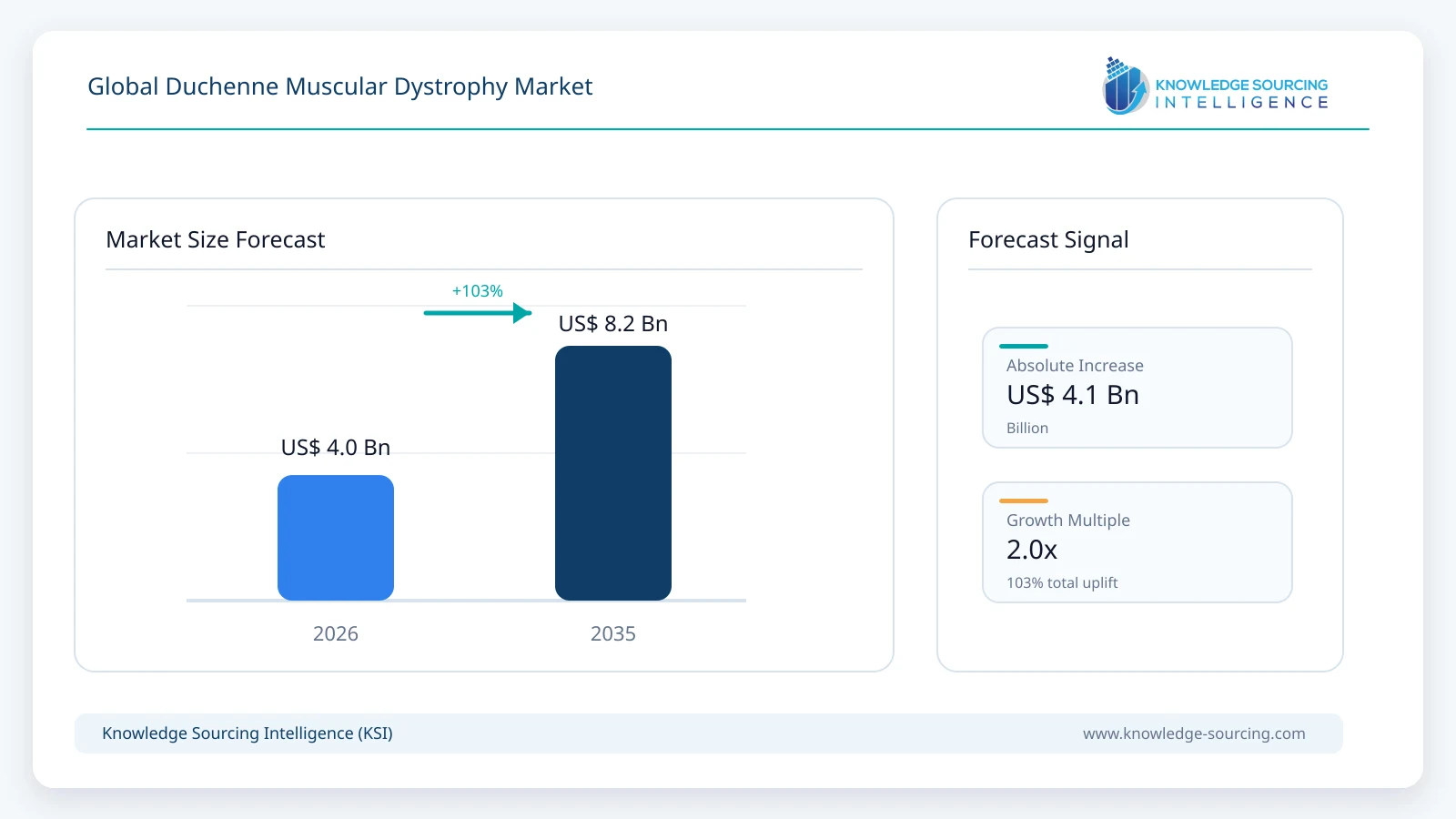
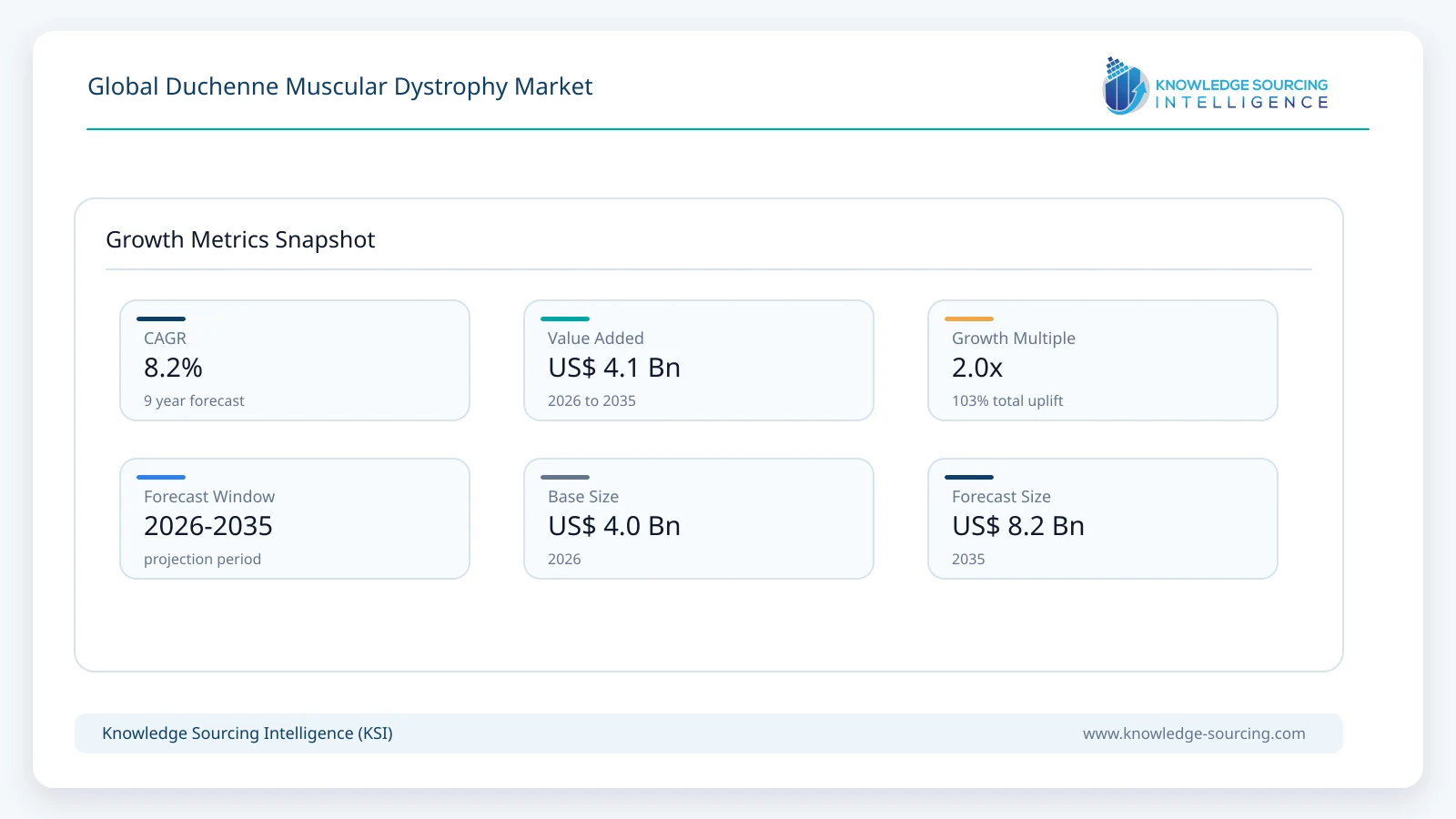
The Global Duchenne Muscular Dystrophy Market is expected to increase at a CAGR of 8.2% for the forecast period, growing from USD 4.02 billion in 2026 to USD 8.16 billion by 2035.
Highlights:
- 1Expansion of gene therapy approvals is increasing demand for early genetic diagnosis because treatment eligibility depends on confirmed dystrophin mutations.
- 2Approval of mutation-independent therapies is broadening treatment access because clinicians can address larger patient populations regardless of genotype.
- 3Exon-skipping programs continue attracting investment because targeted dystrophin restoration addresses defined genetic subgroups.
- 4Regulatory support for rare diseases is accelerating pipeline progression because sponsors receive orphan-drug incentives and expedited review pathways.
DMD remains one of the most severe inherited neuromuscular disorders because mutations in the dystrophin gene cause progressive skeletal, respiratory, and cardiac muscle deterioration. Treatment demand increases as genetic diagnosis becomes more accessible, which allows earlier identification of eligible patients and expands the addressable population for targeted therapies.
The market depends heavily on continuous innovation because corticosteroids provide symptomatic benefit but do not fully address disease progression. Gene therapies, exon-skipping agents, and epigenetic modulators are therefore attracting investment as healthcare systems seek interventions capable of altering disease trajectory.
Regulatory influence remains substantial because rare-disease frameworks accelerate review timelines and encourage orphan drug development. Recent approvals of Elevidys, Duvyzat, and Agamree demonstrate how regulators are expanding treatment options while requiring continued evidence generation to confirm long-term clinical value.
The strategic importance of DMD continues to increase because successful therapies can establish platform technologies applicable across broader neuromuscular and genetic disease indications.
Market Dynamics
Market Drivers
Expansion of Gene Therapy Adoption: Gene replacement strategies represent a major market catalyst because they target the underlying genetic defect responsible for dystrophin deficiency. Demand is increasing for one-time therapeutic interventions as physicians seek durable functional improvements. Manufacturing complexity creates supply and delivery constraints, which elevate the importance of specialized treatment centers. Sponsors are expanding production capabilities and clinical evidence generation programs to address these limitations. Gene therapy, therefore, remains a central growth engine for the DMD market.
Growing Availability of Genetic Testing: Genetic confirmation serves as the foundation for treatment selection because multiple therapies target specific mutations. Diagnostic utilization is increasing as newborn screening discussions and precision medicine initiatives expand globally. Testing accessibility remains uneven across healthcare systems, which delays treatment initiation in some regions. Healthcare providers are strengthening referral networks and diagnostic pathways to improve identification rates. Earlier diagnosis consequently supports greater therapeutic uptake.
Increasing Regulatory Support for Rare Diseases: Rare-disease policies encourage innovation because sponsors receive market exclusivity, development incentives, and accelerated review opportunities. Regulatory engagement is increasing as multiple DMD programs enter advanced clinical stages. Evidence requirements remain rigorous because agencies continue evaluating long-term safety and functional outcomes. Companies are conducting confirmatory studies and post-marketing surveillance activities to satisfy regulatory expectations. This environment supports continued pipeline investment.
Rising Focus on Functional Preservation: Clinical decision-making increasingly prioritizes preservation of ambulation and respiratory function because these outcomes directly affect quality of life. Demand is shifting toward therapies demonstrating measurable functional benefit. Progressive disease biology limits treatment effectiveness when intervention occurs late. Clinicians are adopting earlier treatment strategies to maximize therapeutic impact. Functional outcome preservation, therefore, shapes purchasing and prescribing behavior.
Market Restraints
High treatment costs create reimbursement challenges and limit access in resource-constrained healthcare systems.
Long-term safety uncertainties surrounding advanced genetic therapies increase regulatory scrutiny and payer caution.
Mutation-specific eligibility requirements restrict the addressable patient population for several targeted therapies.
Market Opportunities
Combination Treatment Strategies: DMD progression involves multiple pathological pathways because inflammation, fibrosis, muscle degeneration, and dystrophin deficiency occur simultaneously. Interest is increasing in combination approaches that integrate gene therapy, exon skipping, and supportive pharmacological interventions. Clinical complexity limits immediate adoption because interaction effects require validation. Sponsors are evaluating complementary mechanisms across development programs. Combination therapy, therefore, represents a significant future opportunity.
Expansion into Non-Ambulatory Populations: Advanced-stage patients remain underserved because historical clinical development focused primarily on ambulatory individuals. Demand is increasing for therapies capable of preserving upper-limb and respiratory function after ambulation loss. Clinical endpoint selection presents development challenges because disease progression differs substantially in later stages. Companies are expanding trials to include broader patient populations. This shift creates new commercial opportunities.
International Commercial Expansion: Access to advanced DMD therapies remains concentrated in developed markets because infrastructure and reimbursement capabilities vary significantly. Demand is emerging across Asia-Pacific, Latin America, and the Middle East as diagnostic awareness improves. Healthcare budget constraints affect adoption rates. Manufacturers are pursuing regional partnerships and regulatory filings to expand availability. Geographic expansion, therefore, remains a major growth avenue.
Novel RNA-Based Platforms: RNA-targeting technologies provide precision treatment options because they can address specific genetic defects while maintaining flexibility for future mutations. Development activity is increasing across exon-skipping and RNA-editing approaches. Clinical validation remains essential because long-term efficacy data are still developing. Sponsors are advancing differentiated platforms to improve dystrophin production. RNA innovation continues to create pipeline opportunities.
Disease & Epidemiology Analysis
DMD is an X-linked recessive disorder caused by mutations in the dystrophin gene. The disease primarily affects males and leads to progressive muscle degeneration, loss of ambulation, respiratory compromise, cardiomyopathy, and premature mortality. Demand for disease-modifying therapies exists because disease progression begins in early childhood and accelerates during adolescence.
Diagnosis increasingly relies on genetic confirmation because therapeutic eligibility depends on mutation identification. Clinical practice is emphasizing earlier intervention as evidence suggests treatment benefits are greater before extensive muscle loss occurs. This shift increases demand for genetic testing, specialty neuromuscular care, and long-term monitoring services.
The epidemiological burden remains clinically significant because affected individuals require lifelong multidisciplinary management. Healthcare systems are expanding neuromuscular programs to address increasing treatment complexity. The result is stronger integration of diagnostics, specialty care, and advanced therapeutics within the DMD treatment pathway.
Treatment Guidelines Landscape
Treatment Category | Guideline Position | Clinical Objective |
Corticosteroids | Standard foundational therapy | Preserve muscle strength and delay progression |
Exon Skipping Therapies | Mutation-specific use | Restore partial dystrophin production |
Gene Therapy | Eligible genetically confirmed patients | Address the underlying genetic defect |
Cardiac Management | Recommended throughout the disease course | Reduce cardiovascular complications |
Market Segmentation
By Therapy Type
Gene therapies, exon-skipping therapies, corticosteroids, and supportive therapies collectively define treatment demand. Gene therapy demand is increasing because physicians seek durable disease modification. Exon-skipping products maintain relevance because specific mutations remain addressable through targeted molecular interventions. Corticosteroids continue serving as a foundational treatment because they provide established clinical benefit. Supportive therapies remain essential because progressive disease requires respiratory, cardiac, and rehabilitative management. The segment, therefore, reflects a transition from symptom control toward molecular intervention.
By End User
Hospitals remain the primary treatment setting because advanced therapies require multidisciplinary expertise and intensive monitoring. Demand is increasing within specialty clinics as neuromuscular centers expand access to genetic testing and targeted treatment programs. Ambulatory care centers support ongoing disease management because patients require repeated assessments and supportive interventions. Research institutions maintain strategic importance because pipeline development depends on clinical trial recruitment and biomarker evaluation. The end-user landscape, therefore, continues to become more specialized.
By Distribution Channel
Hospital pharmacies dominate advanced therapy distribution because gene therapies and specialty biologics require controlled administration pathways. Demand is increasing for specialty and retail pharmacies as chronic DMD medications expand beyond inpatient settings. Online pharmacy utilization is growing because caregivers seek convenient access to maintenance therapies. Regulatory oversight and cold-chain requirements create operational constraints for complex products. Distribution channels, therefore, continue evolving alongside therapeutic innovation.
Regional Analysis
North America Market Analysis
North America represents the most advanced DMD treatment market because regulatory approvals, reimbursement infrastructure, and specialist availability support the rapid adoption of innovative therapies. Demand is increasing for gene therapies as treatment centers gain experience with administration and patient selection. Payer scrutiny remains significant because therapy costs are substantial. Manufacturers are generating post-marketing evidence to strengthen value propositions and support reimbursement decisions. The region, therefore, continues leading the commercialization of advanced DMD therapeutics. Recent approvals of Elevidys and Duvyzat reinforce North America's leadership position in innovation and access.
Europe Market Analysis
Europe maintains a strong demand because rare-disease policies encourage orphan-drug development and cross-border clinical research. Treatment adoption is increasing as regulators evaluate novel therapies and expand access pathways. Reimbursement negotiations create country-level variability because healthcare funding decisions remain decentralized. Companies are pursuing evidence packages tailored to health technology assessment requirements. The region, therefore, supports both commercial growth and clinical innovation.
Asia Pacific Market Analysis
Asia Pacific is emerging as a strategic growth region because genetic testing awareness and specialty neurology infrastructure are expanding. Demand is increasing in developed healthcare markets where rare-disease policy frameworks are evolving. Access limitations persist because reimbursement systems vary substantially across countries. Pharmaceutical companies are establishing partnerships and regional development strategies to improve availability. The region consequently offers long-term expansion potential.
Rest of the World
Demand across Latin America, the Middle East, and Africa remains constrained by diagnostic limitations and funding challenges. Awareness initiatives are increasing because patient advocacy organizations are encouraging earlier recognition of rare neuromuscular disorders. Infrastructure gaps affect access to advanced therapeutics. Governments and healthcare providers are strengthening rare-disease frameworks to improve treatment pathways. Market development, therefore, continues to progress gradually.
Regulatory Landscape
The regulatory environment increasingly supports DMD innovation because the unmet medical need remains substantial. Agencies evaluate therapies using accelerated approval mechanisms when clinical evidence demonstrates meaningful potential benefit. This approach encourages investment while maintaining requirements for confirmatory evidence generation.
Regulatory activity is increasing around gene therapies because long-term efficacy and safety monitoring remain critical. Authorities are requiring continued post-marketing surveillance and additional clinical studies to verify therapeutic durability. This framework balances rapid patient access with evidence-based oversight.
Recent approvals of Elevidys, Duvyzat, and Agamree illustrate regulatory willingness to expand treatment options while maintaining ongoing evaluation requirements.
Pipeline Analysis
The DMD pipeline remains highly active because sponsors are pursuing multiple mechanisms capable of modifying disease progression. Exon-skipping programs continue targeting specific mutations, while gene therapies aim to restore dystrophin expression through viral-vector delivery. RNA-targeting technologies are also advancing as developers seek broader applicability and improved efficacy.
Clinical development activity is increasing among REGENXBIO, Solid Biosciences, Dyne Therapeutics, Wave Life Sciences, Sarepta Therapeutics, and Pfizer. Sponsors are focusing on functional outcomes, biomarker validation, and long-term durability because regulatory and reimbursement success depends on demonstrating sustained clinical value.
Pipeline diversification reduces dependence on a single therapeutic modality because developers are addressing distinct disease mechanisms. The result is a more competitive innovation environment with multiple potential future treatment options.
Reimbursement Landscape
Reimbursement remains a defining market factor because advanced DMD therapies carry substantial acquisition costs. Demand is increasing for outcomes-based agreements as payers seek evidence linking treatment expenditure to measurable clinical benefit. This trend is particularly important for gene therapies, where upfront costs are concentrated.
Coverage decisions increasingly depend on genetic confirmation, functional status, and treatment eligibility criteria. Manufacturers are expanding real-world evidence programs because long-term outcomes influence payer confidence. The reimbursement landscape, therefore, continues evolving toward value-based assessment models.
Competitive Landscape
Sarepta Therapeutics
Sarepta remains strategically distinct because it combines a commercial exon-skipping franchise with the first approved gene therapy for DMD. The company benefits from approved products, including Elevidys, Exondys 51, Vyondys 53, and Amondys 45. Demand for its portfolio is increasing because clinicians seek both mutation-specific and broader disease-modifying approaches. Continued evidence generation supports regulatory expansion and payer engagement. Sarepta therefore maintains one of the strongest competitive positions in the DMD market.
PTC Therapeutics
PTC differentiates itself through expertise in rare genetic disorders and mutation-targeted therapies. The company maintains strong engagement within neuromuscular disease communities and focuses on specialized patient populations. Development strategy emphasizes precision medicine and long-term clinical utility. Its position remains important because targeted therapies continue serving defined genetic subsets within DMD.
Italfarmaco
Italfarmaco achieved strategic relevance through Duvyzat, which addresses all genetic variants of DMD. Demand is increasing because clinicians seek mutation-independent treatment options that can complement existing standards of care. The company continues expanding evidence generation activities to reinforce clinical adoption. Broad applicability strengthens its commercial outlook.
Santhera Pharmaceuticals
Santhera distinguishes itself through Agamree, a dissociative corticosteroid designed to maintain efficacy while addressing limitations associated with traditional steroid therapy. Clinical demand is increasing because physicians seek alternatives that support long-term treatment adherence. The company focuses on expanding market penetration and demonstrating sustained therapeutic value.
Pfizer
Pfizer remains strategically important due to its extensive capabilities in biologics, manufacturing, and rare diseases. The company continues evaluating neuromuscular opportunities and leveraging global development infrastructure. Competitive strength derives from scale, scientific resources, and international market access capabilities.
Roche Holding
Roche occupies a significant position through its collaboration with Sarepta on the international commercialization of Elevidys. The company benefits from global regulatory expertise and extensive specialty-care experience. Strategic focus centers on expanding access to advanced therapies across multiple markets. This partnership strengthens Roche's presence in neuromuscular disease treatment.
Key Developments
June 2026: Health Canada accepted and initiated priority review of Italfarmaco's New Drug Submission for givinostat for Duchenne muscular dystrophy, targeting an expedited 180-day review to support Canadian DMD patients as the first disease-modifying HDAC inhibitor in Canada.
February 2026: Precision BioSciences received FDA clearance of its Investigational New Drug application for PBGENE DMD, its first in-class in vivo gene editing therapy for DMD, enabling clinical development of a single dose, non-viral CRISPR gene editor targeting the DMD locus.
January 2026: Solid Biosciences dosed the first participant in the Phase 3 IMPACT DUCHENNE trial of SGT 003 gene therapy, a randomized, double blind, placebo-controlled study in ambulatory boys with DMD designed to evaluate efficacy and safety of a single IV infusion of SGT 003.
Strategic Insights and Future Market Outlook
The DMD market is transitioning from supportive care dominance toward molecularly targeted intervention because therapeutic innovation increasingly addresses underlying disease mechanisms. Demand continues shifting toward therapies capable of altering long-term functional outcomes rather than simply delaying symptom progression. This transition is encouraging greater investment across gene therapy, RNA-targeting technologies, and mutation-independent approaches.
Competition is intensifying because multiple sponsors are pursuing differentiated strategies across overlapping patient populations. Clinical success increasingly depends on demonstrating durable functional improvement, manageable safety profiles, and reimbursement value. Regulatory agencies continue supporting innovation while requiring stronger long-term evidence, which raises the importance of post-marketing studies and real-world data collection.
The market outlook remains favorable because scientific advances are expanding therapeutic possibilities across broader patient populations. Earlier diagnosis, expanding genetic testing, and increasing treatment availability support sustained demand. As pipeline programs mature and evidence accumulates, DMD management is expected to become increasingly personalized, integrated, and outcome-focused.
Duchenne Muscular Dystrophy Market Scope:
| Report Metric | Details |
|---|---|
| Total Market Size in 2026 | USD 4.02 billion |
| Total Market Size in 2035 | USD 8.16 billion |
| Forecast Unit | USD Billion |
| Growth Rate | 8.2% |
| Study Period | 2021 to 2035 |
| Historical Data | 2021 to 2024 |
| Base Year | 2025 |
| Forecast Period | 2026 – 2035 |
| Segmentation | Therapy Type, Route of Administration, End User, Geography |
| Companies |
|
Market Segmentation
By Geography
Key Countries Analysis
Regulatory & Policy Landscape
Table of Contents
1. EXECUTIVE SUMMARY
1.1 Market Overview
1.2 Key Findings
1.3 Duchenne Muscular Dystrophy (DMD) Market Snapshot
1.4 Major Commercial Products Overview
1.5 Pipeline Innovation Highlights
1.6 Regional Market Outlook
1.7 Competitive Intelligence Summary
1.8 Future Growth Opportunities
2. DISEASE & EPIDEMIOLOGY ANALYSIS
2.1 Duchenne Muscular Dystrophy Disease Overview
2.1.1 Definition and Disease Characteristics
2.1.2 Genetic Basis and Dystrophin Deficiency
2.1.3 Disease Pathophysiology
2.1.4 Disease Progression Stages
2.2 Disease Burden Assessment
2.2.1 Global Prevalence Analysis
2.2.2 Global Incidence Analysis
2.2.3 Diagnosed Patient Population
2.2.4 Treated Patient Population
2.3 Epidemiology Segmentation
2.3.1 Age-Based Distribution
2.3.2 Mutation-Specific Distribution
2.3.2.1 Exon 51 Amenable Population
2.3.2.2 Exon 53 Amenable Population
2.3.2.3 Exon 45 Amenable Population
2.3.2.4 Nonsense Mutation Population
2.3.2.5 Other Mutation Categories
2.3.3 Ambulatory vs Non-Ambulatory Population
2.3.4 Disease Severity Distribution
2.4 Diagnostic Landscape
2.4.1 Clinical Evaluation Pathway
2.4.2 Genetic Testing Technologies
2.4.3 Newborn Screening Initiatives
2.4.4 Biomarker Developments
3. MARKET DYNAMICS
3.1 Market Drivers
3.1.1 Rising Genetic Testing Adoption
3.1.2 Increasing Availability of Disease-Modifying Therapies
3.1.3 Growth in Gene Therapy Development
3.1.4 Expanding Rare Disease Funding Programs
3.2 Market Restraints
3.2.1 High Therapy Acquisition Costs
3.2.2 Limited Eligible Patient Populations
3.2.3 Regulatory and Safety Challenges
3.2.4 Reimbursement Constraints
3.3 Market Opportunities
3.3.1 Next-Generation Gene Therapies
3.3.2 Precision Medicine Approaches
3.3.3 Combination Therapy Development
3.3.4 Emerging Market Expansion
3.4 Market Challenges
3.4.1 Long-Term Safety Monitoring Requirements
3.4.2 Manufacturing Complexity
3.4.3 Clinical Trial Recruitment Constraints
3.5 Porter’s Five Forces Analysis
3.6 PESTLE Analysis
3.7 Value Chain Analysis
4. COMMERCIAL & MARKET ACCESS
4.1 Commercialization Framework
4.2 Pricing Analysis
4.3 Reimbursement Landscape
4.4 Rare Disease Funding Mechanisms
4.5 Patient Assistance Programs
4.6 Health Technology Assessment Trends
4.7 Market Access Challenges
4.8 Stakeholder Ecosystem Analysis
5. INNOVATION & PIPELINE LANDSCAPE
5.1 Innovation Overview
5.2 Emerging Therapeutic Modalities
5.2.1 Gene Replacement Therapies
5.2.2 Exon Skipping Therapies
5.2.3 Gene Editing Approaches
5.2.4 Muscle Regeneration Strategies
5.2.5 Anti-Inflammatory Therapies
5.3 Pipeline Landscape by Clinical Stage
5.3.1 Preclinical Candidates
5.3.2 Phase I Candidates
5.3.3 Phase II Candidates
5.3.4 Phase III Candidates
5.4 Pipeline Landscape by Mechanism of Action
5.4.1 Micro-Dystrophin Gene Transfer
5.4.2 Exon Skipping Technology
5.4.3 Myostatin Pathway Modulation
5.4.4 Muscle Preservation Mechanisms
5.4.5 Gene Editing Technologies
5.5 Pipeline Landscape by Modality
5.5.1 AAV-Based Gene Therapy
5.5.2 Antisense Oligonucleotides
5.5.3 Small Molecules
5.5.4 Biologics
5.5.5 Gene Editing Platforms
5.6 Clinical Trial Landscape Analysis
5.7 Licensing, Partnerships, and Collaborations
5.8 Investment and Funding Trends
6. TREATMENT LANDSCAPE
6.1 Current Standard of Care
6.2 Corticosteroid-Based Treatment Approaches
6.3 Mutation-Specific Therapies
6.4 Gene Therapy Treatment Approaches
6.5 Supportive Care Management
6.6 Physical and Rehabilitation Therapies
6.7 Cardiac and Respiratory Management
6.8 Treatment Guidelines Overview
6.9 Unmet Medical Needs
7. GLOBAL DUCHENNE MUSCULAR DYSTROPHY MARKET FORECAST REPORT SIZE & FORECAST
7.1 Global Market Overview
7.2 Historical Market Analysis (2020–2024)
7.3 Market Forecast (2025–2035)
7.4 Revenue Forecast by Therapy Type
7.5 Revenue Forecast by Route of Administration
7.6 Revenue Forecast by Distribution Channel
7.7 Revenue Forecast by Region
7.8 Scenario Analysis
7.9 Market Growth Assumptions
8. GLOBAL DUCHENNE MUSCULAR DYSTROPHY MARKET FORECAST REPORT SEGMENTATION
8.1 By Therapy Type
8.1.1 Corticosteroids
8.1.2 Exon Skipping Therapies
8.1.3 Gene Therapies
8.1.4 Supportive Therapies
8.2 By Route of Administration
8.2.1 Intravenous
8.2.2 Oral
8.2.3 Other Routes
8.3 By End User
8.3.1 Hospitals
8.3.2 Specialty Clinics
8.3.3 Ambulatory Care Centers
8.3.4 Research Institutions
8.4 By Distribution Channel
8.4.1 Hospital Pharmacies
8.4.2 Specialty &Retail Pharmacies
8.4.3 Online Pharmacies
9. GEOGRAPHICAL ANALYSIS (REGIONAL LEVEL)
9.1 North America
9.1.1 Market Size and Growth
9.1.2 Demand Drivers
9.1.3 Regional Regulatory Environment
9.1.4 Competitive Intensity
9.2 Europe
9.2.1 Market Size and Growth
9.2.2 Demand Drivers
9.2.3 Regional Regulatory Environment
9.2.4 Competitive Intensity
9.3 Asia-Pacific
9.3.1 Market Size and Growth
9.3.2 Demand Drivers
9.3.3 Regional Regulatory Environment
9.3.4 Competitive Intensity
9.4 Latin America
9.4.1 Market Size and Growth
9.4.2 Demand Drivers
9.4.3 Regional Regulatory Environment
9.4.4 Competitive Intensity
9.5 Middle East & Africa
9.5.1 Market Size and Growth
9.5.2 Demand Drivers
9.5.3 Regional Regulatory Environment
9.5.4 Competitive Intensity
10. KEY COUNTRIES ANALYSIS
10.1 United States
10.1.1 Market Size
10.1.2 Epidemiology
10.1.3 Regulatory Framework
10.1.4 Reimbursement Environment
10.1.5 Key Companies and Products Presence
10.2 Canada
10.3 Germany
10.4 United Kingdom
10.5 France
10.6 Italy
10.7 Spain
10.8 China
10.9 Japan
10.10 India
10.11 South Korea
10.12 Australia
10.13 Brazil
10.14 Mexico
10.15 Saudi Arabia
10.16 South Africa
11. REGULATORY & POLICY LANDSCAPE
11.1 Global Regulatory Overview
11.2 Rare Disease Regulatory Incentives
11.3 United States Regulatory Framework
11.3.1 FDA Orphan Drug Designation
11.3.2 Accelerated Approval Pathways
11.3.3 Gene Therapy Regulatory Requirements
11.4 Europe Regulatory Framework
11.4.1 EMA Orphan Medicinal Product Framework
11.4.2 Advanced Therapy Medicinal Products (ATMPs)
11.4.3 Post-Marketing Requirements
11.5 Japan Regulatory Framework
11.5.1 PMDA Review Pathways
11.5.2 Conditional Approval Mechanisms
11.6 India Regulatory Framework
11.6.1 CDSCO Requirements
11.6.2 Rare Disease Policy Environment
11.7 China Regulatory Framework
11.7.1 NMPA Approval Process
11.7.2 Accelerated Review Programs
11.8 Pharmacovigilance Requirements
11.9 Market Authorization Trends
11.10 Reimbursement and Policy Developments
12. COMPETITIVE LANDSCAPE
12.1 Market Share Analysis
12.2 Competitive Benchmarking
12.3 Product Portfolio Assessment
12.4 Pipeline Competitiveness Analysis
12.5 Strategic Developments
12.5.1 Mergers and Acquisitions
12.5.2 Licensing Agreements
12.5.3 Co-Development Partnerships
12.5.4 Manufacturing Collaborations
12.6 SWOT Analysis of Leading Participants
13. COMPANY PROFILES
13.1 Sarepta Therapeutics
13.1.1 Company Overview
13.1.2 Approved Products (Elevidys, Exondys 51, Vyondys 53, Amondys 45)
13.1.3 Key Indications
13.1.4 Verified Pipeline Assets
13.1.5 Strategic Outlook
13.2 PTC Therapeutics
13.2.1 Company Overview
13.2.2 Approved Products
13.2.3 Key Indications
13.2.4 Verified Pipeline Assets
13.2.5 Strategic Outlook
13.3 Italfarmaco
13.3.1 Company Overview
13.3.2 Approved Products (Duvyzat/Givinostat)
13.3.3 Key Indications
13.3.4 Verified Pipeline Assets
13.3.5 Strategic Outlook
13.4 Santhera Pharmaceuticals
13.4.1 Company Overview
13.4.2 Approved Products (Agamere/Vamorolone)
13.4.3 Key Indications
13.4.4 Verified Pipeline Assets
13.4.5 Strategic Outlook
13.5 Pfizer
13.5.1 Company Overview
13.5.2 Approved Products Relevant to Neuromuscular Disorders
13.5.3 Key Indications
13.5.4 Verified DMD Pipeline Assets
13.5.5 Strategic Outlook
13.6 Roche Holding
13.6.1 Company Overview
13.6.2 Commercial Portfolio Overview
13.6.3 Key Indications
13.6.4 Verified DMD Programs
13.6.5 Strategic Outlook
13.7 REGENXBIO
13.7.1 Company Overview
13.7.2 DMD Development Programs
13.7.3 Key Indications
13.7.4 Clinical Pipeline Status
13.7.5 Strategic Outlook
13.8 Solid Biosciences
13.8.1 Company Overview
13.8.2 DMD Development Programs
13.8.3 Key Indications
13.8.4 Clinical Pipeline Status
13.8.5 Strategic Outlook
13.9 Dyne Therapeutics
13.9.1 Company Overview
13.9.2 DMD Development Programs
13.9.3 Key Indications
13.9.4 Clinical Pipeline Status
13.9.5 Strategic Outlook
13.10 Wave Life Sciences
13.10.1 Company Overview
13.10.2 DMD Development Programs
13.10.3 Key Indications
13.10.4 Clinical Pipeline Status
13.10.5 Strategic Outlook
14. FUTURE OUTLOOK
14.1 Market Evolution Scenarios
14.2 Future Treatment Paradigm Shifts
14.3 Impact of Gene Therapy Adoption
14.4 Emerging Technologies Assessment
14.5 Forecast of Competitive Dynamics
14.6 Investment Outlook
14.7 Long-Term Market Opportunities (2025–2035)
15. METHODOLOGY
15.1 Research Objectives
15.2 Study Scope and Definitions
15.3 Data Collection Methodology
15.4 Primary Research Framework
15.5 Secondary Research Sources
15.6 Epidemiology Modeling Methodology
15.7 Market Forecasting Methodology
15.8 Data Validation and Triangulation
15.9 Assumptions and Limitations
15.10 Abbreviations and Glossary
Navigate
Trusted by the world's leading organizations











