
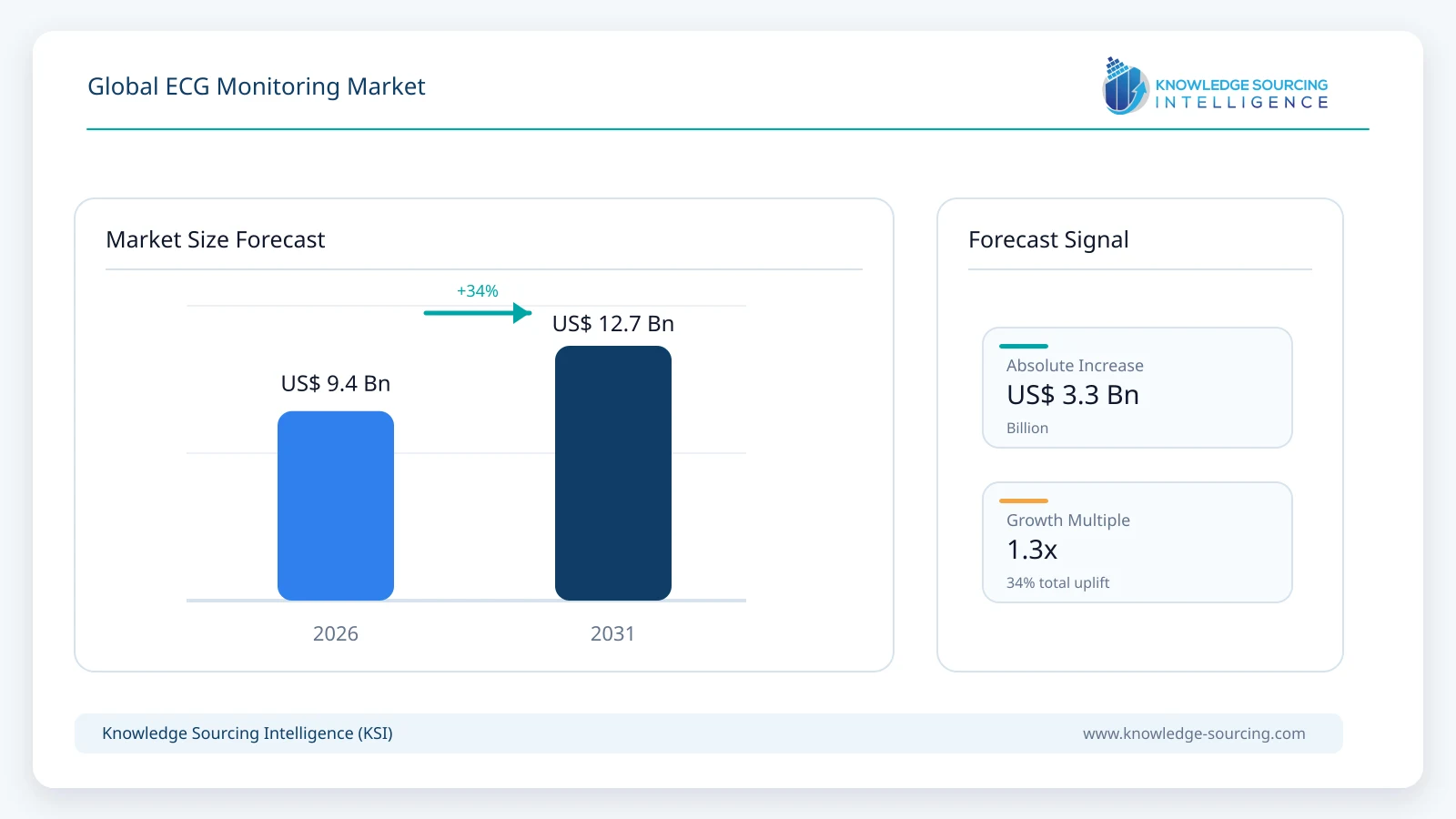
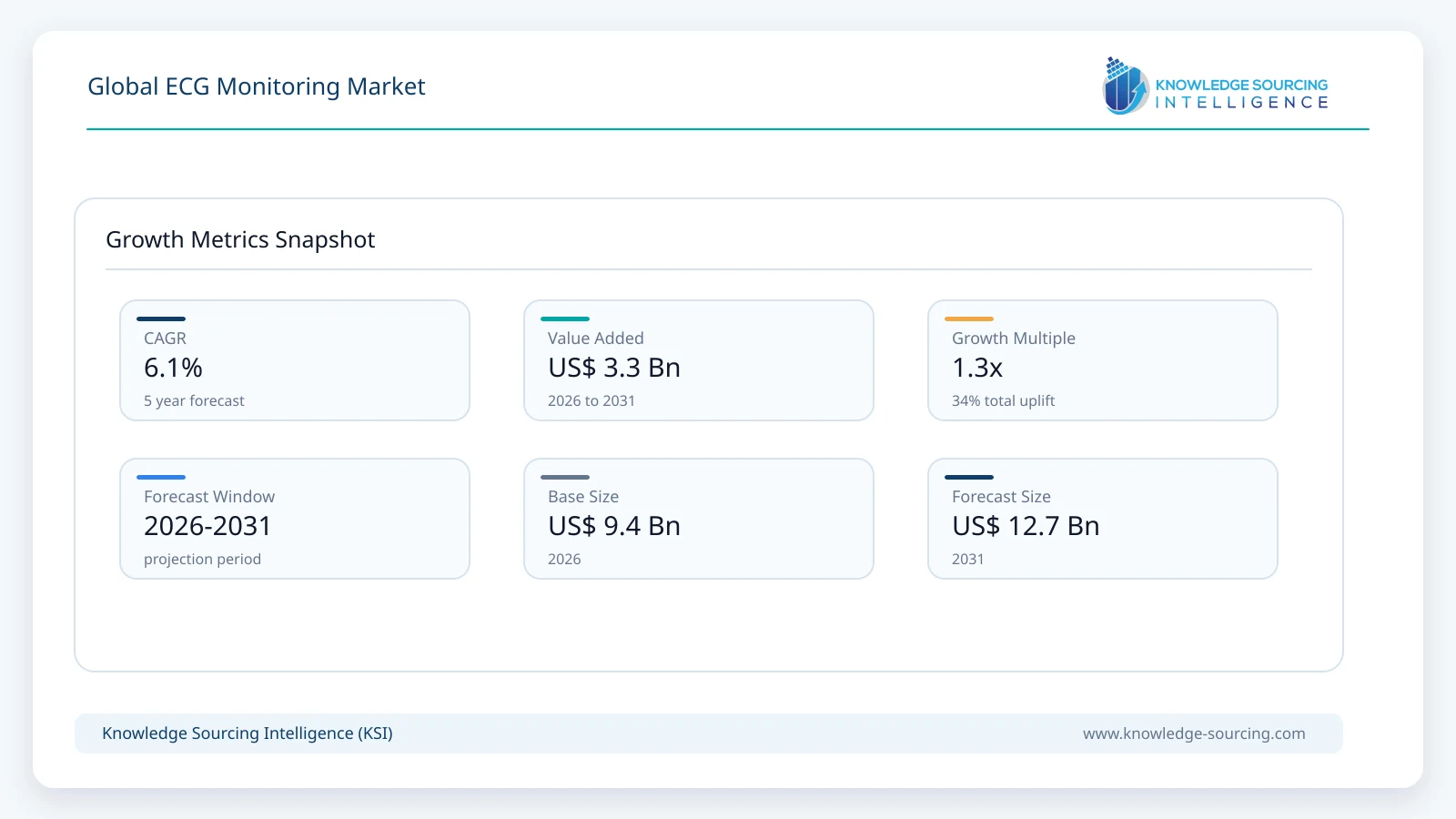
The Global ECG Monitoring Market is forecast to grow at a CAGR of 6.1%, reaching USD 12.68 billion in 2031 from USD 9.43 billion in 2026.
Highlights:
- 1Rising cardiovascular disease prevalence is increasing demand for continuous ECG surveillance because healthcare systems require earlier arrhythmia detection and preventive cardiac intervention.
- 2Expansion of remote patient monitoring programs is accelerating wearable ECG adoption because providers are reducing dependency on inpatient observation models.
- 3AI-enabled rhythm analysis platforms are improving diagnostic efficiency because clinicians increasingly require automated interpretation support for high patient volumes.
- 4Aging populations are increasing long-duration cardiac monitoring utilization because elderly patients exhibit higher risks of atrial fibrillation and conduction abnormalities.
The ECG monitoring market functions as a critical diagnostic and surveillance segment within cardiovascular healthcare because arrhythmias, ischemic abnormalities, and cardiac conduction disorders require continuous electrophysiological assessment for accurate clinical intervention. Hospitals rely on ECG monitoring systems for acute care management, while outpatient facilities increasingly depend on portable and wearable devices to extend monitoring duration beyond conventional clinical settings.
Demand is increasing for long-term ambulatory monitoring because intermittent arrhythmias frequently remain undetected during standard resting ECG evaluations. Healthcare providers are expanding remote cardiac monitoring programs as patient volumes rise and healthcare systems face pressure to reduce avoidable hospital admissions linked to cardiovascular complications. This transition is increasing adoption of wearable ECG patches, wireless telemetry systems, and AI-supported diagnostic algorithms capable of continuous rhythm interpretation.
Regulatory influence remains structurally important because ECG devices operate within high-risk diagnostic pathways where accuracy, interoperability, and cybersecurity directly affect patient outcomes. Regulatory bodies such as the U.S. FDA continue enforcing device validation requirements for diagnostic ECG systems and cardiac monitoring technologies, which strengthens clinical standardization across connected monitoring ecosystems.
The market also carries strategic importance for healthcare infrastructure modernization because remote monitoring platforms support value-based care, chronic disease management, and aging population care models. Healthcare systems increasingly prioritize decentralized monitoring because cardiovascular disease prevalence continues rising across both urbanized and aging populations. WHO data indicates that more than three-quarters of cardiovascular deaths occur in low- and middle-income countries, which is increasing demand for scalable and cost-efficient ECG monitoring systems.
Market Dynamics
Market Drivers
Increasing Burden of Cardiovascular Disorders: Cardiovascular disease prevalence remains the primary structural driver for ECG monitoring demand because arrhythmia detection, ischemic evaluation, and cardiac rhythm management require continuous electrophysiological assessment. Healthcare providers are expanding screening programs as hypertension, obesity, diabetes, and sedentary lifestyles continue increasing cardiac risk exposure across multiple age groups. This burden increases dependency on portable and wearable ECG technologies because intermittent rhythm disturbances often remain undiagnosed through conventional episodic testing. WHO identifies cardiovascular disease as the leading global cause of death, which continues strengthening institutional demand for scalable monitoring infrastructure.
Transition Toward Remote Cardiac Monitoring: Healthcare systems increasingly prioritize decentralized diagnostics because hospital congestion and chronic disease management costs continue pressuring inpatient resources. Providers are integrating wearable ECG platforms into remote patient monitoring programs as reimbursement systems increasingly support home-based cardiac surveillance. This shift reduces dependency on repeated hospital visits while increasing monitoring duration for high-risk cardiac patients. Longitudinal monitoring improves arrhythmia detection rates, which strengthens adoption across cardiology clinics and home healthcare settings.
Integration of AI-Based Diagnostic Interpretation: Clinical workloads continue increasing because cardiology departments face rising patient volumes alongside specialist shortages. ECG monitoring vendors are embedding AI-assisted rhythm interpretation capabilities into monitoring ecosystems to accelerate diagnostic triage and reduce interpretation delays. Automated analytics improve scalability because healthcare systems require faster identification of atrial fibrillation, tachycardia, and conduction abnormalities across large patient populations. This transition is increasing investment toward software-integrated ECG platforms rather than standalone hardware systems.
Growth of Wearable Healthcare Infrastructure: Consumer familiarity with wearable health technologies is reshaping patient behavior because individuals increasingly expect continuous physiological tracking outside traditional clinical environments. Healthcare providers are responding by integrating medical-grade wearable ECG systems into preventive cardiology workflows. Academic research continues validating wearable ECG feasibility for long-duration rhythm tracking, which strengthens institutional confidence in connected monitoring ecosystems.
Market Restraints
High clinical validation requirements increase commercialization timelines because ECG monitoring devices operate within regulated diagnostic environments.
Data interoperability limitations constrain workflow integration because hospitals often use fragmented electronic health record infrastructures.
False-positive rhythm alerts increase clinician review burdens because AI-assisted wearable monitoring systems continuously generate large diagnostic datasets.
Market Opportunities
Expansion of Home Healthcare Monitoring: Home healthcare adoption is increasing because healthcare systems continue reducing avoidable hospitalization costs associated with chronic cardiovascular management. ECG monitoring companies are expanding wearable and patch-based platforms that support continuous at-home rhythm tracking. This transition creates opportunities for subscription-based monitoring ecosystems, cloud diagnostics, and physician-connected telemetry services.
Penetration Across Emerging Healthcare Systems: Emerging economies are increasing investment in cardiovascular screening infrastructure because noncommunicable disease burdens continue rising alongside urbanization and aging demographics. Healthcare providers are adopting portable ECG systems that reduce infrastructure dependency while supporting broader diagnostic accessibility. This trend creates opportunities for cost-efficient wireless ECG technologies across underserved populations.
AI-Driven Predictive Cardiology: Predictive analytics adoption is increasing because healthcare systems increasingly prioritize preventive intervention over reactive treatment pathways. ECG monitoring vendors are integrating machine learning models capable of identifying arrhythmia patterns before acute cardiac events occur. This capability strengthens demand for cloud-connected ECG ecosystems that support continuous data collection and longitudinal patient analysis.
Ambulatory Monitoring Expansion: Cardiology clinics increasingly rely on ambulatory ECG monitoring because short-duration hospital diagnostics frequently fail to capture episodic cardiac abnormalities. Holter monitors, event monitors, and wearable ECG patches are gaining clinical importance because extended monitoring windows improve diagnostic accuracy for transient arrhythmias. This trend supports long-term demand for lightweight, wireless, and patient-compliant ECG technologies.
Supply Chain Analysis
The ECG monitoring supply chain depends on semiconductor manufacturers, biosensor suppliers, software developers, contract manufacturers, and healthcare distribution networks because modern monitoring systems increasingly combine hardware diagnostics with cloud-based analytics infrastructure. Sensor precision and battery efficiency remain critical procurement priorities because wearable ECG platforms require uninterrupted long-duration monitoring performance.
Supply chain complexity is increasing because ECG manufacturers are integrating wireless connectivity modules, AI software engines, and cybersecurity frameworks into diagnostic devices. Component sourcing disruptions directly affect production continuity because medical-grade semiconductor availability remains strategically important for portable and wearable monitoring systems. Vendors are responding by regionalizing manufacturing partnerships and increasing inventory diversification strategies.
Healthcare providers increasingly prefer integrated monitoring ecosystems because fragmented procurement increases interoperability challenges across hospital information systems. This preference is encouraging partnerships between ECG device manufacturers, cloud analytics providers, and remote care platforms, which is consolidating the competitive structure around end-to-end monitoring capabilities.
Government Regulations
Region | Regulatory Body | Regulatory Focus |
United States | U.S. Food and Drug Administration (FDA) | ECG device clearance, cybersecurity validation, and diagnostic performance standards |
European Union | European Medicines Agency / MDR Framework | Clinical evidence requirements for connected diagnostic devices |
Japan | Pharmaceuticals and Medical Devices Agency (PMDA) | Medical device quality and interoperability compliance |
Market Segmentation
By Product Type
Wearable ECG devices and Holter monitors increasingly dominate demand because healthcare systems require long-duration cardiac monitoring for intermittent arrhythmia detection. Hospitals continue using resting and stress ECG systems for acute diagnostics, although outpatient environments are increasingly prioritizing portable and wireless alternatives. Demand is shifting toward wearable and event-monitoring technologies because providers are reducing dependence on short-duration in-clinic evaluations. This transition strengthens investment in cloud-connected ECG platforms that support continuous rhythm interpretation and remote physician access.
By Lead Type
12-lead ECG monitoring remains clinically essential for comprehensive cardiac diagnostics because acute care settings require detailed electrophysiological assessment during emergency and inpatient management. Demand is simultaneously increasing for single-lead and 6-lead wearable ECG systems because remote monitoring programs prioritize portability and patient adherence. Healthcare providers are balancing diagnostic depth against usability constraints, which is increasing the adoption of compact lead configurations across ambulatory and home healthcare settings.
By End User
Hospitals remain the largest institutional users because acute cardiac emergencies require continuous bedside monitoring and rapid diagnostic interpretation. Demand is increasingly shifting toward cardiology clinics and home healthcare settings because healthcare systems continue decentralizing chronic cardiac disease management. Diagnostic centers and ambulatory surgical centers are integrating portable ECG technologies to improve procedural efficiency and reduce patient throughput delays. This shift increases the strategic importance of interoperable wireless monitoring ecosystems.
Regional Analysis
North America Market Analysis
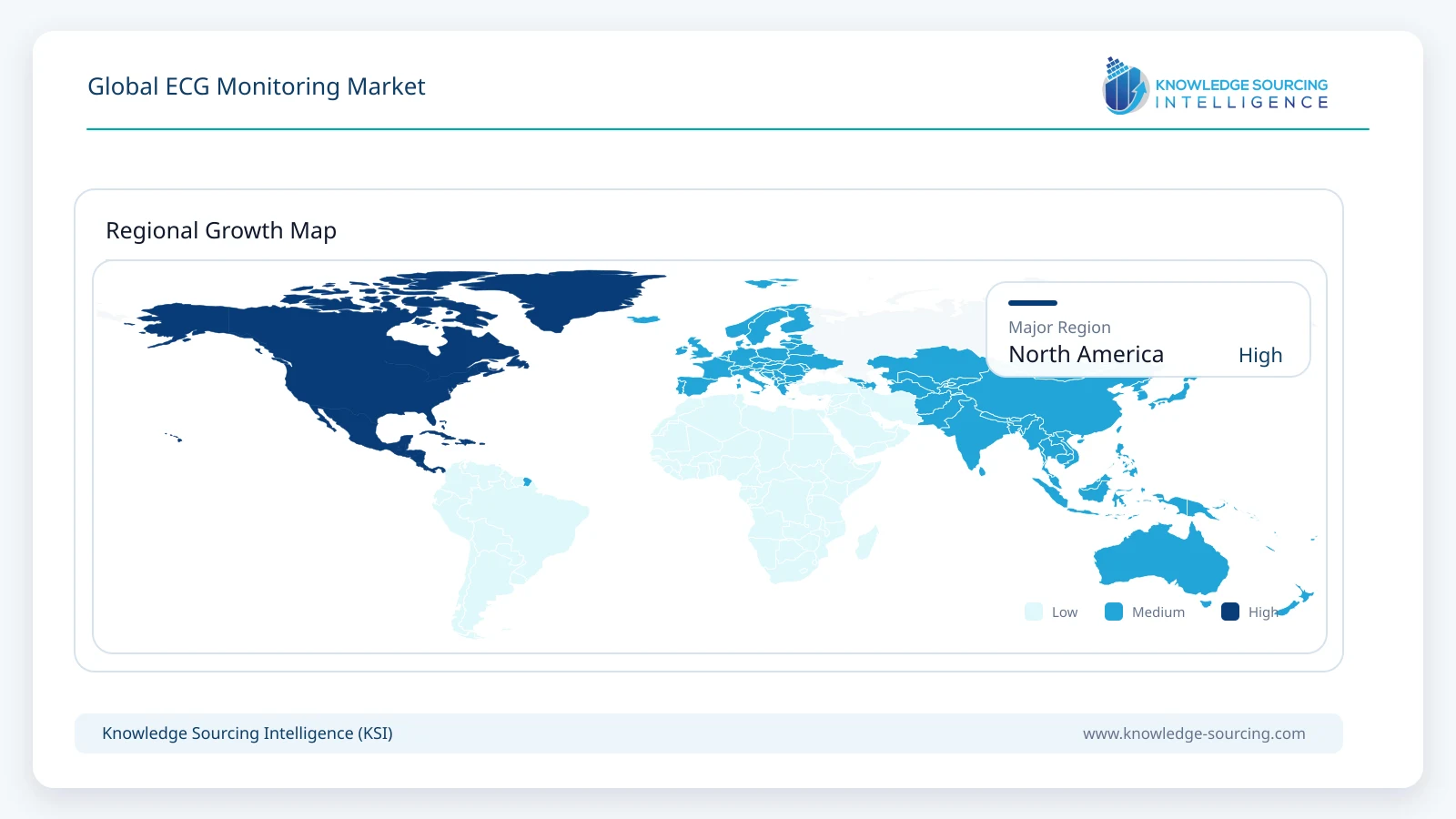
North America maintains strong ECG monitoring demand because cardiovascular disease prevalence, digital health adoption, and reimbursement-supported remote monitoring infrastructures remain highly developed across the region. Healthcare providers are expanding ambulatory cardiac monitoring programs as aging populations and obesity-linked cardiac disorders continue increasing patient volumes. The United States healthcare system increasingly depends on wearable ECG technologies because value-based care models prioritize early detection and chronic disease prevention over acute intervention dependency.
Regulatory standardization strengthens market expansion because FDA oversight increases physician confidence in connected ECG technologies. Hospitals are integrating AI-assisted monitoring systems into cardiology workflows as diagnostic workloads continue rising alongside specialist shortages. This pressure increases demand for automated rhythm interpretation and cloud-enabled telemetry integration. Consumer adoption of wearable health technologies also supports market expansion because patients increasingly participate in self-monitoring and preventive cardiac management.
Europe Market Analysis
Europe demonstrates sustained ECG monitoring demand because aging populations and hypertension prevalence continue increasing cardiovascular disease burdens across major healthcare systems. Public healthcare infrastructures prioritize early cardiac intervention because chronic disease management costs continue pressuring healthcare budgets. Hospitals are integrating connected ECG systems into preventive cardiology programs as remote patient monitoring adoption expands throughout Western Europe.
Regulatory harmonization under European medical device frameworks strengthens product quality requirements because connected diagnostic systems increasingly handle sensitive patient data and remote clinical workflows. This environment favors established manufacturers with validated clinical evidence and cybersecurity capabilities. Healthcare providers are simultaneously increasing deployment of wearable ECG technologies because decentralized care pathways reduce outpatient congestion and improve long-term arrhythmia detection rates.
Asia Pacific Market Analysis
Asia Pacific is experiencing rapid ECG monitoring expansion because urbanization, aging demographics, and rising noncommunicable disease prevalence continue increasing cardiovascular risk exposure. Healthcare systems across China, India, Japan, and Southeast Asia are strengthening cardiac diagnostics infrastructure because cardiovascular disease burdens increasingly affect working-age populations. WHO data highlights rising cardiovascular mortality pressure across low- and middle-income regions, which continues increasing demand for scalable monitoring technologies.
Healthcare providers are adopting portable and wireless ECG systems because rural healthcare accessibility constraints limit dependence on centralized hospital diagnostics. Governments continue investing in telemedicine and digital healthcare infrastructure, which strengthens deployment opportunities for connected ECG platforms. Hospitals increasingly require compact and interoperable systems because patient volumes continue increasing across densely populated urban healthcare networks.
Rest of the World
The Rest of the World region demonstrates increasing ECG monitoring demand because cardiovascular disease burdens continue rising across Latin America, the Middle East, and Africa. Healthcare systems are expanding diagnostic accessibility because delayed cardiac intervention continues increasing mortality risks in underserved populations. Portable ECG technologies are gaining importance because infrastructure limitations constrain dependence on advanced hospital-based diagnostics.
Governments and healthcare organizations increasingly support preventive cardiology programs because chronic disease prevalence continues rising alongside urbanization and lifestyle transitions. Remote monitoring systems are becoming operationally attractive because healthcare workforce shortages limit specialist accessibility across geographically dispersed populations. This environment strengthens demand for wireless and cloud-enabled ECG platforms capable of supporting remote consultations and telecardiology services.
Regulatory Landscape
Regulatory frameworks continue evolving because ECG monitoring systems increasingly combine medical diagnostics, wireless connectivity, cloud storage, and AI-based interpretation capabilities within a single clinical ecosystem. Regulatory agencies require stronger validation standards because inaccurate rhythm interpretation or cybersecurity vulnerabilities directly affect patient safety outcomes. FDA guidance frameworks for cardiac monitors and diagnostic ECG devices continue shaping commercialization pathways for connected cardiac monitoring systems.
European regulatory frameworks increasingly emphasize post-market surveillance and clinical evidence generation because wearable monitoring technologies continue entering decentralized care environments. This pressure increases operational costs for smaller manufacturers while strengthening competitive advantages for established companies with integrated compliance infrastructure.
Data privacy regulations also influence market deployment because ECG monitoring systems increasingly transmit sensitive patient data across remote monitoring platforms. Healthcare providers now prioritize encrypted interoperability and cloud security compliance during procurement decisions, which is increasing strategic investment toward cybersecurity-enabled ECG ecosystems.
Pipeline Analysis
The ECG monitoring innovation pipeline increasingly focuses on wearable miniaturization, AI-assisted interpretation, and continuous remote surveillance because healthcare systems require scalable chronic cardiac disease management solutions. Manufacturers are developing lightweight patch-based systems that improve patient compliance during long-duration monitoring periods. This transition increases clinical utility because intermittent arrhythmias frequently require extended observation windows for accurate diagnosis.
Research activity continues expanding around AI-driven predictive analytics because healthcare providers increasingly seek earlier identification of atrial fibrillation and conduction abnormalities. Academic studies continue validating wearable ECG feasibility for continuous cardiac monitoring and automated rhythm analysis applications.
Technology developers are also exploring integrated biosensor ecosystems capable of combining ECG monitoring with photoplethysmography and other physiological metrics. This convergence supports predictive cardiology development because longitudinal biometric datasets improve risk stratification capabilities across remote monitoring platforms.
Competitive Landscape
Medtronic plc
Medtronic remains strategically distinct because it combines broad cardiovascular device expertise with integrated patient monitoring capabilities across hospital and ambulatory environments. The company continues expanding connected cardiac care infrastructure because healthcare systems increasingly require interoperable monitoring ecosystems rather than isolated diagnostic hardware.
Abbott Laboratories
Abbott maintains competitive strength because it integrates diagnostics, cardiovascular technologies, and remote monitoring capabilities within a diversified healthcare portfolio. The company benefits from increasing ambulatory cardiac monitoring demand because healthcare providers continue prioritizing minimally invasive and long-duration diagnostic solutions.
GE HealthCare Technologies Inc.
GE HealthCare remains strategically important because its imaging, monitoring, and AI-enabled healthcare infrastructure support integrated hospital workflow deployment. The company continues to strengthen connected cardiac monitoring solutions because healthcare systems increasingly require centralized diagnostic interoperability.
Koninklijke Philips N.V.
Philips differentiates itself through connected care infrastructure and remote patient monitoring integration. The company is expanding cloud-enabled cardiac surveillance capabilities because decentralized healthcare delivery continues to increase across developed healthcare systems.
Boston Scientific Corporation
Boston Scientific benefits from strong cardiovascular specialization because electrophysiology and rhythm management increasingly depend on continuous patient monitoring. The company continues aligning ECG monitoring capabilities with broader cardiac intervention ecosystems, which strengthens longitudinal patient management integration across arrhythmia care pathways.
Baxter International Inc.
Baxter strengthens its ECG monitoring presence through patient monitoring infrastructure integration and acute care capabilities. The company benefits from increasing demand for connected monitoring systems because hospitals continue to modernize bedside surveillance and telemetry environments. Its operational reach across critical care settings supports institutional adoption.
Key Developments
April 2026: WELL Health partnered with AliveCor to bring AI-powered cardiac monitoring and cardiologist oversight to Canadian users. The collaboration adds remote ECG review by Canadian cardiologists, giving patients a “second set of eyes” on heart data.
July 2025: Philips launched the ECG AI Marketplace to give cardiac teams access to multiple AI tools from one central platform. The marketplace includes Anumana’s LEF algorithm, which analyzes standard ECGs to help flag reduced ejection fraction earlier.
May 2025: iRhythm launched its Zio long-term continuous monitoring service in Japan under the local name Zio ECG Recording and Analysis System. The service expands AI-assisted arrhythmia detection in a major ambulatory cardiac monitoring market and offers up to 14 days of patch-based monitoring.
Strategic Insights and Future Market Outlook
The ECG monitoring market increasingly operates as part of a broader connected cardiovascular management ecosystem because healthcare systems now prioritize longitudinal patient surveillance rather than isolated diagnostic intervention. Wearable technologies, AI-assisted interpretation, and cloud-based telemetry platforms are transforming monitoring workflows because providers require scalable approaches for managing growing cardiovascular disease burdens. This transition strengthens competitive advantages for companies capable of integrating diagnostics, analytics, and remote care infrastructure within unified ecosystems.
Demand will likely continue shifting toward ambulatory and home-based monitoring because healthcare systems remain under pressure to reduce inpatient costs while improving chronic disease outcomes. Remote cardiac monitoring programs are expanding across both developed and emerging healthcare markets because aging populations and lifestyle-linked cardiovascular disorders continue increasing patient monitoring requirements. Regulatory frameworks will simultaneously strengthen around cybersecurity, interoperability, and clinical validation because connected ECG ecosystems increasingly operate within decentralized healthcare networks.
The market, therefore, continues evolving from hardware-centric diagnostics toward data-driven cardiovascular surveillance infrastructure. Companies that combine wearable monitoring, predictive analytics, and integrated telecardiology capabilities remain positioned to benefit from structural healthcare transitions focused on preventive intervention, decentralized diagnostics, and continuous patient engagement.
ECG Monitoring Market Scope:
| Report Metric | Details |
|---|---|
| Total Market Size in 2026 | USD 9.43 billion |
| Total Market Size in 2031 | USD 12.68 billion |
| Forecast Unit | USD Billion |
| Growth Rate | 6.1% |
| Study Period | 2021 to 2031 |
| Historical Data | 2021 to 2024 |
| Base Year | 2025 |
| Forecast Period | 2026 – 2031 |
| Segmentation | Product Type, Lead Type, Distribution Channel, Geography |
| Companies |
|
Market Segmentation
By Product Type
Resting ECG Systems
Stress ECG Systems
Holter Monitors
Event Monitors
Wearable ECG Devices
Others
By Lead Type
Single-Lead ECG Monitoring
3-Lead ECG Monitoring
6-Lead ECG Monitoring
12-Lead ECG Monitoring
By End User
Hospitals
Cardiology Clinics
Ambulatory Surgical Centers
Diagnostic Centers
Home Healthcare Settings
By Distribution Channel
Offline Sales Channel
Direct Tender Sales
Third-Party Distributors
Online Sales Channels
By Geography
North America
United States
Canada
Europe
Germany
United Kingdom
France
Italy
Spain
Asia-Pacific
China
Japan
India
South Korea
Australia
Latin America
Brazil
Mexico
Middle East & Africa
Saudi Arabia
South Africa
Table of Contents
1. Executive Summary
1.1 Market Overview
1.1.1 Definition of ECG Monitoring
1.1.2 Scope of the Global ECG Monitoring Market
1.1.3 Clinical Importance of ECG Monitoring in Cardiovascular Care
1.1.4 Key Market Highlights
1.1.5 Market Size and Forecast Snapshot
1.1.6 Key Technological Trends
1.1.7 Competitive Landscape Overview
1.1.8 Key Strategic Recommendations
2. Disease & Epidemiology Analysis
2.1 Overview of Cardiovascular Diseases Associated with ECG Monitoring
2.1.1 Arrhythmias
2.1.2 Atrial Fibrillation
2.1.3 Bradycardia
2.1.4 Tachycardia
2.1.5 Coronary Artery Disease
2.1.6 Heart Failure
2.1.7 Myocardial Infarction
2.1.8 Sudden Cardiac Arrest Risk Monitoring
2.2 Global Epidemiology Overview
2.2.1 Prevalence of Cardiac Arrhythmias
2.2.2 Incidence of Atrial Fibrillation
2.2.3 Burden of Cardiovascular Diseases by Age Group
2.2.4 Gender-Based Epidemiological Trends
2.2.5 Mortality Associated with Cardiac Rhythm Disorders
2.2.6 High-Risk Patient Population Analysis
2.3 ECG Monitoring Utilization Trends
2.3.1 Hospital-Based ECG Monitoring Utilization
2.3.2 Ambulatory ECG Monitoring Adoption
2.3.3 Home-Based Cardiac Monitoring Trends
2.3.4 Remote Patient Monitoring Penetration
2.3.5 Preventive Cardiology and Early Diagnosis Trends
2.4 Clinical Guidelines and Recommendations
2.4.1 ACC/AHA Guidelines
2.4.2 ESC Guidelines
2.4.3 Heart Rhythm Society Recommendations
2.4.4 Remote Monitoring Guidelines
3. Market Dynamics
3.1 Market Drivers
3.1.1 Rising Global Cardiovascular Disease Burden
3.1.2 Increasing Geriatric Population
3.1.3 Growing Adoption of Remote Cardiac Monitoring
3.1.4 Technological Advancements in Wearable ECG Devices
3.1.5 Expansion of Telehealth Infrastructure
3.1.6 Rising Demand for Early Arrhythmia Detection
3.2 Market Restraints
3.2.1 High Cost of Advanced Monitoring Systems
3.2.2 Data Privacy and Cybersecurity Concerns
3.2.3 Reimbursement Limitations in Emerging Markets
3.2.4 False Positives and Diagnostic Challenges
3.2.5 Regulatory Approval Complexities
3.3 Market Opportunities
3.3.1 AI-Integrated ECG Interpretation
3.3.2 Cloud-Based Cardiac Monitoring Platforms
3.3.3 Expansion of Home Healthcare Monitoring
3.3.4 Integration with Smartwatches and Consumer Wearables
3.3.5 Emerging Markets Expansion
3.4 Market Challenges
3.4.1 Interoperability Issues Across Healthcare Systems
3.4.2 Limited Skilled Cardiology Workforce
3.4.3 Device Compliance and Patient Adherence
3.4.4 Large-Scale Data Management Challenges
3.5 Porter’s Five Forces Analysis
3.6 PESTLE Analysis
3.7 Value Chain Analysis
3.8 Supply Chain Analysis
3.9 Pricing Analysis
3.10 Reimbursement Scenario Analysis
4. Commercial & Market Access
4.1 Market Access Overview
4.2 Reimbursement Landscape
4.2.1 Public Reimbursement Models
4.2.2 Private Insurance Coverage
4.2.3 CPT Coding and Billing Framework
4.2.4 Remote Monitoring Reimbursement Trends
4.3 Healthcare Infrastructure Assessment
4.3.1 Cardiology Care Infrastructure
4.3.2 Ambulatory Monitoring Infrastructure
4.3.3 Telemedicine Integration
4.4 Distribution and Commercialization Strategies
4.4.1 Direct Sales Models
4.4.2 Distributor-Based Commercialization
4.4.3 Hospital Procurement Trends
4.4.4 Digital Health Platform Partnerships
4.5 Mergers, Acquisitions, and Strategic Collaborations
4.6 Investment and Funding Landscape
5. Innovation & Pipeline Landscape
5.1 Overview of Innovation Trends in ECG Monitoring
5.2 Artificial Intelligence in ECG Monitoring
5.2.1 AI-Based Arrhythmia Detection
5.2.2 Predictive Analytics in Cardiac Monitoring
5.2.3 Automated ECG Interpretation Systems
5.3 Wearable and Patch-Based ECG Innovations
5.3.1 Smartwatch ECG Technologies
5.3.2 Continuous ECG Patch Monitors
5.3.3 Wireless Cardiac Telemetry Systems
5.4 Remote and Cloud-Based Monitoring Platforms
5.5 Pipeline Product Analysis
5.5.1 Phase I Pipeline Devices and Technologies
5.5.2 Phase II Pipeline Devices and Technologies
5.5.3 Phase III Pipeline Devices and Technologies
5.6 Pipeline Assessment by Modality
5.6.1 Wearable Monitoring Systems
5.6.2 Implantable Cardiac Monitoring Systems
5.6.3 Mobile Cardiac Telemetry Solutions
5.6.4 AI-Driven Software Platforms
5.7 Patent Analysis
5.8 Clinical Trial Landscape
5.9 Emerging Digital Biomarkers and ECG Analytics
6. Treatment Landscape
6.1 Role of ECG Monitoring in Cardiovascular Disease Management
6.2 Diagnostic Workflow Integration
6.3 Monitoring Across Care Settings
6.3.1 Acute Care Monitoring
6.3.2 Outpatient Monitoring
6.3.3 Home-Based Monitoring
6.3.4 Post-Procedural Cardiac Monitoring
6.4 Comparative Analysis of ECG Monitoring Modalities
6.4.1 Resting ECG Systems
6.4.2 Stress ECG Systems
6.4.3 Holter Monitoring Systems
6.4.4 Event Monitoring Systems
6.4.5 Implantable Loop Recorders
6.4.6 Mobile Cardiac Telemetry
6.5 Integration with Electrophysiology and Cardiac Imaging
6.6 Future Clinical Applications
7. Global ECG Monitoring Market Size & Forecast
7.1 Global Market Size Overview
7.1.1 Historical Market Analysis
7.1.2 Current Market Assessment
7.1.3 Forecast Market Analysis
7.2 Market Forecast by Product Type
7.3 Market Forecast by Lead Type
7.4 Market Forecast by End User
7.5 Market Forecast by Region
7.6 Market Forecast by Country
7.7 CAGR Analysis
7.8 Incremental Growth Opportunity Analysis
8. Global ECG Monitoring Market Segmentation
8.1 By Product Type
8.1.1 Resting ECG Systems
8.1.2 Stress ECG Systems
8.1.3 Holter Monitors
8.1.4 Event Monitors
8.1.5 Wearable ECG Devices
8.1.6 Others
8.2 By Lead Type
8.2.1 Single-Lead ECG Monitoring
8.2.2 3-Lead ECG Monitoring
8.2.3 6-Lead ECG Monitoring
8.2.4 12-Lead ECG Monitoring
8.3 By End User
8.3.1 Hospitals
8.3.2 Cardiology Clinics
8.3.3 Ambulatory Surgical Centers
8.3.4 Diagnostic Centers
8.3.5 Home Healthcare Settings
8.5 By Distribution Channel
8.5.1 Offline Sales Channel
8.5.1.1 Direct Tender Sales
8.5.1.2 Third-Party Distributors
8.5.3 Online Sales Channels
9. Geographical Analysis (Regional Level)
9.1 North America
9.1.1 Regional Market Size and Forecast
9.1.2 Demand Drivers
9.1.3 Regulatory Environment
9.1.4 Reimbursement Trends
9.1.5 Competitive Intensity
9.2 Europe
9.2.1 Regional Market Size and Forecast
9.2.2 Demand Drivers
9.2.3 MDR and CE Marking Landscape
9.2.4 Healthcare Infrastructure Trends
9.2.5 Competitive Intensity
9.3 Asia-Pacific
9.3.1 Regional Market Size and Forecast
9.3.2 Growing Cardiovascular Disease Burden
9.3.3 Digital Health Expansion
9.3.4 Regulatory Environment
9.3.5 Competitive Intensity
9.4 Latin America
9.4.1 Regional Market Size and Forecast
9.4.2 Healthcare Infrastructure Development
9.4.3 Adoption of Remote Monitoring Technologies
9.4.4 Regulatory Environment
9.4.5 Competitive Intensity
9.5 Middle East & Africa
9.5.1 Regional Market Size and Forecast
9.5.2 Cardiovascular Disease Trends
9.5.3 Government Healthcare Investments
9.5.4 Regulatory Environment
9.5.5 Competitive Intensity
10. Key Countries Analysis
10.1 United States
10.1.1 Market Size and Forecast
10.1.2 Cardiovascular Disease Epidemiology
10.1.3 FDA Regulatory Framework
10.1.4 Reimbursement Landscape
10.1.5 Key Companies and Product Presence
10.2 Canada
10.2.1 Market Size and Forecast
10.2.2 Epidemiology Overview
10.2.3 Regulatory Framework
10.2.4 Reimbursement Landscape
10.2.5 Key Companies and Product Presence
10.3 Germany
10.3.1 Market Size and Forecast
10.3.2 Epidemiology Overview
10.3.3 MDR Regulatory Environment
10.3.4 Reimbursement Landscape
10.3.5 Key Companies and Product Presence
10.4 United Kingdom
10.4.1 Market Size and Forecast
10.4.2 Epidemiology Overview
10.4.3 MHRA Regulatory Framework
10.4.4 Reimbursement Landscape
10.4.5 Key Companies and Product Presence
10.5 France
10.5.1 Market Size and Forecast
10.5.2 Epidemiology Overview
10.5.3 Regulatory Framework
10.5.4 Reimbursement Landscape
10.5.5 Key Companies and Product Presence
10.6 Italy
10.6.1 Market Size and Forecast
10.6.2 Epidemiology Overview
10.6.3 Regulatory Framework
10.6.4 Reimbursement Landscape
10.6.5 Key Companies and Product Presence
10.7 Spain
10.7.1 Market Size and Forecast
10.7.2 Epidemiology Overview
10.7.3 Regulatory Framework
10.7.4 Reimbursement Landscape
10.7.5 Key Companies and Product Presence
10.8 China
10.8.1 Market Size and Forecast
10.8.2 Cardiovascular Disease Burden
10.8.3 NMPA Regulatory Framework
10.8.4 Reimbursement Landscape
10.8.5 Key Companies and Product Presence
10.9 Japan
10.9.1 Market Size and Forecast
10.9.2 Epidemiology Overview
10.9.3 PMDA Regulatory Framework
10.9.4 Reimbursement Landscape
10.9.5 Key Companies and Product Presence
10.10 India
10.10.1 Market Size and Forecast
10.10.2 Cardiovascular Disease Burden
10.10.3 CDSCO Regulatory Framework
10.10.4 Reimbursement Landscape
10.10.5 Key Companies and Product Presence
10.11 South Korea
10.11.1 Market Size and Forecast
10.11.2 Epidemiology Overview
10.11.3 MFDS Regulatory Framework
10.11.4 Reimbursement Landscape
10.11.5 Key Companies and Product Presence
10.12 Australia
10.12.1 Market Size and Forecast
10.12.2 Epidemiology Overview
10.12.3 TGA Regulatory Framework
10.12.4 Reimbursement Landscape
10.12.5 Key Companies and Product Presence
10.13 Brazil
10.13.1 Market Size and Forecast
10.13.2 Epidemiology Overview
10.13.3 ANVISA Regulatory Framework
10.13.4 Reimbursement Landscape
10.13.5 Key Companies and Product Presence
10.14 Mexico
10.14.1 Market Size and Forecast
10.14.2 Epidemiology Overview
10.14.3 COFEPRIS Regulatory Framework
10.14.4 Reimbursement Landscape
10.14.5 Key Companies and Product Presence
10.15 Saudi Arabia
10.15.1 Market Size and Forecast
10.15.2 Epidemiology Overview
10.15.3 SFDA Regulatory Framework
10.15.4 Reimbursement Landscape
10.15.5 Key Companies and Product Presence
10.16 South Africa
10.16.1 Market Size and Forecast
10.16.2 Epidemiology Overview
10.16.3 SAHPRA Regulatory Framework
10.16.4 Reimbursement Landscape
10.16.5 Key Companies and Product Presence
11. Regulatory & Policy Landscape
11.1 Overview of Global Medical Device Regulations
11.2 United States Regulatory Framework
11.2.1 FDA Device Classification
11.2.2 510(k) Clearance Pathway
11.2.3 Software as a Medical Device Regulations
11.2.4 Cybersecurity Guidance for Connected Devices
11.3 Europe Regulatory Framework
11.3.1 EU MDR Requirements
11.3.2 CE Marking Procedures
11.3.3 Clinical Evaluation Requirements
11.4 Japan Regulatory Framework
11.4.1 PMDA Approval Process
11.4.2 Quality Management System Requirements
11.5 India Regulatory Framework
11.5.1 CDSCO Medical Device Rules
11.5.2 Import and Manufacturing Regulations
11.6 China Regulatory Framework
11.6.1 NMPA Registration Process
11.6.2 Local Clinical Trial Requirements
11.7 Data Privacy and Digital Health Regulations
11.7.1 HIPAA Compliance
11.7.2 GDPR Compliance
11.7.3 AI and Digital Health Governance
11.8 Regulatory Impact on Market Entry
11.9 Future Regulatory Trends
12. Competitive Landscape
12.1 Market Share Analysis
12.2 Competitive Benchmarking
12.3 Strategic Initiatives
12.3.1 Product Launches
12.3.2 Partnerships and Collaborations
12.3.3 Mergers and Acquisitions
12.3.4 Geographic Expansion Strategies
12.4 SWOT Analysis
12.5 Innovation Leadership Assessment
12.6 Start-Up and Emerging Company Landscape
12.7 ESG and Sustainability Initiatives
13. Company Profiles
13.1 Medtronic plc
13.1.1 Company Overview
13.1.2 Approved ECG and Cardiac Monitoring Products
13.1.2.1 LINQ II Insertable Cardiac Monitor
13.1.2.2 Reveal LINQ System
13.1.3 Key Indications
13.1.4 Verified Pipeline Technologies
13.1.5 Financial Performance
13.1.6 Recent Developments
13.2 Abbott Laboratories
13.2.1 Company Overview
13.2.2 Approved ECG and Cardiac Monitoring Products
13.2.2.1 Confirm Rx Insertable Cardiac Monitor
13.2.2.2 Merlin.net Remote Monitoring Platform
13.2.3 Key Indications
13.2.4 Verified Pipeline Technologies
13.2.5 Financial Performance
13.2.6 Recent Developments
13.3 GE HealthCare Technologies Inc.
13.3.1 Company Overview
13.3.2 Approved ECG Monitoring Products
13.3.2.1 MAC VU360 ECG System
13.3.2.2 SEER 1000 Holter Recorder
13.3.3 Key Indications
13.3.4 Verified Pipeline Technologies
13.3.5 Financial Performance
13.3.6 Recent Developments
13.4 Koninklijke Philips N.V.
13.4.1 Company Overview
13.4.2 Approved ECG Monitoring Products
13.4.2.1 Philips IntelliVue Patient Monitor
13.4.2.2 Philips Cardiology Informatics Solutions
13.4.3 Key Indications
13.4.4 Verified Pipeline Technologies
13.4.5 Financial Performance
13.4.6 Recent Developments
13.5 Boston Scientific Corporation
13.5.1 Company Overview
13.5.2 Approved Cardiac Monitoring Products
13.5.2.1 LUX-Dx Insertable Cardiac Monitor System
13.5.3 Key Indications
13.5.4 Verified Pipeline Technologies
13.5.5 Financial Performance
13.5.6 Recent Developments
13.6 Baxter International Inc.
13.6.1 Company Overview
13.6.2 Approved ECG Monitoring Products
13.6.2.1 Welch Allyn CP 150 Resting ECG
13.6.3 Key Indications
13.6.4 Verified Pipeline Technologies
13.6.5 Financial Performance
13.6.6 Recent Developments
13.7 iRhythm Technologies, Inc.
13.7.1 Company Overview
13.7.2 Approved ECG Monitoring Products
13.7.2.1 Zio XT Patch
13.7.2.2 Zio AT System
13.7.3 Key Indications
13.7.4 Verified Pipeline Technologies
13.7.5 Financial Performance
13.7.6 Recent Developments
13.8 Nihon Kohden Corporation
13.8.1 Company Overview
13.8.2 Approved ECG Monitoring Products
13.8.2.1 Cardiofax ECG Systems
13.8.2.2 Life Scope Patient Monitoring Systems
13.8.3 Key Indications
13.8.4 Verified Pipeline Technologies
13.8.5 Financial Performance
13.8.6 Recent Developments
13.9 Hill-Rom Holdings, Inc. (Baxter)
13.9.1 Company Overview
13.9.2 Approved ECG Monitoring Products
13.9.2.1 Bardy Diagnostics CAM Patch
13.9.3 Key Indications
13.9.4 Verified Pipeline Technologies
13.9.5 Financial Performance
13.9.6 Recent Developments
13.10 AliveCor, Inc.
13.10.1 Company Overview
13.10.2 Approved ECG Monitoring Products
13.10.2.1 KardiaMobile
13.10.2.2 KardiaMobile 6L
13.10.3 Key Indications
13.10.4 Verified Pipeline Technologies
13.10.5 Financial Performance
13.10.6 Recent Developments
14. Future Outlook
14.1 Future Market Projections
14.2 Evolution of AI-Enabled ECG Monitoring
14.3 Growth of Consumer-Centric Cardiac Monitoring
14.4 Future of Wearable and Continuous Monitoring
14.5 Integration with Digital Therapeutics and Telehealth
14.6 Emerging Business Models
14.7 Strategic Recommendations for Stakeholders
14.8 Long-Term Market Outlook
15. Methodology
15.1 Research Methodology Overview
15.2 Secondary Research Sources
15.3 Primary Research Methodology
15.4 Market Size Estimation Techniques
15.5 Forecasting Methodology
15.6 Data Triangulation
15.7 Assumptions and Limitations
15.8 Abbreviations and Definitions
Navigate
Trusted by the world's leading organizations











