
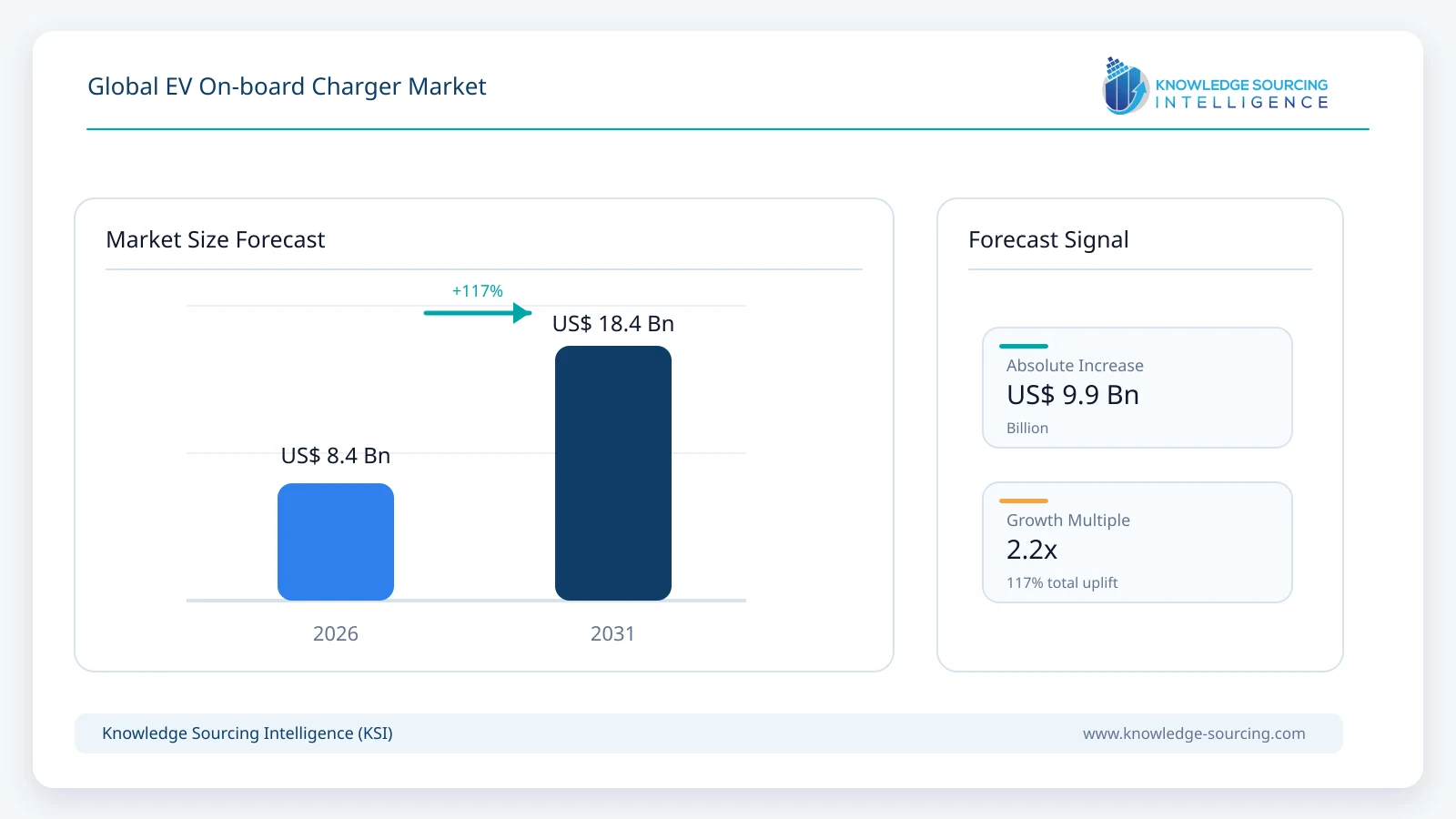
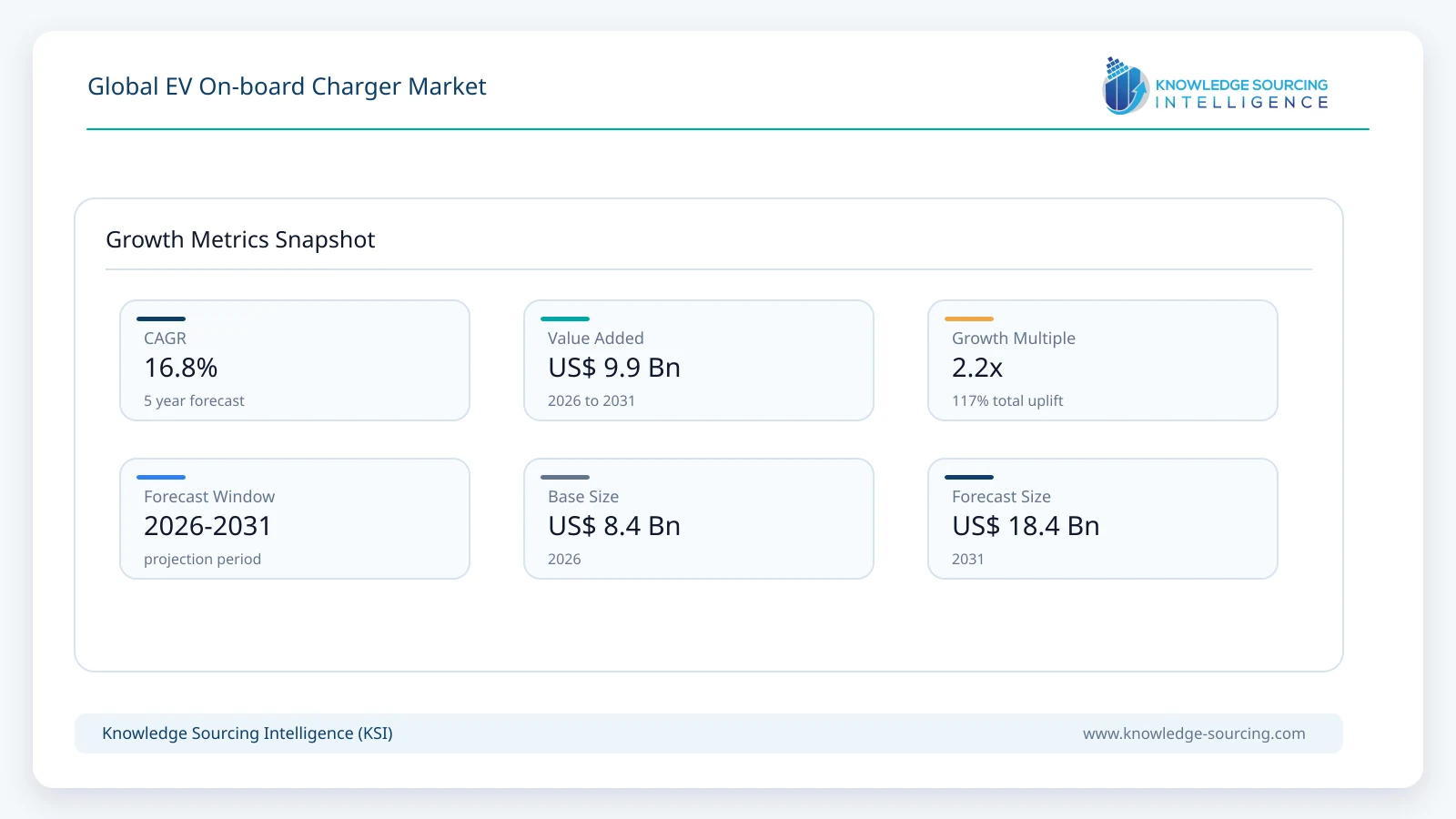
The global EV on-board charger market is estimated at USD 8.45 billion in 2026 and is projected to reach USD 18.35 billion by 2031, representing a CAGR of 16.8% during the forecast period.
Highlights:
- 1Up-to-7.4 kW chargers generate approximately USD 3.63 billion in global revenue during 2026.
- 2The 11-22 kW segment approaches USD 4.40 billion by 2031 as higher-power AC charging expands.
- 3Battery electric vehicles generate approximately USD 5.83 billion of on-board charger demand in 2026.
- 4Integrated OBC and DC/DC architectures approach USD 9.18 billion in revenue by 2031.
- 5Bidirectional on-board chargers approach USD 6.42 billion by 2031 as V2X functionality scales.
- 6Asia Pacific generates approximately USD 5.07 billion of global on-board charger revenue in 2026.
On-board chargers occupy a distinct position between the external charging point and the traction battery. AC charging supplies alternating current to the vehicle, while the OBC performs rectification, power-factor correction, galvanic isolation, voltage conversion, battery communication and safety management before energy reaches the high-voltage battery. DC fast charging largely bypasses the OBC, but it does not eliminate the component because passenger EVs still require convenient overnight, workplace and destination charging from AC sources. The International Energy Agency (IEA) reported more than 20 million electric-car sales in 2025 and expects approximately 23 million in 2026, creating a large annual vehicle-production base for OBC demand.
OBC value per vehicle is also changing. Entry and mass-market vehicles continue to use lower-power single-phase units, particularly in markets where residential connections limit AC power. Premium vehicles, European models, commercial fleets and newer 800 V platforms increasingly support 11 kW or 22 kW charging. The technology stack is shifting at the same time: SiC improves switching efficiency and power density, while GaN is being evaluated for still higher switching frequencies and smaller passive components. Infineon demonstrated an 11 kW, 800 V all-GaN OBC architecture in 2025 and reported a 26% bill-of-material reduction against a standard two-level SiC reference design, illustrating how semiconductor innovation can support both packaging and cost objectives.
System integration is becoming equally important. Instead of packaging the OBC as an isolated module, suppliers increasingly combine it with the high-voltage DC/DC converter, power distribution unit and charging communication electronics. Valeo, Delta, Bosch and Schaeffler all offer integrated configurations. This can reduce housings, connectors, cabling, thermal interfaces and assembly steps, but it also raises the engineering and qualification requirements for suppliers because a single integrated power box becomes responsible for multiple vehicle energy functions.
Selected Segment Estimates
Dimension | Selected Subsegment | 2026 Indicator | Forecast Interpretation |
Power Rating | Up to 7.4 kW | ~43% / USD 3.63B | Largest installed-volume segment; broad use in mass-market BEVs and PHEVs. |
Power Rating | Above 11-22 kW | ~18% / USD 1.52B | Fastest power band; approximately 23.7% CAGR through 2031. |
Propulsion | Battery Electric Vehicle | ~69% / USD 5.83B | Largest propulsion pool due higher BEV volumes and charging-power content. |
Architecture | Integrated OBC + DC/DC / power box | ~38% / USD 3.21B | Fastest architecture; approximately 23.4% CAGR as functions consolidate. |
Directionality | Bidirectional | ~18% / USD 1.52B | Fastest functional category; approximately 33.4% CAGR as V2X reaches series programs. |
Power Semiconductor | Silicon Carbide | ~38% / USD 3.21B | Rapid share gain in high-voltage and higher-power OBC platforms. |
Vehicle Type | Passenger Cars | ~91% / USD 7.69B | Largest vehicle class because global electric-car production dominates annual OBC units. |
Geography | Asia Pacific | ~60% / USD 5.07B | Largest regional pool, led by China and expanding Asian EV production. |
Market Dynamics
Electric Vehicle Production Directly Expands Annual OBC Unit Demand
The strongest volume driver is the number of plug-in vehicles entering production. The IEA reported more than 20 million electric-car sales in 2025 and expects around 23 million in 2026. Each BEV and PHEV requires an onboard AC charging pathway unless the vehicle is designed around a specialized charging architecture. The relationship is therefore more direct than for many optional EV components. China remains especially important: more than 13 million electric cars were sold there in 2025, representing about six out of ten global electric-car sales. Europe sold approximately 4.2 million electric cars in 2025, while emerging markets outside the three largest EV regions are also increasing rapidly.
Higher AC Charging Power Raises Electronics Content per Vehicle
Charging expectations are moving upward from 3.3 kW and 6.6-7.4 kW toward 11 kW and, in selected platforms, 22 kW. Valeo, BorgWarner, Delta, KOSTAL and MAHLE all advertise OBC portfolios extending to 22 kW. Higher power requires more capable switching devices, magnetics, thermal management, filtering and control while maintaining automotive packaging and electromagnetic-compatibility requirements. The shift is particularly relevant in Europe, where three-phase AC availability supports 11 kW and 22 kW charging, and in premium or commercial applications where vehicle downtime carries a higher economic cost.
Bidirectional Charging Creates a New Functional Revenue Layer
Bidirectional OBCs can reverse power flow so the traction battery supplies a home, electrical load or grid. Suppliers increasingly treat vehicle-to-load (V2L), vehicle-to-home (V2H) and vehicle-to-grid (V2G) as platform capabilities rather than laboratory features. Valeo, Delta, Schaeffler and KOSTAL all describe bidirectional operation in current product portfolios. The hardware must support reverse conversion, grid synchronization, protection, communication and control, increasing system complexity and software content. Adoption will remain dependent on standards, utility rules and OEM activation, but platforms designed for V2X create higher-value OBC opportunities through 2031.
DC Fast Charging Can Reduce the Need for Very High AC OBC Power
Public DC charging bypasses the vehicle OBC and can deliver much higher charging power than AC systems. As ultra-fast public networks improve, automakers do not need to continuously increase OBC power across every vehicle segment. A compact 7-11 kW OBC remains sufficient for overnight charging in many use cases. This creates a practical ceiling for onboard AC power because larger chargers add cost, weight and cooling requirements. The market therefore grows primarily through EV volume, bidirectional functionality, higher-value semiconductors and integration rather than an unrestricted shift toward very high OBC power.
Integration Increases Qualification Risk and Supplier Responsibility
Combining the OBC with DC/DC conversion, power distribution and charging communication reduces packaging but increases the consequence of component failure. Integrated power boxes must satisfy high-voltage isolation, electromagnetic compatibility, cybersecurity, functional safety and thermal requirements across several energy functions. OEM qualification cycles can therefore be long, and a design change may affect multiple vehicle subsystems simultaneously. This favors suppliers with proven automotive quality systems, power-semiconductor expertise, software capability and local manufacturing support.
Technological Outlook
Silicon Carbide and Gallium Nitride Power Electronics
Wide-bandgap semiconductors are central to the next efficiency and packaging gains in OBC design. SiC is already established in high-voltage automotive power electronics and supports high switching efficiency across 400 V and 800 V platforms. GaN is progressing into higher-power automotive conversion as device voltage ratings and packaging improve. Infineon's 2025 demonstration of an 11 kW, 800 V three-level GaN OBC reported more than 98% efficiency at the power-factor-correction stage and a 26% bill-of-material reduction relative to a standard SiC reference topology. Through 2031, semiconductor selection increasingly becomes a system-level decision balancing efficiency, thermal load, magnetics size, cost and supply security.
Bidirectional Charging and V2X
Bidirectional capability is moving into scalable production platforms. Valeo's fourth-generation OBC is designed for bidirectional power flow, Delta offers dedicated bidirectional OBC modules, and Schaeffler's High Voltage Box supports V2L, V2H and V2G. KOSTAL similarly lists bidirectional operation as a core OBC trend. These designs require both hardware capability and standardized communication with charging equipment and energy-management systems. The bidirectional category remains smaller than unidirectional charging in 2026 but records the fastest growth as OEMs prepare vehicles for energy services and backup-power use cases.
Integrated OBC, DC/DC and Power Distribution
Integration is reducing duplicated housings, connectors and cooling interfaces. Delta offers a 22 kW OBC with a 3.5 kW DC/DC converter in a combined module, while Valeo combines the OBC, DC/DC converter and power distribution unit in a high-voltage power box. Bosch integrates charger and converter functions, and Schaeffler offers a compact High Voltage Box for 400 V and 800 V systems. The integrated architecture is projected to grow faster than standalone OBCs because OEMs are reducing vehicle electronic complexity and seeking fewer high-voltage modules.
800 V Compatibility and Higher-Power AC Charging
The spread of 800 V traction systems affects insulation, device selection, transformer design and output-voltage range. Valeo and Schaeffler both offer OBC platforms spanning 400 V and 800 V batteries, while BorgWarner lists compatibility across 400 V, 650 V and 800 V ranges. Higher voltage does not automatically mean higher AC charge power, but it increases the need for flexible OBC platforms that can serve multiple battery architectures. Supplier scalability across voltage classes is therefore becoming an important OEM sourcing criterion.
Segment Analysis
By Power Rating - Up to 7.4 kW
Up-to-7.4 kW systems remain the largest power-rating segment, accounting for approximately 43% of global OBC revenue in 2026. The category includes 3.3 kW, 6.6 kW, 7 kW and 7.4 kW configurations used across mass-market passenger EVs and PHEVs. Its strength comes from broad compatibility with single-phase residential electricity, adequate overnight charging performance and lower cost and thermal burden than larger three-phase systems. The segment continues to grow in absolute value through 2031, but its revenue share declines as 11 kW and 22 kW chargers become more common in higher-specification vehicles and markets with stronger three-phase charging availability.
By Architecture - Integrated OBC + DC/DC / Power Box
Integrated power-electronics architectures are the fastest-growing configuration, with revenue projected to rise at approximately 23.4% annually from 2026 to 2031. These systems combine charging with high-voltage-to-low-voltage conversion and, increasingly, power distribution or communication functions. The commercial advantage is not simply component count reduction: integration can lower packaging volume, vehicle wiring, connectors, assembly operations and cooling duplication. It also increases supplier value per platform and makes the module more deeply embedded in the vehicle electrical architecture. Adoption is strongest in new EV platforms where OEMs can design around a consolidated power box from the outset.
Market and Technology Indicators
Indicator | Latest Development | Market Relevance |
Global electric-car sales | More than 20 million in 2025; IEA expects about 23 million in 2026. | Directly expands annual OBC unit demand. |
China EV scale | More than 13 million electric cars sold in 2025, around six in ten globally. | Supports Asia Pacific OBC manufacturing and demand leadership. |
Mainstream power range | Major suppliers offer roughly 3.3/7.4 kW through 11 kW and 22 kW platforms. | Confirms widening AC charging-power requirements. |
400 V / 800 V support | Valeo and Schaeffler support both battery-voltage classes. | Raises need for scalable high-voltage OBC platforms. |
GaN cost potential | Infineon 11 kW, 800 V GaN demo reported 26% lower BoM than reference SiC topology. | Shows pathway to smaller and potentially lower-cost high-power OBCs. |
Functional integration | Valeo, Delta, Bosch and Schaeffler combine OBC with DC/DC and other power functions. | Moves revenue toward integrated power boxes rather than isolated modules. |
Asia Pacific Market Analysis
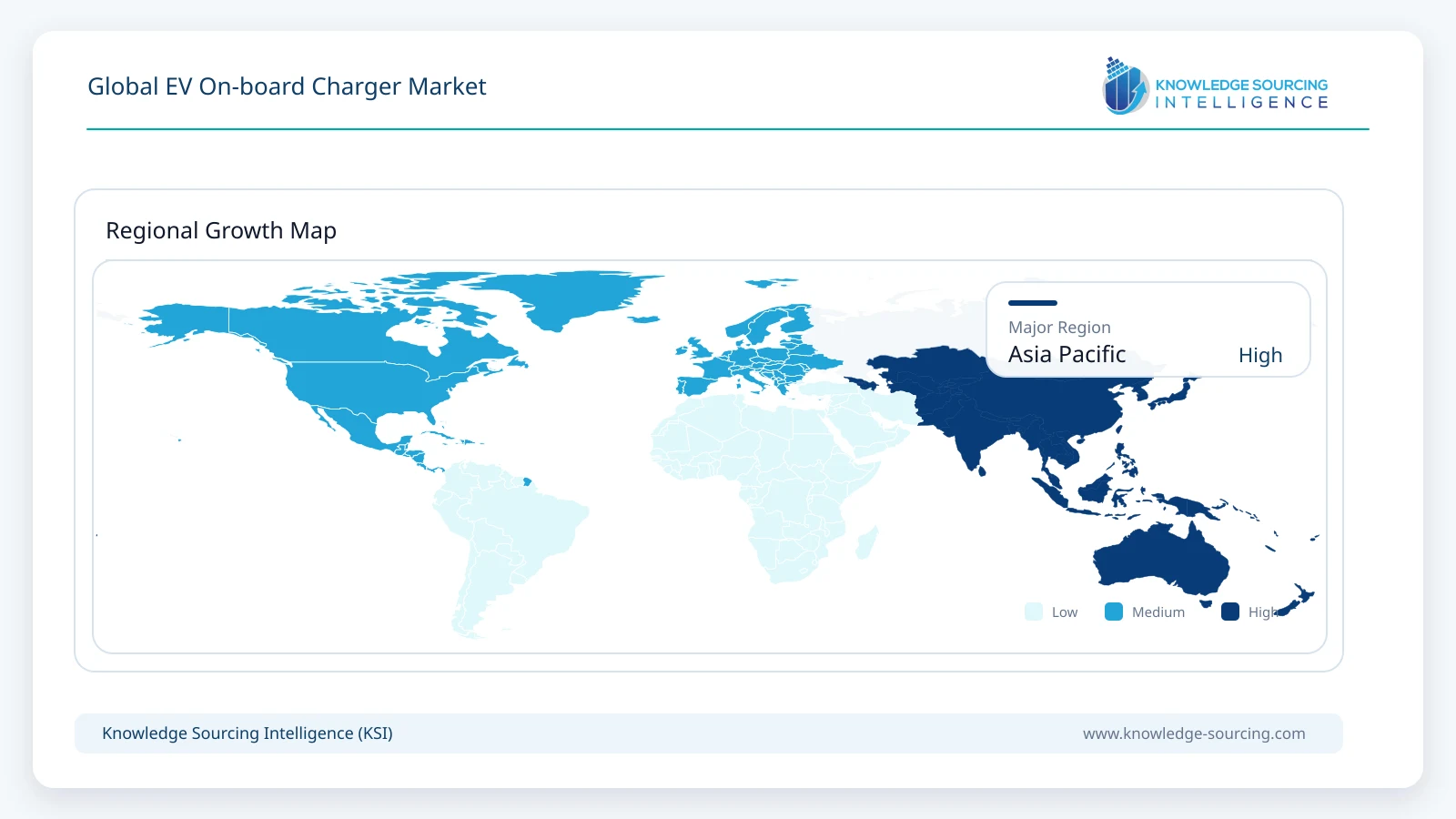
Asia Pacific is the largest regional OBC market, accounting for approximately 60% of global revenue in 2026. China is the principal driver because of its unmatched EV production and sales scale. The IEA reported more than 13 million electric-car sales in China during 2025 and nearly 75% of global electric-car production taking place in the country. This creates dense local demand for OBCs, DC/DC converters, inverters and integrated power boxes, while competition among Chinese automakers places strong pressure on supplier cost, efficiency and packaging. Local power-electronics manufacturers also benefit from proximity to battery, semiconductor and vehicle assembly ecosystems.
The regional opportunity extends beyond China. Korea and Japan maintain strong automotive electronics and semiconductor capabilities, while India and Southeast Asia are expanding EV production from smaller bases. Valeo is localizing OBC combo units in India and has linked that capacity to its Mahindra electrification program. Delta operates a broad Asian power-electronics base and supplies standalone, bidirectional and integrated OBC solutions. Through 2031, Asia Pacific remains the largest region by value, although faster adoption in several emerging markets and stronger European electrification prevent its share from increasing indefinitely.
Competitive Landscape
Competition spans global Tier-1 automotive suppliers, specialist high-voltage power-electronics manufacturers and vertically integrated vehicle groups. Valeo, BorgWarner, Bosch, Schaeffler, KOSTAL, MAHLE and Delta compete with scalable OBC platforms and increasingly integrated power boxes. BRUSA HyPower, Bel Fuse, innolectric, Stercom and other specialists compete through high-efficiency designs, flexible voltage ranges and engineering support. Competitive differentiation is moving toward power density, efficiency, bidirectionality, 800 V readiness, functional integration, software, cybersecurity and the ability to localize production near OEM platforms.
The supplier boundary is also broadening because semiconductor architecture has a growing influence on OBC performance. SiC and GaN device suppliers increasingly participate in topology development and reference designs, shortening OEM and Tier-1 development cycles. At the same time, automakers are consolidating multiple high-voltage functions into fewer modules. Suppliers that can deliver an OBC as part of an integrated energy-conversion platform may gain more content per vehicle, while standalone specialists need to compete on compactness, efficiency, cost or niche vehicle requirements.
Recent Developments
September 2026: onsemi and Subaru announced a strategic technology engagement on September 16 to evaluate onsemi’s Embedded Power Platform for next-generation electrified-vehicle power architectures, supporting higher integration.
April 2026: Fraunhofer IZM announced April 28 the EU-funded HiPower 5.0 project’s development of a compact 22 kW GaN on-board charger targeting four-liter packaging for electric vehicles.
February 2026: Valeo expanded its India electrification footprint around localized e-axles and OBC/DC-DC/PDU combo units supporting customer EV programs.
2025: Valeo scheduled start of production for its fourth-generation bidirectional OBC platform supporting 7 kW, 11 kW and 22 kW charging.
2025: Schaeffler presented a multifunctional 800 V four-in-one power-electronics concept combining OBC, DC boost charging, traction drive and HV/LV conversion.
2024–2026: Delta expanded its EV power-electronics portfolio across standalone, bidirectional and integrated OBC/DC-DC architectures up to 22 kW.
EV On-board Charger Market Scope
| Report Metric | Details |
|---|---|
| Total Market Size in 2026 | USD 8.45 billion |
| Total Market Size in 2031 | USD 18.35 billion |
| Forecast Unit | Billion |
| Growth Rate | 16.8% |
| Study Period | 2021 to 2031 |
| Historical Data | 2021 to 2024 |
| Base Year | 2025 |
| Forecast Period | 2026 – 2031 |
| Segmentation | Power Rating, Propulsion Type, Vehicle Type, Architecture, Directionality, Power Semiconductor, Geography |
| Companies |
|
Market Segmentation
By Power Rating
Up to 7.4 kW
Above 7.4 kW to 11 kW
Above 11 kW to 22 kW
Above 22 kW
By Propulsion Type
Battery Electric Vehicles (BEVs)
Plug-in Hybrid Electric Vehicles (PHEVs)
By Vehicle Type
Passenger Cars
Commercial Vehicles
By Architecture
Standalone OBC
Integrated OBC + DC/DC / High-Voltage Power Box
By Directionality
Unidirectional
Bidirectional
By Power Semiconductor
Silicon
Silicon Carbide (SiC)
Gallium Nitride (GaN)
By Geography
North America
United States
Canada
Mexico
South America
Brazil
Argentina
Rest of South America
Europe
Germany
United Kingdom
France
Norway
Rest of Europe
Middle East and Africa
Saudi Arabia
United Arab Emirates
South Africa
Rest of Middle East and Africa
Asia Pacific
China
Japan
South Korea
India
Southeast Asia
Rest of Asia Pacific
Table of Contents
1. EXECUTIVE SUMMARY
2. MARKET SNAPSHOT
2.1. Market Overview
2.2. Market Segmentation
3. BUSINESS LANDSCAPE
3.1. Market Drivers
3.1.1. Electric Vehicle Production Directly Expands Annual OBC Unit Demand
3.1.2. Higher AC Charging Power Raises Electronics Content per Vehicle
3.1.3. Bidirectional Charging Creates a New Functional Revenue Layer
3.2. Market Restraints
3.2.1. DC Fast Charging Can Reduce the Need for Very High AC OBC Power
3.2.2. Integration Increases Qualification Risk and Supplier Responsibility
3.3. Market Opportunities
3.4. Porter's Five Forces Analysis
3.5. Industry Value Chain Analysis
3.6. Policies, Charging Standards and Functional Safety
4. TECHNOLOGICAL OUTLOOK
4.1. Silicon, Silicon Carbide and Gallium Nitride Power Electronics
4.2. Bidirectional Charging and V2X
4.3. Integrated OBC, DC/DC and Power Distribution
4.4. 800 V Compatibility and Higher-Power AC Charging
5. GLOBAL EV ON-BOARD CHARGER MARKET BY POWER RATING
5.1. Up to 7.4 kW
5.2. Above 7.4 kW to 11 kW
5.3. Above 11 kW to 22 kW
5.4. Above 22 kW
6. GLOBAL EV ON-BOARD CHARGER MARKET BY PROPULSION TYPE
6.1. Battery Electric Vehicles (BEVs)
6.2. Plug-in Hybrid Electric Vehicles (PHEVs)
7. GLOBAL EV ON-BOARD CHARGER MARKET BY VEHICLE TYPE
7.1. Passenger Cars
7.2. Commercial Vehicles
8. GLOBAL EV ON-BOARD CHARGER MARKET BY ARCHITECTURE
8.1. Standalone OBC
8.2. Integrated OBC + DC/DC / High-Voltage Power Box
9. GLOBAL EV ON-BOARD CHARGER MARKET BY DIRECTIONALITY
9.1. Unidirectional
9.2. Bidirectional
10. GLOBAL EV ON-BOARD CHARGER MARKET BY POWER SEMICONDUCTOR
10.1. Silicon
10.2. Silicon Carbide (SiC)
10.3. Gallium Nitride (GaN)
11. GLOBAL EV ON-BOARD CHARGER MARKET BY GEOGRAPHY
11.1. North America
11.1.1. United States
11.1.2. Canada
11.1.3. Mexico
11.2. South America
11.2.1. Brazil
11.2.2. Argentina
11.2.3. Rest of South America
11.3. Europe
11.3.1. Germany
11.3.2. United Kingdom
11.3.3. France
11.3.4. Norway
11.3.5. Rest of Europe
11.4. Middle East and Africa
11.4.1. Saudi Arabia
11.4.2. United Arab Emirates
11.4.3. South Africa
11.4.4. Rest of Middle East and Africa
11.5. Asia Pacific
11.5.1. China
11.5.2. Japan
11.5.3. South Korea
11.5.4. India
11.5.5. Southeast Asia
11.5.6. Rest of Asia Pacific
12. COMPETITIVE ENVIRONMENT AND ANALYSIS
12.1. Major Players and Strategy Analysis
12.2. Market Share Analysis
12.3. Agreements, Programs and Collaborations
12.4. Competitive Dashboard
13. COMPANY PROFILES
13.1. Valeo
13.2. BorgWarner Inc.
13.3. Robert Bosch GmbH
13.4. Delta Electronics, Inc.
13.5. Schaeffler AG
13.6. KOSTAL Automobil Elektrik GmbH & Co. KG
13.7. MAHLE GmbH
13.8. BRUSA HyPower AG
13.9. Bel Fuse Inc.
13.10. Toyota Industries Corporation
13.11. Ficosa Internacional SA
13.12. Lear Corporation
13.13. LG Magna e-Powertrain Co., Ltd.
13.14. Eaton Corporation plc
13.15. Hyundai Mobis Co., Ltd.
13.16. Shinry Technologies Co., Ltd.
13.17. innolectric AG
13.18. Stercom Power Solutions GmbH
14. RECENT DEVELOPMENTS
15. APPENDIX
15.1. Currency
15.2. Assumptions
15.3. Base and Forecast Years Timeline
15.4. Abbreviations
Navigate
Trusted by the world's leading organizations











