
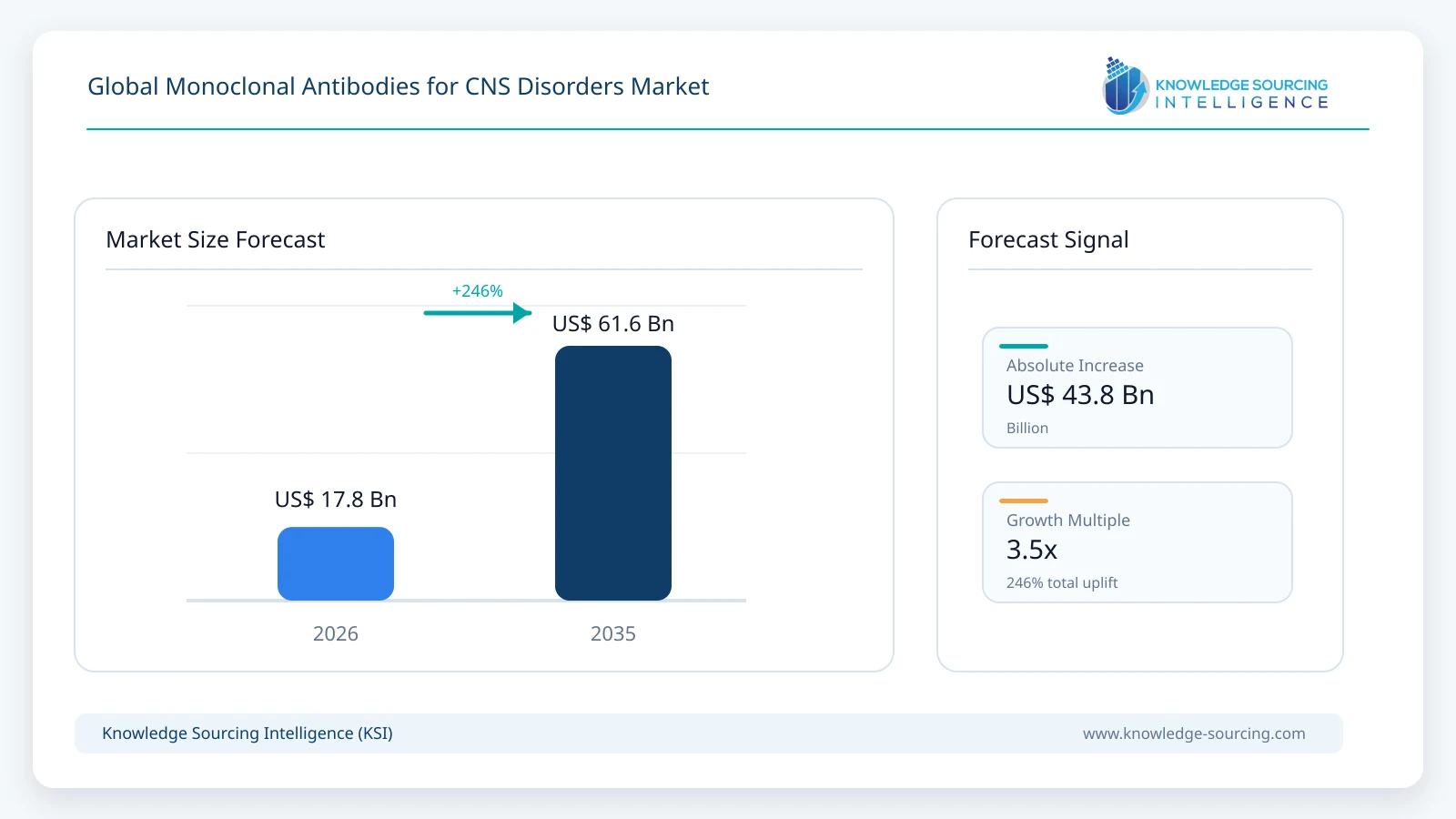
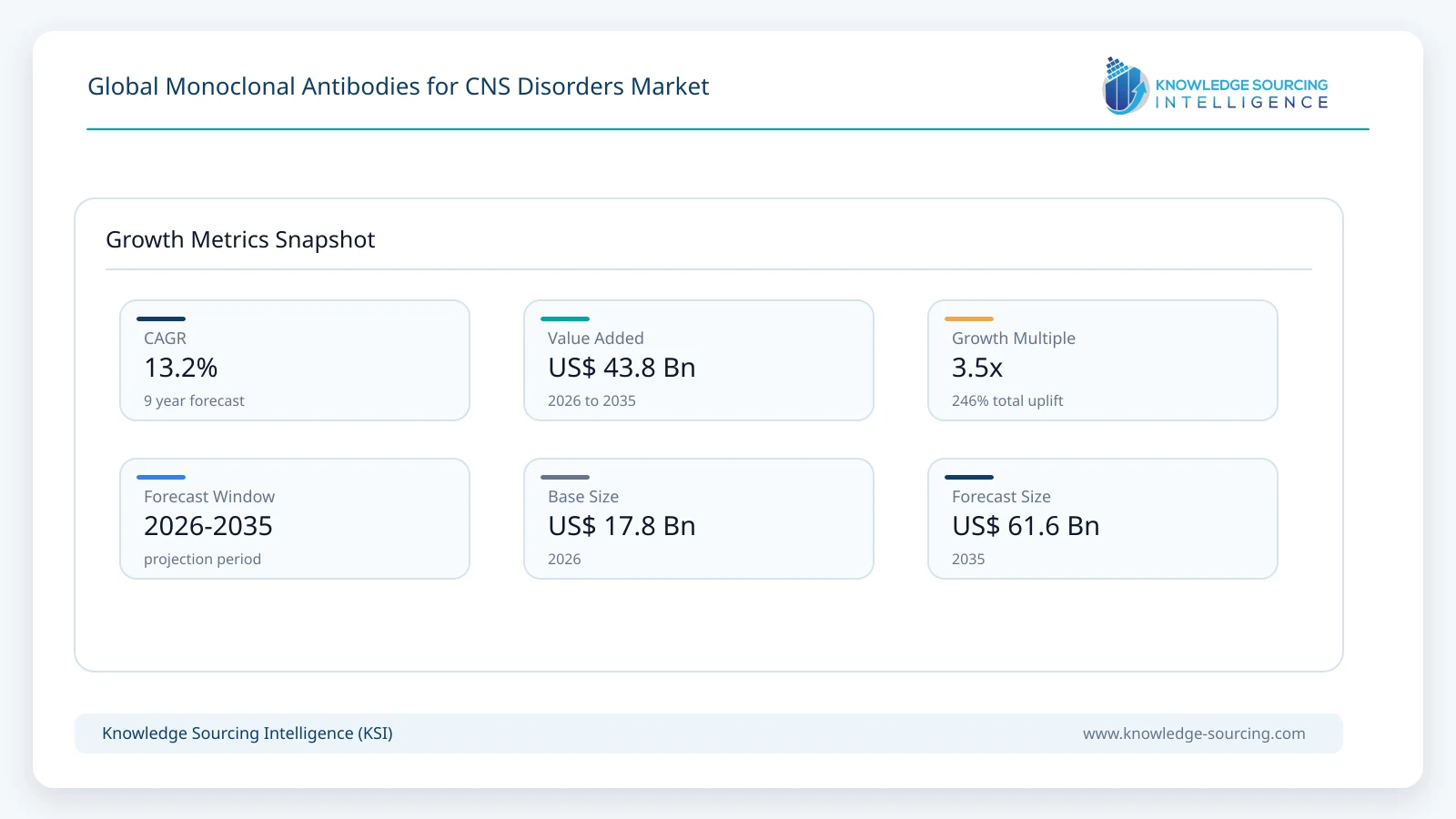
The Global Monoclonal Antibodies for CNS Disorders Market is projected to grow at a CAGR of 13.2% the forecast period, increasing from USD 17.8 billion in 2026 to USD 61.62 billion by 2035.
Highlights:
- 1Rising dementia prevalence is increasing demand for disease-modifying biologics because cognitive decline continues to create a substantial long-term healthcare burden.
- 2Biomarker-guided treatment eligibility is expanding monoclonal antibody utilization because precision patient selection improves therapeutic targeting.
- 3Autoimmune CNS disorders are driving biologic adoption because relapse prevention increasingly requires targeted immune modulation.
- 4MRI-based monitoring requirements are increasing infrastructure dependency because safety management directly affects treatment continuity.
CNS monoclonal antibodies function through highly targeted immune or pathological pathway modulation because neurological disorders increasingly demonstrate identifiable molecular drivers. Treatment demand is shifting toward biologics because clinicians are seeking durable efficacy in diseases where conventional therapies often fail to alter long-term progression. This movement is strengthening adoption of anti-CD20 antibodies, anti-amyloid therapies, anti-CGRP monoclonal antibodies, complement inhibitors, and IL-6 pathway inhibitors.
Regulatory agencies increasingly support accelerated neurological innovation because unmet clinical need remains significant across neurodegenerative and autoimmune CNS disorders. Drug developers are expanding biomarker-based development strategies while payers continue evaluating long-term value frameworks. This environment increases commercial importance for therapies capable of demonstrating measurable disease modification, relapse reduction, or disability stabilization.
Leqembi became the first amyloid beta-directed monoclonal antibody to receive traditional FDA approval for Alzheimer’s disease after confirmatory evidence demonstrated clinical benefit. This regulatory milestone is accelerating investment into disease-modifying neurological biologics and reshaping CNS drug development priorities.
Market Dynamics
Market Drivers
Expansion of Disease-Modifying Alzheimer's Therapies: Alzheimer’s treatment demand increasingly depends on biologic intervention because conventional therapies largely address symptoms rather than pathology. Physicians are integrating anti-amyloid monoclonal antibodies while biomarker-confirmed diagnosis pathways continue expanding. Treatment eligibility therefore increasingly depends on early-stage disease identification. This transition strengthens demand for specialized neurological biologics.
Growing Utilization of Anti-CD20 Therapies in Multiple Sclerosis: Multiple sclerosis management increasingly prioritizes relapse suppression because long-term disability progression directly affects patient outcomes. Neurologists are adopting high-efficacy monoclonal antibodies while B-cell depletion strategies continue demonstrating durable clinical benefits. Disease control therefore increasingly depends on advanced biologic intervention. This dynamic supports anti-CD20 market expansion.
Increasing Adoption of CGRP Monoclonal Antibodies: Migraine treatment increasingly focuses on preventive intervention because recurrent attacks substantially affect productivity and quality of life. Clinicians are expanding CGRP-targeted prescribing while patients continue seeking therapies with reduced systemic adverse-event burden. Preventive treatment utilization therefore continues increasing. This shift supports sustained monoclonal antibody demand.
Expansion of Rare Autoimmune CNS Indications: NMOSD and generalized myasthenia gravis require targeted immune modulation because relapse-driven disease progression creates severe neurological consequences. Specialized biologics are gaining utilization while regulatory support for rare diseases continues improving commercialization pathways. This environment strengthens premium biologic adoption.
Market Restraints
High biologic therapy costs constrain broad utilization because reimbursement approval remains essential for treatment access.
MRI monitoring requirements increase treatment complexity because safety surveillance affects patient eligibility and persistence.
Infusion infrastructure limitations restrict access because administration requirements remain concentrated in specialized treatment centers.
Market Opportunities
Expansion of Subcutaneous Biologic Delivery: Administration burden affects long-term adherence because repeated infusion visits increase healthcare dependency. Manufacturers are developing subcutaneous formulations while healthcare systems increasingly prioritize outpatient treatment flexibility. This shift improves accessibility and supports broader utilization.
Growth of Biomarker-Guided Neurology: Patient selection increasingly influences treatment outcomes because biologic efficacy often depends on molecular disease confirmation. Diagnostic capabilities are expanding while precision neurology frameworks continue strengthening. This evolution increases demand for integrated diagnostic-therapeutic ecosystems.
Emerging Disease-Modifying CNS Platforms: Neurodegenerative disorders remain underserved because effective progression-slowing therapies remain limited. Investment is increasing in next-generation monoclonal antibodies while CNS-targeted biologics continue expanding across development pipelines. This activity broadens future commercial opportunities.
Expansion in Autoimmune Neurology: Autoimmune neurological disorders require long-term immune control because relapse activity directly influences disability progression. Biologic utilization is increasing while treatment algorithms continue shifting toward targeted intervention. This trend supports sustained specialty-market growth.
Government Regulations
Regulatory Authority | Regulatory Focus | Market Impact |
FDA | CNS biologic approval and safety monitoring | Accelerates disease-modifying therapy commercialization |
EMA | Centralized biologic authorization | Expands European patient access |
PMDA | Neurological biologic review | Supports Japanese market expansion |
NMPA | CNS therapy approval pathways | Improves biologic availability in China |
CDSCO | Biologic approval and compliance oversight | Expands specialty neurology treatment access |
Market Segmentation
By Mechanism
Mechanism-based competition increasingly determines clinical differentiation because efficacy alone no longer defines neurologic biologic adoption. Anti-CD20 antibodies maintain strong utilization while multiple sclerosis treatment increasingly favors high-efficacy disease control. Anti-amyloid antibodies are expanding because Alzheimer’s disease management is shifting toward disease modification. Anti-CGRP biologics continue growing while migraine prevention increasingly prioritizes targeted intervention. This segmentation links demand directly to biological pathway relevance.
By Disease Indication
Alzheimer’s disease is becoming a major growth segment because disease-modifying monoclonal antibodies are creating new treatment pathways. Multiple sclerosis maintains substantial biologic utilization while relapse prevention remains central to treatment strategy. Migraine biologics continue expanding because preventive therapy adoption is increasing among high-burden patients. NMOSD and generalized myasthenia gravis support specialty demand because targeted immune modulation significantly affects disease outcomes.
By Route of Administration
Intravenous administration remains important because several high-value biologics continue requiring controlled infusion delivery. Subcutaneous therapies are gaining preference while healthcare systems increasingly emphasize treatment convenience and resource optimization. Administration flexibility therefore increasingly influences treatment selection. This transition supports lifecycle management and adherence-focused innovation.
Regional Analysis
North America
North America represents the largest CNS monoclonal antibody adoption environment because advanced neurological diagnostics support early patient identification. Biomarker-guided treatment pathways are expanding while amyloid-confirmation testing continues to increase Alzheimer’s therapy eligibility. Reimbursement systems increasingly evaluate long-term clinical value because biologic treatment costs remain substantial. Manufacturers are strengthening evidence-generation strategies while providers continue integrating disease-modifying therapies into specialty neurology workflows. Multiple sclerosis biologics maintain strong utilization because relapse prevention directly affects long-term disability outcomes. Alzheimer’s monoclonal antibodies are creating additional demand because disease-modifying treatment options remain limited. This structure supports sustained biologic expansion despite pricing pressure and monitoring requirements.
Europe
Europe maintains significant CNS biologic utilization because centralized healthcare systems support specialist neurological care access. Adoption is increasing for disease-modifying therapies while reimbursement authorities continue requiring robust clinical evidence. Cost-effectiveness evaluations create access constraints because premium biologics require demonstrated value. Manufacturers are expanding real-world evidence programs while neurologists increasingly prioritize progression control. This environment favors therapies capable of delivering measurable long-term outcomes.
Asia Pacific
Asia Pacific is emerging as a major CNS biologic opportunity because neurological disease prevalence continues increasing alongside healthcare modernization. Diagnostic infrastructure is expanding while specialist neurology access continues improving across major economies. Demand is shifting toward advanced biologics because treatment expectations are rising among urban healthcare systems. Regulatory reforms continue accelerating market entry timelines. This combination supports long-term biologic adoption growth.
Rest of the World
Emerging healthcare markets continue expanding neurological treatment access because previously underserved patient populations remain substantial. Demand is increasing for specialty biologics while reimbursement limitations continue affecting penetration rates. Healthcare investment is improving diagnostic capabilities because neurological disease burden continues growing. This environment supports gradual biologic adoption driven by infrastructure development.
Regulatory Landscape
Regulatory agencies increasingly support accelerated neurological innovation because unmet need remains substantial across neurodegenerative and autoimmune CNS diseases. Approval pathways are evolving while biomarker-driven development strategies continue receiving regulatory attention. This framework encourages disease-modifying biologic investment.
Post-marketing surveillance remains central because long-term neurological safety profiles require continuous monitoring. MRI-based safety management continues influencing treatment protocols while regulators increasingly evaluate real-world effectiveness evidence. These requirements strengthen pharmacovigilance importance across CNS biologic markets.
Pipeline Analysis
Pipeline activity increasingly focuses on disease modification because neurological treatment goals continue moving beyond symptomatic management. Companies are expanding anti-amyloid, anti-inflammatory, and immune-modulating biologic programs while biomarker-guided patient selection continues improving development efficiency. This transition supports a broader biologic innovation ecosystem.
Next-generation CNS antibodies increasingly target blood-brain barrier challenges because CNS penetration remains a major therapeutic constraint. Developers are advancing bispecific antibodies and engineered delivery technologies while seeking improved neurological tissue engagement. This innovation trajectory expands future market potential.
Competitive Landscape
Roche
Roche remains strategically distinct because Ocrevus established leadership within multiple sclerosis biologics while Enspryng expanded autoimmune neurology presence. Demand is increasing for high-efficacy immune modulation because relapse prevention remains central to long-term neurological outcomes. The company continues strengthening CNS specialization while biologic treatment adoption expands across autoimmune disorders. This positioning supports sustained market influence.
Novartis
Novartis benefits from diversified CNS biologic exposure because Kesimpta and Aimovig address distinct neurological populations. Demand is shifting toward self-administered therapies while treatment convenience increasingly affects adherence. The company continues expanding neurological market reach through differentiated biologic platforms. This approach strengthens commercial resilience.
Eisai
Eisai remains strategically important because Leqembi helped establish disease-modifying Alzheimer’s therapy. Demand is increasing for early-intervention treatment because biomarker-confirmed patient identification continues expanding. The company’s Alzheimer’s leadership strengthens competitive positioning within neurodegenerative disease therapeutics.
Biogen
Biogen maintains relevance through Alzheimer’s disease biologic development because disease modification remains a critical industry objective. Clinical evidence generation continues shaping market perception while neurological specialization supports strategic focus. This position sustains influence within cognitive disorder treatment markets.
Eli Lilly
Eli Lilly is strengthening neurological biologic leadership because Kisunla and Emgality address both neurodegenerative and migraine populations. Demand is increasing for targeted biologics while clinicians continue prioritizing measurable clinical outcomes. This diversification supports long-term CNS growth.
Amgen
Amgen maintains competitive strength through migraine and autoimmune neurology biologics because targeted immune modulation continues expanding clinical relevance. Demand is shifting toward specialty biologics while long-term disease management increasingly favors precision approaches. This positioning strengthens neurological market participation.
AstraZeneca
AstraZeneca, through Alexion, benefits from rare neurological disease specialization because complement inhibition remains highly effective in selected autoimmune indications. Demand is increasing where relapse prevention directly affects disability outcomes. This focus supports premium biologic positioning.
Lundbeck
Lundbeck differentiates itself through Vyepti because migraine prevention increasingly requires targeted biologic intervention. Demand continues expanding among patients requiring sustained preventive control. This specialization strengthens CNS-focused competitive positioning.
Key Developments
May 2026: Tonix Pharmaceuticals Holding Corp., a fully integrated, commercial-stage biotechnology company, announced the publication of a paper, “First-in-Human, Phase 1, Randomized, Double-Blind, Placebo-Controlled Study of TNX-1500, an Fc-Modified anti-CD154 Monoclonal Antibody, Evaluating the Safety, Tolerability, Pharmacokinetics, and Pharmacodynamics of Single-Ascending Doses in Healthy Adults,” in the peer-reviewed Journal of Clinical Immunology.
Strategic Insights and Future Market Outlook
The CNS monoclonal antibody market increasingly depends on disease-modifying value because healthcare systems continue prioritizing long-term neurological outcome improvement. Demand is shifting toward biologics capable of altering progression trajectories rather than only controlling symptoms. This movement supports premium therapeutic positioning.
Neurological diagnostics are becoming more important because biomarker-confirmed treatment eligibility increasingly determines access. Healthcare systems are investing in imaging and molecular testing while biologic adoption continues expanding. This integration strengthens precision neurology infrastructure.
Future competition increasingly centers on efficacy durability, safety management, and treatment convenience because long-term neurological disease management requires sustained patient engagement. Manufacturers are investing in next-generation biologics while CNS-targeted innovation continues accelerating. This environment supports continued expansion of monoclonal antibodies across neurodegenerative and autoimmune CNS disorders.
The Global Monoclonal Antibodies for CNS Disorders Market remains defined by expanding disease-modifying treatment adoption, increasing biomarker-guided care pathways, and rising neurological disease burden. Treatment demand continues shifting toward precision biologics because durable disease control increasingly depends on targeted pathway intervention rather than broad symptomatic management alone.
Market Segmentation
By Geography
Key Countries Analysis
Table of Contents
1. EXECUTIVE SUMMARY
1.1 Strategic Overview
1.1.1 Monoclonal Antibodies for CNS Disorders Market Definition
1.1.2 Scope of CNS Monoclonal Antibody Therapies
1.1.3 Key Commercial Insights
1.1.4 Key Clinical Insights
1.1.5 Regulatory Milestones
1.1.6 Innovation Highlights
1.1.7 Strategic Opportunities and Risks
1.2 Market Snapshot
1.2.1 Global Revenue Overview
1.2.2 Treated Patient Overview
1.2.3 Prescription and Administration Volume Overview
1.2.4 Forecast Summary
1.3 Executive Conclusions
1.3.1 Market Evolution Outlook
1.3.2 Competitive Positioning Summary
1.3.3 Innovation Outlook
2. DISEASE & PATIENT POPULATION INTELLIGENCE
2.1 CNS Disease Landscape Overview
2.1.1 Alzheimer's Disease
2.1.2 Multiple Sclerosis
2.1.3 Neuromyelitis Optica Spectrum Disorder (NMOSD)
2.1.4 Generalized Myasthenia Gravis
2.1.5 Migraine
2.1.6 Progressive Neurological Disorders with Biologic Therapy Potential
2.2 Epidemiology Assessment
2.2.1 Global CNS Disease Prevalence
2.2.2 Global CNS Disease Incidence
2.2.3 Disease Burden Analysis
2.2.4 Mortality and Disability Assessment
2.3 Patient Funnel Modeling
2.3.1 Total Patient Population
2.3.2 Diagnosed Population
2.3.3 Treated Population
2.3.4 Biologic-Eligible Population
2.3.5 Advanced Therapy Eligible Population
2.4 Disease Severity Segmentation
2.4.1 Early-Stage Disease Population
2.4.2 Moderate Disease Population
2.4.3 Severe Disease Population
2.4.4 Treatment-Refractory Population
2.5 Biomarker-Based Segmentation
2.5.1 Alzheimer's Disease Biomarkers
2.5.1.1 Amyloid PET Positive Population
2.5.1.2 CSF Amyloid Biomarker Population
2.5.1.3 Tau Biomarker Population
2.5.2 Multiple Sclerosis Biomarkers
2.5.2.1 MRI Active Disease Population
2.5.2.2 Neurofilament Light Chain Population
2.5.3 NMOSD Biomarkers
2.5.3.1 AQP4-IgG Positive Population
2.6 Comorbidity Assessment
2.6.1 Cognitive Impairment
2.6.2 Depression and Anxiety
2.6.3 Autoimmune Disorders
2.6.4 Cardiovascular Comorbidities
2.6.5 Sleep Disorders
2.7 Treatment Journey Analysis
2.7.1 Diagnosis Pathway
2.7.2 First-Line Therapy Utilization
2.7.3 Escalation to Biologic Therapy
2.7.4 Long-Term Maintenance Therapy
2.7.5 Switching and Persistence Patterns
3. PHARMACOLOGICAL & MECHANISTIC LANDSCAPE
3.1 CNS Monoclonal Antibody Class Overview
3.1.1 Evolution of CNS Biologics
3.1.2 Current Treatment Paradigm
3.1.3 Future Therapeutic Direction
3.2 Mechanism of Action Landscape
3.2.1 Anti-CD20 Monoclonal Antibodies
3.2.1.1 Ocrevus (Ocrelizumab) – Roche
3.2.1.2 Kesimpta (Ofatumumab) – Novartis
3.2.1.3 Ublitux (Ublituximab) – TG Therapeutics
3.2.2 Anti-Amyloid Beta Monoclonal Antibodies
3.2.2.1 Leqembi (Lecanemab) – Eisai/Biogen
3.2.2.2 Kisunla (Donanemab) – Eli Lilly
3.2.2.3 Aduhelm (Aducanumab) – Biogen
3.2.3 CGRP-Targeting Monoclonal Antibodies
3.2.3.1 Aimovig (Erenumab) – Amgen/Novartis
3.2.3.2 Ajovy (Fremanezumab) – Teva
3.2.3.3 Emgality (Galcanezumab) – Eli Lilly
3.2.3.4 Vyepti (Eptinezumab) – Lundbeck
3.2.4 Complement Inhibitor Monoclonal Antibodies
3.2.4.1 Soliris (Eculizumab) – Alexion/AstraZeneca
3.2.4.2 Ultomiris (Ravulizumab) – Alexion/AstraZeneca
3.2.5 IL-6 Pathway Monoclonal Antibodies
3.2.5.1 Enspryng (Satralizumab) – Roche/Chugai
3.2.6 CD19-Directed Monoclonal Antibodies
3.2.6.1 Uplizna (Inebilizumab) – Amgen
3.3 Biological Pathway Assessment
3.3.1 Amyloid Cascade Pathway
3.3.2 B-Cell Depletion Pathway
3.3.3 Complement Cascade Pathway
3.3.4 CGRP Signaling Pathway
3.3.5 IL-6 Inflammatory Pathway
3.4 Mechanism Benchmarking
3.4.1 Monoclonal Antibodies vs Small Molecules
3.4.2 Monoclonal Antibodies vs Cell Therapies
3.4.3 Monoclonal Antibodies vs Gene Therapies
3.4.4 Disease-Modifying Potential Comparison
3.5 Blood-Brain Barrier Considerations
3.5.1 CNS Penetration Challenges
3.5.2 Antibody Engineering Approaches
3.5.3 Receptor-Mediated Transport Strategies
4. CLINICAL OUTCOMES & EVIDENCE BENCHMARKING
4.1 Clinical Endpoint Framework
4.1.1 Alzheimer's Disease Endpoints
4.1.1.1 CDR-SB
4.1.1.2 ADAS-Cog
4.1.1.3 Amyloid Plaque Reduction
4.1.2 Multiple Sclerosis Endpoints
4.1.2.1 Annualized Relapse Rate
4.1.2.2 MRI Lesion Reduction
4.1.2.3 Confirmed Disability Progression
4.1.3 Migraine Endpoints
4.1.3.1 Monthly Migraine Days
4.1.3.2 Responder Rate
4.1.4 NMOSD Endpoints
4.1.4.1 Relapse-Free Survival
4.1.4.2 Time to First Relapse
4.2 Landmark Clinical Trial Assessment
4.2.1 CLARITY AD – Leqembi
4.2.2 TRAILBLAZER-ALZ 2 – Kisunla
4.2.3 OPERA I and OPERA II – Ocrevus
4.2.4 ORATORIO – Ocrevus
4.2.5 ASCLEPIOS I and II – Kesimpta
4.2.6 ULTIMATE I and II – Ublituximab
4.2.7 EVOLVE and REGAIN – Soliris
4.2.8 PREVENT – Uplizna
4.2.9 SAkuraSky and SAkuraStar – Enspryng
4.2.10 STRIVE and ARISE – Aimovig
4.2.11 HALO Program – Ajovy
4.2.12 PROMISE Program – Vyepti
4.3 Head-to-Head Benchmarking
4.3.1 Ocrevus vs Kesimpta
4.3.2 Leqembi vs Kisunla
4.3.3 CGRP Monoclonal Antibody Benchmarking
4.3.4 NMOSD Monoclonal Antibody Benchmarking
4.4 Safety and Tolerability Assessment
4.4.1 Infusion-Related Reactions
4.4.2 Injection-Site Reactions
4.4.3 ARIA Events
4.4.4 Opportunistic Infections
4.4.5 Immunogenicity Assessment
4.5 Real-World Evidence Assessment
4.5.1 Registry-Based Evidence
4.5.2 Long-Term Extension Studies
4.5.3 Persistence and Adherence
4.5.4 Healthcare Resource Utilization
5. PIPELINE & INNOVATION LANDSCAPE
5.1 Pipeline Overview
5.1.1 Pipeline by Development Stage
5.1.2 Pipeline by Disease Indication
5.1.3 Pipeline by Mechanism
5.2 Preclinical Pipeline Assessment
5.3 Phase I Pipeline Assessment
5.4 Phase II Pipeline Assessment
5.5 Phase III Pipeline Assessment
5.6 Next-Generation CNS Antibody Technologies
5.6.1 Bispecific Antibodies
5.6.2 Blood-Brain Barrier Shuttle Antibodies
5.6.3 Fc-Engineered Antibodies
5.6.4 Long-Acting Subcutaneous Antibodies
5.7 Innovation Benchmarking
5.7.1 Disease-Modifying Potential
5.7.2 CNS Penetration Optimization
5.7.3 Administration Route Innovation
5.8 Probability of Success Modeling
5.9 Launch Timeline Assessment
6. REGULATORY & MARKET ACCESS INTELLIGENCE
6.1 Regulatory Landscape
6.1.1 FDA Framework
6.1.2 EMA Framework
6.1.3 PMDA Framework
6.1.4 NMPA Framework
6.1.5 CDSCO Framework
6.2 Accelerated Approval Pathways
6.3 Post-Marketing Requirements
6.4 Reimbursement Intelligence
6.4.1 Public Payer Policies
6.4.2 Private Payer Policies
6.4.3 Prior Authorization Trends
6.5 Pricing and Access Assessment
6.5.1 Value-Based Pricing Models
6.5.2 Cost-Effectiveness Evaluation
6.5.3 Patient Access Barriers
7. MARKET SIZE, UTILIZATION & FORECAST
7.1 Market Modeling Framework
7.2 Revenue Analysis
7.2.1 Historical Revenue
7.2.2 Current Revenue
7.2.3 Forecast Revenue
7.3 Treated Patient Analysis
7.4 Administration Volume Analysis
7.5 Adoption Curve Assessment
7.6 Pricing Assumption Framework
7.7 Forecast Assumptions
8. SEGMENTATION ANALYSIS
8.1 By Mechanism
8.1.1 Anti-CD20 Antibodies
8.1.2 Anti-Amyloid Antibodies
8.1.3 Anti-CGRP Antibodies
8.1.4 Complement Inhibitors
8.1.5 IL-6 Inhibitors
8.1.6 CD19-Directed Antibodies
8.2 By Disease Indication
8.2.1 Alzheimer's Disease
8.2.2 Multiple Sclerosis
8.2.3 Migraine
8.2.4 NMOSD
8.2.5 Generalized Myasthenia Gravis
8.3 By Route of Administration
8.3.1 Intravenous
8.3.2 Subcutaneous
9. GEOGRAPHIC INTELLIGENCE
9.1 North America
9.1.1 Market Size
9.1.2 Adoption Trends
9.1.3 Regulatory Environment
9.1.4 Pricing Dynamics
9.2 Europe
9.2.1 Market Size
9.2.2 Adoption Trends
9.2.3 Regulatory Environment
9.2.4 Pricing Dynamics
9.3 Asia-Pacific
9.3.1 Market Size
9.3.2 Adoption Trends
9.3.3 Regulatory Environment
9.3.4 Pricing Dynamics
9.4 Latin America
9.4.1 Market Size
9.4.2 Adoption Trends
9.4.3 Regulatory Environment
9.4.4 Pricing Dynamics
9.5 Middle East & Africa
9.5.1 Market Size
9.5.2 Adoption Trends
9.5.3 Regulatory Environment
9.5.4 Pricing Dynamics
10. KEY COUNTRIES ANALYSIS
10.1 United States
10.2 Canada
10.3 Germany
10.4 United Kingdom
10.5 France
10.6 Italy
10.7 Spain
10.8 China
10.9 Japan
10.10 India
10.11 South Korea
10.12 Australia
10.13 Brazil
10.14 Mexico
10.15 Saudi Arabia
10.16 South Africa
11. COMPETITIVE LANDSCAPE
11.1 Market Share Analysis
11.1.1 Company-Level Market Share
11.1.2 Molecule-Level Market Share
11.2 Competitive Benchmarking
11.2.1 Clinical Efficacy
11.2.2 Safety Profile
11.2.3 Pricing
11.2.4 Adoption Trends
11.3 Strategic Activity Assessment
11.3.1 Licensing Agreements
11.3.2 Partnerships
11.3.3 Acquisitions
11.4 Company Profiles and Molecule Mapping
11.4.1 Roche – Ocrevus, Enspryng
11.4.2 Novartis – Kesimpta, Aimovig
11.4.3 Eisai – Leqembi
11.4.4 Biogen – Leqembi, Aduhelm
11.4.5 Eli Lilly – Kisunla, Emgality
11.4.6 Amgen – Aimovig, Uplizna
11.4.7 AstraZeneca (Alexion) – Soliris, Ultomiris
11.4.8 Lundbeck – Vyepti
11.4.9 Teva Pharmaceutical Industries – Ajovy
11.4.10 TG Therapeutics – Ublitux
12. DRUG-LEVEL COMMERCIAL INTELLIGENCE
12.1 Leqembi (Lecanemab) – Eisai/Biogen
12.1.1 Product Overview
12.1.2 Mechanism of Action
12.1.3 Clinical Performance
12.1.4 Pricing and Access
12.1.5 Sales Performance
12.1.6 Forecast
12.1.7 Lifecycle Strategy
12.2 Kisunla (Donanemab) – Eli Lilly
12.3 Ocrevus (Ocrelizumab) – Roche
12.4 Kesimpta (Ofatumumab) – Novartis
12.5 Aimovig (Erenumab) – Amgen/Novartis
12.6 Ajovy (Fremanezumab) – Teva
12.7 Emgality (Galcanezumab) – Eli Lilly
12.8 Vyepti (Eptinezumab) – Lundbeck
12.9 Soliris (Eculizumab) – AstraZeneca
12.10 Ultomiris (Ravulizumab) – AstraZeneca
12.11 Uplizna (Inebilizumab) – Amgen
12.12 Enspryng (Satralizumab) – Roche
12.13 Ublitux (Ublituximab) – TG Therapeutics
13. INVESTMENT & DEAL LANDSCAPE
13.1 Venture Capital and Private Equity Activity
13.2 Licensing Landscape
13.3 Strategic Partnerships
13.4 Mergers and Acquisitions
13.5 Investment Attractiveness Assessment
14. FUTURE OUTLOOK & STRATEGIC RECOMMENDATIONS
14.1 Future Market Evolution
14.2 CNS Antibody Innovation Outlook
14.3 Competitive Outlook
14.4 Pricing and Access Outlook
14.5 Strategic Recommendations
14.5.1 Pharmaceutical Manufacturers
14.5.2 Investors
14.5.3 Healthcare Providers
14.5.4 Payers
15. METHODOLOGY & DATA FRAMEWORK
15.1 Research Methodology
15.2 Epidemiology Modeling Framework
15.3 Clinical Evidence Assessment Framework
15.4 Forecasting Methodology
15.5 Competitive Intelligence Framework
15.6 Data Sources
15.6.1 FDA
15.6.2 EMA
15.6.3 PMDA
15.6.4 ClinicalTrials.gov
15.6.5 EU Clinical Trials Register
15.6.6 Company Annual Reports
15.6.7 Peer-Reviewed Publications
15.7 Assumptions and Limitations
15.8 Abbreviations and Definitions
Navigate
Trusted by the world's leading organizations











