
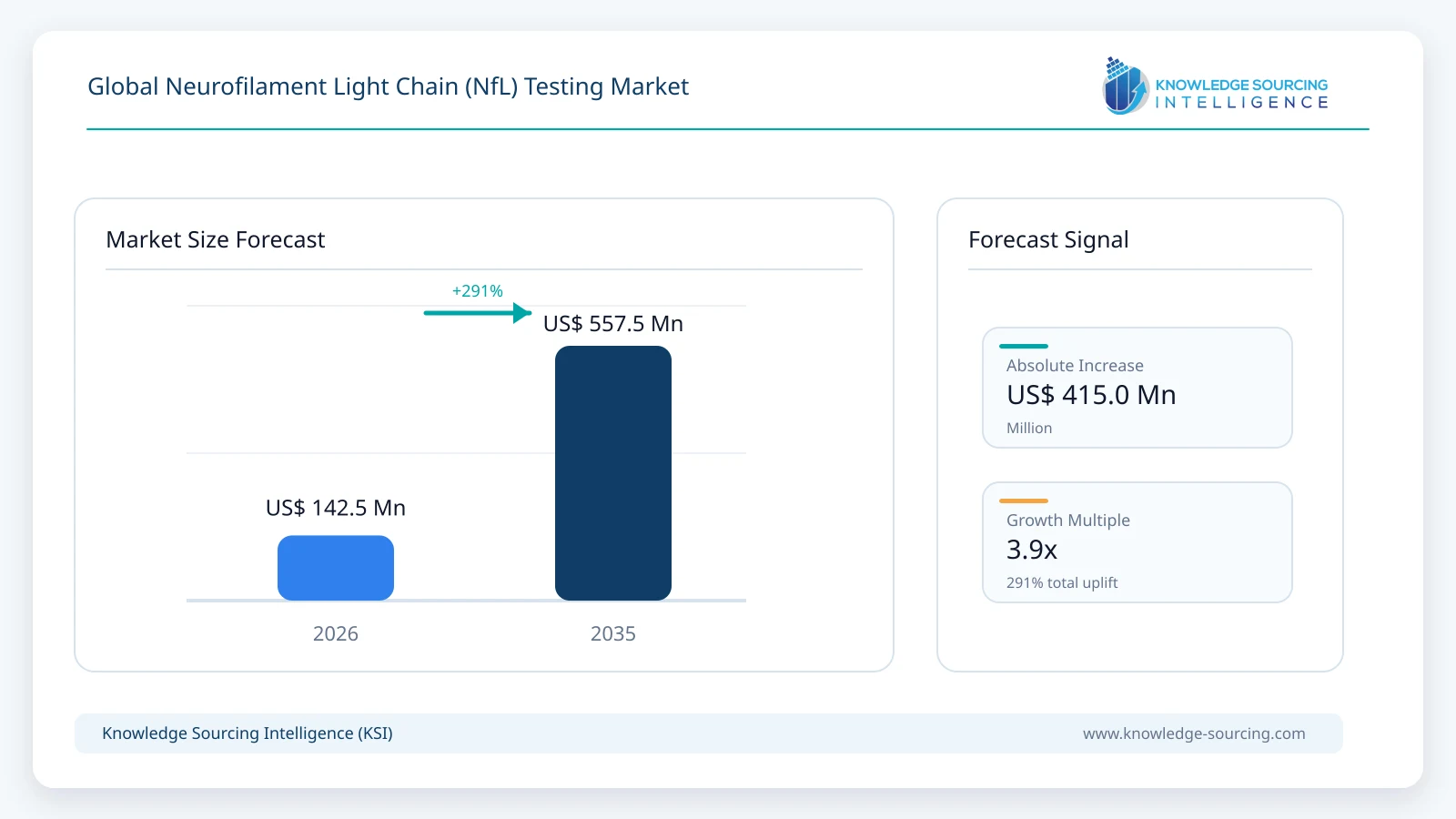
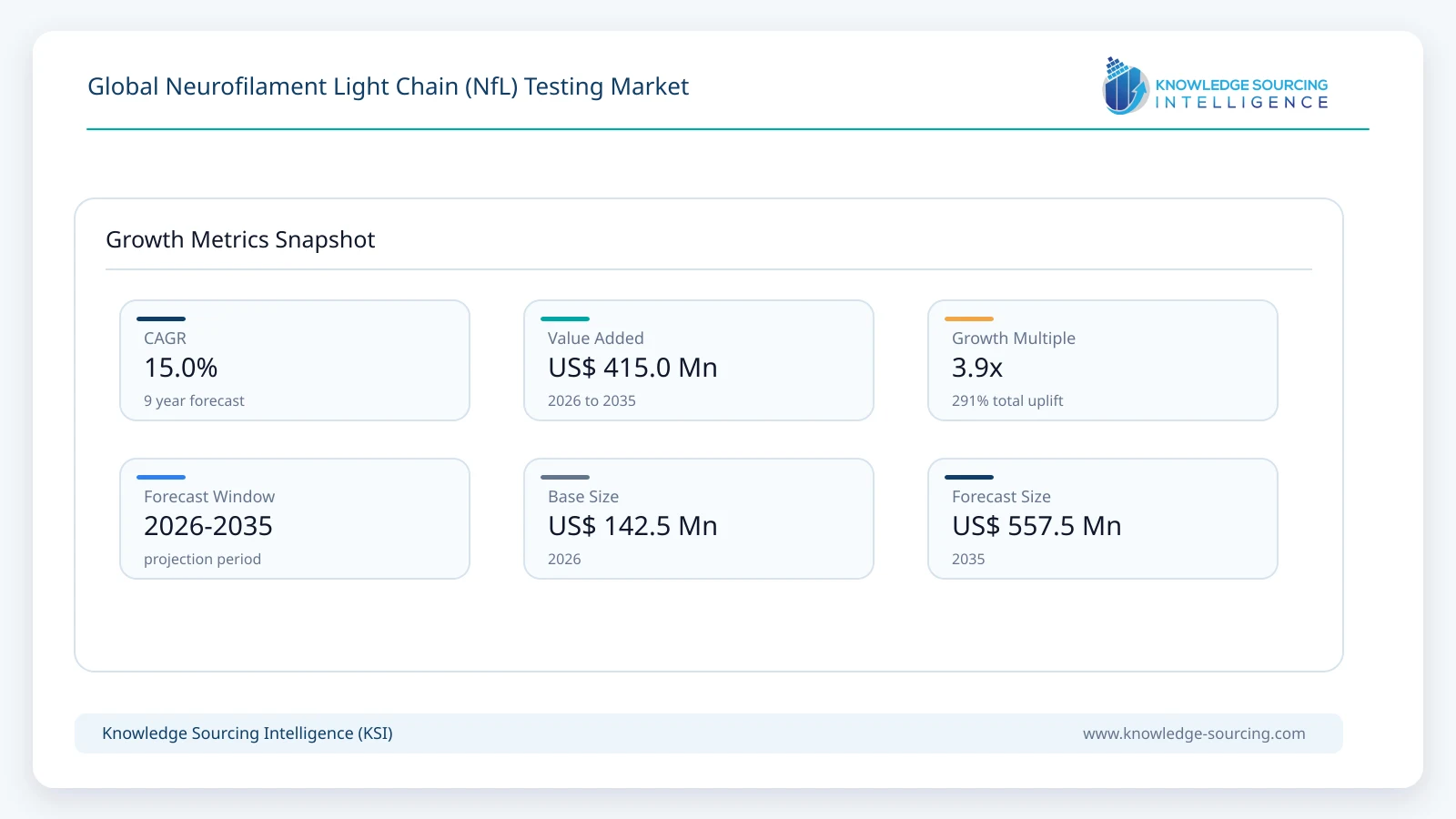
The Global Neurofilament Light Chain (NfL) Testing Market is forecast to grow at a CAGR of 15.0%, reaching USD 557.50 million in 2035 from USD 142.5 million in 2026.
Highlights:
- 1Rising neurodegenerative disease prevalence is increasing demand for longitudinal biomarker monitoring platforms that support earlier intervention strategies.
- 2Pharmaceutical companies are expanding NfL integration into clinical trials because biological response tracking improves therapy development efficiency.
- 3Blood-based testing adoption is reducing dependence on invasive cerebrospinal fluid procedures, which is improving testing accessibility across outpatient settings.
- 4Ultra-sensitive immunoassay technologies are gaining adoption because neurological biomarkers require low-concentration detection capabilities.
The NfL testing market functions as a biomarker-driven neurological diagnostics segment focused on detecting axonal injury and neurodegeneration through measurable neurofilament protein concentrations. Demand is increasing because healthcare systems are prioritizing earlier neurological intervention models that reduce long-term disability costs and improve disease progression management. Neurology departments are integrating biomarker-supported monitoring because imaging-based disease tracking alone creates delayed clinical visibility across progressive neurological disorders.
Clinical dependency on sensitive neurological biomarkers is expanding because disease-modifying therapies require measurable indicators capable of tracking treatment effectiveness over time. Pharmaceutical companies are increasing biomarker integration within clinical trials because regulators are requiring stronger biological evidence supporting therapeutic efficacy. This pressure is strengthening demand for standardized assay technologies capable of reproducible longitudinal measurement across clinical environments.
Government-funded neurological research programs are supporting biomarker validation studies because aging populations are increasing neurodegenerative disease prevalence globally. Academic institutions and diagnostic manufacturers are collaborating to establish reference ranges, disease progression thresholds, and real-world validation datasets. This ecosystem is increasing the strategic importance of NfL testing as neurological care models transition toward precision medicine frameworks.
Market Dynamics
Market Drivers
Increasing Neurodegenerative Disease Burden: Neurological disorders remain a major healthcare burden because aging populations are increasing susceptibility to neurodegenerative disease progression. Healthcare systems are expanding neurological monitoring programs because delayed diagnosis increases long-term disability management costs. This pressure is increasing demand for scalable biomarker-based diagnostics capable of identifying neuronal damage before irreversible progression occurs. Diagnostic manufacturers are investing in high-sensitivity assay platforms because clinicians require measurable disease activity indicators across chronic neurological conditions. The market consequently supports wider integration of NfL testing within neurological disease management pathways.
Expansion of Precision Neurology Approaches: Precision medicine frameworks are reshaping neurological disease management because treatment response variability limits standardized therapeutic effectiveness. Pharmaceutical companies are integrating biomarker-driven patient stratification models because targeted therapies require measurable biological differentiation between patient populations. Neurology clinics are adopting longitudinal biomarker monitoring because individualized disease progression tracking improves treatment optimization. This transition is increasing demand for reproducible NfL testing platforms capable of supporting personalized therapeutic decision-making. The market therefore benefits from expanding precision neurology infrastructure.
Growth in Neurology Clinical Trials: Neurology-focused drug development activity is increasing because pharmaceutical pipelines are targeting progressive neurological diseases with limited treatment options. Clinical trial sponsors are incorporating NfL endpoints because regulators and payers require objective biological evidence supporting therapeutic outcomes. Research institutions are standardizing biomarker assessment methodologies because multicenter trial consistency remains critical for data reliability. This environment is increasing demand for validated ultra-sensitive testing technologies and centralized laboratory capabilities. The market consequently gains structural support from expanding biomarker-driven neurological research activity.
Market Restraints
Lack of universal clinical standardization limits cross-platform comparability, which constrains broad reimbursement adoption.
Neurological biomarker interpretation variability increases dependency on specialist expertise and restricts testing scalability across general healthcare environments.
High-sensitivity assay infrastructure requirements increase operational costs, which limits accessibility in resource-constrained healthcare systems.
Market Opportunities
Expansion into Alzheimer’s Disease Monitoring: Alzheimer’s disease management increasingly depends on biomarker-supported detection because cognitive symptom manifestation often occurs after extensive neuronal damage develops. Research organizations are expanding longitudinal neurodegeneration studies because earlier disease visibility improves therapeutic intervention potential. Diagnostic firms are integrating NfL with broader neurodegenerative biomarker panels because multi-marker approaches improve disease differentiation accuracy. This transition is increasing commercial opportunities across memory clinics and neurodegenerative disease centers. The market consequently gains long-term growth potential from expanding dementia-focused diagnostics adoption.
Integration into Traumatic Brain Injury Assessment: Traumatic brain injury monitoring requires objective neuronal damage indicators because imaging-based assessments frequently fail to capture subtle neurological injury progression. Sports medicine programs and emergency care providers are evaluating blood-based neurological biomarkers because rapid neurological assessment improves patient management decisions. Diagnostic developers are validating acute injury applications because military and sports-related neurological monitoring demand is increasing. This environment is expanding commercial opportunities for rapid neurological injury assessment platforms. The market therefore benefits from widening neurological monitoring applications beyond chronic neurodegenerative disease management.
Development of Multiplex Neurology Panels: Neurological disorders often demonstrate overlapping symptoms because neurodegenerative pathways share inflammatory and axonal injury mechanisms. Diagnostic manufacturers are developing multiplex biomarker panels because clinicians require broader neurological profiling capabilities. Research collaborations are expanding biomarker combinations because integrated datasets improve disease differentiation accuracy and longitudinal monitoring precision. This technological direction is increasing demand for scalable immunoassay platforms capable of supporting multi-analyte testing. The market consequently supports innovation across integrated neurological diagnostics ecosystems.
Supply Chain Analysis
The NfL testing supply chain depends on specialized assay reagent manufacturing, high-sensitivity instrumentation development, laboratory integration services, and neurological research partnerships. Diagnostic companies maintain strong dependency on antibody production quality because assay sensitivity directly affects low-concentration biomarker detection accuracy. Raw material suppliers are strengthening biologics manufacturing capabilities because ultra-sensitive immunoassays require high-purity reagents and standardized calibration materials.
Instrument manufacturers are expanding automated immunoassay capabilities because clinical laboratories require scalable workflows capable of supporting larger neurological testing volumes. Centralized laboratories are increasing adoption of advanced biomarker platforms because neurological clinical trials require standardized multicenter testing consistency. This concentration of testing capability within specialized laboratories continues supporting operational efficiency while simultaneously constraining broader decentralized adoption.
Academic institutions and neurological research centers remain critical within the supply chain because clinical validation datasets directly influence commercial adoption and regulatory acceptance. Pharmaceutical companies are strengthening collaborations with biomarker developers because neurological drug development increasingly depends on measurable biological endpoints. This interconnected ecosystem is creating a supply chain structure where assay innovation, clinical validation, and therapeutic development remain operationally dependent on one another.
Government Regulations
Region | Regulatory Focus | Market Impact |
United States | FDA oversight for in vitro diagnostic devices and laboratory-developed tests | Increases validation requirements for clinical NfL assay commercialization |
European Union | IVDR implementation for diagnostic performance and post-market surveillance | Expands compliance burden while strengthening clinical reliability standards |
Japan | PMDA review of advanced diagnostic technologies | Supports controlled adoption of neurology-focused biomarker assays |
China | NMPA regulatory expansion for advanced diagnostics | Encourages localization and regional clinical validation activities |
Canada | Health Canada diagnostic approval pathways | Supports evidence-based neurological testing integration |
Market Segmentation
By Testing Type
Blood-based testing dominates emerging demand because healthcare systems are prioritizing scalable neurological monitoring approaches with lower procedural complexity. Hospitals and outpatient neurology centers are increasing blood-based biomarker utilization because repeated cerebrospinal fluid collection limits longitudinal monitoring frequency. Diagnostic companies are improving assay sensitivity because low-concentration biomarker detection remains essential for clinical reliability. Cerebrospinal fluid testing continues supporting high-specificity neurological research applications because specialized neurological centers require confirmatory biomarker analysis in complex disease investigations. This dual testing structure maintains clinical relevance while accelerating broader blood-based adoption across routine neurological workflows.
By Technology Platform
Single molecule array technologies maintain strong commercial positioning because neurological biomarkers require ultra-sensitive low-abundance protein detection capabilities. Research institutions and pharmaceutical companies are increasing Simoa platform adoption because neurological clinical trials require reproducible longitudinal measurement precision. ELISA and electrochemiluminescence technologies continue supporting broader laboratory accessibility because established immunodiagnostic workflows reduce operational transition barriers. Mass spectrometry applications are expanding within neurological research environments because multiplex biomarker profiling improves disease differentiation capabilities. This technological diversification is strengthening competition between sensitivity optimization and operational scalability.
By Application
Multiple sclerosis remains a major application area because disease progression monitoring increasingly depends on measurable neuronal injury indicators. Alzheimer’s disease testing demand is expanding because neurodegenerative disease management is shifting toward earlier biomarker-supported intervention strategies. Parkinson’s disease and ALS research programs are increasing biomarker integration because treatment development requires objective neurological progression assessment. Traumatic brain injury applications are gaining momentum because emergency neurological evaluation workflows require rapid injury assessment tools. This widening application range is strengthening the strategic importance of NfL testing across chronic and acute neurological care pathways.
Regional Analysis
North America Market Analysis
North America maintains leadership within the NfL testing market because neurological biomarker research infrastructure remains highly developed across the United States and Canada. Academic medical centers are increasing biomarker validation activities because neurodegenerative disease prevalence continues expanding within aging populations. Pharmaceutical companies are integrating NfL endpoints into neurological clinical trials because regulators and payers require measurable evidence supporting therapeutic efficacy. This transition is increasing demand for standardized high-sensitivity immunoassay platforms across research and clinical environments.
Europe Market Analysis
Europe demonstrates strong market momentum because neurological disease management increasingly aligns with precision medicine initiatives across public healthcare systems. Research consortia and university hospitals are expanding neurodegenerative disease biomarker studies because aging demographics are increasing long-term neurological care burdens. Diagnostic firms are strengthening regional clinical collaborations because IVDR implementation requires extensive performance validation and post-market evidence generation. This regulatory transition is increasing demand for clinically standardized biomarker platforms.
Multiple sclerosis monitoring remains a major regional growth driver because European neurological research networks maintain extensive disease registry infrastructure. Pharmaceutical companies are integrating NfL biomarkers into therapeutic monitoring frameworks because biological disease activity assessment improves treatment optimization strategies. Hospitals are adopting advanced immunoassay technologies because earlier neurological intervention reduces long-term disability management costs. This demand shift is supporting investment into scalable laboratory automation and standardized biomarker workflows.
Asia Pacific Market Analysis
Asia Pacific is emerging as a high-growth region because neurological disease awareness and healthcare infrastructure investment are increasing simultaneously. Urban healthcare systems are expanding neurology-focused diagnostic capabilities because aging populations are increasing neurodegenerative disease prevalence across China, Japan, South Korea, and Australia. Academic institutions are strengthening neurological biomarker research because early disease detection remains a strategic healthcare priority. This transition is increasing adoption of advanced immunoassay technologies across tertiary care hospitals and research laboratories.
Government-backed healthcare modernization programs are improving access to advanced diagnostics because chronic disease management costs continue rising across densely populated economies. Diagnostic manufacturers are expanding regional partnerships because local clinical validation and distribution capabilities remain necessary for market penetration. Blood-based testing adoption is increasing because healthcare providers require scalable neurological monitoring solutions suitable for large patient populations. This shift is supporting demand for automated high-throughput laboratory systems.
Rest of the World
The Rest of the World region demonstrates gradual market expansion because neurological disease diagnosis and monitoring capabilities remain uneven across developing healthcare systems. Latin American and Middle Eastern tertiary hospitals are increasing adoption of advanced neurological diagnostics because specialist neurology services are expanding within urban healthcare centers. Academic research partnerships are strengthening because regional healthcare institutions require access to validated biomarker technologies. This transition is improving awareness surrounding blood-based neurological monitoring applications.
Healthcare infrastructure limitations continue to constrain large-scale adoption because high-sensitivity immunoassay platforms require specialized laboratory capabilities and trained personnel. Governments and private healthcare providers are investing in centralized diagnostic laboratories because advanced biomarker testing remains operationally concentrated within major metropolitan healthcare facilities. Diagnostic companies are pursuing regional distributors and academic collaborations because localized support improves commercial sustainability. This environment is increasing demand for scalable and operationally simplified testing workflows.
Regulatory Landscape
Regulatory oversight within the NfL testing market is intensifying because neurological biomarkers increasingly influence therapeutic decision-making and longitudinal disease monitoring. Regulatory agencies are strengthening analytical validation expectations because cross-platform assay variability continues constraining broad clinical standardization. Diagnostic manufacturers are expanding multicenter validation studies because reproducibility and longitudinal consistency remain critical for clinical adoption. This environment is increasing operational pressure on companies developing high-sensitivity neurological assays.
The European Union IVDR framework is reshaping commercialization strategies because post-market evidence generation requirements are increasing substantially. Diagnostic firms are strengthening clinical documentation and surveillance capabilities because compliance complexity directly influences regional market access. United States regulatory agencies continue evaluating laboratory-developed tests and advanced diagnostic platforms because biomarker-driven precision medicine applications are expanding rapidly. This regulatory tightening is improving clinical confidence while increasing commercialization timelines.
Global harmonization challenges continue affecting market scalability because neurological biomarker interpretation standards remain inconsistent across regions. Academic institutions and industry groups are increasing collaborative standardization initiatives because broader reimbursement adoption requires clinically aligned evidence frameworks. This regulatory evolution supports long-term market credibility while maintaining elevated entry barriers for smaller diagnostic developers.
Pipeline Analysis
Neurology-focused therapeutic pipelines are increasing demand for biomarker-supported monitoring because disease-modifying therapies require objective biological response indicators. Pharmaceutical companies are integrating NfL endpoints within multiple sclerosis, ALS, and Alzheimer’s disease trials because clinical outcome measures alone provide delayed visibility into therapeutic effectiveness. Research organizations are strengthening biomarker validation programs because regulatory authorities increasingly expect biological evidence supporting neurological treatment efficacy.
Blood-based biomarker integration is accelerating within neurological pipelines because minimally invasive monitoring improves patient retention and longitudinal data collection consistency. Diagnostic firms are developing higher-sensitivity assays because expanding therapeutic pipelines require scalable biomarker assessment across multicenter trials. Academic institutions are generating disease progression datasets because therapeutic developers require baseline variability understanding across diverse patient populations. This interaction between therapeutic development and biomarker innovation continues reinforcing commercial demand for advanced NfL testing technologies.
Pipeline diversification across neurodegenerative and acute neurological injury applications is broadening long-term market potential because biomarker-supported disease monitoring extends beyond chronic neurological disorders. Companies are evaluating multiplex neurological panels because integrated biomarker approaches improve disease differentiation and treatment-response tracking. This expansion of biomarker-enabled neurology research supports sustained innovation throughout the NfL testing ecosystem.
Competitive Landscape
Quanterix Corporation
Quanterix Corporation maintains strategic distinction through ultra-sensitive Simoa technology platforms that support low-concentration neurological biomarker detection across research and clinical environments. The company continues expanding neurological collaborations because pharmaceutical developers and academic institutions require reproducible longitudinal biomarker assessment capabilities. Demand for blood-based neurological testing is increasing adoption of the Simoa HD-X platform because minimally invasive monitoring requires extremely high assay sensitivity. Quanterix is strengthening neurological disease validation studies because broader reimbursement and clinical integration depend on multicenter evidence generation. This positioning reinforces the company’s leadership within advanced neuro biomarker testing infrastructure.
Roche Diagnostics
Roche Diagnostics maintains competitive strength through integrated immunodiagnostic platforms and large-scale clinical laboratory presence. The company is expanding neurodegenerative biomarker development because precision neurology demand is increasing across hospital and specialty laboratory environments. Elecsys neurological assays support broader laboratory integration because established automated workflows improve operational scalability. Roche continues strengthening research partnerships because neurological biomarker standardization remains critical for global commercialization. This strategy positions the company to expand within regulated clinical neurology diagnostics markets.
Siemens Healthineers
Siemens Healthineers leverages broad diagnostic infrastructure and automation capabilities to strengthen neurological biomarker testing integration. Healthcare systems are increasing demand for scalable laboratory workflows because neurological disease monitoring volumes continue rising. The company is enhancing immunoassay platform capabilities because advanced biomarker applications require operational consistency and throughput efficiency. Research collaborations remain strategically important because assay validation and clinical utility evidence influence long-term adoption. This operational scale supports Siemens Healthineers’ competitive positioning across hospital-based neurological diagnostics.
Abbott Laboratories
Abbott Laboratories maintains strategic relevance through diversified diagnostic capabilities and strong hospital penetration across global healthcare systems. Neurological biomarker research activity is increasing because precision medicine initiatives are reshaping chronic disease management. Abbott is strengthening biomarker-focused collaborations because neurological disease monitoring increasingly depends on scalable laboratory diagnostics. The company continues evaluating advanced immunodiagnostic applications because healthcare providers require accessible testing workflows compatible with existing clinical infrastructure. This approach supports gradual expansion within neurological diagnostics.
Thermo Fisher Scientific Inc.
Thermo Fisher Scientific Inc. supports the NfL testing ecosystem through research technologies, immunoassay solutions, and laboratory infrastructure capabilities. Pharmaceutical and academic research demand is increasing because neurological biomarker validation requires high-throughput analytical support. The company is expanding neuro biomarker research tools because therapeutic developers require standardized assay environments across multicenter studies. Strategic collaborations continue strengthening the company’s presence because integrated laboratory workflows improve operational efficiency for neurological research organizations. This broad scientific infrastructure positions Thermo Fisher as a major enabler of neurological biomarker innovation.
Key Developments
April 2026: Roche receives CE mark for new Elecsys NfL blood test to detect neuroinflammation in multiple sclerosis
March 2026: Fujirebio announces CE Marking of the fully automated Lumipulse® G Nfl blood assay
November 2025: Quanterix announces landmark study demonstrating dual GFAP/NfL blood test approach for personalized multiple sclerosis monitoring
Strategic Insights and Future Market Outlook
The NfL testing market is transitioning toward clinically integrated neurological monitoring because healthcare systems increasingly prioritize earlier intervention and longitudinal disease management. Blood-based biomarker adoption is accelerating because minimally invasive testing improves patient accessibility and monitoring continuity across chronic neurological conditions. Pharmaceutical developers are increasing biomarker dependence because neurological therapeutic pipelines require objective disease activity measurement for regulatory and commercial validation. This interaction between therapeutics and diagnostics continues reshaping the market toward precision neurology ecosystems.
Technological competition is intensifying because assay sensitivity, automation scalability, and clinical reproducibility collectively determine long-term commercial positioning. Diagnostic companies are strengthening academic and pharmaceutical collaborations because multicenter validation remains essential for reimbursement expansion and regulatory alignment. Regulatory agencies are increasing oversight because biomarker-supported treatment decisions require stronger analytical consistency. This environment favors companies capable of combining scientific validation, operational scalability, and clinical integration capabilities.
Emerging healthcare regions are creating additional growth opportunities because neurological disease awareness and healthcare modernization initiatives continue expanding. Companies are localizing commercialization strategies because regional validation and distribution partnerships improve long-term adoption sustainability. Multiplex neurological biomarker development is likely to influence future competitive differentiation because integrated neurodegenerative profiling improves disease stratification and therapeutic monitoring precision. The market therefore remains positioned for long-term structural expansion driven by precision neurology transformation.
Neurofilament Light Chain (NfL) Testing Market Scope:
| Report Metric | Details |
|---|---|
| Total Market Size in 2026 | USD 142.5 million |
| Total Market Size in 2035 | USD 557.50 million |
| Forecast Unit | USD Million |
| Growth Rate | 15.0% |
| Study Period | 2021 to 2035 |
| Historical Data | 2021 to 2024 |
| Base Year | 2025 |
| Forecast Period | 2026 – 2035 |
| Segmentation | Testing Type, Technology, Clinical Application, Geography |
| Companies |
|
Market Segmentation
By Geography
Key Countries Analysis
Regulatory & Policy Landscape
Table of Contents
1. EXECUTIVE SUMMARY
1.1 Market Snapshot
1.1.1 Definition of Neurofilament Light Chain (NfL) Testing
1.1.2 Scope of the Global NfL Testing Market
1.1.3 Key Applications of NfL Biomarker Testing
1.1.4 Market Evolution and Technology Advancements
1.1.5 Key Market Highlights
1.1.6 Analyst Insights and Strategic Recommendations
1.2 Executive Overview
1.2.1 Market Size and Forecast Summary
1.2.2 Key Growth Drivers
1.2.3 Major Challenges and Limitations
1.2.4 Emerging Commercial Opportunities
1.2.5 Competitive Positioning Overview
2. DISEASE & EPIDEMIOLOGY ANALYSIS
2.1 Overview of Neurodegenerative and Neurological Disorders
2.1.1 Clinical Importance of Axonal Damage Biomarkers
2.1.2 Role of NfL in Neurological Disease Monitoring
2.1.3 Biomarker Utility in Disease Progression Assessment
2.2 Epidemiology of Major Neurological Disorders Associated with NfL Testing
2.2.1 Multiple Sclerosis (MS)
2.2.1.1 Prevalence and Incidence
2.2.1.2 Relapsing and Progressive MS Burden
2.2.1.3 Patient Population Eligible for Biomarker Monitoring
2.2.2 Alzheimer’s Disease
2.2.2.1 Disease Burden and Aging Population Impact
2.2.2.2 Mild Cognitive Impairment (MCI) Population
2.2.2.3 Neurodegeneration Biomarker Trends
2.2.3 Parkinson’s Disease
2.2.3.1 Epidemiological Overview
2.2.3.2 Disease Progression Assessment Needs
2.2.4 Amyotrophic Lateral Sclerosis (ALS)
2.2.4.1 Incidence and Mortality Trends
2.2.4.2 Biomarker-Based Disease Monitoring Demand
2.2.5 Traumatic Brain Injury (TBI)
2.2.5.1 Acute and Chronic TBI Burden
2.2.5.2 Sports-Related and Military Brain Injury Trends
2.2.6 Spinal Cord Injury
2.2.6.1 Injury Incidence and Disability Burden
2.2.6.2 Neuroaxonal Damage Monitoring
2.2.7 Other Neurological Disorders
2.2.7.1 Huntington’s Disease
2.2.7.2 Frontotemporal Dementia
2.2.7.3 Peripheral Neuropathies
2.2.7.4 Stroke and Neuroinflammatory Disorders
2.3 Biomarker Epidemiology and Testing Trends
2.3.1 Adoption of Blood-Based Neurological Biomarkers
2.3.2 Shift from CSF to Minimally Invasive Testing
2.3.3 Biomarker Screening Trends in Clinical Research
3. MARKET DYNAMICS
3.1 Market Drivers
3.1.1 Rising Burden of Neurodegenerative Disorders
3.1.2 Growing Demand for Early Diagnosis
3.1.3 Increasing Adoption of Precision Neurology
3.1.4 Expansion of Biomarker-Based Clinical Trials
3.1.5 Advancements in Ultra-Sensitive Immunoassay Platforms
3.1.6 Growing Use of Blood-Based Biomarkers
3.2 Market Restraints
3.2.1 Limited Standardization Across Assays
3.2.2 Variability in Clinical Interpretation
3.2.3 High Cost of Advanced Testing Platforms
3.2.4 Limited Reimbursement Coverage
3.2.5 Regulatory and Validation Challenges
3.3 Market Opportunities
3.3.1 Integration into Routine Neurology Practice
3.3.2 Expansion in Alzheimer’s Diagnostics
3.3.3 Companion Diagnostic Development
3.3.4 AI-Integrated Biomarker Analytics
3.3.5 Emerging Markets Expansion
3.4 Market Challenges
3.4.1 Cross-Platform Analytical Variability
3.4.2 Limited Clinical Awareness in Developing Regions
3.4.3 Ethical and Data Interpretation Concerns
3.4.4 Laboratory Infrastructure Constraints
3.5 Porter’s Five Forces Analysis
3.5.1 Bargaining Power of Suppliers
3.5.2 Bargaining Power of Buyers
3.5.3 Threat of New Entrants
3.5.4 Threat of Substitute Technologies
3.5.5 Competitive Rivalry
3.6 PESTLE Analysis
3.6.1 Political Factors
3.6.2 Economic Factors
3.6.3 Social Factors
3.6.4 Technological Factors
3.6.5 Legal Factors
3.6.6 Environmental Factors
4. COMMERCIAL & MARKET ACCESS
4.1 Commercialization Landscape
4.1.1 Commercially Available NfL Testing Platforms
4.1.2 Laboratory-Developed Tests (LDTs)
4.1.3 Centralized vs Decentralized Testing Models
4.2 Reimbursement Landscape
4.2.1 Public Reimbursement Trends
4.2.2 Private Payer Coverage
4.2.3 Coding and Billing Challenges
4.2.4 Health Economic Value of Biomarker Testing
4.3 Pricing Analysis
4.3.1 Assay Pricing Trends
4.3.2 Platform-Based Cost Analysis
4.3.3 Cost Comparison Between Blood and CSF Testing
4.4 Stakeholder Analysis
4.4.1 Diagnostic Laboratories
4.4.2 Neurologists and Specialty Clinics
4.4.3 Academic Research Institutions
4.4.4 Biopharmaceutical Companies
4.4.5 Contract Research Organizations (CROs)
4.5 Market Access Challenges
4.5.1 Clinical Utility Validation
4.5.2 Regulatory Approval Pathways
4.5.3 Reimbursement Barriers
4.5.4 Regional Commercialization Differences
5. INNOVATION & PIPELINE LANDSCAPE
5.1 Innovation Overview
5.1.1 Evolution of Neuro Biomarker Technologies
5.1.2 Advances in Ultra-Sensitive Detection Methods
5.1.3 Multiplex Neurological Biomarker Assays
5.1.4 Digital Biomarker Integration
5.2 Pipeline Assay and Diagnostic Development Landscape
5.2.1 Early-Stage Biomarker Assays
5.2.2 Clinical Validation Studies
5.2.3 Emerging Blood-Based Neurology Panels
5.2.4 Biomarker Combination Strategies
5.3 Technology Platform Analysis
5.3.1 Single Molecule Array (Simoa) Technology
5.3.2 Electrochemiluminescence Immunoassays
5.3.3 Mass Spectrometry-Based Biomarker Detection
5.3.4 Automated High-Throughput Platforms
5.3.5 Point-of-Care Neurology Diagnostics
5.4 Clinical Trial Landscape
5.4.1 NfL Use in Neurodegenerative Disease Trials
5.4.2 NfL as a Pharmacodynamic Biomarker
5.4.3 Biomarker-Guided Drug Development
5.4.4 Academic and Industry Collaborations
5.5 Patent and Intellectual Property Analysis
5.5.1 Biomarker Assay Patents
5.5.2 Technology Licensing Trends
5.5.3 Strategic Collaborations and Partnerships
6. TREATMENT LANDSCAPE
6.1 Role of NfL Testing in Clinical Decision-Making
6.1.1 Disease Monitoring Applications
6.1.2 Treatment Response Assessment
6.1.3 Prognostic Applications
6.2 NfL Testing in Multiple Sclerosis Management
6.2.1 Monitoring Disease Activity
6.2.2 Assessing Therapeutic Response
6.2.3 Treatment Escalation Decision Support
6.3 NfL Testing in Alzheimer’s Disease
6.3.1 Early Detection Strategies
6.3.2 Cognitive Decline Monitoring
6.3.3 Integration with Amyloid and Tau Biomarkers
6.4 NfL Testing in ALS and Other Rapid Neurodegenerative Diseases
6.4.1 Prognostic Value
6.4.2 Disease Severity Monitoring
6.4.3 Clinical Trial Endpoint Utility
6.5 NfL Testing in Traumatic Brain Injury
6.5.1 Acute Injury Assessment
6.5.2 Long-Term Neurological Monitoring
6.5.3 Sports Medicine Applications
6.6 Emerging Clinical Applications
6.6.1 Pediatric Neurology
6.6.2 Neuro-Oncology
6.6.3 Autoimmune Neurological Disorders
6.6.4 Critical Care Neurology
7. MARKET SIZE & FORECAST
7.1 Global Market Overview
7.1.1 Historical Market Analysis
7.1.2 Current Market Size Estimation
7.1.3 Forecast Methodology
7.1.4 Market Forecast Summary
7.2 Market Forecast by Testing Type
7.2.1 Blood-Based NfL Testing
7.2.2 Cerebrospinal Fluid (CSF)-Based NfL Testing
7.3 Market Forecast by Technology Platform
7.3.1 Simoa-Based Testing
7.3.2 ELISA-Based Testing
7.3.3 Electrochemiluminescence Assays
7.3.4 Other Advanced Platforms
7.4 Market Forecast by Application
7.4.1 Multiple Sclerosis
7.4.2 Alzheimer’s Disease
7.4.3 Parkinson’s Disease
7.4.4 ALS
7.4.5 Traumatic Brain Injury
7.4.6 Other Neurological Disorders
7.5 Market Forecast by End User
7.5.1 Hospitals
7.5.2 Specialty Neurology Clinics
7.5.3 Diagnostic Laboratories
7.5.4 Academic and Research Institutes
7.5.5 Pharmaceutical and Biotechnology Companies
8. MARKET SEGMENTATION
8.1 By Testing Type
8.1.1 Blood-Based Testing
8.1.2 CSF-Based Testing
8.2 By Technology Platform
8.2.1 Single Molecule Array (Simoa)
8.2.2 ELISA
8.2.3 Electrochemiluminescence Immunoassays
8.2.4 Mass Spectrometry
8.2.5 Other Technologies
8.3 By Application
8.3.1 Multiple Sclerosis
8.3.2 Alzheimer’s Disease
8.3.3 Parkinson’s Disease
8.3.4 ALS
8.3.5 Traumatic Brain Injury
8.3.6 Spinal Cord Injury
8.3.7 Other Neurological Disorders
8.4 By End User
8.4.1 Hospitals
8.4.2 Diagnostic Laboratories
8.4.3 Specialty Clinics
8.4.4 Academic Research Institutes
8.4.5 Biopharmaceutical Companies
8.5 By Distribution Model
8.5.1 Centralized Laboratory Testing
8.5.2 Decentralized Testing
8.5.3 Research-Use-Only (RUO) Assays
8.5.4 Commercial Clinical Testing Services
9. GEOGRAPHICAL ANALYSIS
9.1 North America
9.1.1 Market Size and Forecast
9.1.2 Neurological Disease Burden
9.1.3 Regional Regulatory Overview
9.1.4 Reimbursement Trends
9.1.5 Competitive Landscape
9.2 Europe
9.2.1 Market Size and Forecast
9.2.2 Biomarker Adoption Trends
9.2.3 Regional Regulatory Environment
9.2.4 Research Collaborations and Funding
9.2.5 Competitive Landscape
9.3 Asia-Pacific
9.3.1 Market Size and Forecast
9.3.2 Expanding Neurology Diagnostics Infrastructure
9.3.3 Regional Regulatory Landscape
9.3.4 Investment and Innovation Trends
9.3.5 Competitive Landscape
9.4 Latin America
9.4.1 Market Size and Forecast
9.4.2 Healthcare Infrastructure Development
9.4.3 Regulatory and Reimbursement Trends
9.4.4 Competitive Landscape
9.5 Middle East & Africa
9.5.1 Market Size and Forecast
9.5.2 Diagnostic Accessibility Trends
9.5.3 Regulatory Environment
9.5.4 Competitive Landscape
10. KEY COUNTRIES ANALYSIS
10.1 United States
10.1.1 Market Size and Forecast
10.1.2 Neurological Disease Epidemiology
10.1.3 FDA Regulatory Framework
10.1.4 Reimbursement Scenario
10.1.5 Key Companies and Product Presence
10.2 Canada
10.2.1 Market Overview
10.2.2 Epidemiology Trends
10.2.3 Regulatory and Reimbursement Landscape
10.2.4 Competitive Presence
10.3 Germany
10.3.1 Market Overview
10.3.2 Neurology Diagnostics Adoption
10.3.3 Regulatory and Reimbursement Environment
10.3.4 Key Industry Participants
10.4 United Kingdom
10.4.1 Market Overview
10.4.2 NHS and Biomarker Adoption Trends
10.4.3 Regulatory Framework
10.4.4 Competitive Analysis
10.5 France
10.5.1 Market Overview
10.5.2 Neurological Disorder Burden
10.5.3 Regulatory and Reimbursement Analysis
10.5.4 Key Companies Presence
10.6 Italy
10.6.1 Market Overview
10.6.2 Clinical Research Trends
10.6.3 Regulatory Framework
10.6.4 Competitive Analysis
10.7 Spain
10.7.1 Market Overview
10.7.2 Biomarker Testing Adoption
10.7.3 Regulatory Analysis
10.7.4 Competitive Landscape
10.8 China
10.8.1 Market Overview
10.8.2 Neurological Disease Burden
10.8.3 NMPA Regulatory Framework
10.8.4 Local and International Market Participants
10.9 Japan
10.9.1 Market Overview
10.9.2 Aging Population Impact
10.9.3 PMDA Regulatory Framework
10.9.4 Competitive Analysis
10.10 India
10.10.1 Market Overview
10.10.2 Neurology Diagnostics Infrastructure
10.10.3 CDSCO Regulatory Framework
10.10.4 Competitive Presence
10.11 South Korea
10.11.1 Market Overview
10.11.2 Precision Diagnostics Trends
10.11.3 Regulatory Environment
10.11.4 Industry Analysis
10.12 Australia
10.12.1 Market Overview
10.12.2 Biomarker Research Trends
10.12.3 Regulatory and Reimbursement Framework
10.12.4 Competitive Analysis
10.13 Brazil
10.13.1 Market Overview
10.13.2 Neurological Disease Burden
10.13.3 Regulatory Environment
10.13.4 Competitive Landscape
10.14 Mexico
10.14.1 Market Overview
10.14.2 Diagnostic Accessibility Trends
10.14.3 Regulatory Framework
10.14.4 Competitive Analysis
10.15 Saudi Arabia
10.15.1 Market Overview
10.15.2 Healthcare Modernization Initiatives
10.15.3 Regulatory Environment
10.15.4 Competitive Landscape
10.16 South Africa
10.16.1 Market Overview
10.16.2 Neurology Diagnostics Accessibility
10.16.3 Regulatory Framework
10.16.4 Competitive Analysis
11. REGULATORY & POLICY LANDSCAPE
11.1 United States Regulatory Framework
11.1.1 FDA Oversight of Diagnostic Assays
11.1.2 Laboratory Developed Test (LDT) Regulations
11.1.3 Biomarker Qualification Programs
11.2 Europe Regulatory Framework
11.2.1 IVDR Compliance Requirements
11.2.2 CE Marking Pathways
11.2.3 EMA Biomarker Qualification
11.3 Japan Regulatory Framework
11.3.1 PMDA Approval Process
11.3.2 Companion Diagnostic Regulations
11.4 India Regulatory Framework
11.4.1 CDSCO Diagnostic Device Regulations
11.4.2 Import and Local Manufacturing Policies
11.5 China Regulatory Framework
11.5.1 NMPA Approval Requirements
11.5.2 Local Clinical Validation Requirements
11.6 Reimbursement and Health Policy Analysis
11.6.1 Public Reimbursement Policies
11.6.2 Private Insurance Coverage Trends
11.6.3 Health Technology Assessment (HTA) Considerations
11.7 Ethical and Data Governance Considerations
11.7.1 Patient Data Privacy
11.7.2 Biomarker Data Interpretation Standards
11.7.3 AI and Digital Health Compliance
12. COMPETITIVE LANDSCAPE
12.1 Market Competition Overview
12.1.1 Market Share Analysis
12.1.2 Competitive Benchmarking
12.1.3 Strategic Positioning
12.2 Strategic Developments
12.2.1 Collaborations and Partnerships
12.2.2 Mergers and Acquisitions
12.2.3 Licensing Agreements
12.2.4 Research Collaborations
12.3 Technology Competitiveness Analysis
12.3.1 Sensitivity and Specificity Comparison
12.3.2 Throughput and Automation Capabilities
12.3.3 Cost Competitiveness
12.4 Company Strategy Analysis
12.4.1 Expansion Strategies
12.4.2 Product Launch Strategies
12.4.3 Clinical Research Investments
12.4.4 Geographic Expansion Strategies
13. COMPANY PROFILES
13.1 Quanterix Corporation
13.1.1 Company Overview
13.1.2 NfL Testing Portfolio
13.1.2.1 Simoa NF-light Advantage Kit
13.1.2.2 Simoa HD-X Platform
13.1.3 Key Neurological Applications
13.1.4 Research and Clinical Collaborations
13.1.5 Strategic Developments
13.2 Roche Diagnostics
13.2.1 Company Overview
13.2.2 Neurology Biomarker Portfolio
13.2.2.1 Elecsys Neurofilament Light Chain Assays
13.2.3 Key Indications
13.2.4 Pipeline and Research Activities
13.2.5 Strategic Initiatives
13.3 Siemens Healthineers
13.3.1 Company Overview
13.3.2 Neurology Diagnostics Portfolio
13.3.3 Immunoassay Platform Capabilities
13.3.4 Research Collaborations
13.3.5 Strategic Developments
13.4 Abbott Laboratories
13.4.1 Company Overview
13.4.2 Neurology Diagnostic Capabilities
13.4.3 Biomarker Research Programs
13.4.4 Strategic Partnerships
13.4.5 Growth Strategies
13.5 Thermo Fisher Scientific Inc.
13.5.1 Company Overview
13.5.2 Neuro Biomarker Research Solutions
13.5.3 Immunoassay Technologies
13.5.4 Clinical Research Collaborations
13.5.5 Strategic Initiatives
13.6 Fujirebio
13.6.1 Company Overview
13.6.2 Neurology Biomarker Assay Portfolio
13.6.3 Neurodegenerative Disease Applications
13.6.4 Pipeline Development Activities
13.6.5 Strategic Collaborations
13.7 Bio-Techne Corporation
13.7.1 Company Overview
13.7.2 ProteinSimple and Biomarker Solutions
13.7.3 NfL Research Applications
13.7.4 Technology Innovations
13.7.5 Strategic Initiatives
13.8 Beckman Coulter Diagnostics
13.8.1 Company Overview
13.8.2 Immunodiagnostic Platform Portfolio
13.8.3 Neurology Testing Capabilities
13.8.4 Research Collaborations
13.8.5 Strategic Developments
13.9 Revvity, Inc.
13.9.1 Company Overview
13.9.2 Neuro Biomarker Testing Solutions
13.9.3 Clinical and Research Applications
13.9.4 Innovation Strategies
13.9.5 Strategic Outlook
13.10 Becton, Dickinson and Company (BD)
13.10.1 Company Overview
13.10.2 Diagnostic and Research Solutions
13.10.3 Neurology Biomarker Initiatives
13.10.4 Strategic Collaborations
13.10.5 Growth Strategies
14. FUTURE OUTLOOK
14.1 Future Market Trends
14.1.1 Expansion of Blood-Based Neurology Diagnostics
14.1.2 AI-Driven Biomarker Interpretation
14.1.3 Personalized Neurology Approaches
14.1.4 Home-Based and Point-of-Care Testing Potential
14.2 Emerging Opportunities
14.2.1 Expansion into Primary Care Screening
14.2.2 Integration into Drug Development Programs
14.2.3 Biomarker Panels and Multi-Analyte Testing
14.2.4 Emerging Market Penetration
14.3 Strategic Recommendations
14.3.1 Recommendations for Diagnostic Companies
14.3.2 Recommendations for Biopharmaceutical Companies
14.3.3 Recommendations for Healthcare Providers
14.3.4 Recommendations for Investors and Stakeholders
15. METHODOLOGY
15.1 Research Methodology Overview
15.1.1 Primary Research Methodology
15.1.2 Secondary Research Sources
15.1.3 Data Validation and Triangulation
15.2 Market Estimation Methodology
15.2.1 Top-Down Approach
15.2.2 Bottom-Up Approach
15.2.3 Forecasting Models
15.3 Epidemiology Modeling Methodology
15.3.1 Patient Population Estimation
15.3.2 Biomarker Adoption Modeling
15.3.3 Clinical Utilization Assumptions
15.4 Competitive Intelligence Methodology
15.4.1 Company Revenue Analysis
15.4.2 Product Benchmarking
15.4.3 Pipeline Validation Criteria
15.5 Assumptions and Limitations
15.5.1 Research Assumptions
15.5.2 Data Limitations
15.5.3 Disclaimer
Navigate
Trusted by the world's leading organizations











