
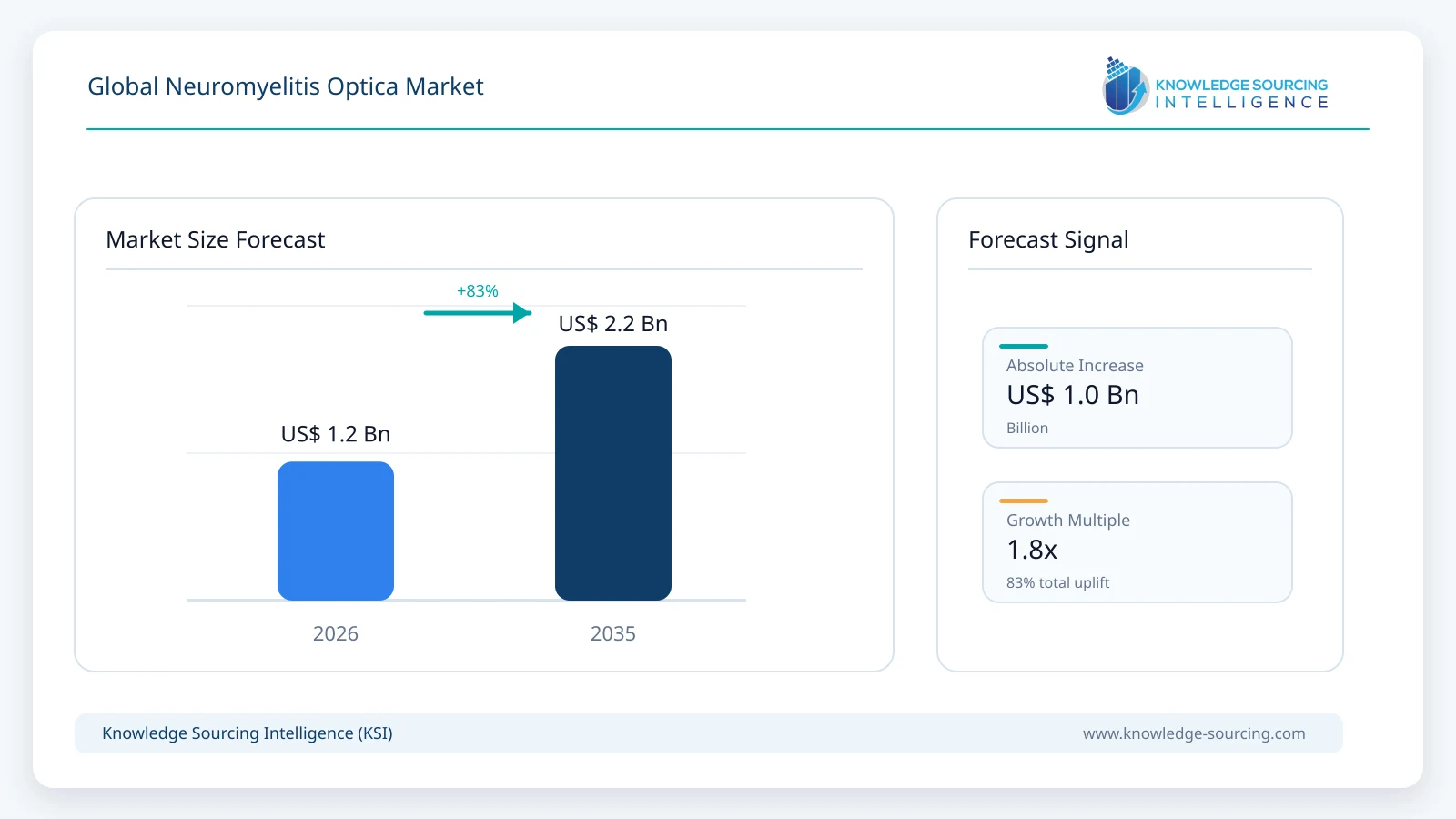
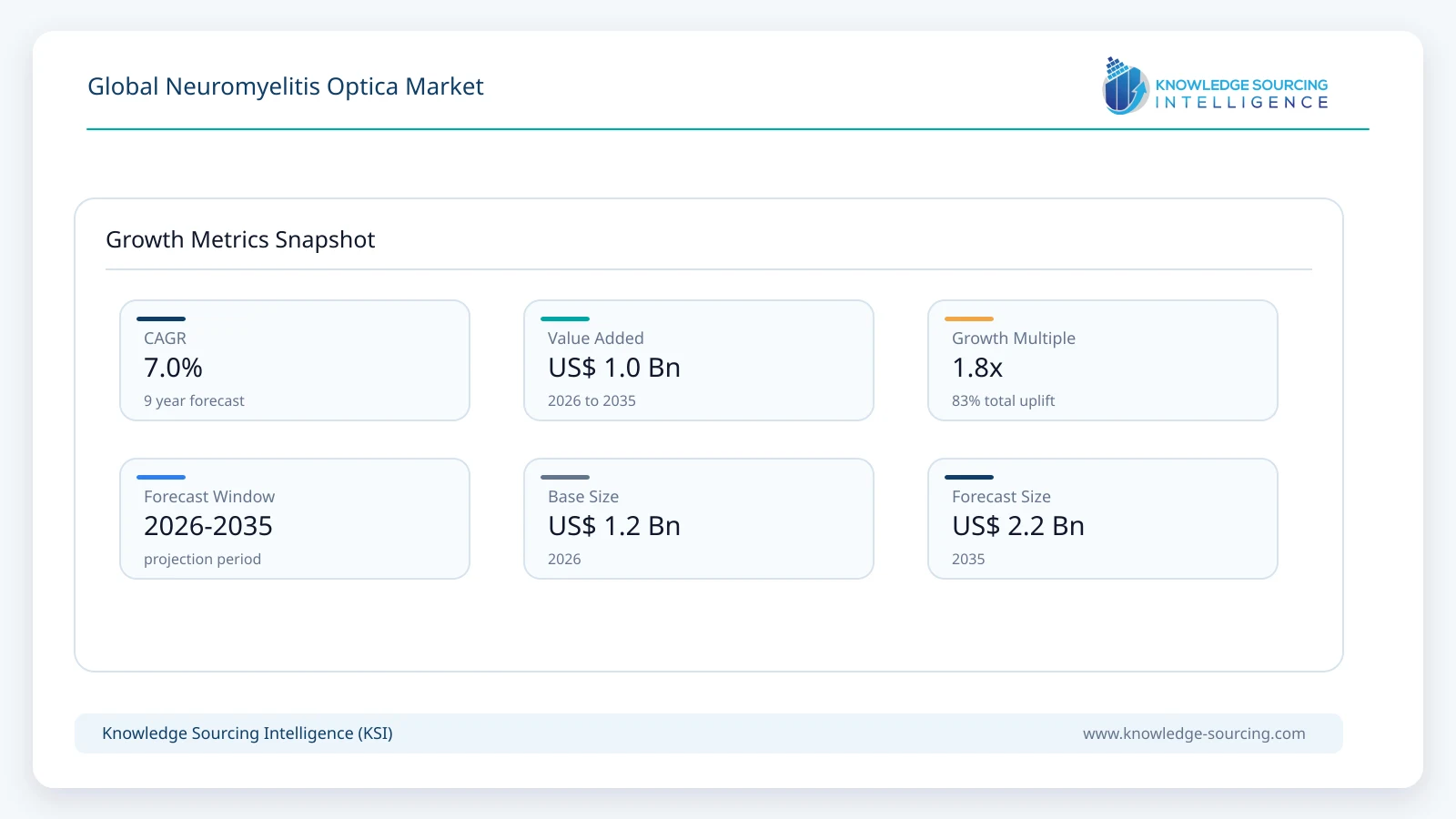
The Global Neuromyelitis Optica Market Forecast Report is projected to grow at a CAGR of 7.0% during the forecast period, increasing from USD 1.2 billion in 2026 to USD 2.2 billion by 2035.
Highlights:
- 1Increasing identification of AQP4-IgG positive patients is expanding demand for targeted biologics that reduce relapse risk.
- 2Adoption of complement inhibitors is increasing because long-term disability prevention remains the primary treatment objective.
- 3Demand for self-administered therapies is rising as patients seek reduced hospital visits and improved treatment convenience.
- 4Clinical pipelines are diversifying because companies are pursuing novel targets with longer dosing intervals and differentiated safety profiles.
Neuromyelitis optica spectrum disorder (NMOSD) is a rare autoimmune disease that primarily affects the optic nerves and spinal cord. The market demand arises from the need to prevent recurrent attacks because each relapse carries a risk of permanent blindness, paralysis, or neurological impairment. Physicians are increasingly prioritizing preventive biologics as disease awareness improves and diagnostic antibody testing becomes more accessible.
The market depends strongly on serological classification, particularly aquaporin-4 immunoglobulin G (AQP4-IgG) status, because approved therapies demonstrate the greatest efficacy in antibody-positive patients. Regulatory agencies are supporting orphan drug development through accelerated pathways and rare disease incentives, which are encouraging companies to expand their neuroimmunology portfolios.
The prevalence of NMOSD ranges from approximately 0.3 to 4.4 cases per 100,000 people, while women account for nearly 80% of patients. This epidemiological profile is maintaining a concentrated yet clinically significant treatment market.
Market Dynamics
Market Drivers
Expansion of Antibody-Based Diagnostics: Accurate serological testing defines treatment selection in NMOSD. Diagnostic capacity is improving across tertiary hospitals, which is increasing the identification of AQP4-IgG positive patients. The disease requires long-term relapse prevention because neurological damage accumulates with every attack. Healthcare providers are increasingly prescribing targeted biologics as clinical evidence strengthens. Precision treatment becomes the dominant care paradigm.
Growing Preference for Targeted Immunotherapy: Traditional immunosuppressants offer broad immune modulation but produce variable outcomes. Physicians are increasingly preferring biologics that target complement proteins, B cells, or IL-6 receptors because these therapies provide predictable relapse reduction. Treatment guidelines emphasize sustained disease control. Companies are expanding biologic portfolios and lifecycle strategies. The market consequently favors mechanism-driven innovation.
Increasing Rare Disease Policy Support: Rare disease policies provide regulatory incentives for NMOSD therapies. Governments are expanding orphan drug frameworks because unmet clinical needs remain substantial. Development programs benefit from expedited reviews and market exclusivity protections. Pharmaceutical companies are increasing investment in neuroimmunology franchises. Regulatory support strengthens long-term pipeline sustainability.
Rising Awareness Among Neurologists: Disease awareness influences diagnosis timing and treatment initiation. Educational initiatives are increasing physician recognition of NMOSD symptoms because early intervention limits irreversible disability. Misdiagnosis rates continue to decline. Specialty centers are expanding antibody testing and biologic access. Earlier treatment becomes increasingly common.
Market Restraints
High biologic treatment costs limit accessibility in countries with fragmented reimbursement systems.
Small patient populations restrict large-scale clinical trials and slow comparative effectiveness research.
Diagnostic delays remain common in emerging economies because specialized antibody testing infrastructure is limited.
Market Opportunities
Long-Acting Complement Inhibitors: Relapse prevention remains the principal treatment objective in NMOSD. Demand is shifting toward therapies with extended dosing intervals because patients prefer reduced infusion frequency. Complement inhibition demonstrates strong clinical efficacy. Companies are developing next-generation molecules with improved pharmacokinetics. Long-acting therapies, therefore, represent a major commercialization opportunity.
Expansion into MOG Antibody-associated Disease: MOG antibody-associated disease (MOGAD) remains an area of unmet need. Research activity is increasing because clinicians recognize biological distinctions between MOGAD and AQP4-positive NMOSD. Existing biologics provide variable responses. Companies are evaluating targeted candidates with broader neuroimmunology applications. Disease-specific therapies, therefore, offer growth potential.
Self-Administration Platforms: Treatment convenience influences adherence in chronic rare diseases. Demand is increasing for subcutaneous formulations because patients seek flexible dosing outside infusion centers. Healthcare systems prioritize outpatient management. Companies are investing in user-friendly delivery technologies. Home-based therapy gains strategic importance.
Disease & Epidemiology Analysis
NMOSD is an autoimmune inflammatory disorder characterized by recurrent attacks affecting the optic nerves, spinal cord, and brainstem. Disease biology centers on pathogenic autoantibodies, particularly AQP4-IgG, which activate complement pathways and astrocyte injury. The disorder differs mechanistically from multiple sclerosis, which makes disease-specific therapies essential.
Epidemiological trends are changing as antibody testing becomes more widely available. Diagnosed patient populations are increasing because improved diagnostic algorithms reduce misclassification. Women remain disproportionately affected, and most cases occur between 30 and 40 years of age. Disease burden remains significant because recurrent attacks lead to cumulative neurological disability. Early diagnosis, therefore, strongly influences long-term outcomes.
Treatment Guidelines Landscape
Therapy Class | Mechanism | Representative Drugs | Clinical Role |
Complement Inhibitors | C5 inhibition | Soliris, Ultomiris | Relapse prevention |
IL-6 Inhibitors | IL-6 receptor blockade | Enspryng | AQP4-positive NMOSD |
Anti-CD19 Therapies | B-cell depletion | Uplizna | Long-term disease control |
Immunosuppressants | Broad immune suppression | Azathioprine, Mycophenolate | Off-label maintenance |
Market Segmentation
By Therapy Type
IL-6 inhibitors, anti-CD19 therapies, and other immunotherapies define the treatment landscape. Demand is shifting toward targeted biologics because relapse prevention requires precise immune modulation. Complement inhibitors maintain strong clinical relevance. Companies are expanding differentiated mechanisms with longer dosing schedules. Therapeutic competition increasingly centers on efficacy, durability, and treatment convenience.
By Indication
AQP4-IgG-positive NMOSD represents the largest treatment segment because most approved biologics target this population. Diagnostic testing is increasing patient stratification accuracy. AQP4-negative NMOSD continues to present therapeutic challenges. Research programs are evaluating broader neuroimmunology indications. Disease segmentation, therefore, shapes future pipeline priorities.
By Route of Administration
Intravenous therapies dominate current treatment because leading biologics rely on infusion-based delivery. Demand is increasing for subcutaneous and alternative administration methods because patients seek convenience and fewer hospital visits. Manufacturers are optimizing delivery systems. Treatment flexibility, therefore, becomes an important competitive differentiator.
Regional Analysis
North America Market Analysis
North America leads the NMOSD market because biologic adoption rates remain high and rare disease awareness is well established. Diagnostic testing infrastructure supports early patient identification, which is increasing treatment initiation rates. Reimbursement frameworks favor innovative therapies despite high acquisition costs. Pharmaceutical companies are expanding rare disease portfolios and investing in physician education. The region, therefore, remains the primary commercialization hub for approved and pipeline NMOSD therapies.
Europe Market Analysis
Europe benefits from centralized regulatory pathways and growing rare disease networks. Demand is increasing as specialty neurology centers expand access to antibody testing and biologics. Health technology assessments influence reimbursement decisions because healthcare systems prioritize cost-effectiveness. Companies are pursuing value-based strategies and regional partnerships. The market, therefore, emphasizes clinical differentiation and long-term outcomes.
Asia Pacific Market Analysis
Asia Pacific is experiencing increasing NMOSD diagnosis rates because disease prevalence appears comparatively higher in several Asian populations. Healthcare systems are improving diagnostic capabilities and specialist access. Regulatory agencies are accelerating rare disease evaluations. Companies are expanding regional clinical trials and commercialization partnerships. The market consequently offers substantial long-term growth opportunities.
Rest of the World
Emerging markets remain underpenetrated because diagnostic capacity and reimbursement support vary widely. Awareness campaigns are improving disease recognition across tertiary hospitals. Healthcare providers increasingly seek targeted biologics with proven relapse reduction. Companies are expanding distribution partnerships and rare disease programs. Treatment access, therefore, gradually improves across these regions.
Regulatory Landscape
NMOSD regulation centers on orphan drug incentives and expedited review mechanisms because patient populations remain small and unmet clinical needs persist. Regulatory agencies emphasize relapse prevention endpoints and long-term safety evaluation. Clinical trials increasingly incorporate biomarker-defined patient populations, which strengthens the precision medicine approach.
The FDA approved Enspryng in 2020 for AQP4-positive NMOSD and recognized its role as the first subcutaneous treatment option in this indication. The therapy targets IL-6 receptor signaling, which plays a central role in NMOSD inflammation.
Japan approved Enspryng in 2020 for both adults and children with NMOSD, expanding treatment availability in a region with comparatively high disease prevalence. Regulatory acceptance of targeted therapies is therefore encouraging broader pipeline investment.
Pipeline Analysis
The NMOSD pipeline is moving beyond first-generation biologics and increasingly focuses on differentiated immune targets. Complement inhibition remains an active area because blockade of terminal complement activation directly prevents antibody-mediated astrocyte injury. Companies are also investigating longer-acting antibodies to reduce infusion burden and improve adherence.
Dianthus Therapeutics is advancing next-generation complement inhibitors with extended half-life characteristics, while HanAll Biopharma is evaluating immune-modulating candidates that may expand treatment options across autoimmune indications. Established players continue to refine lifecycle strategies because long-term disease control remains the principal therapeutic goal.
Pipeline diversity is increasing because companies seek differentiated efficacy, improved safety profiles, and more convenient administration routes. Competitive intensity continues to rise despite the relatively small patient population.
Reimbursement Landscape
Reimbursement policies strongly influence biologic adoption because NMOSD therapies command premium pricing. Public and private payers prioritize therapies that demonstrate durable relapse reduction and meaningful disability prevention. Clinical evidence plays a central role in reimbursement negotiations.
Coverage frameworks increasingly favor targeted therapies with strong real-world evidence because relapse-related hospitalization costs remain substantial. Companies are expanding patient support programs and value-based access initiatives. Reimbursement systems increasingly reward long-term clinical outcomes.
Competitive Landscape
Alexion Pharmaceuticals
Alexion pioneered complement inhibition in NMOSD and established a strong rare disease franchise through Soliris and Ultomiris. The company focuses on long-term relapse prevention because complement-mediated injury drives disease progression. Lifecycle management strategies continue expanding across neuroimmunology indications. Alexion maintains strategic leadership in complement-targeted therapy.
Amgen
Amgen strengthened its NMOSD position through Uplizna and expanded its rare disease portfolio with B-cell depletion expertise. The company emphasizes durable disease control because infrequent dosing improves patient convenience. Clinical expansion across autoimmune disorders continues to support franchise growth.
Roche
Roche differentiates itself through IL-6 pathway inhibition and subcutaneous delivery. Enspryng addresses patient demand for convenient long-term therapy because home administration reduces infusion dependence. The company continues investing in neuroimmunology research and biomarker-driven development.
Chugai Pharmaceutical
Chugai developed the recycling antibody technology underlying Enspryng and continues advancing antibody engineering platforms. Research investment remains focused on immune-mediated diseases because targeted biologics provide durable therapeutic value. Strategic collaboration with Roche strengthens commercialization reach.
Horizon Therapeutics
Horizon established a rare disease portfolio emphasizing specialty therapeutics and patient support infrastructure. The company historically contributed to NMOSD commercialization capabilities through strategic acquisitions and market expansion activities. Rare disease expertise remains its primary competitive advantage.
Mitsubishi Tanabe Pharma
Mitsubishi Tanabe focuses on neurology and immunology markets where unmet clinical needs remain high. The company continues expanding research partnerships and evaluating novel biologic approaches. Strategic investments emphasize long-term specialty care growth. Its neuroimmunology expertise supports future market participation.
Dianthus Therapeutics
Dianthus concentrates on complement biology and next-generation antibody engineering. Clinical development is advancing toward long-acting complement inhibition because patients increasingly prefer reduced treatment frequency. The company pursues differentiated pharmacokinetic profiles and precision targeting.
HanAll Biopharma
HanAll Biopharma is expanding autoimmune and rare disease programs through antibody-based innovation. Research efforts are exploring immune-modulating mechanisms that may address neuroimmunological disorders. Development partnerships are increasing global visibility.
Viela Bio
Viela Bio established a major milestone in NMOSD treatment through the development and approval of Uplizna. The company demonstrated that CD19-targeted B-cell depletion could deliver durable relapse prevention. Its scientific legacy continues to influence rare neuroimmunology development strategies.
Key Developments
April 2026: AstraZeneca announced that Ultomiris (ravulizumab) met the primary endpoint of the Phase III I CAN trial, demonstrating a 43.4% placebo-adjusted reduction in proteinuria versus placebo at week 34 in adults with immunoglobulin A nephropathy (IgAN) at risk of disease progression. The reduction was rapid, observed as early as week 10, sustained through 34 weeks, with a safety profile consistent with known Ultomiris data and no new safety concerns.
April 2026: Roche announced a new global pivotal Phase III study for Elevidys (delandistrogene moxeparvovec), its gene therapy for Duchenne muscular dystrophy, enrolling approximately 100 early ambulatory boys over 72 weeks. The study uses "time to rise" from the floor as its primary endpoint to generate placebo-controlled data for EMA resubmission after prior trial rejection.
December 2025: The FDA approved Amgen's UPLIZNA (inebilizumab-cdon) for adults with generalized myasthenia gravis (gMG), making it the first and only CD19-targeted B-cell therapy approved for gMG in patients who are anti-AChR or anti-MuSK antibody positive. This approval gives UPLIZNA dual indication for gMG and NMOSD, the first approved treatment for that rare autoimmune neurological disease.
Strategic Insights and Future Market Outlook
The NMOSD market increasingly rewards therapies that combine high efficacy with patient convenience. Demand is shifting toward biologics that reduce relapse risk while minimizing treatment burden. Companies are expanding precision medicine strategies because antibody status and disease biology increasingly guide treatment selection. Competitive differentiation, therefore, depends on mechanism specificity, safety, and administration flexibility.
Pipeline innovation remains active despite the limited patient population because rare disease incentives continue supporting investment. Complement inhibitors, IL-6 blockers, and B-cell targeted therapies are expanding therapeutic options while emerging candidates pursue longer dosing intervals and broader indications. Regulatory agencies continue encouraging innovation through orphan drug frameworks, which strengthen development activity.
The market structure favors companies capable of integrating scientific differentiation with long-term patient support and global commercialization capabilities. Treatment strategies increasingly emphasize sustained disease control, and this focus positions targeted biologics as the foundation of future NMOSD management.
Market Segmentation
By Geography
Key Countries Analysis
Regulatory & Policy Landscape
Table of Contents
1. EXECUTIVE SUMMARY
1.1 Market Snapshot
1.2 Key Findings
1.3 Neuromyelitis Optica (NMO) Market Highlights
1.4 Epidemiology Overview
1.5 Approved Therapies Overview
1.6 Pipeline and Innovation Highlights
1.7 Market Outlook (2025–2035)
2. DISEASE & EPIDEMIOLOGY ANALYSIS
2.1 Introduction to Neuromyelitis Optica
2.1.1 Disease Definition
2.1.2 Disease Classification
2.1.3 Pathophysiology
2.1.4 Disease Burden and Clinical Impact
2.2 Etiology and Risk Factors
2.2.1 Autoimmune Mechanisms
2.2.2 Genetic Factors
2.2.3 Environmental Factors
2.3 Signs and Symptoms
2.4 Diagnosis and Biomarkers
2.4.1 Diagnostic Criteria
2.4.2 Imaging Techniques
2.4.3 Serological Biomarkers
2.4.3.1 Aquaporin-4 (AQP4) Antibody
2.4.3.2 Myelin Oligodendrocyte Glycoprotein (MOG) Antibody
2.5 Epidemiology Analysis
2.5.1 Prevalence of Neuromyelitis Optica
2.5.2 Incidence of Neuromyelitis Optica
2.5.3 Diagnosed Patient Population
2.5.4 Gender-wise Distribution
2.5.5 Age-wise Distribution
2.5.6 AQP4-IgG Positive NMOSD Population
2.5.7 AQP4-IgG Negative NMOSD Population
2.5.8 MOG Antibody-associated Disease Population
3. MARKET DYNAMICS
3.1 Market Drivers
3.1.1 Increasing Diagnosis Rates
3.1.2 Growing Adoption of Targeted Biologics
3.1.3 Expanding Awareness and Diagnostic Testing
3.2 Market Restraints
3.2.1 High Treatment Costs
3.2.2 Limited Patient Population
3.2.3 Reimbursement Challenges
3.3 Market Opportunities
3.3.1 Novel Mechanisms of Action
3.3.2 Emerging Complement Inhibitors
3.3.3 FcRn-targeted Therapies
3.3.4 Expansion in Emerging Markets
3.4 Porter’s Five Forces Analysis
3.5 PESTLE Analysis
4. COMMERCIAL & MARKET ACCESS
4.1 Market Access Overview
4.2 Pricing Analysis
4.3 Reimbursement Landscape
4.4 Patient Assistance Programs
4.5 Healthcare Infrastructure and Access Barriers
4.6 Commercialization Strategies
5. INNOVATION & PIPELINE LANDSCAPE
5.1 Innovation Trends
5.2 Pipeline Overview by Development Stage
5.2.1 Phase I
5.2.2 Phase II
5.2.3 Phase III
5.3 Pipeline Analysis by Mechanism of Action
5.3.1 Complement Inhibitors
5.3.2 Interleukin-6 (IL-6) Inhibitors
5.3.3 B-cell Targeted Therapies
5.3.4 FcRn Inhibitors
5.3.5 Other Emerging Mechanisms
5.4 Pipeline Analysis by Modality
5.4.1 Monoclonal Antibodies
5.4.2 Biologics
5.4.3 Novel Immunotherapies
5.5 Clinical Trial Landscape
5.5.1 Ongoing Trials
5.5.2 Completed Trials
5.5.3 Trial Outcomes and Key Insights
6. TREATMENT LANDSCAPE
6.1 Current Treatment Paradigm
6.2 Acute Attack Management
6.3 Maintenance Therapy
6.4 Approved Therapies Analysis
6.4.1 Soliris (eculizumab)
6.4.2 Ultomiris (ravulizumab)
6.4.3 Uplizna (inebilizumab)
6.4.4 Enspryng (satralizumab)
6.5 Treatment Algorithm
6.6 Unmet Medical Needs
7. GLOBAL NEUROMYELITIS OPTICA MARKET FORECAST REPORT SIZE & FORECAST
7.1 Market Overview
7.2 Historical Market Size (2020–2024)
7.3 Market Forecast (2025–2035)
7.4 Market Forecast by Therapy Type
7.5 Market Forecast by Route of Administration
7.6 Market Forecast by Distribution Channel
7.7 Absolute Dollar Opportunity Analysis
8. GLOBAL NEUROMYELITIS OPTICA MARKET FORECAST REPORT SEGMENTATION
8.1 By Therapy Type
8.1.1 IL-6 Inhibitors
8.1.2Anti-CD19 Therapies
8.1.3 Other Immunotherapies
8.2 By Indication
8.2.1 AQP4-IgG Positive NMOSD
8.2.2 AQP4-IgG Negative NMOSD
8.2.3 MOG Antibody-associated Disease
8.3 By Route of Administration
8.3.1 Intravenous
8.3.2 Oral
8.3.3 Others
8.4 By End User
8.4.1 Hospitals
8.4.2 Specialty Clinics
8.4.3 Academic and Research Centers
8.5 By Distribution Channel
8.5.1 Hospital Pharmacies
8.5.2 Retail & Specialty Pharmacies
8.5.3 Online Pharmacies
9. GEOGRAPHICAL ANALYSIS
9.1 North America
9.1.1 Market Size and Growth
9.1.2 Demand Drivers
9.1.3 Regulatory Overview
9.1.4 Competitive Intensity
9.2 Europe
9.2.1 Market Size and Growth
9.2.2 Demand Drivers
9.2.3 Regulatory Overview
9.2.4 Competitive Intensity
9.3 Asia-Pacific
9.3.1 Market Size and Growth
9.3.2 Demand Drivers
9.3.3 Regulatory Overview
9.3.4 Competitive Intensity
9.4 Latin America
9.4.1 Market Size and Growth
9.4.2 Demand Drivers
9.4.3 Regulatory Overview
9.4.4 Competitive Intensity
9.5 Middle East & Africa
9.5.1 Market Size and Growth
9.5.2 Demand Drivers
9.5.3 Regulatory Overview
9.5.4 Competitive Intensity
10. KEY COUNTRIES ANALYSIS
10.1 United States
10.2 Canada
10.3 Germany
10.4 United Kingdom
10.5 France
10.6 Italy
10.7 Spain
10.8 China
10.9 Japan
10.10 India
10.11 South Korea
10.12 Australia
10.13 Brazil
10.14 Mexico
10.15 Saudi Arabia
10.16 South Africa
11. REGULATORY & POLICY LANDSCAPE
11.1 Overview of Global Regulatory Environment
11.2 United States Regulatory Framework (FDA)
11.3 European Regulatory Framework (EMA)
11.4 Japan Regulatory Framework (PMDA)
11.5 India Regulatory Framework (CDSCO)
11.6 China Regulatory Framework (NMPA)
11.7 Orphan Drug Designation and Incentives
11.8 Pricing and Reimbursement Policies
12. COMPETITIVE LANDSCAPE
12.1 Market Share Analysis
12.2 Competitive Benchmarking
12.3 Product Portfolio Comparison
12.4 Strategic Developments
12.4.1 Product Launches
12.4.2 Collaborations and Partnerships
12.4.3 Acquisitions and Licensing Agreements
12.4.4 Clinical Trial Developments
13. COMPANY PROFILES
13.1 Alexion Pharmaceuticals
13.1.1 Company Overview
13.1.2 Approved Products: Soliris (eculizumab), Ultomiris (ravulizumab)
13.1.3 Key Indications
13.1.4 Pipeline Assets
13.1.5 Strategic Outlook
13.2 Amgen
13.2.1 Company Overview
13.2.2 Approved Product: Uplizna (inebilizumab)
13.2.3 Key Indications
13.2.4 Pipeline Assets
13.2.5 Strategic Outlook
13.3 Roche
13.3.1 Company Overview
13.3.2 Approved Product: Enspryng (satralizumab)
13.3.3 Key Indications
13.3.4 Pipeline Assets
13.3.5 Strategic Outlook
13.4 Chugai Pharmaceutical
13.4.1 Company Overview
13.4.2 Approved Product: Enspryng (satralizumab)
13.4.3 Key Indications
13.4.4 Pipeline Assets
13.4.5 Strategic Outlook
13.5 Horizon Therapeutics
13.5.1 Company Overview
13.5.2 Approved Product: Uplizna (inebilizumab)
13.5.3 Key Indications
13.5.4 Pipeline Assets
13.5.5 Strategic Outlook
13.6 Mitsubishi Tanabe Pharma
13.6.1 Company Overview
13.6.2 Neurology Portfolio Overview
13.6.3 Key Indications
13.6.4 Pipeline Assets
13.6.5 Strategic Outlook
13.7 Dianthus Therapeutics
13.7.1 Company Overview
13.7.2 Pipeline Candidate Portfolio
13.7.3 Mechanism of Action
13.7.4 Clinical Development Status
13.7.5 Strategic Outlook
13.8 HanAll Biopharma
13.8.1 Company Overview
13.8.2 Pipeline Candidate Portfolio
13.8.3 Mechanism of Action
13.8.4 Clinical Development Status
13.8.5 Strategic Outlook
13.9 AstraZeneca Rare Disease
13.9.1 Company Overview
13.9.2 Approved Products: Soliris (eculizumab), Ultomiris (ravulizumab)
13.9.3 Key Indications
13.9.4 Pipeline Assets
13.9.5 Strategic Outlook
13.10 Viela Bio
13.10.1 Company Overview
13.10.2 Approved Product: Uplizna (inebilizumab)
13.10.3 Key Indications
13.10.4 Development History
13.10.5 Strategic Outlook
14. FUTURE OUTLOOK
14.1 Emerging Market Trends
14.2 Future Treatment Paradigm
14.3 Innovation Roadmap
14.4 Pipeline Commercialization Outlook
14.5 Market Growth Projections Through 2035
15. METHODOLOGY
15.1 Research Methodology
15.2 Primary Research
15.3 Secondary Research
15.4 Data Triangulation
15.5 Forecasting Assumptions
15.6 Abbreviations and Definitions
15.7 Disclaimer and Scope of Study
Navigate
Trusted by the world's leading organizations











