
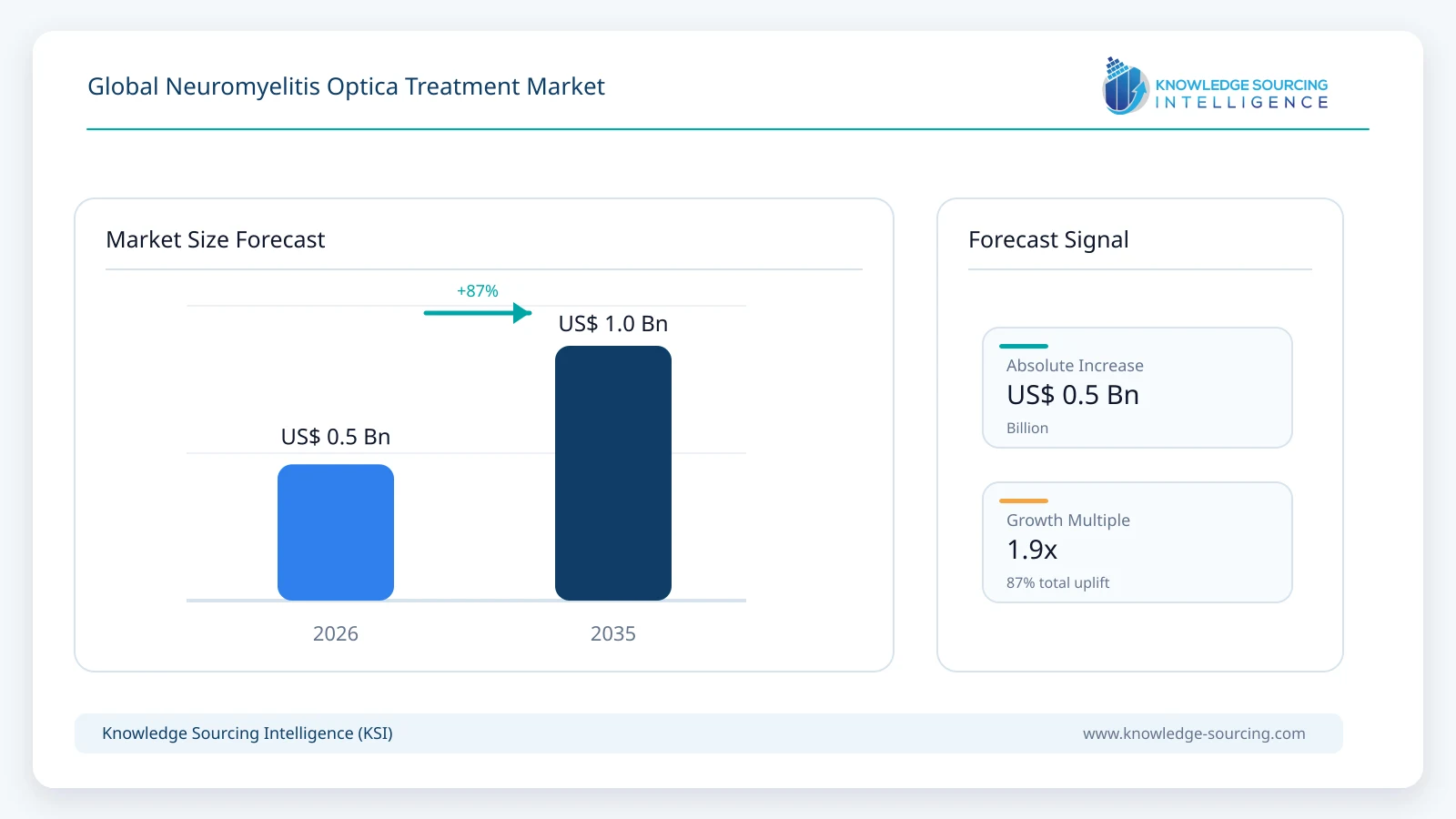
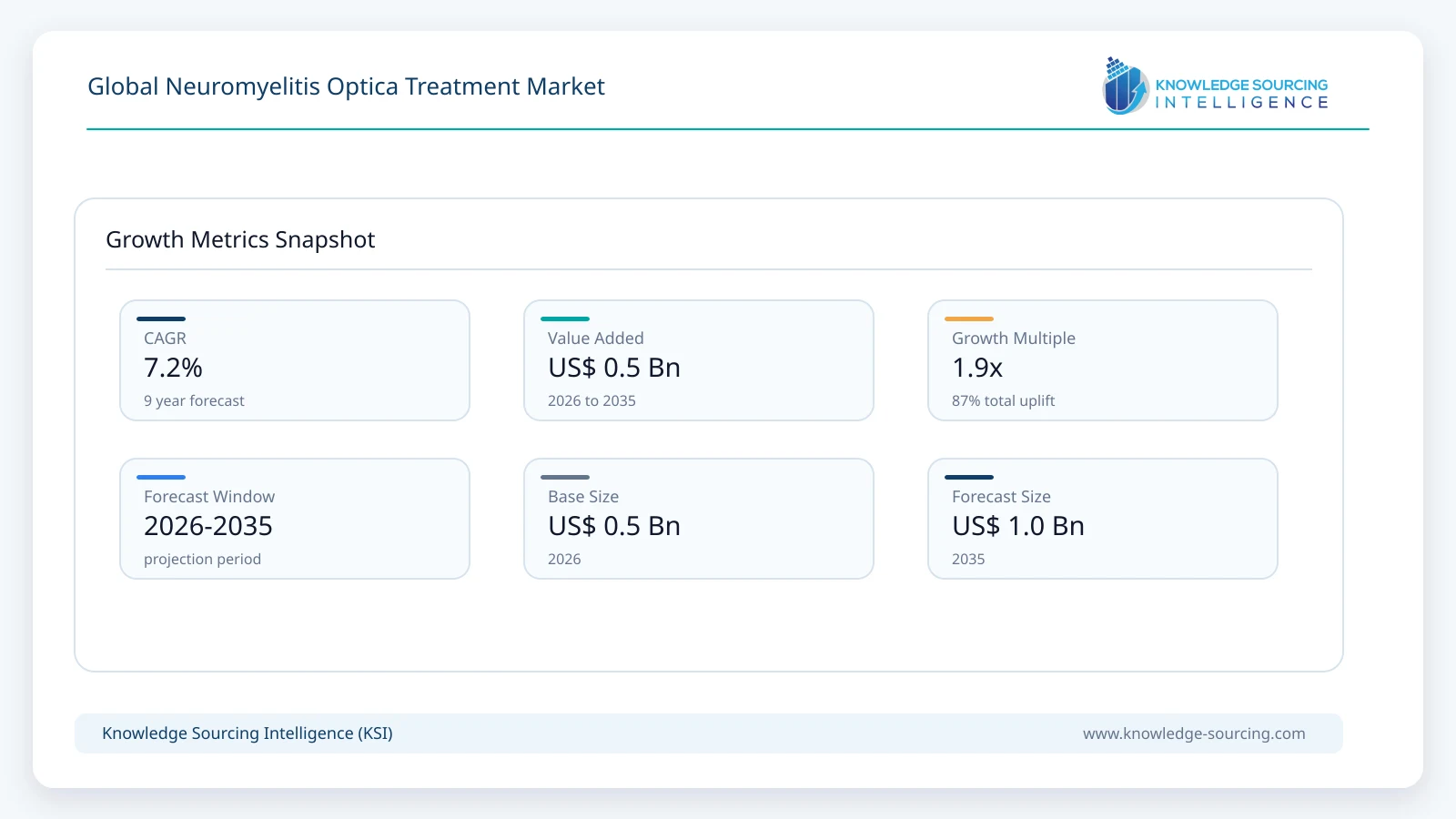
The Global Neuromyelitis Optica Treatment Market is projected to grow at a CAGR of 7.2% during the forecast period, increasing from USD 0.54 billion in 2026 to USD 1.01 billion by 2035.
Highlights:
- 1Increasing use of antibody-based diagnostics is expanding patient identification, which raises demand for targeted relapse prevention therapies.
- 2Complement inhibition reduces inflammatory damage in AQP4-IgG-positive disease, which strengthens adoption of mechanism-specific biologics.
- 3IL-6 receptor inhibitors are improving long-term disease management because they suppress inflammatory signaling associated with relapse activity.
- 4FcRn inhibitors are entering clinical development as sponsors seek therapies that lower pathogenic antibodies without broad immune depletion.
Neuromyelitis optica spectrum disorder is an autoimmune inflammatory disorder that primarily affects the optic nerves and spinal cord through pathogenic autoantibodies directed against aquaporin-4. The disease burden remains strongly associated with relapse frequency because repeated inflammatory episodes often result in permanent neurological impairment. Demand is increasing for preventive therapies as clinicians increasingly emphasize early intervention and long-term disease stabilization. This treatment philosophy creates dependency on biologics that selectively target disease-driving immune pathways rather than generalized immune suppression. Pharmaceutical companies are expanding research programs that improve efficacy while reducing treatment burden, which strengthens competition across targeted therapeutic classes. The market prioritizes durable relapse reduction and personalized treatment strategies.
Regulatory agencies increasingly support rare disease innovation because NMOSD lacks extensive therapeutic alternatives in many patient subgroups. Clinical development is focusing on complement inhibition, B-cell depletion, IL-6 blockade, and FcRn inhibition because these mechanisms directly interfere with antibody-mediated pathology. Treatment adoption is accelerating as long-term clinical data continue demonstrating relapse reduction and improved quality of life. This trend encourages sponsors to broaden indications, expand geographic access, and invest in post-marketing studies that strengthen physician confidence. The therapeutic landscape consequently remains innovation-driven and clinically differentiated.
Market Dynamics
Market Drivers
Expanding Adoption of Targeted Biologics: Targeted biologics increasingly define NMOSD treatment because relapse prevention remains the primary therapeutic objective. Demand is shifting toward complement inhibitors, IL-6 receptor blockers, and CD19-directed therapies as clinicians prioritize durable efficacy with predictable safety profiles. This transition reduces reliance on off-label immunosuppressants that often show variable effectiveness across patient populations. Pharmaceutical companies are expanding commercial investments and post-marketing studies to strengthen physician confidence in these therapies. The market increasingly rewards products with mechanism-specific efficacy and long-term clinical evidence.
Improving Diagnostic Capabilities: NMOSD diagnosis increasingly relies on antibody testing because disease presentation frequently overlaps with other inflammatory neurological disorders. Diagnostic accuracy is improving as cell-based assays for aquaporin-4 antibodies are becoming standard practice in tertiary neurological centers. This expansion increases identification of eligible patients and strengthens demand for approved therapies. Healthcare systems are investing in specialized neuroimmunology services that facilitate earlier diagnosis and treatment initiation. The market therefore benefits from expanding diagnostic infrastructure and improved clinical awareness.
Increasing Rare Disease Regulatory Support: Rare disease policies increasingly support NMOSD innovation because treatment options remain limited in many patient populations. Regulatory agencies are granting orphan drug incentives that reduce development risk and encourage investment in specialized therapeutics. This environment attracts biotechnology companies that are advancing FcRn inhibitors and next-generation immune modulators. Competition is increasing as sponsors seek differentiated efficacy and improved administration profiles. The market continues expanding through innovation and regulatory encouragement.
Market Restraints
High biologic treatment costs limit access in many healthcare systems because reimbursement policies vary substantially across countries.
AQP4-IgG-negative NMOSD lacks extensive clinical evidence, which restricts treatment options and complicates therapeutic decision-making.
Long-term immunomodulation increases concerns regarding infections and treatment monitoring, which affects prescribing patterns in selected patient populations.
Market Opportunities
Expansion of FcRn Inhibitors: FcRn inhibition is emerging as a promising therapeutic strategy because pathogenic antibodies drive disease activity in many NMOSD patients. Demand is increasing for therapies that selectively reduce IgG concentrations while preserving broader immune function. This approach addresses limitations associated with generalized immunosuppression and creates opportunities for improved safety profiles. Biotechnology companies are advancing clinical programs that evaluate FcRn inhibitors across multiple autoimmune diseases, which strengthens investment in NMOSD. The market increasingly recognizes FcRn inhibition as a significant growth avenue.
Expansion into Seronegative NMOSD: AQP4-IgG-negative NMOSD remains an underserved patient segment because approved therapies primarily target antibody-positive disease. Demand is increasing for treatments that demonstrate efficacy regardless of serostatus as clinicians seek broader therapeutic coverage. This unmet need encourages sponsors to explore alternative immune pathways and develop therapies with wider applicability. Clinical research is expanding into novel mechanisms that address inflammatory pathways beyond aquaporin-4 autoimmunity. The market offers meaningful opportunities for innovation.
Geographic Expansion in Emerging Markets: Emerging healthcare systems increasingly recognize NMOSD because diagnostic infrastructure and specialist care networks are expanding. Demand is rising for approved biologics as physicians gain access to advanced diagnostic technologies and treatment guidelines. This expansion creates pressure on manufacturers to improve affordability and establish regional partnerships. Companies are responding through localized commercialization strategies and patient support programs that enhance access.
Disease & Epidemiology Analysis
Neuromyelitis optica spectrum disorder represents a rare autoimmune neurological disease characterized by recurrent inflammatory attacks involving the optic nerves, spinal cord, and selected brain regions. Disease burden primarily arises from relapse activity because each attack may cause irreversible visual or motor impairment. Diagnostic rates are increasing as antibody testing is becoming more accessible across specialized neurology centers. This trend increases identification of patients who require long-term preventive treatment and shifts clinical management toward earlier intervention. The epidemiological landscape increasingly supports sustained demand for targeted biologic therapies.
Global prevalence varies considerably across ethnic groups and geographic regions because genetic susceptibility, diagnostic practices, and healthcare access differ substantially. Epidemiological studies indicate that prevalence generally ranges from 0.3 to 4.4 cases per 100,000 population, while higher rates have been reported in populations with African and Asian ancestry. Women account for the majority of cases because AQP4-IgG-positive disease exhibits a strong female predominance. Diagnostic activity is increasing in Asia-Pacific and Latin America as specialist neuroimmunology centers are expanding and awareness campaigns are improving physician recognition. The disease burden continues to become more visible within healthcare systems.
Treatment Guidelines Landscape
Organization | Guideline Focus | Key Recommendations | Demand Impact |
International Panel for NMO Diagnosis (IPND) | Diagnostic criteria | Recommends AQP4-IgG testing and classification according to serostatus | Expands biomarker-driven treatment selection |
European neurological expert groups | Long-term disease management | Prioritizes relapse prevention using approved targeted biologics | Increases demand for complement inhibitors, IL-6 inhibitors, and CD19 therapies |
National neurology societies | Acute relapse management | Supports high-dose corticosteroids followed by plasma exchange for refractory relapses | Sustains hospital-based treatment demand |
Rare disease clinical networks | Patient stratification | Encourages early diagnosis and personalized treatment according to disease biology | Strengthens adoption of precision therapeutics |
Market Segmentation
By Treatment Type
Complement inhibitors represent one of the most established therapeutic classes in NMOSD because complement-mediated astrocyte injury plays a central role in AQP4-IgG-positive disease. Demand is increasing for therapies that provide durable relapse prevention as neurologists increasingly prioritize long-term disease stabilization over episodic management. This shift strengthens the position of complement-targeting biologics because clinical evidence demonstrates substantial reductions in relapse risk and disability progression. Manufacturers are expanding lifecycle strategies and geographic approvals that improve treatment accessibility across major healthcare markets. The segment therefore remains an important revenue contributor and a benchmark for efficacy in NMOSD treatment.
By Disease Type
AQP4-IgG-positive NMOSD represents the dominant disease segment because the majority of diagnosed patients carry antibodies against aquaporin-4. Demand is increasing for highly targeted therapies as physicians increasingly adopt biomarker-based treatment strategies that improve clinical outcomes. This transition favors complement inhibitors, IL-6 receptor inhibitors, and CD19-directed therapies because these agents directly interfere with antibody-mediated disease mechanisms. Pharmaceutical companies are expanding clinical evidence and geographic reach that support earlier treatment initiation and long-term disease management. The segment remains the primary focus of therapeutic innovation and commercial investment.
By Distribution Channel
Hospital pharmacies account for a major share of NMOSD treatment distribution because biologics often require specialist supervision and infusion-based administration. Demand is increasing for hospital-based services as newly diagnosed patients require comprehensive neurological assessment and long-term treatment monitoring. This dependency strengthens the role of tertiary care centers that provide integrated neuroimmunology services and access to advanced therapeutics. Healthcare institutions are expanding specialty pharmacy capabilities that improve patient adherence and treatment continuity.
Regional Analysis
North America Market Analysis
North America represents the most established NMOSD treatment market because the region combines advanced diagnostic capabilities with early adoption of targeted biologics. Demand is increasing for complement inhibitors, IL-6 receptor inhibitors, and CD19-directed therapies as neurologists increasingly prioritize relapse prevention and personalized treatment strategies. This trend strengthens dependence on specialized neuroimmunology centers that provide antibody testing, imaging, and long-term disease management. Healthcare systems are expanding access to biologics through insurance coverage and patient support initiatives that improve treatment continuity. The regional market remains strongly innovation-driven.
The United States accounts for the majority of regional demand because rare disease awareness and biomarker testing are widely integrated into neurological practice. Diagnostic rates are increasing as cell-based AQP4 antibody assays become more accessible, which expands the number of patients eligible for targeted therapies.
Europe Market Analysis
Europe maintains a strong position in the NMOSD treatment landscape because healthcare systems emphasize early diagnosis, specialist care, and evidence-based therapeutic decisions. Demand is increasing for targeted biologics as neurologists increasingly adopt treatment strategies focused on preventing irreversible disability. This preference strengthens the role of biomarker-guided therapy because antibody testing allows more accurate patient stratification. Healthcare authorities are expanding reimbursement frameworks that improve access to approved treatments across major European markets. The region continues supporting sustained growth in precision therapeutics.
Countries including Germany, France, Italy, Spain, and the United Kingdom are strengthening neuroimmunology services because rare autoimmune neurological diseases require multidisciplinary management. Diagnostic capabilities are improving as specialized centers increasingly use advanced antibody assays and MRI protocols that distinguish NMOSD from multiple sclerosis and related disorders.
Asia Pacific Market Analysis
Asia Pacific is emerging as one of the fastest-evolving NMOSD treatment regions because diagnostic awareness and specialty neurological care are expanding rapidly. Demand is increasing for targeted therapies as healthcare providers increasingly recognize the burden of recurrent relapses and long-term disability. This trend creates opportunities for biologics that offer sustained relapse prevention and convenient administration profiles. Governments and healthcare institutions are investing in rare disease programs that improve diagnosis and treatment accessibility. The region therefore is becoming a strategic priority for pharmaceutical companies.
Japan remains the leading market within Asia Pacific because the country has advanced neurological care infrastructure and strong clinical expertise in neuroimmunology. China and South Korea are increasing investments in antibody testing and rare disease management programs that improve patient identification and treatment access.
Rest of the World
The Rest of the World region is gradually expanding within the NMOSD treatment landscape because healthcare systems increasingly recognize the disease burden associated with recurrent neurological disability. Demand is increasing for targeted therapies as physicians gain access to improved diagnostic tools and international treatment guidelines. This shift strengthens the role of specialized referral centers that provide antibody testing and long-term disease management. Healthcare institutions are improving rare disease infrastructure that enhances patient identification and treatment continuity. The region is progressively integrating advanced NMOSD therapies into clinical practice.
Countries in Latin America and the Middle East are strengthening neurological care capabilities because disease awareness and specialist training continue improving. Diagnostic rates are increasing as healthcare providers adopt internationally accepted criteria and biomarker testing methods that enable earlier diagnosis.
Regulatory Landscape
The regulatory framework for NMOSD increasingly favors targeted therapies because rare autoimmune diseases require differentiated development pathways and accelerated access mechanisms. Regulatory agencies prioritize treatments that demonstrate meaningful reductions in relapse frequency because recurrent inflammatory attacks often result in irreversible neurological disability. Clinical development is increasingly focusing on biomarker-defined populations as AQP4-IgG testing improves patient stratification and strengthens trial design. Pharmaceutical companies are expanding global regulatory strategies that align clinical evidence with regional requirements and orphan drug incentives. The regulatory landscape increasingly supports innovation in precision immunology.
The U.S. Food and Drug Administration has approved multiple biologics for AQP4-IgG-positive NMOSD, including complement inhibitors, IL-6 receptor inhibitors, and CD19-directed therapies. Demand is increasing for mechanism-specific agents because physicians increasingly prefer therapies supported by robust relapse prevention data. Regulatory evaluations increasingly emphasize long-term safety and durability of response because maintenance treatment often extends over many years. Sponsors are conducting extension studies and post-marketing surveillance programs that strengthen confidence in chronic therapy use. The approval environment increasingly rewards durable clinical benefit and differentiated mechanisms.
Pipeline Analysis
The NMOSD pipeline increasingly focuses on targeted immune modulation because disease activity is strongly associated with pathogenic antibodies and inflammatory signaling pathways. Demand is shifting toward therapies that provide durable efficacy with lower treatment burden as physicians seek long-term disease control with improved safety profiles. This transition expands interest in FcRn inhibitors, next-generation complement inhibitors, and precision immunotherapies that selectively interfere with disease-driving mechanisms. Sponsors are investing heavily in platform technologies that can be expanded across multiple autoimmune diseases. The pipeline is becoming broader, more competitive, and increasingly mechanism-driven.
FcRn inhibition is emerging as one of the most important areas of development because reducing circulating IgG antibodies directly addresses the underlying autoimmune process. Johnson & Johnson is advancing nipocalimab across antibody-mediated diseases through inhibition of the neonatal Fc receptor, while HanAll Biopharma is developing batoclimab using a similar approach. Demand is increasing for these therapies because selective antibody reduction may provide sustained efficacy without broad immune suppression. Clinical programs are expanding across autoimmune indications that share common pathogenic pathways. FcRn inhibitors are expected to become an important future therapeutic class in NMOSD.
Reimbursement Landscape
The reimbursement landscape for NMOSD increasingly revolves around clinical value because biologic therapies require substantial long-term healthcare expenditure. Demand is increasing for therapies that demonstrate sustained relapse prevention as payers seek to reduce hospitalization costs and long-term disability burden. This requirement places emphasis on clinical evidence that quantifies reductions in relapse frequency, healthcare utilization, and quality-of-life deterioration. Pharmaceutical companies are expanding health economics and outcomes research that strengthens reimbursement negotiations across major healthcare markets. The reimbursement environment, therefore, increasingly favors therapies with clear long-term benefits.
North America and Europe maintain comparatively favorable reimbursement frameworks because rare disease policies support access to innovative therapies with high unmet clinical need. Healthcare authorities increasingly assess the durability of response and patient-reported outcomes because chronic neurological diseases require lifelong management strategies. Manufacturers are establishing patient support programs and financial assistance initiatives that improve therapy accessibility and treatment adherence.
Competitive Landscape
Alexion Pharmaceuticals
Alexion Pharmaceuticals remains strategically distinct because it pioneered complement inhibition in rare autoimmune diseases and established one of the earliest targeted therapies for NMOSD. The company's competitive position relies on deep expertise in complement biology, which allows it to address the underlying inflammatory cascade responsible for AQP4-IgG-positive disease.
AstraZeneca
AstraZeneca maintains a strong strategic position because its rare disease business combines global commercialization capabilities with expertise in immunology and complement biology. The company strengthened its NMOSD presence through the acquisition of Alexion Pharmaceuticals, which expanded its portfolio of complement-targeting therapies and rare disease assets.
Roche
Roche remains strategically differentiated because it combines expertise in biologics, diagnostics, and personalized medicine within a unified healthcare model. The company established a strong presence in NMOSD through Enspryng (satralizumab), an IL-6 receptor inhibitor designed to prevent relapses in AQP4-IgG-positive patients. Demand is increasing for therapies that balance efficacy with convenient administration because long-term disease management increasingly extends beyond hospital settings.
Amgen
Amgen occupies a significant position in NMOSD because it commercializes Uplizna (inebilizumab), a CD19-directed monoclonal antibody that targets B cells involved in disease pathogenesis. The company's strategy focuses on durable immune modulation because relapse prevention remains the primary therapeutic objective in NMOSD. Demand is increasing for therapies that provide broad B-cell depletion with predictable long-term efficacy.
Johnson & Johnson
Johnson & Johnson is strategically distinct because it is developing advanced immunotherapies that target antibody-mediated autoimmune diseases through novel mechanisms of action. The company's NMOSD strategy increasingly centers on nipocalimab, an FcRn inhibitor designed to reduce circulating pathogenic IgG antibodies. Johnson & Johnson is expanding global clinical development programs that evaluate FcRn inhibition across multiple autoimmune indications.
Argenx
Argenx differentiates itself through its FcRn platform, which focuses on the selective reduction of pathogenic IgG antibodies across multiple autoimmune diseases. The company has established a strong reputation in immunology because FcRn inhibition addresses disease mechanisms that are shared across antibody-mediated disorders.
Key Developments
April 2026: Genentech announced that Enspryng (satralizumab) reduced the risk of relapses by 68% versus placebo in myelin oligodendrocyte glycoprotein antibody–associated disease (MOGAD), meeting its primary endpoint in the Phase 3 METEOROID trial with 87% of Enspryng patients relapse-free at 48 weeks compared to 67% on placebo. The annualized relapse rate was reduced by 66% with Enspryng versus placebo.
April 2025: Alexion/AstraZeneca's Ultomiris (ravulizumab) became the first-ever targeted treatment for NMOSD listed on Australia's Pharmaceutical Benefits Scheme (PBS), providing government-subsidized access for eligible adults with anti-aquaporin-4 antibody-positive NMOSD who experienced recent relapse despite rituximab treatment or cannot tolerate rituximab.
Strategic Insights and Future Market Outlook
The NMOSD treatment landscape increasingly revolves around precision immunology because disease management depends on preventing relapses before irreversible neurological damage occurs. Demand is shifting toward therapies that selectively target disease-driving pathways as physicians increasingly rely on biomarker-guided treatment strategies. This evolution strengthens the position of complement inhibitors, IL-6 receptor blockers, CD19-directed therapies, and emerging FcRn inhibitors because these mechanisms directly address antibody-mediated pathology. Pharmaceutical companies are expanding investments in long-term evidence generation and next-generation immune therapies that improve convenience and broaden treatment eligibility. The market, therefore, increasingly prioritizes durable efficacy and individualized care.
Rare disease policies continue encouraging innovation because regulators increasingly recognize the burden associated with chronic neurological disability. Demand is increasing for therapies that demonstrate sustained clinical benefit and meaningful improvements in quality of life as healthcare systems seek to optimize long-term outcomes. This requirement encourages sponsors to develop therapies with differentiated mechanisms and stronger safety profiles that support lifelong disease management. Companies are expanding global clinical programs and commercial infrastructure that improve patient access across developed and emerging markets. The therapeutic environment remains highly competitive and innovation-focused.
The growing emphasis on early diagnosis and biomarker testing also reshapes future market dynamics because treatment initiation increasingly occurs before significant neurological impairment develops. Demand consequently favors therapies that provide long-term relapse prevention with minimal treatment burden and flexible administration options. Pharmaceutical companies are responding through investments in subcutaneous biologics, long-acting therapies, and FcRn inhibitors that improve patient experience and adherence. This strategy strengthens the transition from generalized immunosuppression toward targeted and personalized treatment approaches.
Market Segmentation
By Geography
Key Countries Analysis
Regulatory & Policy Landscape
Table of Contents
1. EXECUTIVE SUMMARY
1.1 Market Overview
1.2 Key Findings
1.3 Major Approved Therapies and Emerging Trends
1.4 Epidemiology Snapshot
1.5 Competitive Landscape Highlights
1.6 Pipeline Outlook and Future Opportunities
2. DISEASE & EPIDEMIOLOGY ANALYSIS
2.1 Introduction to Neuromyelitis Optica Spectrum Disorder (NMOSD)
2.1.1 Disease Definition
2.1.2 Disease Pathophysiology
2.1.3 Immunological Mechanisms
2.1.4 Disease Burden and Clinical Impact
2.2 Classification of NMOSD
2.2.1 AQP4-IgG Positive NMOSD
2.2.2 AQP4-IgG Negative NMOSD
2.2.3 MOG Antibody Associated Disease (MOGAD) – Differential Diagnosis
2.2.4 Seronegative NMOSD
2.3 Risk Factors and Etiology
2.3.1 Genetic Factors
2.3.2 Autoimmune Comorbidities
2.3.3 Environmental Factors
2.4 Epidemiology Analysis
2.4.1 Prevalence by Population
2.4.2 Incidence Trends
2.4.3 Gender-wise Distribution
2.4.4 Age-wise Distribution
2.4.5 Serostatus-wise Distribution
2.4.6 Disease Severity and Relapse Patterns
3. MARKET DYNAMICS
3.1 Market Drivers
3.1.1 Increasing Disease Awareness and Diagnosis
3.1.2 Growing Availability of Targeted Biologics
3.1.3 Improved Access to Rare Disease Therapies
3.2 Market Restraints
3.2.1 High Treatment Cost
3.2.2 Limited Access in Emerging Markets
3.2.3 Reimbursement Challenges
3.3 Market Opportunities
3.3.1 Expansion of Complement Inhibitors
3.3.2 FcRn Inhibitors and Novel Immunotherapies
3.3.3 Biosimilars and Cost Optimization
3.3.4 Personalized Medicine Approaches
3.4 Porter’s Five Forces Analysis
3.5 PESTLE Analysis
3.6 Value Chain Analysis
3.7 Unmet Needs Assessment
4. COMMERCIAL & MARKET ACCESS
4.1 Pricing Analysis
4.2 Reimbursement Landscape
4.3 Patient Access Programs
4.4 Rare Disease Funding Mechanisms
4.5 Health Technology Assessment Trends
4.6 Commercialization Strategies
5. INNOVATION & PIPELINE LANDSCAPE
5.1 Pipeline Overview
5.2 Pipeline Distribution by Clinical Phase
5.2.1 Phase I
5.2.2 Phase II
5.2.3 Phase III
5.3 Pipeline Distribution by Mechanism of Action
5.3.1 Complement Inhibitors
5.3.2 IL-6 Receptor Inhibitors
5.3.3 CD19 Targeting Therapies
5.3.4 FcRn Inhibitors
5.3.5 B-cell Directed Therapies
5.3.6 Other Emerging Mechanisms
5.4 Pipeline Distribution by Modality
5.4.1 Monoclonal Antibodies
5.4.2 Recombinant Proteins
5.4.3 Cell-Based Therapies
5.4.4 Other Novel Modalities
5.5 Clinical Trial Landscape
5.5.1 Active Trials
5.5.2 Recruiting Trials
5.5.3 Completed Trials
5.5.4 Trial Outcomes and Success Trends
6. TREATMENT LANDSCAPE
6.1 Treatment Algorithm
6.2 Acute Relapse Management
6.2.1 Corticosteroids
6.2.2 Plasma Exchange
6.2.3 Intravenous Immunoglobulin
6.3 Maintenance Therapy Landscape
6.3.1 Complement Inhibitors
6.3.2 IL-6 Receptor Inhibitors
6.3.3 CD19 Directed Therapies
6.3.4 Anti-CD20 Therapies
6.3.5 Immunosuppressive Agents
6.4 Approved Drugs Landscape
6.4.1 Soliris
6.4.2 Ultomiris
6.4.3 Enspryng
6.4.4 Uplizna
7. GLOBAL NEUROMYELITIS OPTICA TREATMENT LANDSCAPE REPORT SIZE & FORECAST
7.1 Global Market Size (Historical)
7.2 Global Market Forecast
7.3 Revenue Forecast by Therapy Type
7.4 Revenue Forecast by Route of Administration
7.5 Revenue Forecast by Distribution Channel
7.6 Market Share Analysis
8. GLOBAL NEUROMYELITIS OPTICA TREATMENT LANDSCAPE REPORT SEGMENTATION
8.1 By Treatment Type
8.1.1 Complement Inhibitors
8.1.2 IL-6 Receptor Inhibitors
8.1.3 CD19 Directed Therapies
8.1.4 Other Therapies
8.2 By Disease Type
8.2.1 AQP4-IgG Positive NMOSD
8.2.2 AQP4-IgG Negative NMOSD
8.3 By Route of Administration
8.3.1 Intravenous
8.3.2 Oral
8.3.3 Others
8.4 By End User
8.4.1 Hospitals
8.4.2 Specialty Clinics
8.4.3 Academic & Research Centers
8.4.4 Others
8.5 By Distribution Channel
8.5.1 Hospital Pharmacies
8.5.2 Retail & Specialty Pharmacies
8.5.4 Online Pharmacies
9. GEOGRAPHICAL ANALYSIS
9.1 North America
9.1.1 Market Size & Growth
9.1.2 Demand Drivers
9.1.3 Regulatory Overview
9.1.4 Competitive Intensity
9.2 Europe
9.2.1 Market Size & Growth
9.2.2 Demand Drivers
9.2.3 Regulatory Overview
9.2.4 Competitive Intensity
9.3 Asia-Pacific
9.3.1 Market Size & Growth
9.3.2 Demand Drivers
9.3.3 Regulatory Overview
9.3.4 Competitive Intensity
9.4 Latin America
9.4.1 Market Size & Growth
9.4.2 Demand Drivers
9.4.3 Regulatory Overview
9.4.4 Competitive Intensity
9.5 Middle East & Africa
9.5.1 Market Size & Growth
9.5.2 Demand Drivers
9.5.3 Regulatory Overview
9.5.4 Competitive Intensity
10. KEY COUNTRIES ANALYSIS
10.1 United States
10.2 Canada
10.3 Germany
10.4 United Kingdom
10.5 France
10.6 Italy
10.7 Spain
10.8 China
10.9 Japan
10.10 India
10.11 South Korea
10.12 Australia
10.13 Brazil
10.14 Mexico
10.15 Saudi Arabia
10.16 South Africa
11. REGULATORY & POLICY LANDSCAPE
11.1 Regulatory Overview for Rare Disease Therapies
11.2 United States – FDA
11.3 Europe – EMA
11.4 Japan – PMDA
11.5 India – CDSCO
11.6 China – NMPA
11.7 Orphan Drug Designation Framework
11.8 Pharmacovigilance Requirements
11.9 Pricing and Market Access Regulations
12. COMPETITIVE LANDSCAPE
12.1 Market Share Analysis
12.2 Competitive Benchmarking
12.3 Product Portfolio Comparison
12.4 Pipeline Competitiveness Assessment
12.5 Strategic Collaborations and Licensing
12.6 Mergers & Acquisitions
12.7 Recent Developments
13. COMPANY PROFILES
13.1 Alexion Pharmaceuticals
13.1.1 Company Overview
13.1.2 Approved Drugs: Soliris (eculizumab), Ultomiris (ravulizumab)
13.1.3 Key Indications
13.1.4 NMOSD Development Strategy
13.2 AstraZeneca
13.2.1 Company Overview
13.2.2 Rare Disease Portfolio
13.2.3 NMOSD Commercial Strategy
13.2.4 Future Growth Initiatives
13.3 Roche
13.3.1 Company Overview
13.3.2 Approved Drug: Enspryng (satralizumab)
13.3.3 Key Indications
13.3.4 Pipeline & Strategy
13.4 Chugai Pharmaceutical
13.4.1 Company Overview
13.4.2 Approved Drug: Enspryng (satralizumab)
13.4.3 Key Indications
13.4.4 Pipeline & Strategy
13.5 Amgen
13.5.1 Company Overview
13.5.2 Approved Drug: Uplizna (inebilizumab)
13.5.3 Key Indications
13.5.4 Pipeline & Strategy
13.6 Tanabe Pharma Corporation
13.6.1 Company Overview
13.6.2 Immunology Portfolio
13.6.3 NMOSD Development Activities
13.6.4 Growth Strategy
13.7 Johnson & Johnson
13.7.1 Company Overview
13.7.2 Pipeline Candidate: Nipocalimab
13.7.3 Mechanism of Action: FcRn Inhibition
13.7.4 Clinical Development Strategy
13.8 HanAll Biopharma
13.8.1 Company Overview
13.8.2 Pipeline Candidate: Batoclimab
13.8.3 Mechanism of Action: FcRn Inhibition
13.8.4 Clinical Development Strategy
13.9 Argenx
13.9.1 Company Overview
13.9.2 Autoimmune Disease Portfolio
13.9.3 FcRn Platform Strategy
13.9.4 Pipeline Overview
13.10 Immunovant
13.10.1 Company Overview
13.10.2 FcRn Inhibitor Portfolio
13.10.3 Pipeline Development Strategy
13.10.4 Future Outlook
14. FUTURE OUTLOOK
14.1 Market Growth Outlook
14.2 Emerging Therapeutic Modalities
14.3 Future Pipeline Launches
14.4 Competitive Evolution
14.5 Opportunities in Rare Disease Management
14.6 Long-Term Forecast Scenario
15. METHODOLOGY
15.1 Research Objectives
15.2 Primary Research Methodology
15.3 Secondary Research Sources
15.4 Market Size Estimation Approach
15.5 Forecasting Methodology
15.6 Data Triangulation
15.7 Assumptions and Limitations
15.8 Abbreviations and Definitions
Navigate
Trusted by the world's leading organizations











