
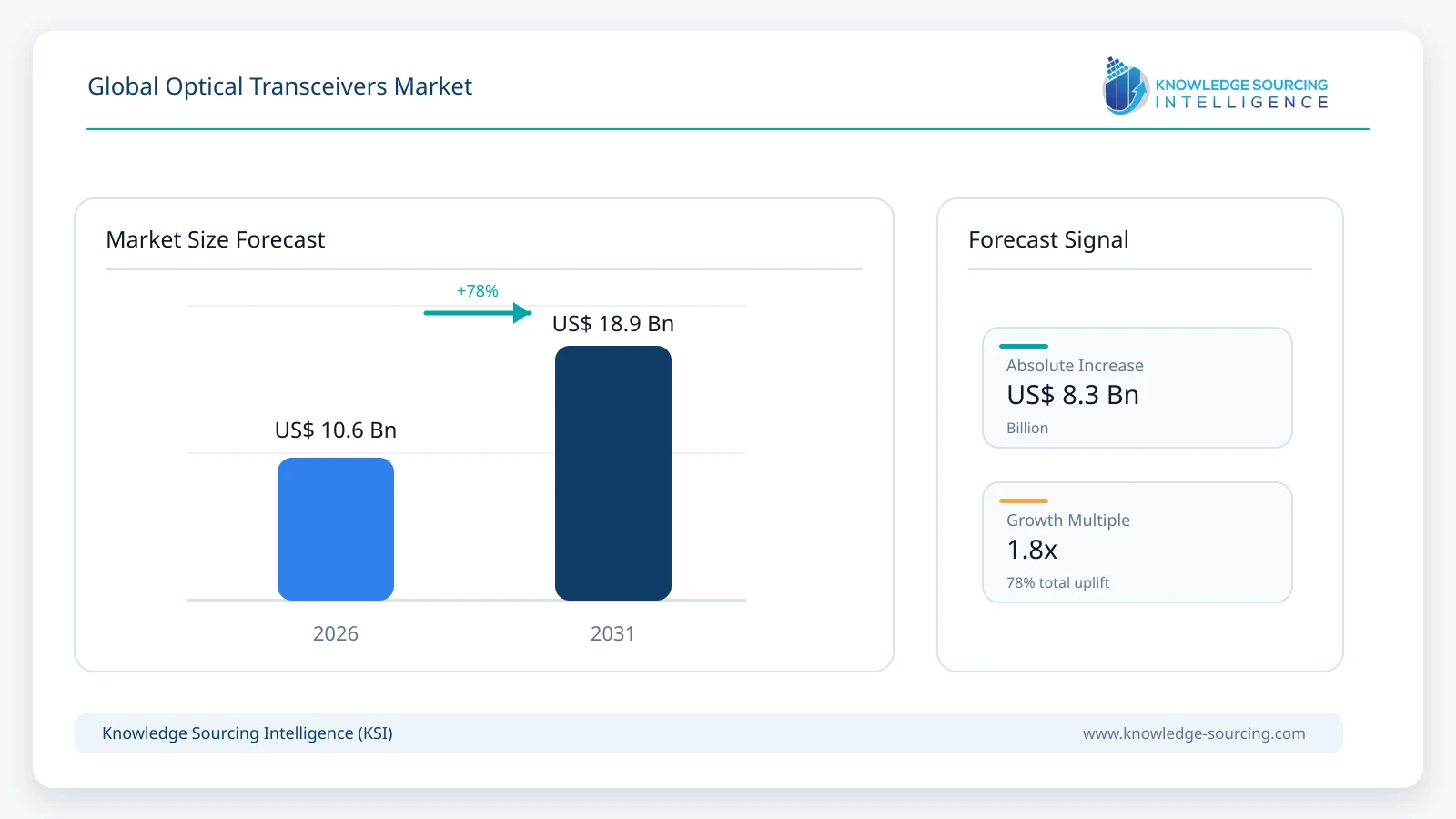
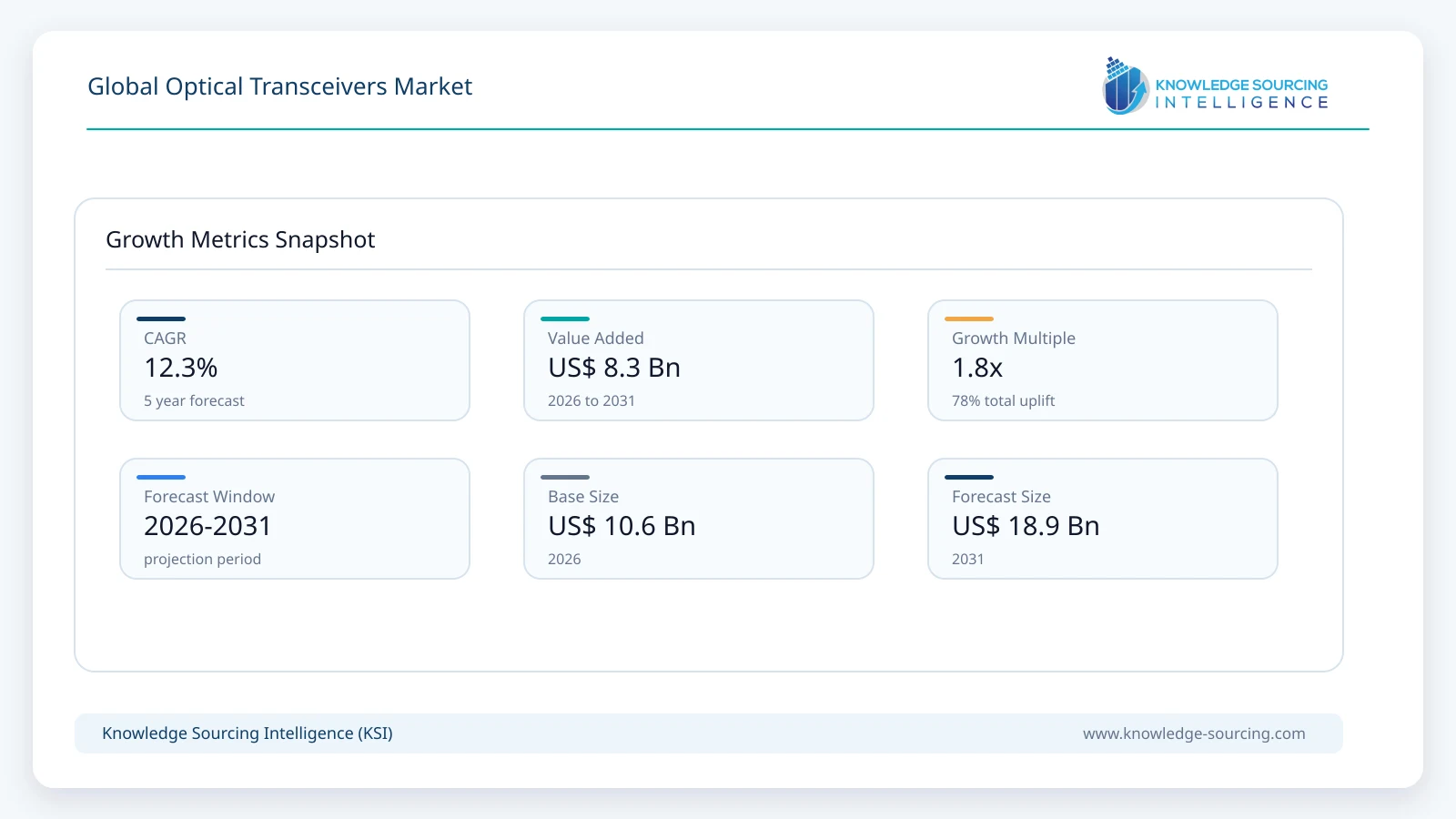
The Global Optical Transceivers market is forecast to grow at a CAGR of 12.3%, reaching USD 18.9 billion in 2031 from USD 10.6 billion in 2026.
Highlights:
- 1Expansion of AI computing infrastructure and hyperscale cloud data centers represents the strongest demand catalyst for high-speed optical transceivers.
- 2Data center applications account for the largest commercial opportunity due to continuous upgrades toward higher bandwidth architectures.
- 3Asia Pacific remains the leading manufacturing and deployment region, supported by substantial investments in telecommunications and cloud infrastructure.
- 4Adoption of 800G modules and development of 1.6T optical transceivers are accelerating network capacity expansion.
- 5International interoperability standards and energy efficiency requirements are influencing product development and purchasing specifications.
- 6Competition increasingly depends on manufacturing scale, optical integration expertise, product qualification capabilities, and long-term supply reliability.
The optical transceivers market forms a critical component of modern digital communication infrastructure by enabling high-speed optical data transmission across fiber optic networks. Optical transceivers convert electrical signals into optical signals for transmission and reconvert incoming optical signals into electrical form at the receiving end. These modules are deployed across hyperscale data centers, carrier transport networks, enterprise campuses, cloud infrastructure, industrial communication systems, and high-performance computing environments. Their commercial importance has expanded as organizations increase bandwidth capacity while seeking lower power consumption, higher port density, and improved network efficiency.
Demand for optical transceivers is closely aligned with investments in cloud computing, artificial intelligence (AI) infrastructure, 5G transport networks, broadband expansion, and enterprise network modernization. Large cloud service providers continue to deploy higher-speed optical interfaces to accommodate growing east-west traffic within data centers, while telecommunications operators are upgrading backbone and metro networks to support increasing consumer and enterprise data consumption. Industrial users are also adopting optical connectivity to improve network reliability in manufacturing, transportation, and energy applications where electromagnetic interference limits the performance of conventional copper-based communication systems.
Buyer priorities have shifted beyond transmission speed alone. Procurement decisions increasingly emphasize power efficiency, interoperability with existing switching platforms, thermal performance, lifecycle reliability, and compliance with international networking standards. Network operators also evaluate suppliers based on manufacturing capacity, qualification testing, software compatibility, delivery schedules, and long-term product support. As network equipment refresh cycles shorten, customers seek transceivers capable of supporting future bandwidth requirements without requiring extensive infrastructure redesign.
Industry structure reflects a combination of vertically integrated component manufacturers, optical networking specialists, semiconductor companies, and module assembly providers. Supply chains encompass lasers, photonic integrated circuits, digital signal processors, optical packaging, testing equipment, and fiber interconnect technologies. Manufacturing concentration within Asia Pacific provides cost advantages but also exposes suppliers to geopolitical risks, export controls, and semiconductor supply constraints, prompting many buyers to diversify procurement sources.
Revenue generation increasingly depends on higher-speed products such as 400G, 800G, and emerging 1.6T optical modules. Although lower-speed transceivers continue serving enterprise and industrial applications, premium pricing and stronger investment activity are concentrated in advanced modules supporting AI clusters, cloud networking, and high-capacity telecommunications infrastructure. Continuous innovation in coherent optics, silicon photonics, and advanced packaging technologies is reshaping competitive positioning across the value chain.
Market Drivers
Expansion of AI Data Centers and High-Performance Computing
Artificial intelligence workloads generate exceptionally high east-west traffic within data centers, requiring substantially greater bandwidth between servers, storage systems, and networking equipment. Cloud service providers and AI infrastructure developers are deploying larger GPU clusters connected through high-speed optical networks.
Purchasing decisions increasingly prioritize optical modules capable of minimizing latency while maintaining low power consumption and reliable thermal performance. Suppliers are responding through expanded production of 400G, 800G, and next-generation 1.6T transceivers incorporating advanced optical integration technologies. This trend supports higher average selling prices and increases demand for premium optical networking components.
Continued Investment in Telecommunications Infrastructure
Telecommunications operators continue expanding fiber-based transport networks to support growing mobile traffic, fixed broadband subscriptions, and enterprise connectivity requirements. Deployment of standalone 5G networks requires substantial upgrades to fronthaul, midhaul, and backhaul optical infrastructure.
Network operators increasingly procure standardized, interoperable optical modules compatible with multiple equipment vendors. Manufacturers that demonstrate compliance with industry standards while ensuring product reliability gain stronger positioning during carrier procurement cycles. Infrastructure investments therefore create recurring demand beyond initial network deployment.
Growth in Cloud Computing and Enterprise Digital Infrastructure
Organizations continue migrating applications toward hybrid cloud environments, increasing demand for scalable networking solutions capable of supporting distributed computing architectures. Enterprises upgrading campus networks and private cloud facilities require higher-capacity optical connectivity while minimizing operational complexity.
Customers increasingly prefer modular network architectures allowing future bandwidth expansion without complete hardware replacement. This purchasing behavior supports sustained replacement demand for advanced optical transceivers as switching platforms evolve toward higher-speed interfaces.
Advances in Silicon Photonics and Optical Integration
Manufacturing improvements in silicon photonics, photonic integration, and advanced packaging technologies are reducing power consumption while increasing transmission density. These developments improve module scalability for large-scale data center deployments.
Equipment manufacturers integrate these technologies to differentiate performance, simplify manufacturing, and improve long-term reliability. Commercial adoption strengthens as production yields improve and deployment economics become more favorable.
Market Restraints and Challenges
Supply Chain Dependence for Critical Optical Components
Optical transceiver manufacturing depends on specialized lasers, digital signal processors, photonic integrated circuits, precision packaging materials, and semiconductor fabrication capacity. Supply disruptions can delay product deliveries and increase procurement costs.
Network operators often maintain multiple qualified suppliers to reduce sourcing risk, while manufacturers expand regional production capabilities and inventory management strategies. Nevertheless, supply constraints continue affecting delivery schedules for high-speed products.
Rapid Technology Transition
The industry experiences frequent migration toward higher transmission speeds, creating inventory management challenges for both suppliers and customers. Products introduced only a few years earlier may experience declining demand as customers accelerate network upgrades.
Manufacturers must balance research investment with production planning while managing legacy product portfolios. Customers also evaluate upgrade timing carefully to maximize infrastructure utilization before adopting newer optical technologies.
Rising Thermal and Power Management Requirements
Higher-speed optical modules generate greater thermal loads while operating within densely populated networking equipment. Data center operators increasingly evaluate energy efficiency as electricity costs and sustainability objectives receive greater attention.
Manufacturers invest heavily in improved optical packaging, thermal management, and power optimization. However, engineering complexity increases product development costs and qualification timelines.
Export Controls and Geopolitical Uncertainty
International trade restrictions affecting advanced semiconductor technologies and telecommunications equipment influence procurement strategies across multiple regions. Some customers diversify supplier relationships to reduce regulatory exposure and maintain supply continuity.
Manufacturers respond by expanding geographic production footprints and strengthening regional partnerships, although compliance requirements continue increasing operational complexity.
Major Segment Analysis
Data Centers
Data centers represent the most commercially important application segment because they consume the highest volumes of advanced optical transceivers while maintaining relatively short technology refresh cycles. Hyperscale cloud operators, colocation providers, AI infrastructure developers, financial institutions, and government cloud operators collectively account for substantial procurement activity.
Purchasing priorities within this segment extend beyond bandwidth capacity. Buyers evaluate module interoperability with switching platforms, power efficiency, thermal stability, reliability under continuous operation, and lifecycle availability. Qualification processes remain rigorous because network downtime carries considerable operational and financial consequences.
Competitive differentiation increasingly depends on delivering consistent manufacturing quality, high-volume production capability, and rapid product qualification. Suppliers capable of supporting 400G, 800G, and future 1.6T deployments while maintaining reliable delivery schedules strengthen long-term customer relationships. As AI infrastructure expands globally, the data center segment is expected to remain the principal revenue contributor for optical transceiver suppliers.
Regional Analysis
North America
North America benefits from continued investment by hyperscale cloud providers, AI infrastructure developers, and telecommunications operators. Enterprise modernization and broadband expansion further support procurement activity. Buyers emphasize performance, interoperability, cybersecurity compliance, and long-term supplier relationships. Export regulations and supply chain diversification remain important procurement considerations.
Europe
European demand is supported by fiber broadband deployment, industrial automation, research networks, and cloud infrastructure expansion. Sustainability policies encourage procurement of energy-efficient networking equipment. Telecommunications operators maintain disciplined investment strategies, while regulatory compliance and product certification influence supplier selection.
Asia Pacific
Asia Pacific represents both the largest manufacturing base and one of the strongest demand centers. China, Japan, South Korea, and India continue investing in cloud infrastructure, telecommunications modernization, semiconductor production, and digital connectivity. Regional manufacturers benefit from integrated supply chains, although international trade policies and technology restrictions influence market access.
Middle East & Africa
Governments continue investing in national broadband programs, smart city initiatives, and digital public infrastructure. Data center construction is expanding in selected Gulf countries, supporting demand for advanced optical networking equipment. Adoption remains constrained in some markets by limited fiber infrastructure and capital expenditure priorities.
South America
Brazil leads regional demand through telecommunications modernization, cloud service expansion, and enterprise network upgrades. Infrastructure investment continues gradually across neighboring countries, although economic volatility and exchange rate fluctuations influence procurement decisions and project timing.
Competitive Landscape
The optical transceivers market exhibits competition based on technology capability, manufacturing efficiency, product qualification, supply reliability, and customer support. Suppliers differentiate themselves through optical integration expertise, semiconductor capabilities, thermal management performance, and compliance with international networking standards.
Competition also reflects partnerships across semiconductor manufacturers, switch vendors, cloud operators, and telecommunications equipment providers. Product development increasingly emphasizes higher-speed modules supporting AI networking, coherent optical communication, and power-efficient architectures. Geographic expansion, production capacity investment, and diversified manufacturing footprints remain important competitive strategies among Cisco Systems, Inc., Fujitsu Limited, Lumentum Holdings Inc., Coherent Corp., Broadcom Inc., Intel Corporation, Nokia Corporation, Sumitomo Electric Industries, Ltd., InnoLight Technology, Accelink Technologies Co., Ltd., Eoptolink Technology Inc., Ltd., and Yangtze Optical Fibre and Cable Joint Stock Limited Company (YOFC).
Recent Developments
July 2026: Applied Optoelectronics (AOI) announced the expansion of its Pearland, Texas manufacturing campus to increase production capacity for 800G and 1.6T optical transceivers, supporting accelerating AI data center and hyperscale networking demand.
March 2026: Eoptolink introduced its industry-first 12.8Tbps XPO liquid-cooled pluggable optical transceiver for AI data centers, delivering 64 lanes at 200G each with advanced cooling and higher front-panel density for next-generation AI interconnects.
February 2026: Ciena unveiled the industry's highest-density, lowest-power pluggable optical engine for AI-driven data center networking, designed to enable higher-capacity optical transceivers while reducing power consumption and improving deployment efficiency.
Regulatory and Policy Environment
The market operates within an established framework of international optical communication standards, telecommunications regulations, and product safety requirements. Technical interoperability specifications developed by organizations such as the IEEE, IEC, and Multi-Source Agreement (MSA) groups facilitate compatibility across networking equipment from different manufacturers.
Government broadband programs across North America, Europe, and Asia continue supporting fiber infrastructure investment, indirectly stimulating demand for optical networking equipment. Energy efficiency regulations also encourage deployment of lower-power networking technologies within large-scale data centers.
Manufacturers must comply with environmental requirements governing hazardous substances, electronic waste management, electromagnetic compatibility, and product safety certification. Export control regulations affecting advanced semiconductors, photonic technologies, and telecommunications equipment also influence manufacturing strategies, customer qualification, and international supply chain planning.
Outlook and Strategic Implications
Commercial opportunities over the forecast period will increasingly center on AI infrastructure, hyperscale cloud expansion, coherent optical networking, and higher-capacity Ethernet deployments. Investment priorities are expected to favor production scalability, silicon photonics, advanced packaging technologies, automated testing, and supply chain resilience.
Procurement strategies are shifting toward long-term supplier partnerships capable of supporting successive technology transitions from 400G to 800G and eventually 1.6T deployments. Buyers are expected to place greater emphasis on interoperability, energy efficiency, manufacturing consistency, and product lifecycle support rather than unit pricing alone.
Competitive positioning will depend on balancing innovation with manufacturing execution. Companies capable of expanding production capacity while maintaining quality, delivery reliability, and regulatory compliance are likely to strengthen customer relationships across cloud computing, telecommunications, and enterprise networking markets. At the same time, geopolitical uncertainty, semiconductor supply constraints, evolving export regulations, and accelerating technology migration will remain important strategic risks requiring continuous investment in diversified sourcing and product development.
Optical Transceivers Market Scope
| Report Metric | Details |
|---|---|
| Total Market Size in 2026 | USD 10.6 billion |
| Total Market Size in 2031 | USD 18.9 billion |
| Forecast Unit | Billion |
| Growth Rate | 12.3% |
| Study Period | 2021 to 2031 |
| Historical Data | 2021 to 2024 |
| Base Year | 2025 |
| Forecast Period | 2026 – 2031 |
| Segmentation | Form Factor, Data Rate, Technology, Application, Geography |
| Companies |
|
Market Segmentation
By Form Factor
- SFP/SFP+
- QSFP/QSFP28
- QSFP-DD
- OSFP
- CFP
- Others
By Data Rate
- Below 100G
- 100G
- 200G
- 400G
- 800G
- 1.6T
By Technology
- Direct Detection
- Coherent
By Application
- Data Centers
- Telecommunications
- Enterprise Networking
- Industrial
- Others
By Geography
- Americas
- United States
- Canada
- Brazil
- Others
- Europe, Middle East and Africa
- Germany
- United Kingdom
- France
- Italy
- Others
- Asia Pacific
- China
- Japan
- India
- South Korea
- Australia
- Others
Table of Contents
1. INTRODUCTION
1.1. Market Overview
1.2. Market Definition
1.3. Market Segmentation
2. RESEARCH METHODOLOGY
2.1. Research Data
2.2. Assumptions
3. EXECUTIVE SUMMARY
3.1. Research Highlights
4. MARKET DYNAMICS
4.1. Market Drivers
4.2. Market Restraints
4.3. Market Opportunities
4.4. Industry Trends
5. GOVERNMENT REGULATIONS/POLICIES
6. OPTICAL TRANSCEIVERS MARKET, BY FORM FACTOR
6.1. Introduction
6.2. SFP/SFP+
6.3. QSFP/QSFP28
6.4. QSFP-DD
6.5. OSFP
6.6. CFP
6.7. Others
7. OPTICAL TRANSCEIVERS MARKET, BY DATA RATE
7.1. Introduction
7.2. Below 100G
7.3. 100G
7.4. 200G
7.5. 400G
7.6. 800G
7.7. 1.6T
8. OPTICAL TRANSCEIVERS MARKET, BY TECHNOLOGY
8.1. Introduction
8.2. Direct Detection
8.3. Coherent
9. OPTICAL TRANSCEIVERS MARKET, BY APPLICATION
9.1. Introduction
9.2. Data Centers
9.3. Telecommunications
9.4. Enterprise Networking
9.5. Industrial
9.6. Others
10. OPTICAL TRANSCEIVERS MARKET, BY GEOGRAPHY
10.1. Introduction
10.2. Americas
10.2.1. United States
10.2.2. Canada
10.2.3. Brazil
10.2.4. Others
10.3. Europe, Middle East and Africa
10.3.1. Germany
10.3.2. United Kingdom
10.3.3. France
10.3.4. Italy
10.3.5. Others
10.4. Asia Pacific
10.4.1. China
10.4.2. Japan
10.4.3. India
10.4.4. South Korea
10.4.5. Australia
10.4.6. Others
11. RECENT DEVELOPMENTS AND INVESTMENTS
12. COMPETITIVE ENVIRONMENT AND ANALYSIS
12.1. Major Players and Strategic Analysis
12.2. Vendor Competitiveness Matrix
13. COMPANY PROFILES
13.1. Cisco Systems, Inc.
13.2. Fujitsu Limited
13.3. Lumentum Holdings Inc.
13.4. Coherent Corp.
13.5. Broadcom Inc.
13.6. Intel Corporation
13.7. Nokia Corporation
13.8. Sumitomo Electric Industries, Ltd.
13.9. InnoLight Technology
13.10. Accelink Technologies Co., Ltd.
13.11. Eoptolink Technology Inc., Ltd.
13.12. Yangtze Optical Fibre and Cable Joint Stock Limited Company (YOFC)
Navigate
Trusted by the world's leading organizations











