
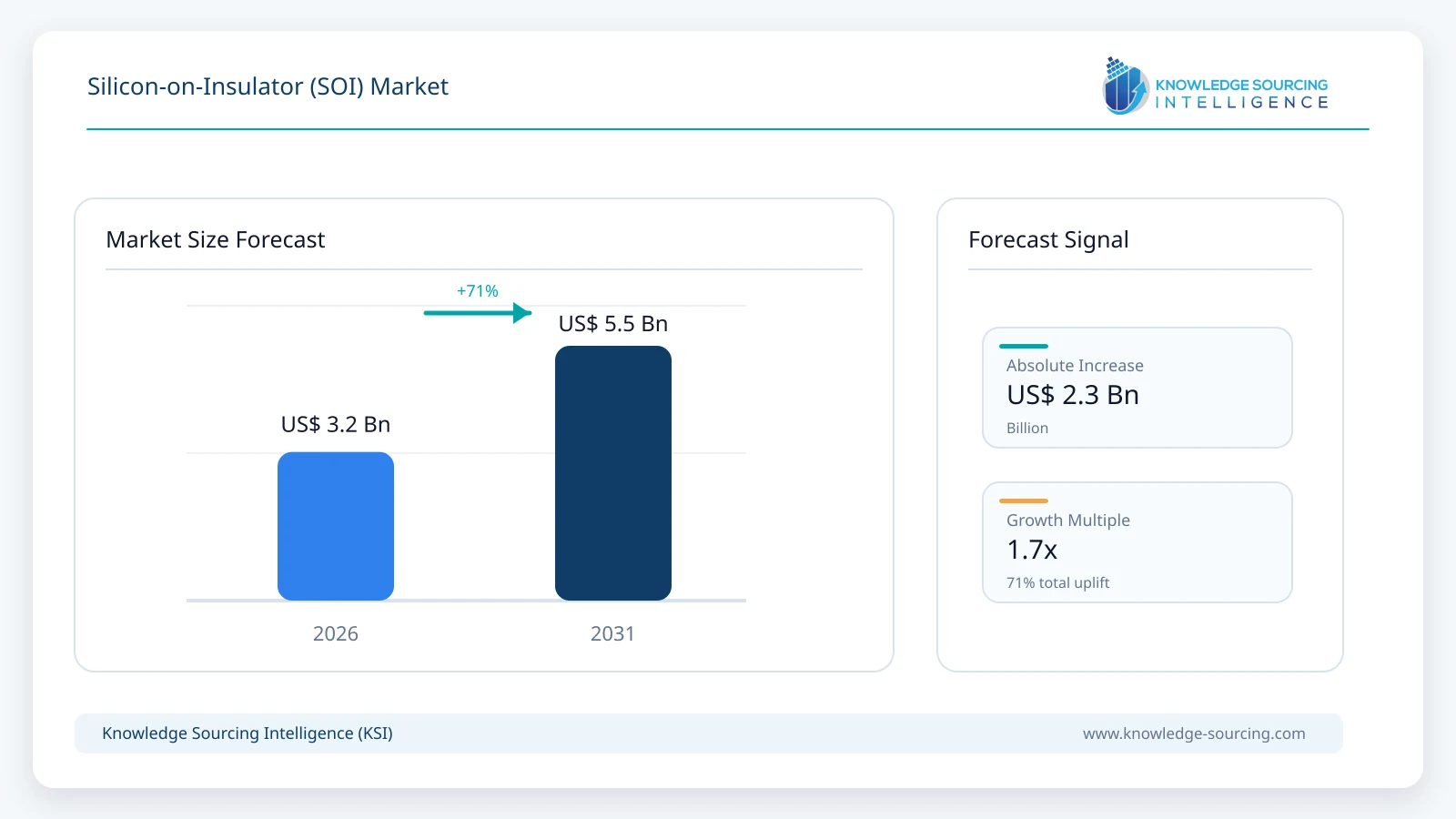
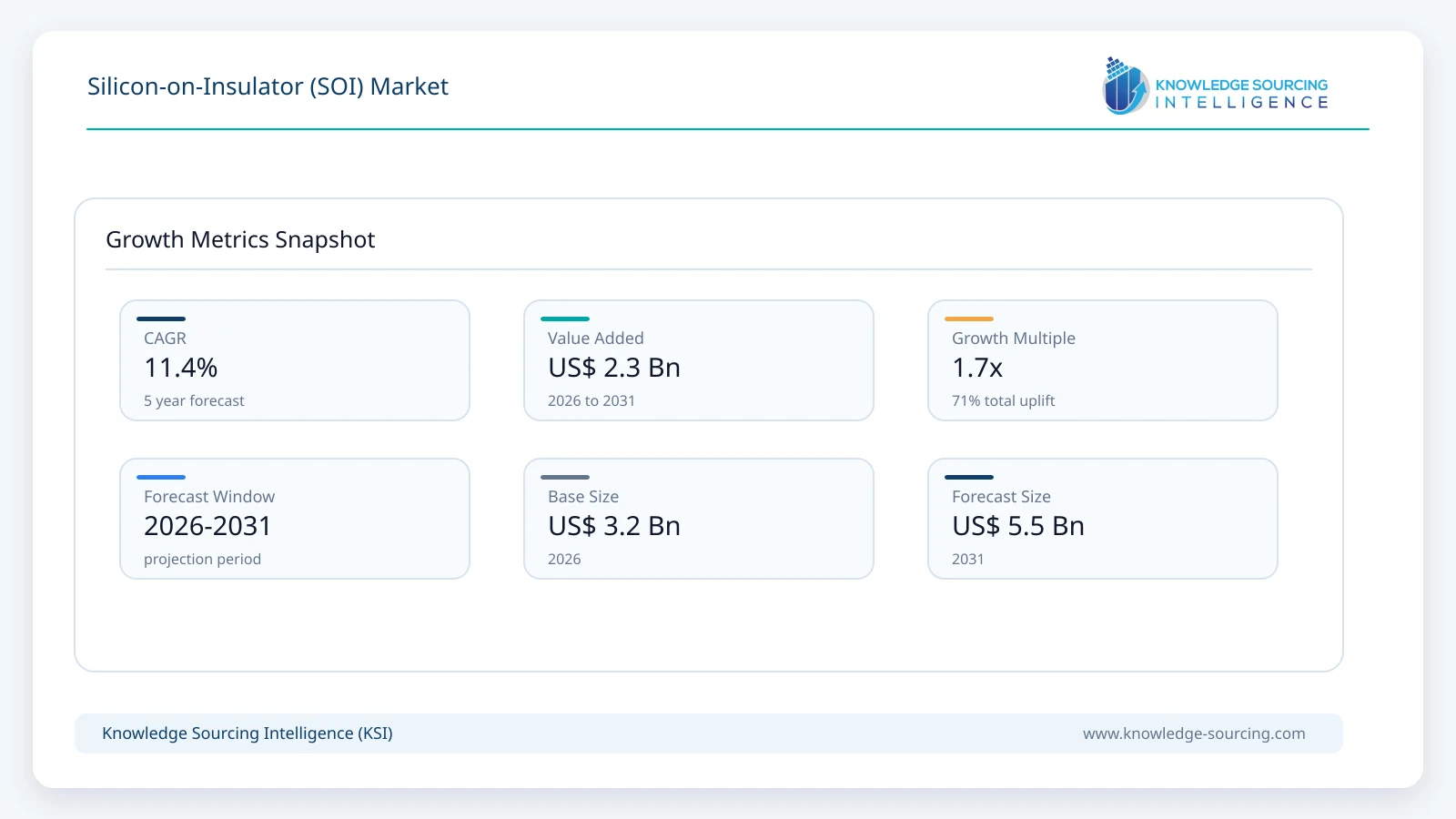
The Silicon-on-Insulator (SOI) Market is forecast to grow at a CAGR of 11.4%, reaching USD 5.52 billion in 2031 from USD 3.22 billion in 2026.
Highlights:
- 1RF-SOI substrates remain central to 5G radio front-end semiconductor manufacturing.
- 2Automotive electrification and industrial automation are expanding demand for power and FD-SOI devices.
- 3Supply remains concentrated among a limited number of specialized SOI wafer manufacturers.
- 4Government semiconductor manufacturing initiatives support long-term wafer capacity investments across major regions.
- 5Product differentiation increasingly depends on wafer quality, defect density, process compatibility, and yield consistency.
Market Overview
Demand is concentrated in applications where radio frequency performance, low power consumption, high switching speed, or harsh operating conditions justify the additional manufacturing cost. These characteristics have established SOI as an important substrate technology for RF front-end modules, automotive electronics, industrial semiconductors, silicon photonics, and selected high-performance computing applications.
Commercial demand is shaped less by consumer electronics unit shipments alone than by semiconductor content per device. Fifth-generation mobile communications, connected vehicles, advanced driver assistance systems (ADAS), edge computing, and expanding data traffic require increasingly complex RF and mixed-signal devices. According to Soitec, RF-SOI has become an industry-standard substrate used in virtually all modern 4G and 5G smartphones, while automotive and edge AI applications continue to increase semiconductor content per system.
The supply structure remains relatively concentrated because SOI wafer production requires specialized intellectual property, high-yield bonding technologies, strict defect control, and advanced process expertise. Technologies such as Smart Cut and wafer bonding require substantial capital investment, long qualification cycles, and close collaboration between substrate suppliers, foundries, and integrated device manufacturers. As a result, purchasing decisions increasingly emphasize wafer quality, long-term supply reliability, process compatibility, and technical support rather than acquisition cost alone.
Government semiconductor strategies in North America, Europe, Japan, South Korea, China, and Taiwan continue to encourage domestic fabrication capacity and supply-chain resilience. OECD analysis indicates that global wafer fabrication capacity remains geographically concentrated, reinforcing the strategic importance of reliable semiconductor material suppliers for advanced manufacturing ecosystems.
Key Market Indicators
Indicator | Latest Evidence | Commercial Meaning |
RF-SOI adoption | Industry standard for 4G/5G smartphones (2025–26) | Sustains long-term demand for RF substrates. |
Semiconductor production | Global wafer fabrication remains geographically concentrated (2025) | Supply diversification remains a strategic priority. |
Automotive semiconductor content | Growing electronics integration in connected vehicles (2025–26) | Expands demand for FD-SOI and Power-SOI devices. |
Manufacturing strategy | Government-backed semiconductor capacity expansion across major economies | Supports long-term investment in substrate manufacturing. |
Product qualification | Long customer qualification cycles for specialty wafers | Creates high switching costs for qualified suppliers. |
Key indicator: RF-SOI remains the standard substrate for virtually all contemporary 4G and 5G smartphones, according to Soitec's FY2025–26 disclosures.
Commercial meaning: Mobile connectivity continues to provide a stable demand base despite periodic fluctuations in handset shipments.
Market Drivers
Expansion of RF front-end complexity in wireless communications. Mobile network evolution continues to increase RF content per device rather than simply expanding handset volumes. Higher frequency bands, carrier aggregation, Wi-Fi evolution, and emerging 5G-Advanced architectures require improved signal integrity and lower power losses, supporting sustained procurement of RF-SOI wafers. Manufacturers are responding through expanded 300 mm production capabilities and long-term supply agreements with semiconductor foundries developing next-generation wireless platforms. Recent agreements between Soitec and GlobalFoundries illustrate continued investment in RF-SOI for future wireless chip platforms.
Rising semiconductor content in automotive electronics. Modern vehicles integrate larger numbers of sensors, radar systems, power management devices, vehicle connectivity modules, and advanced driver assistance functions. These applications require semiconductor technologies capable of maintaining performance under demanding thermal and electrical operating conditions while reducing overall system power consumption. Company disclosures indicate increasing emphasis on automotive-oriented FD-SOI technologies, cybersecurity solutions, and automotive electronics development, reflecting customer demand for higher reliability and longer product qualification cycles.
Government-backed semiconductor manufacturing programmes supporting specialty substrate demand. Public investment programmes across North America, Europe, and Asia increasingly prioritize resilient semiconductor supply chains, domestic fabrication capacity, and advanced process technologies. Although most incentives target fabrication facilities rather than substrate suppliers directly, additional wafer capacity creates corresponding demand for specialty silicon materials, including SOI wafers. OECD analysis highlights that semiconductor production capacity remains concentrated among relatively few economies, encouraging continued investment in localized manufacturing ecosystems and supporting long-term procurement opportunities for qualified SOI wafer suppliers.
Increasing adoption of silicon photonics and AI infrastructure. Growth in cloud computing, AI accelerators, optical interconnects, and high-speed networking is creating new commercial opportunities beyond traditional RF applications. Photonics-SOI substrates enable optical communication devices with lower transmission losses and higher integration density, making them increasingly relevant for data center infrastructure. Semiconductor manufacturers are expanding research partnerships and production capacity to address anticipated demand from AI networking and silicon photonics applications, diversifying revenue beyond smartphone markets.
Market Restraints and Challenges
High qualification costs and extended customer approval cycles. Semiconductor manufacturers require extensive validation before qualifying a new SOI wafer supplier because substrate characteristics directly influence device yield, reliability, and long-term process stability. Qualification often spans several production runs and may take many months before commercial volumes are approved. This raises development costs for new entrants and limits rapid supplier substitution. Established manufacturers such as Soitec and Shin-Etsu continue to benefit from long-standing customer relationships, while smaller suppliers must invest heavily in process validation, quality systems, and technical support before securing recurring production contracts. This challenge is structural rather than cyclical because qualification standards continue to tighten as semiconductor geometries become more complex.
Manufacturing complexity limits rapid capacity expansion. SOI wafer production involves advanced wafer bonding, layer transfer, precision polishing, and defect control processes that demand high capital expenditure and specialized engineering expertise. Yield losses during manufacturing can materially affect production costs, particularly for larger wafer formats. Company disclosures across the semiconductor materials industry indicate continued investment in process optimization and automation to improve manufacturing efficiency while maintaining stringent quality standards. Capacity expansion therefore progresses gradually, since new production lines require equipment qualification and customer approval before reaching commercial utilization. These factors constrain supply flexibility during periods of stronger demand.
Dependence on concentrated semiconductor supply chains. Although governments continue supporting domestic semiconductor manufacturing, the global ecosystem remains concentrated across a limited number of countries for advanced wafer fabrication, specialty materials, and semiconductor equipment. OECD assessments show that manufacturing capacity and upstream material production remain geographically concentrated, increasing exposure to geopolitical developments, export controls, logistics disruptions, and trade restrictions. Specialty substrate suppliers therefore face procurement and planning challenges that extend beyond their own manufacturing operations. Buyers increasingly evaluate long-term supply security alongside technical performance, encouraging suppliers to diversify manufacturing footprints and strengthen regional supply networks rather than relying on single-country production.
Pricing pressure from high-volume consumer electronics markets. Smartphones remain an important destination for RF-SOI devices, but handset manufacturers continue to demand lower component costs while expecting improved performance and shorter product development cycles. This creates continuous pricing pressure throughout the semiconductor value chain. Wafer suppliers must improve manufacturing yields, reduce defect densities, and increase automation to protect margins without compromising quality. Companies are responding by expanding 300 mm production capabilities, improving process efficiency, and prioritizing higher-value applications such as automotive electronics and silicon photonics where technical differentiation is greater and pricing pressure is comparatively lower.
Major Segment Analysis
RF-SOI
RF-SOI represents the most commercially important product segment because it supports radio frequency front-end components used in smartphones, wireless infrastructure, Wi-Fi equipment, and emerging connected devices. Industry adoption has matured over multiple technology generations, making RF-SOI compatible with established semiconductor manufacturing processes while delivering lower signal losses, improved linearity, and reduced power consumption. These characteristics remain essential as wireless devices support additional frequency bands and increasingly complex radio architectures.
Purchasing decisions within this segment prioritize electrical performance, wafer uniformity, defect density, process compatibility, and long-term supply reliability rather than substrate cost alone. Device manufacturers generally maintain long supplier relationships because replacing a qualified wafer source requires extensive process validation and production testing. Suppliers therefore compete through manufacturing consistency, larger wafer capabilities, technical collaboration with foundries, and continued investment in Smart Cut technology. Although FD-SOI and Power-SOI continue expanding in automotive and industrial applications, RF-SOI remains the principal revenue contributor for specialty SOI wafer suppliers due to its established deployment across global wireless semiconductor production.
Regional Analysis
Region | Main Demand Signal | Principal Constraint |
North America | Government-backed semiconductor manufacturing investment, defense electronics, RF chip development | High production costs and dependence on global materials supply |
Europe | Automotive semiconductors, industrial electronics, strong SOI ecosystem | Energy costs and expanding manufacturing capacity |
Asia Pacific | Semiconductor fabrication leadership, consumer electronics manufacturing, foundry investment | Geopolitical risks and supply-chain concentration |
Middle East and Africa | Increasing electronics manufacturing investment and digital infrastructure | Limited domestic semiconductor fabrication capacity |
North America benefits from expanding domestic semiconductor manufacturing under industrial policy initiatives that encourage investment across the semiconductor value chain. The United States remains an important market for RF devices, aerospace electronics, defense systems, and advanced semiconductor design, supporting demand for qualified SOI substrates. Commercial purchasing increasingly emphasizes supply-chain resilience alongside wafer quality as manufacturers seek to reduce dependence on overseas sourcing for critical semiconductor materials.
Europe maintains a strong position through automotive electronics, industrial automation, and established semiconductor manufacturers. France remains particularly important because Soitec's manufacturing operations support global SOI wafer supply, while Germany continues driving demand through automotive semiconductor production and industrial electronics. Regional semiconductor policy increasingly supports investments in advanced manufacturing capacity and research collaboration, strengthening long-term demand for specialty wafer technologies.
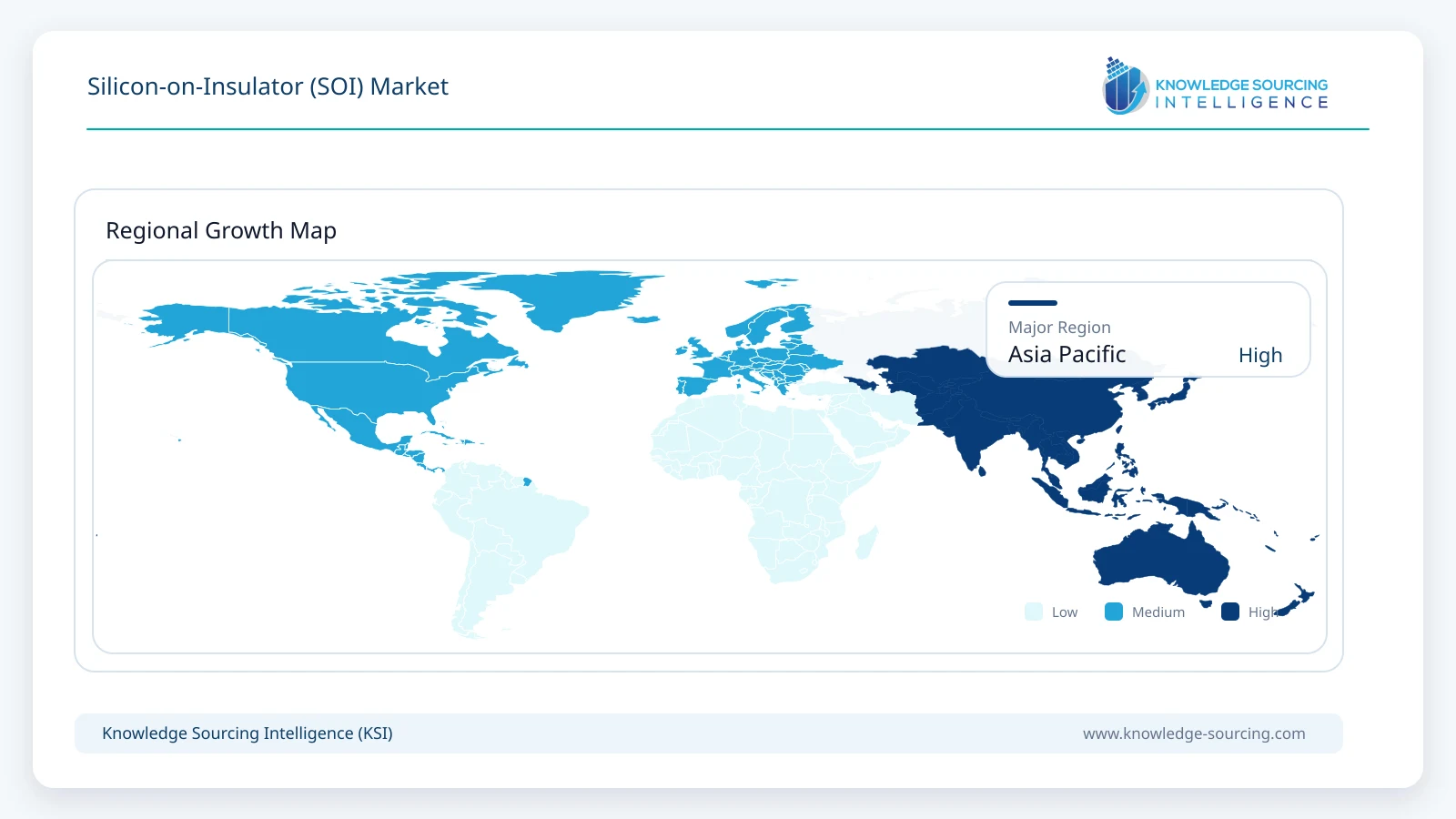
Asia Pacific represents the manufacturing center of the global semiconductor industry. Taiwan, Japan, South Korea, China, and increasingly India continue expanding fabrication capacity, electronics production, and semiconductor investment. Japan remains particularly influential through silicon wafer manufacturing and semiconductor materials expertise, while Taiwan and South Korea support demand through advanced foundry operations. China's continuing investment in domestic semiconductor capability is also increasing procurement of specialty wafer technologies. At the same time, supply-chain concentration within the region leaves manufacturers exposed to geopolitical tensions, export restrictions, and logistics disruptions.
The Middle East and Africa remain comparatively smaller markets but are receiving greater attention through digital infrastructure investment, technology diversification strategies, and government-backed semiconductor initiatives. Israel contributes through semiconductor research, chip design, and defense electronics, while Gulf countries continue investing in technology manufacturing and advanced industrial development. Although regional wafer fabrication capacity remains limited, increasing electronics investment could gradually expand demand for imported SOI substrates during the forecast period.
Competitive Landscape
The Silicon-on-Insulator (SOI) market exhibits a concentrated competitive structure because commercial-scale production requires proprietary manufacturing technologies, extensive process know-how, and long customer qualification cycles. These characteristics create high entry barriers and limit the number of suppliers capable of supporting high-volume semiconductor production. Competition is driven primarily by wafer quality, defect density, process compatibility, manufacturing yield, supply reliability, and technical collaboration with foundries and integrated device manufacturers rather than by price alone.
SOITEC maintains a strong position through its Smart Cut technology portfolio and broad engagement with RF-SOI, FD-SOI, and photonics applications. Shin-Etsu Chemical Co., Ltd. and SUMCO Corporation compete through advanced silicon wafer manufacturing capabilities and long-established relationships with semiconductor manufacturers. Shanghai Simgui Technology Co., Ltd. continues expanding domestic SOI wafer production to support China's semiconductor supply chain. Downstream companies including GlobalFoundries, STMicroelectronics, Qorvo, Inc., and Murata Manufacturing influence market development by incorporating SOI technologies into RF, automotive, industrial, and connectivity solutions while working closely with substrate suppliers on process optimization and next-generation product development. Across the industry, suppliers continue investing in larger wafer formats, manufacturing automation, localized production, and research partnerships to improve supply security and address increasingly demanding customer specifications.
Recent Developments
June 2026 – Soitec and ZenSemi partnership for 300mm BCD-on-SOI production: Soitec partnered with ZenSemi to scale production of 300mm Power-SOI substrates supporting BCD-on-SOI integrated circuits for AI infrastructure, electric vehicles, industrial electronics, and humanoid robotics, strengthening next-generation power semiconductor manufacturing.
March 2026 – Soitec secures multi-year POI wafer supply agreement with Skyworks: Soitec signed a long-term agreement to supply Piezoelectric-on-Insulator (POI) wafers for Skyworks' Sky5 platform, expanding advanced engineered substrates used in high-performance RF front-end modules for next-generation mobile connectivity.
October 2025 – Soitec and CEA expand FD-SOI for automotive cybersecurity: Soitec and CEA announced a collaboration leveraging FD-SOI technology to develop secure automotive integrated circuits, enhancing hardware-level cybersecurity while improving energy efficiency and reliability for future connected vehicle electronics.
June 2025 – CEA-Leti and Soitec strategic FD-SOI partnership: CEA-Leti and Soitec launched a strategic initiative to advance FD-SOI technologies for secure integrated circuits, targeting enhanced chip-level protection, improved power efficiency, and broader adoption across industrial and critical electronic applications.
Regulatory and Policy Environment
Government policy is becoming an increasingly important factor shaping long-term demand for SOI substrates, even though most policy measures target semiconductor manufacturing rather than specialty wafer production directly. The U.S. CHIPS and Science Act, the European Chips Act, Japan's semiconductor revitalization initiatives, South Korea's K-Semiconductor Strategy, and China's continuing investment in domestic semiconductor production all encourage expansion of fabrication capacity, research infrastructure, and supply-chain resilience. These programmes increase indirect demand for specialty substrates as new fabrication facilities require qualified wafer suppliers.
Environmental regulation is also influencing manufacturing practices. Semiconductor material producers continue investing in lower energy consumption, recycling systems, water management, and emissions reduction to comply with increasingly stringent environmental standards. Customer qualification processes increasingly incorporate sustainability metrics alongside product quality and manufacturing capability.
Export controls and technology transfer restrictions have become additional commercial considerations for companies operating across multiple jurisdictions. Suppliers are responding by diversifying production locations, strengthening regional supply chains, and expanding local technical support to reduce exposure to geopolitical uncertainty. Although these measures increase operating costs in the short term, they improve supply continuity for semiconductor manufacturers seeking geographically diversified sourcing strategies.
Outlook and Strategic Implications
Commercial demand for SOI wafers is expected to remain closely aligned with long-term semiconductor content growth rather than fluctuations in individual consumer electronics product cycles. Expansion of 5G-Advanced networks, automotive electrification, industrial automation, edge artificial intelligence, silicon photonics, and high-speed data communication will continue supporting procurement of specialty substrates that offer higher electrical performance and lower power consumption than conventional bulk silicon.
The competitive environment is also expected to become more technology intensive. Manufacturers are likely to prioritize process optimization, larger wafer production, improved manufacturing yields, and lower defect densities while expanding collaboration with foundries and integrated device manufacturers. At the same time, customers are expected to place greater emphasis on supply continuity, regional manufacturing presence, and long-term technical partnerships as semiconductor supply-chain resilience remains a strategic procurement objective.
Key strategic implications include:
Semiconductor manufacturers: Continue diversifying qualified wafer suppliers while strengthening long-term sourcing agreements for specialty substrates.
SOI wafer producers: Expand manufacturing capacity selectively, improve process yields, and increase investment in 300 mm wafer production and next-generation Smart Cut technologies.
Foundries and integrated device manufacturers: Deepen collaboration with substrate suppliers during process development to accelerate qualification and reduce manufacturing risk.
Investors: Monitor capital expenditure trends in semiconductor materials, automotive electronics, RF devices, and silicon photonics, as these sectors are expected to generate sustained demand for SOI technologies.
Policymakers: Continue supporting semiconductor ecosystem development, workforce expansion, and domestic materials capability to improve supply-chain resilience without disrupting international technology collaboration.
During the 2026–2031 forecast period, market performance will depend less on overall semiconductor shipment volumes and more on the increasing value of specialty substrates in advanced device architectures. Companies capable of consistently delivering high-quality wafers, maintaining long-term customer qualifications, and supporting geographically diversified semiconductor manufacturing are expected to strengthen their competitive position as fabrication technologies continue to evolve.
Silicon-on-Insulator (SOI) Market Scope:
| Report Metric | Details |
|---|---|
| Total Market Size in 2026 | USD 3.22 billion |
| Total Market Size in 2031 | USD 5.52 billion |
| Forecast Unit | USD Billion |
| Growth Rate | 11.4% |
| Study Period | 2021 to 2031 |
| Historical Data | 2021 to 2024 |
| Base Year | 2025 |
| Forecast Period | 2026 – 2031 |
| Segmentation | Wafer Size, Technology, Product, End-User Industry, Geography |
| Companies |
|
Market Segmentation
By Wafer Size
Less than 200 mm
200 mm
300 mm
By Technology
Smart Cut
Wafer Bonding
Separation by Implanted Oxygen (SIMOX)
ELTRAN / Layer Transfer
Others
By Product
RF-SOI
PD-SOI
FD-SOI
Power-SOI
Others
By End-User Industry
Consumer Electronics
Automotive
Telecommunication
Military and Defense
Industrial
Healthcare
Data Centers and Computing
Others
By Geography
North America
USA
Canada
Mexico
South America
Brazil
Argentina
Others
Europe
United Kingdom
Germany
France
Spain
Others
Middle East and Africa
Saudi Arabia
UAE
Israel
Others
Asia Pacific
China
Japan
India
South Korea
Taiwan
Thailand
Indonesia
Others
Table of Contents
1. INTRODUCTION
1.1. Market Overview
1.2. Market Definition
1.3. Scope of the Study
1.4. Market Segmentation
1.5. Currency
1.6. Assumptions
1.7. Base and Forecast Years Timeline
1.8. Key Benefits for the Stakeholder
2. RESEARCH METHODOLOGY
2.1. Research Design
2.2. Research Processes
3. EXECUTIVE SUMMARY
3.1. Key Findings
3.2. Analyst View
4. MARKET DYNAMICS
4.1. Market Drivers
4.2. Market Restraints
4.3. Porter’s Five Forces Analysis
4.3.1. Bargaining Power of Suppliers
4.3.2. Bargaining Power of Buyers
4.3.3. Threat of New Entrants
4.3.4. Threat of Substitutes
4.3.5. Competitive Rivalry in the Industry
4.4. Industry Value Chain Analysis
4.5. Analyst View
5. SILICON ON INSULATOR (SOI) MARKET, BY WAFER SIZE
5.1. Introduction
5.2. Less than 200mm
5.2.1. Market Trends and Opportunities
5.2.2. Growth Prospects
5.2.3. Geographic Lucrativeness
5.3. 200 mm
5.3.1. Market Trends and Opportunities
5.3.2. Growth Prospects
5.3.3. Geographic Lucrativeness
5.4. 300 mm
5.4.1. Market Trends and Opportunities
5.4.2. Growth Prospects
5.4.3. Geographic Lucrativeness
6. SILICON ON INSULATOR (SOI) MARKET, BY TECHNOLOGY
6.1. Introduction
6.2. Smart Cut
6.2.1. Market Trends and Opportunities
6.2.2. Growth Prospects
6.2.3. Geographic Lucrativeness
6.3. Wafer Bonding
6.3.1. Market Trends and Opportunities
6.3.2. Growth Prospects
6.3.3. Geographic Lucrativeness
6.4. Separation by Implanted Oxygen (SIMOX)
6.4.1. Market Trends and Opportunities
6.4.2. Growth Prospects
6.4.3. Geographic Lucrativeness
6.5. ELTRAN / Layer Transfer
6.5.1. Market Trends and Opportunities
6.5.2. Growth Prospects
6.5.3. Geographic Lucrativeness
6.6. Others
6.6.1. Market Trends and Opportunities
6.6.2. Growth Prospects
6.6.3. Geographic Lucrativeness
7. SILICON ON INSULATOR (SOI) MARKET, BY PRODUCT
7.1. Introduction
7.2. RF-SOI
7.2.1. Market Trends and Opportunities
7.2.2. Growth Prospects
7.2.3. Geographic Lucrativeness
7.3. PD-SOI
7.3.1. Market Trends and Opportunities
7.3.2. Growth Prospects
7.3.3. Geographic Lucrativeness
7.4. FD-SOI
7.4.1. Market Trends and Opportunities
7.4.2. Growth Prospects
7.4.3. Geographic Lucrativeness
7.5. Power-SOI
7.5.1. Market Trends and Opportunities
7.5.2. Growth Prospects
7.5.3. Geographic Lucrativeness
7.6. Others
7.6.1. Market Trends and Opportunities
7.6.2. Growth Prospects
7.6.3. Geographic Lucrativeness
8. SILICON ON INSULATOR (SOI) MARKET, BY END-USER INDUSTRY
8.1. Introduction
8.2. Consumer Electronics
8.2.1. Market Trends and Opportunities
8.2.2. Growth Prospects
8.2.3. Geographic Lucrativeness
8.3. Automotive
8.3.1. Market Trends and Opportunities
8.3.2. Growth Prospects
8.3.3. Geographic Lucrativeness
8.4. Telecommunication
8.4.1. Market Trends and Opportunities
8.4.2. Growth Prospects
8.4.3. Geographic Lucrativeness
8.5. Military and Defense
8.5.1. Market Trends and Opportunities
8.5.2. Growth Prospects
8.5.3. Geographic Lucrativeness
8.6. Industrial
8.6.1. Market Trends and Opportunities
8.6.2. Growth Prospects
8.6.3. Geographic Lucrativeness
8.7. Healthcare
8.7.1. Market Trends and Opportunities
8.7.2. Growth Prospects
8.7.3. Geographic Lucrativeness
8.8. Data Centers and Computing
8.8.1. Market Trends and Opportunities
8.8.2. Growth Prospects
8.8.3. Geographic Lucrativeness
8.9. Others
8.9.1. Market Trends and Opportunities
8.9.2. Growth Prospects
8.9.3. Geographic Lucrativeness
9. SILICON ON INSULATOR (SOI) MARKET, BY GEOGRAPHY
9.1. Introduction
9.2. North America
9.2.1. By Wafer Size
9.2.2. By Technology
9.2.3. By Product
9.2.4. By End-User Industry
9.2.5. By Country
9.2.5.1. USA
9.2.5.1.1. Market Trends and Opportunities
9.2.5.1.2. Growth Prospects
9.2.5.2. Canada
9.2.5.2.1. Market Trends and Opportunities
9.2.5.2.2. Growth Prospects
9.2.5.3. Mexico
9.2.5.3.1. Market Trends and Opportunities
9.2.5.3.2. Growth Prospects
9.3. South America
9.3.1. By Wafer Size
9.3.2. By Technology
9.3.3. By Product
9.3.4. By End-User Industry
9.3.5. By Country
9.3.5.1. Brazil
9.3.5.1.1. Market Trends and Opportunities
9.3.5.1.2. Growth Prospects
9.3.5.2. Argentina
9.3.5.2.1. Market Trends and Opportunities
9.3.5.2.2. Growth Prospects
9.3.5.3. Others
9.3.5.3.1. Market Trends and Opportunities
9.3.5.3.2. Growth Prospects
9.4. Europe
9.4.1. By Wafer Size
9.4.2. By Technology
9.4.3. By Product
9.4.4. By End-User Industry
9.4.5. By Country
9.4.5.1. United Kingdom
9.4.5.1.1. Market Trends and Opportunities
9.4.5.1.2. Growth Prospects
9.4.5.2. Germany
9.4.5.2.1. Market Trends and Opportunities
9.4.5.2.2. Growth Prospects
9.4.5.3. France
9.4.5.3.1. Market Trends and Opportunities
9.4.5.3.2. Growth Prospects
9.4.5.4. Spain
9.4.5.4.1. Market Trends and Opportunities
9.4.5.4.2. Growth Prospects
9.4.5.5. Others
9.4.5.5.1. Market Trends and Opportunities
9.4.5.5.2. Growth Prospects
9.5. Middle East and Africa
9.5.1. By Wafer Size
9.5.2. By Technology
9.5.3. By Product
9.5.4. By End-User Industry
9.5.5. By Country
9.5.5.1. Saudi Arabia
9.5.5.1.1. Market Trends and Opportunities
9.5.5.1.2. Growth Prospects
9.5.5.2. UAE
9.5.5.2.1. Market Trends and Opportunities
9.5.5.2.2. Growth Prospects
9.5.5.3. Israel
9.5.5.3.1. Market Trends and Opportunities
9.5.5.3.2. Growth Prospects
9.5.5.4. Others
9.5.5.4.1. Market Trends and Opportunities
9.5.5.4.2. Growth Prospects
9.6. Asia Pacific
9.6.1. By Wafer Size
9.6.2. By Technology
9.6.3. By Product
9.6.4. By End-User Industry
9.6.5. By Country
9.6.5.1. China
9.6.5.1.1. Market Trends and Opportunities
9.6.5.1.2. Growth Prospects
9.6.5.2. Japan
9.6.5.2.1. Market Trends and Opportunities
9.6.5.2.2. Growth Prospects
9.6.5.3. India
9.6.5.3.1. Market Trends and Opportunities
9.6.5.3.2. Growth Prospects
9.6.5.4. South Korea
9.6.5.4.1. Market Trends and Opportunities
9.6.5.4.2. Growth Prospects
9.6.5.5. Taiwan
9.6.5.5.1. Market Trends and Opportunities
9.6.5.5.2. Growth Prospects
9.6.5.6. Thailand
9.6.5.6.1. Market Trends and Opportunities
9.6.5.6.2. Growth Prospects
9.6.5.7. Indonesia
9.6.5.7.1. Market Trends and Opportunities
9.6.5.7.2. Growth Prospects
9.6.5.8. Others
9.6.5.8.1. Market Trends and Opportunities
9.6.5.8.2. Growth Prospects
10. COMPETITIVE ENVIRONMENT AND ANALYSIS
10.1. Major Players and Strategy Analysis
10.2. Market Share Analysis
10.3. Mergers, Acquisitions, Agreements, and Collaborations
10.4. Competitive Dashboard
11. COMPANY PROFILES
11.1. SOITEC
11.2. Sumco Corporation
11.3. GlobalFoundries
11.4. STMicroelectronics
11.5. Murata Manufacturing
11.6. Shin- Etsu Chemical Co., Ltd.
11.7. Qorvo, Inc.
11.8. Shanghai Simgui Technology Co., Ltd.
LIST OF FIGURES
LIST OF TABLES
Navigate
Trusted by the world's leading organizations











