
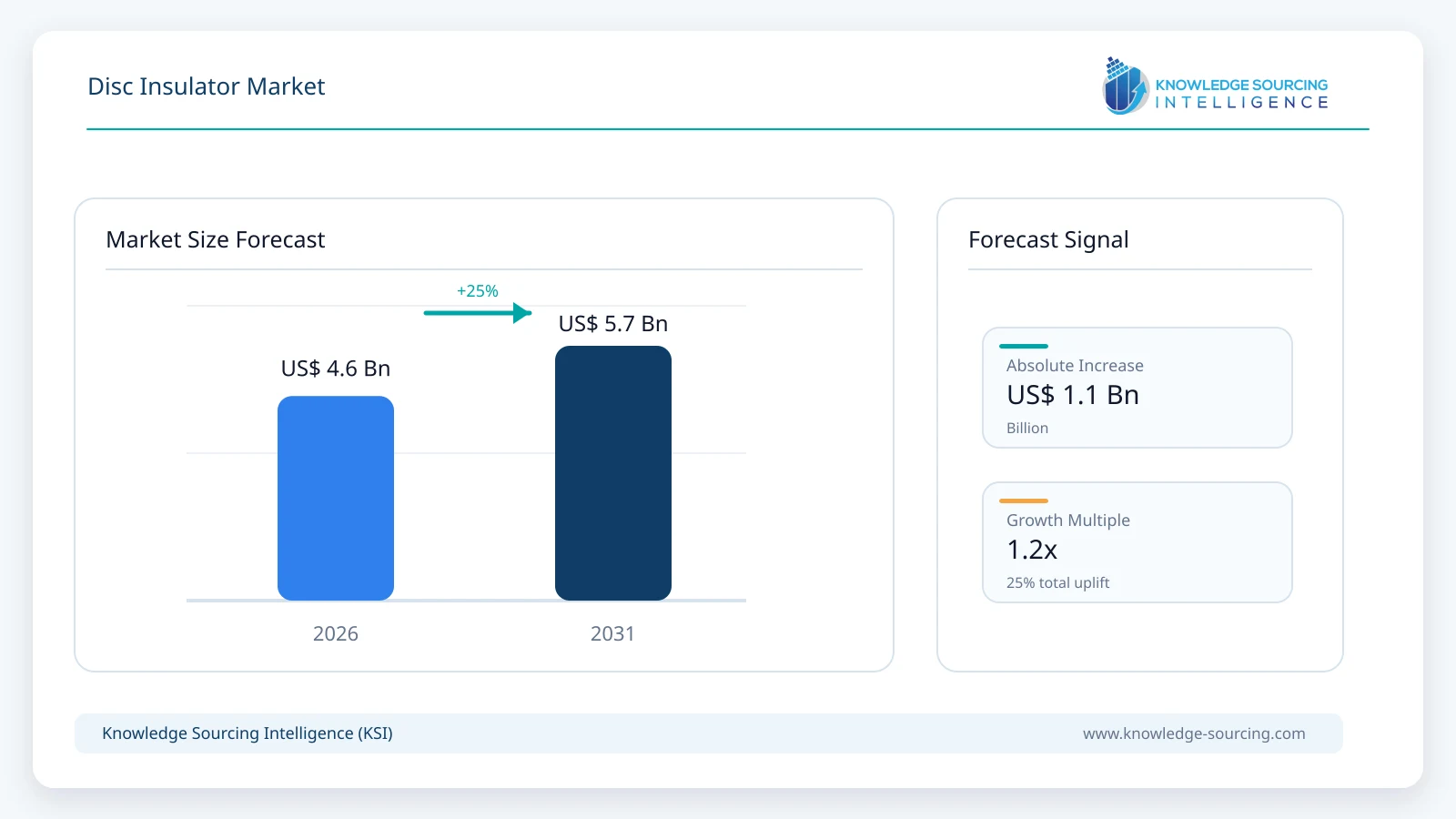
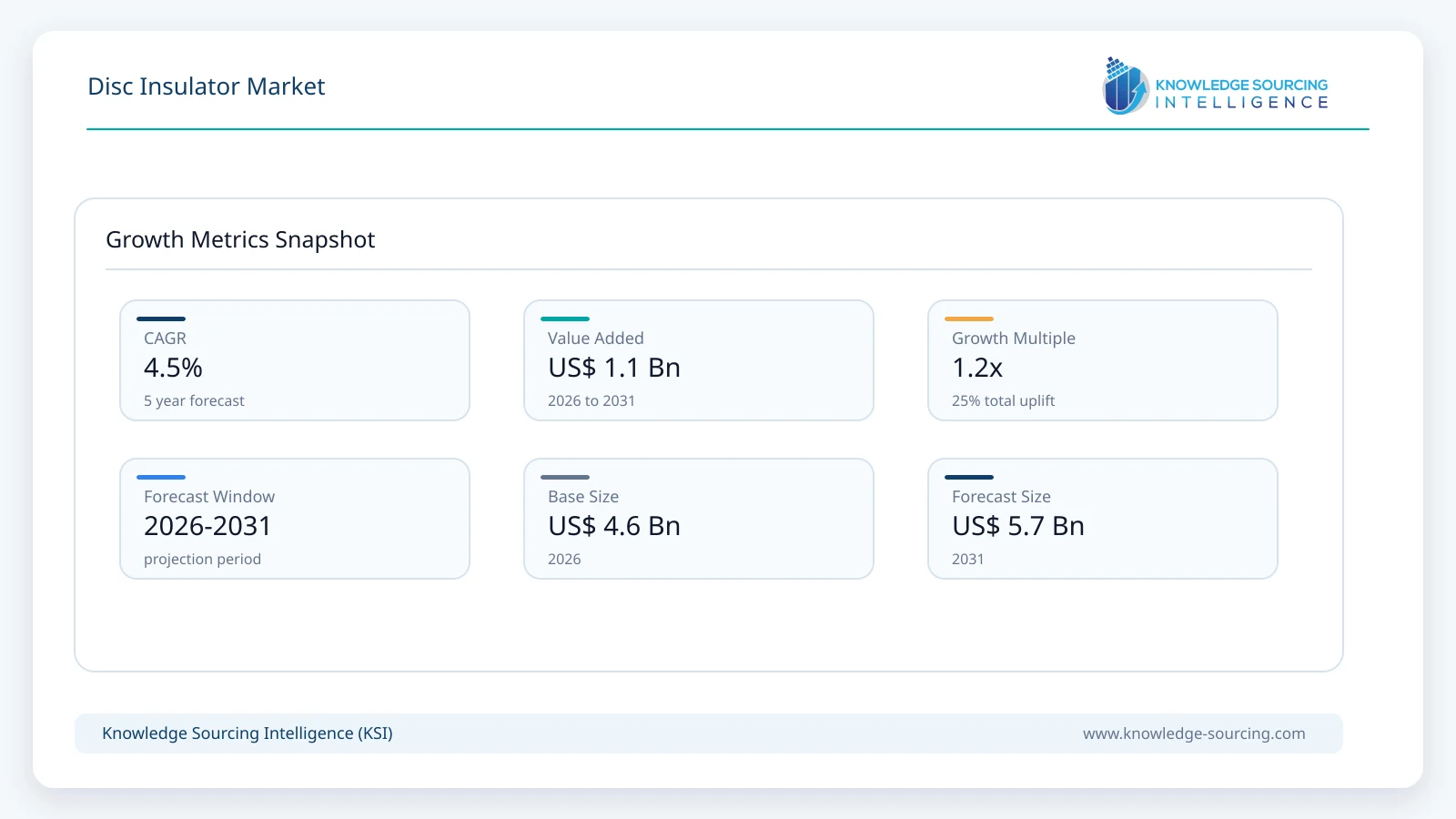
The disc insulator market is forecast to grow at a CAGR of 4.5%, reaching USD 5.68 billion in 2031 from USD 4.56 billion in 2026.
Highlights:
- 1Expansion of transmission infrastructure remains the primary demand catalyst for disc insulators.
- 2Renewable energy integration is increasing the procurement of high-voltage insulation components.
- 3Suspension disc insulators represent a commercially important product category across grid projects.
- 4Supply chain constraints for power equipment continue to affect project execution timelines.
- 5Asia Pacific benefits from large-scale grid expansion programs and rising electricity demand.
- 6Utilities increasingly prioritize reliability, pollution resistance, lifecycle cost, and maintenance performance.
Utilities remain the largest buyers of disc insulators, although procurement activity also originates from engineering, procurement, and construction contractors, transmission system operators, railway electrification authorities, industrial power networks, and government-backed infrastructure projects. Purchasing decisions increasingly extend beyond unit pricing. Utilities are placing greater emphasis on lifecycle cost, contamination resistance, mechanical strength, voltage performance, maintenance requirements, and compliance with national and international grid standards.
Electricity demand growth, renewable energy deployment, and the need to improve grid resilience are reshaping procurement patterns across many regions. According to the International Energy Agency (IEA), global electricity consumption continues to expand due to industrial electrification, digital infrastructure growth, electric vehicle adoption, and population-driven demand increases. These developments require utilities to invest in new substations, transmission corridors, interconnections, and distribution upgrades, creating a sustained requirement for insulation products used throughout overhead line networks.
Value creation within the disc insulator market is distributed across raw material suppliers, insulator manufacturers, metal fitting providers, transmission equipment vendors, utilities, and grid construction contractors. Competitive differentiation increasingly depends on manufacturing quality, product consistency, mechanical performance, testing capabilities, service support, and the ability to meet utility qualification requirements. Suppliers with established relationships with transmission operators and proven long-term field performance maintain an advantage in large-scale infrastructure tenders.
Key Market Indicators
Indicator | Latest Evidence | Commercial Meaning |
Global electricity demand | Continued increase reported by the International Energy Agency | Supports long-term transmission network expansion and asset upgrades |
Renewable power additions | Utility-scale renewable deployment is expanding across major economies | Requires new transmission corridors and grid interconnections |
Transmission investment | Multiple national grid expansion programs have been announced across Asia, Europe, and North America | Creates recurring procurement opportunities for disc insulators |
Ageing grid assets | Many developed economies continue replacing ageing overhead line infrastructure | Supports replacement demand alongside new installations |
Utility procurement focus | Reliability, contamination resistance, and lifecycle cost are increasingly prioritized | Encourages demand for higher-performance insulator products |
Grid modernization activity | Smart grid and transmission reinforcement projects are accelerating globally | Increases demand for qualified transmission components |
Key Indicator: Grid expansion associated with renewable integration remains one of the largest sources of transmission infrastructure investment globally.
Commercial Meaning: Every new transmission corridor requires substantial quantities of insulation hardware, creating recurring demand for disc insulator manufacturers.
Market Drivers
Expansion of high-voltage transmission networks. Utilities across North America, Europe, Asia Pacific, and parts of Latin America are expanding transmission capacity to improve grid reliability and accommodate rising electricity demand. The IEA reports continued growth in transmission investment and identifies transmission infrastructure as a critical requirement for future power systems. Every new transmission corridor requires substantial volumes of suspension and strain insulators, making grid expansion one of the strongest demand drivers.
Renewable energy integration and grid connection requirements. Renewable projects frequently require new transmission infrastructure because generation assets are often located far from demand centers. The IEA has identified transmission constraints as a major obstacle for renewable deployment, with large volumes of solar and wind capacity awaiting grid connections. Transmission developers, therefore, continue to invest in line expansion projects that increase demand for insulator assemblies.
Replacement of aging transmission assets. Many transmission networks in developed economies contain equipment that has been in operation for several decades. Utilities increasingly replace aging insulators to improve reliability, reduce maintenance costs, and limit outage risks. Procurement activity is particularly strong in regions where utilities are implementing asset-management programs focused on long-term network resilience.
Growth in electricity consumption and electrification. The IEA expects global electricity demand to continue expanding at close to 4% annually through the near term. Rising demand from electric vehicles, industrial electrification, data centers, cooling systems, and digital infrastructure increases pressure on transmission networks. Utilities respond through network reinforcement and capacity expansion programs that require additional insulation components.
Utility investment in grid resilience. Extreme weather events, wildfire risks, and network reliability requirements are changing utility purchasing criteria. Utilities increasingly seek insulators capable of maintaining performance under pollution, humidity, salt contamination, and harsh environmental conditions. This trend supports demand for higher-value products with improved durability and lower maintenance requirements.
Market Restraints and Challenges
Long transmission project development cycles. Disc insulator demand is heavily dependent on transmission infrastructure deployment. Permitting delays, land acquisition challenges, environmental reviews, and regulatory approvals frequently postpone transmission projects. The IEA identifies permitting as a major cause of transmission project delays, directly affecting equipment procurement schedules.
Supply chain constraints across power equipment markets. Manufacturers of transmission components face pressure from rising demand for cables, transformers, steel structures, and related equipment. The IEA reports that procurement lead times for several critical transmission assets have increased materially since 2021. Although disc insulators are less constrained than transformers, project delays can postpone associated insulator orders.
Price competition in standardized products. Utility procurement often emphasizes technical compliance and cost competitiveness. Mature insulator technologies, particularly in conventional transmission applications, face pricing pressure from regional manufacturers. Suppliers therefore compete through manufacturing efficiency, quality consistency, testing capabilities, and long-term reliability rather than product differentiation alone.
Stringent qualification and testing requirements. Utilities and transmission operators maintain rigorous qualification procedures for insulation products. Suppliers must demonstrate compliance with international and local standards covering electrical performance, mechanical strength, contamination resistance, and long-term durability. These requirements increase market-entry costs and extend commercialization timelines for new suppliers.
Raw material and energy cost exposure. Ceramic, porcelain, and glass insulator manufacturing depends on energy-intensive production processes. Fluctuations in fuel, electricity, transportation, and industrial raw material costs can affect margins, particularly when long-term supply contracts limit manufacturers' ability to pass through higher costs immediately.
Major Segment Analysis
Transmission and Distribution Lines
Transmission and distribution lines represent the most commercially important end-user segment within the disc insulator market. Every overhead transmission network requires extensive use of suspension and strain insulators to maintain conductor isolation while supporting mechanical loads generated by conductor weight, wind, and environmental conditions.
Demand in this segment is supported by network expansion, grid modernization programs, renewable integration projects, and the replacement of aging infrastructure. Utilities prioritize mechanical reliability, flashover resistance, contamination performance, and lifecycle economics because insulator failures can result in service interruptions and costly maintenance interventions.
Purchasing criteria differ from those of utility pole applications. Transmission operators generally require higher voltage performance, greater mechanical strength, more extensive testing documentation, and longer service life expectations. Suppliers therefore compete through product quality, manufacturing consistency, certification capability, and utility approval records.
Performance in the transmission and distribution segment influences the broader market because large grid projects generate substantial order volumes and often establish long-term supplier relationships. As utilities expand higher-voltage networks, demand increasingly shifts toward insulators capable of operating under more demanding electrical and environmental conditions.
Regional Analysis
Region | Main Demand Signal | Principal Constraint |
North America | Grid modernization and renewable integration | Permitting delays |
Europe | Renewable energy targets and cross-border transmission | Approval complexity |
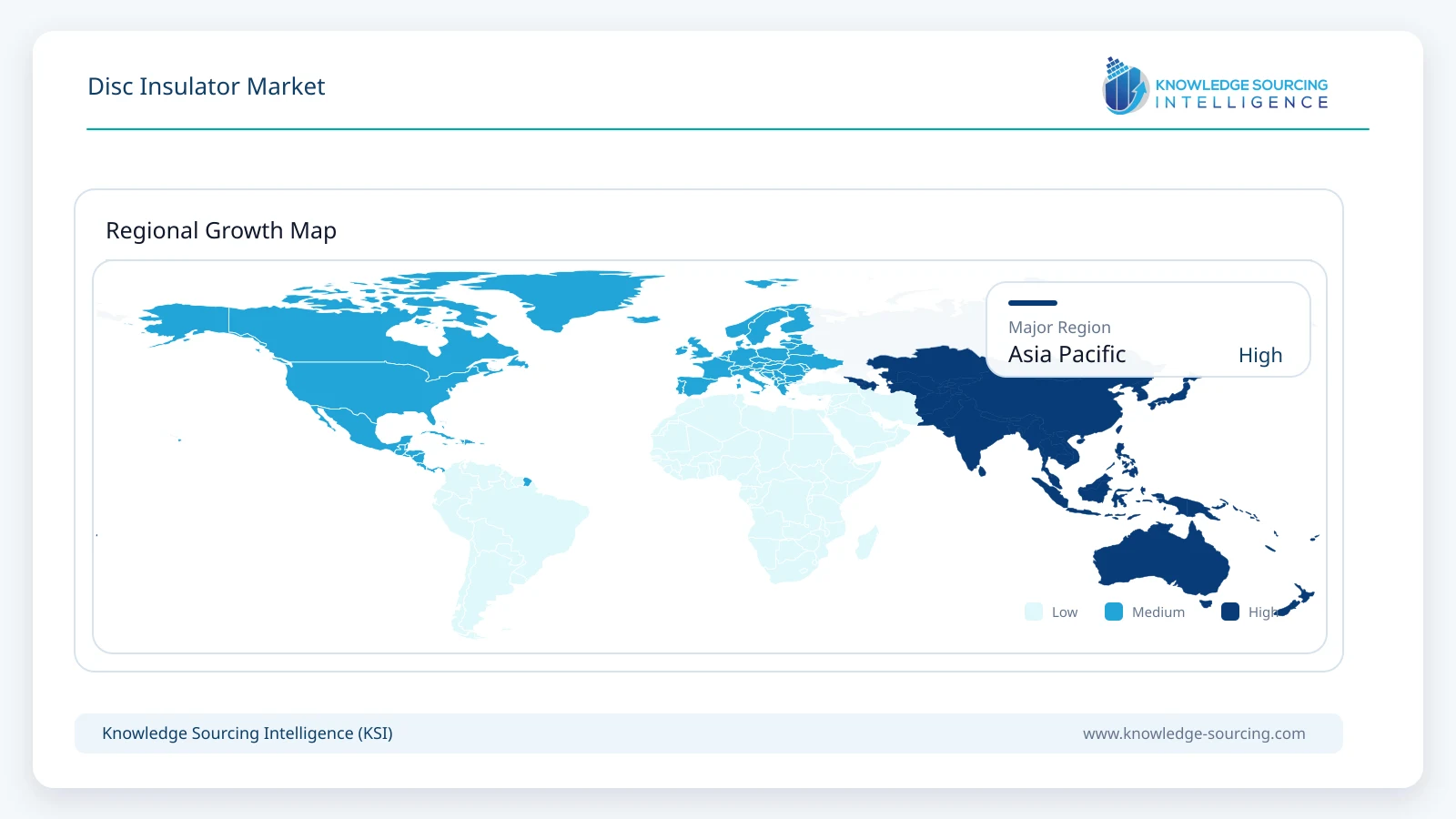
Asia Pacific | Transmission expansion and rising electricity demand | Supply chain pressure |
Middle East and Africa | Grid investment and electrification programs | Funding constraints |
South America | Renewable connection projects and network upgrades | Economic volatility |
North America
Transmission investment remains a central theme across the United States and Canada. Federal and state-level initiatives support grid modernization, resilience improvements, and renewable energy integration. The U.S. government has committed funding toward major transmission projects intended to strengthen grid reliability and connect new energy resources. These developments support demand for transmission hardware, including disc insulators.
Europe
Europe's transmission sector continues to expand as countries strengthen interconnections and accommodate renewable generation growth. The IEA reports that European electricity grid investment plans extend into hundreds of billions of euros through 2030. Utilities increasingly prioritize equipment reliability because transmission infrastructure plays a central role in energy security and decarbonization objectives.
Asia Pacific
Asia Pacific represents the largest concentration of transmission infrastructure investment. China, India, Japan, South Korea, and Southeast Asian economies continue expanding transmission capacity to support industrial growth, urbanization, and renewable deployment. China's state grid investment plans and India's ongoing transmission expansion programs create substantial demand for insulators and related line components.
India illustrates the scale of regional investment. As of early 2026, the country's transmission network exceeded 500,000 circuit kilometers at 220 kV and above, while additional capacity continues to be developed through national and state-level projects.
Middle East and Africa
Electricity demand growth, industrial development, and grid access initiatives support transmission investment across parts of the Middle East and Africa. Gulf countries continue strengthening transmission networks to support economic diversification programs, while several African markets are expanding grid infrastructure to improve electrification rates. Financing availability remains a key determinant of project execution speed.
South America
Brazil remains the most influential market in the region due to its large transmission network and renewable energy resources. New transmission corridors connecting renewable generation assets to consumption centers continue to create opportunities for insulator suppliers. Currency fluctuations and project financing conditions can affect procurement timing.
Competitive Landscape
The disc insulator market exhibits characteristics of a moderately fragmented industrial manufacturing sector. Competition is shaped by utility qualification requirements, manufacturing capability, product reliability, testing infrastructure, geographic presence, and long-term customer relationships.
Key participants include Global Insulator Group LLC, Aditya Birla Insulators, Bharat Heavy Electricals Limited, NGK Insulators Ltd., Compaq International, Iran Insulator Co., NS Transmission Pvt. Ltd., and Mosil Lubricants Pvt. Ltd.
Utilities generally maintain strict supplier approval processes, creating barriers to entry for new manufacturers. Established suppliers benefit from qualification history, operating performance records, and familiarity with utility specifications.
Manufacturers are responding to market requirements through capacity expansion, product quality improvements, higher-voltage product development, and investments in testing facilities. Suppliers also seek opportunities in export markets where transmission investment is accelerating.
For companies serving transmission applications, the ability to supply large project volumes while maintaining consistent quality standards remains a competitive advantage. Reliability concerns often outweigh modest pricing differences when utilities evaluate suppliers for critical infrastructure projects.
Recent Developments
June 2026: Quality Power Electrical Equipment signed a deal to acquire 100% of Winwin Speciality Insulators, adding high-voltage ceramic and polymeric insulator manufacturing capabilities up to 1200 kV and expanding its transmission-grid portfolio.
January 2026: India's transmission network exceeded 501,000 circuit kilometers at 220 kV and above. Continued network expansion supports long-term demand for line hardware and insulators.
December 2025: Trench Group agreed to acquire the composite insulator production assets of Reinhausen Power Composites, including machinery, software, and intellectual property, strengthening hollow-core composite insulator manufacturing capacity and supply reliability.
June 2025: Duke Robotics introduced the ICDS2 next-generation insulator-cleaning drone system, featuring longer flight endurance, higher payload capacity, improved stability, and enhanced maintenance efficiency for transmission-line insulator infrastructure.
Regulatory and Policy Environment
Disc insulator demand is indirectly influenced by electricity sector regulation, grid reliability standards, transmission planning requirements, renewable energy targets, and utility investment approvals.
Transmission projects generally require compliance with environmental regulations, land-use approvals, grid codes, and technical standards governing network safety and performance. Regulatory agencies also establish reliability requirements that influence equipment specifications and maintenance practices.
Renewable energy policies are increasingly relevant because many renewable generation projects depend on transmission expansion. Delays in transmission approvals can slow associated equipment demand, while accelerated permitting frameworks can improve procurement visibility for manufacturers.
International standards developed by organizations such as the International Electrotechnical Commission (IEC) remain important reference points for product qualification, testing, and performance verification.
Outlook and Strategic Implications
The disc insulator market is expected to maintain steady growth through 2031 as utilities continue investing in transmission and distribution infrastructure. Electrification trends, renewable energy integration, grid modernization programs, and replacement demand provide a stable foundation for market expansion.
Several factors will shape competitive performance during the forecast period:
Utility spending on transmission expansion projects.
Speed of renewable energy grid integration.
Availability of transmission equipment and raw materials.
Regulatory approval timelines for new grid infrastructure.
Adoption of higher-voltage transmission technologies.
Supplier's ability to meet increasingly demanding reliability requirements.
Manufacturers with strong utility relationships, proven product performance, established testing capabilities, and geographically diversified production networks are likely to be better positioned to capture opportunities arising from long-term transmission investment programs. Rising grid investment worldwide supports demand fundamentals, but project execution schedules, supply chain conditions, and utility procurement practices will continue to determine revenue realization across the value chain.
Disc Insulator Market Scope:
| Report Metric | Details |
|---|---|
| Total Market Size in 2026 | USD 4.56 billion |
| Total Market Size in 2031 | USD 5.68 billion |
| Forecast Unit | Billion |
| Growth Rate | 4.5% |
| Study Period | 2021 to 2031 |
| Historical Data | 2021 to 2024 |
| Base Year | 2025 |
| Forecast Period | 2026 – 2031 |
| Segmentation | Type, Material, End-user, Geography |
| Companies |
|
Market Segmentation
By Type
By Material
By End-user
By Geography
Table of Contents
1. EXECUTIVE SUMMARY
2. MARKET SNAPSHOT
2.1. Market Overview
2.2. Market Definition
2.3. Scope of the Study
2.4. Market Segmentation
3. BUSINESS LANDSCAPE
3.1. Market Drivers
3.2. Market Restraints
3.3. Market Opportunities
3.4. Porter’s Five Forces Analysis
3.5. Industry Value Chain Analysis
3.6. Policies and Regulations
3.7. Strategic Recommendations
4. TECHNOLOGICAL OUTLOOK
5. DISC INSULATOR MARKET BY TYPE
5.1. Introduction
5.2. Suspension Disc Insulator
5.3. Strain Disc Insulator
6. DISC INSULATOR MARKET BY MATERIAL
6.1. Introduction
6.2. Glass
6.3. Ceramic
6.4. Porcelain
6.5. Others
7. DISC INSULATOR MARKET BY END-USER
7.1. Introduction
7.2. Transmission and Distribution Lines
7.3. Utility Poles
8. DISC INSULATOR MARKET BY GEOGRAPHY
8.1. Introduction
8.2. North America
8.2.1. USA
8.2.2. Canada
8.2.3. Mexico
8.3. South America
8.3.1. Brazil
8.3.2. Argentina
8.3.3. Others
8.4. Europe
8.4.1. Germany
8.4.2. France
8.4.3. United Kingdom
8.4.4. Spain
8.4.5. Others
8.5. Middle East and Africa
8.5.1. Saudi Arabia
8.5.2. UAE
8.5.3. Others
8.6. Asia Pacific
8.6.1. China
8.6.2. India
8.6.3. Japan
8.6.4. South Korea
8.6.5. Indonesia
8.6.6. Thailand
8.6.7. Others
9. COMPETITIVE ENVIRONMENT AND ANALYSIS
9.1. Major Players and Strategy Analysis
9.2. Market Share Analysis
9.3. Mergers, Acquisitions, Agreements, and Collaborations
9.4. Competitive Dashboard
10. COMPANY PROFILES
10.1. Global Insulator Group LLC
10.2. Aditya Birla Insulators (Grasim Industries Ltd.)
10.3. Bharat Heavy Electrical Limited
10.4. NGK Insulators Ltd.
10.5. Compaq International
10.6. Iran Insulator Co.
10.7. NS Transmission PVT. Ltd.
11. APPENDIX
11.1. Currency
11.2. Assumptions
11.3. Base and Forecast Years Timeline
11.4. Key benefits for the stakeholders
11.5. Research Methodology
11.6. Abbreviations
Navigate
Trusted by the world's leading organizations











