
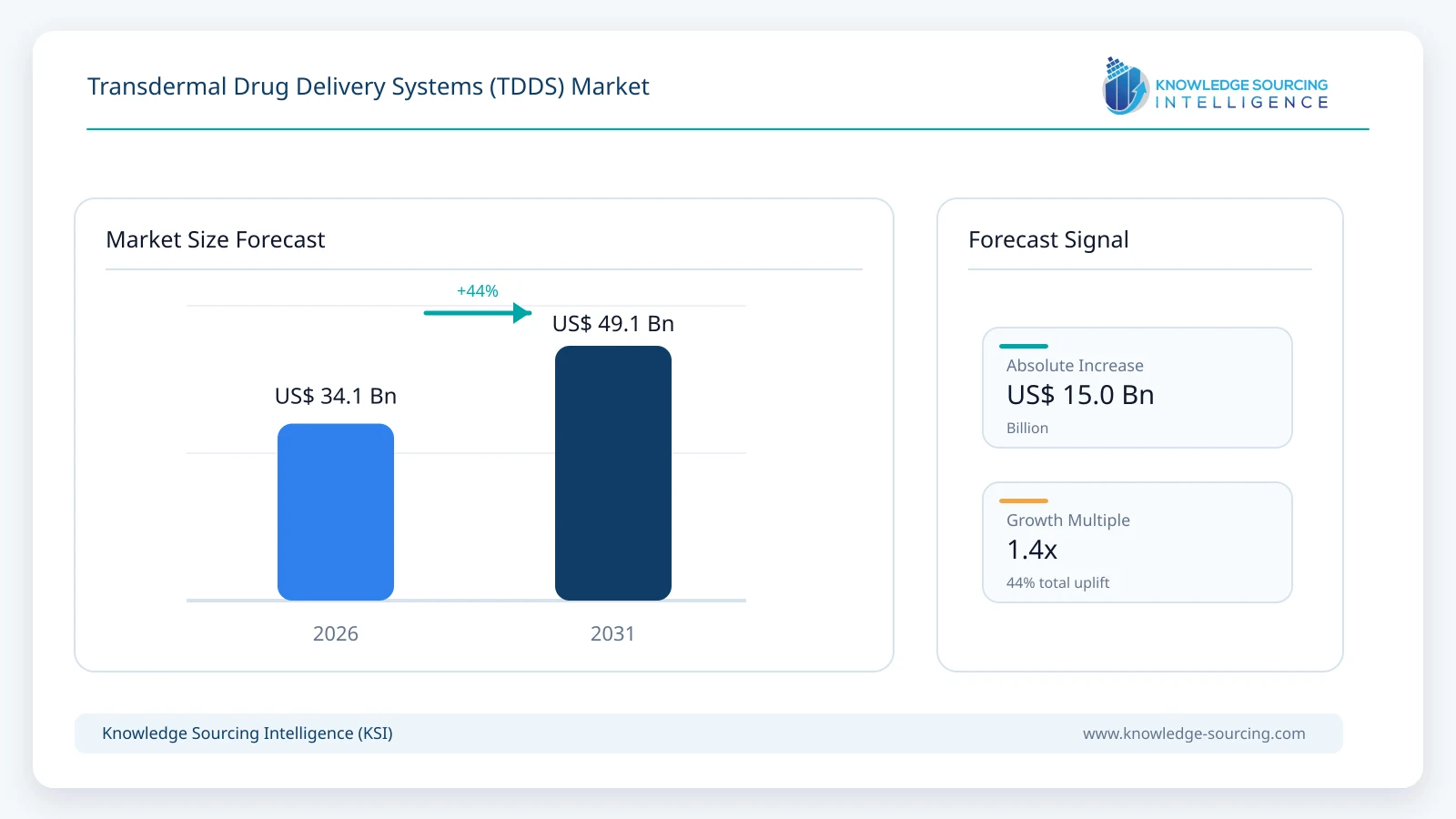
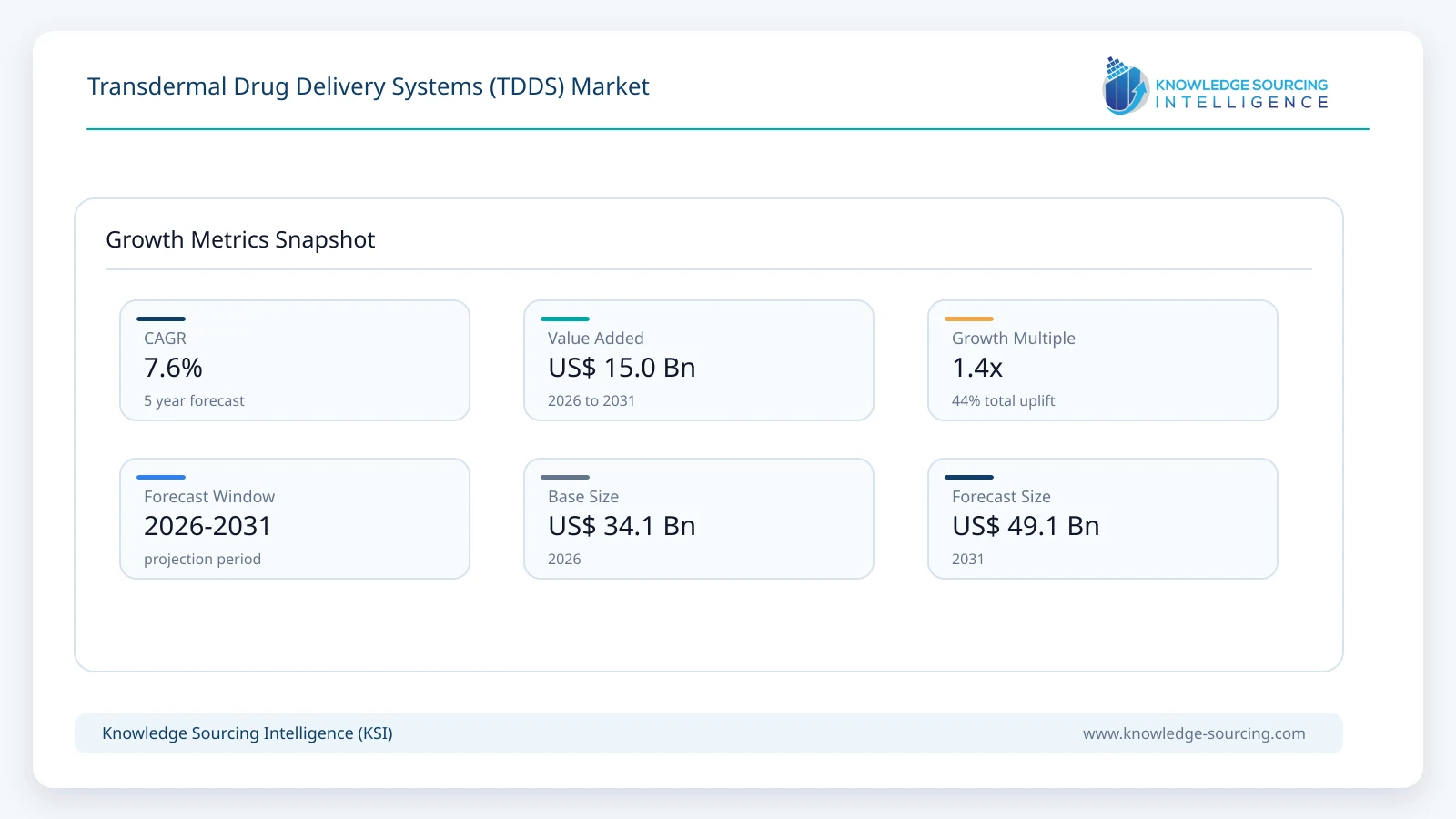
The Transdermal Drug Delivery Systems (TDDS) market is forecast to grow at a CAGR of 7.6%, reaching USD 49.1 billion in 2031 from USD 34.1 billion in 2026.
Highlights:
- 1The Transdermal Drug Delivery Systems market is expanding at a CAGR of 7.6% and is reaching USD 49.1 billion by 2031 amid rising demand for non-invasive therapies.
- 2Patches are currently dominating the type segment with the highest approximate revenue share, as manufacturers are advancing drug-in-adhesive and hydrogel platforms for controlled release.
- 3Pain management is holding the largest application share while cardiovascular and hormone therapies are steadily gaining traction through specialized long-duration patches.
- 4North America is leading regional share, driven by high surgical volumes, as Asia-Pacific is recording the fastest growth from rising chronic disease cases.
- 5Home-care settings are experiencing the quickest end-user expansion as patients are increasingly adopting self-administered patches to improve adherence and reduce clinic visits.
- 6Industry players are continuously integrating advanced permeation testing and solvent-free processes to support next-generation biologics and non-opioid delivery systems.
The global Transdermal Drug Delivery Systems (TDDS) market is increasingly shifting toward convenient, non-invasive, and patient-friendly drug administration, supported by continued adoption of patches for pain management and other chronic therapies. Recent regulatory records demonstrate sustained activity in transdermal products: the U.S. FDA recorded multiple 2025 and 2026 label updates for lidocaine pain-relief patches, including products from Rugby Laboratories, Walmart, and other manufacturers, while its March 2025 Orange Book update also listed the 1.8% lidocaine topical patch ZTLIDO. Diclofenac-based transdermal products also remain an established segment, with FDA records showing recent labeling activity for Flector and Licart diclofenac epolamine topical drug-delivery systems.
At the technology-development level, pharmaceutical developers are placing greater emphasis on controlled drug release, skin permeation, and laboratory-based performance characterization before clinical and regulatory stages. MedPharm states that its IVRT and IVPT capabilities are used to evaluate drug release and permeation from topical and transdermal products, with these studies supporting formulation development, product benchmarking, bioequivalence strategies and regulatory programs for generic and 505(b)(2) products. This reinforces the importance of advanced in-vitro testing in reducing formulation and regulatory uncertainty for next-generation and generic transdermal products.
Meanwhile, established patch manufacturers continue to expand their transdermal technology capabilities. Teikoku Seiyaku identifies transdermal absorption technology as a core development area and reports approximately 7,500 tonnes of plaster production capacity annually, equivalent to around 500 million 10 cm × 14 cm pieces based on its 2023 production volume. Its Hydrohesive platform also demonstrates continued investment in hydrogel-based patch formulations, while its strategy explicitly targets applications beyond conventional pain-relief products. Consequently, the TDDS industry is moving toward more sophisticated patch architectures, validated release and permeation testing, and broader therapeutic applications rather than relying solely on conventional pain-relief patches.
Market Dynamics
Market Drivers
Rising Chronic Disease Prevalence: The increasing incidence of diabetes and heart disease is currently driving the need for long-term, consistent medication delivery via transdermal routes.
Preference for Non-Invasive Therapy: Patients are continuing to shift away from injections toward patches to reduce discomfort and eliminate the need for healthcare professional assistance.
Growth in Self-Administration: The expansion of home-based drug delivery is currently fueling demand for user-friendly patch designs that ensure administration of a complete dose.
Technological Advancements: The integration of novel permeation enhancers is currently increasing the capacity of patches to hold larger amounts of API without increasing patch size.
Restraints and Opportunities
High Manufacturing Costs: Tariffs and the rising cost of specialized polymers are currently creating pricing pressures for advanced iontophoresis and microneedle devices.
Skin Irritation Constraints: Traditional adhesives are continuing to face challenges regarding skin sensitization, which is currently limiting the wear-duration of certain patch formulations.
Biologics Delivery (Opportunity): Adapting silicone-based adhesives for the complex delivery of large-molecule biologics represents a significant future growth frontier for the market.
OTC Channel Expansion (Opportunity): The movement of certain strengths of pain and nicotine patches to over-the-counter (OTC) status is currently broadening the accessible patient base.
Supply Chain Analysis
The TDDS supply chain is currently shifting toward "Solvent-Free Manufacturing" as companies like Medherant adopt cleaner processes to meet environmental and safety standards. Manufacturers are enlisting advanced analytical services to ensure batch-to-batch consistency and regulatory compliance for global market approvals. This evolution is becoming critical as the industry is currently diversifying its supply architecture to mitigate the rising costs of imported active pharmaceutical ingredients (APIs).
Government Regulations
Regulation/Policy | Region | Impact on Market |
Non-Opioid Mandates | Global | Drives demand for topical NSAIDs as first-line recommendations in clinical guidelines for osteoarthritis. |
FDA Patch Approvals | USA | Recent approvals for restless legs syndrome and peptide delivery are currently expanding treatable conditions. |
Tariff Adjustments | USA/Global | Increases the cost of imported polymers and electronic components used in advanced transdermal systems. |
Key Developments:
July 2026: Viatris received U.S. FDA approval for Gwyn Lo™, a once-weekly low-dose estrogen contraceptive transdermal patch, delivering norelgestromin and ethinyl estradiol through a multilayer matrix system. Commercial availability is expected later in 2026.
June 2026: DBV Technologies announced additional FDA engagement for the VIASKIN® Peanut Patch BLA, stating that the agency had not requested additional data and that the company would incorporate FDA feedback before submitting the application in Q3 2026.
May 2026: Viatris presented clinical data for its investigational once-weekly low-dose estrogen combined hormonal contraceptive patch at the 2026 ACOG meeting, highlighting Phase 3 efficacy, safety and strong patch-adhesion performance ahead of its FDA action date.
March 2026: Nutriband selected the commercial worldwide brand-name candidate for its AVERSA™ Fentanyl abuse-deterrent transdermal system and announced plans to submit the proposed name and product labeling to FDA and international regulators for review.
Market Segmentation Analysis
By Type
Patches are currently the dominant segment, accounting for the highest share of revenue due to their ability to provide controlled plasma levels of potent drugs. Gels and Ointments are witnessing steady demand as they are currently enlisting stimuli-responsive hydrogels to improve drug delivery precision. This movement is resulting in an outcome where "Drug-in-Adhesive" patches are reaching a structural preference because they are thin, flexible, and leave no residue upon removal.
By Application
Pain Management currently serves as the largest application area, as clinicians are shifting away from systemic opioids to avoid addiction risks. Cardiovascular and Neurologic Conditions are continuing to grow as specialized patches are currently providing consistent dosing for patients with chronic management needs. Consequently, the application segment is reaching a structural outcome where Hormone Replacement Therapy (HRT) is currently gaining new momentum through innovations in women's health patches.
By End-Users
Home Care Settings are currently experiencing the fastest growth as patients are prioritizing self-administered therapies to avoid outpatient visit costs. Hospitals and Clinics are continuing to utilize TDDS for post-operative pain and chronic condition management to enhance patient adherence. This transition is resulting in a market where surgical centers are reaching a structural outcome of enlisting transdermal systems for faster post-surgical recovery and localized relief.
Regional Analysis
North America remains the leading regional market, currently driven by high surgical volumes and the increasing prevalence of cardiovascular disorders. Asia-Pacific is currently recording the highest growth rate as rising emergency medical cases in China and India are successfully fueling the demand for non-invasive drug delivery. Europe is witnessing a shift toward advanced microneedle and thin-film technologies as regional innovators are currently enlisting interdisciplinary materials research.
List of Companies
3M (Solventum)
ProSolus, Inc.
Zosano Pharma Corporation
MedPharm
Tesa Labtec GmbH
Medherant Limited
Tapemark
Toyochem Co. Ltd.
Delivra Corp
Epinamics GmbH
Company Profiles
3M (Solventum): Strategically distinct for its leadership in material science, the company is successfully enlisting stimuli-responsive hydrogels and advanced foams to optimize drug delivery and wound healing.
Medherant Limited: Notable for its proprietary TEPI® Patch technology, the company is currently developing the world's first testosterone patch for post-menopausal women with high loading capacity and zero "cold flow".
MedPharm: Distinguished by its advanced analytical and formulation expertise, the company is successfully supporting pharmaceutical firms in the seamless scale-up of transdermal patches from early phase to commercial manufacturing.
Analyst View
The TDDS market is entering a "Precision Wearables" phase. Success for participants now depends on successfully enlisting microneedle and silicone adhesive innovations to deliver large-molecule biologics and long-duration non-opioid pain therapies through 2031.
Transdermal Drug Delivery Systems (TDDS) Market Scope:
| Report Metric | Details |
|---|---|
| Total Market Size in 2026 | USD 34.1 billion |
| Total Market Size in 2031 | USD 49.1 billion |
| Forecast Unit | Billion |
| Growth Rate | 7.6% |
| Study Period | 2021 to 2031 |
| Historical Data | 2021 to 2024 |
| Base Year | 2025 |
| Forecast Period | 2026 – 2031 |
| Segmentation | Product, Application, End-User, Geography |
| Companies |
|
Table of Contents
1. Introduction
1.1. Market Definition
1.2. Scope of the Study
1.3. Currency
1.4. Assumptions
1.5. Base and Forecast Years Timeline
2. Research Methodology
2.1. Research Design
2.2. Secondary Sources
2.3. Validation
3. Key Findings of the Study
4. Market Dynamics
4.1. Drivers
4.2. Restraints
4.3. Opportunities and Market Trends
4.4. Market Segmentation
4.5. Porter’s Five Forces Analysis
4.5.1. Bargaining Power of Suppliers
4.5.2. Bargaining Power of Buyers
4.5.3. Threat of New Entrants
4.5.4. Threat of Substitutes
4.5.5. Competitive Rivalry in the Industry
4.6. Industry Value Chain Analysis
4.7. Industry Regulations
4.8. Scenario Analysis
5. Global Transdermal Drug Delivery System Market Forecast by type (US$ billion)
5.1. Patches
5.2. Gels and Ointments
6. Global Transdermal Drug Delivery System Market Forecast by Applications (US$ billion)
6.1. Neurologic Conditions
6.2. Pain Management
6.3. Nicotine Cessation
6.4. Cardiovascular
6.5. Others
7. Global Transdermal Drug Delivery System Market Forecast by End-Users (US$ billion)
7.1. Hospitals and Clinics
7.2. Surgical Centers
7.3. Home Care Settings
8. Global Transdermal Drug Delivery System Market Forecast by Geography (US$ billion)
8.1. North America
8.1.1. The U.S
8.1.2. Canada
8.1.3. Mexico
8.1.4. Others
8.2. South America
8.2.1. Brazil
8.2.2. Argentina
8.2.3. Others
8.3. Europe
8.3.1. U.K.
8.3.2. France
8.3.3. Germany
8.3.4. Italy
8.3.5. Others
8.4. Middle East and Africa
8.4.1. Saudi Arabia
8.4.2. UAE
8.4.3. Israel
8.4.4. Others
8.5. Asia Pacific
8.5.1. China
8.5.2. India
8.5.3. Australia
8.5.4. South Korea
8.5.5. Others
9. Competitive intelligence
9.1. Market Share Analysis
9.2. Strategies of Key Players
9.3. Recent Investments and Deals
10. Company Profiles
10.1.1. Overview
10.1.2. Financials
10.1.3. Product and Services
10.1.4. Recent Developments
10.2. ProSolus, Inc.
10.2.1. Overview
10.2.2. Financials
10.2.3. Product and Services
10.2.4. Recent Developments
10.3. Zosano Pharma Corporation
10.3.1. Overview
10.3.2. Financials
10.3.3. Product and Services
10.3.4. Recent Developments
10.4. MedPharm
10.4.1. Overview
10.4.2. Financials
10.4.3. Product and Services
10.4.4. Recent Developments
10.5. Tesa Labtec GmbH
10.5.1. Overview
10.5.2. Financials
10.5.3. Product and Services
10.5.4. Recent Developments
10.6. Medherant Limited
10.6.1. Overview
10.6.2. Financials
10.6.3. Product and Services
10.6.4. Recent Developments
10.7. Tapemark
10.7.1. Overview
10.7.2. Financials
10.7.3. Product and Services
10.7.4. Recent Developments
10.8. Toyochem Co. Ltd.
10.8.1. Overview
10.8.2. Financials
10.8.3. Product and Services
10.8.4. Recent Developments
10.9. Delivra Corp
10.9.1. Overview
10.9.2. Financials
10.9.3. Product and Services
10.9.4. Recent Developments
10.10. Epinamics GmbH
10.10.1. Overview
10.10.2. Financials
10.10.3. Product and Services
10.10.4. Recent Developments
List of Figures
List of Tables
Navigate
Trusted by the world's leading organizations











