
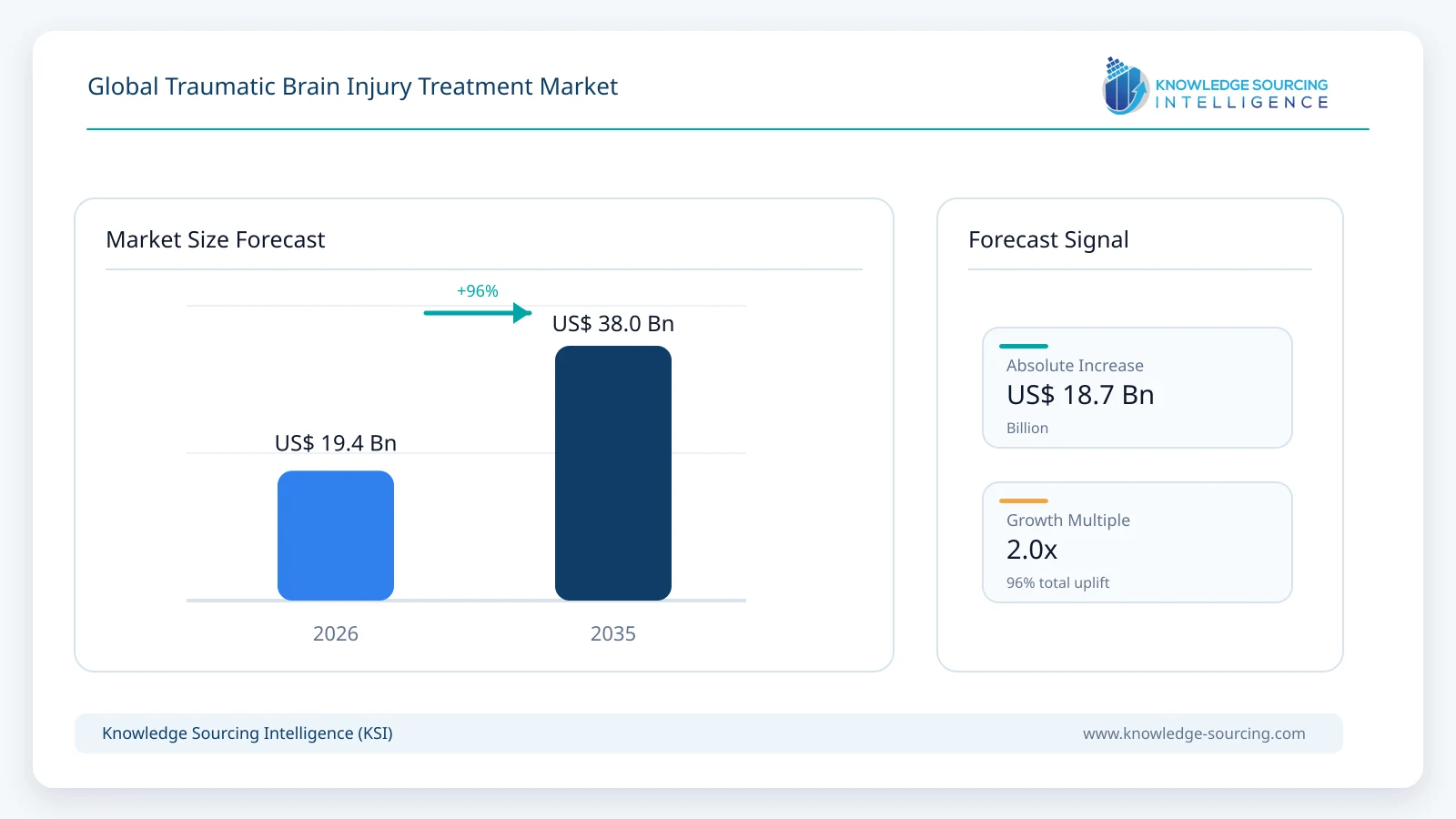
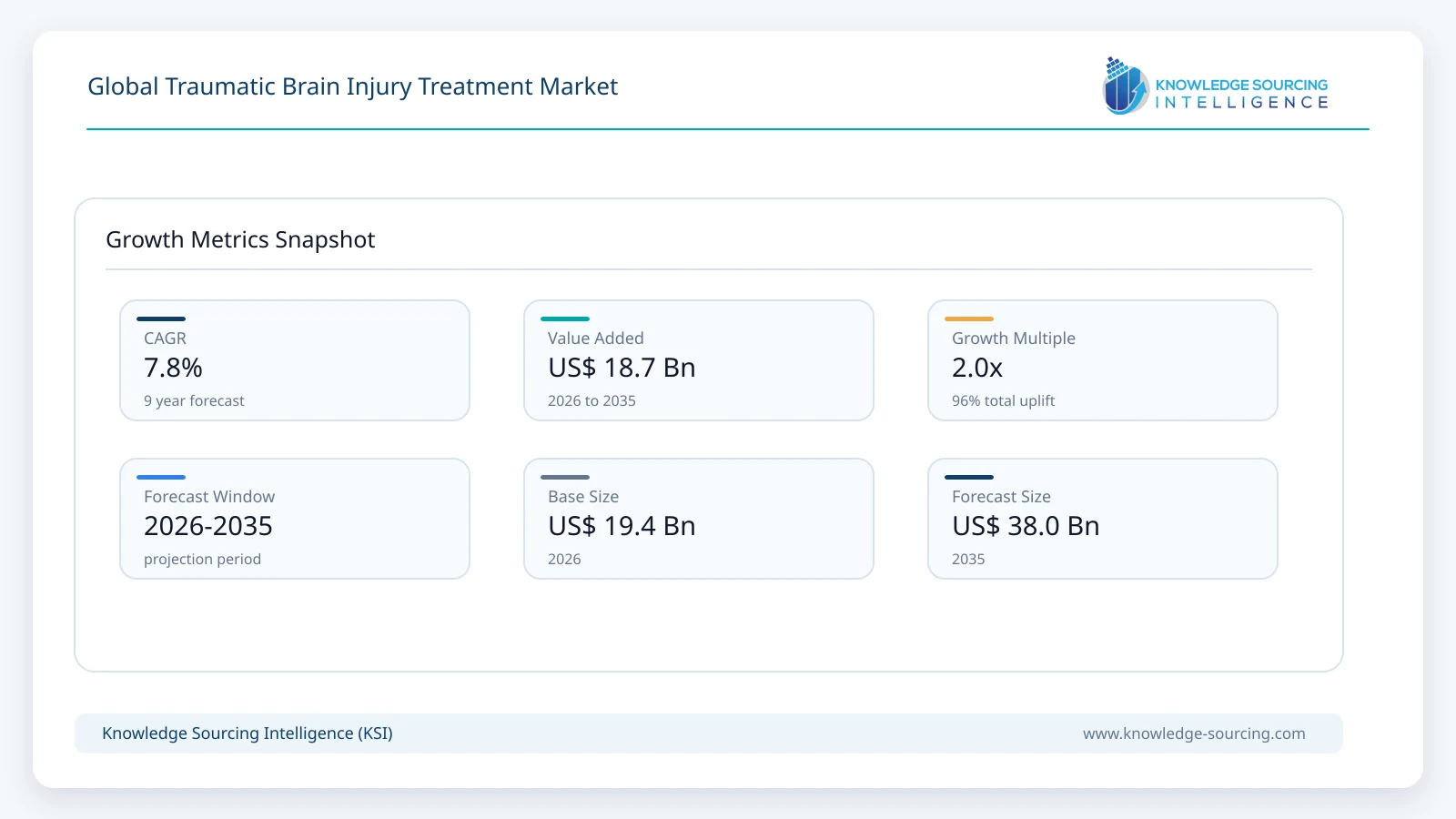
The Global Traumatic Brain Injury Treatment Market is set to reach USD 38.04 billion in 2035, growing at a CAGR of 7.8% from USD 19.38 billion in 2026.
Highlights:
- 1Cell-based regenerative therapies are expanding because restoration of neurological function remains a major unmet need.
- 2Neuroprotective agents continue attracting investment due to their potential to limit secondary brain injury.
- 3Biomarker-guided development is increasing because patient heterogeneity complicates clinical trial outcomes.
- 4Academic-industry collaborations are strengthening as developers seek access to specialized neuroscience expertise.
Traumatic brain injury treatment encompasses acute pharmacological interventions, neuropsychiatric symptom management, and cognitive rehabilitation strategies designed to reduce disability and improve quality of life. Acute treatment remains essential because secondary injury processes contribute significantly to neurological deterioration following trauma. Clinical care pathways are increasingly emphasizing early intervention accordingly. Treatment demand therefore remains closely associated with injury severity and healthcare access.
Long-term management is becoming increasingly important because many patients experience persistent cognitive and behavioral symptoms despite successful acute stabilization. Healthcare systems are expanding rehabilitation services as a result. Treatment strategies therefore continue evolving beyond traditional critical care models.
Market Dynamics
Market Drivers
Falls remain a major cause of traumatic brain injury because aging populations experience greater vulnerability to head trauma. Healthcare utilization continues increasing accordingly. Diagnosed populations therefore continue expanding.
Emergency departments increasingly utilize advanced diagnostic pathways for suspected brain injuries. Detection rates are improving as a result. Epidemiological reporting therefore continues strengthening.
Sports organisations continue implementing concussion monitoring programs because neurological safety concerns are receiving greater attention. Case identification is increasing accordingly. Documented prevalence therefore continues rising.
Biomarker testing and portable neurological assessment tools are becoming increasingly available. Earlier diagnosis is improving accordingly. Disease recognition therefore continues expanding.
Market Restraints
Underreporting remains common among mild TBI cases.
Access to advanced diagnostics varies significantly across regions.
Long-term outcome monitoring remains inconsistent in many healthcare systems.
Marekt Opportunities
Expanded Concussion Awareness
Public education programs continue improving recognition of mild brain injuries. More patients are seeking medical evaluation. Diagnosed populations therefore continue growing.
Integration of Biomarker Testing
Novel diagnostic biomarkers are supporting earlier detection of neurological injury. Clinical confidence is increasing accordingly. Epidemiological accuracy therefore continues improving.
Improved Trauma Registries
National injury surveillance systems are becoming increasingly comprehensive. Population tracking is strengthening accordingly. Long-term epidemiological forecasting therefore continues to improve.
Disease & Epidemiology Analysis
Traumatic brain injury remains one of the leading causes of neurological disability because injury-related cognitive, behavioral, and physical impairments frequently persist beyond the acute event. Disease burden varies according to injury severity. Mild injuries dominate incidence statistics, while moderate and severe injuries account for a disproportionate share of hospitalizations and long-term disability.
Healthcare systems are increasing efforts to identify previously unreported cases because mild injuries often remain undiagnosed. Diagnostic awareness continues improving accordingly. Epidemiological estimates therefore continue becoming more accurate across global healthcare markets.
Treatment Guidelines Landscape
Guideline Area | Mild Traumatic Brain Injury (mTBI) | Moderate Traumatic Brain Injury | Severe Traumatic Brain Injury |
Initial Assessment | Neurological examination, symptom assessment, Glasgow Coma Scale (GCS 13–15), concussion screening, cognitive evaluation | Comprehensive neurological assessment, GCS 9–12, trauma evaluation, neuroimaging assessment | Emergency neurological stabilization, GCS ?8, intensive trauma assessment, airway and hemodynamic evaluation |
Diagnostic Imaging | CT scan when clinically indicated; MRI for persistent symptoms | Routine CT imaging; MRI for detailed structural evaluation | Immediate CT imaging; serial neuroimaging for monitoring intracranial pathology |
Hospitalization Requirement | Usually outpatient management; short observation when necessary | Frequently requires hospitalization for neurological monitoring | Mandatory hospitalization, typically in intensive care units (ICU) |
Intracranial Pressure (ICP) Monitoring | Generally not recommended | Considered in selected high-risk patients | Standard practice for patients with severe injury and suspected elevated ICP |
Surgical Intervention | Rarely required | Required in selected cases involving hematoma or mass effect | Commonly required for hematoma evacuation, decompressive craniectomy, or management of intracranial hypertension |
Pharmacological Management | Symptom-directed therapy for headache, nausea, sleep disturbances, and mood symptoms | Analgesics, seizure prophylaxis when indicated, management of cerebral edema | Sedation, analgesia, anticonvulsants, osmotherapy, neurocritical care medications |
Rehabilitation Approach | Gradual return-to-activity programs, cognitive rehabilitation when needed | Multidisciplinary rehabilitation including physical, occupational, and cognitive therapies | Intensive inpatient neurorehabilitation involving physical, occupational, speech, cognitive, and behavioral therapies |
Return-to-Work / Return-to-Activity | Stepwise return based on symptom resolution and clinical assessment | Individualized return plan following neurological recovery | Long-term functional assessment and rehabilitation before return-to-work consideration |
Follow-Up Monitoring | Monitoring for post-concussion syndrome, cognitive impairment, and psychological symptoms | Regular neurological and functional assessments | Long-term neurological, cognitive, psychiatric, and functional outcome monitoring |
Key Treatment Goal | Symptom resolution and prevention of recurrent injury | Prevention of secondary brain injury and restoration of neurological function | Survival optimization, reduction of secondary injury, and long-term functional recovery |
Primary Care Setting | Emergency department, outpatient clinics, sports medicine centers | Trauma centers and neurological units | Specialized neurocritical care centers and tertiary hospitals |
Long-Term Outcome Focus | Recovery of cognitive and functional performance | Restoration of independence and quality of life | Reduction of disability burden and maximization of neurological recovery |
Market Segmentation
Acute Care Pharmacotherapy
Acute care pharmacotherapy remains the foundation of traumatic brain injury treatment because rapid stabilization of intracranial pressure, cerebral perfusion, and neurological status directly influences patient outcomes. Clinical utilization continues concentrating on interventions that prevent secondary brain injury and support critical care management during the immediate post-trauma period. Healthcare providers are increasingly adopting protocol-driven treatment approaches because timely therapeutic intervention reduces the risk of neurological deterioration. Demand for acute pharmacological management therefore remains closely linked to hospitalization rates and severe injury incidence.
Neuropsychiatric Symptom Management
Neuropsychiatric symptom management represents an increasingly important component of traumatic brain injury care because depression, anxiety, behavioral disturbances, and emotional dysregulation frequently persist after the acute recovery phase. Treatment strategies are increasingly focusing on improving quality of life, rehabilitation participation, and long-term functional outcomes as awareness of chronic neuropsychiatric complications continues growing. Multidisciplinary care models are expanding accordingly. Demand for neuropsychiatric interventions therefore continues increasing across rehabilitation and outpatient settings.
Cognitive Dysfunction Management
Cognitive dysfunction management remains a critical treatment segment because deficits in attention, memory, executive functioning, and information processing significantly affect long-term recovery and social reintegration. Clinicians are increasingly incorporating pharmacological interventions into comprehensive rehabilitation programs as recognition of persistent cognitive impairment continues expanding. Research efforts are simultaneously evaluating novel approaches that enhance neuroplasticity and cognitive recovery. The segment therefore continues gaining strategic importance within the broader traumatic brain injury treatment landscape.
Regional Analysis
North America
North America maintains one of the most comprehensive TBI surveillance infrastructures because trauma registries, emergency care networks, and neurodiagnostic technologies remain highly developed. Concussion awareness programs continue improving identification rates. Epidemiological reporting therefore remains robust. Aging populations are increasing fall-related injuries accordingly. Long-term prevalence therefore continues rising.
Europe
European healthcare systems continue strengthening TBI monitoring because injury prevention and neurological rehabilitation remain public health priorities. Diagnostic pathways are becoming increasingly standardized. Case identification therefore continues improving. Population burden remains significant due to demographic aging and transportation-related injuries.
Asia Pacific
Rapid urbanization and expanding transportation networks continue contributing to injury incidence across many Asia-Pacific countries. Healthcare investment is improving diagnostic access accordingly. Reported prevalence therefore continues increasing. Epidemiological visibility is expected to strengthen substantially through 2045.
Rest of the World
Healthcare infrastructure improvements are increasing recognition of traumatic brain injury across Latin America, the Middle East, and Africa. Diagnostic capabilities remain variable. Awareness initiatives nevertheless continue improving reporting rates. Epidemiological growth therefore remains supported by strengthening healthcare systems.
Regulatory Landscape
Regulatory agencies recognize traumatic brain injury as an area of significant unmet need because approved pharmacological options remain limited. Development incentives are supporting innovation accordingly. Emerging therapy activity therefore continues expanding globally.
Cell therapies and regenerative medicine programs face enhanced regulatory scrutiny because manufacturing consistency, safety monitoring, and long-term efficacy remain critical considerations. Sponsors are increasing regulatory engagement as a result. Development pathways therefore continue evolving alongside scientific advances.
Pipeline Analysis
Current TBI drug development remains concentrated within early and mid-stage clinical programs because historical failures have created substantial scientific and regulatory challenges. Neuroprotective agents account for the largest share of investigational therapies due to their potential to reduce secondary neuronal injury.
Anti-inflammatory therapies continue expanding because increasing evidence links chronic neuroinflammation with persistent neurological dysfunction. Clinical programs are evaluating targeted immune modulation strategies accordingly. This segment therefore represents a significant area of future growth.
Stem cell therapies remain among the most innovative pipeline categories because regenerative medicine offers the possibility of repairing damaged neural tissue. Although development complexity remains high, growing clinical evidence continues supporting ongoing investment.
Reimbursement Landscape
Healthcare payers increasingly recognize the economic burden associated with traumatic brain injury because long-term disability generates significant healthcare expenditures and productivity losses. Diagnostic testing reimbursement continues expanding accordingly. Patient identification therefore continues improving.
Coverage policies increasingly support advanced imaging and neurological assessment when clinical evidence demonstrates improved patient outcomes. Diagnostic utilization is increasing as a result. Epidemiological reporting therefore continues strengthening.
Competitive Landscape
Oragenics, Inc.
Oragenics differentiates itself through intranasal therapeutic delivery platforms designed to rapidly target central nervous system injury pathways. The company focuses on neuroprotective interventions because timely treatment remains critical following traumatic brain injury. Development activities continue emphasizing concussion and mild TBI applications. Its competitive position therefore depends on demonstrating rapid neurological benefit through noninvasive administration.
Cellvation, Inc.
Cellvation concentrates on regenerative cellular technologies designed to promote neurological repair following traumatic brain injury. The company is expanding development programs because regenerative medicine offers potential advantages over purely symptomatic approaches. Clinical translation remains a strategic priority. Its competitive positioning therefore relies on demonstrating meaningful functional recovery outcomes.
Moleac Pte. Ltd.
Moleac focuses on neurorestorative therapies that seek to enhance recovery after neurological injury. Development efforts target mechanisms associated with neuronal repair and functional improvement because long-term disability remains a significant burden. Research programs continue advancing accordingly. The company therefore occupies a differentiated position within neurorecovery-focused development.
Athersys Inc.
Athersys has historically emphasized stem-cell-based regenerative medicine platforms designed to address neurological injury. The company focuses on cellular therapies because regenerative mechanisms may improve recovery potential. Clinical development activity continues informing future strategy. Its competitive strength therefore remains linked to regenerative medicine expertise.
Algernon NeuroScience
Algernon NeuroScience pursues neuroprotective and repurposed therapeutic approaches targeting inflammatory and injury-related pathways. The company emphasizes development efficiency because repurposed compounds may reduce overall development risk. Clinical evaluation continues progressing accordingly. Competitive differentiation therefore stems from pathway-focused innovation.
Hope Biosciences
Hope Biosciences specializes in mesenchymal stem-cell technologies designed to support tissue repair and neurological recovery. Development programs continue expanding because regenerative medicine remains an important area of unmet need. Research collaborations support advancement efforts. The company therefore maintains a strong position within cell-based therapy development.
SanBio Co., Ltd.
SanBio is among the most recognized regenerative medicine developers in neurological disorders because of its focus on cell-based recovery therapies. Clinical advancement remains centered on improving functional outcomes after brain injury. Commercialization capabilities continue strengthening accordingly. Competitive positioning therefore benefits from advanced regenerative expertise.
Medtronic Plc
Medtronic participates in traumatic brain injury management through neurological monitoring and neurotechnology capabilities. The company increasingly supports precision treatment approaches because objective neurological assessment improves patient management. Technology integration continues expanding accordingly. Its competitive strength therefore derives from neurocritical care infrastructure and clinical adoption.
Supernus Pharmaceuticals, Inc.
Supernus possesses extensive central nervous system development expertise that supports evaluation of neurological recovery opportunities. The company focuses on differentiated neuroscience strategies because unmet clinical needs remain substantial. Research activities continue exploring potential expansion areas. Competitive positioning therefore benefits from established CNS capabilities.
Neuren Pharmaceuticals Ltd.
Neuren specializes in neurodevelopmental and neurorestorative therapeutic approaches that may support neurological recovery. The company continues advancing innovative neuroscience programs because functional restoration remains a significant unmet need. Clinical evidence generation remains central to strategy. Its competitive advantage therefore lies in specialized neurological expertise.
Key Developments
March 2025: Oragenics, Inc. continued advancement activities supporting ONP-002 development for concussion and mild traumatic brain injury applications, emphasizing intranasal delivery to improve rapid central nervous system exposure.
February 2025: SanBio Co., Ltd. maintained commercialization and lifecycle expansion activities for regenerative cell therapy programs while evaluating broader neurological recovery opportunities.
January 2025: Hope Biosciences expanded clinical research initiatives involving mesenchymal stem-cell-based neurological recovery programs, supporting regenerative medicine development.
December 2024: Algernon NeuroScience continued development of repurposed neuroprotective approaches targeting inflammatory and neurological injury pathways.
Strategic Insights and Future Market Outlook
The traumatic brain injury treatment landscape is evolving from symptom-focused management toward biological recovery because clinicians increasingly recognize the importance of addressing secondary injury mechanisms and chronic neurological impairment. Development efforts are expanding accordingly. Therapeutic innovation therefore remains strong.
Regenerative medicine, neurorestorative therapies, and precision neuroprotective interventions are expected to drive future market evolution because these approaches target underlying disease processes rather than isolated symptoms. Clinical investment continues increasing as a result. Development momentum therefore remains favorable.
Future competitive leadership will likely depend on demonstrating measurable improvements in neurological recovery, cognitive function, and quality of life. Companies capable of combining innovative science, efficient development strategies, and scalable commercialization models are expected to establish the strongest positions within the evolving traumatic brain injury treatment landscape.
Market Scope:
| Report Metric | Details |
|---|---|
| Total Market Size in 2026 | USD 19.38 billion |
| Total Market Size in 2035 | USD 38.04 billion |
| Forecast Unit | USD Billion |
| Growth Rate | 7.8% |
| Study Period | 2021 to 2035 |
| Historical Data | 2021 to 2024 |
| Base Year | 2025 |
| Forecast Period | 2026 – 2035 |
| Segmentation | Treatment Type, Injury Severity, Treatment Setting, Geography |
| Companies |
|
Market Segmentation
By Geography
Key Countries Analysis
Table of Contents
1. EXECUTIVE SUMMARY
1.1 Report Scope and Objectives
1.2 Key Findings
1.3 Treatment Landscape Overview
1.4 Current Standard of Care Assessment
1.5 Emerging Treatment Trends
1.6 Key Industry Participants
1.7 Strategic Insights
1.8 Future Outlook
2. DISEASE OVERVIEW
2.1 Introduction to Traumatic Brain Injury (TBI)
2.2 Disease Classification
2.2.1 Mild Traumatic Brain Injury (Concussion)
2.2.2 Moderate Traumatic Brain Injury
2.2.3 Severe Traumatic Brain Injury
2.3 Epidemiology and Disease Burden
2.4 Pathophysiology of TBI
2.5 Primary Injury Mechanisms
2.6 Secondary Injury Mechanisms
2.7 Clinical Manifestations
2.8 Diagnosis and Assessment
2.9 Disease Progression
2.10 Unmet Medical Needs
3. CURRENT TREATMENT LANDSCAPE
3.1 Treatment Paradigm Overview
3.2 Acute TBI Management
3.2.1 Emergency Stabilization
3.2.2 Neurocritical Care Management
3.2.3 Intracranial Pressure Management
3.2.4 Surgical Interventions
3.3 Post-Acute Treatment Approaches
3.3.1 Inpatient Rehabilitation
3.3.2 Outpatient Rehabilitation
3.3.3 Cognitive Rehabilitation
3.3.4 Behavioral Rehabilitation
3.4 Long-Term Management Strategies
3.4.1 Symptom Management
3.4.2 Functional Recovery Programs
3.4.3 Quality-of-Life Improvement Strategies
4. PHARMACOLOGICAL TREATMENT LANDSCAPE
4.1 Acute Care Pharmacotherapy
4.1.1 Hyperosmolar Therapy
4.1.2 Sedatives and Analgesics
4.1.3 Anticonvulsants
4.1.4 Neuromuscular Blocking Agents
4.2 Neuropsychiatric Symptom Management
4.2.1 Antidepressants
4.2.2 Anxiolytics
4.2.3 Antipsychotics
4.2.4 Mood Stabilizers
4.3 Cognitive Dysfunction Management
4.3.1 Stimulants
4.3.2 Dopaminergic Agents
4.3.3 Cholinergic Agents
4.4 Sleep Disorder Management
4.4.1 Wakefulness-Promoting Agents
4.4.2 Sleep-Promoting Therapies
4.5 Headache and Pain Management
4.5.1 Analgesics
4.5.2 Migraine Therapies
4.5.3 Neuropathic Pain Treatments
5. NON-PHARMACOLOGICAL TREATMENT LANDSCAPE
5.1 Rehabilitation Therapies
5.1.1 Physical Therapy
5.1.2 Occupational Therapy
5.1.3 Speech and Language Therapy
5.1.4 Vestibular Rehabilitation
5.2 Cognitive Rehabilitation
5.2.1 Memory Training Programs
5.2.2 Executive Function Rehabilitation
5.2.3 Attention Enhancement Programs
5.2.4 Computer-Assisted Cognitive Training
5.3 Behavioral and Psychological Interventions
5.3.1 Psychotherapy
5.3.2 Behavioral Therapy
5.3.3 Family-Based Interventions
5.3.4 Social Reintegration Programs
5.4 Neuromodulation Approaches
5.4.1 Transcranial Magnetic Stimulation (TMS)
5.4.2 Transcranial Direct Current Stimulation (tDCS)
5.4.3 Deep Brain Stimulation (DBS) Research
6. EMERGING TREATMENT LANDSCAPE
6.1 Neuroprotective Therapies
6.1.1 Anti-Inflammatory Therapies
6.1.2 Anti-Excitotoxic Therapies
6.1.3 Antioxidant Therapies
6.1.4 Neuroprotective Small Molecules
6.2 Neurorestorative Therapies
6.2.1 Synaptic Repair Approaches
6.2.2 Neuroplasticity Enhancement Therapies
6.2.3 Functional Recovery Therapies
6.3 Regenerative Medicine
6.3.1 Stem Cell Therapies
6.3.2 Cell-Based Therapies
6.3.3 Tissue Repair Technologies
6.4 Precision Medicine Approaches
6.4.1 Biomarker-Guided Treatments
6.4.2 Personalized Recovery Programs
6.4.3 Patient Stratification Strategies
7. EMERGING DRUG PROFILES
7.1 ONP-002
7.1.1 Drug Overview
7.1.2 Mechanism of Action
7.1.3 Clinical Development Status
7.1.4 Clinical Data Review
7.1.5 Competitive Assessment
7.1.6 Future Outlook
7.2 CMX-2043
7.2.1 Drug Overview
7.2.2 Mechanism of Action
7.2.3 Clinical Development Status
7.2.4 Clinical Data Review
7.2.5 Competitive Assessment
7.2.6 Future Outlook
7.3 CEVA101
7.3.1 Therapy Overview
7.3.2 Mechanism of Action
7.3.3 Clinical Development Status
7.3.4 Clinical Data Review
7.3.5 Competitive Assessment
7.3.6 Future Outlook
7.4 NeuroAiD (MLC901)
7.4.1 Therapy Overview
7.4.2 Mechanism of Action
7.4.3 Clinical Development Status
7.4.4 Clinical Data Review
7.4.5 Competitive Assessment
7.4.6 Future Outlook
7.5 AP-188
7.5.1 Therapy Overview
7.5.2 Mechanism of Action
7.5.3 Clinical Development Status
7.5.4 Clinical Data Review
7.5.5 Competitive Assessment
7.5.6 Future Outlook
8. TREATMENT LANDSCAPE SEGMENTATION
8.1 By Treatment Type
8.1.1 Pharmacological Therapies
8.1.2 Rehabilitation Therapies
8.1.3 Surgical Interventions
8.1.4 Neuromodulation Therapies
8.1.5 Regenerative Medicine Therapies
8.2 By Injury Severity
8.2.1 Mild Traumatic Brain Injury
8.2.2 Moderate Traumatic Brain Injury
8.2.3 Severe Traumatic Brain Injury
8.3 By Treatment Setting
8.3.1 Emergency Care Settings
8.3.2 Intensive Care Units
8.3.3 Inpatient Rehabilitation Centers
8.3.4 Outpatient Clinics
8.3.5 Home-Based Care
8.4 By End User
8.4.1 Hospitals
8.4.2 Specialty Neurology Centers
8.4.3 Rehabilitation Centers
8.4.4 Academic Medical Centers
8.4.5 Home Healthcare Providers
9. CLINICAL PRACTICE AND TREATMENT GUIDELINES
9.1 Current Treatment Guidelines Overview
9.2 Acute Management Recommendations
9.3 Rehabilitation Guidelines
9.4 Long-Term Follow-Up Recommendations
9.5 Regional Guideline Comparison
9.6 Future Guideline Evolution
10. GEOGRAPHICAL ANALYSIS
10.1 North America
10.1.1 Treatment Adoption Trends
10.1.2 Healthcare Infrastructure
10.1.3 Access to Therapies
10.1.4 Reimbursement Environment
10.1.5 Growth Opportunities
10.2 Europe
10.2.1 Treatment Adoption Trends
10.2.2 Healthcare Infrastructure
10.2.3 Access to Therapies
10.2.4 Reimbursement Environment
10.2.5 Growth Opportunities
10.3 Asia-Pacific
10.3.1 Treatment Adoption Trends
10.3.2 Healthcare Infrastructure
10.3.3 Access to Therapies
10.3.4 Reimbursement Environment
10.3.5 Growth Opportunities
10.4 Latin America
10.4.1 Treatment Adoption Trends
10.4.2 Healthcare Infrastructure
10.4.3 Access to Therapies
10.4.4 Reimbursement Environment
10.4.5 Growth Opportunities
10.5 Middle East & Africa
10.5.1 Treatment Adoption Trends
10.5.2 Healthcare Infrastructure
10.5.3 Access to Therapies
10.5.4 Reimbursement Environment
10.5.5 Growth Opportunities
11. KEY COUNTRIES ANALYSIS
11.1 United States
11.1.1 Treatment Landscape Overview
11.1.2 Standard of Care Analysis
11.1.3 Access to Therapies
11.1.4 Reimbursement Environment
11.1.5 Growth Opportunities
11.2 Canada
11.2.1 Treatment Landscape Overview
11.2.2 Standard of Care Analysis
11.2.3 Access to Therapies
11.2.4 Reimbursement Environment
11.2.5 Growth Opportunities
11.3 Germany
11.3.1 Treatment Landscape Overview
11.3.2 Standard of Care Analysis
11.3.3 Access to Therapies
11.3.4 Reimbursement Environment
11.3.5 Growth Opportunities
11.4 United Kingdom
11.4.1 Treatment Landscape Overview
11.4.2 Standard of Care Analysis
11.4.3 Access to Therapies
11.4.4 Reimbursement Environment
11.4.5 Growth Opportunities
11.5 France
11.5.1 Treatment Landscape Overview
11.5.2 Standard of Care Analysis
11.5.3 Access to Therapies
11.5.4 Reimbursement Environment
11.5.5 Growth Opportunities
11.6 Italy
11.6.1 Treatment Landscape Overview
11.6.2 Standard of Care Analysis
11.6.3 Access to Therapies
11.6.4 Reimbursement Environment
11.6.5 Growth Opportunities
11.7 Spain
11.7.1 Treatment Landscape Overview
11.7.2 Standard of Care Analysis
11.7.3 Access to Therapies
11.7.4 Reimbursement Environment
11.7.5 Growth Opportunities
11.8 China
11.8.1 Treatment Landscape Overview
11.8.2 Standard of Care Analysis
11.8.3 Access to Therapies
11.8.4 Reimbursement Environment
11.8.5 Growth Opportunities
11.9 Japan
11.9.1 Treatment Landscape Overview
11.9.2 Standard of Care Analysis
11.9.3 Access to Therapies
11.9.4 Reimbursement Environment
11.9.5 Growth Opportunities
11.10 India
11.10.1 Treatment Landscape Overview
11.10.2 Standard of Care Analysis
11.10.3 Access to Therapies
11.10.4 Reimbursement Environment
11.10.5 Growth Opportunities
11.11 South Korea
11.11.1 Treatment Landscape Overview
11.11.2 Standard of Care Analysis
11.11.3 Access to Therapies
11.11.4 Reimbursement Environment
11.11.5 Growth Opportunities
11.12 Australia
11.12.1 Treatment Landscape Overview
11.12.2 Standard of Care Analysis
11.12.3 Access to Therapies
11.12.4 Reimbursement Environment
11.12.5 Growth Opportunities
12. COMPANY PROFILES
12.1 Oragenics, Inc.
12.1.1 Overview
12.1.2 Financials
12.1.3 TBI Emerging Therapy Portfolio
12.1.4 Research and Development Strategy
12.1.5 Key Therapy Candidates
12.1.6 Clinical Development Programs
12.1.7 Regulatory Strategy
12.1.8 Strategic Collaborations
12.1.9 Recent Developments
12.2 Cellvation, Inc.
12.2.1 Overview
12.2.2 Financials
12.2.3 TBI Emerging Therapy Portfolio
12.2.4 Research and Development Strategy
12.2.5 Key Therapy Candidates
12.2.6 Clinical Development Programs
12.2.7 Regulatory Strategy
12.2.8 Strategic Collaborations
12.2.9 Recent Developments
12.3 Moleac Pte. Ltd.
12.3.1 Overview
12.3.2 Financials
12.3.3 TBI Emerging Therapy Portfolio
12.3.4 Research and Development Strategy
12.3.5 Key Therapy Candidates
12.3.6 Clinical Development Programs
12.3.7 Regulatory Strategy
12.3.8 Strategic Collaborations
12.3.9 Recent Developments
12.4 Athersys Inc.
12.4.1 Overview
12.4.2 Financials
12.4.3 TBI Emerging Therapy Portfolio
12.4.4 Research and Development Strategy
12.4.5 Key Therapy Candidates
12.4.6 Clinical Development Programs
12.4.7 Regulatory Strategy
12.4.8 Strategic Collaborations
12.4.9 Recent Developments
12.5 Algernon NeuroScience
12.5.1 Overview
12.5.2 Financials
12.5.3 TBI Emerging Therapy Portfolio
12.5.4 Research and Development Strategy
12.5.5 Key Therapy Candidates
12.5.6 Clinical Development Programs
12.5.7 Regulatory Strategy
12.5.8 Strategic Collaborations
12.5.9 Recent Developments
12.6 Hope Biosciences
12.6.1 Overview
12.6.2 Financials
12.6.3 TBI Emerging Therapy Portfolio
12.6.4 Research and Development Strategy
12.6.5 Key Therapy Candidates
12.6.6 Clinical Development Programs
12.6.7 Regulatory Strategy
12.6.8 Strategic Collaborations
12.6.9 Recent Developments
12.7 SanBio Co., Ltd.
12.7.1 Overview
12.7.2 Financials
12.7.3 TBI Emerging Therapy Portfolio
12.7.4 Research and Development Strategy
12.7.5 Key Therapy Candidates
12.7.6 Clinical Development Programs
12.7.7 Regulatory Strategy
12.7.8 Strategic Collaborations
12.7.9 Recent Developments
12.8 Medtronic Plc
12.8.1 Overview
12.8.2 Financials
12.8.3 TBI Emerging Therapy Portfolio
12.8.4 Research and Development Strategy
12.8.5 Key Therapy Candidates
12.8.6 Clinical Development Programs
12.8.7 Regulatory Strategy
12.8.8 Strategic Collaborations
12.8.9 Recent Developments
12.9 Supernus Pharmaceuticals, Inc.
12.9.1 Overview
12.9.2 Financials
12.9.3 TBI Emerging Therapy Portfolio
12.9.4 Research and Development Strategy
12.9.5 Key Therapy Candidates
12.9.6 Clinical Development Programs
12.9.7 Regulatory Strategy
12.9.8 Strategic Collaborations
12.9.9 Recent Developments
12.10 Neuren Pharmaceuticals Ltd.
12.10.1 Overview
12.10.2 Financials
12.10.3 TBI Emerging Therapy Portfolio
12.10.4 Research and Development Strategy
12.10.5 Key Therapy Candidates
12.10.6 Clinical Development Programs
12.10.7 Regulatory Strategy
12.10.8 Strategic Collaborations
12.10.9 Recent Developments
13. TREATMENT GAP ANALYSIS AND FUTURE OPPORTUNITIES
13.1 Unmet Clinical Needs
13.2 Treatment Access Challenges
13.3 Emerging Therapeutic Opportunities
13.4 Innovation Opportunities
13.5 Commercial Opportunity Assessment
13.6 Future Treatment Paradigm Evolution
14. KEY OPINION LEADER (KOL) INSIGHTS
14.1 Current Treatment Challenges
14.2 Emerging Therapeutic Trends
14.3 Clinical Practice Evolution
14.4 Future Innovation Priorities
14.5 Expert Outlook
15. RESEARCH METHODOLOGY
15.1 Primary Research
15.2 Secondary Research
15.3 Treatment Landscape Assessment Framework
15.4 Pipeline Evaluation Methodology
15.5 Data Validation and Triangulation
15.6 Assumptions and Limitations
16. APPENDIX
16.1 Abbreviations
16.2 Glossary of Terms
16.3 References
16.4 List of Tables
16.5 List of Figures
16.6 Clinical Trial Registries
16.7 Regulatory Sources
16.8 Company Sources
16.9 Scientific Literature Source
Navigate
Trusted by the world's leading organizations











