
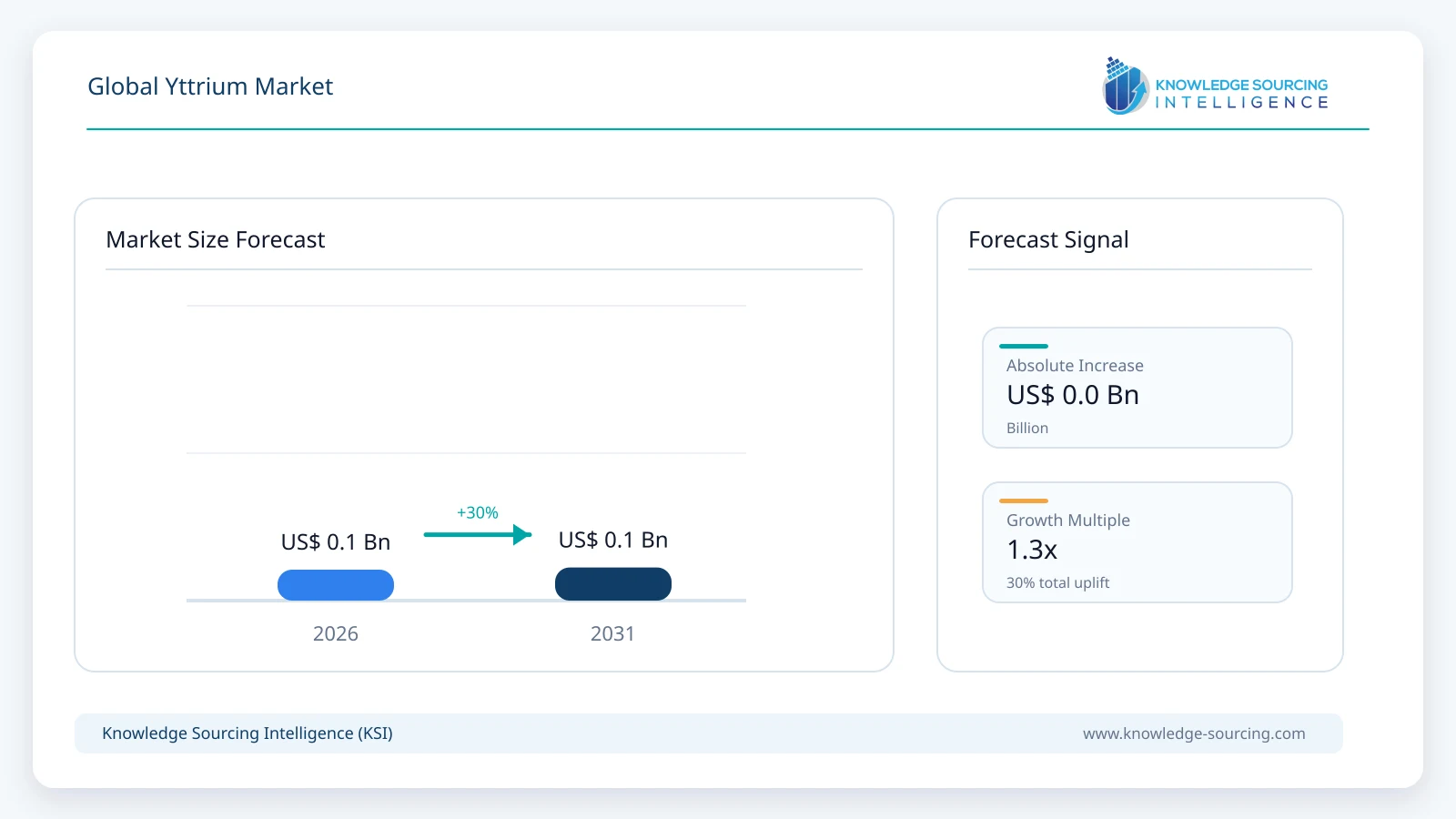
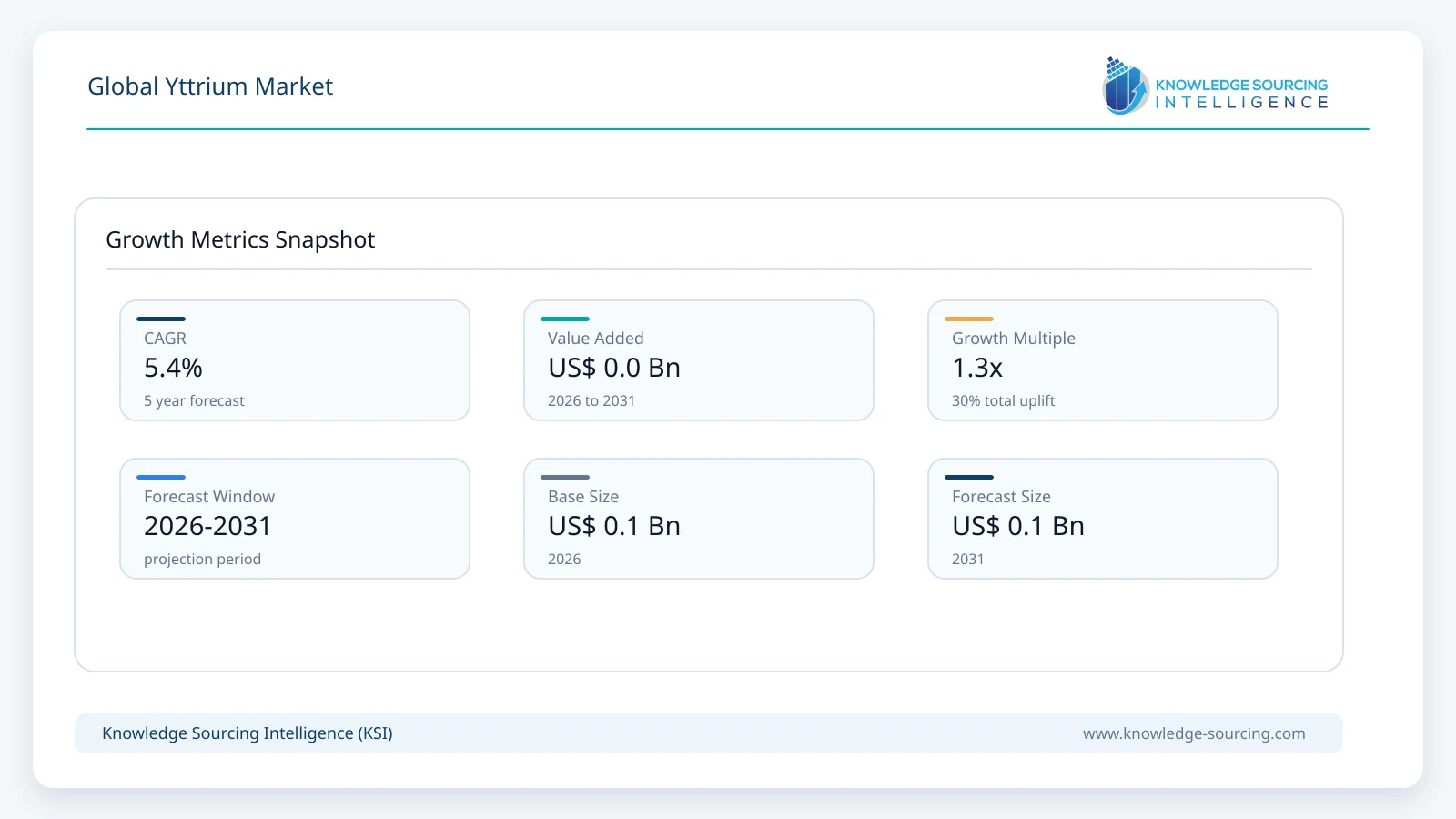
The Global Yttrium Market is forecast to grow at a CAGR of 5.4%, reaching USD 0.13 billion in 2031 from USD 0.10 billion in 2026.
Highlights:
- 1Primary demand catalystExpanding use of high-performance ceramics, semiconductor materials, and specialty alloys requiring high-purity yttrium products.
- 2Leading segmentYttrium compounds represent the largest commercial product category because of their widespread use in ceramics, phosphors, catalysts, lasers, and medical applications.
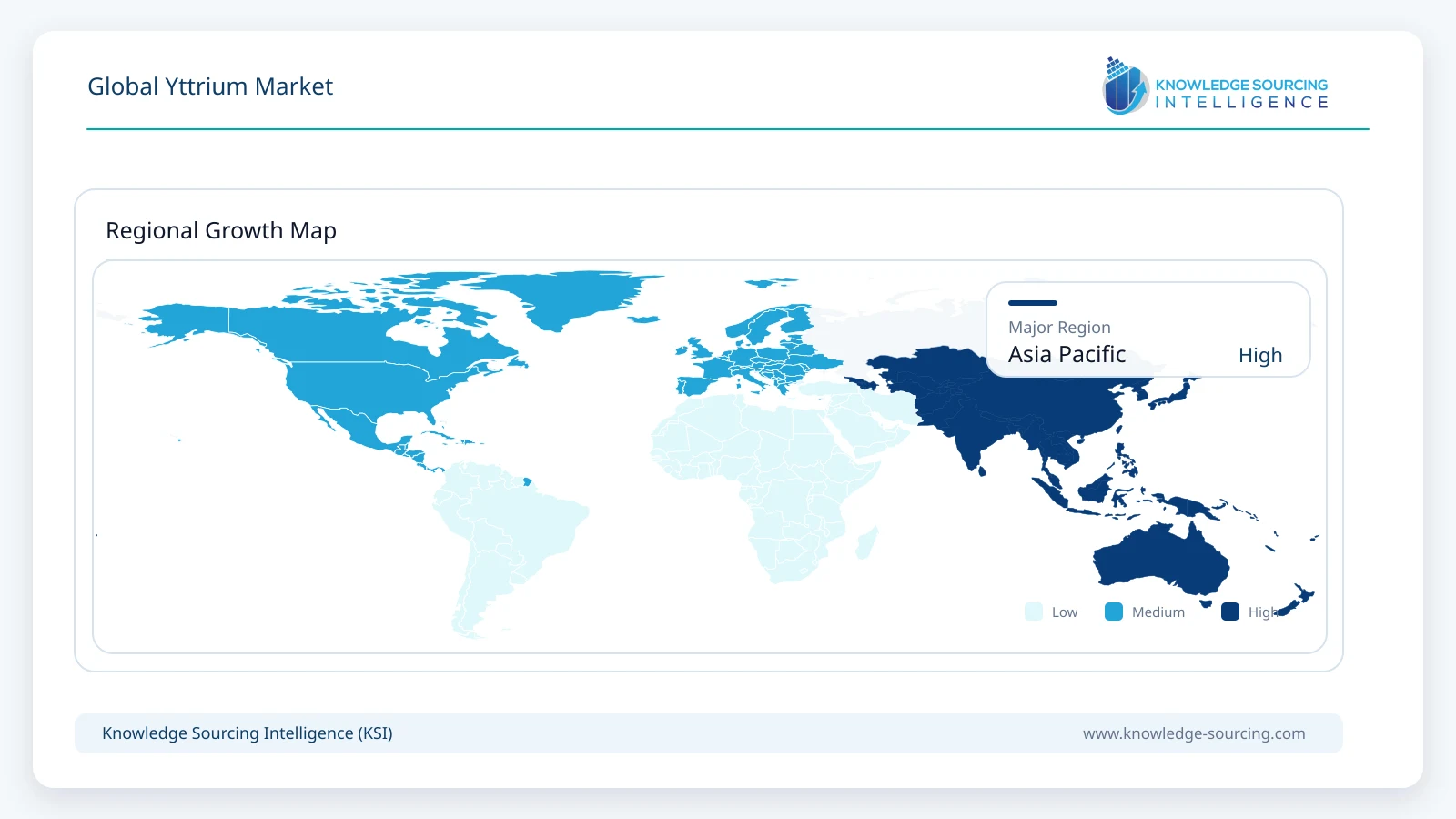
- 3Regional opportunityAsia-Pacific remains the leading production and consumption hub, while North America and Europe continue investing in diversified rare earth processing capacity.
- 4Technology trendHigher-purity refining processes, advanced separation technologies, and rare earth recycling are improving supply reliability and product quality.
- 5Regulatory influenceCritical mineral strategies, export controls, and government-backed supply chain diversification initiatives continue influencing investment decisions.
- 6Competitive trendSuppliers increasingly differentiate themselves through processing capability, product purity, downstream integration, and long-term customer agreements.
The yttrium market comprises the mining, separation, refining, and commercialization of yttrium metal, yttrium compounds, and yttrium-containing alloys used in advanced industrial applications. Although yttrium is categorized as a rare earth element, it is generally recovered as a by-product during the processing of heavy and light rare earth mineral deposits rather than through dedicated mining operations. The market serves a diverse customer base that includes ceramics manufacturers, electronics and semiconductor producers, aerospace and defense contractors, automotive component suppliers, metallurgical companies, and healthcare equipment manufacturers. Commercial demand is determined less by volume consumption and more by the material's ability to enhance thermal stability, mechanical strength, optical performance, corrosion resistance, and electrical characteristics in high-value applications.
Procurement decisions within the market emphasize purity, consistency, and long-term supply security. Industrial buyers typically specify yttrium products according to stringent technical standards because impurities can affect the performance of ceramic components, phosphors, laser crystals, superconducting materials, and semiconductor devices. Consequently, purchasing contracts frequently involve detailed quality specifications, traceability requirements, and long-term supply agreements rather than spot transactions. Manufacturers capable of delivering high-purity yttrium products supported by analytical testing and reliable logistics generally secure stronger commercial relationships with downstream industries.
Supply chain economics remain closely linked to the broader rare earth industry. Yttrium production depends on the availability of rare earth concentrates, separation capacity, and refining infrastructure, making supply vulnerable to mining output, processing capacity, export policies, and environmental permitting. China continues to account for a substantial portion of global rare earth separation and processing, influencing international availability and pricing of yttrium materials. At the same time, governments in North America, Europe, and Asia-Pacific are encouraging investment in diversified rare earth supply chains to reduce dependence on single-country processing and strengthen critical mineral security.
Demand is increasingly supported by industries requiring materials capable of operating under extreme temperatures, corrosive environments, and demanding electrical conditions. Yttrium oxide remains an essential raw material for advanced ceramics and thermal barrier coatings, while yttrium-containing phosphors support specialized lighting, imaging, and display applications. In metallurgy, yttrium improves grain refinement and oxidation resistance in specialty alloys used in aerospace, energy, and industrial equipment. Healthcare applications, including medical imaging and laser technologies, also contribute to steady commercial demand for high-purity yttrium compounds.
Competition across the market extends beyond production volume. Suppliers compete through refining expertise, product purity, application-specific grades, technical support, secure sourcing arrangements, and geographic diversification of processing operations. Companies are also investing in recycling technologies, downstream value-added products, and strategic partnerships with manufacturers operating in semiconductor, defense, and clean energy supply chains. These initiatives strengthen commercial resilience while supporting customer requirements for dependable critical mineral supply.
Market Drivers
Rising Demand for Advanced Ceramics Supports Yttrium Consumption
Advanced ceramics represent one of the largest commercial applications for yttrium compounds because they improve thermal stability, fracture resistance, and mechanical performance in demanding operating environments. Manufacturers serving electronics, industrial equipment, medical devices, and energy sectors increasingly specify yttrium-stabilized ceramic materials to achieve longer product life and higher operational reliability. Feedstock suppliers are responding by expanding refining capacity and developing higher-purity yttrium oxide grades that satisfy increasingly stringent industrial specifications. This demand continues to strengthen long-term procurement agreements between refiners and ceramic manufacturers.
Semiconductor Manufacturing Requires High-Purity Rare Earth Materials
Growth in semiconductor fabrication continues supporting demand for ultra-high-purity yttrium materials used in deposition equipment, ceramic components, sputtering targets, and specialized electronic applications. Semiconductor manufacturers prioritize consistent chemical composition, contaminant control, and dependable delivery schedules because production interruptions carry substantial financial consequences. Suppliers continue investing in purification technologies, analytical laboratories, and process control systems to satisfy these demanding customer requirements while strengthening their competitive positions within high-value electronics supply chains.
Government Support for Critical Mineral Supply Chains Encourages Investment
Many governments now classify rare earth elements as strategic materials because of their importance in defense, electronics, renewable energy, and advanced manufacturing. Public investment programs, financial incentives, and policy initiatives supporting domestic mining, refining, and recycling are encouraging the development of alternative yttrium supply chains outside traditional production centers. Mining companies, refiners, and downstream manufacturers are responding through joint ventures, processing investments, and long-term offtake agreements that improve supply security and reduce geopolitical supply risks.
Aerospace and High-Temperature Metallurgy Expand Material Requirements
Yttrium-containing alloys and coatings are increasingly specified for aerospace engines, industrial turbines, and other applications requiring exceptional oxidation resistance and high-temperature performance. Manufacturers seek materials capable of extending component service life while reducing maintenance costs under severe operating conditions. Suppliers continue developing specialized yttrium alloy products and coating materials tailored to demanding engineering applications, creating opportunities for higher-value product portfolios and closer collaboration with advanced manufacturing industries.
Market Restraints and Challenges
Concentrated Processing Capacity Creates Supply Risks
Although yttrium occurs in numerous rare earth mineral deposits, commercial refining capacity remains concentrated in a limited number of countries. Dependence on relatively few processing facilities increases exposure to export restrictions, geopolitical developments, environmental regulations, and logistical disruptions. Industrial buyers requiring uninterrupted supply frequently diversify procurement sources, establish inventory buffers, and negotiate long-term supply agreements to reduce operational risk.
Complex Separation Processes Increase Production Costs
Recovering yttrium from mixed rare earth concentrates requires sophisticated separation technologies, extensive chemical processing, and strict quality control procedures. High capital expenditure, energy requirements, reagent consumption, and environmental management obligations contribute to elevated production costs compared with more common industrial materials. Companies continue investing in process optimization, solvent extraction improvements, and recycling technologies to improve operating efficiency and strengthen long-term competitiveness.
Price Volatility Complicates Procurement Planning
Yttrium pricing is influenced by rare earth mining output, processing availability, export policies, and fluctuations in downstream industrial demand. Unexpected price movements complicate procurement planning for manufacturers operating under long-term production contracts. Buyers increasingly utilize diversified sourcing strategies, strategic inventories, and supply agreements with established producers to improve pricing stability and reduce exposure to market disruptions.
Environmental Compliance Extends Project Development Timelines
Rare earth extraction and refining operations are subject to increasingly rigorous environmental assessment, waste management, water treatment, and emissions regulations across many jurisdictions. Compliance requirements may increase development costs and extend permitting timelines for new mining and processing projects. Companies are responding by investing in cleaner processing technologies, improved waste recovery systems, and enhanced environmental management practices that support long-term operational sustainability.
Major Segment Analysis
Yttrium Compounds Represent the Largest Commercial Segment
Yttrium compounds account for the largest share of commercial demand because they serve a broad range of high-value industrial applications where material performance directly influences product reliability and manufacturing quality. Yttrium oxide, yttrium nitrate, yttrium fluoride, and related compounds are extensively used in advanced ceramics, phosphors, catalysts, laser crystals, electronic substrates, medical imaging technologies, and thermal barrier coatings. Their versatility allows manufacturers to address requirements across multiple industries using highly specialized chemical formulations.
Commercial demand is primarily generated by ceramics manufacturers, semiconductor companies, healthcare equipment producers, and advanced materials suppliers that require exceptionally high chemical purity and consistent physical characteristics. Buyers frequently establish long-term procurement relationships with qualified suppliers because changes in material quality can directly affect manufacturing yields, equipment performance, and regulatory compliance. Product certification, analytical testing, and traceability therefore remain essential purchasing criteria.
Competition within the yttrium compounds segment centers on refining capability, purity standards, technical application support, and the ability to produce customized formulations for specific industrial processes. Manufacturers continue investing in advanced purification technologies, laboratory infrastructure, and downstream processing to supply premium-grade materials suitable for electronics, defense, and medical applications. As demand for high-performance materials continues expanding across technology-intensive industries, yttrium compounds are expected to remain the principal revenue-generating segment within the global yttrium market throughout the forecast period.
Regional Analysis
Asia-Pacific
Asia-Pacific represents the largest regional market for yttrium due to its concentration of rare earth mining, separation, refining, and downstream manufacturing activities. China dominates global yttrium production and processing through its integrated rare earth supply chain, supplying high-purity yttrium compounds and metals for ceramics, electronics, phosphors, and specialty alloys. Japan, South Korea, and Taiwan generate substantial demand from semiconductor fabrication, electronic component manufacturing, precision ceramics, and advanced materials industries, where product quality depends on ultra-high-purity yttrium materials. India is gradually expanding its rare earth processing capabilities through government-backed critical mineral initiatives, while Southeast Asian countries continue attracting investments in electronics manufacturing that support long-term demand. Despite its leadership, the region faces increasing regulatory oversight of mining activities, stricter environmental requirements, and geopolitical developments affecting international trade in critical minerals.
North America
North America is strengthening its position within the yttrium market through investments in domestic rare earth mining, processing infrastructure, and downstream manufacturing to reduce dependence on imported critical minerals. The United States is encouraging development of integrated rare earth supply chains through financial incentives, public-private partnerships, and critical mineral policies supporting defense, semiconductor, and advanced manufacturing industries. Demand is primarily generated by aerospace, defense, healthcare, semiconductor, and industrial ceramic manufacturers seeking secure supplies of high-purity yttrium materials. Canada contributes through mineral exploration and rare earth project development, while Mexico benefits from its electronics and automotive manufacturing base. Commercial activity increasingly focuses on refining capacity, recycling technologies, and strategic partnerships designed to improve supply security and strengthen regional competitiveness.
Europe
Europe remains a technology-intensive market where demand is driven by advanced ceramics, aerospace components, medical equipment, industrial coatings, and semiconductor manufacturing rather than primary rare earth production. Germany, France, the United Kingdom, Italy, and other European countries rely largely on imported yttrium products while investing in supply chain diversification through recycling, refining projects, and strategic sourcing partnerships. Government initiatives under the European Union's Critical Raw Materials Act encourage domestic processing, circular economy practices, and reduced dependence on concentrated external supply sources. Buyers place considerable emphasis on product purity, environmental compliance, responsible sourcing, and long-term supply agreements, encouraging suppliers to expand local processing capabilities and technical support services.
Middle East & Africa and South America
The Middle East & Africa and South America remain emerging participants in the yttrium value chain. Commercial demand originates primarily from metallurgy, industrial ceramics, healthcare, and manufacturing sectors, while several countries continue evaluating rare earth mineral resources for future development. Brazil possesses notable rare earth mineral potential and continues attracting exploration and investment activity, whereas Saudi Arabia is expanding mining investment under broader industrial diversification programs. South Africa also maintains mineral processing capabilities that support future opportunities within the rare earth industry. Infrastructure development, regulatory modernization, and foreign investment are expected to determine the pace of regional participation, although limited refining capacity and downstream manufacturing currently constrain market expansion.
Competitive Landscape
The yttrium market is characterized by a concentrated upstream supply structure combined with specialized downstream processing and distribution networks. Competition depends on access to rare earth feedstock, separation technology, refining capability, product purity, and the ability to maintain reliable supply for industries operating under demanding technical specifications.
Companies including MP Materials Corp., Arafura Rare Earths Limited, Lynas Rare Earths Ltd, China Minmetals Rare Earth Co., Ltd., Neo Performance Materials Inc., Shenghe Resources Holding Co., Ltd., Iluka Resources Limited, Otto Chemie Pvt. Ltd., Tokyo Chemical Industry Co., Ltd., Chinalco Rare Earth & Metals Co., Ltd., and AEM REE Inc. compete by expanding refining capacity, strengthening downstream processing, improving product quality, and securing long-term supply agreements with industrial customers.
Competition increasingly extends beyond mining operations toward vertically integrated business models encompassing separation, refining, alloy production, recycling, and advanced material manufacturing. Strategic partnerships with governments, semiconductor manufacturers, aerospace suppliers, and defense contractors continue supporting investment in processing infrastructure outside traditional production centers. Suppliers capable of delivering consistent high-purity yttrium products with dependable logistics, technical support, and traceable sourcing remain well positioned within high-value industrial applications.
Recent Developments
April 2026: USA Rare Earth confirmed that its commercial yttrium metal capability complements planned yttrium extraction from the Round Top project and downstream oxide processing, strengthening an integrated non-Chinese rare-earth supply chain for aerospace, defense, and advanced manufacturing customers.
April 2026: China approved a 60-ton shipment of yttrium oxide to the United States, the largest export since export controls were introduced, easing supply constraints for aerospace and semiconductor manufacturers dependent on high-purity yttrium materials.
February 2026: MP Materials Corp. reported the first commercial production of NdFeB magnets at its Independence facility and announced continued expansion of its integrated rare earth manufacturing platform. The development reinforces investment in downstream processing and strengthens supply security for advanced manufacturing industries.
Regulatory and Policy Environment
The yttrium market is increasingly influenced by government policies governing critical minerals, environmental protection, export controls, and strategic industrial development. Many economies now classify rare earth elements as strategically important because of their role in semiconductors, aerospace systems, renewable energy technologies, defense equipment, and advanced manufacturing.
The European Union's Critical Raw Materials Act encourages diversification of rare earth supply chains through domestic processing, recycling, and strategic partnerships. In the United States, federal initiatives supporting domestic mining, refining, and magnet manufacturing seek to strengthen long-term supply resilience and reduce reliance on imported rare earth products. Similar policy initiatives in Australia, Canada, Japan, and South Korea continue supporting investment in processing facilities, mineral exploration, and downstream manufacturing.
Mining and refining projects must also comply with increasingly rigorous environmental regulations governing waste management, emissions control, water use, and rehabilitation. These requirements encourage producers to adopt cleaner processing technologies, improve resource recovery, and invest in recycling systems capable of recovering yttrium and other valuable rare earth elements from industrial waste streams and end-of-life products.
Outlook and Strategic Implications
Between 2026 and 2031, the yttrium market is expected to benefit from sustained demand across advanced ceramics, semiconductor manufacturing, aerospace, defense, healthcare, and specialty metallurgy. Procurement strategies are likely to place greater emphasis on supply diversification, long-term contractual relationships, and verified product quality as industrial users seek to reduce exposure to concentrated global processing capacity.
Investment priorities are expected to focus on rare earth separation facilities, downstream refining, recycling technologies, and integrated manufacturing operations capable of producing high-purity yttrium compounds and specialty materials. Governments are also likely to continue supporting domestic critical mineral projects through financial incentives, permitting reforms, and strategic procurement initiatives.
Competition will increasingly depend on technological capability rather than mining output alone. Companies investing in advanced refining processes, high-purity production, vertical integration, and strategic customer partnerships are expected to strengthen their market positions. Although challenges associated with supply concentration, regulatory compliance, environmental permitting, and raw material price volatility will persist, continued investment in diversified processing infrastructure and critical mineral security is expected to support the long-term development of the global yttrium market during the 2026–2031 forecast period.
Yttrium Market Scope
| Report Metric | Details |
|---|---|
| Total Market Size in 2026 | USD 0.10 billion |
| Total Market Size in 2031 | USD 0.13 billion |
| Forecast Unit | Billion |
| Growth Rate | 5.4% |
| Study Period | 2021 to 2031 |
| Historical Data | 2021 to 2024 |
| Base Year | 2025 |
| Forecast Period | 2026 – 2031 |
| Segmentation | Product, End-Use Industry, Geography |
| Companies |
|
Market Segmentation
By Product
- Yttrium Compounds
- Yttrium Alloys
- Yttrium Metal
By End-Use Industry
- Ceramics
- Electronics and Semiconductors
- Metallurgy
- Automotive
- Healthcare
- Aerospace and Defense
- Others
By Geography
- North America
- United States
- Canada
- Mexico
- South America
- Brazil
- Argentina
- Rest of South America
- Europe
- United Kingdom
- Germany
- France
- Italy
- Spain
- Rest of Europe
- Middle East and Africa
- Saudi Arabia
- South Africa
- Rest of Middle East and Africa
- Asia-Pacific
- China
- India
- Japan
- South Korea
- Taiwan
- Thailand
- Indonesia
- Rest of Asia-Pacific
Table of Contents
1. INTRODUCTION
1.1. Market Overview
1.2. Market Definition
1.3. Scope of the Study
1.4. Market Segmentation
1.5. Currency
1.6. Assumptions
1.7. Base, Historical, Estimated, and Forecast Years Timeline
1.8. Key Benefits for Stakeholders
2. RESEARCH METHODOLOGY
2.1. Research Design
2.2. Research Process
3. EXECUTIVE SUMMARY
3.1. Key Findings
3.2. Analyst View
4. MARKET DYNAMICS
4.1. Market Drivers
4.1.1. Increasing Demand from the Electronics Industry
4.1.2. Rising Applications in the Defense and Aerospace Sectors
4.1.3. Growing Use in Semiconductor Manufacturing
4.2. Market Restraints
4.2.1. High Supply Chain Concentration and Dependence on China
4.3. Porter's Five Forces Analysis
4.3.1. Bargaining Power of Suppliers
4.3.2. Bargaining Power of Buyers
4.3.3. Threat of New Entrants
4.3.4. Threat of Substitutes
4.3.5. Competitive Rivalry in the Industry
4.4. Industry Value Chain Analysis
5. GLOBAL YTTRIUM MARKET BY PRODUCT
5.1. Introduction
5.2. Yttrium Compounds
5.3. Yttrium Alloys
5.4. Yttrium Metal
6. GLOBAL YTTRIUM MARKET BY END-USE INDUSTRY
6.1. Introduction
6.2. Ceramics
6.3. Electronics and Semiconductors
6.4. Metallurgy
6.5. Automotive
6.6. Healthcare
6.7. Aerospace and Defense
6.8. Others
7. GLOBAL YTTRIUM MARKET BY GEOGRAPHY
7.1. Global Overview
7.2. North America
7.2.1. United States
7.2.2. Canada
7.2.3. Mexico
7.3. South America
7.3.1. Brazil
7.3.2. Argentina
7.3.3. Rest of South America
7.4. Europe
7.4.1. United Kingdom
7.4.2. Germany
7.4.3. France
7.4.4. Italy
7.4.5. Spain
7.4.6. Rest of Europe
7.5. Middle East and Africa
7.5.1. Saudi Arabia
7.5.2. South Africa
7.5.3. Rest of Middle East and Africa
7.6. Asia-Pacific
7.6.1. China
7.6.2. India
7.6.3. Japan
7.6.4. South Korea
7.6.5. Taiwan
7.6.6. Thailand
7.6.7. Indonesia
7.6.8. Rest of Asia-Pacific
8. COMPETITIVE LANDSCAPE
8.1. Major Players and Strategy Analysis
8.2. Market Share Analysis
8.3. Mergers, Acquisitions, Agreements, and Collaborations
8.4. Competitive Dashboard
9. COMPANY PROFILES
9.1. MP Materials Corp.
9.2. Arafura Rare Earths Limited
9.3. Lynas Rare Earths Ltd
9.4. China Minmetals Rare Earth Co., Ltd.
9.5. Neo Performance Materials Inc.
9.6. Shenghe Resources Holding Co., Ltd.
9.7. Iluka Resources Limited
9.8. Otto Chemie Pvt. Ltd.
9.9. Tokyo Chemical Industry Co., Ltd.
9.10. Chinalco Rare Earth & Metals Co., Ltd.
9.11. AEM REE Inc.
Navigate
Trusted by the world's leading organizations











