
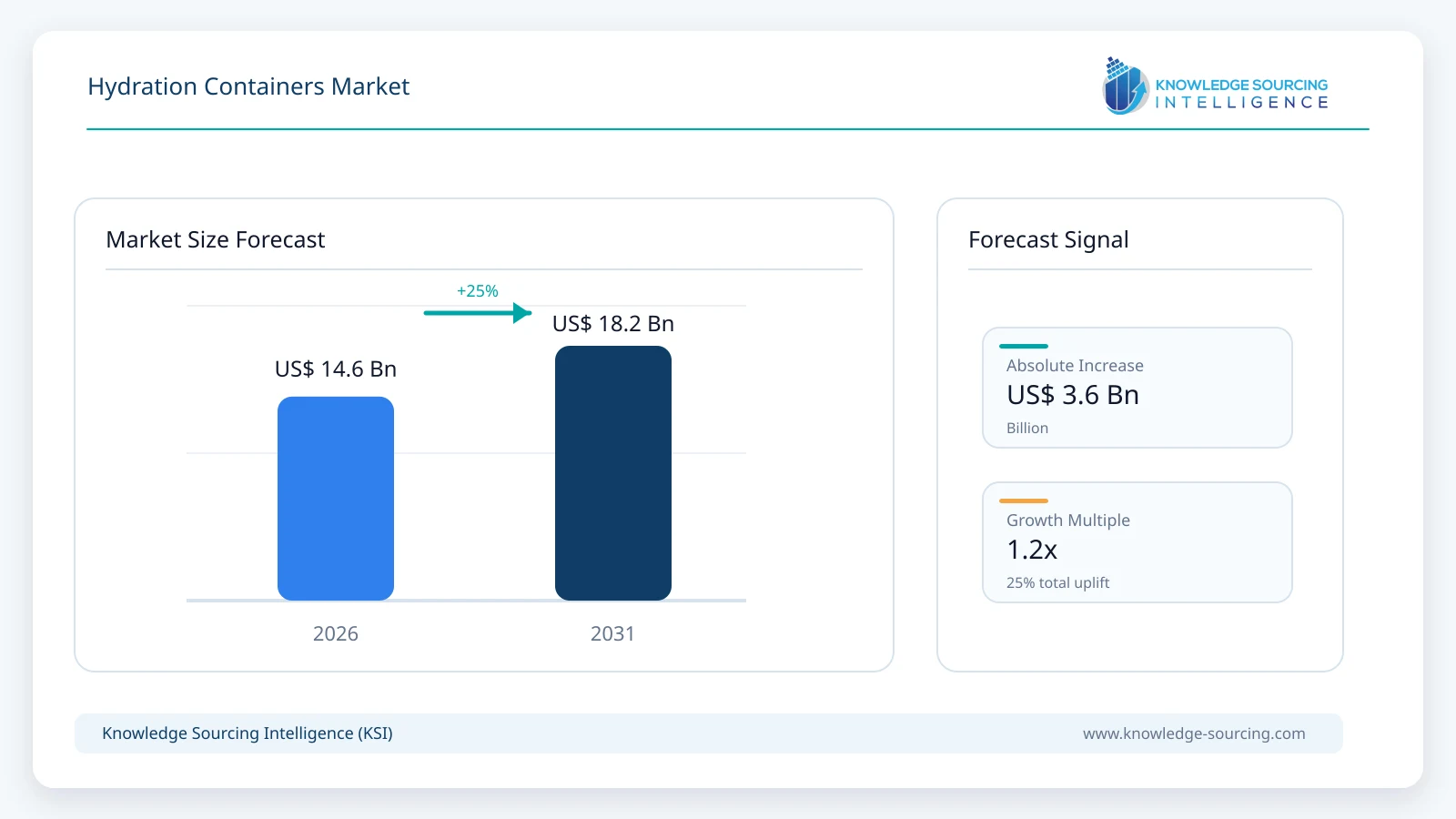
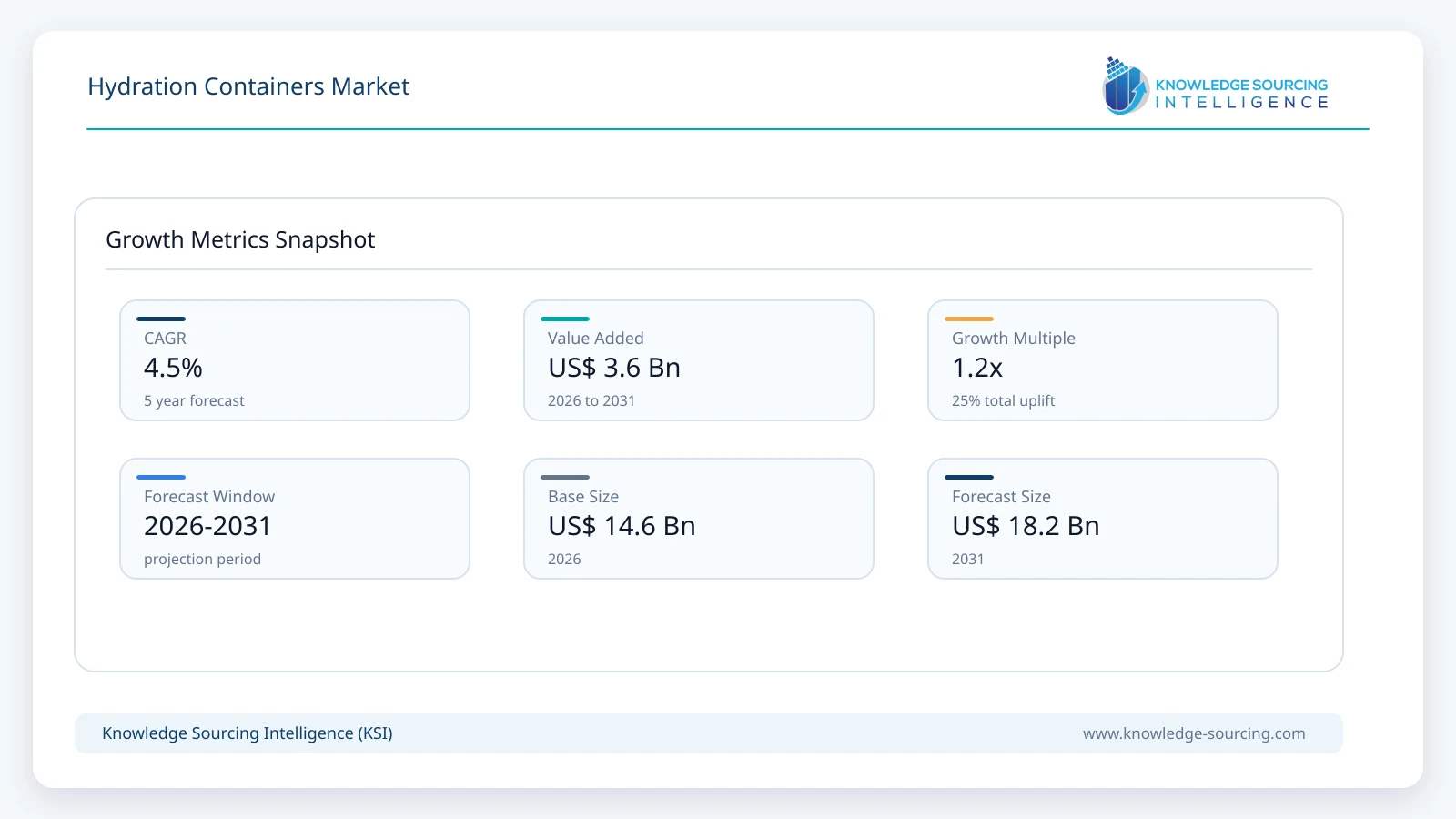
The Hydration Containers market is forecast to grow at a CAGR of 4.54%, reaching USD 18.21 billion in 2031 from USD 14.58 billion in 2026.
Highlights:
- 1Regulatory EnforcementNew EU prohibitions on Bisphenol A (BPA) in food contact materials are forcing a massive industrial pivot toward high-grade stainless steel and glass.
- 2Supply Chain LocalizationManufacturers are relocating production closer to consumption hubs in India and Southeast Asia to counteract volatile freight costs and improve lead times for seasonal releases.
- 3Premiumization PressureScarcity-driven marketing and exclusive "color-drop" releases are transforming standard hydration tools into prioritized status symbols in urban markets.
- 4Omnichannel DominanceThe bankruptcy of traditional direct-sales giants like Tupperware signals a structural collapse of legacy distribution models in favor of e-commerce and retail-hybrid platforms.
The hydration containers market operates as a critical infrastructure for personal health maintenance within the consumer goods sector. The demand drivers center on the rising necessity for mobile fluid delivery systems that mitigate environmental waste while ensuring beverage temperature stability. Dependency on these products increases as urban populations prioritize wellness-oriented lifestyles and hydration tracking. Regulatory influence remains a primary catalyst for market restructuring, particularly through international bans on bisphenols and microplastic-leaching materials. Strategic importance is elevating as containers shift from utilitarian commodities to high-margin lifestyle accessories integrated into corporate wellness and individual identity branding.
Market Dynamics
Drivers
Chemical Safety Mandates: Strict global regulations targeting hazardous bisphenols are driving an immediate shift toward inert materials like 180/8 stainless steel and borosilicate glass.
Urban Mobility Needs: The expansion of commuter-centric lifestyles is increasing the demand for leak-proof, slim-profile containers that integrate into laptop bags and vehicle cup holders.
Lifestyle Branding Trends: Consumer behavior is evolving to view reusable bottles as fashion accessories, which triggers high-frequency replacement cycles based on aesthetic trends rather than product failure.
Corporate Sustainability Requirements: Global enterprises are mandating the use of reusable hydration vessels within office environments to meet internal ESG targets, thereby creating massive bulk-order demand.
Restraints and Opportunities
Raw Material Price Volatility: Fluctuations in the cost of high-quality polymers and stainless steel are compressing manufacturer margins, forcing a reliance on automated production to maintain price competitiveness.
Counterfeit Market Saturation: The proliferation of low-quality, non-regulated replicas in emerging markets is diluting brand equity and posing safety risks to consumers.
Smart Integration Expansion: Opportunities are emerging in the integration of sensor-based lids that track water intake, catering to a data-driven fitness demographic.
Bio-based Material Innovation: The industry is exploring PLA and seaweed-derived plastics to provide lightweight, biodegradable alternatives for the mass-market segment.
Supply Chain Analysis
The supply chain for hydration containers is undergoing a fundamental restructuring to mitigate geopolitical risks and shipping delays. Material sourcing represents the primary node, where the procurement of high-purity stainless steel and medical-grade silicone is becoming increasingly competitive. Manufacturers are currently shifting production from centralized large-scale hubs to regionalized manufacturing centers to reduce the carbon footprint associated with intercontinental transport. This transition is forcing a change in the assembly phase, as companies integrate more advanced vacuum-insulation and laser-welding technologies to meet consumer expectations for thermal performance.
Logistical constraints are pressuring brands to adopt sophisticated inventory management systems that prioritize direct-to-consumer (DTC) fulfillment over traditional wholesaling. Warehousing strategies are evolving to include regional fulfillment centers that can process rapid "drop-style" releases of limited-edition products. The final stage of the supply chain is experiencing a digital transformation, where e-commerce platforms now serve as the primary point of contact, reducing the dependency on physical storefronts. This shift results in a more responsive supply chain that can adjust production volumes based on real-time online engagement metrics.
Government Regulations
Regulation/Body | Description | Impact on Market |
Commission Regulation (EU) 2024/3190 | Bans the use and trade of Bisphenol A (BPA) in food contact materials from Jan 20, 2025. | Forces manufacturers to eliminate BPA from reusable plastic bottles and metal coatings. |
U.S. FDA 21 CFR 177.1210 | Regulates the safety of closures with sealing gaskets for food containers. | Dictates the selection of silicone and rubber materials used in leak-proof lids. |
BIS (India) IS 17526:2021 | Specifies quality standards for vacuum-insulated stainless-steel flasks. | Mandates performance testing for thermal retention and material purity in the Indian market. |
Key Developments
April 2026: Owala launched its highly anticipated 2026 limited-edition collection, featuring the "Rolling In" resin-textured bottle. The release focused on "ocean-inspired" aesthetics and innovative lid constructions to maintain its dominant Gen-Z market position.
June 2025: YETI significantly expanded its global footprint by officially launching its full drinkware and hydration line in Japan. This strategic move targeted the premium outdoor segment, driving a massive increase in international revenue.
December 2024: The European Commission finalized the ban on BPA in all food contact materials, including the internal coatings of metal beverage cans and reusable plastic drink bottles.
Market Segmentation
By Product Type
The product landscape is currently diverging into specialized categories based on specific usage contexts. Standard water bottles maintain a dominant presence as the primary tool for general hydration due to their established role in personal health routines. However, tumblers are experiencing a significant surge in demand as consumers seek vessels that provide easier access and superior insulation for both hot and cold beverages in office settings. This shift is occurring because buyer behavior is moving toward multi-use containers that transition seamlessly from home to transit.
Pressure for product differentiation is forcing brands to introduce highly specialized formats like shakers for the fitness-conscious demographic and mason jars for aesthetic-focused home use. These sub-segments are growing because niche communities require specific functional features, such as integrated mixing balls or wide-mouth openings for infusion. Manufacturers are responding by expanding their tooling capabilities to produce complex geometries that cater to these specific needs. The structural outcome is a fragmented market where functional specialization dictates consumer loyalty more than general brand awareness.
By Material Type
Material selection is the primary battlefield for market share as safety concerns and sustainability mandates redefine consumer preferences. Stainless steel is becoming the gold standard for high-performance hydration because its inherent durability and thermal properties align with the needs of long-duration commuters and outdoor enthusiasts. This material is currently displacing traditional plastics, which are facing intense scrutiny due to chemical leaching and microplastic contamination. The regulatory pressure from BPA bans is accelerating this transition, making metal the default choice for premium and mid-market offerings.
Glass and silicone are emerging as critical alternatives for consumers who prioritize chemical inertness and easy cleaning. Glass containers are growing in popularity within the home and office segments where weight is less of a constraint than taste purity. Silicone is increasingly serving as a secondary material for protective sleeves and seals, providing the necessary durability to glass and metal bases. This synergy between materials is resulting in a market where hybrid constructions dominate the high-end segment to balance weight, safety, and durability.
By Distribution Channel
The distribution of hydration containers is undergoing a radical shift away from physical retail toward sophisticated digital ecosystems. Online channels are capturing a larger share of the market as they provide the platform necessary for the "drop culture" and limited-edition marketing that currently drives high-margin sales. Consumers are increasingly bypassing traditional department stores to purchase directly from brand websites or specialized e-commerce marketplaces. This transition is occurring because digital platforms allow for more complex product storytelling and direct engagement with the consumer base.
Offline channels are adapting by focusing on "experiential retail" and specialized outdoor equipment stores where physical product interaction is essential. These traditional outlets are facing pressure to reduce stock of generic items in favor of high-turnover, trendy brands that drive foot traffic. Retailers are responding by integrating digital kiosks and offering in-store personalization services to maintain relevance in a competitive landscape. The final outcome is an omnichannel environment where physical stores act more as showrooms while the majority of transactions are processed and fulfilled through digital backends.
Regional Analysis
North America
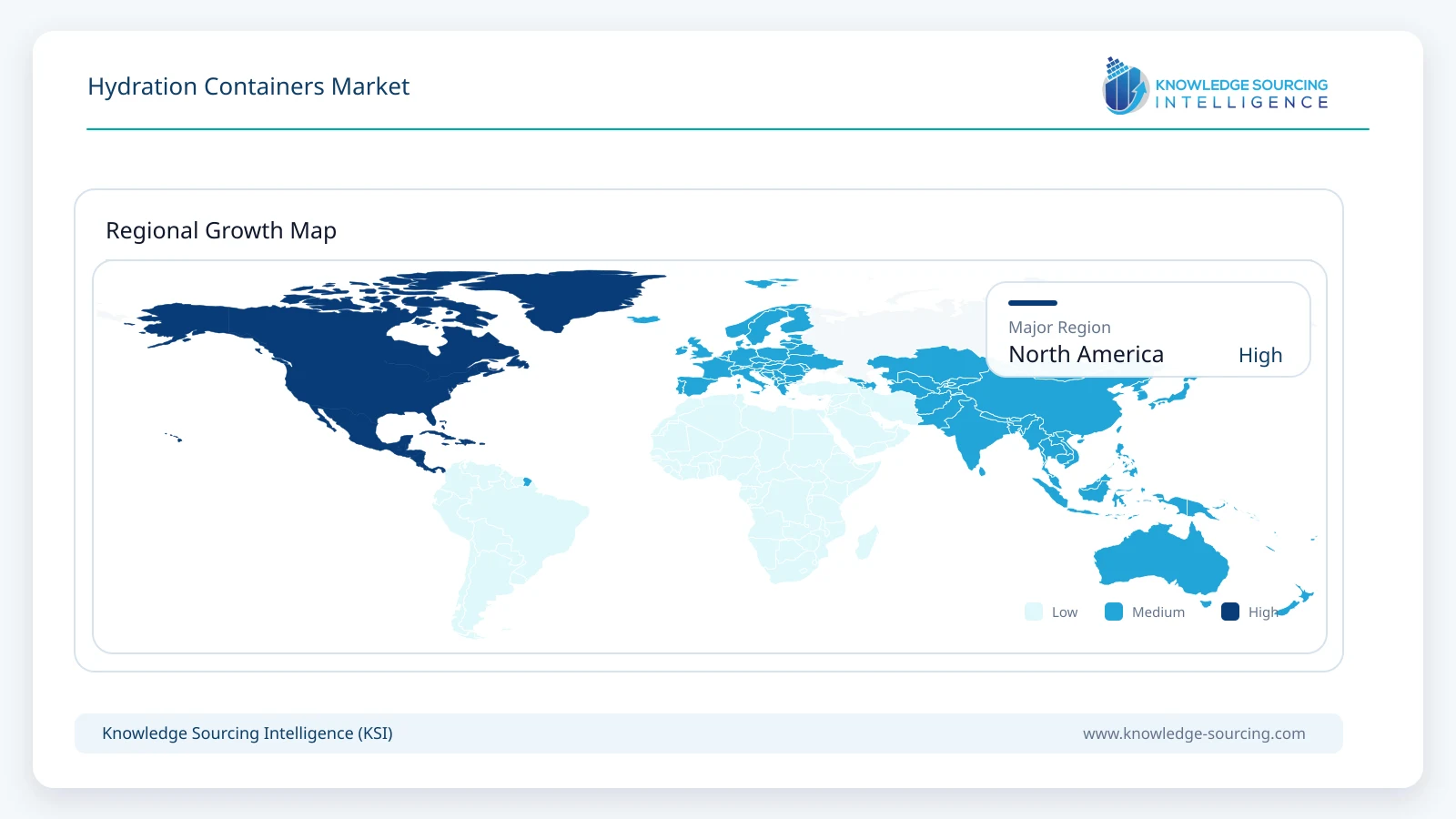
The North American market is characterized by a high degree of premiumization and a consumer base that treats hydration containers as essential lifestyle gear. Demand in the United States is currently shifting toward high-capacity insulated tumblers, driven by the social influence of wellness influencers and the widespread availability of vehicle-integrated cup holders. This regional trend is placing immense pressure on brands to innovate in lid design and handle ergonomics to maximize portability. Consumers are increasingly willing to pay a significant premium for brands that signify a specific social status or outdoor-ready capability.
Logistical infrastructure in the region supports a robust direct-to-consumer model, allowing brands to launch frequent aesthetic updates without the lag time of traditional retail. However, high labor costs are forcing many companies to maintain manufacturing offshore while focusing domestic operations on marketing and regional assembly. The market response involves a heavy investment in digital marketing and social media engagement to sustain the high-velocity product cycles that North American consumers now expect. The outcome is a highly competitive, brand-saturated environment where market dominance is determined by cultural relevance rather than just functional utility.
Asia Pacific
Asia Pacific represents the fastest-growing region due to rapid urbanization and an expanding middle class in India and China. In these markets, demand is shifting toward affordable but high-quality vacuum-insulated flasks that can withstand high ambient temperatures. Regional giants like Cello World and Hamilton Housewares are expanding their manufacturing capacities to meet this domestic surge, leveraging local supply chains to maintain competitive pricing. This expansion is occurring because the shift from single-use plastic bottles to reusable metal vessels is becoming a mainstream environmental and economic priority.
Government initiatives in the region, such as India's "Make in India" campaign, are encouraging local production and reducing the dependency on imported goods. This policy pressure is leading to the development of sophisticated local manufacturing hubs that can produce world-class products at lower price points. Consequently, global brands are entering the region through strategic partnerships to gain access to these efficient production bases and vast consumer networks. The structural outcome is a shift in the global manufacturing center of gravity toward Asia Pacific, serving both domestic and international demand.
Europe
The European market is the most heavily influenced by strict chemical safety regulations and environmental sustainability mandates. Demand is currently pivoting toward circular economy models where bottles are not only reusable but also made from 100% recycled or bio-based materials. This regional behavior is driven by the EU's proactive stance on banning bisphenols and microplastics, which forces an immediate phase-out of traditional polymer-based containers. Manufacturers are responding by launching product lines made from recycled aluminum and certified ocean-bound plastics to comply with these stringent standards.
Consumer behavior in Europe is increasingly favoring minimalist and highly durable designs that align with a "buy-less, buy-better" philosophy. This mindset is placing pressure on brands to offer extensive warranties and repair services, transforming the business model from product sales to long-term lifecycle management. Digital procurement is growing, but it is often coupled with a strong preference for brands that can prove a transparent and ethical supply chain. The resulting market structure is one where regulatory compliance and ethical transparency are the primary barriers to entry.
List of Companies
Cello World
Hamilton Housewares Pvt. Ltd
Tupperware
Vista Outdoor, Inc.
Cool Gear International LLC
Newell Brands Inc
Aquasana Inc.
Thermos LLC
O2COOL LLC
Klean Kanteen
SIGG Switzerland Bottles AG
Nathan Sports Inc
Hydro Flask
Cascade Designs Inc.
Company Profiles
Hydro Flask (Helen of Troy Limited)
Hydro Flask is strategically distinct due to its pioneering role in the "lifestyle hydration" movement, focusing on vibrant aesthetic variety coupled with high-performance insulation. The company is currently expanding its product ecosystem beyond bottles into soft goods and outdoor accessories to leverage its high brand equity. This transition is occurring because the brand needs to diversify its revenue streams as the insulated bottle market reaches a point of high saturation. Hydro Flask is responding by focusing on exclusive color drops and limited-edition collaborations to maintain consumer urgency and premium pricing.
Newell Brands Inc. (Contigo & Bubba)
Newell Brands is strategically distinct for its focus on functional innovation in lid technology, particularly through its "Autoseal" and "Autospout" mechanisms. The company is currently streamlining its Outdoor and Recreation segment to improve operational margins amid a challenging macroeconomic environment. This restructuring is forcing a focus on core, high-volume products that appeal to the mass-market commuter and parent demographics. Newell is responding by integrating its hydration brands into a more unified distribution network to leverage economies of scale in retail placement.
Cello World
Cello World is strategically distinct because of its massive vertical integration and dominant market position in the Indian domestic landscape. The company is currently utilizing its IPO-generated capital to expand its manufacturing facilities for high-end glassware and opalware. This shift is occurring because the company recognizes a structural demand for premium household hydration solutions in the growing Indian middle class. Cello World is responding by diversifying its material portfolio to include borosilicate glass, reducing its historical reliance on lower-margin plastic products.
Analyst View
The hydration containers market is shifting from a utilitarian commodity structure toward a high-velocity lifestyle sector. Regulatory bans on polymers are forcing a permanent transition to metal and glass. Brands that master digital-first "drop" marketing will dominate.
Hydration Containers Market Scope:
| Report Metric | Details |
|---|---|
| Total Market Size in 2026 | USD 14.58 billion |
| Total Market Size in 2031 | USD 18.21 billion |
| Forecast Unit | Billion |
| Growth Rate | 4.54% |
| Study Period | 2021 to 2031 |
| Historical Data | 2021 to 2024 |
| Base Year | 2025 |
| Forecast Period | 2026 – 2031 |
| Segmentation | Product Type, Material Type, Capacity, Distribution Channel |
| Companies |
|
Market Segmentation
By Product Type
Bottles
Tumblers
Cans
Mason Jars
Shakers
Others
By Material Type
Plastic
Glass
Metal
Silicone
By Capacity
0-20 Oz
20-40 Oz
40-60 Oz
60-80 Oz
80 Oz and above
By Distribution Channel
Online
Offline
By Geography
North America
USA
Canada
Mexico
South America
Brazil
Argentina
Others
Europe
Germany
France
United Kingdom
Spain
Others
Middle East and Africa
Saudi Arabia
Israel
Others
Asia Pacific
China
Japan
South Korea
India
Others
Table of Contents
1. INTRODUCTION
1.1. Market Overview
1.2. Market Definition
1.3. Scope of the Study
1.4. Currency
1.5. Assumptions
1.6. Base and Forecast Years Timeline
2. RESEARCH METHODOLOGY
2.1. Research Design
2.2. Secondary Sources
3. EXECUTIVE SUMMARY
4. MARKET DYNAMICS
4.1. Market Segmentation
4.2. Market Drivers
4.3. Market Restraints
4.4. Market Opportunities
4.5. Porter’s Five Forces Analysis
4.5.1. Bargaining Power of Suppliers
4.5.2. Bargaining Power of Buyers
4.5.3. Threat of New Entrants
4.5.4. Threat of Substitutes
4.5.5. Competitive Rivalry in the Industry
4.6. Life Cycle Analysis - Regional Snapshot
4.7. Market Attractiveness
5. HYDRATION CONTAINERS MARKET BY PRODUCT TYPE
5.1. Bottles
5.2. Tumblers
5.3. Cans
5.4. Mason Jars
5.5. Shakers
5.6. Others
6. HYDRATION CONTAINERS MARKET BY MATERIAL TYPE
6.1. Plastic
6.2. Glass
6.3. Metal
6.4. Silicone
7. HYDRATION CONTAINERS MARKET BY CAPACITY
7.1. 0-20 Oz
7.2. 20-40 Oz
7.3. 40-60 Oz
7.4. 60-80 Oz
7.5. 80 Oz and above
8. HYDRATION CONTAINERS MARKET BY DISTRIBUTION CHANNEL
8.1. Online
8.2. Offline
9. HYDRATION CONTAINERS MARKET BY GEOGRAPHY
9.1. North America
9.1.1. USA
9.1.2. Canada
9.1.3. Mexico
9.2. South America
9.2.1. Brazil
9.2.2. Argentina
9.2.3. Others
9.3. Europe
9.3.1. Germany
9.3.2. France
9.3.3. United Kingdom
9.3.4. Spain
9.3.5. Others
9.4. Middle East and Africa
9.4.1. Saudi Arabia
9.4.2. Israel
9.4.3. Others
9.5. Asia Pacific
9.5.1. China
9.5.2. Japan
9.5.3. South Korea
9.5.4. India
9.5.5. Others
10. COMPETITIVE INTELLIGENCE
10.1. Competitive Benchmarking and Analysis
10.2. Recent Investments and Deals
10.3. Strategies of Key Players
11. COMPANY PROFILES
11.1. Cello world
11.2. Hamilton Housewares Pvt. Ltd
11.3. Tupperware
11.4. Vista Outdoor, Inc.
11.5. Cool Gear International LLC
11.6. Newell Brands Inc
11.7. Aquasana Inc.
11.8. Thermos LLC
11.9. O2COOL LLC
11.10. Klean Kanteen
11.11. SIGG Switzerland Bottles AG
11.12. Nathan Sports Inc
11.13. Hydro Flask
11.14. Cascade Designs Inc.
LIST OF FIGURES
LIST OF TABLES
Navigate
Trusted by the world's leading organizations











