
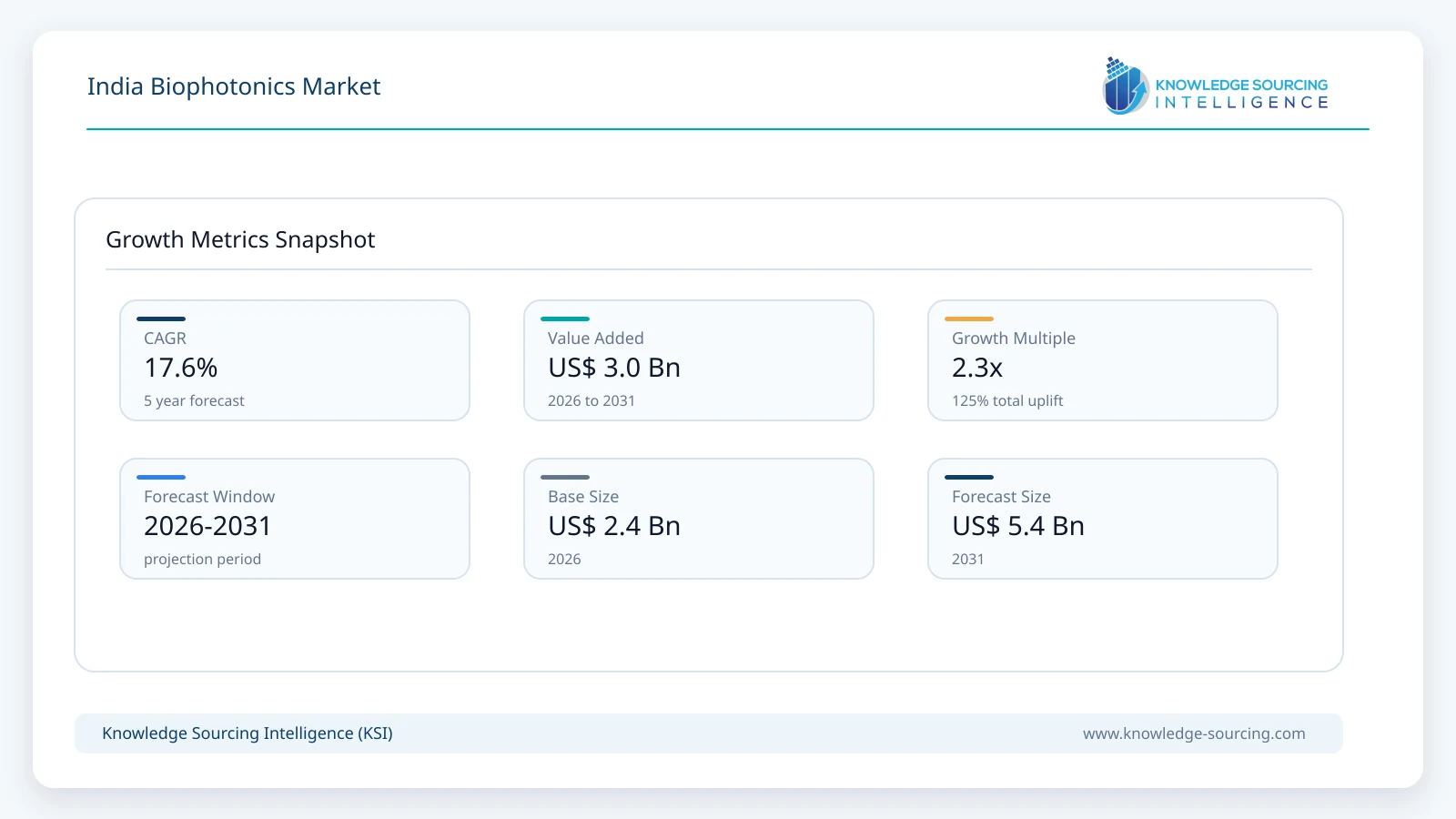
India’s Biophotonics Market is expected to surge from USD 2.4 billion in 2026 to USD 5.4 billion by 2031, at a 17.6% CAGR during the forecast period.
Highlights:
- 1India’s biophotonics market is expanding rapidly toward USD 5.4 billion by 2031 at a strong 17.6% CAGR, driven by rising demand for precision diagnostics and advanced medical technologies.
- 2Medical diagnostics is dominating the market with approximately a 45-50% share, as optical coherence tomography and fluorescence imaging gain widespread adoption in hospitals and clinics.
- 3Research institutions and laboratories account for nearly 30-35% share, continuously procuring high-end microscopy and spectroscopy systems for cancer and biomedical research.
- 4Southern and western regions are leading with roughly 55-60% combined share, supported by stronger healthcare infrastructure, medical device parks, and research hubs.
- 5Government initiatives are actively boosting domestic manufacturing and innovation, steadily reducing import dependence while accelerating biophotonics integration in clinical settings.
- 6High capital costs remain constraining broader adoption, yet ongoing efforts in cost-effective, localized devices are opening new opportunities across smaller healthcare providers.
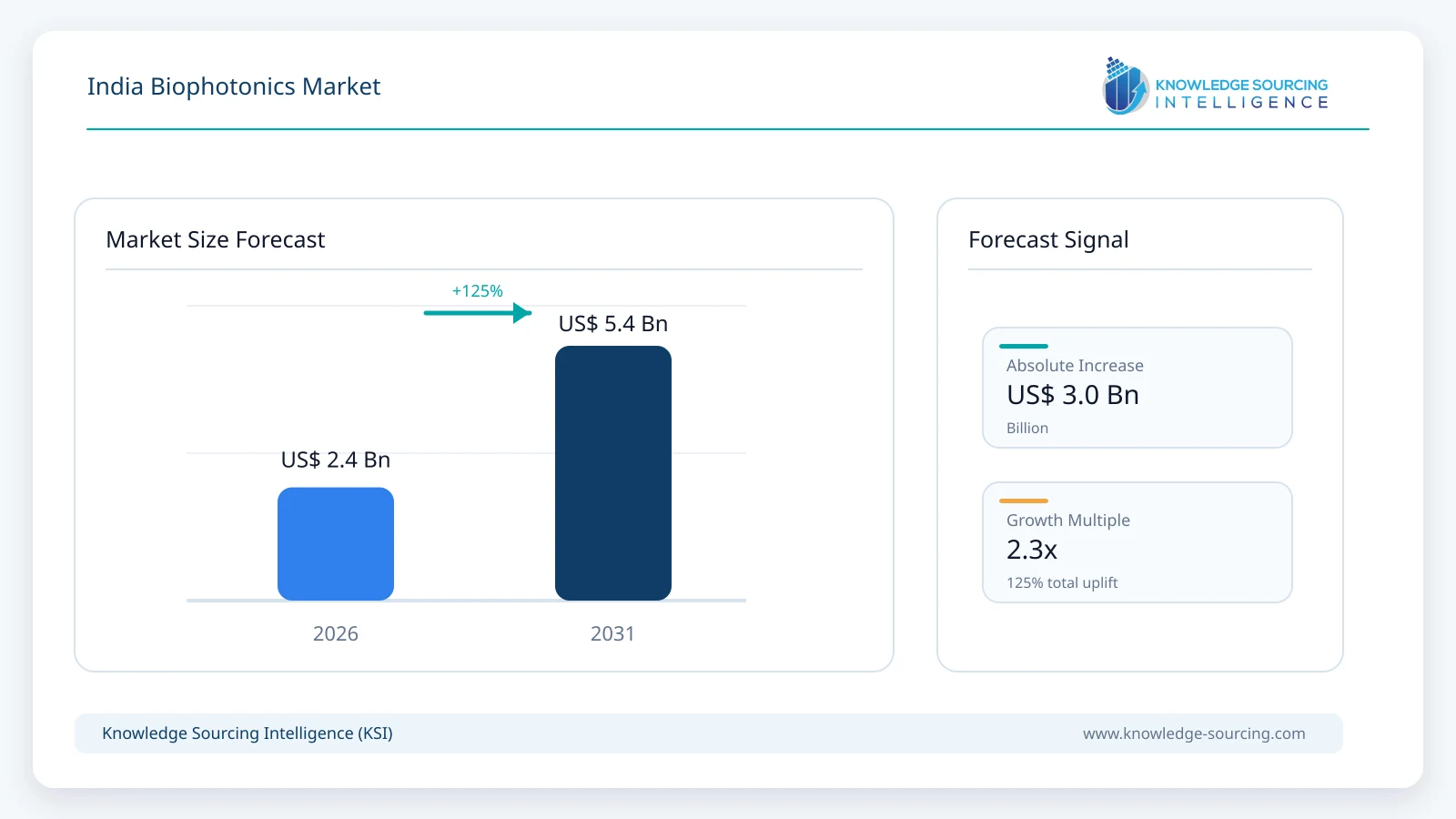
The Indian Biophotonics Market is developing within the country’s accelerating medical technology and advanced healthcare ecosystem. Biophotonics combines light-based technologies such as lasers, optical systems, spectroscopy, imaging, microscopy, and fiber-optic technologies with biological and medical applications for detection, diagnosis, monitoring, and treatment. Its development in India is closely connected with the modernization of medical infrastructure, growing adoption of high-precision diagnostic technologies, and increasing emphasis on earlier, more accurate, and minimally invasive healthcare interventions. Government initiatives are also strengthening the domestic medical-device ecosystem, creating a more supportive environment for photonics-enabled healthcare technologies. In 2025, the Department of Pharmaceuticals reported that India’s domestic share of medical-device requirements had increased from below 10% to around 30% over five years, while medical-device exports exceeded US$4 billion.
The broader medical-device manufacturing base is becoming increasingly capable of supporting sophisticated imaging and diagnostic technologies. Under the Production Linked Incentive (PLI) Scheme for Medical Devices, 27 applications had been approved by July 2026, including 14 MSMEs, with approved projects reporting actual investment of ?1,153.07 crore and beginning domestic production of high-precision equipment such as MRI and CT systems, mammography systems, C-arms, and ultrasound equipment. This expansion is relevant to biophotonics because optical and photonic technologies can complement conventional imaging and diagnostic platforms, particularly where high-resolution visualization, real-time measurement, tissue characterization, or non-contact analysis is required.
India’s policy environment is further supporting innovation through the National Medical Devices Policy, 2023, which emphasizes regulatory streamlining, enabling infrastructure, research and development, innovation, investment, human-resource development, and global positioning. By September 2025, PLI-supported medical-device projects had generated cumulative eligible sales of ?12,344.37 crore, including ?5,869.36 crore of exports, while 22 greenfield projects had been commissioned and production had started for 55 products. The establishment of medical-device parks in Uttar Pradesh, Madhya Pradesh, and Tamil Nadu is also intended to provide common infrastructure and strengthen the domestic manufacturing ecosystem.
The regulatory environment is simultaneously becoming more structured. The Central Drugs Standard Control Organisation (CDSCO) regulates medical devices in India under the Drugs & Cosmetics Act, 1940 and Medical Devices Rules, 2017, with risk-based classification covering Class A through Class D devices. Recent regulatory activity includes updated classifications for oncology, radiotherapy, and interventional-radiology devices during 2025-2026. These developments provide an increasingly defined pathway for the introduction and commercialization of advanced diagnostic and therapeutic technologies.
As India expands domestic MedTech manufacturing, strengthens research capabilities, and promotes high-precision healthcare technologies, biophotonics is positioned to benefit from the wider transition toward technology-intensive diagnostics and treatment. The Department of Science and Technology’s 2025 Health & Medical Technologies vision also highlights the need to integrate advanced technologies into India’s healthcare system as part of the country’s longer-term Viksit Bharat 2047 objective. Consequently, opportunities for biophotonics are emerging across medical imaging, optical diagnostics, microscopy, spectroscopy, laser-based therapies, and other precision healthcare applications, supported by expanding healthcare infrastructure and the government’s continued push toward indigenous, affordable, and high-precision medical technology.
India Biophotonics Market Analysis
Growth Drivers
The escalating prevalence of chronic and lifestyle diseases, such as cardiovascular disorders and various forms of cancer, is the primary growth catalyst. Biophotonic techniques, including Optical Coherence Tomography (OCT) and fluorescence imaging, provide high-resolution, often non-invasive, early detection capabilities. The imperative for early-stage diagnosis directly increases the procurement of biophotonics-enabled imaging and sensing platforms by hospitals and specialized diagnostic chains. Furthermore, the Indian government's commitment to boosting the indigenous medical device sector through initiatives like the 'Make in India' program and associated financial incentives stimulates local manufacturing. This policy support reduces the cost of certain components and finished goods, thereby lowering the procurement barrier for smaller healthcare providers and expanding the accessible demand pool for biophotonics products. The rise in public and private investment in biomedical research also directly fuels demand for high-end spectroscopy and microscopy systems in research institutions.
Challenges and Opportunities
The most significant constraint on market expansion is the high capital cost associated with advanced biophotonics systems, particularly imported units. This financial barrier limits adoption primarily to large, well-funded tertiary care hospitals and central research laboratories, constraining demand penetration across smaller clinics and rural health centers. However, this challenge simultaneously presents a major opportunity: the increasing national R&D focus on miniaturization and cost-effective component development. Developing localized, handheld, or point-of-care biophotonics devices using Indian-made components can dramatically lower unit costs, exponentially expanding the addressable market in a price-sensitive healthcare environment. The strong regulatory push for quality standards also opens a door for companies that can provide superior training and maintenance, transforming a compliance requirement into a value-added service opportunity that sustains long-term equipment demand.
Raw Material and Pricing Analysis
Biophotonics instruments are physical products, relying heavily on sophisticated hardware components. Key raw materials and components include high-power laser diodes, specialized optical filters, high-sensitivity photodetectors (such as photomultiplier tubes and high-speed InGaAs photodiodes), and optical fibers. The manufacturing of these highly specialized components remains concentrated outside India, primarily in East Asia and Europe. Consequently, the price structure of finished biophotonics devices in India is highly sensitive to global supply chain volatility, including semiconductor shortages and fluctuating exchange rates, as these devices are largely import-dependent. Pricing dynamics are complex, characterized by premium costs for cutting-edge devices (e.g., those incorporating advanced CMOS cameras or ultrafast lasers) and downward pressure on older, more commoditized technologies.
Supply Chain Analysis
The Indian Biophotonics Market is primarily a downstream consumer, with the global supply chain originating from core production hubs in Japan, Germany, and the United States. These regions dominate the manufacturing of critical components such as high-precision optics, lasers, and advanced detectors. The logistical complexity for the Indian market stems from the high-value, fragile nature of these components, necessitating specialized cold-chain and low-vibration transportation, often resulting in high landed costs. The supply chain dependency exposes the Indian market to geopolitical and trade-related risks. Local assembly and integration facilities in India, often established by multinational companies or their local partners, manage the final system build, calibration, and distribution. A critical dependency exists on a limited pool of highly skilled technical personnel for installation and post-sales service, adding a layer of non-physical logistical complexity.
Government Regulations
The regulation of biophotonics products, largely classified as medical devices, falls under the purview of the Central Drugs Standard Control Organization (CDSCO). The regulatory environment has rapidly matured, moving from a previously fragmented system to a comprehensive, risk-based classification regime. This standardization provides clarity for manufacturers but imposes stricter quality and compliance mandates, directly influencing the demand for compliant, quality-certified products.
Jurisdiction | Key Regulation / Agency | Market Impact Analysis |
India | Medical Devices Rules, 2017 & Amendments (CDSCO) | Mandates risk-based classification (Class A-D) and compulsory registration/licensing for all devices, eliminating the grey market for unclassified products and increasing demand for certified, high-quality biophotonics systems. |
India | National Medical Devices Policy, 2023 | Promotes domestic R&D and manufacturing through financial and infrastructural support (e.g., medical device parks). This aims to localize the supply chain, potentially reducing the cost of mid-range biophotonics devices and stimulating demand among budget-conscious buyers. |
India | Materiovigilance Programme of India (MvPI) | Introduced a revamped adverse event reporting form in late 2024 to enhance post-market surveillance. This drives demand for products from manufacturers with robust quality management systems (ISO 13485) and high product reliability, favoring established global players. |
India Biophotonics Market Segment Analysis
By Application: Medical Diagnostics
The Medical Diagnostics segment is the most dominant demand center, propelled by the urgent need for non-invasive and high-precision diagnostic tools. Biophotonics technologies like Optical Coherence Tomography (OCT) have revolutionized ophthalmology and cardiology diagnostics by offering cross-sectional imaging with micron-level resolution, eliminating the need for excisional biopsy in many cases. The dramatic increase in diabetic retinopathy and glaucoma cases across India drives the consistent and expanding demand for OCT systems in eye clinics and multi-specialty hospitals. Furthermore, the application of Raman Spectroscopy for label-free, real-time chemical fingerprinting of tissue is generating significant demand in oncology research and intraoperative margin assessment. This capability directly addresses the clinical imperative for rapid, accurate differentiation between healthy and malignant tissue during surgery, creating a strong pull from premier cancer centers. The necessity here is fundamentally driven by the clinical outcome: faster, more accurate diagnosis leads to better patient management and reduced overall healthcare costs, justifying the high capital expenditure.
By End-User: Research Institutions and Laboratories
Research Institutions and Laboratories represent a concentrated, high-value segment, uniquely driven by the cutting-edge of biophotonics technology. This end-user segment, which includes CSIR, ICMR, and premier university labs, primarily procures advanced instruments for fundamental biological and translational research. The key growth drivers are the government's increased funding for national research projects focused on cancer biology, infectious disease mechanisms, and drug discovery, coupled with the global push for high-resolution in vivo and in vitro studies. Institutions actively seek advanced microscopy systems such as Confocal Microscopy, Two-Photon Fluorescence Excitation Microscopy, and High-Content Screening Systems. These sophisticated tools enable real-time visualization of cellular and molecular processes, driving demand for equipment with superior sensitivity, higher acquisition speed, and complex image analysis capabilities. This necessity is less price-elastic than the clinical segment, prioritizing advanced performance and customizable functionality to support groundbreaking academic and pharmaceutical research initiatives.
India Biophotonics Market Competitive Environment and Analysis
The Indian Biophotonics Market is characterized by the dominance of established global players in the high-end segments, facing competition from localized integrators in the mid- to low-end. Global corporations leverage their established technology platforms and robust distribution networks to supply advanced research and clinical equipment. Local and regional companies often focus on system assembly, application-specific sensor technologies, and providing specialized service support, competing primarily on cost and proximity.
Hamamatsu Photonics K.K.
Hamamatsu Photonics K.K. maintains a strategic positioning as a core component and system supplier across the entire biophotonics value chain. Their primary strength lies in their proprietary technology for highly sensitive and high-speed light detection and generation. Key products, such as their InGaAs Photodiodes and advanced ORCA®-Quest qCMOS® cameras, directly fuel the demand for next-generation scientific imaging systems used in Indian research institutions for applications like fluorescence lifetime imaging and high-content screening. Their strategic focus is on providing high-performance subsystems and customized solutions to Original Equipment Manufacturers (OEMs) and advanced research laboratories, effectively establishing a foundational technological dependence in high-precision Indian biophotonics.
Carl Zeiss AG
Carl Zeiss AG strategically anchors its position in the Indian market through its Research Microscopy Solutions and Medical Technology segments. The company is a key supplier of advanced optical, electron/ion, and X-ray microscopes, which are indispensable for cellular and material research in government and private research institutions. Key products include its surgical microscopes and a comprehensive portfolio of ophthalmic devices, such as OCT systems and Refractive Lasers. This dual focus enables them to capture demand from both the academic research segment (high-resolution imaging) and the clinical diagnostic segment (ophthalmic health), positioning them as a premium provider whose brand equity is synonymous with optical precision and reliability.
India Biophotonics Market Developments
June 2026: FUJIFILM India installed its AI-powered AMULET SOPHINITY digital mammography system at NM Medical, Mumbai, strengthening advanced optical imaging and biophotonics-driven breast cancer detection capabilities within India’s preventive diagnostic healthcare ecosystem.
May 2026: Supported by the Karnataka Startup Cell and the Department of Electronics, IT & BT, the Govt CPC Polytechnic in Mysuru established a Biotechnology Innovation Lab focused on biophotonics-based sensor design, medical applications, and rapid prototyping. The initiative aims to develop affordable diagnostics and monitoring solutions for rural healthcare.
May 2026: India approved two semiconductor and compound semiconductor manufacturing units under ISM 1.0, including a GaN-based Mini/Micro-LED display facility, indirectly strengthening domestic photonics, optical sensing, and biophotonics-enabled imaging technology supply chains.
India Biophotonics Market Scope
| Report Metric | Details |
|---|---|
| Total Market Size in 2026 | USD 2.4 billion |
| Total Market Size in 2031 | USD 5.4 billion |
| Forecast Unit | Billion |
| Growth Rate | 17.6% |
| Study Period | 2021 to 2031 |
| Historical Data | 2021 to 2024 |
| Base Year | 2025 |
| Forecast Period | 2026 – 2031 |
| Segmentation | Technology, Application, End-User |
| Companies |
|
Market Segmentation
By Technology
Imaging Technologies
Spectroscopy Technologies
Light-Based Therapeutics
Biosensors and Bioassays
By Application
Medical Diagnostics
Therapeutics
Research and Development
Environmental Monitoring
By End-user
Hospitals and Clinics
Research Institutions and Laboratories
Pharmaceutical and Biotechnology Companies
Environmental Agencies
Table of Contents
1. EXECUTIVE SUMMARY
2. MARKET SNAPSHOT
2.1. Market Overview
2.2. Market Definition
2.3. Scope of the Study
2.4. Market Segmentation
3. BUSINESS LANDSCAPE
3.1. Market Drivers
3.2. Market Restraints
3.3. Market Opportunities
3.4. Porter’s Five Forces Analysis
3.5. Industry Value Chain Analysis
3.6. Policies and Regulations
3.7. Strategic Recommendations
4. TECHNOLOGICAL OUTLOOK
5. INDIA BIOPHOTONICS MARKET BY TECHNOLOGY
5.1. Introduction
5.2. Imaging Technologies
5.3. Spectroscopy Technologies
5.4. Light-Based Therapeutics
5.5. Biosensors and Bioassays
6. INDIA BIOPHOTONICS MARKET BY APPLICATION
6.1. Introduction
6.2. Medical Diagnostics
6.3. Therapeutics
6.4. Research and Development
6.5. Environmental Monitoring
7. INDIA BIOPHOTONICS MARKET BY END-USER
7.1. Introduction
7.2. Hospitals and Clinics
7.3. Research Institutions and Laboratories
7.4. Pharmaceutical and Biotechnology Companies
7.5. Environmental Agencies
8. COMPETITIVE ENVIRONMENT AND ANALYSIS
8.1. Major Players and Strategy Analysis
8.2. Market Share Analysis
8.3. Mergers, Acquisitions, Agreements, and Collaborations
8.4. Competitive Dashboard
9. COMPANY PROFILES
9.1. Hamamatsu Photonics K.K.
9.2. Olympus Corporation
9.3. Carl Zeiss AG
9.4. Thermo Fisher Scientific Inc.
9.5. Becton, Dickinson and Company
9.6. Leica Microsystems (Danaher Corporation)
9.7. Nikon Corporation (Nikon Instruments Inc.)
9.8. Agilent Technologies, Inc.
9.9. PerkinElmer (Revvity Inc.)
9.10. Roche Diagnostics
9.11. Abbott Laboratories
9.12. Wipro GE Healthcare
9.13. Trivitron Healthcare
9.14. Thorlabs, Inc.
10. APPENDIX
10.1. Currency
10.2. Assumptions
10.3. Base and Forecast Years Timeline
10.4. Key benefits for the stakeholders
10.5. Research Methodology
10.6. Abbreviations
LIST OF FIGURES
LIST OF TABLES
Navigate
Trusted by the world's leading organizations











