
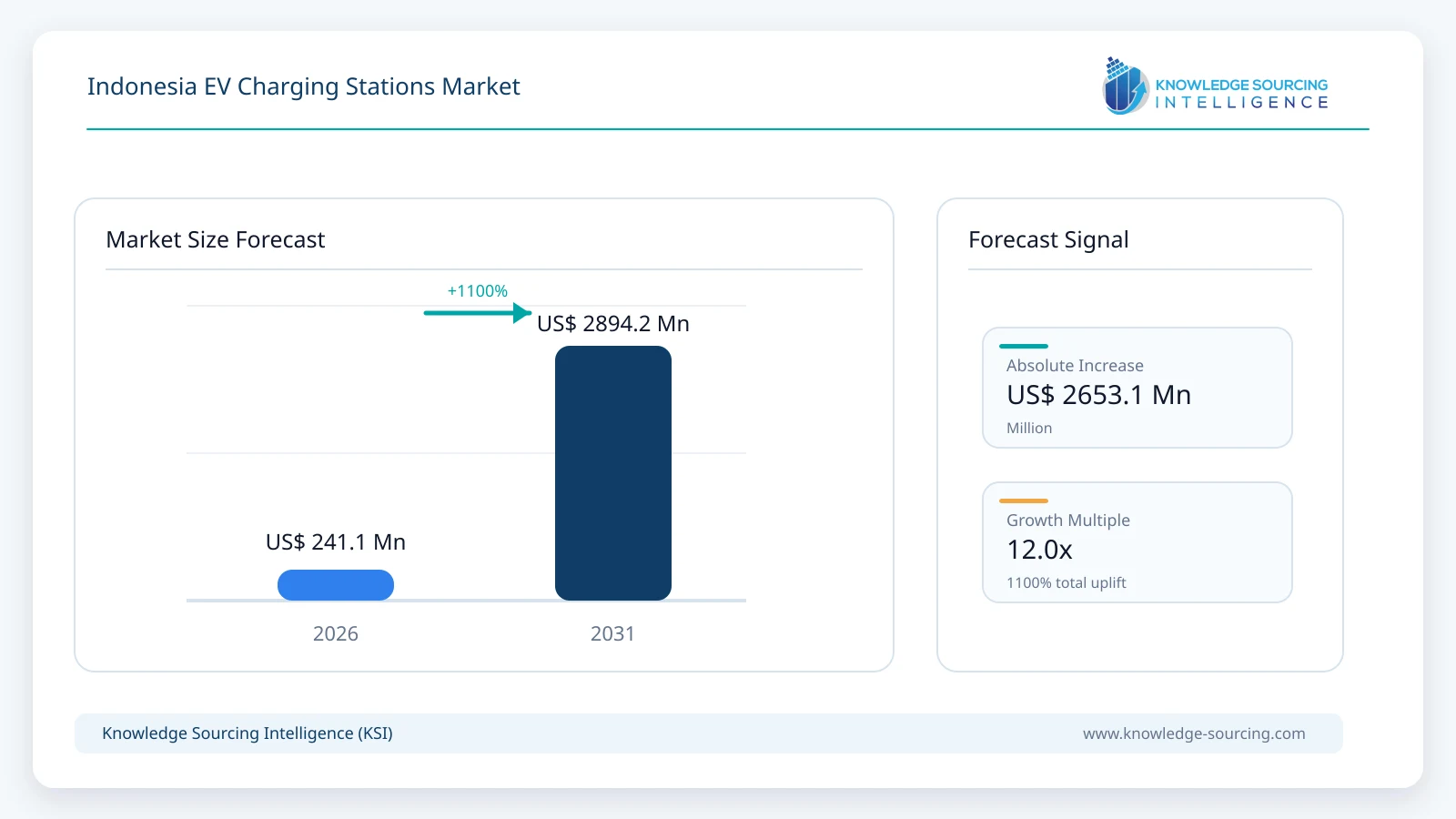
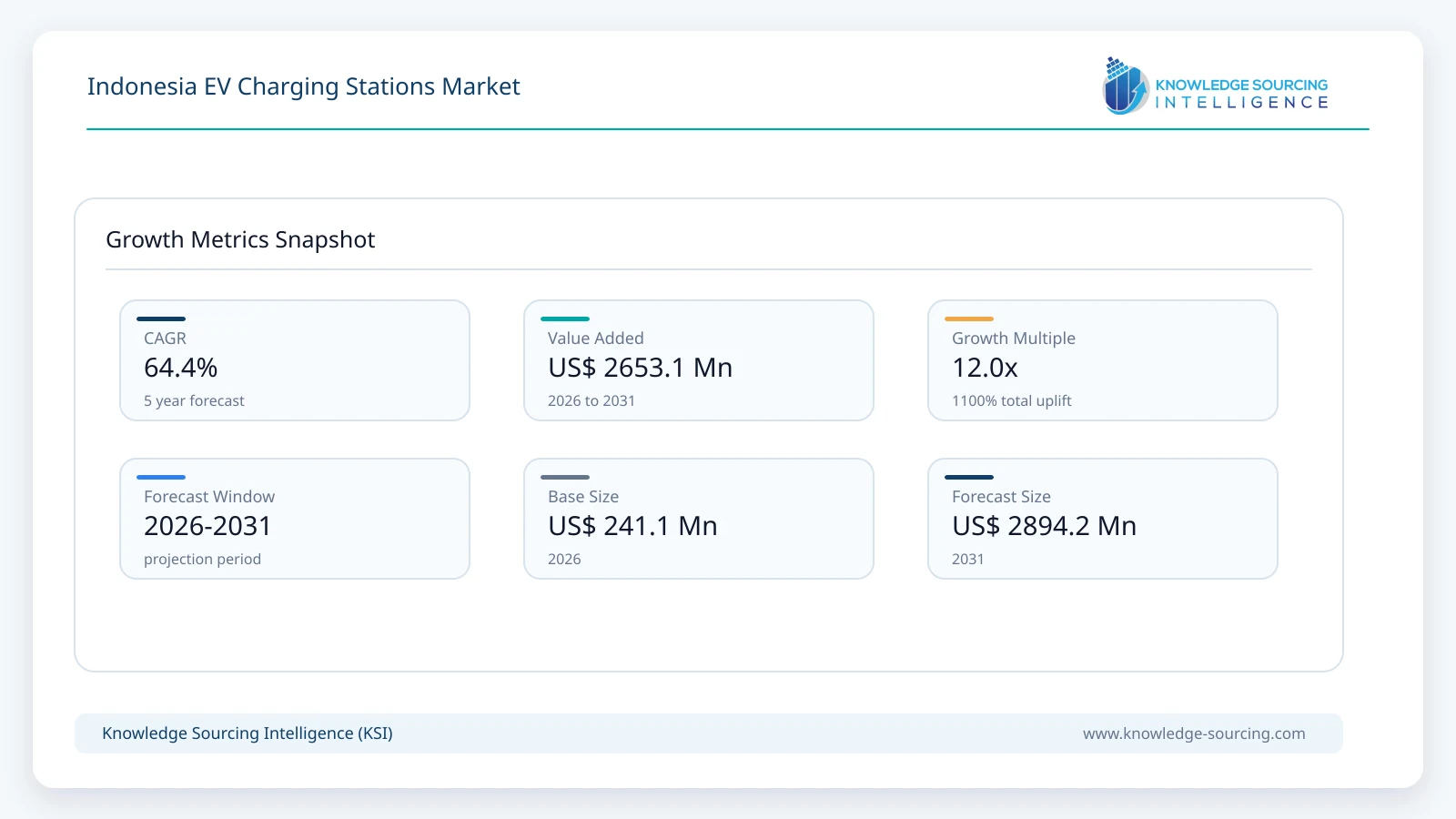
The Indonesian electric vehicle charging stations market is set to reach USD 2,894.2 million in 2031, growing at a CAGR of 64.4% from USD 241.1 million in 2026.
Highlights:
- 1Government incentives supporting electric vehicle adoption remain the primary catalyst for charging infrastructure deployment.
- 2Public charging stationsrepresent the leading ownership segment due to national infrastructure expansion led by PT PLN and private charging operators.
- 3Java accounts for the largest regional opportunity because it hosts the majority of Indonesia's vehicle population, urban centers, and commercial activity.
- 4DC fast-charging technology continues gaining investment for highways, commercial facilities, and fleet operations requiring shorter charging durations.
- 5National EV policies and technical charging standards are strengthening investor confidence and encouraging private sector participation.
- 6Competition is based on charging speed, network coverage, software integration, uptime reliability, pricing models, and strategic installation partnerships.
The Indonesia EV charging stations market comprises the deployment, operation, and management of charging infrastructure supporting battery electric vehicles (BEVs) and plug-in hybrid electric vehicles (PHEVs). The market includes AC and DC charging stations installed across residential premises, commercial facilities, public parking areas, highways, transit corridors, and fleet depots. Infrastructure providers, electric utilities, charge point operators, automotive manufacturers, property developers, and government agencies collectively contribute to market development as Indonesia expands its electric mobility ecosystem.
Demand for EV charging infrastructure is directly linked to the country's electric vehicle adoption strategy. Buyers include state-owned enterprises, commercial fleet operators, shopping mall developers, office complexes, fuel retailers, logistics companies, hospitality operators, and residential property developers seeking to support the growing number of electric vehicles. Procurement decisions are primarily influenced by charger reliability, charging speed, interoperability, installation cost, grid connectivity, software management capabilities, maintenance support, and compliance with national technical standards.
Indonesia's policy commitment to developing a domestic electric vehicle industry is creating sustained investment in charging infrastructure. The government has identified EVs as a strategic industry to reduce petroleum imports, improve energy security, and utilize the country's extensive nickel resources for battery manufacturing. Presidential Regulation No. 55 of 2019 established the national framework for accelerating battery electric vehicle adoption, encouraging investment across vehicle manufacturing, battery production, and charging infrastructure.
The state electricity utility PT PLN (Persero) continues expanding the national charging network through its SPKLU (Stasiun Pengisian Kendaraan Listrik Umum) program. According to PLN, the company has steadily increased public charging infrastructure across major cities and intercity transport corridors to improve accessibility and reduce range anxiety among EV users.
Growth in the charging infrastructure market is also supported by increasing vehicle electrification. According to Gaikindo (Association of Indonesia Automotive Industries), battery electric vehicle sales have recorded substantial year-on-year increases as additional vehicle models enter the domestic market and consumer awareness improves. Rising EV ownership is encouraging investments in both public fast-charging stations and private residential charging solutions.
Commercial infrastructure deployment increasingly prioritizes DC fast chargers in urban centers and highway locations where charging time directly influences utilization rates. Residential charging remains important for private passenger vehicle owners, while logistics companies and public transportation operators are investing in depot-based charging systems that support predictable fleet operations and overnight charging schedules.
Market Drivers
Government Policies Supporting Electric Mobility
Indonesia's long-term transportation and industrial policies continue encouraging investment in EV charging infrastructure. Fiscal incentives, domestic manufacturing initiatives, and infrastructure development programs reduce barriers for both vehicle manufacturers and charging network operators. Public investment also encourages private companies to participate through partnerships with utilities, property developers, and fleet operators.
The Ministry of Energy and Mineral Resources and PT PLN continue expanding charging infrastructure to improve national coverage and strengthen consumer confidence in electric mobility.
Expansion of Electric Vehicle Sales
Growing availability of electric passenger vehicles and commercial vehicles is increasing demand for accessible charging facilities. Consumers increasingly consider charging availability when purchasing electric vehicles, making infrastructure deployment an essential component of market development.
Automotive manufacturers are collaborating with charging providers to improve customer convenience by integrating home charging solutions, mobile applications, and public charging network access into vehicle ownership packages.
Investment in Public Charging Infrastructure
Public charging infrastructure remains essential because a substantial proportion of urban residents lack dedicated residential parking suitable for private charger installation. Shopping centers, office buildings, hotels, fuel stations, and highway service areas continue investing in public charging stations to attract EV users while generating additional commercial traffic.
Expansion of fast-charging networks along major transportation corridors also supports intercity travel and reduces range anxiety, improving consumer confidence in battery electric vehicles.
Fleet Electrification Initiatives
Commercial fleet operators are increasingly evaluating electric vehicles to reduce fuel expenses and support corporate sustainability objectives. Logistics providers, taxi operators, public transportation agencies, and corporate fleets require dedicated charging infrastructure capable of supporting high daily vehicle utilization.
Depot charging installations are becoming an important procurement segment because centralized charging improves operational efficiency while allowing fleet managers to optimize electricity consumption during off-peak periods.
Market Restraints and Challenges
Limited Charging Coverage Outside Major Urban Areas
Although infrastructure deployment continues to expand, charging station availability remains concentrated in Java and selected metropolitan areas. Limited charging coverage across secondary cities and remote regions affects long-distance travel and slows EV adoption outside major economic centers.
Infrastructure providers are gradually expanding regional networks, but deployment remains dependent on local electricity infrastructure and commercial viability.
Grid Capacity and Infrastructure Constraints
High-capacity DC fast chargers require reliable electrical infrastructure and sufficient grid capacity. In certain locations, electricity distribution upgrades are necessary before commercial charging stations can be installed, increasing project costs and extending deployment timelines.
Utilities continue investing in grid modernization, transformer upgrades, and smart energy management systems to accommodate increasing electricity demand from transportation electrification.
High Initial Investment Requirements
Commercial charging stations involve substantial capital expenditure covering charging equipment, electrical installation, civil works, software platforms, maintenance systems, and land preparation. Investors carefully evaluate utilization rates, electricity tariffs, customer demand, and long-term revenue potential before expanding charging networks.
Public-private partnerships and government incentives continue reducing investment risks while encouraging infrastructure deployment across commercially important locations.
Major Segment Analysis
DC Charging Stations
DC charging stations represent the most commercially important segment because they substantially reduce charging time compared with conventional AC chargers, making them suitable for public charging hubs, highway corridors, commercial vehicle fleets, and high-utilization urban locations. As Indonesia's electric vehicle population expands, demand is shifting toward charging solutions capable of supporting rapid vehicle turnaround and minimizing operational downtime.
Fleet operators, ride-hailing companies, logistics providers, and highway service operators prioritize DC fast chargers because shorter charging sessions improve vehicle utilization and enhance operational efficiency. Public charging network operators also benefit from higher charger throughput, allowing greater revenue generation at strategically located sites.
Competition within this segment centers on charging capacity, interoperability with multiple connector standards, digital payment integration, remote monitoring, equipment reliability, and maintenance services. Suppliers offering scalable charging platforms compatible with future vehicle technologies are expected to strengthen their competitive position as Indonesia continues expanding its national electric mobility infrastructure.
Regional Analysis
Java
Java represents the largest market for EV charging stations because it accounts for the majority of Indonesia's population, vehicle ownership, commercial activity, and electricity demand. Jakarta, West Java, Central Java, East Java, and Banten have become the primary deployment locations for public charging stations due to higher electric vehicle adoption and better-developed power infrastructure. The region also hosts major shopping malls, office buildings, industrial parks, airports, and toll road networks where charging stations experience relatively higher utilization. Government agencies and private operators continue prioritizing Java for network expansion because infrastructure investments generate faster commercial returns and support intercity travel along heavily used transportation corridors.
Sumatra
Sumatra is emerging as the second major investment destination as economic activity, logistics operations, and interprovincial transportation continue expanding. Charging infrastructure deployment is concentrated around Medan, Palembang, Pekanbaru, and strategic highway corridors connecting commercial centers. Utility investments and increasing private participation are improving charging accessibility, although infrastructure density remains below that of Java. Commercial fleets, government agencies, and logistics operators represent important early adopters within the region.
Kalimantan, Sulawesi, and Bali & Nusa Tenggara
Deployment across Kalimantan and Sulawesi is primarily driven by government programs, regional development initiatives, and gradual EV adoption within urban centers. Indonesia's new capital development in East Kalimantan is expected to encourage additional investment in sustainable transportation infrastructure over the forecast period. Bali remains an important market because provincial authorities continue promoting electric mobility to support sustainable tourism. Hotels, resorts, airports, retail centers, and tourism operators increasingly install charging stations to accommodate domestic and international EV users. Infrastructure expansion across smaller islands will depend on electricity network capacity, local vehicle adoption, and commercial feasibility.
Competitive Landscape
The Indonesia EV charging stations market consists of multinational electrical equipment manufacturers, domestic charging network operators, technology providers, and the national electricity utility. Competition is based on charging reliability, network coverage, installation capability, software functionality, maintenance support, interoperability, and strategic partnerships.
Companies including ABB Ltd., Schneider Electric SE, Siemens AG, Delta Electronics, Inc., Charge+ Pte. Ltd., PT PLN (Persero), Voltron Indonesia, ALVA, Starvo Global Tekindo, and Evolt Charging compete by expanding charging networks through collaborations with automotive manufacturers, property developers, retail chains, hospitality operators, and fleet owners. Hardware suppliers differentiate themselves through charger efficiency, power output, remote monitoring capabilities, and compatibility with multiple charging standards, including CCS, GB/T, and Type 2 connectors.
Software platforms have become an important competitive factor because customers increasingly expect mobile applications that provide charger availability, reservation capability, digital payment options, navigation support, and charging history. Service reliability and network uptime remain critical procurement criteria for commercial customers operating fleet vehicles and public charging facilities.
Public-private partnerships continue shaping market expansion as utility companies collaborate with private investors to accelerate deployment while reducing capital requirements and improving nationwide charging accessibility.
Recent Developments
April 2026: PT PLN (Persero) inaugurated Jakarta’s fourth SPKLU Center at Sakura Garden City, featuring six chargers (five ultra-fast units and one medium charging unit) plus one SPKLU R2 unit for two-wheelers, delivering a total of ten CCS2 connectors and one AC connector.
March 2026: PT PLN (Persero) prepared 1,681 SPKLU units across 994 locations on Trans Sumatra, Java, and Bali homecoming routes for Eid travel, alongside 15 mobile charging units.
February 2026: ALVA confirmed its charging ecosystem had expanded beyond 180 connectors across 70 Indonesian charging locations, with availability and navigation integrated through the MY ALVA application.
Regulatory and Policy Environment
Indonesia's EV charging station market is supported by a structured policy framework designed to accelerate transportation electrification and encourage domestic manufacturing. Presidential Regulation No. 55 of 2019 established the national roadmap for battery electric vehicle development, providing the legal foundation for investment in charging infrastructure, vehicle manufacturing, and battery production.
The Ministry of Energy and Mineral Resources (MEMR) regulates charging infrastructure through technical standards governing charger installation, electricity supply, safety requirements, and operational licensing. Standardization improves interoperability between charging equipment and electric vehicles while enhancing consumer confidence.
PT PLN (Persero) plays a central role by providing grid connections, electricity supply, charging infrastructure development, and digital charging services. The company also supports smart charging initiatives that optimize electricity demand and improve grid stability as EV adoption increases.
Indonesia's broader industrial strategy, including downstream processing of critical minerals and battery manufacturing, complements charging infrastructure development by strengthening the domestic electric mobility value chain. Government incentives for EV manufacturing and infrastructure investment are expected to continue encouraging private sector participation during the forecast period.
Outlook and Strategic Implications
The Indonesia EV charging stations market is expected to advance steadily between 2026 and 2031 as vehicle electrification, supportive government policies, and private investment continue expanding the country's charging ecosystem. Infrastructure deployment is likely to extend beyond major metropolitan areas into secondary cities and strategic transportation corridors as EV ownership becomes more geographically diverse.
Investment priorities will increasingly focus on high-power DC charging stations, intelligent energy management systems, renewable energy integration, and software platforms that improve charger utilization and customer experience. Commercial fleet operators, logistics companies, ride-hailing providers, and public transportation agencies are expected to remain major buyers because fleet electrification offers long-term operating cost advantages.
Procurement decisions will increasingly emphasize charger reliability, interoperability, predictive maintenance, cybersecurity, and scalable network management platforms. Operators capable of delivering integrated hardware, software, payment systems, and maintenance services are expected to strengthen their competitive position.
Challenges remain, including uneven charging infrastructure outside major urban centers, electricity network upgrades, capital-intensive deployment, and utilization risk during the early stages of market expansion. Nevertheless, continued policy support, growing domestic EV production, expanding battery manufacturing capacity, and sustained investment by utilities and private charging operators are expected to create favorable commercial opportunities for infrastructure providers throughout the 2026 to 2031 forecast period.
Indonesia EV Charging Stations Market Scope
| Report Metric | Details |
|---|---|
| Total Market Size in 2026 | USD 241.1 million |
| Total Market Size in 2031 | USD 2,894.2 million |
| Forecast Unit | Million |
| Growth Rate | 64.4% |
| Study Period | 2021 to 2031 |
| Historical Data | 2021 to 2024 |
| Base Year | 2025 |
| Forecast Period | 2026 – 2031 |
| Segmentation | Vehicle Type, Charging Type, Ownership Type, Charger Type |
| Companies |
|
Market Segmentation
By Vehicle Type
By Charging Type
By Ownership Type
By Charger Type
By Powertrain Type
By Installation Type
By Region
Table of Contents
1. EXECUTIVE SUMMARY
2. MARKET SNAPSHOT
2.1. Market Overview
2.2. Market Definition
2.3. Scope of the Study
2.4. Market Segmentation
3. BUSINESS LANDSCAPE
3.1. Market Drivers
3.2. Market Restraints
3.3. Market Opportunities
3.4. Porter’s Five Forces Analysis
3.5. Industry Value Chain Analysis
3.6. Policies and Regulations
3.7. Strategic Recommendations
4. TECHNOLOGICAL OUTLOOK
5. INDONESIA ELECTRIC VEHICLE CHARGING STATIONS MARKET BY VEHICLE TYPE
5.1. Introduction
5.2. Passenger Vehicle
5.3. Commercial Vehicle
5.4. Others
6. INDONESIA ELECTRIC VEHICLE CHARGING STATIONS MARKET BY CHARGING TYPE
6.1. Introduction
6.2. AC Charging Station
6.3. DC Charging Station
7. INDONESIA ELECTRIC VEHICLE CHARGING STATIONS MARKET BY OWNERSHIP TYPE
7.1. Introduction
7.2. Public
7.3. Private
7.4. Public-Private Partnership (PPP)
8. INDONESIA ELECTRIC VEHICLE CHARGING STATIONS MARKET BY CHARGER TYPE
8.1. Introduction
8.2. Type 2
8.3. CCS
8.4. GB/T
8.5. CHAdeMO
8.6. Others
9. INDONESIA ELECTRIC VEHICLE CHARGING STATIONS MARKET BY POWERTRAIN TYPE
9.1. Introduction
9.2. Battery Electric Vehicles (BEV)
9.3. Plug-in Hybrid Electric Vehicles (PHEV)
10. INDONESIA ELECTRIC VEHICLE CHARGING STATIONS MARKET BY INSTALLATION TYPE
10.1. Introduction
10.2. Residential
10.3. Commercial
10.4. Highway and Transit Corridors
10.5. Others
11. INDONESIA ELECTRIC VEHICLE CHARGING STATIONS MARKET BY REGION
11.1. Introduction
11.2. Java
11.3. Sumatra
11.4. Kalimantan
11.5. Sulawesi
11.6. Bali and Nusa Tenggara
11.7. Others
12. COMPETITIVE ENVIRONMENT AND ANALYSIS
12.1. Major Players and Strategy Analysis
12.2. Market Share Analysis
12.3. Mergers, Acquisitions, Agreements, and Collaborations
12.4. Competitive Dashboard
13. COMPANY PROFILES
13.1. ABB Ltd.
13.2. Schneider Electric SE
13.3. Siemens AG
13.4. Delta Electronics, Inc.
13.5. Charge+ Pte. Ltd.
13.6. PT PLN (Persero)
13.7. Voltron Indonesia
13.8. ALVA
13.9. Starvo Global Tekindo
13.10. Evolt Charging
14. LIST OF FIGURES
15. LIST OF TABLES
Navigate
Trusted by the world's leading organizations











