
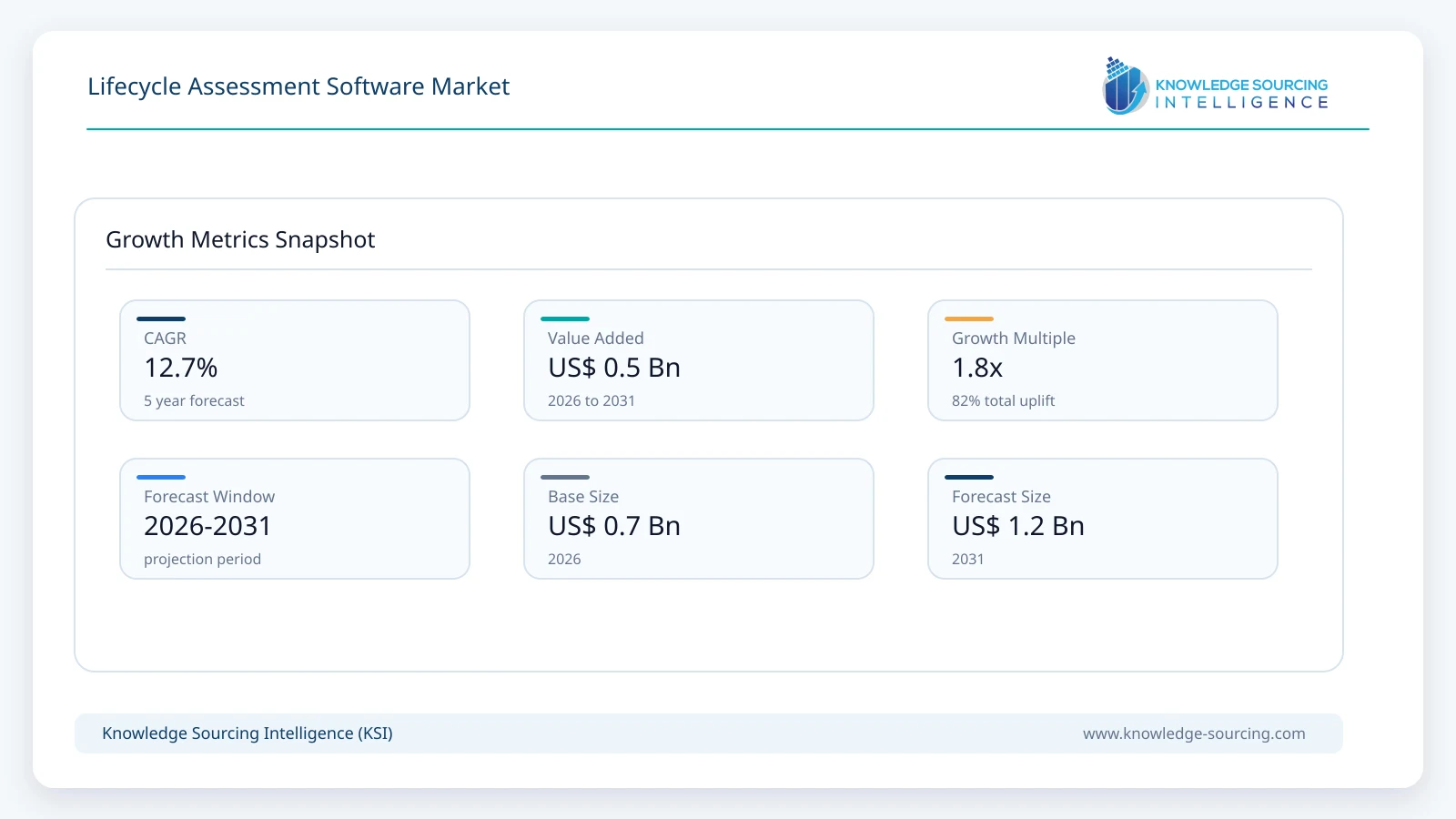
The lifecycle assessment software market is forecast to grow at a CAGR of 12.7%, reaching USD 1.20 billion in 2031 from USD 0.66 billion in 2026.
Highlights:
- 1Growing integration of LCA software with enterprise systems like PLM, ERP, and CAD for seamless sustainability data sharing and informed decision-making across product lifecycles.
- 2Increasing adoption is driven by emphasis on circular economy principles, enabling better evaluation of material flows, recycling strategies, and end-of-life scenarios.
- 3Rising incorporation of AI and machine learning to enhance predictive modeling, automate analysis, and improve accuracy in environmental impact assessments.
- 4Expanding use in supporting regulatory compliance and corporate sustainability goals through transparent, data-driven insights into product environmental footprints.
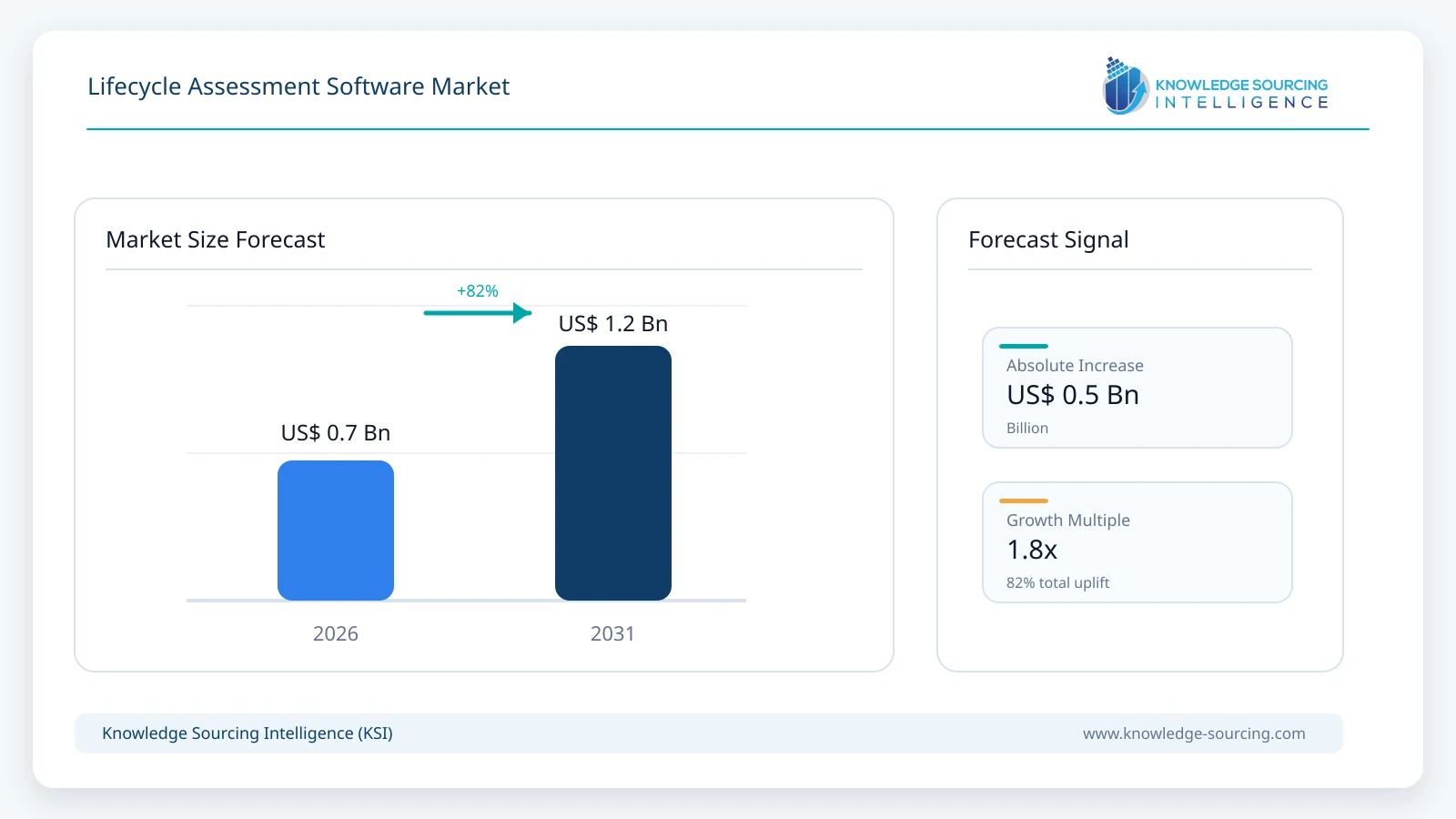
The lifecycle assessment software market is growing rapidly as companies in various sectors are increasingly using digital technologies to evaluate, control, and minimize the environmental effects of their products. LCA software allows companies to measure environmental factors like carbon emissions, energy usage, water consumption, and waste generation. This helps them make better sustainability choices based on data and meet international environmental regulations.
Environmental regulations and sustainability standards are the main drivers behind the global increase in the use of life cycle assessment software. For instance, through its European Green Deal and the EU Ecodesign Directive, the European Union requires companies to analyze the environmental impacts of their products and enhance the eco-efficiency of their products throughout their entire life cycle. Additionally, the Corporate Sustainability Reporting Directive requires detailed environmental disclosures, which in turn motivates companies to utilize LCA software for conducting precise carbon and environmental footprint measurement. The two international standards ISO 14040 and ISO 14044 support the globally accepted practices of life cycle assessment. As a result, these standards are also significantly contributing to the rise in adoption of LCA software in manufacturing, construction, automotive, and consumer goods sectors.
However, due to the increasing emphasis on net-zero emissions, environmentally friendly product designs, and circular economy practices, the global demand for life cycle assessment software solutions is likely to rise. The Paris Agreement established a global aim of limiting global warming to less than 2 °C and making efforts to limit it to 1.5 °C. The global energy-related carbon dioxide (CO2) emissions stand at 38 gigatonnes (Gt) in 2024. Under the NZE Scenario, emissions decrease by almost 55% by 2035, reaching around 18 Gt.
Market Dynamics
Market Drivers
Increasing Use in Green Building and Infrastructure Projects
Growing focus on sustainable construction and environmentally responsible infrastructure development is one of the major factors for the rising use of life cycle assessment software in the building and construction sector. The building and construction sector remains one of the leading contributors to the climate crisis, accounting for 32% of global energy consumption and 34% of global CO2 emissions. Materials such as cement and steel, which are heavily used in the sector, are responsible for 18% of global emissions and are also a significant source of construction waste.
Governments, developers, and construction companies are becoming increasingly aware of the need to reduce the carbon footprint of buildings. They are doing this by breaking down materials and energy consumption, transportation, and construction processes, as well as considering end-of-life disposal. LCA software gives architects, engineers, and project planners the opportunity to explore the environmental performance of various building materials and design alternatives when the building is still in the planning stage. This way, they can choose the most sustainable and resource-efficient options.
One Click LCA has just announced the launch of a new toolkit that will support architects, engineers, construction companies, and materials manufacturers in fulfilling the requirements of several new sustainability laws effective from 2026 onwards. One Click LCA is providing architects and technicians with completely new opportunities by updating their Carbon Designer 3D early design software with generative design and freehand drawing building shapes so that architects and engineers can practically simulate different material choices in the design phase, to find the best possible solutions with the lowest carbon emissions.
Segment Analysis
By Deployment: Cloud
Based on deployment, the Lifecycle Assessment Software Market is divided into on-premises and cloud. Cloud-based systems are driving the adoption of cloud-based tools within the LCA software market as they allow firms to complete their environmental impact assessments using a scalable web-based platform instead of local systems. Firms can evaluate the environmental impact of products and processes throughout their lifecycle (from raw material extraction to disposal) using centralised data and automated calculation tools on these platforms.
Cloud computing also increases ease of accessibility and collaboration throughout supply chains. Sustainability teams, manufacturers and consultants can all work together on LCA models, product data and emissions inventories from multiple remote locations (in real-time) to allow firms to incorporate sustainability assessments into product design and procurement as part of their supply chain process. In addition, cloud platforms enable integration with other enterprise systems (e.g., product lifecycle management (PLM) or building information modelling (BIM)), whereby the environmental impact of a product can be compared to its engineering and economic value.
Automated calculations using large environmental databases and automated workflows also offer additional benefits of a cloud-based LCA system, as they allow firms to calculate key indicators such as greenhouse gas emissions, resource use and pollution impacts very quickly compared to other traditional LCA methods. This means that firms can generate sustainability and regulatory reports more quickly after completing an LCA.
The transition to using cloud-based tools to complete LCAs in 2025 is being driven by increasing regulatory pressure regarding the need for detailed carbon accounting, digital product passports and environmental reporting. The ability to constantly update data via cloud systems, streamlining compliance checks, and conducting analysis across an increasing number of global locations, makes cloud-based systems attractive to many organizations implementing digital sustainability management systems.
The revenue growth of Intertek Group plc from €3,393.2 million in 2024 to €3,431.6 million in 2025 reflects increasing global demand for testing, inspection, certification, and sustainability assurance services. This trend supports the adoption of cloud-deployed lifecycle assessment (LCA) software, which enables organizations to analyze environmental impacts of products and industrial processes across supply chains. As companies expand sustainability verification and compliance activities, cloud-based LCA platforms allow real-time data access, centralized environmental databases, and scalable lifecycle calculations across multiple locations. The growth of assurance providers like Intertek indicates stronger industry demand for digital sustainability tools, particularly cloud systems that support regulatory reporting, carbon footprint assessments, and lifecycle-based product certifications in global markets.
Regional Analysis
The United States LCA software sector is experiencing steady growth, as businesses and policymakers rely on electronic means to calculate environmental impacts across supply chains. Lifecycle Assessments measure the effects on the environment at each step of a product's lifecycle (production, purchase/use, and disposal) from raw material extraction through manufacturing, use and disposal. This enables the understanding, quantification, and reporting of emissions, resource use, and waste throughout the life cycle of products produced worldwide.
The role of the United States Government in this ecosystem cannot be understated. Federal government agencies (Department of Energy, EPA, NIST, USDA) provide publicly accessible datasets, analytical tools, and standards used to create and maintain LCA software platforms. These agencies are a major source of lifecycle inventory datasets that can be used to create analytical models by software developers and researchers who require standardised environmental data.
At the federal level, the Federal Life Cycle Assessment Commons provide agencies such as the U.S. Department of Energy, the U.S. Environmental Protection Agency (EPA), the National Institute of Standards and Technology (NIST) and the United States Department of Agriculture (USDA) with centralised repositories of lifecycle inventory datasets that are used by all LCA software platforms. These datasets are divided into the following market sectors: agriculture, transportation, energy systems, and manufacturing. In other words, utilising the LCA's data sources is a "one-baseline" method for engineers, scientists, and others in agricultural, transportation, energy systems, and manufacturing markets to create and develop analytical models based on standardised environmental data.
The technical underpinnings of the LCA software marketplace have also been significantly enhanced by EPA's tools. These tools include industrial ecology modelling and lifecycle methodology tools that can be utilised to analyse environmental impacts (based upon economic activities, materials, and energy systems) associated with a particular activity. In many cases, outputs produced by these tools are structured to integrate with LCA software platforms and databases for LCA software practitioners.
The construction spending in the United States, increasing from $2,163.1 billion in November 2025 to $2,168.8 billion in December 2025, reflecting sustained investment in residential, commercial, and infrastructure development. Rising construction expenditure highlights growing building activity and material consumption across the country. This trend supports demand for lifecycle assessment software, as construction firms and project developers increasingly evaluate environmental impacts associated with building materials, energy use, and project design. Lifecycle assessment tools help measure embodied carbon, resource efficiency, and waste generation throughout a building’s life cycle. As construction spending expands, the adoption of digital lifecycle analysis solutions becomes more important for sustainability reporting, green building certification, and regulatory compliance.
U.S. Construction Spending, November–December 2025
Nov-25: $2,163.1 billion
Dec-25: $2,168.8 billion
List of Companies
iPoint-systems GmBh
One Click LCA Ltd.
EarthShift Global, LLC
GreenDelta
Athena Sustainable Materials Institute
Solid Forest s.r.o.
SCS Global Services
Intertek Group plc
Sphera
Altermaker
Minviro Ltd
P6 Technologies
Intertek Group Plc is a global provider of testing, inspection, certification, and assurance services that supports companies in ensuring product quality, safety, and sustainability across multiple industries. The company offers environmental and sustainability solutions such as life cycle assessment (LCA), product carbon footprint analysis, and environmental product declaration (EPD) verification, helping organizations evaluate and improve the environmental performance of their products and operations.
Through its global network of laboratories, technical experts, and digital solutions, Intertek assists manufacturers, construction companies, and consumer goods producers in meeting international regulatory requirements and sustainability standards. The company’s services enable organizations to strengthen compliance, enhance product transparency, and integrate sustainable practices throughout the product lifecycle.
Key Developments
September 2026: SimaPro cloud introduces parameterized scenario analysis, allowing users to test alternative calculation values, save five named scenarios, and compare two scenarios side by side.
August 2026: GreenDelta releases openLCA 2.7, introducing a database migration tool alongside additional software improvements and fixes to support lifecycle assessment modelling workflows.
July 2026: SimaPro cloud expands its Master Data API, enabling users to retrieve all processes within a model or primary data library and import custom impact assessment methods directly.
June 2026: GreenDelta releases openLCA 2.6.2, improving the System Dynamics graphical editor following its introduction in version 2.6.0, with further refinements to modelling functionality.
2025: Intertek launched a comprehensive compliance solution to support the European Union Deforestation Regulation (EUDR), helping companies ensure traceability and sustainability in global commodity supply chains.
Lifecycle Assessment Software Market Scope
| Report Metric | Details |
|---|---|
| Total Market Size in 2026 | USD 0.66 billion |
| Total Market Size in 2031 | USD 1.20 billion |
| Forecast Unit | Billion |
| Growth Rate | 12.7% |
| Study Period | 2021 to 2031 |
| Historical Data | 2021 to 2024 |
| Base Year | 2025 |
| Forecast Period | 2026 – 2031 |
| Segmentation | Deployment, Enterprise Type, Application, Geography |
| Companies |
|
Market Segmentation
By Deployment
On-premises
Cloud
By Enterprise Type
Small
Medium
Large
By Application
Food & Beverages
Consumer Goods
Packaging
Construction
Pharmaceuticals & Chemicals
Others
By Geography
North America
USA
Canada
Mexico
South America
Brazil
Argentina
Others
Europe
United Kingdom
Germany
France
Spain
Others
Middle East and Africa
Saudi Arabia
UAE
Others
Asia Pacific
China
Japan
India
South Korea
Australia
Singapore
Indonesia
Others
Table of Contents
1. EXECUTIVE SUMMARY
1.1. Market Overview
1.2. Key Findings
1.3. Key Drivers and Challenges
1.4. Analyst View
2. MARKET INTRODUCTION
2.1. Market Definition
2.2. Market Size and Growth Outlook
2.3. Scope of the Study
2.4. Market Segmentation
2.5. Value Chain Analysis
3. MARKET DYNAMICS
3.1. Market Drivers
3.2. Market Restraints
3.3. Market Opportunities by Segment
3.3.1. Variety
3.3.2. Distribution Channel
3.3.3. Application
3.4. Porter’s Five Forces Analysis
4. BUSINESS LANDSCAPE
4.1. Policies and Regulations
4.2. Import Export Analysis
4.3. Price Trends
4.4. Strategic Recommendations
5. LIFE CYCLE ASSESSMENT SOFTWARE MARKET BY DEPLOYMENT
5.1. Introduction
5.2. On-premises
5.3. Cloud
6. LIFE CYCLE ASSESSMENT SOFTWARE MARKET BY ENTERPRISE TYPE
6.1. Introduction
6.2. Small
6.3. Medium
6.4. Large
7. LIFE CYCLE ASSESSMENT SOFTWARE MARKET BY APPLICATION
7.1. Introduction
7.2. Food & Beverages
7.3. Consumer Goods
7.4. Packaging
7.5. Construction
7.6. Pharmaceuticals & Chemicals
7.7. Others
8. LIFE CYCLE ASSESSMENT (LCA) SOFTWARE MARKET BY GEOGRAPHY
8.1. Introduction
8.2. North America
8.2.1. By Deployment
8.2.2. By Enterprise Type
8.2.3. By Application
8.2.4. By Country
8.2.4.1. USA
8.2.4.2. Canada
8.2.4.3. Mexico
8.3. South America
8.3.1. By Deployment
8.3.2. By Enterprise Type
8.3.3. By Application
8.3.4. By Country
8.3.4.1. Brazil
8.3.4.2. Argentina
8.3.4.3. Others
8.4. Europe
8.4.1. By Deployment
8.4.2. By Enterprise Type
8.4.3. By Application
8.4.4. By Country
8.4.4.1. United Kingdom
8.4.4.2. Germany
8.4.4.3. France
8.4.4.4. Spain
8.4.4.5. Others
8.5. Middle East and Africa
8.5.1. By Deployment
8.5.2. By Enterprise Type
8.5.3. By Application
8.5.4. By Country
8.5.4.1. Saudi Arabia
8.5.4.2. UAE
8.5.4.3. Others
8.6. Asia Pacific
8.6.1. By Deployment
8.6.2. By Enterprise Type
8.6.3. By Application
8.6.4. By Country
8.6.4.1. China
8.6.4.2. Japan
8.6.4.3. India
8.6.4.4. South Korea
8.6.4.5. Australia
8.6.4.6. Singapore
8.6.4.7. Indonesia
8.6.4.8. Others
9. COMPETITIVE ENVIRONMENT AND ANALYSIS
9.1. Major Players and Strategy Analysis
9.2. Market Share Analysis
9.3. Mergers, Acquisitions, Agreements, and Collaborations
9.4. Competitive Dashboard
10. COMPANY PROFILES
10.1. iPoint-systems GmBh
10.2. One Click LCA Ltd.
10.3. EarthShift Global, LLC
10.4. GreenDelta
10.5. Athena Sustainable Materials Institute
10.6. Solid Forest s.r.o.
10.7. SCS Global Services
10.8. Intertek Group plc
10.9. Sphera
10.10. Altermaker
10.11. Minviro Ltd
10.12. P6 Technologies
11. APPENDIX
11.1. Research Methodology
11.2. Currency
11.3. Assumptions
11.4. Base and Forecast Years Timeline
11.5. Key Benefits for Stakeholders
Navigate
Trusted by the world's leading organizations











