
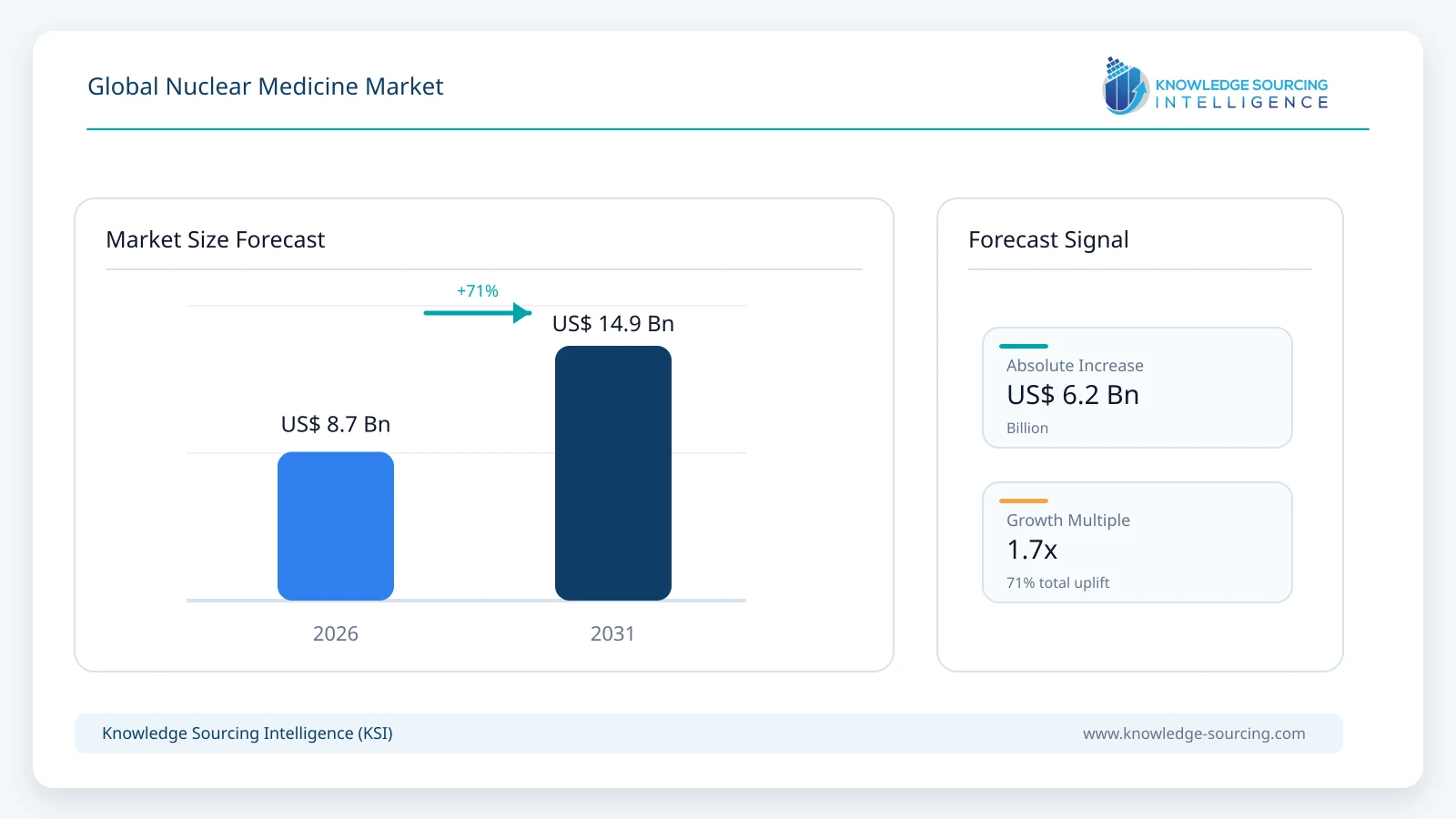
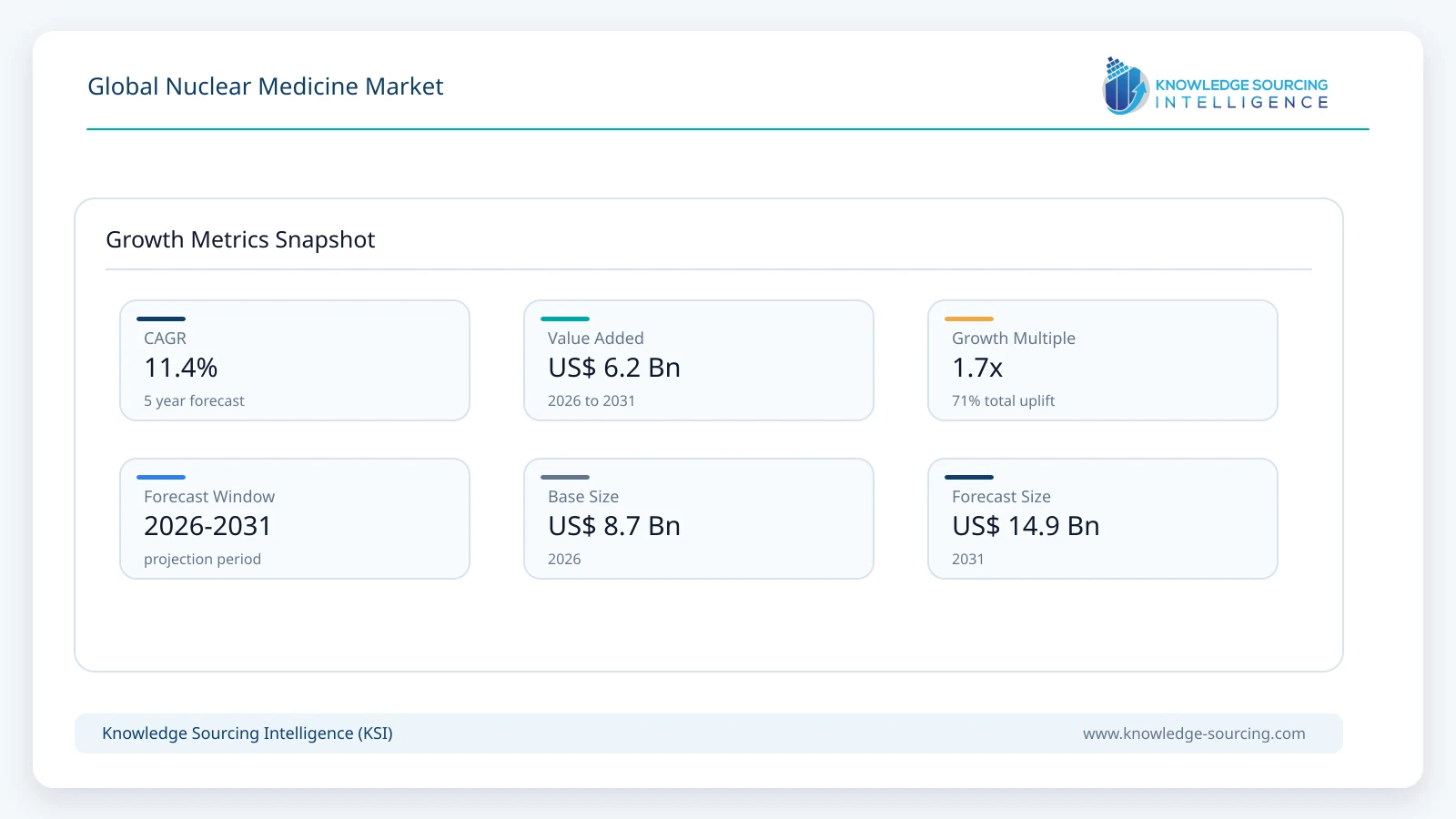
The global nuclear medicine market is projected to increase from USD 8.70 billion in 2026 to USD 14.90 billion in 2031, representing a CAGR of 11.4% over the forecast period.
Highlights:
- 1Diagnostic applications account for approximately 72% of global nuclear medicine revenue in 2026.
- 2Therapeutic radiopharmaceuticals record the fastest growth as radioligand therapy expands.
- 3Hospitals account for approximately 61% of 2026 market revenue worldwide.
- 4PET gains share through oncology, PSMA imaging, amyloid imaging and quantitative workflows.
- 5Radiopharmacy networks are becoming strategic assets because many products require time-critical delivery.
- 6Isotope-production investment is increasing across North America, Europe and Asia Pacific.
Nuclear medicine combines functional imaging with radioactive tracers that reveal biological activity rather than anatomy alone. This remains clinically important in cancer staging, cardiac perfusion assessment, bone imaging, thyroid disease, renal function and neurological diagnosis. SPECT remains the broader-volume modality because technetium-99m supports a large installed base of routine procedures, while PET carries higher average revenue per procedure and is growing more quickly in oncology and neurology. Hybrid PET/CT and SPECT/CT systems continue to replace standalone platforms, improving anatomical localisation and supporting quantitative interpretation.
Commercial growth is increasingly concentrated in radiopharmaceuticals. Diagnostic tracers generate recurring demand around every scan, while targeted therapies can create substantially higher revenue per treated patient. The expansion of PSMA-targeted imaging and therapy in prostate cancer is the clearest example, but neuroendocrine tumours, kidney cancer, glioblastoma and additional solid-tumour indications are also advancing through development. The market is therefore becoming more vertically integrated, with equipment manufacturers, isotope producers, radiopharmacies and pharmaceutical companies competing around complete clinical workflows rather than isolated products.
Selected Segment Estimates
Dimension | Selected Subsegment | 2026 Indicator | Forecast Interpretation |
Application | Diagnosis | ~72% / USD 6.26B | Largest revenue pool; SPECT remains broad-based while PET gains share. |
Application | Therapeutic | ~28% / USD 2.44B | Fastest-growing segment as radioligand therapy expands into earlier disease settings. |
Procedure | PET | ~35% / USD 3.05B | Higher-value imaging segment with strong oncology and neurology demand. |
Procedure | SPECT | ~32% / USD 2.78B | Large established procedure base; growth is steadier and replacement-led. |
End User | Hospitals | ~61% / USD 5.31B | Largest end-user group because complex imaging and therapy require integrated infrastructure. |
End User | Diagnostic Centres | ~26% / USD 2.26B | Expands through outpatient PET/SPECT and commercial radiopharmacy partnerships. |
Market Dynamics
Radioligand Therapy Is Expanding Nuclear Medicine Beyond Diagnostic Imaging
Targeted radioligand therapy is the strongest value-growth driver through 2031. Novartis reported Pluvicto sales of USD 651 million in the second quarter of 2026, up 43% year on year in constant currencies, and the U.S. Food and Drug Administration expanded Pluvicto into an earlier metastatic prostate-cancer setting in July 2026. Curium's September 2026 approval of BEXLUTRY adds competition in lutetium-177 therapy for gastroenteropancreatic neuroendocrine tumours. These products increase demand not only for therapeutic doses but also for PET imaging, dosimetry, treatment planning, radiation-safety infrastructure and specialist nuclear-medicine capacity.
PET Is Broadening Across Oncology and Neurology
PET continues to gain share because of its sensitivity, quantitative performance and expanding tracer portfolio. PSMA PET has become central to prostate-cancer staging and treatment selection, while amyloid PET is gaining relevance in neurodegenerative disease pathways. Lantheus reported USD 240.4 million of PYLARIFY sales and USD 39.6 million of Neuraceq sales in the second quarter of 2026. The mix is shifting from a small number of high-volume oncology tracers toward a wider portfolio of disease-specific agents, increasing both radiopharmacy complexity and commercial value per installed scanner.
Manufacturing and Distribution Capacity Is Becoming a Competitive Advantage
Radioactive decay places unusual constraints on nuclear-medicine supply chains. Many products cannot be manufactured centrally and shipped globally like conventional pharmaceuticals; they require regional cyclotrons, isotope-processing facilities, radiopharmacies and precisely scheduled logistics. This is prompting investment in distributed manufacturing networks. Telix reported USD 146 million of first-half 2026 revenue in its manufacturing-solutions segment and expanded production assets across the United States, Europe, Australia and Japan. Curium and Lantheus also announced a proposed combination valued at up to USD 8.0 billion, highlighting the strategic value of integrated radiopharmaceutical portfolios and distribution networks.
Isotope Supply, Workforce and Regulatory Complexity Remain Structural Constraints
Growth is limited by the availability of medical isotopes, qualified nuclear-medicine physicians, radiopharmacists, physicists and technologists, as well as the capital required for licensed facilities. Regulatory requirements span pharmaceuticals, radiation protection, transport, waste handling and occupational safety. Therapeutic workflows are especially demanding because they require patient-specific scheduling, dose preparation, radiation isolation and follow-up. These constraints can slow adoption even when clinical demand is strong, particularly in emerging healthcare systems and outside major metropolitan centres.
Global Nuclear Medicine Market Segment Analysis
By Application
Diagnostic Nuclear Medicine
Diagnostic nuclear medicine remains the largest application segment, accounting for approximately 72% of 2026 revenue. SPECT supports high procedure volumes in cardiac, bone, renal and endocrine imaging, while PET is gaining value share through oncology and neurology. Diagnostic growth is increasingly tied to tracer innovation rather than basic scanner penetration. PSMA PET, somatostatin-receptor imaging and amyloid PET create new referral pathways and can directly determine eligibility for targeted therapies. This makes diagnostic radiopharmaceuticals strategically important even as therapy becomes the faster-growing application.
By Application
Therapeutic Radiopharmaceuticals
Therapeutic radiopharmaceuticals are the fastest-growing application segment through 2031. Lutetium-177 products currently provide the clearest commercial base, particularly in prostate cancer and neuroendocrine tumours, while alpha-emitter programs and new disease targets broaden the development pipeline. Therapy growth also increases downstream demand for imaging, dosimetry and longitudinal follow-up, meaning therapeutic adoption can expand revenue across several parts of the nuclear-medicine ecosystem rather than only within the drug category itself.
Market and Demand Indicators
Indicator | Latest Development | Market Impact |
Radioligand therapy | Pluvicto Q2 2026 sales reached USD 651M, up 43% cc. | Confirms rapid commercial scaling of targeted radionuclide therapy. |
U.S. label expansion | FDA expanded Pluvicto use into an earlier metastatic prostate-cancer setting in July 2026. | Broadens the addressable treatment population and linked PSMA imaging demand. |
New therapy entrant | FDA approved Curium BEXLUTRY in September 2026 for SSTR-positive GEP-NETs. | Adds competition and expands availability of Lu-177 therapy. |
Radiopharma consolidation | Curium and Lantheus announced an up-to-USD-8B transaction in August 2026. | Concentrates manufacturing, distribution and diagnostic portfolios. |
Commercial diagnostics | Lantheus reported USD 240.4M PYLARIFY sales in Q2 2026. | Demonstrates the scale of PSMA PET tracer demand. |
Manufacturing network | Telix manufacturing solutions reported USD 146M H1 2026 segment revenue. | Shows growing value of distributed radiopharmacy and production infrastructure. |
North America Market Analysis
North America remains the largest commercial region for nuclear medicine, supported by extensive PET and SPECT infrastructure, high oncology spending, established reimbursement and the world's deepest commercial radiopharmacy network.
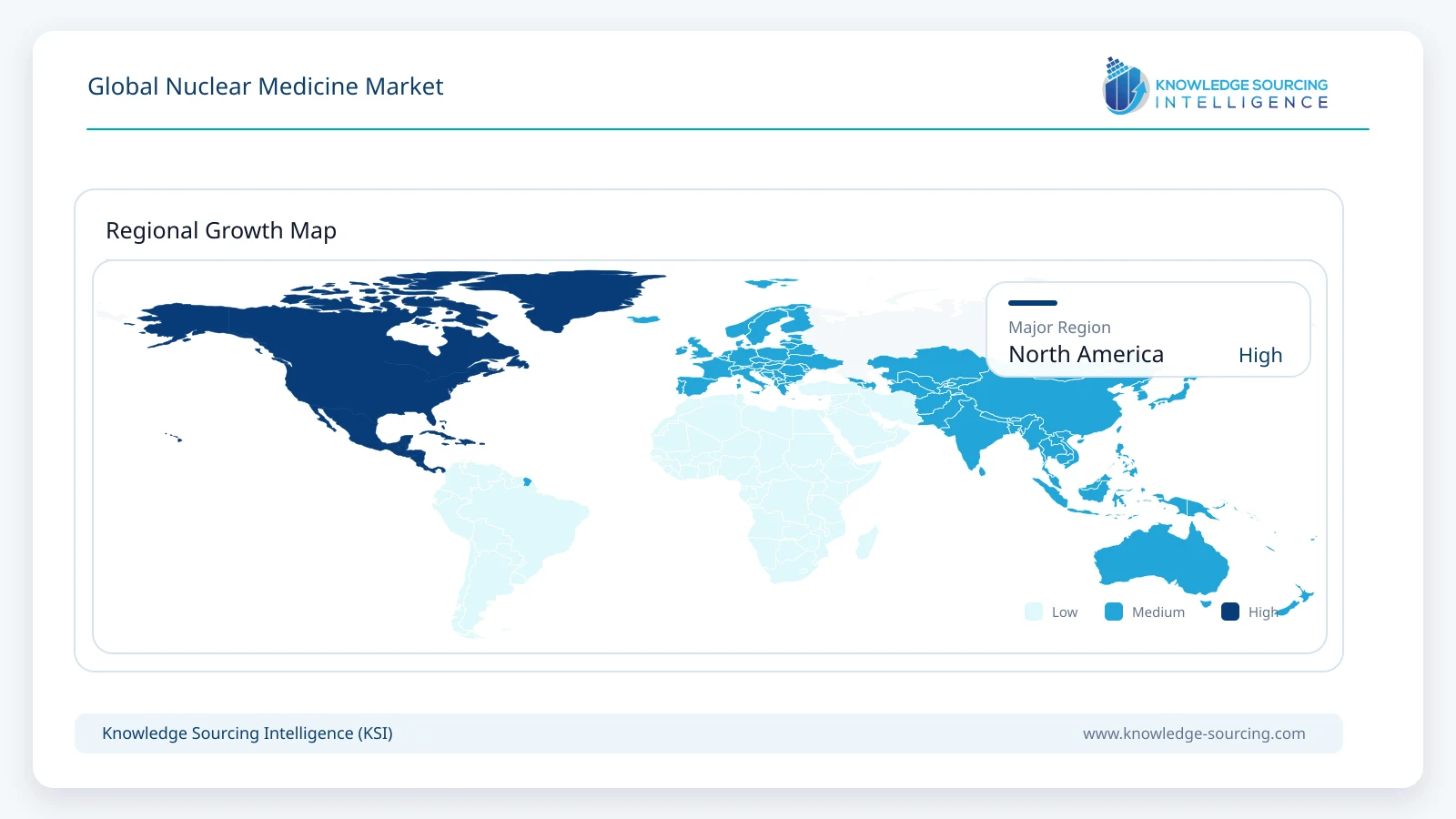
The United States is particularly important for PSMA PET and radioligand therapy adoption, with 2026 approvals expanding treatment into earlier prostate-cancer settings and adding another lutetium-177 option for neuroendocrine tumours. Canada contributes strategic isotope-production and processing capability, while Mexico remains a smaller but expanding market centred on major private and tertiary hospitals.
The region's competitive advantage is increasingly tied to logistics and manufacturing density. Lantheus, Curium, Cardinal Health, Telix/RLS and other suppliers operate radiopharmacy or distribution networks that shorten delivery times for short-half-life products. Growth is likely to remain strongest in therapeutic radiopharmaceuticals, PET tracers and software-enabled quantitative imaging rather than conventional SPECT procedure volumes. Constraints include reimbursement variation, workforce capacity, isotope supply and the need for specialised treatment facilities as radioligand therapy volumes increase.
Competitive Landscape
The competitive landscape spans radiopharmaceutical developers, medical-isotope suppliers, imaging-equipment manufacturers and radiopharmacy networks. Novartis / Advanced Accelerator Applications, Curium, Lantheus, Telix, Bracco, Cardinal Health, Jubilant Radiopharma and Eckert & Ziegler compete across diagnostic and therapeutic products. GE HealthCare, Siemens Healthineers, Philips, Canon Medical and United Imaging compete in PET/CT and SPECT/CT systems, software and service. Competitive advantage increasingly depends on the ability to combine tracer portfolios, manufacturing, regulatory expertise and distribution with installed imaging infrastructure.
Industry consolidation is increasing because scale matters in radiopharmaceutical manufacturing and logistics. Curium's proposed acquisition of Lantheus would combine a broad international isotope and radiopharmaceutical platform with a leading U.S. diagnostic portfolio. Telix has also expanded its global manufacturing footprint and late-stage therapy pipeline. Equipment vendors are responding by strengthening quantitative imaging, digital detectors, workflow automation and theranostic planning tools, keeping hardware relevant even as recurring radiopharmaceutical revenue grows faster.
Recent Developments
September 2026: The U.S. FDA approved Curium BEXLUTRY, a lutetium-177 therapy for SSTR-positive gastroenteropancreatic neuroendocrine tumours.
August 2026: Curium announced a definitive agreement to acquire Lantheus in a transaction valued at up to USD 8.0 billion.
July 2026: The U.S. FDA expanded Pluvicto into PSMA-positive metastatic androgen pathway modulation-naive or -sensitive prostate cancer.
July 2026: Telix dosed the first patient in the Phase III LUTEON study of TLX250-Tx for clear-cell renal-cell carcinoma.
July 2026: Telix opened a Melbourne facility integrating radiopharmaceutical research, manufacturing and patient administration.
June 2026: Curium announced a EUR 32 million investment in France for a new lutetium-177 PSMA production line.
Global Nuclear Medicine Market Scope:
| Report Metric | Details |
|---|---|
| Total Market Size in 2026 | USD 8.70 billion |
| Total Market Size in 2031 | USD 14.90 billion |
| Forecast Unit | Billion |
| Growth Rate | 11.4% |
| Study Period | 2021 to 2031 |
| Historical Data | 2021 to 2024 |
| Base Year | 2025 |
| Forecast Period | 2026 – 2031 |
| Segmentation | Application, Procedure, End User, Geography |
| Companies |
|
Market Segmentation
By Application
Diagnosis
Therapeutic
By Procedure
PET Scan
SPECT Scan
Radioimmunotherapy and Radioligand Therapy
Thyroid Ablation
Brachytherapy
Others
By End User
Hospitals
Diagnostic Centres
Research Institutes
By Geography
North America
United States
Canada
Mexico
South America
Brazil
Argentina
Rest of South America
Europe
Germany
United Kingdom
France
Italy
Rest of Europe
Middle East and Africa
Saudi Arabia
Israel
South Africa
Rest of Middle East and Africa
Asia Pacific
China
Japan
India
South Korea
Taiwan
Rest of Asia Pacific
Table of Contents
1. EXECUTIVE SUMMARY
2. MARKET SNAPSHOT
2.1. Market Overview
2.2. Market Segmentation
3. BUSINESS LANDSCAPE
3.1. Market Drivers
3.1.1. Radioligand Therapy Is Expanding Nuclear Medicine Beyond Diagnostic Imaging
3.1.2. PET Is Broadening Across Oncology and Neurology
3.1.3. Manufacturing and Distribution Capacity Is Becoming a Competitive Advantage
3.2. Market Restraints
3.2.1. Isotope Supply, Workforce and Regulatory Complexity Remain Structural Constraints
3.3. Market Opportunities
3.4. Porter's Five Forces Analysis
3.5. Industry Value Chain Analysis
3.6. Regulatory Landscape
4. TECHNOLOGICAL OUTLOOK
4.1. SPECT and SPECT/CT
4.2. PET and PET/CT
4.3. Digital Detectors and Quantitative Imaging
4.4. Radioligand Therapy and Theranostics
5. GLOBAL NUCLEAR MEDICINE MARKET BY APPLICATION
5.1. Diagnosis
5.2. Therapeutic
6. GLOBAL NUCLEAR MEDICINE MARKET BY PROCEDURE
6.1. PET Scan
6.2. SPECT Scan
6.3. Radioimmunotherapy and Radioligand Therapy
6.4. Thyroid Ablation
6.5. Brachytherapy
6.6. Others
7. GLOBAL NUCLEAR MEDICINE MARKET BY END USER
7.1. Hospitals
7.2. Diagnostic Centres
7.3. Research Institutes
8. GLOBAL NUCLEAR MEDICINE MARKET BY GEOGRAPHY
8.1. North America
8.1.1. United States
8.1.2. Canada
8.1.3. Mexico
8.2. South America
8.2.1. Brazil
8.2.2. Argentina
8.2.3. Rest of South America
8.3. Europe
8.3.1. Germany
8.3.2. United Kingdom
8.3.3. France
8.3.4. Italy
8.3.5. Rest of Europe
8.4. Middle East and Africa
8.4.1. Saudi Arabia
8.4.2. Israel
8.4.3. South Africa
8.4.4. Rest of Middle East and Africa
8.5. Asia Pacific
8.5.1. China
8.5.2. Japan
8.5.3. India
8.5.4. South Korea
8.5.5. Taiwan
8.5.6. Rest of Asia Pacific
9. COMPETITIVE ENVIRONMENT AND ANALYSIS
9.1. Major Players and Strategy Analysis
9.2. Market Share Analysis
9.3. Mergers, Acquisitions, Agreements and Collaborations
9.4. Competitive Dashboard
10. COMPANY PROFILES
10.1. Novartis / Advanced Accelerator Applications
10.2. Curium Pharma
10.3. Lantheus Holdings, Inc.
10.4. Telix Pharmaceuticals Limited
10.5. Bracco
10.6. Cardinal Health, Inc.
10.7. Jubilant Radiopharma
10.8. Eckert & Ziegler
10.9. Nordion (Sotera Health)
10.10. IBA Radiopharma Solutions
10.11. GE HealthCare
10.12. Siemens Healthineers
10.13. Koninklijke Philips N.V.
10.14. Canon Medical Systems Corporation
10.15. United Imaging Healthcare
10.16. Spectrum Dynamics Medical
10.17. SHINE Technologies
10.18. Nuclear Research and Consultancy Group (NRG)
11. RECENT DEVELOPMENTS
12. APPENDIX
12.1. Currency
12.2. Assumptions
12.3. Base and Forecast Years Timeline
12.4. Research Methodology
12.5. Abbreviations
Navigate
Trusted by the world's leading organizations











