
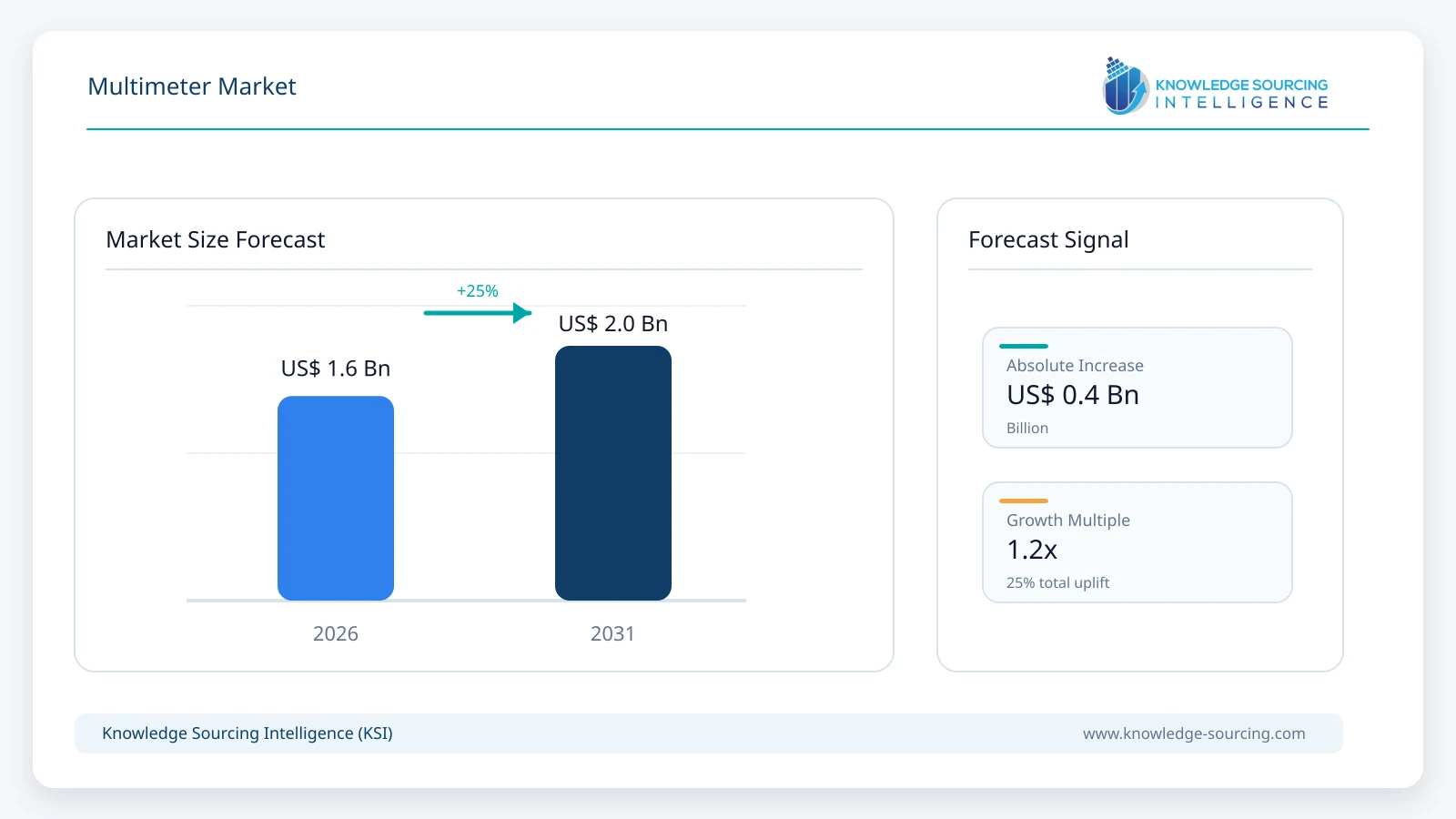
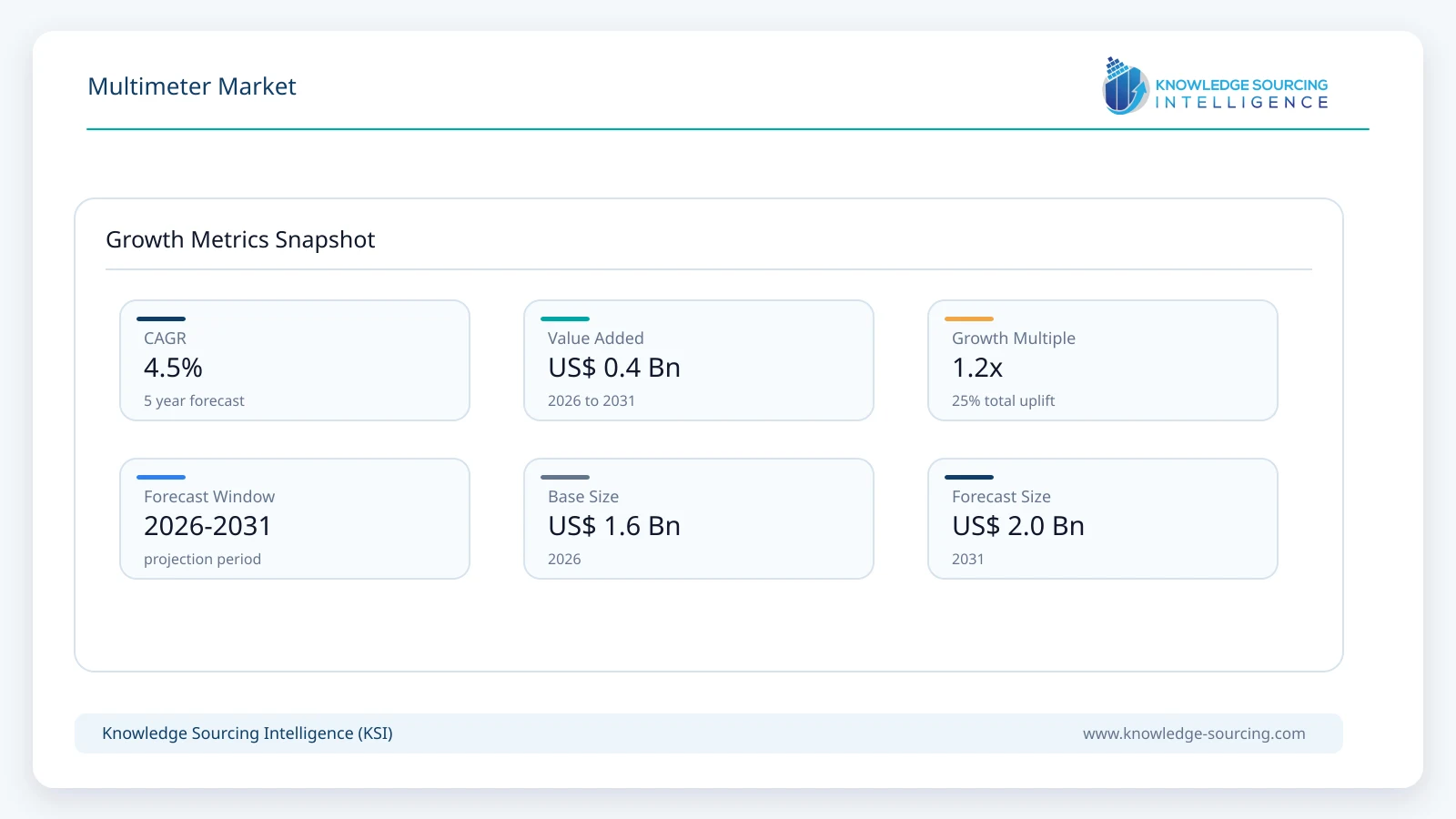
The multimeter market is forecast to grow at a CAGR of 4.5%, reaching USD 2.03 billion in 2031 from USD 1.63 billion in 2026.
Highlights:
- 1Digital multimeters account for the largest share of product demand across industrial applications.
- 2Electrical infrastructure expansion is increasing demand for testing and maintenance instruments.
- 3Automotive electrification is raising accuracy and safety requirements for diagnostic equipment.
- 4Asia Pacific benefits from concentrated electronics manufacturing and industrial production capacity.
- 5Product differentiation increasingly depends on safety ratings, connectivity, and measurement precision.
- 6Supply-chain disruptions and pricing pressure continue to affect instrument manufacturers.
Purchasing decisions in this market are shaped less by unit price and more by measurement accuracy, safety certification, durability, reliability, and compatibility with modern industrial environments. End users increasingly require instruments that support preventive maintenance programs, equipment diagnostics, and digital recordkeeping. As a result, suppliers are investing in wireless connectivity, cloud-based data management, enhanced safety ratings, and improved measurement capabilities.
Industrial maintenance teams, utility operators, automotive service providers, aerospace manufacturers, electronics producers, and government agencies remain among the most important buyers. While basic handheld multimeters continue to serve routine troubleshooting tasks, demand is shifting toward higher-specification digital instruments that support complex electrical systems, renewable energy installations, battery management systems, industrial automation equipment, and advanced electronic assemblies.
Value creation within the market extends beyond hardware sales. Calibration services, software integration, training, after-sales support, and certification services are becoming increasingly important components of supplier revenue. This trend is particularly visible in regulated industries where traceable measurements and compliance documentation influence equipment selection.
Key Market Indicators
Indicator | Latest Evidence | Commercial Meaning |
Global electric vehicle sales | More than 17 million units (2024, IEA) | Expands demand for batteries, charging systems, and electrical diagnostics |
Global renewable power additions | Over 580 GW added in 2024 (IEA) | Increases testing requirements across generation and grid infrastructure |
Industrial robot installations | Over 540,000 units installed globally in 2024 (IFR) | Supports demand for maintenance and electrical troubleshooting tools |
Global electricity demand growth | Approximately 4% growth in 2024 (IEA) | Creates additional inspection and maintenance requirements |
Connected IoT devices | Billions of deployed industrial and commercial devices globally | Expands the need for electrical verification and field diagnostics |
Electronics manufacturing concentration in the Asia Pacific | A major share of global electronics production | Supports sustained demand for test and measurement equipment |
Key Indicator: Global electric vehicle sales exceeded 17 million units in 2024, according to the International Energy Agency.
Commercial Meaning: Battery systems, charging infrastructure, power electronics, and vehicle diagnostics require extensive electrical measurement throughout production and maintenance cycles.
Market Drivers
Expansion of the electrical grid and power infrastructure.
Electricity demand continues to increase across industrial, residential, transportation, and digital infrastructure sectors. The International Energy Agency (IEA) projects global electricity consumption growth of approximately 4% annually through 2027. Grid expansion, transmission upgrades, renewable integration projects, and substation modernization require extensive electrical testing during installation, commissioning, and maintenance activities. These conditions support recurring demand for field measurement instruments, including multimeters.
Rising complexity of vehicle electrical systems.
Electric vehicles, hybrid powertrains, battery management systems, charging infrastructure, and advanced driver assistance systems have increased the number of electronic components requiring testing and diagnostics. Service centers and vehicle manufacturers require instruments capable of measuring higher voltages while meeting stringent safety standards. Automotive applications are becoming an increasingly important source of demand for premium digital multimeters.
Growth in electronics manufacturing and industrial automation.
Production facilities increasingly depend on electronic controls, sensors, programmable automation systems, and power management equipment. Manufacturing operations require routine verification, calibration, troubleshooting, and preventive maintenance. The concentration of electronics production across Asia Pacific has created sustained demand for handheld and benchtop measurement instruments used throughout production and quality-control processes.
Higher safety and compliance requirements in industrial maintenance.
Industrial facilities face stricter workplace safety standards when working with energized equipment. As a result, purchasing decisions increasingly prioritize measurement accuracy, category safety ratings (CAT III and CAT IV), overload protection, and certified testing capabilities. Suppliers such as Fluke, Hioki, Keysight Technologies, and Yokogawa continue to develop instruments emphasizing operator safety and compliance-driven functionality.
Demand from aerospace and defense diagnostics.
Aircraft maintenance organizations, defense agencies, and aerospace manufacturers require highly reliable testing equipment for electrical and avionics systems. Growth in aircraft maintenance activity and increasing electrification within aerospace platforms are creating demand for higher-precision diagnostic tools. These customers typically prioritize reliability and certification compliance over purchase price, supporting premium market segments.
Market Restraints and Challenges
Price competition from low-cost manufacturers.
The market contains a wide range of regional and local suppliers offering lower-priced alternatives. This creates pricing pressure for established manufacturers that invest heavily in calibration accuracy, safety certification, product testing, and technical support. Premium suppliers must justify higher pricing through performance, reliability, and service capabilities rather than basic measurement functionality alone.
Component sourcing and supply-chain volatility.
Electronic test instruments rely on semiconductors, sensors, displays, connectors, and precision components. Supply-chain disruptions and component shortages have affected production schedules across the broader electrical equipment sector. Manufacturers increasingly seek supplier diversification and inventory management strategies to reduce procurement risks. Similar pressures have affected electrical infrastructure equipment markets globally.
Calibration and certification requirements.
Industrial, aerospace, defense, and utility customers often require traceable calibration and documented measurement accuracy. Maintaining these standards increases manufacturing costs and creates barriers for smaller suppliers seeking entry into regulated applications. Certification requirements also extend product-development timelines and increase testing expenditures.
Product commoditization in entry-level segments.
Basic multimeter functions have become widely available across numerous manufacturers. In entry-level markets, differentiation is limited, and customers frequently prioritize price over performance. This environment can compress margins and increase competition among suppliers targeting general-purpose users.
Long replacement cycles.
Unlike rapidly changing electronic devices, professional-grade multimeters often remain operational for many years. High-quality instruments can remain in service for extended periods with periodic calibration. This limits replacement-driven revenue and increases reliance on new applications, infrastructure investment, and technological upgrades to generate incremental market demand.
Major Segment Analysis
Digital Multimeters
Digital multimeters represent the most commercially important product segment within the market. Their position is supported by higher measurement accuracy, ease of use, automatic ranging functions, digital displays, data logging capabilities, and compatibility with modern maintenance workflows. Industrial users increasingly prefer digital instruments because they reduce reading errors and support more advanced diagnostic functions.
Purchasing criteria within the digital segment extend beyond measurement capability. Industrial buyers evaluate safety ratings, environmental durability, wireless connectivity, software compatibility, battery life, and calibration support. Utility operators and maintenance technicians frequently prioritize ruggedized handheld designs capable of operating under demanding field conditions, while laboratories and manufacturing facilities often require higher-precision bench instruments.
Competition within the segment increasingly focuses on integrated functionality rather than basic measurement performance. Suppliers are introducing Bluetooth connectivity, data capture, remote monitoring, and expanded logging capabilities to improve workflow efficiency. Premium manufacturers benefit from customer preference for trusted brands in safety-critical environments, particularly within utilities, aerospace, and industrial maintenance applications.
Regional Analysis
Region | Main Demand Signal | Principal Constraint |
North America | Utility modernization, EV adoption, aerospace activity | Higher labor and compliance costs |
Europe | Industrial automation and energy-transition investment | Regulatory complexity and economic uncertainty |
Asia Pacific | Electronics manufacturing and vehicle production | Intense pricing competition |
Middle East and Africa | Power infrastructure expansion | Import dependence and technical workforce shortages |
South America | Industrial maintenance and energy projects | Currency volatility and investment fluctuations |
North America
North America remains an important market due to advanced industrial infrastructure, aerospace activity, utility modernization programs, and growing electric vehicle deployment. The United States represents the largest regional demand center, supported by extensive maintenance requirements across manufacturing, energy, transportation, and government sectors. Buyers generally prioritize safety compliance, accuracy, and lifecycle support over initial acquisition cost.
Europe
Demand in Europe is supported by industrial automation, renewable energy integration, automotive manufacturing, and stringent workplace safety standards. Germany, the United Kingdom, and France represent key markets due to their industrial bases and engineering-intensive sectors. Compliance requirements encourage adoption of certified instruments and favor established suppliers with strong calibration networks.
Asia Pacific
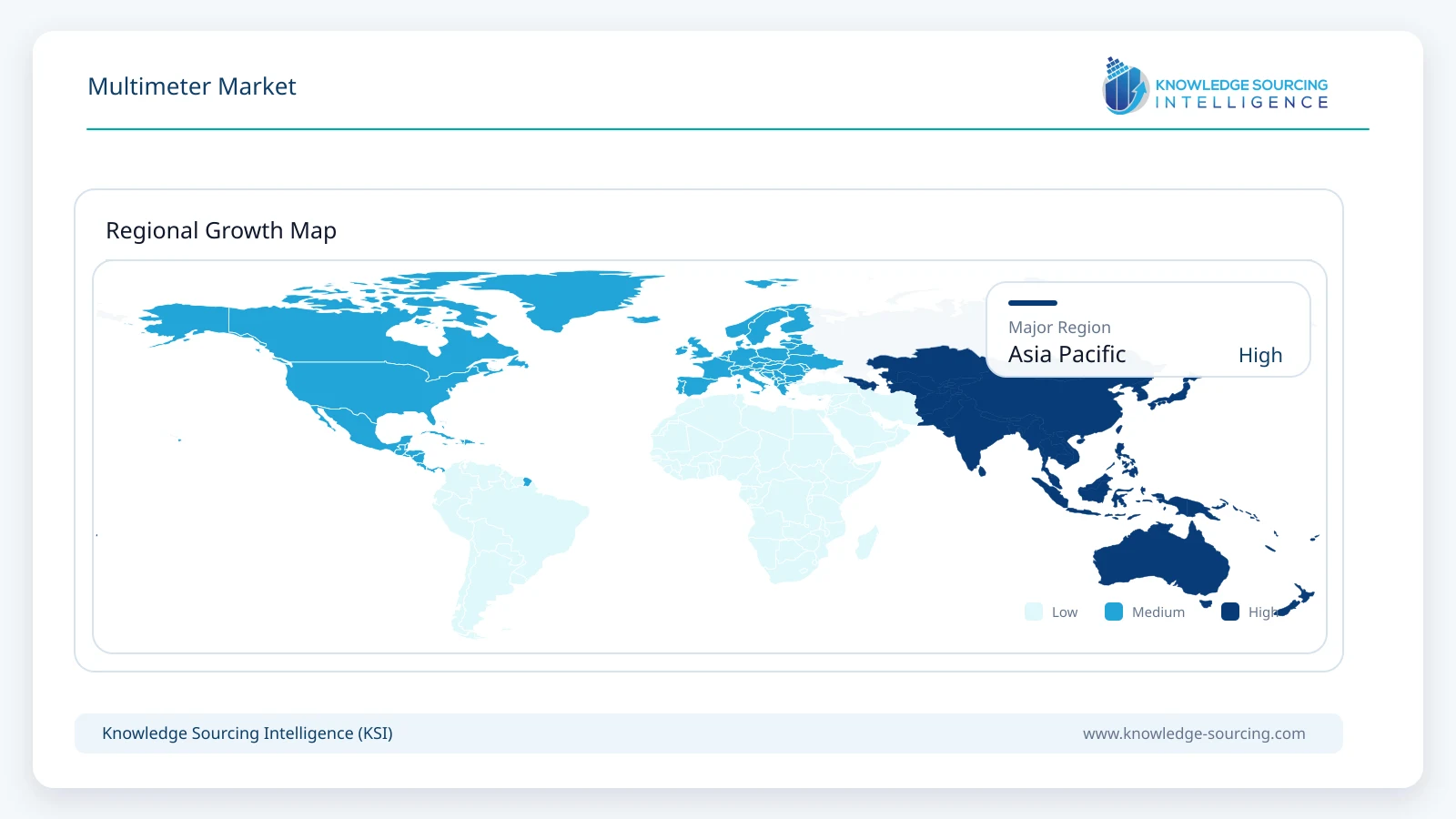
Asia Pacific represents the most important manufacturing hub for electronics, electrical equipment, and automotive production. China, Japan, South Korea, and India account for substantial industrial activity requiring electrical testing and maintenance. Expanding electronics production and vehicle electrification continue to support instrument demand. Regional competitiveness remains heavily influenced by pricing dynamics and manufacturing scale.
Middle East and Africa
Investment in power generation, transmission infrastructure, industrial projects, and oil and gas facilities creates demand for electrical measurement equipment. Utility maintenance and energy-sector operations represent important application areas. However, many markets remain dependent on imported instruments and specialized technical expertise.
South America
Brazil and Argentina account for much of the region's industrial demand. Mining, utilities, manufacturing, and energy infrastructure support multimeter purchases. Economic volatility and fluctuating capital investment cycles can affect procurement activity, particularly for higher-priced professional instruments.
Competitive Landscape
The multimeter market exhibits characteristics of a moderately fragmented test-and-measurement industry. Competition is shaped by product reliability, measurement accuracy, safety certification, brand reputation, distribution reach, calibration capability, and technical support rather than price alone.
Fluke Corporation maintains a strong position in industrial maintenance, utility operations, and electrical safety applications through a broad portfolio of handheld measurement instruments and calibration services.
Keysight Technologies and Yokogawa Test & Measurement Corporation compete through precision measurement capabilities, laboratory-grade equipment, and integration with broader testing ecosystems.
HIOKI E.E. CORPORATION has strengthened its presence in automotive, battery, and industrial testing applications, benefiting from increasing electrification across transportation and energy sectors.
Emerson Electric Co. leverages broader industrial automation relationships, while GMC-Instruments competes through specialized electrical testing and safety-focused product offerings.
Mastech Group (MGL International Group Limited) participates more aggressively in value-oriented segments, where affordability and broad distribution remain important competitive factors.
Barriers to entry are moderate. Basic measurement technology is widely available, but achieving certification compliance, maintaining calibration credibility, establishing distribution channels, and earning customer trust in safety-critical applications require substantial investment and technical expertise.
Recent Developments
January 2026: HIOKI E.E. CORPORATION issued an official transition notice transferring the manufacturing of its analog multimeter and analog insulation tester lines to Nishizawa Electric Meters Manufacturing Co., Ltd.
August 2025: Fluke Corporation launched a new Null Meter option for the Fluke 8588A Reference Multimeter, designed to make traditional analog null detectors obsolete.
June 2025: Rohde & Schwarz launched the R&S UDS digital multimeter series, offering 5½ and 6½-digit resolution instruments with advanced measurement and remote-control functions.
May 2025: GW Instek launched the GDM-9052 5½-digit dual measurement multimeter, featuring AI-powered auto identification and versatile connectivity for manufacturing and QA workflows.
April 2025: Bosch launched a specialized range of professional electrical testing equipment, featuring new digital multimeters and non-contact voltage testers for trade professionals.
Regulatory and Policy Environment
Multimeter manufacturers operate within a framework shaped by electrical safety standards, electromagnetic compatibility requirements, calibration standards, and workplace safety regulations. Compliance with IEC, UL, CE, and related certification frameworks is increasingly important, particularly in industrial, utility, aerospace, and government applications.
Energy-transition policies are indirectly supporting demand. Grid modernization programs, renewable-energy deployment, electric vehicle infrastructure investment, and industrial electrification initiatives increase the volume of electrical assets requiring installation, testing, and maintenance. The International Energy Agency continues to highlight the scale of investment needed in electricity networks and transmission infrastructure, reinforcing long-term demand for electrical testing equipment.
Outlook and Strategic Implications
Demand through 2031 is expected to remain linked to electrification trends rather than short-term economic cycles. Electrical infrastructure upgrades, renewable energy integration, electric vehicle deployment, industrial automation, and electronics manufacturing expansion will continue to create recurring testing and maintenance requirements.
Several strategic implications are likely to shape competitive outcomes:
Premium suppliers will continue investing in connectivity, software integration, and advanced diagnostics.
Safety certification and calibration services will remain important differentiators in industrial markets.
Automotive electrification will increase demand for higher-voltage testing capabilities.
Asia Pacific will remain central to manufacturing activity and volume demand.
Distribution strength and after-sales support will become increasingly important as product functionality converges.
Market growth remains moderate rather than disruptive. Competitive advantage is likely to depend on technical credibility, safety performance, service capability, and the ability to support increasingly complex electrical systems across industrial and infrastructure environments.
Multimeter Market Scope
| Report Metric | Details |
|---|---|
| Total Market Size in 2026 | USD 1.63 billion |
| Total Market Size in 2031 | USD 2.03 billion |
| Forecast Unit | Billion |
| Growth Rate | 4.5% |
| Study Period | 2021 to 2031 |
| Historical Data | 2021 to 2024 |
| Base Year | 2025 |
| Forecast Period | 2026 – 2031 |
| Segmentation | Product Type, Probe Type, End-user, Geography |
| Companies |
|
Market Segmentation
By Product Type
By Probe Type
By End-user
By Geography
Table of Contents
1. EXECUTIVE SUMMARY
2. MARKET SNAPSHOT
2.1. Market Overview
2.2. Market Definition
2.3. Scope of the Study
2.4. Market Segmentation
3. BUSINESS LANDSCAPE
3.1. Market Drivers
3.2. Market Restraints
3.3. Market Opportunities
3.4. Porter’s Five Forces Analysis
3.5. Industry Value Chain Analysis
3.6. Policies and Regulations
3.7. Strategic Recommendations
4. TECHNOLOGICAL OUTLOOK
5. MULTIMETER MARKET BY PRODUCT TYPE
5.1. Introduction
5.2. Digital
5.3. Analog
6. MULTIMETER MARKET BY PROBE TYPE
6.1. Introduction
6.2. Pointed Probes
6.3. Crocodile Clips
6.4. Retractable Hook Clips
7. MULTIMETER MARKET BY END-USER
7.1. Introduction
7.2. Automotive
7.3. Aerospace
7.4. Defense and Government
7.5. Power and Energy
7.6. Others
8. MULTIMETER MARKET BY GEOGRAPHY
8.1. Introduction
8.2. North America
8.2.1. USA
8.2.2. Canada
8.2.3. Mexico
8.3. South America
8.3.1. Brazil
8.3.2. Argentina
8.3.3. Others
8.4. Europe
8.4.1. Germany
8.4.2. France
8.4.3. United Kingdom
8.4.4. Spain
8.4.5. Others
8.5. Middle East and Africa
8.5.1. Saudi Arabia
8.5.2. UAE
8.5.3. Others
8.6. Asia Pacific
8.6.1. China
8.6.2. India
8.6.3. Japan
8.6.4. South Korea
8.6.5. Indonesia
8.6.6. Thailand
8.6.7. Others
9. COMPETITIVE ENVIRONMENT AND ANALYSIS
9.1. Major Players and Strategy Analysis
9.2. Market Share Analysis
9.3. Mergers, Acquisitions, Agreements, and Collaborations
9.4. Competitive Dashboard
10. COMPANY PROFILES
10.1. Fluke Corporation
10.2. Mastech Group (MGL International Group Limited)
10.3. Keysight Technologies
10.4. Yokogawa Test & Measurement Corporation (Yokogawa Electric Corporation)
10.5. GMC-Instruments.
10.6. Emerson Electric Co.
10.7. HIOKI E.E. CORPORATION
11. APPENDIX
11.1. Currency
11.2. Assumptions
11.3. Base and Forecast Years Timeline
11.4. Key benefits for the stakeholders
11.5. Research Methodology
11.6. Abbreviations
Navigate
Trusted by the world's leading organizations











