Report Overview
The neurosymbolic AI market is expected to see steady growth over the forecasted period.
Highlights:
- 1Growing enterprise demand for explainable AI in regulated industries is strengthening adoption of neurosymbolic architectures.
- 2Knowledge-based AI systems remain one of the most commercially valuable application areas because enterprises continue investing in knowledge graphs and intelligent decision platforms.
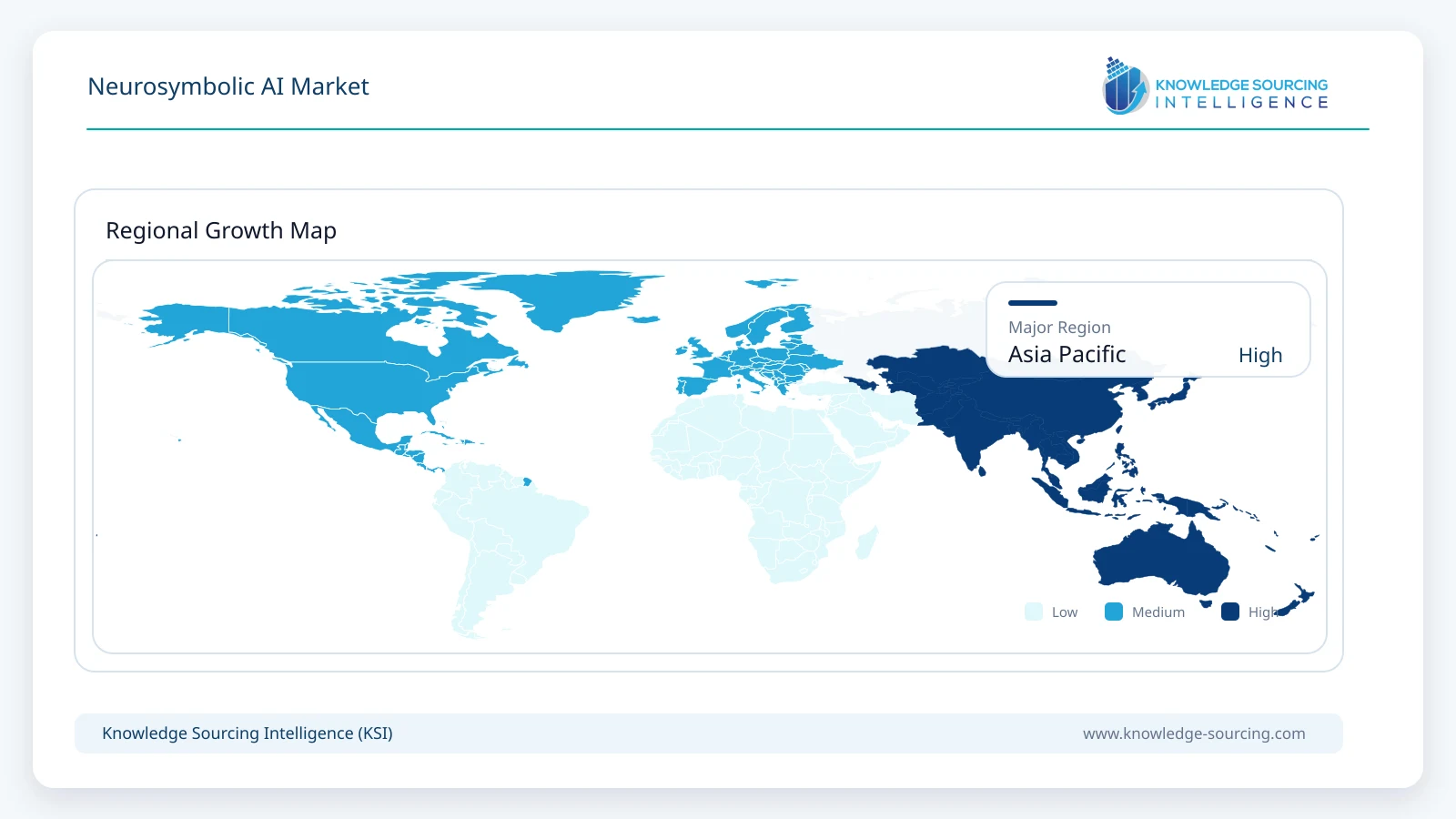
- 3North America maintains strong demand due to enterprise AI investment, research infrastructure, and regulatory emphasis on trustworthy AI.
- 4Integration of large language models with symbolic reasoning is creating new enterprise software opportunities.
- 5Emerging AI governance regulations encourage organizations to adopt transparent and auditable AI systems.
- 6Competition increasingly centers on enterprise integration, reasoning accuracy, scalability, and domain-specific knowledge models rather than standalone predictive performance.
The neurosymbolic AI market represents a specialized segment of artificial intelligence that combines neural networks with symbolic reasoning to improve interpretability, logical inference, and decision accuracy. Unlike conventional deep learning systems that primarily depend on statistical pattern recognition, neurosymbolic AI integrates structured knowledge representations, ontologies, and rule-based reasoning with data-driven learning models. This hybrid architecture addresses one of the most persistent commercial challenges in enterprise AI: delivering reliable decisions that can be explained, audited, and validated across regulated industries.
Demand for neurosymbolic AI is expanding as enterprises move beyond proof-of-concept machine learning projects toward production-grade AI systems supporting mission-critical operations. Financial institutions, healthcare organizations, automotive manufacturers, industrial automation providers, and government agencies increasingly require AI models capable of reasoning over incomplete information while providing transparent decision pathways. Procurement decisions are therefore shifting from selecting models based solely on predictive accuracy to evaluating explainability, governance, lifecycle management, and regulatory compliance.
Commercial adoption is also supported by the growing complexity of enterprise knowledge management. Organizations possess large volumes of structured and unstructured information distributed across databases, documents, operational systems, and business applications. Neurosymbolic AI enables enterprises to combine knowledge graphs with machine learning, allowing organizations to preserve institutional knowledge while improving inference accuracy. Buyers increasingly prioritize platforms capable of integrating with existing enterprise architectures rather than replacing them entirely.
Investment activity reflects broader changes in enterprise AI spending. Organizations continue allocating budgets toward intelligent automation, enterprise search, digital engineering, cybersecurity analytics, and decision-support applications. However, procurement teams increasingly require explainable AI capabilities before approving deployment in regulated environments. This requirement benefits neurosymbolic AI vendors because symbolic reasoning provides traceable decision logic alongside machine learning outputs.
Industry structure remains relatively concentrated, with established technology companies competing alongside specialized AI software providers developing reasoning engines, knowledge graph technologies, and enterprise automation platforms. Competition depends less on algorithmic performance alone and more on enterprise integration capabilities, domain expertise, interoperability with large language models, and long-term governance features. As generative AI becomes more widely deployed, organizations are exploring neurosymbolic architectures to reduce hallucinations, improve factual consistency, and strengthen enterprise trust in AI-generated outputs.
Market Drivers
Growing demand for explainable and trustworthy AI
Organizations operating in financial services, healthcare, defense, and public administration must justify automated decisions to regulators, customers, and internal auditors. Conventional deep learning often lacks transparent reasoning mechanisms, creating adoption barriers for sensitive applications. Neurosymbolic AI addresses this limitation by combining explicit logical reasoning with machine learning, allowing users to examine how recommendations were generated. Vendors therefore compete by expanding explainability features, model governance capabilities, and knowledge representation frameworks that satisfy enterprise compliance requirements.
Expansion of enterprise knowledge graph deployments
Many large organizations have invested substantially in knowledge management systems, semantic databases, and enterprise ontologies. These structured knowledge assets contain operational rules that cannot easily be captured through statistical learning alone. Neurosymbolic AI enables organizations to preserve existing knowledge investments while enhancing them with adaptive learning capabilities. Buyers increasingly seek platforms capable of integrating structured enterprise knowledge with continuously updated machine learning models, improving operational efficiency without abandoning legacy systems.
Rising investment in intelligent automation
Businesses continue automating document processing, customer service, supply chain planning, and operational decision-making. As automation extends into more complex business functions, organizations require AI systems capable of reasoning through exceptions rather than simply identifying patterns. Neurosymbolic AI supports complex workflow automation by combining business rules with probabilistic learning, making it particularly valuable for enterprise resource planning, insurance claims processing, compliance monitoring, and industrial operations.
Increasing adoption of AI in autonomous systems
Automotive manufacturers, robotics developers, and industrial automation companies require AI systems capable of making reliable decisions under changing operating conditions. Symbolic reasoning complements neural perception by applying predefined safety constraints and logical rules during decision-making. This combination improves operational reliability while supporting safety validation, making neurosymbolic AI increasingly attractive for advanced robotics and autonomous transportation applications.
Market Restraints and Challenges
Limited availability of specialized expertise
Developing neurosymbolic AI solutions requires multidisciplinary knowledge spanning machine learning, symbolic logic, ontology engineering, software architecture, and domain expertise. Organizations frequently encounter talent shortages that increase implementation costs and extend deployment timelines. Vendors mitigate this challenge by offering low-code development environments, pre-built knowledge models, and consulting services.
Complex enterprise integration
Many organizations operate heterogeneous IT infrastructures consisting of legacy databases, cloud platforms, and proprietary applications. Integrating symbolic reasoning engines with these environments often requires substantial customization, increasing project complexity and implementation costs. Buyers therefore prioritize vendors with proven enterprise integration capabilities and standardized APIs.
Computational and operational complexity
Hybrid AI architectures frequently require additional processing resources to manage symbolic reasoning alongside neural computation. Enterprises evaluating total cost of ownership consider infrastructure requirements, inference latency, maintenance complexity, and scalability before committing to large deployments. Suppliers continue investing in optimization techniques to improve operational efficiency without compromising reasoning quality.
Evolving regulatory expectations
Although regulatory attention supports explainable AI adoption, evolving compliance requirements also introduce uncertainty. Organizations deploying AI across multiple jurisdictions must continuously monitor changes in governance frameworks, documentation standards, and risk management obligations. Compliance-related investments may increase implementation costs, particularly for multinational enterprises.
Major Segment Analysis
Knowledge-based AI Systems
Knowledge-based AI systems represent one of the most commercially important application segments because they address enterprise requirements for structured reasoning, explainability, and knowledge preservation. Organizations across banking, healthcare, manufacturing, and government increasingly depend on institutional knowledge accumulated through decades of operational experience. Traditional machine learning models cannot consistently utilize this structured expertise, particularly when reasoning through uncommon situations.
Enterprise buyers increasingly require AI platforms capable of combining corporate knowledge graphs, business rules, regulatory frameworks, and continuously updated operational data. Procurement decisions emphasize interoperability with enterprise content management systems, semantic databases, and existing AI infrastructure. Vendors compete by providing scalable ontology management, automated knowledge extraction, multilingual reasoning capabilities, and integration with generative AI applications.
Commercial demand is particularly strong where decision accuracy outweighs processing speed. Financial institutions applying fraud detection, healthcare providers supporting clinical decision systems, and manufacturers optimizing engineering processes all benefit from AI capable of combining learned patterns with explicit logical reasoning. This application area therefore continues generating recurring software licensing, implementation, and enterprise support revenues.
Regional Analysis
North America
North America remains the leading regional market due to substantial enterprise AI investment, advanced cloud infrastructure, and extensive research collaboration between technology companies, universities, and government organizations. Financial institutions, healthcare providers, and defense agencies increasingly prioritize explainable AI to satisfy governance and operational requirements. Public sector initiatives supporting trustworthy AI further encourage enterprise investment.
Europe
European demand is influenced by strong regulatory oversight, responsible AI initiatives, and growing adoption of industrial automation. Organizations increasingly evaluate AI solutions based on transparency, accountability, and documentation requirements. Manufacturing, automotive engineering, and industrial software companies continue investing in neurosymbolic approaches that improve decision traceability while supporting compliance obligations.
Asia Pacific
Asia Pacific demonstrates expanding adoption as governments support AI innovation through national technology programs and digital industrialization strategies. China, Japan, South Korea, and India continue investing in advanced manufacturing, robotics, and enterprise digitalization. Large manufacturing enterprises increasingly evaluate neurosymbolic AI for quality assurance, predictive maintenance, and industrial knowledge management. However, uneven digital maturity across developing economies may slow broader commercialization.
Middle East & Africa
Governments across the Gulf region continue promoting AI adoption through national digital economy strategies, smart city initiatives, and public sector modernization programs. Enterprise investment remains concentrated within energy, financial services, and government organizations. Limited specialist talent and varying digital infrastructure remain adoption constraints across several markets.
South America
South American adoption remains at an earlier stage but continues progressing as financial institutions, retailers, and industrial enterprises expand AI investments. Organizations primarily seek operational efficiency, fraud detection, customer service automation, and intelligent document management. Economic uncertainty and constrained enterprise IT budgets may delay large-scale implementation despite growing interest.
Competitive Landscape
Competition within the neurosymbolic AI market reflects a combination of established enterprise technology providers and specialized AI software developers. Companies compete by integrating symbolic reasoning engines with machine learning platforms, knowledge graphs, enterprise automation software, and generative AI capabilities. Product differentiation increasingly depends on explainability, governance, scalability, interoperability, and domain-specific reasoning models rather than raw algorithmic performance.
Strategic partnerships with cloud providers, enterprise software vendors, research institutions, and industry-specific solution providers remain important competitive approaches. Vendors also continue expanding application programming interfaces, enterprise deployment options, and hybrid cloud capabilities to support customer integration requirements. Geographic expansion increasingly targets regulated industries where explainable AI provides measurable commercial value. The competitive environment includes Kognitos, IBM, Unlikely AI, Robert Bosch GmbH, Franz Inc., and Google DeepMind, each contributing different strengths across enterprise AI, knowledge representation, industrial automation, and advanced reasoning technologies.
Recent Developments
May 2026: Expert.ai partnered with Fincons Group to integrate its neuro-symbolic AI technology into enterprise multi-agent architectures, providing transparent, explainable governance for data-driven processes in regulated industries.
April 2026: UNESCO officially launched the AI Readiness Assessment Methodology (RAM) in Jamaica, establishing a national framework for ethical AI governance that supports responsible AI adoption in cultural heritage, social science, and anthropology-related research ecosystems.
March 2026: The Austrian Academy of Sciences (OeAW), in collaboration with Mistral AI and Reply, announced development of the Apollo Ancient Greek AI model to restore, search, and analyze hundreds of thousands of ancient papyri and inscriptions, significantly accelerating digital humanities and anthropological research.
October 2025: IBM expanded its enterprise AI governance portfolio with additional tools supporting explainability, model lifecycle management, and regulatory compliance. The expansion reinforces demand for trustworthy AI deployments in regulated sectors.
Regulatory and Policy Environment
Governments and regulatory authorities increasingly recognize the importance of trustworthy AI as organizations deploy artificial intelligence across critical sectors. Frameworks including the European Union's AI Act, the U.S. National Institute of Standards and Technology (NIST) AI Risk Management Framework, and similar national AI governance initiatives encourage organizations to implement transparent, accountable, and auditable AI systems.
Industry standards addressing AI lifecycle management, cybersecurity, privacy protection, and algorithmic accountability continue influencing procurement decisions. Financial institutions, healthcare providers, and public sector organizations increasingly require documented governance procedures, human oversight mechanisms, and explainability before approving enterprise AI deployments. These policy developments support commercial adoption of neurosymbolic AI because symbolic reasoning naturally aligns with documentation, traceability, and compliance requirements.
Outlook and Strategic Implications
Enterprise AI investment over the coming years is expected to emphasize trustworthy decision-making rather than predictive performance alone. Organizations increasingly seek AI platforms capable of combining generative AI, knowledge graphs, symbolic reasoning, and machine learning within unified enterprise architectures. Procurement priorities are expected to include governance automation, interoperability, explainability, cybersecurity, and lifecycle management.
Technology suppliers will likely continue investing in reasoning-enhanced large language models, automated knowledge engineering, and scalable enterprise deployment frameworks. Competitive differentiation will increasingly depend on domain expertise, enterprise integration capabilities, and measurable business outcomes rather than standalone model accuracy.
Commercial risks include evolving regulatory requirements, shortages of specialized AI professionals, integration complexity, and uncertainty surrounding enterprise return on investment. Nevertheless, organizations operating in highly regulated industries are expected to continue prioritizing explainable AI systems capable of supporting transparent decision-making. As enterprises seek greater confidence in AI-assisted operations, neurosymbolic AI is positioned to become an important architectural approach for delivering reliable, governed, and commercially scalable artificial intelligence solutions.
Neurosymbolic AI Market Scope
| Report Metric | Details |
|---|---|
| Forecast Unit | Billion |
| Study Period | 2021 to 2031 |
| Historical Data | 2021 to 2024 |
| Base Year | 2025 |
| Forecast Period | 2026 – 2031 |
| Segmentation | Application, End-User, Geography |
| Geographical Segmentation | North America, South America, Europe, Middle East and Africa, Asia Pacific |
| Companies |
|
Market Segmentation
By Application
By End-user
By Geography
Table of Contents
1. EXECUTIVE SUMMARY
2. MARKET SNAPSHOT
2.1. Market Overview
2.2. Market Definition
2.3. Scope of the Study
2.4. Market Segmentation
3. BUSINESS LANDSCAPE
3.1. Market Drivers
3.2. Market Restraints
3.3. Market Opportunities
3.4. Porter’s Five Forces Analysis
3.5. Industry Value Chain Analysis
3.6. Policies and Regulations
3.7. Strategic Recommendations
4. TECHNOLOGICAL OUTLOOK
5. NEUROSYMBOLIC AI MARKET BY APPLICATION
5.1. Introduction
5.2. Knowledge-based AI Systems
5.3. Decision Making
5.4. Natural Language Processing
5.5. Robotics
5.6. Planning and Scheduling
6. NEUROSYMBOLIC AI MARKET BY END-USER
6.1. Introduction
6.2. Banking, Financial Services, and Insurance (BFSI)
6.3. Retail and E-Commerce
6.4. Automotive & Transportation
6.5. Healthcare
6.6. Others
7. NEUROSYMBOLIC AI MARKET BY GEOGRAPHY
7.1. Introduction
7.2. North America
7.2.1. USA
7.2.2. Canada
7.2.3. Mexico
7.3. South America
7.3.1. Brazil
7.3.2. Argentina
7.3.3. Others
7.4. Europe
7.4.1. United Kingdom
7.4.2. Germany
7.4.3. France
7.4.4. Italy
7.4.5. Spain
7.4.6. Others
7.5. Middle East & Africa
7.5.1. Saudi Arabia
7.5.2. UAE
7.5.3. Others
7.6. Asia Pacific
7.6.1. China
7.6.2. India
7.6.3. Japan
7.6.4. South Korea
7.6.5. Thailand
7.6.6. Others
8. COMPETITIVE ENVIRONMENT AND ANALYSIS
8.1. Major Players and Strategy Analysis
8.2. Market Share Analysis
8.3. Mergers, Acquisitions, Agreements, and Collaborations
8.4. Competitive Dashboard
9. COMPANY PROFILES
9.1. Kognitos
9.2. IBM
9.3. Unlikely AI
9.4. Robert Bosch GmbH
9.5. Franz Inc.
9.6. Google DeepMind
10. APPENDIX
10.1. Currency
10.2. Assumptions
10.3. Base and Forecast Years Timeline
10.4. Key Benefits for Stakeholders
10.5. Research Methodology
10.6. Abbreviations
Navigate
Trusted by the world's leading organizations











