
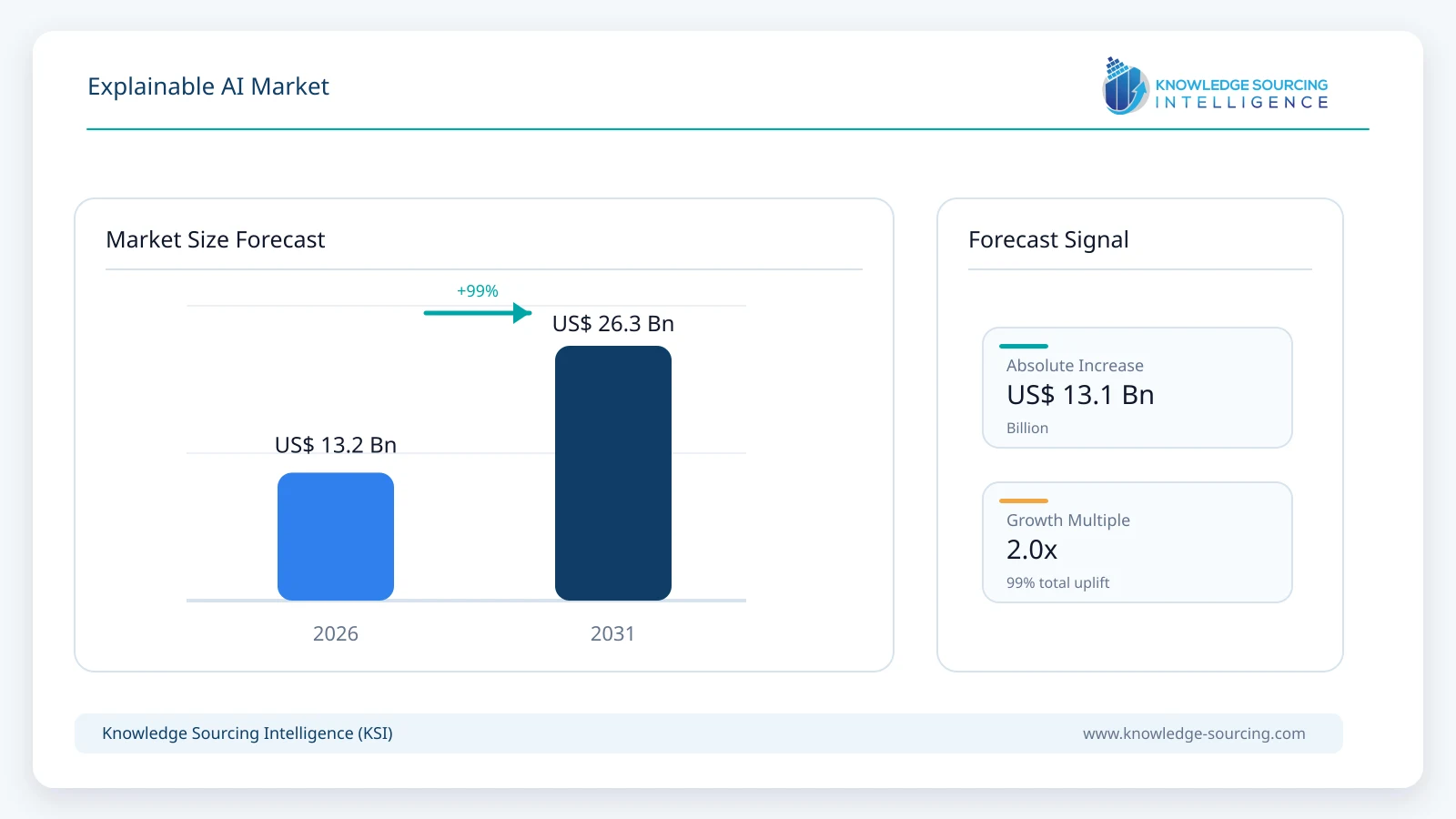
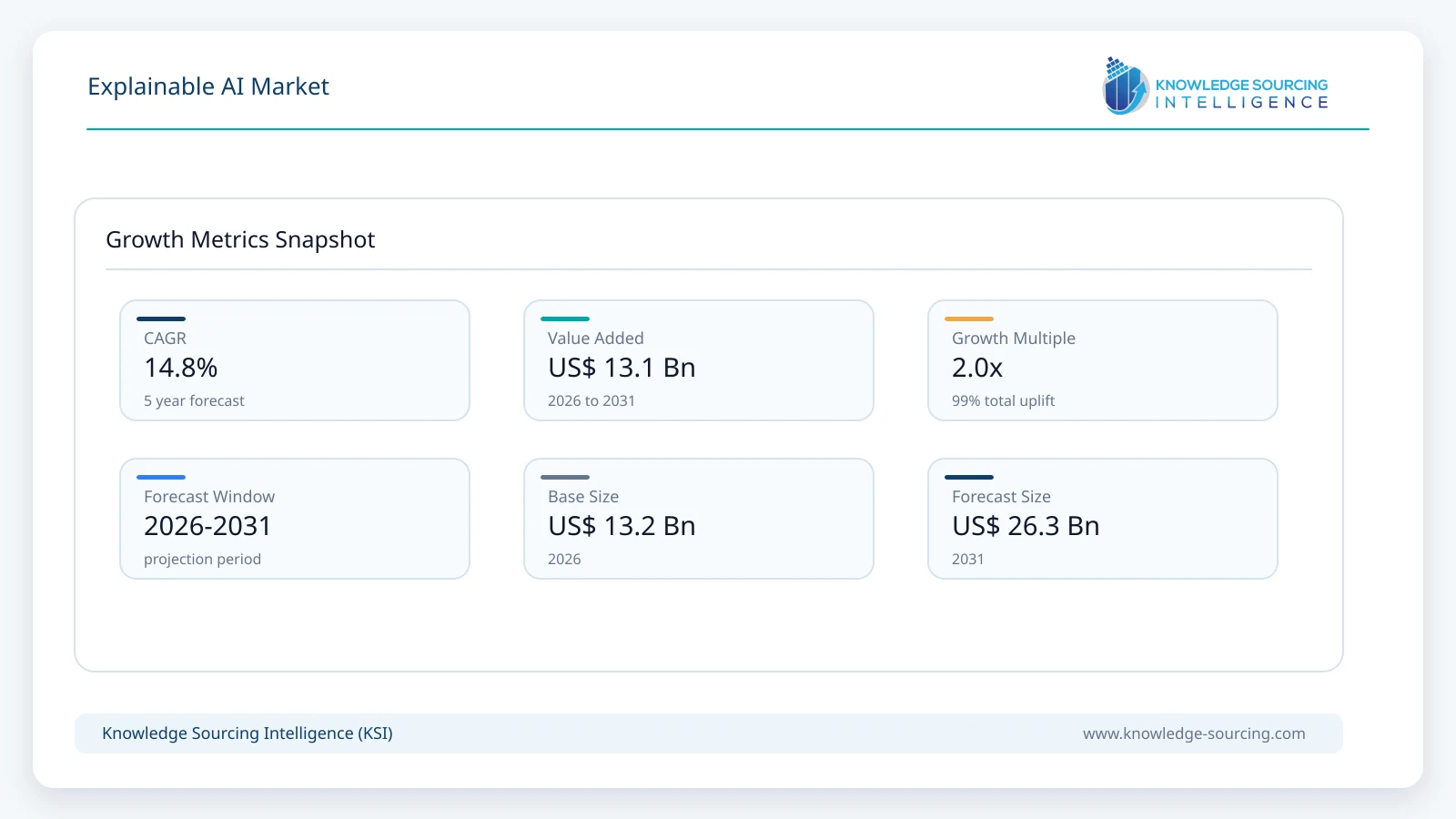
The Explainable AI Market is forecast to grow at a CAGR of 14.77%, reaching USD 26.25 billion in 2031 from USD 13.18 billion in 2026.
Highlights:
- 1Growing enterprise AI governance requirements remain the primary catalyst supporting explainable AI adoption.
- 2Software solutions account for the largest commercial opportunity due to recurring enterprise licensing and cloud subscriptions.
- 3BFSI represents one of the most commercially attractive industry verticals because of extensive regulatory oversight and model validation requirements.
- 4Cloud-based explainability platforms continue gaining traction through centralized monitoring and governance capabilities.
- 5Regulatory initiatives promoting trustworthy and accountable AI are expanding procurement requirements across multiple industries.
- 6Competition increasingly centers on integrated governance, model monitoring, and explainability capabilities rather than standalone interpretability tools.
The Explainable AI market comprises software platforms, model interpretation tools, governance frameworks, and professional services that enable organizations to understand, validate, and document how artificial intelligence systems reach decisions. Unlike conventional AI models that operate as opaque "black boxes," explainable AI provides transparency through techniques such as feature attribution, model visualization, local and global interpretability, confidence scoring, and audit trails. These capabilities have become commercially important as AI moves from experimental deployments into regulated, customer-facing, and mission-critical business processes.
Demand for explainable AI is closely tied to enterprise AI adoption rather than standalone software purchases. Organizations investing in predictive analytics, generative AI, machine learning, and autonomous decision-making increasingly require evidence that model outputs are accurate, fair, traceable, and aligned with internal governance policies. Procurement decisions therefore extend beyond predictive performance to include interpretability, regulatory readiness, model lifecycle management, and integration with existing data science environments. Enterprises purchasing AI platforms now frequently evaluate explainability features during vendor selection, particularly where automated decisions influence financial, medical, legal, or public-sector outcomes.
The buyer base has broadened considerably over the past several years. Financial institutions use explainability to justify credit decisions and strengthen model risk management. Healthcare organizations seek interpretable diagnostic and clinical decision-support systems that clinicians can validate before patient treatment. Government agencies require transparency to support procurement standards, citizen accountability, and ethical AI deployment. Manufacturers increasingly employ explainable AI for predictive maintenance, where engineers require insight into operational variables before taking corrective actions. Similar purchasing behavior is emerging across telecommunications, retail, and insurance, where explainability reduces operational uncertainty while supporting customer trust.
Commercial revenues are generated through enterprise software licensing, cloud subscriptions, implementation services, governance consulting, model monitoring, and ongoing compliance support. Cloud deployment continues to expand because organizations seek centralized governance across geographically distributed AI workloads, while large regulated enterprises maintain hybrid and on-premises environments to satisfy security and data residency requirements. Vendors therefore compete by combining explainability with model management, governance automation, bias detection, and continuous monitoring instead of offering interpretability tools as isolated products.
The industry's competitive structure includes large enterprise software providers, AI platform vendors, analytics companies, and specialized explainability firms. Competition increasingly depends on interoperability with existing machine learning frameworks, compatibility with generative AI applications, regulatory documentation capabilities, and scalability across thousands of production models. Buyers also prioritize solutions that minimize additional computing overhead while providing actionable explanations understandable by both technical and non-technical stakeholders.
Market Drivers
Expansion of enterprise AI governance programs
Organizations are establishing formal AI governance programs as machine learning influences lending, insurance underwriting, healthcare diagnostics, fraud detection, hiring, and supply chain optimization. Executive leadership increasingly requires documented oversight covering model development, deployment, monitoring, and retirement. Explainable AI supports these governance objectives by providing evidence that business decisions remain understandable and defensible. Software providers have responded by embedding explainability into broader AI lifecycle management platforms, creating recurring revenue opportunities through governance subscriptions and professional services.
Regulatory expectations for transparent automated decisions
Public authorities worldwide are introducing frameworks that require organizations to demonstrate accountability for algorithmic decisions. Financial institutions, healthcare providers, and public-sector organizations consequently seek solutions capable of documenting model logic, identifying influential variables, and maintaining comprehensive audit records. Procurement increasingly favors vendors capable of simplifying compliance reporting while reducing manual documentation efforts. This regulatory direction strengthens demand for explainability features as standard procurement requirements rather than optional functionality.
Wider deployment of generative AI in enterprise environments
Generative AI adoption has expanded organizational interest in understanding model outputs, hallucination risks, and decision reliability. Enterprises deploying large language models require monitoring tools that evaluate response quality, confidence levels, prompt behavior, and operational consistency. Explainable AI technologies help organizations identify unexpected outputs and establish governance controls before generative AI applications reach production environments. Vendors are therefore integrating explainability with retrieval systems, model evaluation platforms, and governance dashboards.
Growth in high-value automated decision-making
Organizations increasingly automate decisions involving substantial financial, operational, or safety consequences. These include insurance claims processing, industrial maintenance scheduling, cybersecurity detection, and pharmaceutical research. Decision-makers require interpretable outputs before accepting automated recommendations. Explainable AI reduces organizational resistance by allowing domain experts to verify model reasoning, thereby supporting wider operational deployment while lowering business risk associated with automation.
Market Restraints and Challenges
Trade-off between interpretability and model complexity
Highly sophisticated deep learning architectures often achieve stronger predictive performance than simpler interpretable models. Organizations must therefore balance transparency against analytical accuracy. This trade-off affects procurement decisions in sectors where prediction quality directly influences commercial outcomes. Vendors continue developing post-hoc explanation techniques and hybrid modeling approaches, although achieving complete transparency for highly complex architectures remains technically challenging.
Lack of standardized explainability metrics
Different industries evaluate explainability according to varying operational requirements, making comparisons between competing platforms difficult. Technical users may prioritize feature attribution accuracy, whereas business users require intuitive explanations supporting executive decisions. The absence of universal evaluation standards complicates procurement processes and increases implementation planning requirements for enterprise buyers.
Skills shortages in AI governance
Successful explainable AI implementation requires expertise spanning data science, governance, regulatory compliance, cybersecurity, and business operations. Many organizations possess strong machine learning capabilities but limited experience interpreting model explanations or validating algorithmic fairness. This skills gap increases reliance on consulting services, extends deployment timelines, and raises implementation costs for buyers.
Integration with legacy enterprise infrastructure
Many organizations continue operating heterogeneous analytics environments built over many years. Integrating explainability platforms across legacy databases, proprietary machine learning tools, cloud environments, and operational applications requires considerable technical planning. Integration complexity may delay purchasing decisions, particularly among organizations managing hundreds of existing AI models across multiple business units.
Major Segment Analysis
The Banking, Financial Services, and Insurance (BFSI) segment represents one of the most commercially important markets for explainable AI because financial institutions operate under extensive regulatory scrutiny while processing high-value automated decisions every day. Credit scoring, fraud detection, anti-money laundering, insurance underwriting, portfolio management, and customer risk assessment all depend increasingly on machine learning models whose outputs require justification for internal governance, customer communication, and regulatory review.
Procurement priorities within BFSI extend beyond predictive accuracy. Financial institutions require solutions capable of documenting model decisions, identifying influential variables, monitoring performance drift, detecting bias, and generating audit-ready reports. Enterprise buyers also seek compatibility with existing governance systems and risk management frameworks to minimize implementation disruption.
Competition within this segment increasingly favors vendors delivering integrated governance capabilities rather than isolated explainability modules. Long-term revenue opportunities extend beyond software licensing into managed services, regulatory consulting, implementation support, and continuous model monitoring, strengthening recurring revenue across enterprise customer relationships.
Regional Analysis
North America maintains a leading position due to extensive enterprise AI deployment, mature cloud infrastructure, and substantial investment in responsible AI initiatives. Financial institutions, healthcare providers, technology companies, and federal agencies continue expanding AI governance programs. Strong venture capital activity also supports specialized explainability software providers, while large technology vendors accelerate product innovation through acquisitions and internal research.
Europe benefits from an established regulatory environment emphasizing trustworthy artificial intelligence, privacy protection, and accountable automated decision-making. Enterprises increasingly incorporate explainability into procurement criteria to satisfy governance expectations while reducing regulatory uncertainty. Manufacturing, financial services, healthcare, and public administration remain important demand centers, although compliance requirements may lengthen purchasing cycles.
Asia Pacific represents a major expansion opportunity as governments encourage AI commercialization across manufacturing, healthcare, financial services, and smart infrastructure. Large digital economies, expanding cloud adoption, and increasing enterprise AI investment support long-term demand. Buyers, however, remain price sensitive in several emerging markets, encouraging cloud-based subscription models instead of extensive on-premises deployments.
Middle East & Africa and South America are gradually adopting explainable AI alongside broader digital modernization programs. Banking modernization, government digital services, energy sector analytics, and telecommunications create emerging opportunities. Adoption remains constrained by limited specialist talent and varying AI governance maturity, although multinational enterprise investment continues supporting regional implementation projects.
Competitive Landscape
Competition combines global enterprise technology providers with specialized AI software developers focused on model governance and explainability. Companies including IBM Corporation, Alphabet Inc., Microsoft Corporation, Intel Corporation, SAS Institute Inc., C3 AI, Inc., Fair Isaac Corporation (FICO), H2O.ai, Inc., Fiddler AI, DataRobot, Inc., and Equifax Inc. compete through integrated AI platforms, governance capabilities, cloud deployment options, and industry-specific solutions.
Product differentiation increasingly depends on end-to-end AI lifecycle management, continuous model monitoring, bias detection, regulatory documentation, and compatibility with open-source machine learning frameworks. Strategic partnerships with cloud providers, consulting firms, and enterprise software vendors continue expanding market reach. Vendors also strengthen competitive positioning through application programming interfaces, scalable deployment architectures, and support for both predictive and generative AI workloads across global enterprise customers.
Recent Developments
June 2026: IBM expanded enterprise AI governance capabilities across its watsonx platform with additional monitoring and explainability functions for generative AI applications. The enhancement supports enterprise compliance and model lifecycle management.
June 2026: IBM released watsonx.ai v2.4, expanding governed model access through Model Gateway, strengthening AI governance capabilities, and improving enterprise explainability, transparency, and controlled deployment across hybrid AI environments.
March 2026: Researchers published "Beyond Explainable AI (XAI): An Overdue Paradigm Shift and Post-XAI Research Directions," proposing new verification-focused and user-centered approaches to improve trustworthy, interpretable, and certifiable AI beyond conventional XAI methods.
Regulatory and Policy Environment
The regulatory environment increasingly influences enterprise procurement decisions for explainable AI solutions. The European Union AI Act establishes a risk-based framework requiring governance, transparency, documentation, human oversight, and post-market monitoring for high-risk AI systems. Organizations operating across European markets increasingly incorporate explainability capabilities into procurement planning to support compliance obligations.
In the United States, guidance from financial regulators, healthcare agencies, and standards organizations continues emphasizing accountable AI development, model validation, cybersecurity, and governance. Industry standards developed through international organizations further encourage documentation, risk management, and lifecycle oversight. These initiatives collectively encourage organizations to implement explainability technologies capable of supporting regulatory reporting and internal governance requirements.
Government investment in trustworthy AI research, national AI strategies, and public-sector procurement standards also contributes to commercial demand by establishing common expectations for transparency, fairness, and accountability across both public and private sector deployments.
Outlook and Strategic Implications
Enterprise investment over the coming years will increasingly prioritize explainability as an essential component of AI governance rather than an independent software category. Procurement strategies are expected to favor integrated platforms combining model development, deployment, monitoring, governance, explainability, and compliance reporting within unified environments.
Cloud-native deployment models will continue expanding as organizations seek centralized oversight across diverse AI applications and geographically distributed operations. Buyers will increasingly evaluate vendors based on interoperability, automation capabilities, scalability, and support for generative AI governance. Professional services will remain commercially important because organizations require assistance establishing governance frameworks, validating models, and interpreting explanation outputs.
Competitive positioning will increasingly depend on technical integration rather than algorithmic performance alone. Vendors capable of combining explainability with operational monitoring, regulatory reporting, cybersecurity, and enterprise workflow integration are likely to strengthen customer retention and recurring revenue. At the same time, suppliers must continue addressing computational efficiency, usability, and evolving regulatory expectations to support wider adoption across regulated and non-regulated industries alike.
Explainable AI Market Scope
| Report Metric | Details |
|---|---|
| Total Market Size in 2026 | USD 13.18 billion |
| Total Market Size in 2031 | USD 26.25 billion |
| Forecast Unit | Billion |
| Growth Rate | 14.77% |
| Study Period | 2021 to 2031 |
| Historical Data | 2021 to 2024 |
| Base Year | 2025 |
| Forecast Period | 2026 – 2031 |
| Segmentation | Component, Deployment, Application, Industry Vertical, Geography |
| Companies |
|
Market Segmentation
By Component
- Software
- Services
By Deployment
- On-Premises
- Cloud
By Application
- Fraud Detection and Risk Management
- Model Monitoring and Debugging
- Regulatory Compliance and Decision Support
- Supply Chain Management and Predictive Maintenance
- Others
By Industry Vertical
- Banking, Financial Services, and Insurance (BFSI)
- Healthcare
- Government and Public Sector
- IT and Telecommunications
- Retail and E-commerce
- Manufacturing
- Others
By Geography
- North America
- United States
- Canada
- Mexico
- South America
- Brazil
- Argentina
- Rest of South America
- Europe
- United Kingdom
- Germany
- France
- Spain
- Rest of Europe
- Middle East and Africa
- Saudi Arabia
- United Arab Emirates
- Rest of Middle East and Africa
- Asia Pacific
- China
- Japan
- South Korea
- Australia
- India
- Indonesia
- Thailand
- Rest of Asia Pacific
Table of Contents
1. INTRODUCTION
1.1. Market Overview
1.2. Market Definition
1.3. Scope of the Study
1.4. Market Segmentation
1.5. Currency
1.6. Assumptions
1.7. Base and Forecast Years Timeline
1.8. Key Benefits to the Stakeholder
2. RESEARCH METHODOLOGY
2.1. Research Design
2.2. Research Process
3. EXECUTIVE SUMMARY
3.1. Key Findings
3.2. CXO Perspective
4. MARKET DYNAMICS
4.1. Market Drivers
4.2. Market Restraints
4.3. Porter’s Five Forces Analysis
4.3.1. Bargaining Power of Suppliers
4.3.2. Bargaining Power of Buyers
4.3.3. Threat of New Entrants
4.3.4. Threat of Substitutes
4.3.5. Competitive Rivalry in the Industry
4.4. Industry Value Chain Analysis
4.5. Analyst View
5. EXPLAINABLE AI MARKET BY COMPONENT
5.1. Introduction
5.2. Software
5.3. Services
6. EXPLAINABLE AI MARKET BY DEPLOYMENT
6.1. Introduction
6.2. On-Premises
6.3. Cloud
7. EXPLAINABLE AI MARKET BY APPLICATION
7.1. Introduction
7.2. Fraud Detection and Risk Management
7.3. Model Monitoring and Debugging
7.4. Regulatory Compliance and Decision Support
7.5. Supply Chain Management and Predictive Maintenance
7.6. Others
8. EXPLAINABLE AI MARKET BY INDUSTRY VERTICAL
8.1. Introduction
8.2. Banking, Financial Services, and Insurance (BFSI)
8.3. Healthcare
8.4. Government and Public Sector
8.5. IT and Telecommunications
8.6. Retail and E-commerce
8.7. Manufacturing
8.8. Others
9. EXPLAINABLE AI MARKET BY GEOGRAPHY
9.1. Introduction
9.2. North America
9.2.1. By Component
9.2.2. By Deployment
9.2.3. By Application
9.2.4. By Industry Vertical
9.2.5. By Country
9.2.5.1. United States
9.2.5.2. Canada
9.2.5.3. Mexico
9.3. South America
9.3.1. By Component
9.3.2. By Deployment
9.3.3. By Application
9.3.4. By Industry Vertical
9.3.5. By Country
9.3.5.1. Brazil
9.3.5.2. Argentina
9.3.5.3. Rest of South America
9.4. Europe
9.4.1. By Component
9.4.2. By Deployment
9.4.3. By Application
9.4.4. By Industry Vertical
9.4.5. By Country
9.4.5.1. United Kingdom
9.4.5.2. Germany
9.4.5.3. France
9.4.5.4. Spain
9.4.5.5. Rest of Europe
9.5. Middle East and Africa
9.5.1. By Component
9.5.2. By Deployment
9.5.3. By Application
9.5.4. By Industry Vertical
9.5.5. By Country
9.5.5.1. Saudi Arabia
9.5.5.2. United Arab Emirates
9.5.5.3. Rest of Middle East and Africa
9.6. Asia Pacific
9.6.1. By Component
9.6.2. By Deployment
9.6.3. By Application
9.6.4. By Industry Vertical
9.6.5. By Country
9.6.5.1. China
9.6.5.2. Japan
9.6.5.3. South Korea
9.6.5.4. Australia
9.6.5.5. India
9.6.5.6. Indonesia
9.6.5.7. Thailand
9.6.5.8. Rest of Asia Pacific
10. COMPETITIVE ENVIRONMENT AND ANALYSIS
10.1. Major Players and Strategy Analysis
10.2. Market Share Analysis
10.3. Mergers, Acquisitions, Agreements, and Collaborations
10.4. Competitive Dashboard
11. COMPANY PROFILES
11.1. IBM Corporation
11.2. Alphabet Inc.
11.3. Microsoft Corporation
11.4. Intel Corporation
11.5. SAS Institute Inc.
11.6. C3 AI, Inc.
11.7. Fair Isaac Corporation (FICO)
11.8. H2O.ai, Inc.
11.9. Fiddler AI
11.10. DataRobot, Inc.
11.11. Equifax Inc.
Navigate
Trusted by the world's leading organizations











