
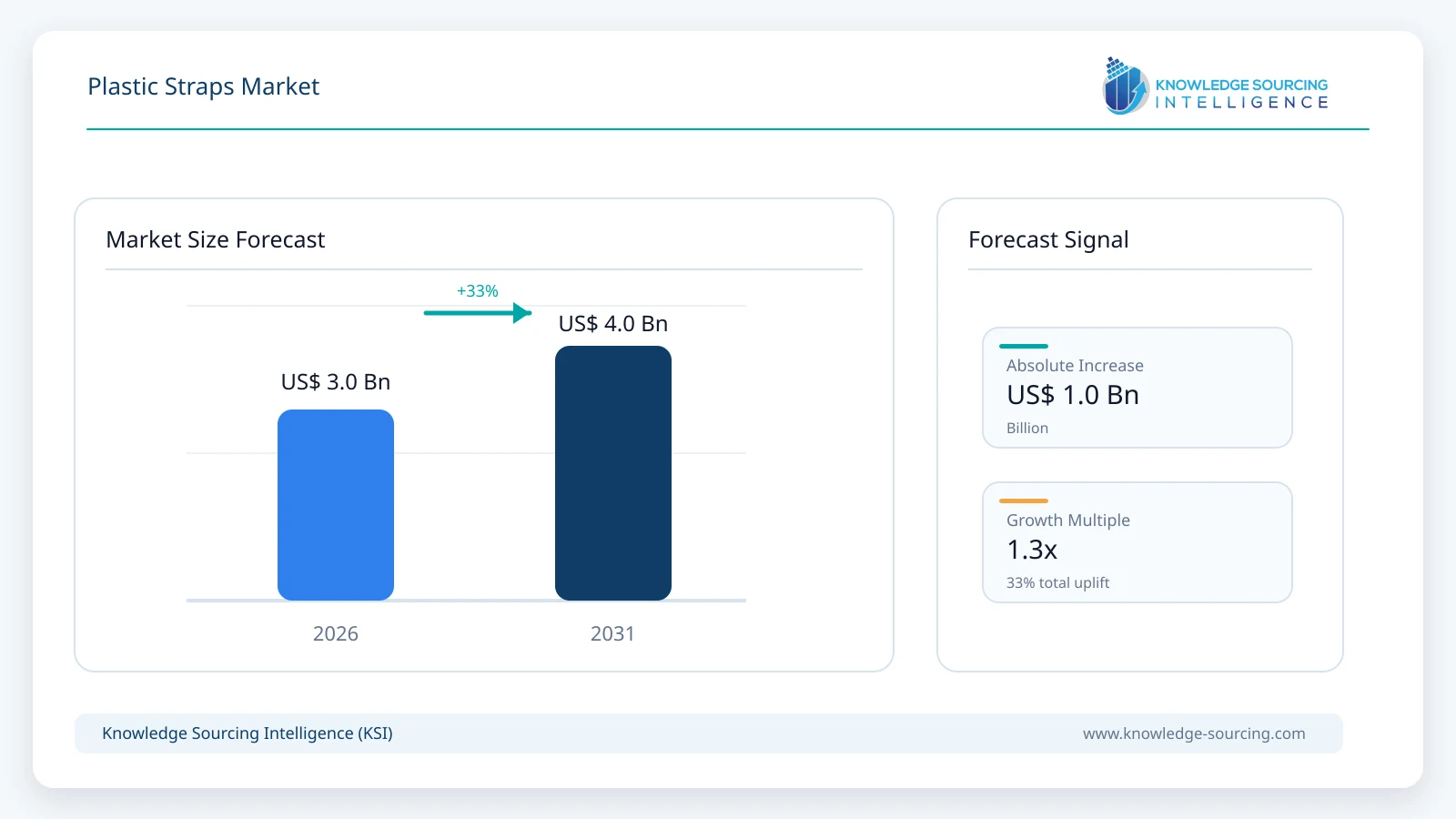
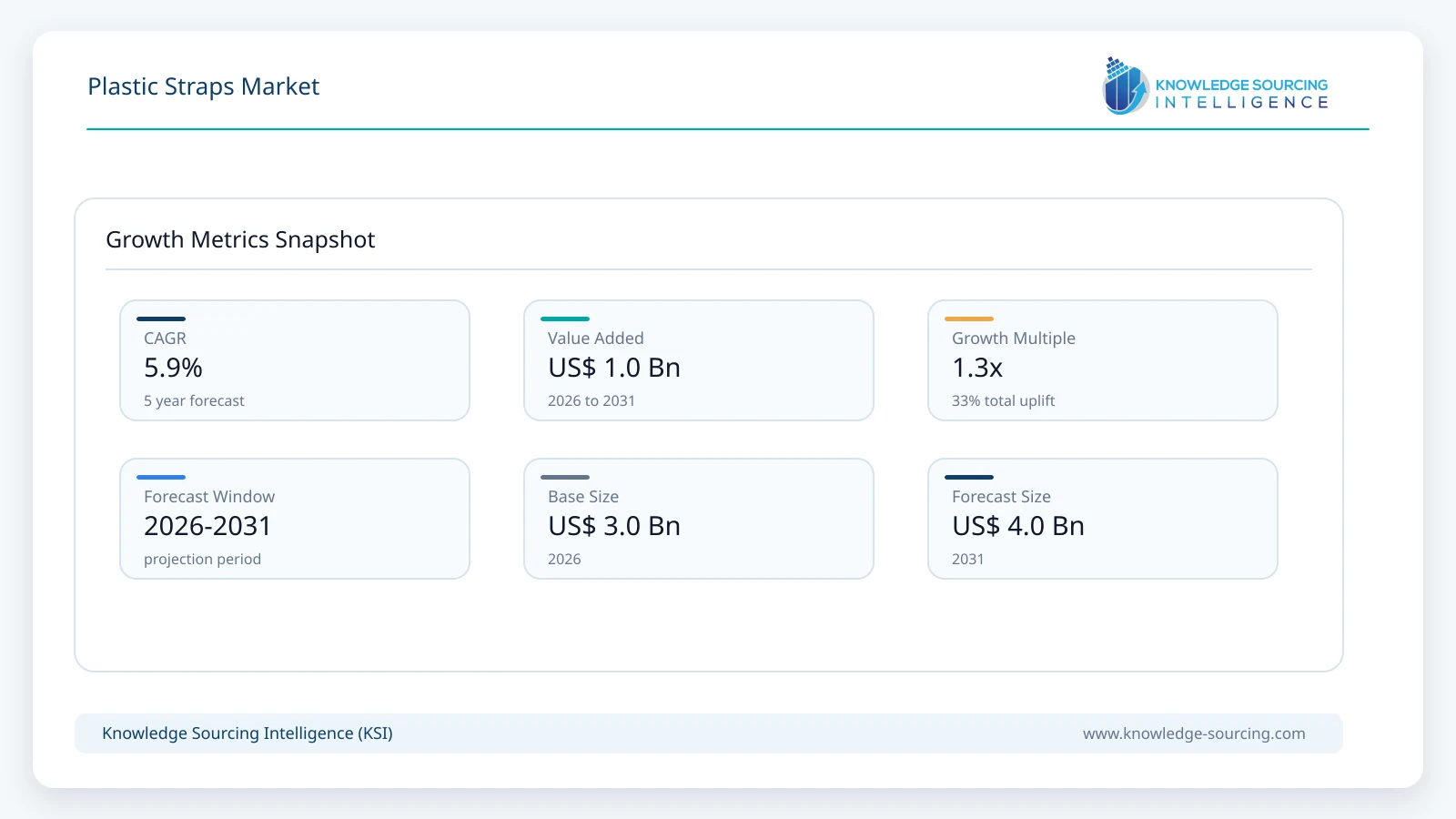
The plastic straps market is forecast to grow at a CAGR of approximately 5.9%, reaching USD 4.0 billion in 2031 from USD 3.0 billion in 2026.
Highlights:
- 1Polypropylene accounts for approximately 55% of market value in 2026 and remains the largest plastic strapping material because of its extensive use in cartons, corrugated packaging, food distribution, logistics and light-to-medium pallet loads.
- 2PET represents approximately 41% of the market and has a higher average value per tonne because it serves heavier loads, retains tension more effectively and increasingly substitutes for steel.
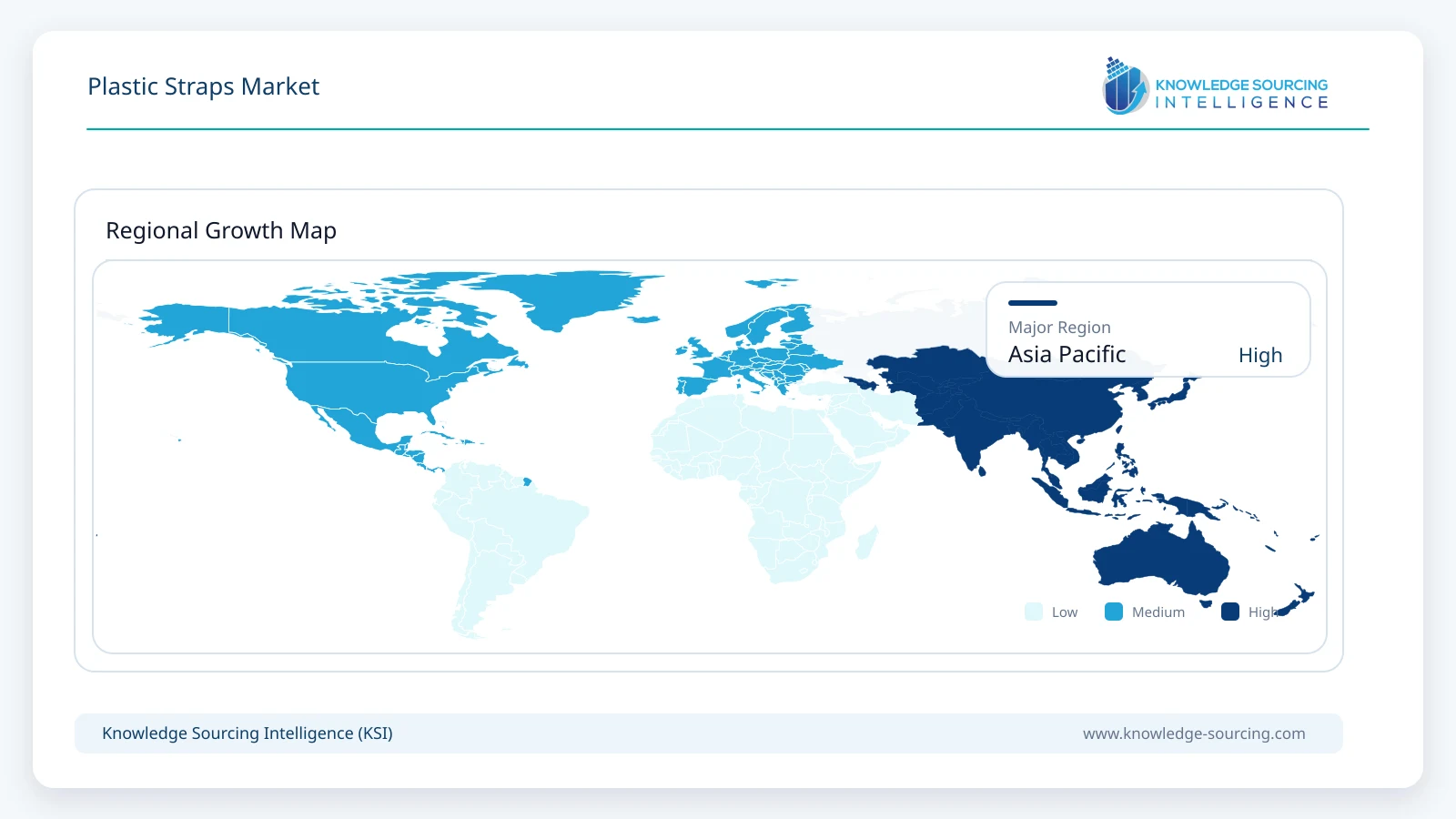
- 3Asia Pacific accounts for approximately 40% of global market value, supported by large manufacturing bases in China, India, Japan, Malaysia and Southeast Asia and substantial regional strapping production capacity.
- 4Automated and machine-grade strapping is gaining share as manufacturers integrate strapping heads and machines directly into end-of-line packaging systems.
- 5Recycled PET, post-consumer recycled polypropylene and closed-loop collection programs are becoming important competitive differentiators.
Market Overview
Plastic strapping consists of polymer-based bands used to bundle products, reinforce cartons, stabilize palletized goods, and secure industrial loads during storage and transportation. The market primarily includes polypropylene and polyethylene terephthalate straps, together with a smaller group of woven, composite, and specialty polymer straps. Polypropylene provides relatively high elongation and is predominantly used for light- and medium-duty applications, while PET offers higher retained tension and break strength and can replace steel in many palletizing and unitizing applications. Major suppliers including Signode, Mosca, Teufelberger, FROMM, LINDER and PAC Strapping consistently classify commercial plastic strapping around PP and PET rather than PVC.
The commercial scale of the sector is supported by the broader transit-packaging industry and by identifiable production capacities. Crown Holdings reported USD 2.026 billion of 2025 revenue from its Signode-led Transit Packaging segment, which includes plastic and steel strapping consumables, industrial film, equipment and protective packaging. Signode itself reports more than USD 2 billion in annual revenue and more than 80 manufacturing facilities. At the production level, Shanghai Zili reports more than 100,000 tonnes of annual PP and PET strapping capacity, Scientex reports approximately 25,000 tonnes of PP-strapping capacity in Malaysia, and Messersi processes approximately 22,000 tonnes of raw material annually for its strapping operations. These suppliers represent only part of a global industry that also contains numerous regional manufacturers across India, China, Europe, the Americas and Southeast Asia.
Market Trends
Recycled Material Is Moving From a Cost Input to a Product Specification
Plastic strapping manufacturers are increasingly specifying recycled content as part of the commercial product rather than relying only on internal production scrap. Signode’s Dylastic PCR polypropylene strap contains 30% post-consumer recycled material and is designed to retain the technical characteristics required for machine and hand-tool applications. Its Dylastic Bio product uses at least 40% bio-based raw material, indicating that alternative feedstocks are also moving into commercial strapping. Teufelberger has developed a better collection system to collect used PET and PP strapping and return recovered material to production, and in February 2026 expanded the system through a partnership with German collection specialist re-strap.
PET strapping already incorporates substantial recycled material because post-consumer beverage bottles provide an established feedstock stream. StraPack states that its polyester-strapping plant uses approximately 97% recycled base material, while LINDER certifies selected PET products with 100% post-consumer recycled content. Hiroyuki Industries produces PET strapping using recycled material and has obtained Global Recycled Standard certification. The competitive issue is therefore shifting from whether recycled feedstock can be used toward the consistency, contamination control, tensile strength, and machine-running performance achievable at increasing recycled-content levels.
PET Continues to Replace Steel in Suitable Heavy-Duty Applications
PET has established a position between polypropylene and steel. It provides substantially greater retained tension and break strength than conventional PP while remaining lighter, corrosion-free, and easier to handle than steel. Signode positions its Tenax PET products for medium- and heavy-duty palletizing and unitizing, while LINDER offers PET straps with tensile strengths reaching approximately 2,800 lb in Association of American Railroads-certified configurations. These characteristics support applications in timber, bricks, metals, building products, automotive components, and other relatively rigid loads.
The substitution opportunity does not mean that PET eliminates steel strapping. Extremely hot, sharp-edged or very heavy rigid loads continue to require steel in many applications. PET instead expands where users can obtain adequate retained tension while reducing handling risks, strap weight and corrosion. This contributes to a faster growth trajectory for PET than conventional PP in several industrial end markets, although PP continues to lead global volume because it is more economical for cartons, newspapers, food packaging and general distribution.
End-of-Line Automation Is Tightening Strap Quality Requirements
Strapping is increasingly integrated into automated packaging cells rather than applied as a separate manual activity. High-speed machines require consistent width, thickness, straightness, surface characteristics, and coil winding because dimensional variation can interrupt automated feeding and welding. Signode, Mosca, FROMM, StraPack and Cyklop combine consumables with semi-automatic and fully automated machines, allowing them to optimize strap characteristics around installed equipment. Mosca currently offers PP, PET and paper strap alongside automated strapping machinery, while Signode provides integrated equipment, tools and consumables across its global transit-packaging platform.
Large independent strap manufacturers are also designing products specifically for automated lines. Shanghai Zili operates 30 production lines and reports annual capacity above 100,000 tonnes, while Scientex produces machine-grade PP strap for automated applications from its Malaysian operation. WRELTT manufactures PP and PET straps across numerous widths for semi-automatic and fully automatic machinery. Greater automation therefore favors producers capable of maintaining tighter extrusion and winding tolerances rather than competing exclusively on resin cost.
Segment Analysis
By Material: Polypropylene
Polypropylene accounts for approximately 55% of global plastic strapping value in 2026 and a larger proportion of physical strap length. Its relatively low material cost, high elongation and compatibility with heat and friction welding make it suitable for carton closure, corrugated products, food packaging, newspapers, light palletizing and general warehouse applications. PAC Strapping describes polypropylene as the most commonly used plastic strapping material, while Signode classifies PP primarily for light- and medium-duty applications.
Machine-grade PP increasingly uses lighter gauges and controlled embossing to reduce material per package while maintaining required performance. Signode’s Dylastic Pro, for example, is designed to provide 33% greater strap length per coil through revised embossing and material efficiency. Scientex operates approximately 25,000 tonnes of PP-strapping capacity in Malaysia and supplies markets across Asia Pacific, Europe and the United States, demonstrating the regional scale of the PP segment.
By Material: PET
PET represents approximately 41% of global market value in 2026. The segment has a smaller physical-volume share than PP but a higher average selling value because it targets greater break strengths and more demanding load-security applications. PET is commonly manufactured using recycled bottle flakes and is available in smooth and embossed configurations for automatic machines, battery tools and pneumatic systems.
Commercial production is geographically diverse. Shanghai Zili operates more than 100,000 tonnes of combined PP/PET annual capacity in China. Messersi reports around 22,000 tonnes of annual raw-material processing in Italy, while several Indian manufacturers have developed meaningful capacity, including Maharashtra Plastic & Industries at approximately 7,500 tonnes annually and WRELTT with substantial PP and PET production. Hiroyuki Industries operates from Malaysia with headquarters in Japan and manufactures both PP and PET strapping for export markets.
By End User: Logistics, Warehousing and General Distribution
Logistics, distribution and general industrial packaging form the largest combined demand pool. Strapping is used to stabilize palletized goods, close cartons, consolidate multiple packages and prevent load movement through warehouse, truck, rail and maritime handling. The expansion of automated fulfillment facilities increases machine-grade consumption because high-throughput operations require consistent packaging cycle times and minimal manual intervention.
Paper and corrugated manufacturing form another large application group because finished sheets, cartons, newspapers and paper products require frequent bundling. Building materials and wood use both PP and PET depending on weight and load rigidity, while food and beverage manufacturers use machine-grade PP extensively for cartons, containers and secondary packaging. Metals, automotive components and heavier engineered products consume a greater proportion of PET and remain important to its substitution of steel.
Market Drivers
Rising Packaging Automation Increases Machine-Grade Consumption
Industrial packaging lines increasingly combine case forming, wrapping, strapping, labeling and pallet handling in automated cells. Plastic strapping is particularly suited to automation because PP and PET can be friction or heat welded without separate metal seals. This lowers handling complexity and allows the strap to be applied at high production speeds. Major suppliers have therefore developed integrated equipment-consumable models in which strap characteristics are matched with strapping heads, dispensers and control systems. Crown’s Transit Packaging business generated USD 2.026 billion in 2025 across these related products, illustrating the commercial scale of integrated end-of-line packaging.
The development of higher-capacity coils also reduces machine downtime. Signode’s Dylastic Pro can provide 33% more strap per coil, while Messersi reports production of approximately 30 million kilometres of strapping per month. These improvements increase packaging-line productivity while supporting continued consumable demand as manufacturers automate greater proportions of their end-of-line operations.
PET Provides an Economically Attractive Alternative to Steel
The ability of PET to retain tension while absorbing shocks has widened its use in industries that previously relied heavily on steel strapping. It avoids corrosion and sharp metal edges and is considerably lighter than steel. The economics become particularly attractive for loads that are sufficiently heavy to exceed standard PP performance but do not require the maximum strength or heat resistance of steel.
Several suppliers now offer AAR-certified PET grades for rail freight, demonstrating that plastic strapping has advanced beyond light packaging applications. Teufelberger and LINDER both offer certified PET products for demanding transportation applications, while Signode positions PET directly as a high-strength alternative for palletized industrial goods.
Market Restraints
Resin Prices and Recycled Feedstock Quality Affect Manufacturing Economics
PP strapping remains closely linked to polypropylene resin economics, while PET production depends increasingly on the availability and quality of recycled PET feedstock. Resin-price movements affect manufacturers relatively quickly because raw polymer represents a large proportion of production cost. Greater use of recycled content can reduce dependence on virgin resin, but contamination, color variability and inconsistent intrinsic viscosity can affect tensile strength and machine performance.
Manufacturers are responding by integrating recycling processes more closely with strap production. Shanghai Zili operates PET-resin and strapping capabilities within its manufacturing system, while Teufelberger and Signode have developed collection and closed-loop programs. This improves raw-material security but requires investment in sorting, cleaning and quality control.
Paper Strap and Reuse Initiatives Create Competition in Light-Duty Applications
Plastic strapping faces growing competition from paper-based solutions in light-duty cartons and bundles where high tensile performance is not essential. Mosca currently offers paper strap alongside PP and PET products, and Signode has introduced LEVEX paper strapping as part of its recyclable-product portfolio. Plastic retains clear performance advantages for moisture exposure, heavier loads and many automated applications, but sustainability requirements can shift some low-load applications toward fibre-based alternatives.
The pressure is therefore greatest on low-strength virgin PP products rather than on high-performance PET. Manufacturers are responding through downgauging, recycled-content certification, take-back programs and bio-based PP formulations, allowing plastic straps to remain competitive while reducing fossil-resource use.
Regional Outlook
Asia Pacific
Asia Pacific accounts for approximately 40% of global plastic strapping market value in 2026 and represents the largest manufacturing and consumption region. China combines extensive PET and PP production capacity with large steel, construction-material, electronics and export-manufacturing industries. Shanghai Zili alone reports annual strapping capacity above 100,000 tonnes, while numerous additional Chinese producers supply domestic and export markets. India has a fragmented but increasingly scaled manufacturing base including WRELTT, Maharashtra Plastic & Industries, Ruparel Polystrap and other PET and PP producers.
Malaysia is particularly important through Scientex and Hiroyuki Industries. Scientex describes itself as one of Asia’s largest PP-strapping producers and supplies Japan, Australia, New Zealand, Southeast Asia, India, Korea, Europe and the United States. Japan remains an important automated-packaging market through StraPack and Tsukasa-related production networks, while South Korea, Indonesia, Thailand and Vietnam contribute additional manufacturing and end-user demand.
North America
North America remains one of the largest value markets because of extensive automated packaging, corrugated production, food distribution, construction-material movement and industrial logistics. Signode has a substantial regional manufacturing and equipment base, while StraPack manufactures polypropylene strapping in Illinois and PET strapping in Georgia. PAC Strapping manufactures polypropylene, PET and polyester cord products, and Samuel Packaging Systems remains active in both plastic and steel strapping systems.
The United States is the dominant country market, followed by Canada and Mexico. Mexico benefits from automotive, appliances and export manufacturing, while U.S. demand is more diversified across distribution, food, corrugated, lumber, construction and industrial manufacturing.
Europe
Europe combines major strapping manufacturers with stringent packaging and recycled-content requirements. Germany is an important production and equipment market through Mosca, LINDER and other suppliers, while Austria is home to Teufelberger. Italy has an established strapping and automation base including Messersi, and Spain hosts Plasticband. France is strategically important for Signode’s PP manufacturing and post-consumer recycled Dylastic products.
Recycling and take-back systems are particularly advanced in the region. Teufelberger’s German better.collect partnership and Signode’s French production of 30% PCR polypropylene strap demonstrate movement toward closed-loop sourcing. European customers are therefore increasingly evaluating recycled content, carbon footprint and collection arrangements alongside conventional strength and machine-performance metrics.
Competitive Landscape
The market includes integrated global transit-packaging suppliers, specialized strapping-equipment companies and high-volume regional polymer processors. Signode is the largest diversified participant, with more than USD 2 billion of annual Transit Packaging revenue encompassing strapping consumables, equipment and associated products. Mosca, FROMM, Teufelberger and Cyklop combine global equipment and consumables operations, while StraPack maintains a broad international machine base supported by PP and PET manufacturing in the United States.
Regional production is increasingly important to competitive economics because strapping is bulky relative to its unit value and freight affects landed cost. Shanghai Zili’s 100,000-tonne-plus capacity gives it substantial scale in China, Scientex operates one of Asia’s largest PP-strapping businesses, and Messersi maintains significant integrated production in Italy. Indian companies including WRELTT, Maharashtra Plastic & Industries and Ruparel Polystrap support growing domestic and export demand. Product differentiation increasingly centers on recycled content, tensile-strength consistency, machine compatibility, lighter-gauge products and the ability to provide equipment, consumables and service through a single supplier relationship.
Recent Developments
In February 2026, Teufelberger expanded its better.collect circular strapping system through a long-term partnership with re-strap in Germany, enabling collected PET and PP material to be returned to new strapping production.
In 2026, Signode continued commercializing Dylastic PCR polypropylene strapping containing 30% post-consumer recycled material and Dylastic Bio products with at least 40% bio-based feedstock.
At Interpack 2026, Signode showcased Dylastic PP, Tenax PET and paper strapping alongside integrated strapping tools and automated equipment.
Scientex’s 2026 corporate profile reported 14 PP-strapping production lines at its Malaysian operation, reflecting continued scale in the Asia Pacific supply base.
StraPack continues to manufacture PET strapping using approximately 97% recycled base plastic at its U.S. polyester-strapping plant.
Teufelberger’s collection program reports that each tonne of PET strapping diverted into its recycling system can reduce carbon emissions by approximately 1,759 kg CO2 equivalent compared with incineration.
Market Outlook
The plastic strapping market is forecast to increase from USD 3.0 billion in 2026 to approximately USD 4.0 billion in 2031, representing a CAGR of around 5.9%. The forecast reflects different trajectories across materials rather than applying a single growth rate to every segment. Conventional PP expands steadily with corrugated packaging, food distribution, parcel movement and automated carton strapping, while PET grows faster as it gains share in heavy-duty palletizing and selected applications previously served by steel. Composite and specialty polyester straps remain smaller but retain attractive positions in cargo securing and irregular loads.
Asia Pacific remains the largest regional market through 2031 and gains modest share as manufacturing and distribution activity expands in China, India and Southeast Asia. North America and Europe remain important higher-value markets because of automation intensity and tighter requirements around load security and recycled content. Recycled resin, downgauged strap, higher-capacity coils and closed-loop collection are expected to become increasingly important procurement criteria, particularly for large manufacturers seeking measurable reductions in packaging material and carbon intensity.
Plastic Straps Market Scope:
| Report Metric | Details |
|---|---|
| Total Market Size in 2026 | USD 3.0 billion |
| Total Market Size in 2031 | USD 4.0 billion |
| Forecast Unit | Billion |
| Growth Rate | 5.9% |
| Study Period | 2021 to 2031 |
| Historical Data | 2021 to 2024 |
| Base Year | 2025 |
| Forecast Period | 2026 – 2031 |
| Segmentation | Material, Grade, End-User Industry, Geography |
| Companies |
|
Market Segmentation
BY Material
Polypropylene
PET / Polyester
Composite and Woven Polyester
Other Polymer Strapping
BY Grade
Hand Grade
Machine Grade
Heavy-Duty / High-Tenacity Grade
BY End-User Industry
Logistics, Warehousing and E-Commerce
Paper, Corrugated and Printing
Building Materials and Wood
Food and Beverage
Metals and Heavy Industry
Automotive and Engineering
Electronics and Appliances
Agriculture and Textiles
Others
BY Geography
North America
United States
Canada
Mexico
South America
Brazil
Argentina
Chile
Others
Europe
Germany
Italy
United Kingdom
France
Spain
Austria
Poland
Turkey
Others
Middle East and Africa
Saudi Arabia
UAE
South Africa
Others
Asia Pacific
China
India
Japan
South Korea
Malaysia
Indonesia
Thailand
Vietnam
Australia
Others
Table of Contents
1. INTRODUCTION
1.1. Market Overview
1.2. Market Definition
1.3. Revenue Inclusion and Exclusion Criteria
1.4. Scope of the Study
1.5. Plastic Strapping versus Steel and Paper Strapping
1.6. Market Segmentation
1.7. Currency
1.8. Assumptions
1.9. Base and Forecast Years
2. RESEARCH METHODOLOGY
3. EXECUTIVE SUMMARY
3.1. Key Findings
3.2. Plastic Strapping Market Size, 2026-2031
3.3. Material Outlook
3.4. Grade and Application Outlook
3.5. End-User Outlook
3.6. Regional Opportunity Summary
4. MARKET DYNAMICS
4.1. Market Drivers
4.1.1. Expansion of Automated End-of-Line Packaging
4.1.2. PET Substitution for Steel Strapping
4.1.3. Growth in Industrial Logistics and Distribution
4.1.4. Recycled and Circular Plastic-Strapping Programs
4.2. Market Restraints
4.2.1. Resin and Recycled-Feedstock Volatility
4.2.2. Paper Strap Competition in Light-Duty Applications
4.2.3. Packaging Waste and Recycling Requirements
4.3. Market Opportunities
4.4. Porter’s Five Forces Analysis
4.5. Industry Value Chain Analysis
4.6. Resin-to-Strap Conversion Economics
5. TECHNOLOGY AND PRODUCT OUTLOOK
6. PLASTIC STRAPS MARKET BY MATERIAL
6.1. Polypropylene
6.2. PET / Polyester
6.3. Composite and Woven Polyester
6.4. Other Polymer Strapping
7. PLASTIC STRAPS MARKET BY GRADE
7.1. Hand Grade
7.2. Machine Grade
7.3. Heavy-Duty / High-Tenacity Grade
8. PLASTIC STRAPS MARKET BY END-USER INDUSTRY
8.1. Logistics, Warehousing and E-Commerce
8.2. Paper, Corrugated and Printing
8.3. Building Materials and Wood
8.4. Food and Beverage
8.5. Metals and Heavy Industry
8.6. Automotive and Engineering
8.7. Electronics and Appliances
8.8. Agriculture and Textiles
8.9. Others
9. PLASTIC STRAPPING MARKET BY GEOGRAPHY
9.1. North America
9.1.1. United States
9.1.2. Canada
9.1.3. Mexico
9.2. South America
9.2.1. Brazil
9.2.2. Argentina
9.2.3. Chile
9.2.4. Others
9.3. Europe
9.3.1. Germany
9.3.2. Italy
9.3.3. United Kingdom
9.3.4. France
9.3.5. Spain
9.3.6. Austria
9.3.7. Poland
9.3.8. Turkey
9.3.9. Others
9.4. Middle East and Africa
9.4.1. Saudi Arabia
9.4.2. UAE
9.4.3. South Africa
9.4.4. Others
9.5. Asia Pacific
9.5.1. China
9.5.2. India
9.5.3. Japan
9.5.4. South Korea
9.5.5. Malaysia
9.5.6. Indonesia
9.5.7. Thailand
9.5.8. Vietnam
9.5.9. Australia
9.5.10. Others
10. COMPETITIVE ENVIRONMENT AND ANALYSIS
10.1. Major Players and Strategy Analysis
10.2. Market Share Analysis
10.3. Competitive Dashboard
11. COMPANY PROFILES
11.1. Crown Holdings, Inc.
11.2. FROMM Group
11.3. Mosca GmbH
11.4. Teufelberger Holding AG
11.5. Cyklop International
11.6. StraPack Corporation
11.7. Scientex Berhad
11.8. Messersi Packaging S.r.l.
11.9. LINDER GmbH
11.10. Shanghai Zili Strapping Co., Ltd.
11.11. Samuel Packaging Systems Group
11.12. PAC Strapping Products
11.13. Dynaric, Inc.
11.14. Plasticband S.A.
11.15. Cordstrap B.V.
11.16. WRELTT India Pvt. Ltd.
11.17. Maharashtra Plastic & Industries
11.18. Hiroyuki Industries (M) Sdn. Bhd.
11.19. Linyi Yongsun New Material Co., Ltd.
12. APPENDIX
Navigate
Trusted by the world's leading organizations











