
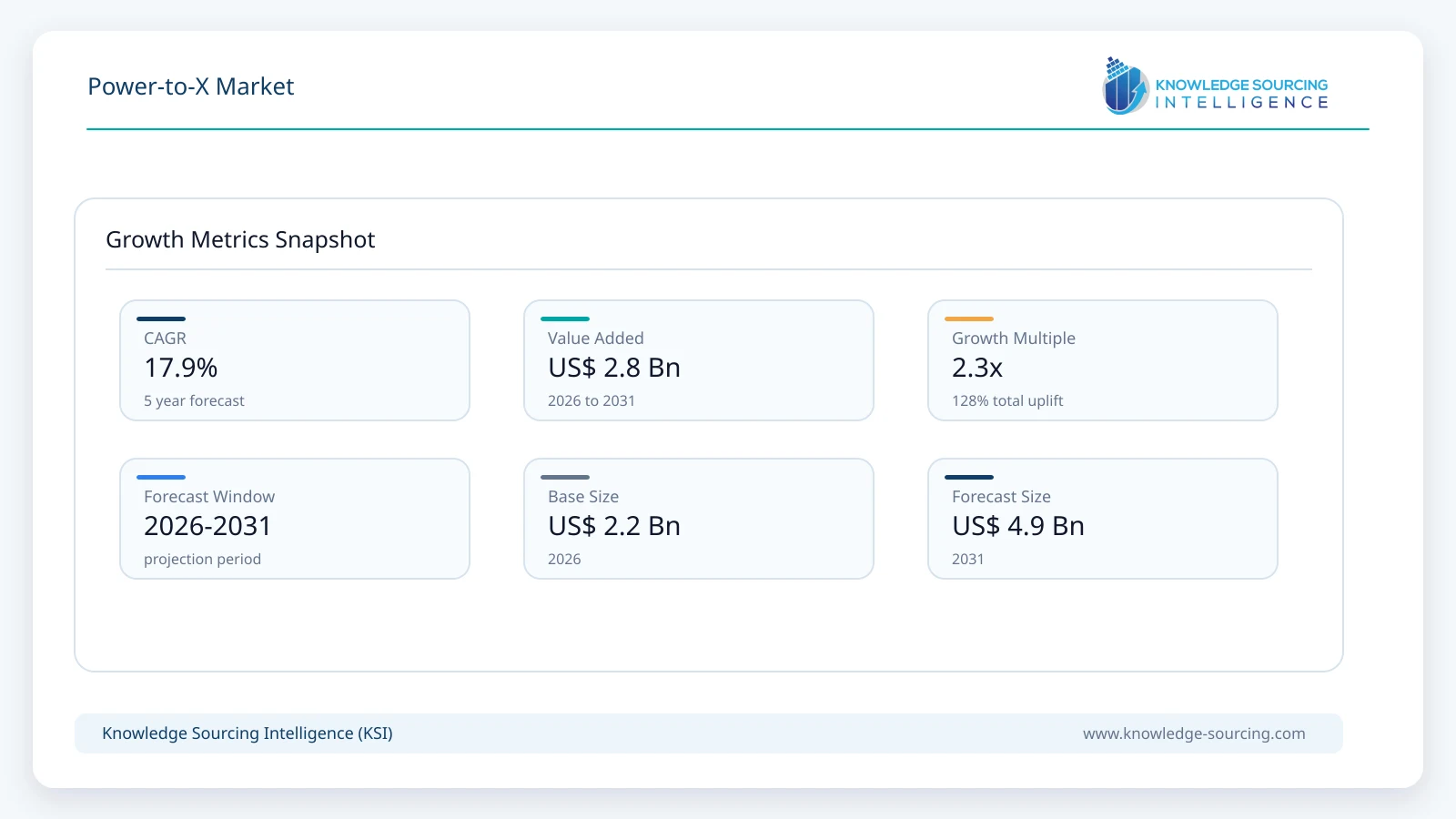
The Power-to-X Market is forecast to grow at a CAGR of 17.9%, reaching USD 4.93 billion in 2031 from USD 2.16 billion in 2026.
Highlights:
- 1Power-to-Gas accounts for approximately 45% of market value in 2026 and remains the largest technology pathway through 2031.
- 2Power-to-Liquid is projected to expand at approximately 18.5% CAGR and increase its share from about 30% in 2026 to 36% by 2031.
- 3Transportation accounts for roughly 33% of market value in 2026 and is projected to reach about 39% by the end of the forecast period.
- 4Industrial & Manufacturing remains a major demand base, supported by refining, ammonia, chemicals and emerging low-carbon industrial applications.
- 5Europe represents approximately 33% of the market in 2026, while Asia Pacific grows faster and increases its share to about 29% by 2031.
- 6The central commercial bottleneck is the conversion of announced projects into FID-backed orders supported by long-term offtake and competitive renewable electricity.
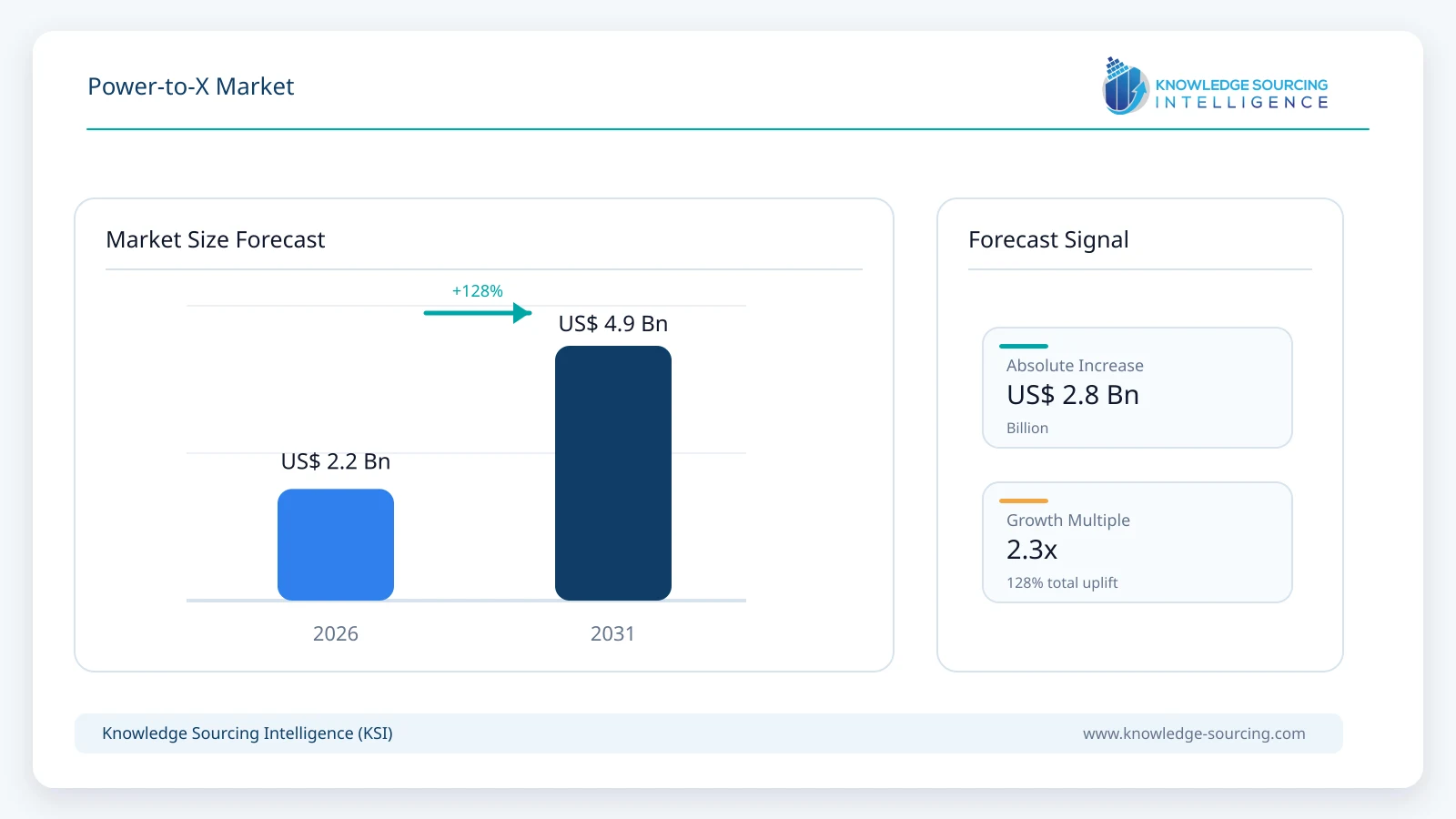
Growth is being driven by the transition from small demonstration projects toward larger electrolyzer installations, industrial renewable-hydrogen projects, and synthetic-fuel developments linked to aviation and maritime decarbonization.
The market is entering a more commercially disciplined phase. Global installed electrolysis capacity doubled in 2025 to exceed 4 GW, while more than 2.5 GW was under construction for operation in 2026. At the same time, the committed low-emissions hydrogen production pipeline for 2030 remains much smaller than the announced pipeline, demonstrating that equipment demand increasingly depends on projects reaching final investment decision, securing offtake and obtaining reliable access to competitively priced renewable electricity.
Power-to-Gas remains the largest technology category because electrolysis is the first conversion step for most Power-to-X pathways and can also supply hydrogen directly to refining, chemical and industrial users. KSI estimates that Power-to-Gas accounts for approximately 45% of market value in 2026. Its share declines to around 40% by 2031 as downstream conversion technologies grow faster, but it remains the largest technology category throughout the forecast period.
Power-to-Liquid is expected to be the principal share gainer. The segment is estimated at approximately 30% of the market in 2026 and is projected to reach roughly 36% by 2031, implying growth of about 18.5% annually. Binding synthetic-fuel requirements, e-methanol projects and the need for low-carbon fuels in aviation and shipping provide a clearer demand pathway than existed during the first phase of the hydrogen investment cycle.
Market Growth Drivers and Trends
Binding Synthetic-Fuel Requirements Are Creating a Commercial Market for Power-to-Liquid
Power-to-Liquid is moving from a demonstration technology toward a compliance-driven fuel pathway. ReFuelEU Aviation requires synthetic aviation fuels to represent 1.2% of aviation fuel supplied at EU airports from 2030. That requirement establishes a regulatory demand floor for e-SAF and strengthens the business case for hydrogen conversion, carbon-processing and fuel-synthesis equipment.
Current projects show how policy can translate into vendor opportunity. In June 2026, Johnson Matthey was selected to license technology for Phelan Green Hydrogen's planned e-SAF facility in Saldanha Bay, South Africa. The first phase is designed to produce around 35,000 tonnes of e-SAF annually, with total capacity expected to reach about 140,000 tonnes when all phases are complete. This supports KSI's expectation that Power-to-Liquid grows faster than the overall market through 2031.
Commercial Electrolyzer Orders Are Reaching Hundreds of Megawatts
Electrolyzer deployment is increasingly moving into project sizes measured in hundreds of megawatts rather than individual pilot units. In March 2026, thyssenkrupp nucera secured an engineering, procurement, fabrication and supply contract to provide 300 MW of alkaline water electrolysis equipment for Moeve's Onuba project in Huelva, Spain. The project had already reached final investment decision and is expected to produce about 45,000 tonnes of renewable hydrogen annually.
This distinction between announced capacity and FID-backed orders is fundamental to the KSI model. Equipment suppliers monetize projects when procurement begins, not when a developer first announces a concept. The current forecast therefore reflects strong growth but excludes the assumption that every announced gigawatt of hydrogen capacity becomes vendor revenue within the forecast period.
E-Methanol Is Emerging as a Major Power-to-X Product Pathway
E-methanol is becoming one of the most visible Power-to-Liquid derivatives because it can serve maritime and industrial markets and can use established chemical and port infrastructure. HIF Global's Paysandu project in Uruguay is planned as a four-stage development requiring approximately USD 5.3 billion of investment and capable of producing up to 876,000 tonnes of e-methanol annually when fully built.
Commercial development is increasingly being paired with offtake. In February 2026, HIF Global and German eFuel One signed a heads of agreement covering approximately 100,000 tonnes of e-methanol per year. Such agreements matter because downstream commitments improve project financeability and create a clearer path toward equipment procurement. This reinforces the modeled shift toward Power-to-Liquid through 2031.
Industrial Hydrogen Demand Provides a More Bankable Near-Term Base
Synthetic fuels provide high growth, but industrial users remain the more established demand base. Refineries, ammonia plants, chemical facilities and emerging low-carbon steel projects already consume hydrogen or hydrogen-derived products. Replacing fossil-derived hydrogen with renewable hydrogen therefore avoids the need to create an entirely new end market, although cost parity remains challenging.
This is why Industrial & Manufacturing remains the largest end-use segment in 2026 at approximately 36% of market value even though Transportation grows faster. The industrial segment is projected to account for about 34% by 2031, reflecting robust absolute expansion but modest share loss as e-SAF and e-methanol projects accelerate.
Export-Oriented Power-to-X Hubs Are Expanding the Geographic Market
Power-to-X development is increasingly emerging in regions with strong renewable resources rather than only where final fuel demand occurs. South America, the Middle East, Australia and parts of Africa can combine low-cost renewable electricity with port access and export infrastructure, creating potential supply hubs for e-methanol, ammonia and synthetic fuels.
This geographic diversification broadens equipment demand beyond Europe and China. However, KSI differentiates between opportunity and committed market value: export-oriented projects contribute materially to the forecast only as they secure environmental approvals, offtake, financing and technology selection.
Market Restraints
Announced Projects Are Not Converting into FID at the Expected Rate
The largest constraint is the gap between announced ambition and committed deployment. The IEA reports that new final investment decisions slowed in 2025, while the 2030 low-emissions hydrogen project pipeline contracted as projects were delayed, paused or cancelled. More than 100 GW of announced electrolysis capacity could miss operation by 2030 if investment decisions are not made by the end of 2027.
This directly affects equipment manufacturers. Factories built against very large pipeline assumptions can remain underutilized when projects fail to progress, creating pressure on margins, working capital and pricing.
Renewable Hydrogen Remains Expensive Relative to Fossil Alternatives
Power-to-X economics depend heavily on renewable electricity because electrolysis introduces an energy-intensive conversion step before downstream synthesis losses are considered. Renewable hydrogen remains more expensive than unabated fossil-based hydrogen across most regions, meaning policy support, premium pricing or carbon constraints are still required for many projects.
The challenge becomes greater for Power-to-Liquid because renewable hydrogen must then be converted into a synthetic fuel. This raises capital intensity and energy consumption compared with direct electrification, limiting deployment to applications where molecules provide a clear technical or regulatory advantage.
Offtake Remains Insufficient for the Announced Production Pipeline
Offtake is increasingly the dividing line between bankable and speculative projects. Long-term buyers provide the revenue certainty required for project finance, yet many announced developments remain exposed to volatile future fuel premiums. The problem is especially important for e-fuels, where producers often need buyers to accept a substantial premium over conventional alternatives.
For this reason, KSI gives greater weight to projects with signed offtake, procurement awards or final investment decisions than to headline project announcements when assessing the market through 2031.
Electrolyzer Manufacturing Capacity Is Entering Consolidation
Electrolyzer manufacturing capacity expanded faster than actual project deployment, creating utilization pressure across the supply chain. The IEA describes the sector as entering a consolidation phase, including in China, where excess capacity and aggressive pricing are reducing manufacturer economics.
Topsoe's May 2026 decision to revise the commercialization pathway for its solid oxide electrolyzer technology illustrates this pressure. The company plans to demonstrate commercial-scale manufacturing capability at Herning before hibernating the factory until demand becomes sufficiently robust. The development supports a more disciplined market forecast despite strong long-term potential.
Supporting Infrastructure Can Delay Otherwise Viable Projects
Power-to-X production requires more than an electrolyzer. Large projects may need dedicated renewable power, grid connections, desalination or water treatment, hydrogen storage, carbon dioxide supply, pipelines, terminals and export infrastructure. Delays in any of these supporting systems can postpone the equipment order or commissioning date.
As a result, integrated engineering capability becomes a competitive advantage. Vendors able to coordinate electrolysis, process integration, compression, storage and downstream synthesis can reduce interfaces and improve project bankability.
Power-to-X Market Segmentation Analysis
By Technology
Power-to-Gas
Power-to-Gas accounts for approximately 45% of market value in 2026, equivalent to around USD 3.6 billion. The category converts renewable electricity into hydrogen through electrolysis and can extend into synthetic methane where hydrogen is combined with carbon dioxide. Its leadership reflects the fact that electrolytic hydrogen can be consumed directly in industry and also serves as the feedstock for most downstream Power-to-X pathways.
The segment is projected to reach approximately USD 6.24 billion by 2031, representing growth of about 11.6% annually. Its share moderates to roughly 40% as Power-to-Liquid expands faster, but the large installed and committed electrolysis base keeps Power-to-Gas the largest technology category at the end of the forecast period.
Power-to-Liquid
Power-to-Liquid is estimated at approximately USD 2.4 billion in 2026, or about 30% of the market. The segment includes technologies used to produce e-methanol, synthetic hydrocarbons and e-SAF from renewable hydrogen and carbon-based feedstocks.
The segment is projected to expand at approximately 18.5% CAGR and reach around USD 5.62 billion by 2031, increasing its share to roughly 36%. ReFuelEU Aviation, e-methanol offtake and growing maritime fuel interest provide a stronger demand foundation than existed in the early Power-to-X investment cycle.
Power-to-Heat
Power-to-Heat represents approximately USD 1.28 billion in 2026, or around 16% of the market. The segment includes systems that use renewable electricity to supply industrial or district heat through electric boilers, heat pumps, resistance systems and thermal-storage integration.
KSI projects the segment to reach about USD 2.18 billion by 2031. Growth remains healthy, but the category loses share because direct electrification is already technically mature in many heat applications and therefore has less room for transformational growth than hydrogen-derived fuels.
Others
Other Power-to-X technologies account for approximately 9% of market value in 2026 and include specialized power-to-chemicals, advanced conversion and emerging pathways outside the principal gas, liquid and heat categories. The segment is projected to reach around 10% of the market by 2031 as new chemical and industrial applications progress.
By End-Use Industry
Transportation
Transportation accounts for approximately USD 2.64 billion, or 33% of the market, in 2026. The segment is projected to expand at about 18.2% annually and reach roughly USD 6.08 billion by 2031, increasing its share to around 39%. Aviation and maritime transport provide the strongest structural opportunity because direct electrification is more difficult in long-distance, high-energy-density applications.
The increase is supported by regulatory fuel requirements and by projects moving from demonstration into technology licensing, environmental approval and offtake. Transportation therefore becomes the largest end-use segment by the end of the forecast period.
Industrial & Manufacturing
Industrial & Manufacturing is the largest end-use category in 2026 at approximately USD 2.88 billion, representing 36% of market value. Refining, ammonia, chemicals and emerging low-carbon steel applications provide an established hydrogen demand base and can therefore support projects without requiring an entirely new molecule market.
The segment is projected to reach approximately USD 5.30 billion by 2031. Its share eases to about 34% as transport-related e-fuels grow faster, but industry remains one of the most bankable sources of Power-to-X equipment demand.
Agriculture
Agriculture represents approximately 13% of market value in 2026, largely through renewable ammonia and fertilizer production. The segment is projected to reach around USD 1.87 billion by 2031 as low-emissions hydrogen begins to penetrate ammonia value chains in countries with supportive policy and competitive renewable resources.
Residential & Commercial Heating
Residential and commercial heating accounts for about 10% of the market in 2026 and grows more slowly than the overall category. The segment is projected to represent roughly 8% by 2031 because heat pumps and direct electrification are generally more energy-efficient than converting electricity into hydrogen and then reconverting that hydrogen into heat.
Geographical Outlook
Europe
Europe represents approximately USD 2.64 billion, or 33% of global market value, in 2026 and remains the largest regional market in the early forecast period. The region benefits from RFNBO requirements, ReFuelEU Aviation, refining obligations, industrial hydrogen programs and a relatively mature project-development ecosystem.
Europe is projected to reach around USD 4.68 billion by 2031. Its share moderates to approximately 30% as Asia Pacific grows faster, but FID-backed projects such as Moeve's Onuba development provide evidence that the European market is converting policy into tangible equipment procurement.
Asia Pacific
Asia Pacific accounts for approximately USD 2.0 billion, or 25% of the market, in 2026. China dominates electrolysis manufacturing and accounted for nearly three-quarters of new global electrolyzer installations in 2025, while Japan, South Korea, India and Australia provide additional industrial, import and export opportunities.
The region is projected to grow at approximately 17.7% annually and reach around USD 4.52 billion by 2031, increasing its share to about 29%. Manufacturing scale, lower equipment costs and growing domestic hydrogen policy support underpin the share gain through the forecast period.
North America
North America represents approximately 19% of market value in 2026 and is projected to reach around USD 2.81 billion by 2031. The region has a substantial project pipeline and strong technology capability, but offtake and policy uncertainty can delay procurement for export-oriented projects.
HIF Global's selection of Electric Hydrogen for its Texas e-fuels facility illustrates how downstream synthetic-fuel projects can translate into large domestic electrolyzer opportunities when developers move into technology selection.
Middle East & Africa
Middle East & Africa represents approximately 13% of market value in 2026. The Middle East combines substantial existing hydrogen consumption with low-cost renewable resources, while Africa offers strong renewable potential but generally faces higher financing and infrastructure constraints.
KSI projects the regional market to reach approximately USD 2.03 billion by 2031. Developments such as the planned South African e-SAF facility demonstrate that export-oriented synthetic fuels can generate significant equipment demand where renewable resources and external fuel mandates align.
South America
South America accounts for approximately 10% of global market value in 2026 and is projected to reach about USD 1.56 billion by 2031. The region is emerging as a potential export hub because of strong wind and solar resources, available land and port access.
HIF's Paysandu project in Uruguay is an important test case. If large developments move through environmental approval, financing and FID, South America can become a more material market for electrolyzers, synthesis technology, compressors and engineering services through the end of the forecast period.
Key Developments
August 2026: thyssenkrupp nucera reported that order intake for the first nine months of fiscal 2025/26 had risen materially, supported by large green-hydrogen orders including Moeve's 300 MW project. The development supports continued Power-to-Gas equipment demand while also reinforcing the market's concentration in a limited number of large projects.
June 2026: Johnson Matthey was selected to license technology for Phelan Green Hydrogen's planned e-SAF facility in South Africa. The first phase is designed for about 35,000 tonnes of e-SAF per year, directly supporting the faster-growth outlook for Power-to-Liquid.
May 2026: Topsoe revised the commercialization pathway for its SOEC technology and announced that its Herning manufacturing facility would be hibernated after commercial-scale capability is demonstrated. The move highlights current manufacturing overcapacity and slower-than-expected project conversion.
March 2026: thyssenkrupp nucera secured a 300 MW alkaline-electrolyzer supply contract for Moeve's Onuba project in Spain after the project reached final investment decision. This is direct evidence of policy-backed European hydrogen projects converting into vendor orders.
March 2026: HIF Global submitted environmental authorization documentation for its Paysandu e-fuels development in Uruguay, a project that could produce up to 876,000 tonnes of e-methanol annually when fully developed.
February 2026: HIF Global and German eFuel One signed a heads of agreement covering approximately 100,000 tonnes of e-methanol per year, linking planned production with a defined offtake pathway.
September 2025: HIF Global selected Electric Hydrogen to supply electrolyzer technology for its Texas e-fuels project, demonstrating the direct connection between downstream e-methanol development and upstream electrolyzer demand.
Competitive Environment
The Power-to-X competitive landscape combines electrolyzer manufacturers, process-technology licensors, industrial-gas companies, rotating-equipment suppliers and engineering contractors. Siemens Energy, thyssenkrupp nucera, Nel, ITM Power, Electric Hydrogen and Sunfire compete primarily through electrolysis technology, while Topsoe and Johnson Matthey provide downstream process and catalyst capabilities that become increasingly important as the market expands from hydrogen into synthetic fuels and chemicals.
Industrial-gas groups including Linde and Air Liquide bring hydrogen-handling, integration and project-execution capability, while Technip Energies and KBR participate through engineering and process design. Competition is therefore moving toward integrated solutions rather than isolated equipment packages.
The near-term market is likely to consolidate. Excess manufacturing capacity and delayed FIDs create pressure on companies without strong balance sheets, credible backlogs or differentiated technology. Vendors that demonstrate commercial-scale operation, standardized modular equipment, lower installed cost and the ability to connect electrolysis with downstream synthesis are better positioned through 2031.
Power-to-X Market Scope:
| Report Metric | Details |
|---|---|
| Total Market Size in 2026 | USD 2.16 billion |
| Total Market Size in 2031 | USD 4.93 billion |
| Forecast Unit | Billion |
| Growth Rate | 17.9% |
| Study Period | 2021 to 2031 |
| Historical Data | 2021 to 2024 |
| Base Year | 2025 |
| Forecast Period | 2026 – 2031 |
| Segmentation | Technology, End-Use Industry, Geography |
| Companies |
|
Market Segmentation
By Technology
Power-to-Gas
Power-to-Liquid
Power-to-Heat
Others
By End-Use Industry
Transportation
Industrial & Manufacturing
Agriculture
Residential & Commercial Heating
Others
By Geography
North America
United States
Canada
Mexico
South America
Brazil
Rest of South America
Europe
Germany
France
United Kingdom
Rest of Europe
Middle East and Africa
United Arab Emirates
Saudi Arabia
Rest of Middle East and Africa
Asia Pacific
China
India
Japan
Rest of Asia Pacific
Table of Contents
1. EXECUTIVE SUMMARY
2. MARKET SNAPSHOT
2.1. Market Overview
2.2. Market Definition
2.3. Scope of the Study
2.4. Market Segmentation
3. BUSINESS LANDSCAPE
3.1. Market Drivers
3.1.1. Binding Synthetic-Fuel Requirements in European Aviation
3.1.2. Expansion of E-Methanol and E-Fuel Offtake for Maritime Transport
3.1.3. Scaling of Commercial Electrolyzer Projects Beyond Demonstration Size
3.1.4. Industrial Demand for Renewable Hydrogen in Refining, Ammonia and Steel
3.1.5. Development of Export-Oriented Power-to-X Hubs in Low-Cost Renewable Regions
3.2. Market Restraints
3.2.1. Delayed Final Investment Decisions Across Announced Hydrogen Projects
3.2.2. High Electricity Requirement and Weak Economics Versus Direct Electrification
3.2.3. Limited Long-Term Offtake for Large Export-Oriented Projects
3.2.4. Electrolyzer Manufacturing Overcapacity and Vendor Consolidation
3.2.5. Dependence on Carbon Supply, Hydrogen Infrastructure and Supporting Logistics
3.3. Market Opportunities
3.4. Porter's Five Forces Analysis
3.5. Industry Value Chain Analysis
3.6. Policies and Regulations
3.7. Strategic Recommendations
4. TECHNOLOGICAL OUTLOOK
4.1. Alkaline Electrolysis
4.2. PEM Electrolysis
4.3. Solid Oxide Electrolysis
4.4. Methanation and Synthetic Gas Systems
4.5. E-Methanol and E-SAF Synthesis
5. POWER-TO-X MARKET BY TECHNOLOGY
5.1. Introduction
5.2. Power-to-Gas
5.3. Power-to-Liquid
5.4. Power-to-Heat
5.5. Others
6. POWER-TO-X MARKET BY END-USE INDUSTRY
6.1. Introduction
6.2. Transportation
6.3. Industrial & Manufacturing
6.4. Agriculture
6.5. Residential & Commercial Heating
6.6. Others
7. POWER-TO-X MARKET BY GEOGRAPHY
7.1. Introduction
7.2. North America
7.2.1. United States
7.2.2. Canada
7.2.3. Mexico
7.3. South America
7.3.1. Brazil
7.3.2. Rest of South America
7.4. Europe
7.4.1. Germany
7.4.2. France
7.4.3. United Kingdom
7.4.4. Rest of Europe
7.5. Middle East and Africa
7.5.1. United Arab Emirates
7.5.2. Saudi Arabia
7.5.3. Rest of Middle East and Africa
7.6. Asia Pacific
7.6.1. China
7.6.2. India
7.6.3. Japan
7.6.4. Rest of Asia Pacific
8. COMPETITIVE ENVIRONMENT AND ANALYSIS
8.1. Major Players and Strategy Analysis
8.2. Market Share Analysis
8.3. Mergers, Acquisitions, Agreements, and Collaborations
8.4. Competitive Dashboard
9. COMPANY PROFILES
9.1. Siemens Energy AG
9.2. thyssenkrupp nucera AG & Co. KGaA
9.3. Topsoe A/S
9.4. Nel ASA
9.5. ITM Power plc
9.6. Electric Hydrogen Co.
9.7. Sunfire GmbH
9.8. Plug Power Inc.
9.9. Cummins Inc.
9.10. MAN Energy Solutions SE
9.11. Johnson Matthey Plc
9.12. Linde plc
9.13. Air Liquide S.A.
9.14. Mitsubishi Power, Ltd.
9.15. Toshiba Energy Systems & Solutions Corporation
9.16. Burckhardt Compression AG
9.17. Chart Industries, Inc.
9.18. Baker Hughes Company
9.19. Technip Energies N.V.
9.20. KBR, Inc.
10. APPENDIX
10.1. Currency
10.2. Assumptions
10.3. Base and Forecast Years Timeline
10.4. Key Benefits for the Stakeholders
10.5. Research Methodology
10.6. Abbreviations
Navigate
Trusted by the world's leading organizations











