
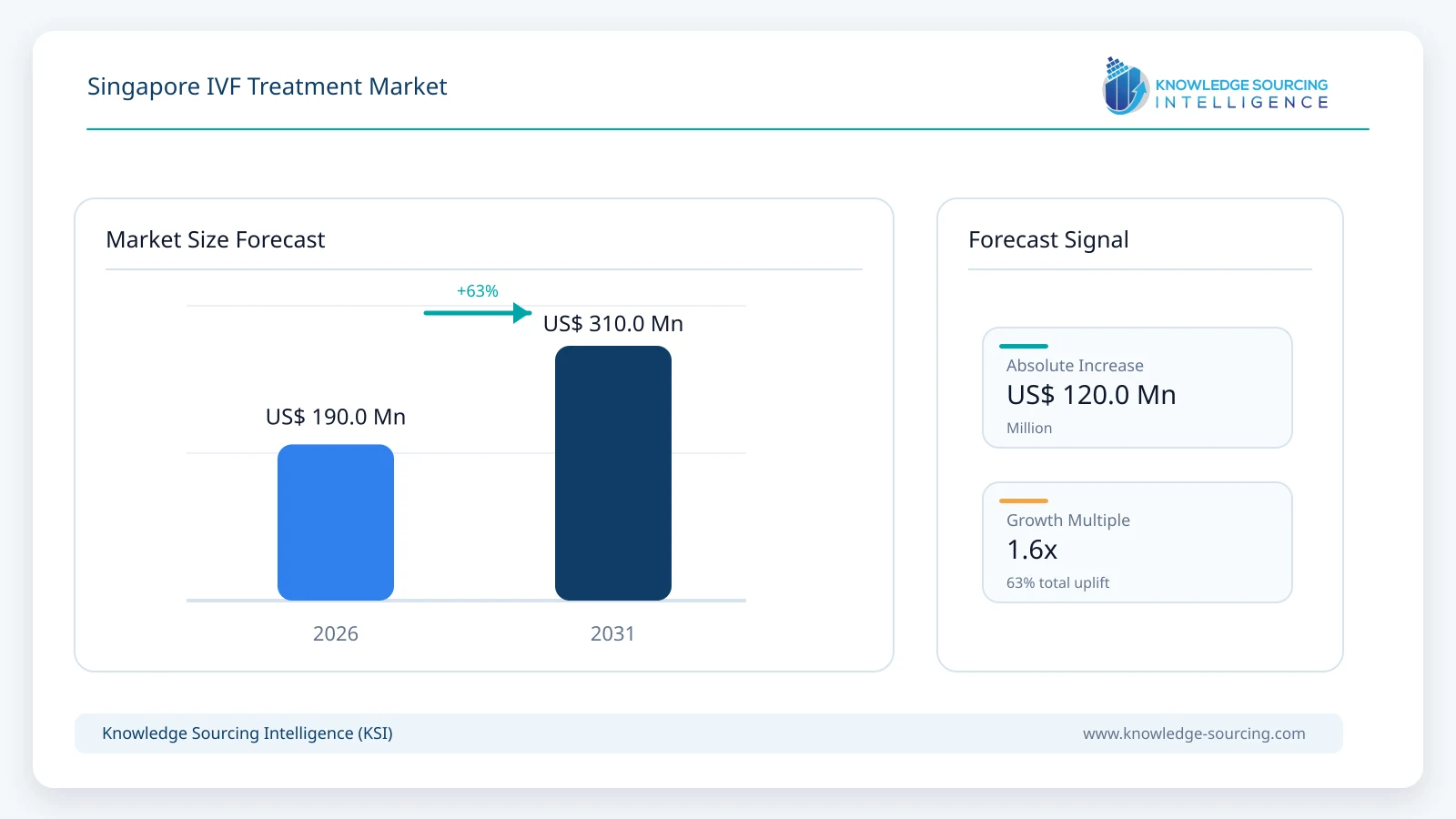
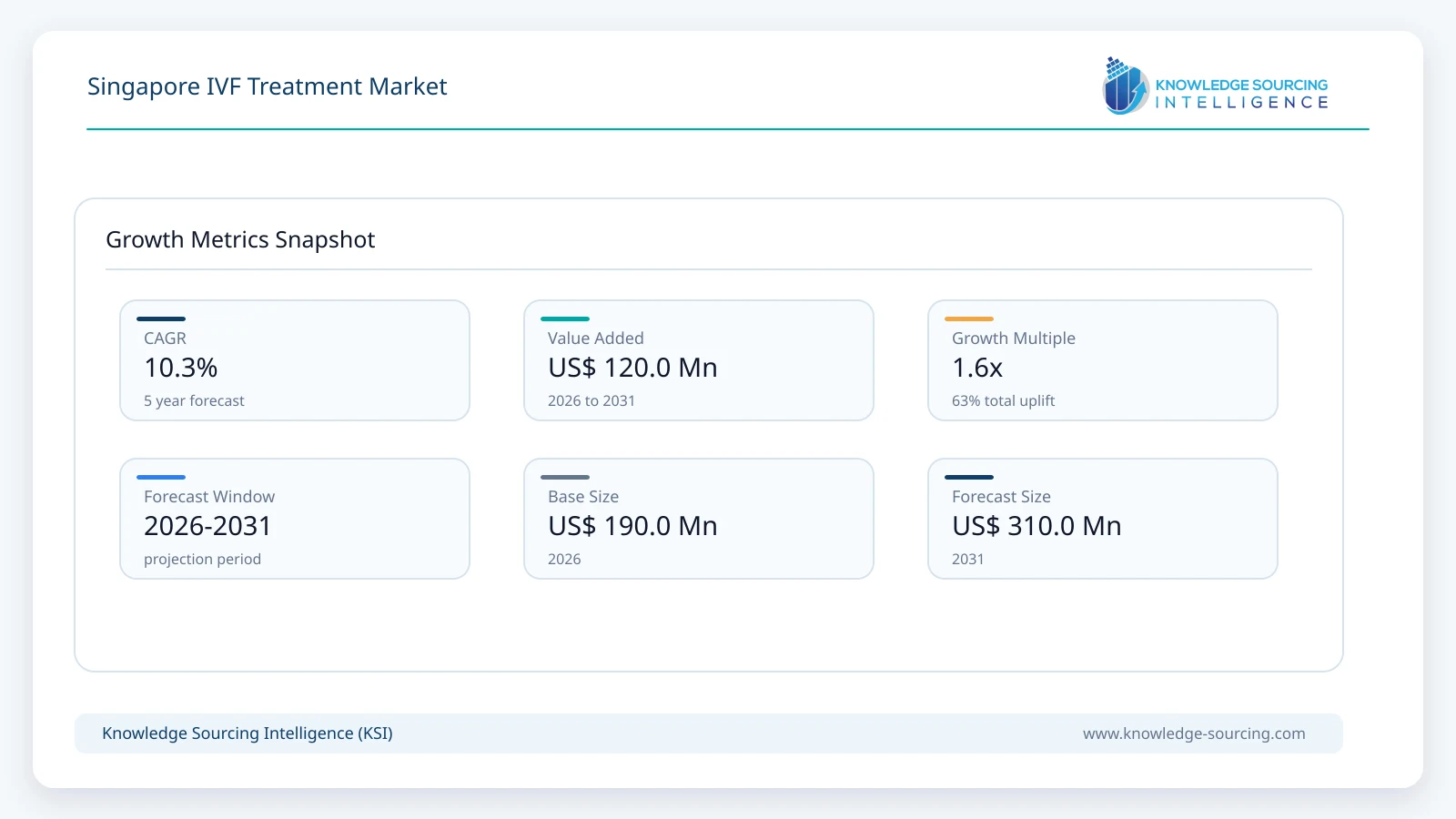
The Singapore IVF treatment market is estimated at USD 190.0 million in 2026 and is projected to reach USD 310.0 million by 2031, growing at a CAGR of 10.3% during the forecast period.
Highlights:
- 1Fresh ART cycles account for approximately 58% of IVF treatment revenue in 2026.
- 2Private assisted reproduction centres generate approximately 54% of market revenue in 2026 despite public centres retaining the majority of treatment volume.
- 3Resident patients account for approximately 88% of Singapore IVF treatment revenue in 2026.
- 4Singapore's resident total fertility rate fell to 0.87 in 2025, increasing policy urgency around family formation and fertility support.
- 5Public ART co-funding remains available for up to three fresh and three frozen cycles, with support of up to 75% for eligible Singapore Citizen couples.
- 6Private-centre expansion and laboratory technologies such as time-lapse imaging, AI-assisted embryo assessment and PGT are increasing treatment intensity per patient.
Singapore has one of Asia's most regulated and clinically sophisticated assisted reproduction environments. The market includes patient-service revenue generated from IVF and directly associated treatment episodes, including ovarian stimulation, monitoring, oocyte retrieval, conventional IVF or ICSI fertilisation, embryo culture, fresh and frozen embryo transfer, cycle-linked medication, cryopreservation and selected preimplantation genetic testing when clinically integrated into the treatment pathway. Standalone infertility diagnostics, IUI-only services, obstetric and maternity care, general women's health services and unrelated fertility-preservation procedures are excluded unless they form part of an IVF treatment episode. This treatment-only definition focuses specifically on IVF treatment services, excluding related products, laboratory equipment, and other ancillary offerings. This approach keeps the market analysis centered on patient treatment activity and provides a clearer basis for evaluating service demand and industry dynamics.
The underlying procedure base is substantial relative to Singapore's population. Ministry of Health data imply more than 5,000 ART cycles were performed at public assisted reproduction centres in 2023 when co-funded and non-co-funded activity is combined, while MOH has separately stated that about 7,000 assisted-conception procedure cycles a year tap MediSave. Public centres continue to serve the majority of ART patients, although the proportion choosing private centres increased between 2018 and 2022. The revenue mix is more balanced than the volume mix because private cycles carry higher realised pricing and a greater incidence of separately billed laboratory, medication, storage and advanced diagnostic services.
Affordability policy is therefore central to the market. Eligible couples using public assisted reproduction centres can receive government co-funding for up to three fresh and three frozen ART cycles, with the highest support reaching 75% subject to per-cycle caps for Singapore Citizen couples. MediSave can also be used within prevailing withdrawal limits, including at private centres, but the Ministry of Health stated in August 2026 that it is reviewing both the co-funding structure and MediSave withdrawal limits as part of the Marriage and Parenthood Reset Workgroup. Any expansion of support to better reflect current treatment costs would increase conversion among patients who otherwise delay or discontinue treatment because of financial pressure.
Market Trends
Private Fertility Capacity Is Expanding Alongside the Public System
Private-sector investment is increasing treatment choice even though public centres remain the largest source of procedure volume. Thomson Fertility opened a second Singapore centre at United Square in Novena in May 2026, combining consultations, embryology and laboratory services at one location. The facility includes time-lapse imaging, blastocyst culture, AI-assisted embryo development assessment, preimplantation genetic testing, advanced sperm selection, IMSI, spindle imaging and DNA-fragmentation testing. This illustrates the competitive direction of the market: leading private providers are not competing only on physician access, but on integrated laboratory capability, patient convenience and higher-value diagnostic and embryology services. Monash IVF, Virtus Fertility, Alpha IVF, Sincere IVF and other specialist providers reinforce the private network around the Novena and Orchard medical clusters.
Low Fertility and Delayed Parenthood Sustain the Treatment Funnel
Singapore's resident total fertility rate fell from 0.97 in 2024 to a preliminary 0.87 in 2025, while resident births also declined sharply. Low national fertility does not translate mechanically into IVF demand, because many couples remain childless by choice or delay family formation for non-medical reasons. However, later attempts to conceive increase the incidence of age-related subfertility, reduce ovarian reserve and raise the probability that patients move from expectant management or IUI toward IVF. For fertility providers, the commercial effect is a persistent flow of older first-time patients who require more diagnostic work, greater medication intensity and, in some cases, multiple retrieval or transfer cycles before achieving a live birth.
Frozen Transfer, Cryopreservation and Genetic Testing Increase Revenue per Treatment Journey
The IVF treatment journey is becoming less concentrated in one fresh cycle. Vitrification allows embryos to be stored and transferred later, separating ovarian stimulation and retrieval from the timing of implantation. This increases the relevance of frozen embryo transfer, cryostorage and repeat transfer activity. At the same time, Singapore maintains a regulated pathway for preimplantation genetic testing for monogenic disorders and structural chromosomal rearrangements, while preimplantation genetic screening has been evaluated through an MOH pilot for selected patients. These services apply to defined patient groups rather than to all IVF users, but they raise the clinical and revenue intensity of complex cases and favour providers with strong laboratory governance and genetics capability.
Market Drivers
Government Co-Funding Reduces the Financial Barrier at Public AR Centres
Government support remains one of the strongest structural demand enablers. Eligible Singapore Citizen couples at public assisted reproduction centres can receive 75% co-funding up to SGD 7,700 for a fresh ART cycle and SGD 2,200 for a frozen ART cycle, with lower co-funding percentages and caps for mixed-citizenship couples. Funding is available for a maximum of three fresh and three frozen ART cycles, subject to eligibility rules, and selected cycles remain co-funded for women aged 40 and above if they began assisted reproduction before age 40. This framework lowers the effective out-of-pocket cost of repeated treatment and gives public centres a durable volume advantage. The 2026 review of financing limits indicates that policy makers recognise the time-sensitive nature of fertility treatment and the possibility that existing caps may need adjustment as clinical costs rise.
Advanced Clinical Infrastructure Supports High-Value Treatment
Singapore's provider base includes major public hospitals, specialist fertility groups and international ART networks operating under the Healthcare Services Act. Assisted Reproduction Service is one of the regulated healthcare services that requires an HCSA licence. In addition, MOH publishes approved providers for selected preimplantation genetic-testing services, providing patients with an identifiable network of centres that meet specific licensing conditions. This regulatory structure raises entry barriers, but it also supports trust in embryo handling, laboratory standards, documentation and clinical governance. The result is a market capable of supporting higher-value treatment protocols and serving a limited number of international patients seeking sophisticated reproductive care.
Rising Private-Centre Utilisation Expands Commercial Revenue
MOH has stated that the proportion of women choosing private assisted reproduction centres increased from 2018 to 2022, even though the majority continued to use public clinics. The shift matters commercially because private treatment is priced materially above the effective patient cost of subsidised public cycles and commonly involves separately billed professional fees, laboratory services, embryo transfer, storage and advanced testing. Virtus Fertility, for example, lists oocyte retrieval packages above SGD 11,000 including laboratory services, before embryo transfer and selected add-ons. Private utilisation therefore contributes disproportionately to revenue growth even when its share of national ART cycle volume remains below that of the public system.
Market Restraints
Private IVF Costs Remain High Relative to Household Willingness to Spend
The main market restraint is the cumulative cost of treatment rather than the price of any single procedure. A private IVF journey may involve consultations, ovarian stimulation medication, egg retrieval, ICSI or other embryology procedures, embryo transfer, cryopreservation, storage and additional diagnostics. Multiple attempts may be required, particularly for women in older age groups where national ART success rates are lower. MediSave offsets part of the burden, but government co-funding remains focused on public centres. The resulting price gap keeps many cost-sensitive residents within the public system and limits the number of patients who can sustain repeated private cycles without substantial household savings.
A Small Resident Population Caps Long-Term Volume Growth
Singapore's market is attractive on treatment value and clinical sophistication but structurally limited by population size. The resident population generates a finite annual pool of couples seeking conception support, and declining birth numbers do not imply that every unrealised birth converts into an IVF cycle. Population ageing also reduces the long-term number of women in peak reproductive age groups. International patients create an additional opportunity, but Singapore competes with Malaysia, Thailand and other Asian medical-travel destinations that can offer lower treatment costs.
Segment Analysis
By Cycle Type: Fresh ART Cycles
Fresh ART cycles remain the largest revenue pool because they include the most resource-intensive part of the treatment pathway: ovarian stimulation, cycle monitoring, oocyte retrieval, fertilisation and embryo culture. Public co-funding caps are also materially higher for fresh cycles than frozen cycles, reflecting their greater clinical cost. Fresh activity remains the foundation on which later frozen transfers are built, so even as freeze-all strategies and vitrification gain adoption, the initial retrieval cycle continues to anchor market revenue. Growth in this segment is supported by delayed parenthood and more patients entering treatment, while pricing is restrained by public-sector funding rules and competitive transparency among private clinics.
By Fertilisation Method: ICSI-Assisted IVF
ICSI is a major component of Singapore IVF practice because it is used for male-factor infertility, prior fertilisation failure and other clinically selected cases. The method requires micromanipulation expertise and laboratory equipment beyond conventional insemination, supporting higher embryology intensity per cycle. Its share of treatment value is expected to remain significant through 2031 as providers increasingly manage complex infertility and older patient cohorts. ICSI is not used in every IVF cycle, as conventional IVF remains appropriate for selected patients. Clinical practice continues to support the use of ICSI according to patient needs, treatment history, and established clinical protocols rather than applying it routinely in all cycles.
By Provider Type: Private Assisted Reproduction Centres
Private AR centres represent the faster-growing revenue channel. Their commercial advantage is not higher national treatment volume, which remains led by public providers, but higher realised revenue per patient and flexibility in scheduling, physician selection and advanced laboratory options. New private capacity, such as Thomson Fertility's Novena centre, increases competitive intensity and can shorten access times for patients willing to pay. Public centres retain a strong position because of co-funding, while private providers are better positioned to capture premium services, international patients and patients who have exhausted public-cycle limits or prefer a specific specialist.
By Patient Type: Resident Patients
Resident patients remain the core demand base because Singapore's co-funding and MediSave frameworks are designed primarily around citizens and permanent residents, and most ART treatment is linked to domestic family formation rather than medical tourism. International patients contribute incremental demand through Singapore's reputation for clinical quality and regulated healthcare, but the city-state is not a low-cost IVF destination. The resident segment therefore provides the most stable forecast base, while non-resident treatment is treated as an upside channel rather than the principal growth driver.
Competitive Landscape
Competition is divided between large public AR centres and a concentrated group of private specialist providers. KK Women's and Children's Hospital, National University Hospital and Singapore General Hospital form the core public capacity and benefit from government co-funding eligibility. Private competition includes Thomson Fertility, Virtus Fertility Centre, Monash IVF Fertility Centre, Alpha IVF Centre, Sincere IVF Center, O&G Partners IVF Centre and Mount Elizabeth-based services. Differentiation increasingly depends on embryology laboratory quality, consultant reputation, treatment transparency, patient experience and access to advanced diagnostics rather than on basic IVF availability alone.
Recent Developments
August 2026: Singapore's Ministry of Health stated that it is reviewing assisted-conception co-funding and MediSave withdrawal limits under the Marriage and Parenthood Reset Workgroup.
May 2026: Thomson Fertility opened a second Singapore centre at United Square in Novena with integrated clinical, embryology and laboratory services.
February 2026: Singapore reported a preliminary resident total fertility rate of 0.87 for 2025, the lowest on record, increasing policy urgency around family formation.
September 2025: MOH published updated public-centre ART cycle and live-birth data, showing continued utilisation of both co-funded and non-co-funded treatment cycles.
March 2025: MOH expanded the list of allowable conditions for regulated PGT-M and PGT-SR services through updated licence conditions.
Singapore IVF Treatment Market Scope:
| Report Metric | Details |
|---|---|
| Total Market Size in 2026 | USD 190.0 million |
| Total Market Size in 2031 | USD 310.0 million |
| Forecast Unit | Million |
| Growth Rate | 10.3% |
| Study Period | 2021 to 2031 |
| Historical Data | 2021 to 2024 |
| Base Year | 2025 |
| Forecast Period | 2026 – 2031 |
| Segmentation | Cycle Type, Fertilisation Method, Provider Type, Patient Type |
| Companies |
|
Market Segmentation
By Cycle Type
Fresh ART Cycles
Frozen ART Cycles
Donor and Other Specialized Cycles
By Fertilisation Method
ICSI-Assisted IVF
Conventional IVF
By Provider Type
Public Assisted Reproduction Centres
Private Assisted Reproduction Centres
By Patient Type
Resident Patients
International and Non-Resident Patients
Table of Contents
1. EXECUTIVE SUMMARY
2. MARKET SNAPSHOT
2.1. Market Overview
2.2. Market Definition
2.3. Scope of the Study
2.4. Market Segmentation
3. BUSINESS LANDSCAPE
3.1. Market Drivers
3.1.1. Government Co-Funding Reduces the Financial Barrier at Public AR Centres
3.1.2. Advanced Clinical Infrastructure Supports High-Value Treatment
3.1.3. Rising Private-Centre Utilisation Expands Commercial Revenue
3.2. Market Restraints
3.2.1. Private IVF Costs Remain High Relative to Household Willingness to Spend
3.2.2. A Small Resident Population Caps Long-Term Volume Growth
3.3. Market Opportunities
3.4. Porter's Five Forces Analysis
3.5. Industry Value Chain Analysis
3.6. Policies and Regulations
3.7. Strategic Recommendations
4. TECHNOLOGICAL OUTLOOK
4.1. Time-Lapse Imaging and AI-Assisted Embryo Assessment
4.2. Vitrification, Cryostorage and Frozen Embryo Transfer
4.3. Preimplantation Genetic Testing and Advanced Reproductive Diagnostics
5. SINGAPORE IVF TREATMENT MARKET BY CYCLE TYPE
5.1. Introduction
5.2. Fresh ART Cycles
5.3. Frozen ART Cycles
5.4. Donor and Other Specialized Cycles
6. SINGAPORE IVF TREATMENT MARKET BY FERTILISATION METHOD
6.1. Introduction
6.2. ICSI-Assisted IVF
6.3. Conventional IVF
7. SINGAPORE IVF TREATMENT MARKET BY PROVIDER TYPE
7.1. Introduction
7.2. Public Assisted Reproduction Centres
7.3. Private Assisted Reproduction Centres
8. SINGAPORE IVF TREATMENT MARKET BY PATIENT TYPE
8.1. Introduction
8.2. Resident Patients
8.3. International and Non-Resident Patients
9. COMPETITIVE ENVIRONMENT AND ANALYSIS
9.1. Major Players and Strategy Analysis
9.2. Market Share Analysis
9.3. Mergers, Acquisitions, Agreements and Collaborations
9.4. Competitive Dashboard
10. COMPANY PROFILES
10.1. Thomson Medical Group
10.2. Virtus Fertility Centre
10.3. Monash IVF Group - Singapore
10.4. Sincere Healthcare Group
10.5. Alpha IVF Centre & Alpha Women's Specialists
10.6. O&G Partners IVF Centre
10.7. IHH Healthcare
10.8. KK Women's and Children's Hospital
10.9. National University Hospital
10.10. Singapore General Hospital
10.11. CooperSurgical Fertility Solutions
10.12. Vitrolife Group
10.13. FUJIFILM Irvine Scientific
10.14. Thermo Fisher Scientific
10.15. Merck KGaA
10.16. Esco Medical
10.17. Hamilton Thorne
10.18. Genea Biomedx
11. APPENDIX
11.1. Currency
11.2. Assumptions
11.3. Base and Forecast Years Timeline
11.4. Key Benefits for Stakeholders
11.5. Research Methodology
11.6. Abbreviations
Navigate
Trusted by the world's leading organizations











