
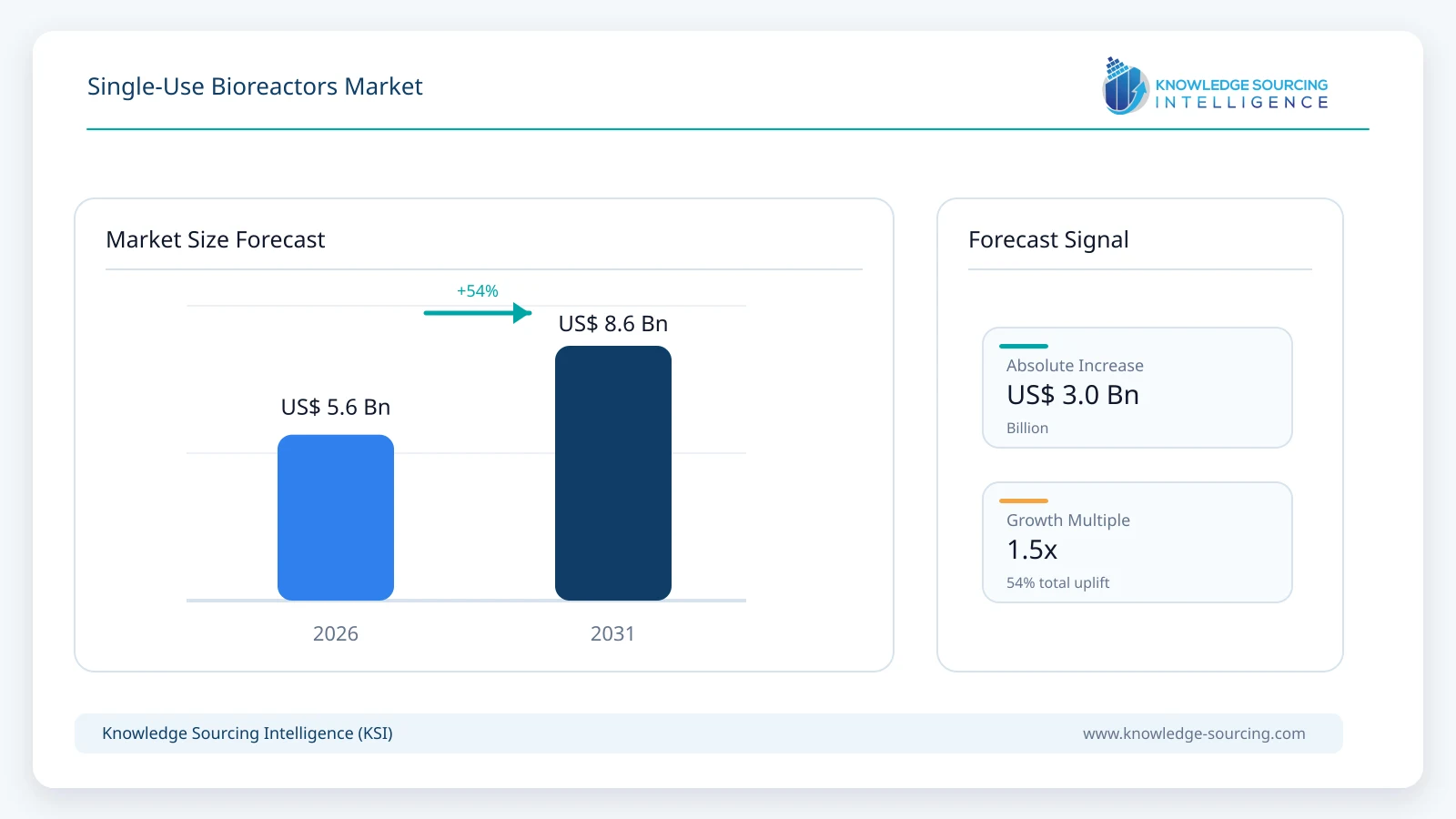
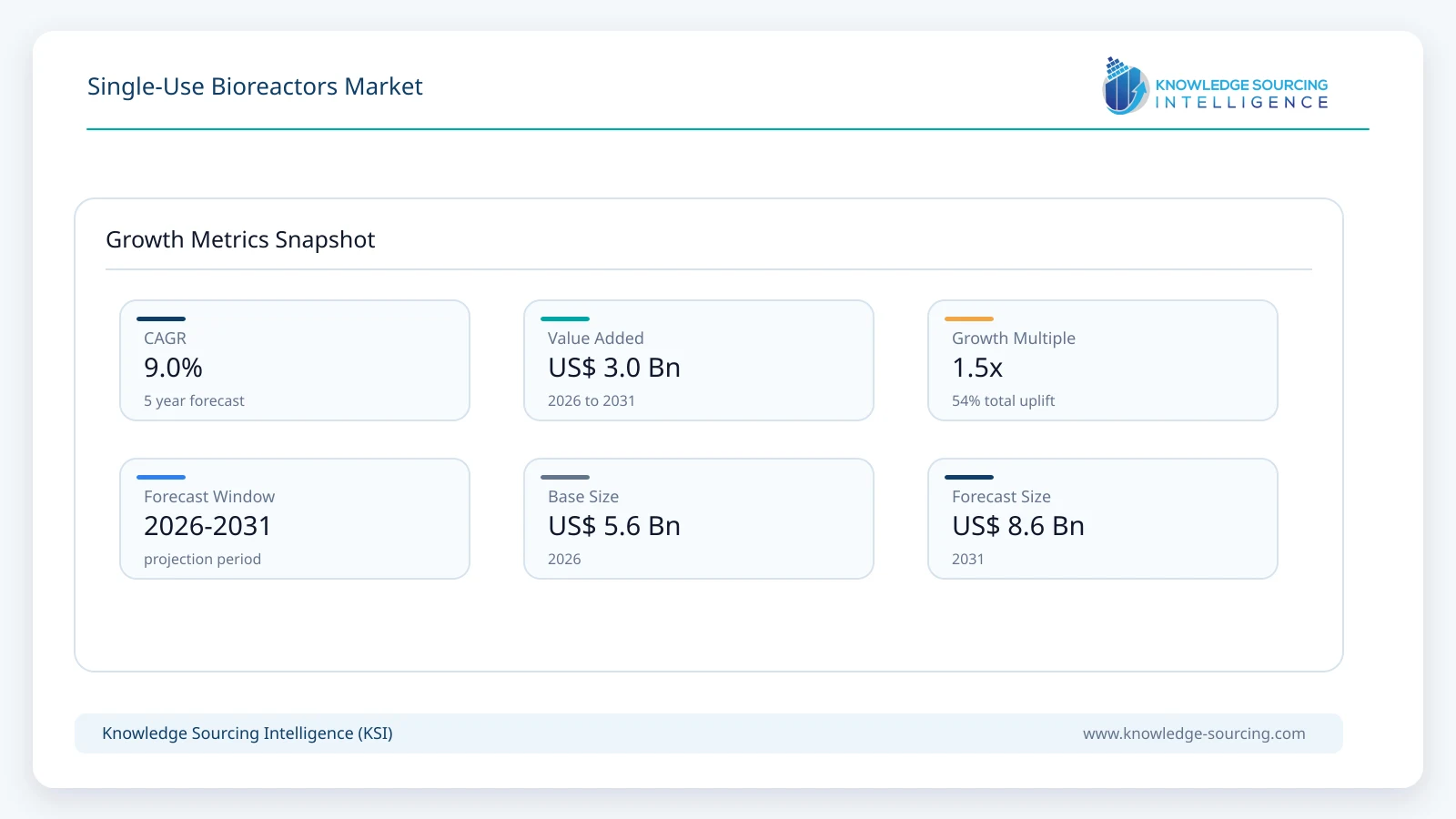
The single-use bioreactors market is estimated at USD 5.60 billion in 2026 and is forecast to reach approximately USD 8.60 billion in 2031, representing a CAGR of 9.0% during the forecast period.
Highlights:
- 1Consumables and accessories represent roughly 48% of 2026 market value through recurring replacement demand.
- 2Stirred-tank platforms account for approximately 68% of 2026 value across development and manufacturing.
- 3Pharmaceutical and biopharmaceutical companies contribute about 61% of 2026 single-use bioreactor demand.
- 4North America represents approximately 39% of 2026 market value, supported by commercial biologics capacity.
- 5Commercial single-use scale has expanded from 2,000 liters toward 5,000-6,000-liter production platforms.
The market covers disposable bioreactor systems, single-use vessels and associated assemblies, and dedicated sensing and control components used in upstream bioprocessing. Conventional stainless-steel bioreactors, standalone mixing systems, general cell-culture media, and downstream purification equipment are excluded unless supplied as an integral part of a single-use bioreactor platform.
Market Overview
Single-use bioreactors have moved from a process-development and clinical-manufacturing tool into a mainstream upstream platform for commercial biologics production. The economic proposition is no longer limited to avoiding clean-in-place and steam-in-place infrastructure. Buyers increasingly evaluate single-use systems on total facility utilization, batch changeover time, seed-train simplification, contamination risk, labor requirements, process intensification capability, consumable supply security, and the cost of locking a validated process into a specific bag, film, connector and sensor ecosystem.
The most important structural change is scale. Historically, 2,000 liters was widely treated as the practical ceiling for disposable stirred-tank manufacturing. Thermo Fisher now markets DynaDrive systems up to 5,000 liters, while WuXi Biologics has completed commercial process performance qualification using three 5,000-liter single-use bioreactors in Hangzhou. WuXi has also disclosed plans for six 6,000-liter single-use bioreactors at its Worcester, Massachusetts facility. Larger vessels reduce the number of parallel reactors and batches required for multi-ton biologics output, narrowing the economic gap with stainless steel in commercial-scale production.
Scale alone does not determine platform choice. High-cell-density fed-batch and perfusion processes increase oxygen-transfer, mixing and heat-removal requirements, making kLa performance, sparger design, turndown ratio and automation architecture commercially important. Sartorius has integrated XCell ATF technology into its Biostat STR Generation 3 platform and offers 50-2,000-liter Flexsafe STR configurations, while Thermo Fisher positions DynaDrive from 5 to 5,000 liters with designs optimized for fed-batch and perfusion. This shifts competition from simple vessel capacity toward performance consistency across the full development-to-commercial scale-up chain.
Single-use economics also create recurring supplier revenue. Unlike stainless-steel vessels, disposable bioreactor bags, tubing, connectors, filters and certain sensors are replaced between batches or campaigns. The installed hardware therefore becomes the entry point to a continuing consumables stream. For manufacturers, however, this same model creates supplier-switching friction because extractables and leachables packages, film compatibility, sterility assurance, connector configuration and process validation are tied to specific assemblies. Supply continuity and change-control discipline can therefore matter as much as the equipment purchase price.
Market growth strengthens through the period as commercial-scale installations expand, perfusion and intensified upstream processing increase the value of reactor-control packages, and cell and gene therapy manufacturing broadens the range of single-use vessel designs. Mature research-scale systems continue to grow more slowly, while recurring consumables and large-scale stirred-tank installations account for a rising portion of market value.
Single-Use Bioreactors Market Trends
5,000-6,000-Liter Systems Shift Single-Use Economics Toward Commercial Manufacturing
The capacity ceiling for disposable bioreactors is moving materially higher. WuXi Biologics completed the first commercial PPQ campaign at its Hangzhou line using three 5,000-liter single-use bioreactors, creating 15,000 liters of upstream capacity on one line and lifting total site capacity to 23,000 liters. WuXi reported that the associated process configuration reduced protein production cost per gram by nearly 70% and increased yield per batch by 20%. Those economics cannot be attributed to reactor size alone, but they demonstrate that large-volume single-use systems can support commercial-scale cost structures when paired with intensified process design. WuXi has separately disclosed a planned six-by-6,000-liter configuration in Massachusetts, showing that scale-out and scale-up are converging.
Turndown Ratio Is Becoming a Seed-Train Economics Metric
Single-use procurement is increasingly influenced by how many expansion steps a platform can eliminate before the production reactor. Thermo Fisher states that its DynaDrive platform can span 5 to 5,000 liters, with high turndown ratios allowing a 5,000-liter reactor to begin at approximately 250 liters. This can reduce the number of intermediate vessels, transfers and disposable assemblies used in seed expansion. Fewer transfer steps lower operator touchpoints and contamination exposure while reducing the amount of installed equipment required to support a production train.
Perfusion and Process Intensification Increase the Value of Controls and Mass Transfer
The commercial value of a single-use platform increasingly depends on whether it can support intensified cultures rather than simply replicate conventional fed-batch operation. Sartorius offers Biostat STR Generation 3 systems from 50 to 2,000 liters with integrated XCell ATF capability and intensified sparger options, while Distek supplies single-use bench reactors configured for perfusion workflows. Higher cell densities raise oxygen-transfer and CO2-stripping requirements and increase the value of advanced sparging, process analytical technology, automated feeding and integrated control software. This shifts part of market value from the disposable vessel itself toward sensors, automation and perfusion-ready configurations.
Cell Therapy Is Driving Alternative Mixing Geometries Below Conventional Commercial Volumes
Not every high-value application requires a 2,000-5,000-liter stirred tank. Cell therapies often require lower-shear environments and commercial scale-out rather than very large volume. PBS Biotech offers vertical-wheel single-use systems ranging through an 80-liter platform for commercial cell-therapy manufacturing, while ABEC introduced its Advanced Therapy Bioreactor in 2025 with 0.2-10-liter working volumes and a closed perfusion-ready architecture. The resulting market is bifurcating between large stirred-tank systems for high-volume biologics and specialized low-shear systems designed around fragile cells and advanced therapies.
Consumable Qualification Creates a Revenue Stream and a Switching Barrier
Disposable assemblies are replaced every batch, but they are not interchangeable commodities once a process reaches late clinical or commercial validation. Film composition, extractables and leachables data, gamma-sterilization compatibility, welding characteristics, connector geometry, sensor integration and bag integrity become part of the validated manufacturing package. A supplier change can therefore trigger engineering runs, comparability work and change-control documentation. This makes continuity of supply and long-term component availability commercially important and gives established platform suppliers recurring revenue beyond the initial hardware installation.
Segment Analysis
By Product Type - Consumables and Accessories
Consumables and accessories are estimated at approximately USD 2.69 billion in 2026, making them the largest product category. Single-use bags, tubing sets, sterile connectors, filters, sampling assemblies and other product-contact components are replaced after individual batches or manufacturing campaigns, producing recurring revenue that scales with reactor utilization rather than installed hardware alone. Once a commercial process is validated around a specific film and assembly configuration, switching suppliers can require additional qualification work, reinforcing the revenue durability of established consumable platforms.
By Bioreactor Type - Stirred-Tank Single-Use Bioreactors
Stirred-tank single-use bioreactors are estimated at approximately USD 3.81 billion in 2026. Their leading position reflects the ability to reproduce familiar stainless-steel process engineering principles while covering development, clinical and commercial manufacturing. Current portfolios span from benchtop volumes to 5,000 liters, with vendors competing on turndown ratio, oxygen-transfer capability, mixing time, sparger design, automation and perfusion compatibility. The category benefits particularly from monoclonal antibodies and recombinant proteins, where established stirred-tank process knowledge can be transferred into disposable manufacturing architectures.
By End-User - Pharmaceutical and Biopharmaceutical Companies
Pharmaceutical and biopharmaceutical companies are estimated to contribute approximately USD 3.42 billion of 2026 demand. Large developers increasingly use single-use systems not only for process development and clinical production but also for commercial manufacturing where product portfolios require frequent changeover or flexible capacity allocation. The technology is particularly attractive for multi-product facilities because each batch begins with a new sterile product-contact path, reducing cleaning validation requirements and shortening transitions between campaigns.
By Geography - North America
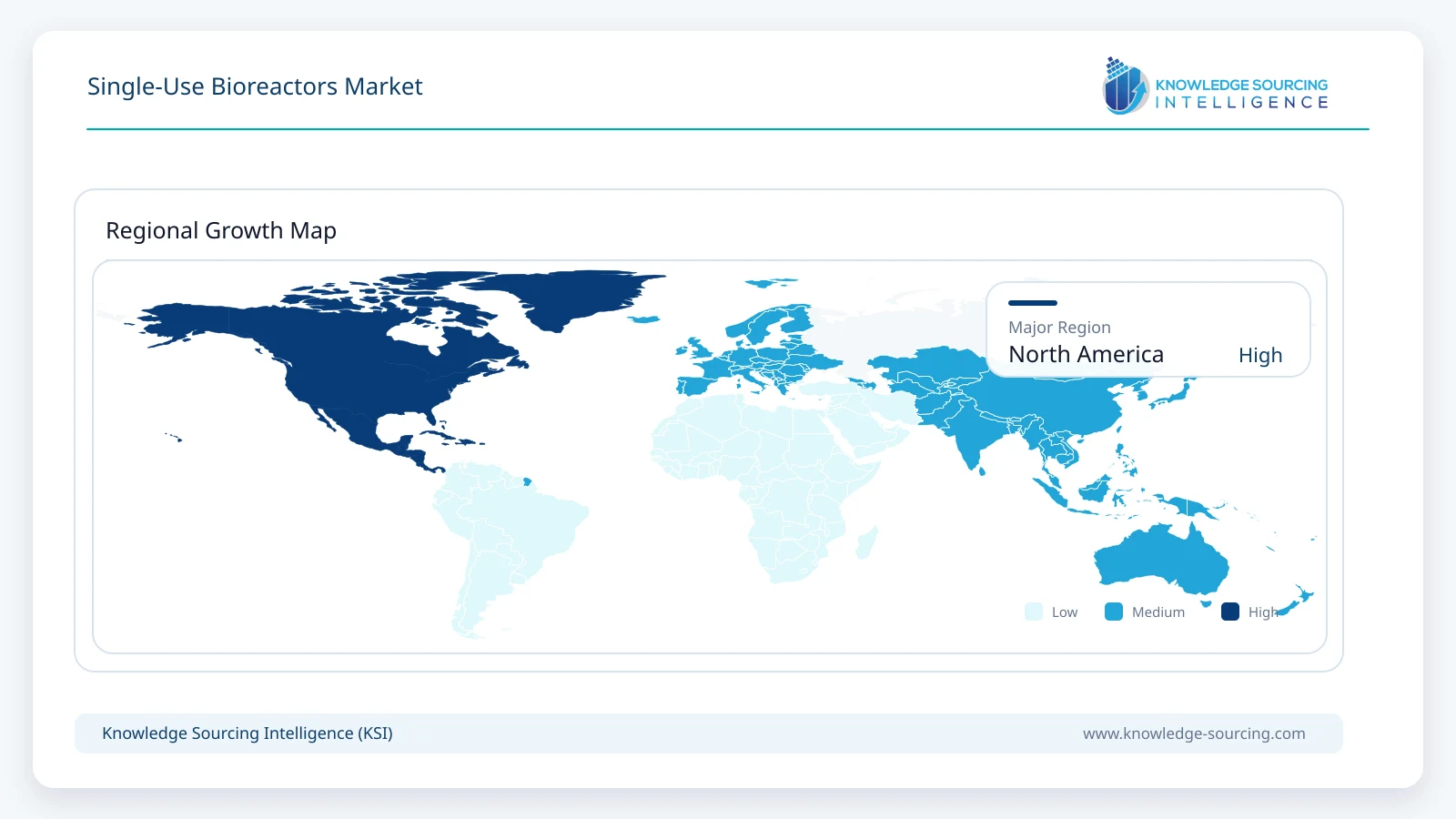
North America is estimated at approximately USD 2.18 billion in 2026. The region combines a large installed base of biologics manufacturing, a dense biotechnology pipeline, major CDMO capacity and early adoption of intensified upstream processing. Commercial investment is also moving toward very large single-use facilities: WuXi Biologics has disclosed plans for a Worcester, Massachusetts site with six 6,000-liter single-use bioreactors, while major platform suppliers including Thermo Fisher, Cytiva, Sartorius and Merck maintain substantial technical and customer-support footprints in the region.
Market Drivers
Commercial biologics manufacturing is extending single-use adoption beyond development and clinical production.
Larger 5,000-6,000-liter reactors reduce batch count and widen the addressable commercial production range.
Perfusion and high-cell-density processing increase demand for mass-transfer, sensing and automation capabilities.
Multi-product facilities benefit from faster batch changeovers and reduced cleaning-validation requirements.
Cell and gene therapy manufacturing expands demand for specialized low-shear and scale-out bioreactor designs.
Market Restraints
Recurring bag and assembly purchases can increase operating cost at high-volume, long-duration production scales.
Film, connector and sensor qualification creates supplier dependence and complicates late-stage component changes.
Plastic waste remains a visible sustainability issue despite lower cleaning-water and steam requirements.
Very high cell densities place demanding requirements on oxygen transfer, mixing and heat removal.
Supply interruptions in sterile assemblies can constrain production because validated substitutes are not always interchangeable.
Competitive Environment
Competition increasingly separates into three groups: global bioprocess-platform suppliers, specialized reactor manufacturers, and advanced-therapy specialists. Sartorius, Thermo Fisher Scientific, Cytiva and Merck Life Science compete across broad upstream portfolios that combine vessels, consumables, process controls and technical support. Eppendorf and Getinge Applikon are particularly visible in development and smaller-scale GMP workflows, while ABEC has pushed large-volume custom single-run systems and newer advanced-therapy architectures. PBS Biotech differentiates around vertical-wheel technology for cell therapy, and Distek targets flexible benchtop and microbial single-use applications.
Scale and ecosystem breadth are increasingly difficult to separate. Thermo Fisher markets DynaDrive from 5 to 5,000 liters and emphasizes common design principles across development and manufacturing. Sartorius combines Biostat STR hardware with Flexsafe bags, Biobrain automation and integrated perfusion capability. Merck offers Mobius systems through 2,000 liters, including newer iFlex configurations for fed-batch and perfusion. Getinge markets the AppliFlex ST family from 500 mL to 15 liters, including GMP configurations. Competitive differentiation therefore depends not only on the reactor vessel but on the validated consumable supply chain, software environment, service coverage, scale-up data and ease of technology transfer.
Recent Developments
April 2026: Distek expanded commercial coverage for its BIOne single-use bioreactor and fermentor portfolio across the U.S. West Coast through Optimal Biotech Group.
April 2025: WuXi Biologics completed commercial PPQ on three 5,000-liter single-use bioreactors at MFG20 in Hangzhou, creating a 15,000-liter production line.
March 2025: ABEC launched the Advanced Therapy Bioreactor, a closed perfusion-ready single-use system designed for sensitive advanced-therapy cell expansion.
January 2025: PBS Biotech secured USD 17 million in growth capital and announced manufacturing expansion intended to support more than USD 100 million in annual revenue capacity.
2025: Thermo Fisher expanded the DynaDrive platform to a 5-liter benchtop system using the same design approach and film family as larger commercial-scale systems.
Market Outlook
Single-use bioreactors are expected to become more deeply embedded in commercial biomanufacturing through 2031 rather than remaining primarily a flexible alternative for clinical production. Large stirred-tank systems will expand the commercial-scale addressable market, while perfusion and process intensification will increase the value of sensors, controls and mass-transfer engineering. At the same time, cell and gene therapy will sustain demand for smaller specialized geometries. The most defensible supplier positions will combine validated consumables, reliable global supply, broad scale-up data, integrated automation and long-term component continuity rather than competing on reactor hardware alone.
Single-Use Bioreactors Market Scope
| Report Metric | Details |
|---|---|
| Total Market Size in 2026 | USD 5.60 billion |
| Total Market Size in 2031 | USD 8.60 billion |
| Forecast Unit | Billion |
| Growth Rate | 9.0% |
| Study Period | 2021 to 2031 |
| Historical Data | 2021 to 2024 |
| Base Year | 2025 |
| Forecast Period | 2026 – 2031 |
| Segmentation | Product Type, Bioreactor Type, End-User, Geography |
| Companies |
|
Market Segmentation
By Product Type
Single-Use Bioreactor Systems
Consumables and Accessories
Sensors and Control Systems
By Bioreactor Type
Stirred-Tank Single-Use Bioreactors
Rocking-Motion Bioreactors
Air-Lift and Pneumatic Bioreactors
Vertical-Wheel and Other Specialized Systems
By End-User
Pharmaceutical and Biopharmaceutical Companies
Contract Development and Manufacturing Organizations
Academic and Research Institutes
Others
By Geography
North America
United States
Canada
Mexico
South America
Brazil
Argentina
Others
Europe
Germany
United Kingdom
France
Switzerland
Ireland
Others
Middle East and Africa
Saudi Arabia
UAE
South Africa
Others
Asia Pacific
China
India
Japan
South Korea
Singapore
Others
Table of Contents
1. INTRODUCTION
1.1. Market Overview
1.2. Market Definition and Scope
1.3. Currency and Assumptions
2. RESEARCH METHODOLOGY
2.1. Secondary Research
2.2. Company and Product Validation
2.3. Market Estimation
3. EXECUTIVE SUMMARY
3.1. Key Findings
3.2. Global Market Size, 2026-2031
4. MARKET DYNAMICS
4.1. Market Drivers
4.2. Market Restraints
4.3. Scale-Up and Process-Intensification Economics
4.4. Consumable Supply and Qualification Dynamics
4.5. Sustainability and Waste Considerations
5. SINGLE-USE BIOREACTORS MARKET BY PRODUCT TYPE
5.1. Single-Use Bioreactor Systems
5.2. Consumables and Accessories
5.3. Sensors and Control Systems
6. SINGLE-USE BIOREACTORS MARKET BY BIOREACTOR TYPE
6.1. Stirred-Tank Single-Use Bioreactors
6.2. Rocking-Motion Bioreactors
6.3. Air-Lift and Pneumatic Bioreactors
6.4. Vertical-Wheel and Other Specialized Systems
7. SINGLE-USE BIOREACTORS MARKET BY END-USER
7.1. Pharmaceutical and Biopharmaceutical Companies
7.2. Contract Development and Manufacturing Organizations
7.3. Academic and Research Institutes
7.4. Others
8. SINGLE-USE BIOREACTORS MARKET BY GEOGRAPHY
8.1. North America
8.1.1. United States
8.1.2. Canada
8.1.3. Mexico
8.2. South America
8.2.1. Brazil
8.2.2. Argentina
8.2.3. Others
8.3. Europe
8.3.1. Germany
8.3.2. United Kingdom
8.3.3. France
8.3.4. Switzerland
8.3.5. Ireland
8.3.6. Others
8.4. Middle East and Africa
8.4.1. Saudi Arabia
8.4.2. UAE
8.4.3. South Africa
8.4.4. Others
8.5. Asia Pacific
8.5.1. China
8.5.2. India
8.5.3. Japan
8.5.4. South Korea
8.5.5. Singapore
8.5.6. Others
9. COMPETITIVE ENVIRONMENT AND ANALYSIS
9.1. Platform and Consumable Ecosystems
9.2. Large-Scale Single-Use Competition
9.3. Advanced-Therapy Bioreactor Positioning
9.4. Automation, Sensors and Perfusion Integration
10. COMPANY PROFILES
10.1. Sartorius AG
10.2. Thermo Fisher Scientific Inc.
10.3. Cytiva
10.4. Merck KGaA
10.5. Eppendorf SE
10.6. Getinge AB
10.7. ABEC, Inc.
10.8. PBS Biotech, Inc.
10.9. Distek, Inc.
10.10. Cellexus International Ltd.
10.11. Celltainer Biotech BV
10.12. Solaris Biotech Solutions
10.13. Esco Aster Pte. Ltd.
11. APPENDIX
11.1. Market Definition and Exclusions
11.2. Assumptions
11.3. Abbreviations
Navigate
Trusted by the world's leading organizations











