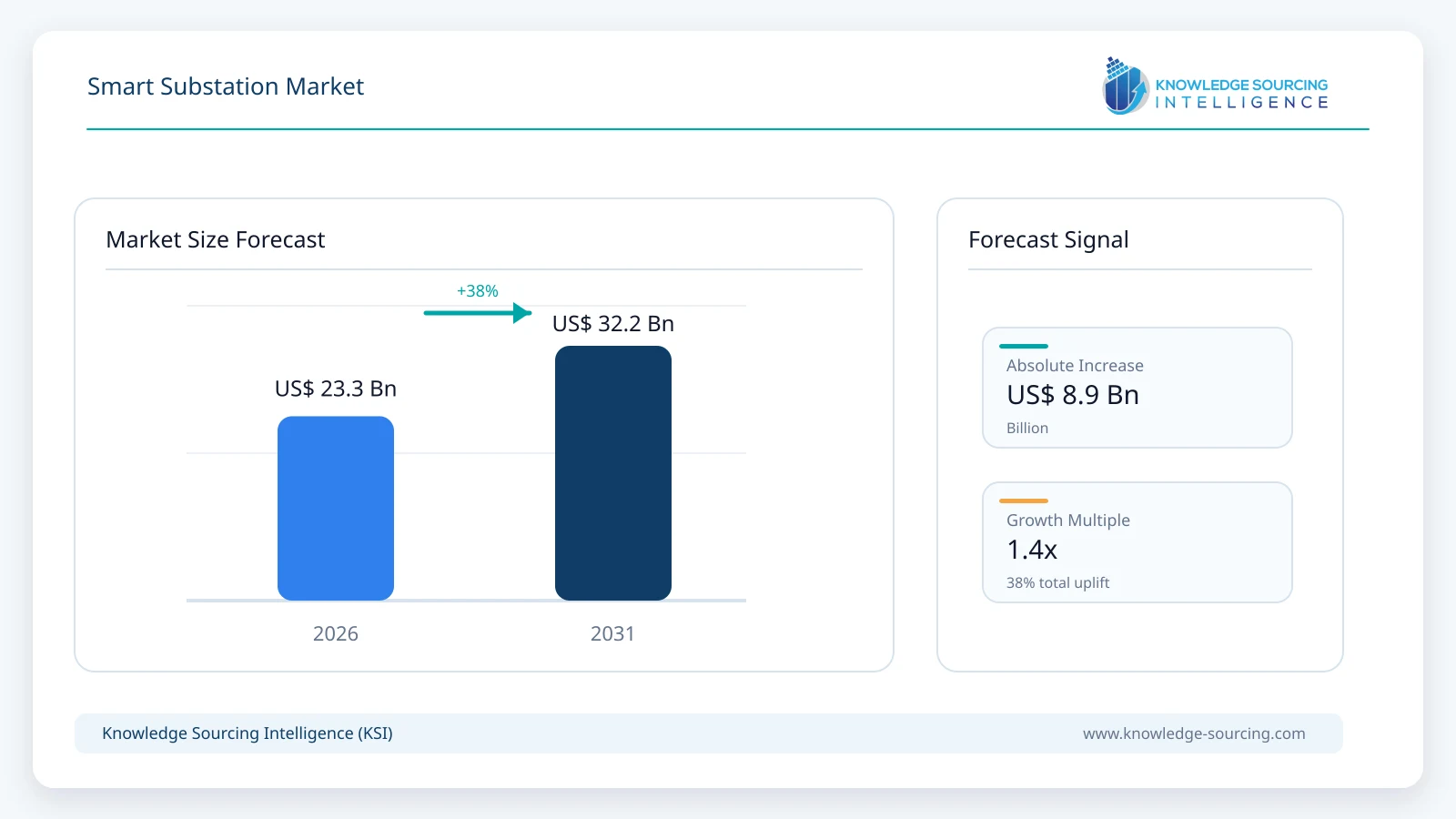
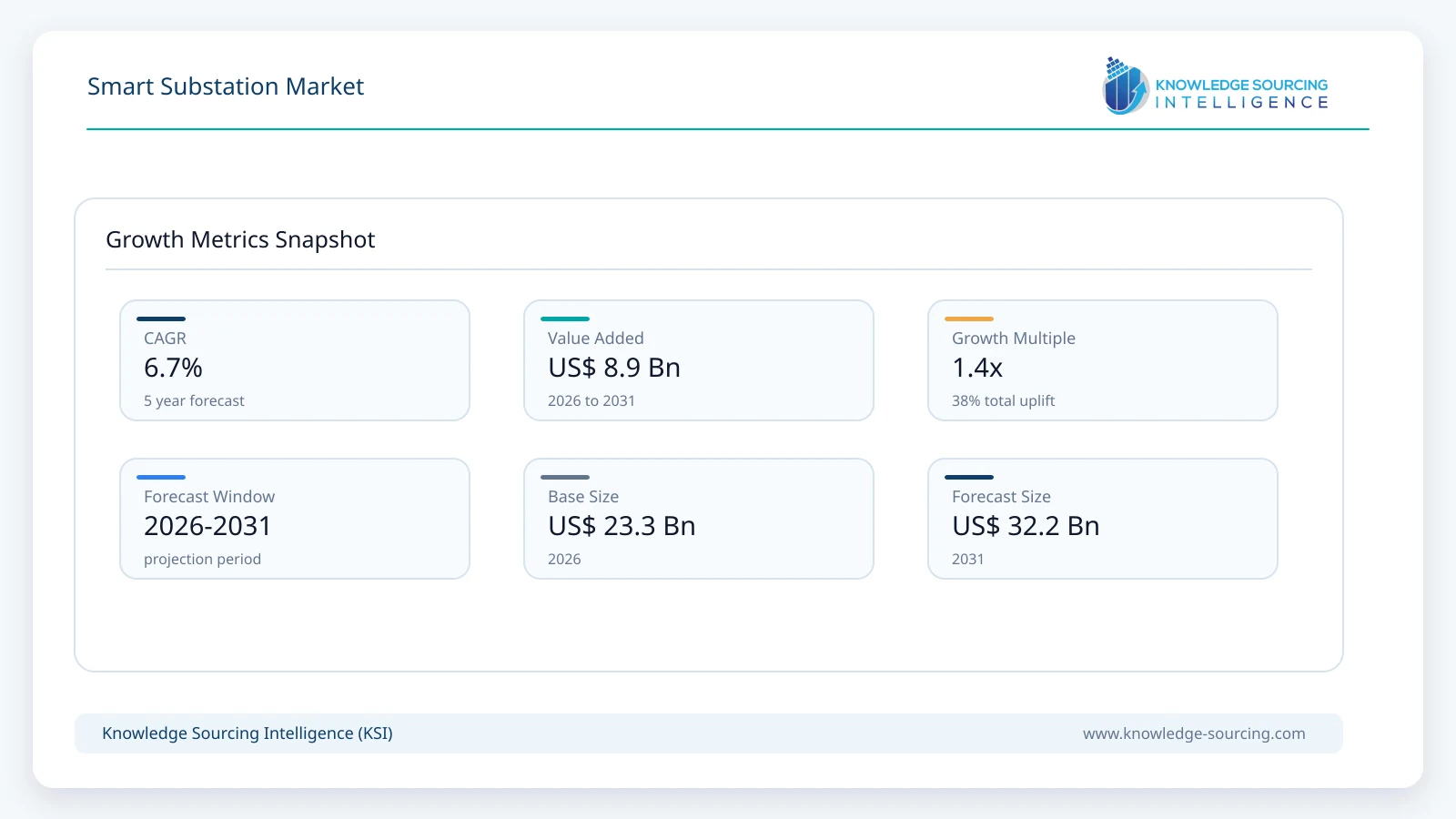
The Smart Substation Market is projected to increase from USD 23.3 billion in 2026 to USD 32.2 billion by 2031, growing at a CAGR of 6.7%.
Highlights:
- 1The rising digitalization occurring in distribution substations, supported by distributed generation, batteries, EVs, and flexible loads that facilitates bidirectional power flows.
- 2More demand for high-speed protection, synchronization, monitoring, and grid-connection control is increasing because of this renewable energy integration.
- 3Utilities continue to be the leading end-user industry, as they own a large number of transmission and distribution substations.
- 4Data centers are becoming a high-value application, as they require robust, fully monitored, and quickly controllable electrical infrastructure.
A smart substation is an electricity substation that is equipped with digital protection, automation, sensing technology, communication technology, and monitoring and control equipment for real-time data transfer between systems and some levels of automated operational decisions. In contrast to conventional substations, which depend greatly on hardwired signals and localized manual intervention, smart substations use IEDs, numerical protection relays, process-level sensors, Ethernet-based communication links, SCADA/HMI systems, remote terminal units (RTUs), gateways, as well as analytics platforms.
Its architecture generally runs on process, bay, and station levels. Electrical signals are picked up at the process level via equipment, while protection and control are done through bay-level IEDs. The systems at the station level collect and integrate information, automate processes, manage operator interfaces, and serve as a communication channel to control-center systems. IEC 61850 is emerging as the major communication and interoperability standard for these architectures. According to Hitachi Energy, the IEC 61850 process bus is key to the digital substation, whereas ABB offers centralized, virtualized protection & control based on IEC 61850.
Smart substations are also increasingly being utilized in conjunction with the integration of renewable energy. Generation from solar and wind sources presents challenges of uncertainty in power flows, necessitating rapid measurement, monitoring, and control at the interconnection point to the grid. There is an increased demand for more responsive operations at substations from battery storage, EV charging, data centers, and industrial loads also in the mix.
The market consists of hardware, software, and services. Hardware includes protection relays, IEDs, sensors, merging units, communication equipment, switchgear, RTUs, and gateways & control systems. Application software comprises SCADA, HMI, asset monitoring, condition analytics, engineering tools, digital twin application, and cybersecurity software platforms. Engineering, system integration, commissioning, retrofit, maintenance, and support services, including cybersecurity and lifecycle management, are part of the services.
Market Dynamics
Market Drivers
Growing grid congestion and the need for real-time substation visibility: The growing grid congestion is leading to an increase in electricity demand, with renewable generation, storage, and large loads continuing to expand. Globally, over 2,500 GW of renewable, storage, and large-load projects await grid connections in the queues. Additionally, grid operators are exploring technologies that can make better use of the current infrastructure. Continuous measurements of voltage, current, frequency, loading, equipment condition, and network status are provided by smart substations. With digital monitoring, operators can detect abnormal operating conditions sooner than traditional periodic inspection. Instead of relying on the need for field crews to conduct routine switching and operations, D2 remotely accomplishes these tasks.
Increasing renewable energy integration: Solar and wind generation are introducing greater variability, whose magnitude is constrained by the nature of those networks and which results in higher power flow across transmission or distribution nodes. Renewable power plants demand stable substations facilitating grid connection, protection, synchronization, as well as voltage control and power- quality enhancement. Further, smart substations are designed to facilitate more rapid information exchange between the renewable generation assets and operators of our power grid. Digital protection systems may adapt quickly to the changing fault and operating conditions. Interoperability between protection and control devices via IEC 61850 communication in substations adds an additional layer of controllable generation and demand in the form of battery energy storage.
Aging infrastructure and grid modernization at substations: electricity networks are substations based on legacy electromechanical or early-generation digital equipment. Gradual replacement of protective and control elements increases maintenance needs while limiting far-off tracking capabilities. The replacement of the legacy equipment with IEDs and implementing digital communication improve operational visibility without having to completely rebuild the substation. The accelerating digital technologies are permitting law utilities to turn from conventional architectures step by step. An example is ABB's EDCS-AC500 platform with an AC500 embedded controller designed for IEC 61850-based modernization initiatives for existing and aging infrastructure.
Increasing electricity demand due to data centers and electrification: Global electricity demand is expected to grow at a compound annual growth rate (CAGR) of 3.6 percent between 2026 and 2030 according to IEA Modeling. This is being fueled by data centers, EVs, industrial electrification, and applications requiring more electricity, such as air conditioning. Data centers need electrical infrastructure with rapid fault detection and many monitoring points very reliably. With smart substations, transformers, switchgear, breakers, and protection systems, electrical loading can be monitored continuously.
Market Restraints & Opportunities
The deployment of smart substations needs investment in a variety of components, including digital relays, communication infrastructure, sensors, gateways, software, and cybersecurity, especially for engineering and testing.
Legacy substations can be more complex to retrofit with existing components. However, utilities are usually responsible for not interrupting electricity even when planning to modernize infrastructure. That may prompt smaller utilities to invest in incremental upgrades rather than a full digital-substation overhaul.
Large installed bases of conventional substations are being modernized in parallel fashion, which is offering opportunities for smart substations. Instead of building whole new substations, utilities can progressively upgrade protection, communications, monitoring, and control systems. This opens up business prospects for system integrators, automation vendors, cybersecurity vendors, and engineering-service companies.
Key Developments
May 2026: Huawei, CIGRE, and Zhuhai Unitech Power Technology discussed an Intelligent Power Substation Solution for Sub-Saharan Africa at Enlit Africa 2026. It included a substation inspection, monitoring, and analysis solution that integrates intelligent video with AI algorithms, secure wireless networks, and digital sensing for automated meter reading on substations.
Smart Substation Market Segmentation
The market is segmented by component, substation type, application, end user, and geography.
By Component
Hardware
It is expected that hardware will remain the dominating component segment for smart substations due to the necessity of physical protection, measurement, and switching, as well as communication and control equipment in every smart substation.
The hardware ecosystem of IEDs, numerical protection relays, RTUs, merging units, and sensors for communicating with the gateways, communication switches to relay commands from there to circuit breakers, switchgear, and transformers that help protect infrastructure at the power generation level, and substation controllers. More specifically, digital substations tend to replace conventional hardwired architectures with networked equipment that can share information through IEC 61850.
Solutions include centralized protection and control, digital-substation gateways, Relion protection products, or IEC 61850-enabled solutions. Likewise, Hitachi Energy has IEDs, automation systems, protection and control solutions, and digital-substation technologies.
By Substation Type
Distribution Substations
Because distribution is changing fast, the capacity to manage power flows and asset visibility requirements well, distribution substations will likely be the largest segment by substation type.
According to the IEA, distribution is the segment with the biggest digitalization gap. With distributed solar, batteries, EVs, and fitting flexible demand, this is shifting unidirectional networks into much more complex living structures. Thus, ADMS, DERMS, smart meters, automation, and remotely controlled assets are increasingly important.
For example, ABB's ReliaGrid digital-substation portfolio supports centralized protection, control, gateways, and monitoring for distribution substations that are IEC 61850-based. At Schneider Electric, IEDs are integrated with SCADA/HMI and communications for substation automation.
By Application
Power Distribution
Power distribution is likely to remain the leading application because there are a large number of substations in the distribution network, which also increasingly includes distributed energy resources (DER), EV charging, changing load profiles, and reliability needs.
The smart distribution substation provides real-time visibility of feeders, transformers, breakers, voltage and current, and even power quality. Automated protection and switching can also make fault isolation and restoration faster. For instance, Eaton's grid automation portfolio combines smart apparatus, sensors, controls, communications, and enterprise software for distribution-grid modernization.
Regional Analysis
North America Market Analysis
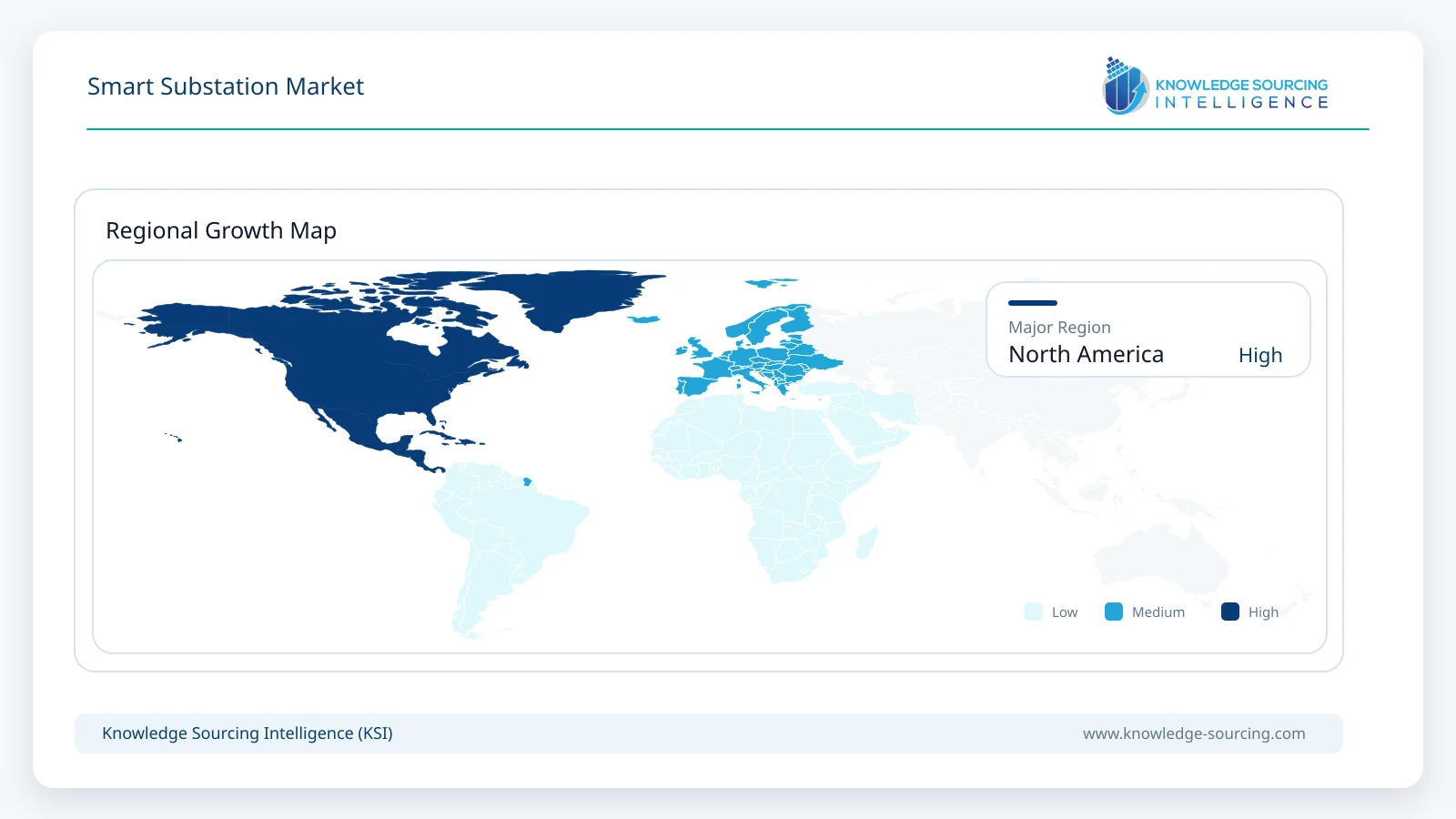
North America accounts for a large market share for smart substations owing to focus on reliability requirements, renewable integration, and utility modernization programs. The United States is paying increasing attention to strengthening grid resiliency to accommodate new loads consuming more electricity. As a result, digital protection, substation automation, SCADA modernization, cybersecurity, and asset monitoring are all emerging as key investment categories. Additionally, regional data centres are generating more demand for highly reliable electrical infrastructure.
South America Market Analysis
In South America, utilities are moving slowly towards containing their smart-substation deployment while modernizing transmission and distribution networks alongside renewable generation integration. Brazil has one of the largest electricity networks in the world as well as a rapidly expanding renewable-energy base, and is seen as an important market. The generation profile of hydropower, wind, and solar is creating demands around grid interconnection reliability and monitoring of dispersed assets.
Europe Market Analysis
Europe is an important smart-substation market because the region is moving quickly toward a transition to renewables while also contending with grid congestion, lagging infrastructure, and energy-system flexibility. Investments in digital monitoring and automated control, advanced protection, and network-management technologies are ramping up as transmission and distribution operators strive for higher performance improvements. Interoperability, cybersecurity, and standardized digital communication are also areas of focus for the region.
Middle East and Africa Market Analysis
Electricity-demand growth, grid expansion, renewable-energy development, and modernization of existing electricity infrastructure support the Middle East & Africa market. Gulf countries are focusing on massive power generation, transmission, and industrial projects, leaving the avenue for high-capacity and digitally monitored substations. The growth of renewable-energy projects is also boosting demand for smart grid-connection systems.
Asia Pacific Market Analysis
Asia Pacific is forecast to continue being one of the fastest-growing areas attributable to electrical energy–demand growth, substantial renewable power additions, urbanization, industrial growth, and various grid-development packages. China and India already have a significant regional demand because of their vast electricity networks and ongoing investment in transmission and distribution infrastructure. In addition to meeting reliability and integrating renewables and energy-efficiency requirements in Japan and South Korea, they are also developing solutions like digital-grid technologies.
List of Companies
ABB
Hitachi Energy
Siemens Energy
GE Vernova
Schneider Electric
Eaton Corporation
Schweitzer Engineering Laboratories, Inc.
Mitsubishi Electric
Cisco
VITAL Infraa
ABB
ABB offers digital-substation protection, control, automation, monitoring, and communication technologies. It offers digital-substation solutions under the ReliaGrid brand, centralized and virtualized protection and control under the SSC600 brand, Relion protection relays, substation automation based on COM600, and ABB Ability/zenon-based control solutions.
Hitachi Energy
Hitachi Energy is a leading global provider of substation automation solutions and services, digital substations, protection and control technology, process-bus technologies meeting the demands of IEC 61850-based architectures for modern substations, substation grid automation services and complete grid automation systems. The portfolio caters to utilities, renewable-energy projects, transportation, data centers and industrial facilities.
GE Vernova
GE Vernova offers products such as DS Agile Digital Control Systems, modular substation automation systems, integrated substation control systems, protection and control solutions, monitoring and diagnostics, and software-defined automation from GridBeats. Its segments include transmission and distribution, renewable generation, data centers, and industrial.
Analyst View
Smart Substation Market is evolving from equipment-centric narrow automation to a more integrated digital infrastructure that brings together protection, communications, software, analytics, and even cybersecurity. Adoption is being driven by factors such as distribution substations, renewable integration, and utility modernization, while centralized protection, IEC 61850, predictive analytics, and AI are shaping the next evolution of Intelligent substation architectures.
Smart Substation Market Scope:
| Report Metric | Details |
|---|---|
| Total Market Size in 2026 | USD 23.3 billion |
| Total Market Size in 2031 | USD 32.2 billion |
| Forecast Unit | USD Billion |
| Growth Rate | 6.7% |
| Study Period | 2021 to 2031 |
| Historical Data | 2021 to 2024 |
| Base Year | 2025 |
| Forecast Period | 2026 – 2031 |
| Segmentation | Component, Substation Type, Application, End User, Geography |
| Companies |
|
Market Segmentation
By Component
Hardware
Software
Services
By Substation Type
Transmission Substations
Distribution Substations
Mobile Substations
Others
By Application
Power Transmission
Power Distribution
Renewable Energy Integration
Grid Modernization
Urban Power Systems
Others
By End User
Utilities
Independent Power Producers (IPPs)
Renewable Energy Developers
Industrial Facilities
Data Centers
Railways & Transportation
Others
By Geography
North America
USA
Canada
Mexico
South America
Brazil
Argentina
Others
Europe
United Kingdom
Germany
France
Italy
Others
Middle East and Africa
Saudi Arabia
UAE
Others
Asia Pacific
China
Japan
India
South Korea
Australia
Others
Table of Contents
1. EXECUTIVE SUMMARY
2. MARKET SNAPSHOT
2.1. Market Overview
2.2. Market Definition
2.3. Scope of the Study
2.4. Market Segmentation
3. MARKET DYNAMICS
3.1. Market Drivers
3.2. Market Restraints
3.3. Market Opportunities
3.4. Porter’s Five Forces Analysis
3.5. Industry Value Chain Analysis
4. BUSINESS LANDSCAPE
4.1. Regulatory, Grid Codes & Substation Standards Landscape
4.2. Smart Substation Equipment Manufacturing & Technology Ecosystem
4.3. Smart Substation Equipment, Components & Technology Supply Chain Analysis
4.4. Import/Export Analysis
.5. Strategic Recommendations
5. TECHNOLOGICAL OUTLOOK
5.1. Digital Substation & Process-Bus Technologies
5.2. Advanced Protection, Control & Intelligent Electronic Device Technologies
5.3. Smart Monitoring, Sensing & Condition-Monitoring Technologies
5.4. AI, Digital Twin, Edge Computing & Predictive Maintenance Technologies
5.5. Cybersecurity, Communication & Grid-Connected Smart Substation Technologies
6. SMART SUBSTATION MARKET BY COMPONENT
6.1. Introduction
6.2. Hardware
6.3. Software
6.4. Services
7. SMART SUBSTATION MARKET BY SUBSTATION TYPE
7.1. Introduction
7.2. Transmission Substations
7.3. Distribution Substations
7.4. Mobile Substations
7.5. Others
8. SMART SUBSTATION MARKET BY APPLICATION
8.1. Introduction
8.2. Power Transmission
8.3. Power Distribution
8.4. Renewable Energy Integration
8.5. Grid Modernization
8.6. Urban Power Systems
8.7. Others
9. SMART SUBSTATION MARKET BY END USER
9.1. Introduction
9.2. Utilities
9.3. Independent Power Producers (IPPs)
9.4. Renewable Energy Developers
9.5. Industrial Facilities
9.6. Data Centers
9.7. Railways & Transportation
9.8. Others
10. SMART SUBSTATION MARKET BY GEOGRAPHY
10.1. Introduction
10.2. North America
10.2.1. USA
10.2.2. Canada
10.2.3. Mexico
10.3. South America
10.3.1. Brazil
10.3.2. Argentina
10.3.3. Others
10.4. Europe
10.4.1. United Kingdom
10.4.2. Germany
10.4.3. France
10.4.4. Italy
10.4.5. Others
10.5. Middle East and Africa
10.5.1. Saudi Arabia
10.5.2. UAE
10.5.3. Others
10.6. Asia Pacific
10.6.1. China
10.6.2. Japan
10.6.3. India
10.6.4. South Korea
10.6.5. Australia
10.6.6. Others
11. COMPETITIVE ENVIRONMENT AND ANALYSIS
11.1. Major Players and Strategy Analysis
11.2. Market Share Analysis
11.3. Mergers, Acquisitions, Agreements, and Collaborations
11.4. Competitive Dashboard
12. COMPANY PROFILES
12.1. ABB
12.2. Hitachi Energy
12.3. Siemens Energy
12.4. GE Vernova
12.5. Schneider Electric
12.6. Eaton Corporation
12.7. Schweitzer Engineering Laboratories, Inc.
12.8. Mitsubishi Electric
12.9. Cisco
12.10. VITAL Infraa
13. APPENDIX
13.1. Currency
13.2. Assumptions
13.3. Base and Forecast Years Timeline
13.4. Key benefits for the stakeholders
13.5. Research Methodology
13.6. Abbreviations
Navigate
Trusted by the world's leading organizations