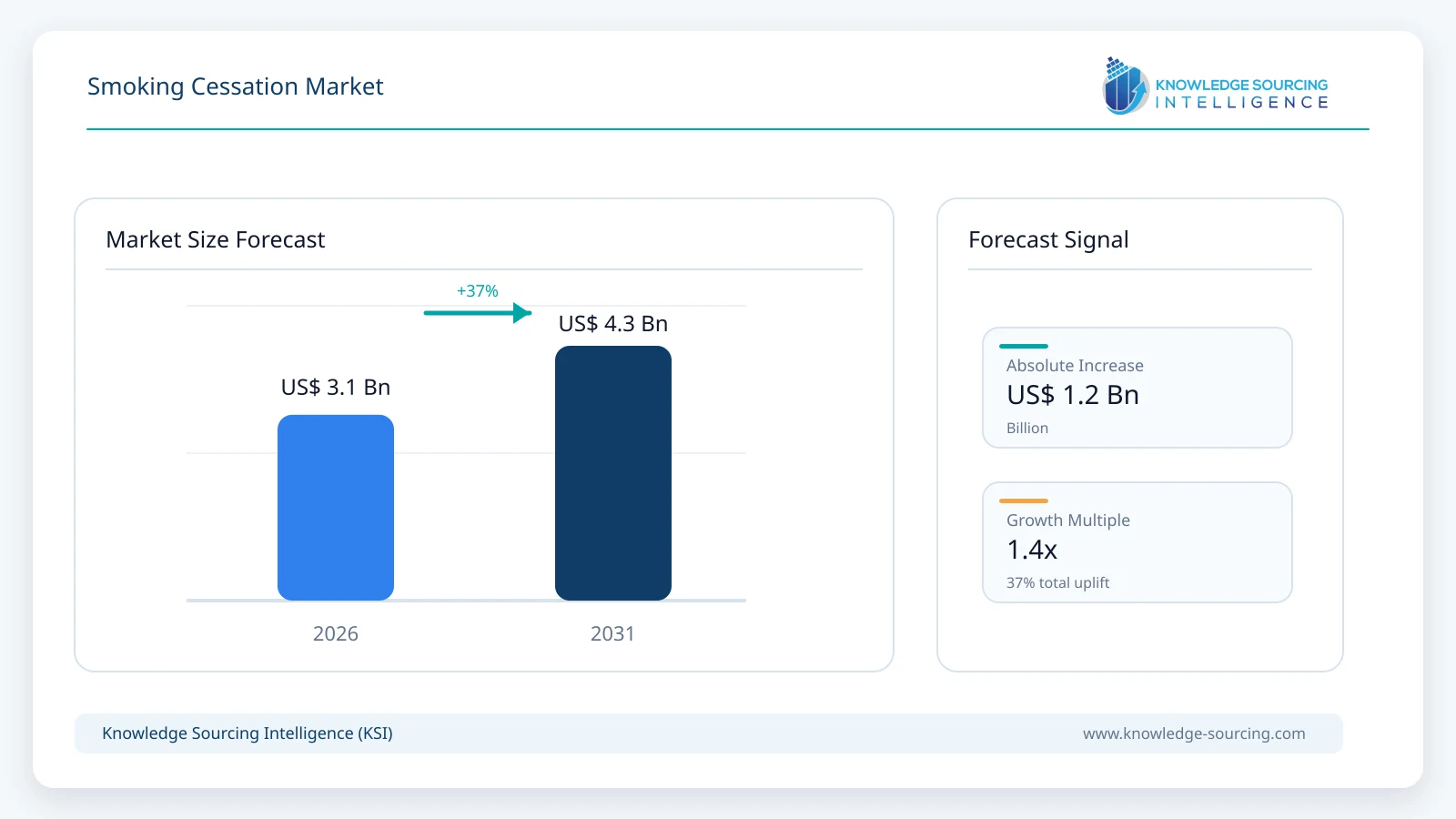
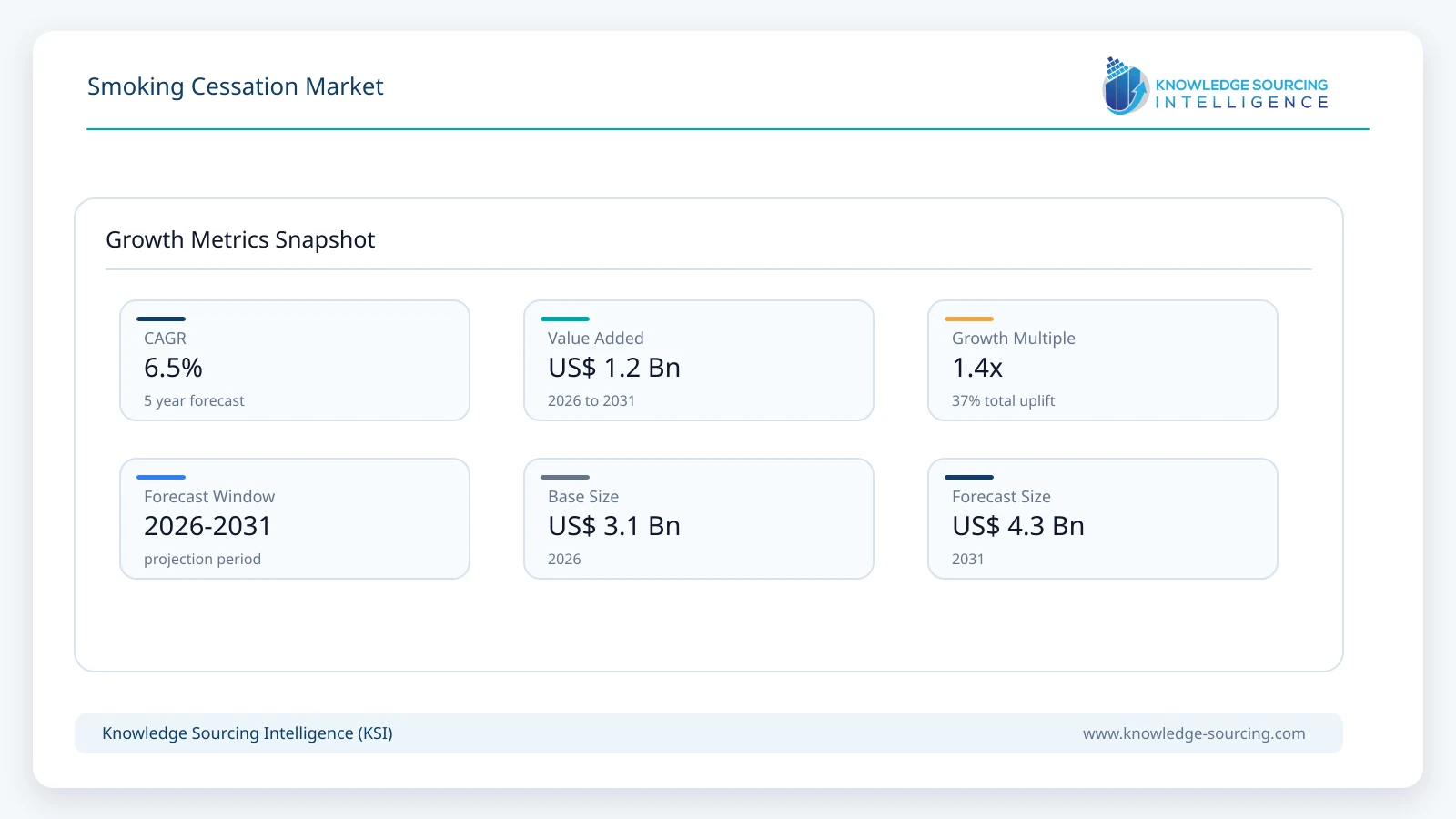
The global smoking cessation market is estimated at USD 3.15 billion in 2026 and is projected to reach USD 4.32 billion by 2031, growing at a CAGR of 6.5% during the forecast period.
Highlights:
- 1Nicotine replacement therapy accounts for about 81% of estimated 2026 market revenue.
- 2Non-nicotine pharmacotherapy is expected to outgrow NRT through broader generic and cytisine access.
- 3WHO treatment guidance strengthens the clinical basis for four established pharmacological cessation approaches.
- 4OTC access keeps gum, patches and lozenges central to global cessation-product demand.
- 5E-cigarettes and nicotine pouches are excluded from the therapeutic smoking-cessation market scope.
Market Overview
The smoking cessation market covers medicines and regulated nicotine-replacement products used to help adults stop tobacco use. The scope includes nicotine gum, patches, lozenges, oral sprays and inhalers; prescription varenicline and bupropion; and cytisine/cytisinicline medicines sold in markets where they are authorized. Ordinary e-cigarettes, nicotine pouches, combustible-tobacco substitutes, behavioural-counselling fees, digital coaching services, and unapproved wellness products are excluded from market revenue. This definition aligns the study with clinically recognized pharmacological cessation treatment rather than the broader nicotine-products market.
The market is estimated at USD 3.15 billion in 2026 and is projected to reach USD 4.32 billion by 2031, representing a CAGR of approximately 6.5%. Nicotine replacement therapy remains the commercial core because it combines OTC access, multiple dose formats, established brands and extensive private-label availability. Non-nicotine pharmacotherapy is smaller but is expected to expand faster as generic varenicline broadens access, cytisine/cytisinicline gains wider regulatory and clinical acceptance, and health systems place greater emphasis on evidence-based cessation support.
The demand base remains substantial despite declining smoking prevalence. WHO estimated 1.2 billion tobacco users worldwide in 2024, while its first clinical tobacco-cessation guideline recommends nicotine replacement therapy, varenicline, bupropion and cytisine as effective pharmacological treatments. Commercial demand is therefore shaped not only by the number of tobacco users, but also by quit-attempt frequency, healthcare access, reimbursement, OTC availability, treatment adherence, pricing and national cessation programmes.
Market Drivers
Large population seeking to quit tobacco
The core demand pool remains very large even as global tobacco use declines. WHO reported that tobacco users fell from 1.38 billion in 2000 to 1.2 billion in 2024, but one in five adults globally still uses tobacco. Earlier WHO cessation guidance noted that more than 60% of tobacco users wanted to quit while a large majority lacked access to effective cessation services. This creates a persistent treatment gap. The market benefits when quit attempts move from unaided cessation toward evidence-based medication, particularly in countries that integrate stop-smoking products into primary care, pharmacy channels and public-health programmes.
Greater use of evidence-based medication during quit attempts
Medication use during quit attempts remains materially below the level suggested by clinical guidance, leaving room for expansion. In the United States, CDC reported that 67.7% of adults who smoked wanted to quit in 2022 and 53.3% made a past-year quit attempt, yet only 36.3% of people making a quit attempt or recently quitting used cessation medication. Improving clinician intervention, pharmacy recommendation, payer coverage and public awareness can therefore increase treated quit attempts without requiring growth in the underlying smoker population. The market is driven by treatment penetration rather than smoking prevalence alone.
Broader international access to NRT
NRT benefits from well-established consumer-health distribution and an increasingly diversified supply base. In 2024, Kenvue nicotine gum and patch products became the first NRT medicines added to the WHO prequalification list, supporting procurement confidence in markets where product quality and access are important constraints. Dr. Reddy's acquisition of the Nicotinell, Nicabate, Habitrol and Thrive portfolio outside the United States also illustrates the strategic value of cessation brands: the acquired portfolio generated GBP 217 million in 2023 and operates across more than 30 countries. Private-label manufacturers and specialist CDMOs further broaden availability and price points.
Expansion of non-nicotine treatment options
Varenicline, bupropion and cytisine/cytisinicline provide alternatives for smokers who do not prefer NRT or require prescription-led treatment. Generic varenicline has materially widened availability following the loss of exclusivity around Chantix, while cytisine products have long-standing commercial use in parts of Europe and are receiving greater guideline and regulatory attention. The United Kingdom has an authorized cytisinicline product, while multiple Polish and Bulgarian manufacturers continue to commercialize cytisine-based therapies. Pipeline activity remains relevant: Achieve Life Sciences received a U.S. FDA Complete Response Letter for cytisinicline in June 2026 related to manufacturing and labeling matters, with no cited clinical efficacy or safety deficiency.
Market Restraints
Successful quitting depends on adherence and behaviour change, limiting medication-only conversion rates.
Declining smoking prevalence constrains the long-term addressable population in several developed markets.
Price sensitivity and limited reimbursement reduce pharmacotherapy use in many low- and middle-income countries.
E-cigarettes and other nicotine products compete for quit-attempt spending despite different regulatory status.
Prescription products face contraindications, monitoring requirements and country-specific reimbursement and access rules.
Segment Analysis
By Therapy
Nicotine replacement therapy is estimated at approximately USD 2.55 billion in 2026, equivalent to about 81% of market revenue. The segment includes gum, patches, lozenges, sprays and inhalers and is projected to reach roughly USD 3.35 billion by 2031, representing growth of about 5.6% annually. Its scale is supported by OTC status in major markets, recognized brands, pharmacy distribution and private-label products. Manufacturing volume is also significant: Fertin Pharma reported producing more than 2.6 billion NRT doses in 2023 for customers across multiple countries.
Non-nicotine pharmacotherapy is estimated at approximately USD 600 million in 2026 and is expected to reach around USD 970 million by 2031, implying growth near 10.1% annually. The segment includes varenicline, bupropion and cytisine/cytisinicline. Generic varenicline launches, wider cytisine availability and possible future U.S. entry of cytisinicline support a faster growth profile than mature NRT. The segment remains prescription-led in many markets, however, and is more exposed to regulatory timelines and medical supervision.
By Product Form
Nicotine gum is the largest individual product form because of high consumer familiarity, flexible dosing and broad branded and private-label availability. Transdermal patches form the second major category and appeal to consumers seeking steady, once-daily nicotine delivery. Lozenges and mini-lozenges continue to gain share because they combine discreet use with fast craving management. Oral sprays and inhalers remain smaller because availability differs substantially by country. Tablets include varenicline, bupropion and cytisine/cytisinicline and represent the fastest-growing form within the forecast period.
By Distribution Channel
Retail pharmacies, drugstores and mass-market channels dominate NRT distribution because most gum, patch and lozenge products can be purchased without a prescription in major markets. E-commerce has become increasingly important for repeat NRT purchases, particularly for multi-week programmes. Prescription pharmacies and healthcare channels account for varenicline, bupropion and prescription cytisinicline sales. Public procurement and smoking-cessation programmes can materially affect demand in countries where medicines are subsidized or distributed through national health systems.
Regional Analysis
North America
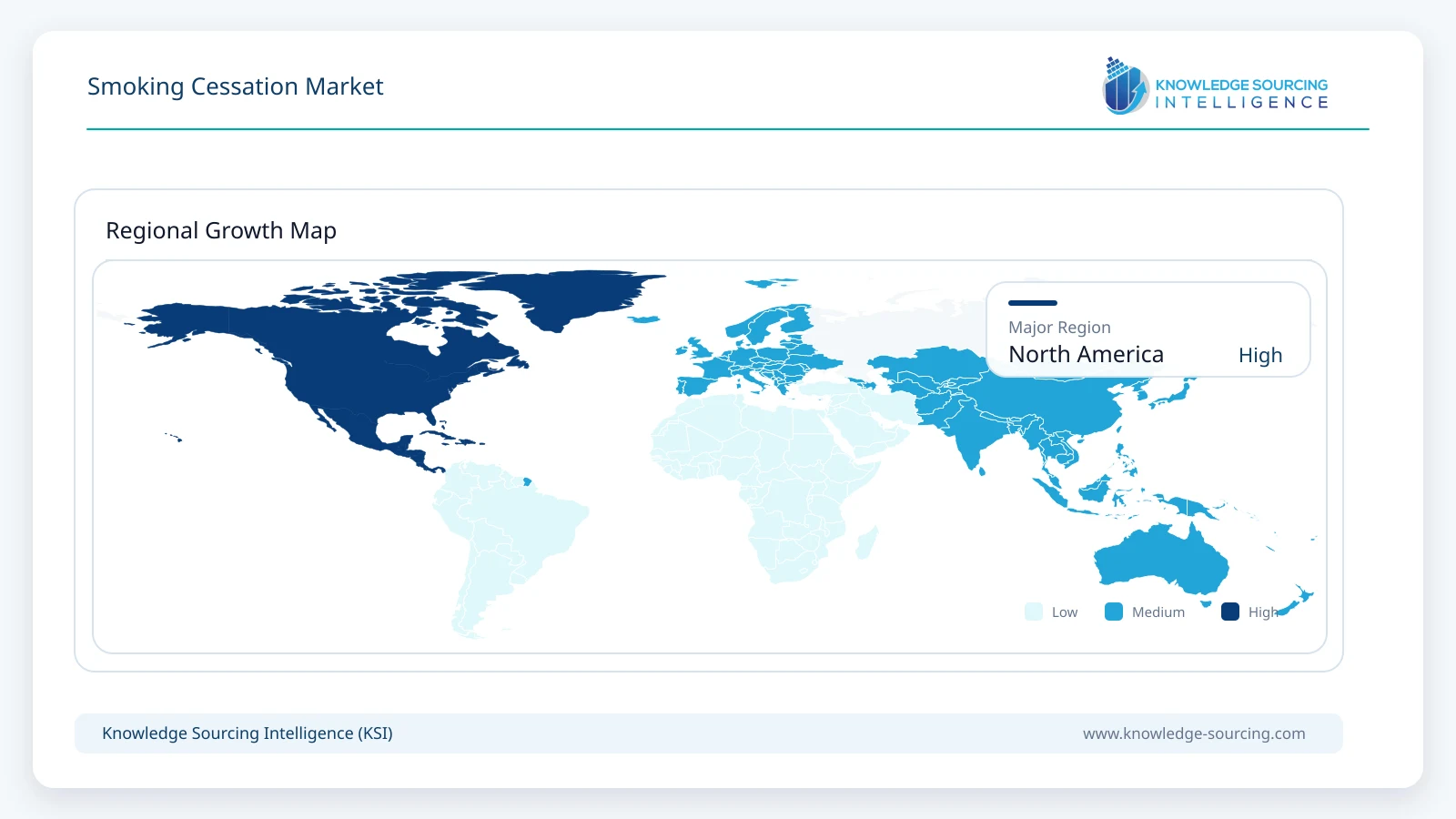
North America is estimated to account for roughly 35% of 2026 market revenue. The United States has a mature OTC NRT category led by branded and private-label gum, lozenges and patches, alongside generic prescription varenicline and bupropion. The principal growth opportunity is higher treatment penetration rather than growth in smoker numbers: CDC data show that medication use remains well below the proportion of smokers who want to quit. Canada also supports demand through established pharmacy access and public cessation programmes.
Europe
Europe represents a large and diverse cessation-products market, combining high historical tobacco prevalence with extensive pharmacy distribution and broader use of cytisine/cytisinicline than in North America. Dr. Reddy's Nicotinell portfolio has a strong presence across European markets, while Sopharma, Aflofarm, Adamed and Bonteque participate in cytisine-based treatment. Public-health programmes, country reimbursement policies and the shift toward lower smoking prevalence will determine the balance between volume growth and category maturity.
Asia Pacific
Asia Pacific has the largest underlying tobacco-user population but lower cessation-medication penetration than many developed markets. This creates a significant long-term access opportunity, particularly in India, China, Japan and Southeast Asia. India has a growing branded NRT market led by products such as Nicotex and 2baconil, while Dr. Reddy's acquired NRT portfolio includes established positions in Japan and other developed Asian markets. Growth will depend on affordability, pharmacy availability, clinician engagement and public-sector cessation initiatives.
South America and Middle East & Africa
These regions remain smaller in value terms but offer expansion opportunities as national tobacco-control programmes mature. NRT is likely to remain the principal pharmacological category because of its established safety profile and OTC potential. Market development is constrained by household affordability, uneven reimbursement, and limited access to structured cessation services, although international prequalification and generic competition can improve procurement options.
Competitive Environment
Competition is split between multinational consumer-health brands, private-label NRT manufacturers, regional cessation specialists and generic pharmaceutical companies. Haleon commercializes Nicorette and NicoDerm CQ in the United States, while Kenvue markets Nicorette in international markets where it retains brand rights. Dr. Reddy's controls Nicotinell and related NRT brands outside the United States following its 2024 Haleon transaction. Perrigo participates through NiQuitin and store-brand NRT, while Cipla Health and Rusan Pharma are important Indian-market suppliers. Fertin Pharma is a major contract manufacturer of medicated nicotine gum and other oral NRT formats.
The non-nicotine segment is more fragmented. Sopharma, Aflofarm and Adamed participate in cytisine products; Bonteque is the marketing-authorization holder for an authorized UK cytisinicline product; and generic pharmaceutical companies including Lupin, Teva and Apotex supply varenicline and/or bupropion products. Achieve Life Sciences remains a pipeline participant rather than a current commercial supplier.
Recent Developments
June 2026: Achieve Life Sciences received a U.S. FDA Complete Response Letter for cytisinicline. The cited issues related to third-party manufacturing observations and unfinished labeling; the FDA did not identify clinical efficacy or safety deficiencies.
May 2026: Aflofarm agreed to acquire Enorama Pharma's nicotine-gum NRT assets, including marketing authorizations in Sweden and Poland, intellectual property, registration documentation and manufacturing know-how.
October 2025: WHO reported that global tobacco users had declined to 1.2 billion in 2024, while one in five adults worldwide continued to use tobacco.
September 2025: The U.S. FDA accepted Achieve Life Sciences' cytisinicline NDA for review, creating a potential future new pharmacological option in the United States.
September 2024: Dr. Reddy's completed its acquisition of Haleon's Nicotinell and related NRT business outside the United States.
July 2024: WHO issued its first clinical tobacco-cessation guideline and recommended NRT, varenicline, bupropion and cytisine as effective pharmacological treatments.
July 2024: Kenvue announced that Nicorette gum and patch had become the first NRT products included on the WHO prequalification list.
January 2024: Lupin launched generic varenicline tablets in the United States following FDA approval.
Market Outlook
The smoking cessation market is expected to expand steadily through 2031 despite a gradual decline in global tobacco prevalence. Growth will come from a higher share of quit attempts using evidence-based medication, broader access in emerging markets, private-label and generic competition, and wider clinical acceptance of cytisine/cytisinicline. NRT will remain the largest revenue pool because of its OTC accessibility and multiple delivery formats, but non-nicotine medicines are expected to gain share. The strongest commercial opportunities are likely to occur where health systems combine pharmacotherapy access with behavioural support, pharmacy intervention and reimbursement. The market excludes the much larger universe of e-cigarettes, nicotine pouches and other recreational or harm-reduction nicotine products.
Smoking Cessation Market Scope:
| Report Metric | Details |
|---|---|
| Total Market Size in 2026 | USD 3.15 billion |
| Total Market Size in 2031 | USD 4.32 billion |
| Forecast Unit | USD Billion |
| Growth Rate | 6.5% |
| Study Period | 2021 to 2031 |
| Historical Data | 2021 to 2024 |
| Base Year | 2025 |
| Forecast Period | 2026 – 2031 |
| Segmentation | Therapy, Product Form, Distribution Channel, Geography |
| Companies |
|
Market Segmentation
By Therapy
Nicotine Replacement Therapy
Non-Nicotine Pharmacotherapy
By Product Form
Nicotine Gum
Transdermal Patches
Lozenges and Mini-Lozenges
Oral Sprays and Inhalers
Tablets
By Distribution Channel
Retail Pharmacies and Drugstores
Hospital and Prescription Pharmacies
E-Commerce
Public and Institutional Programs
By Geography
North America
United States
Canada
Mexico
South America
Brazil
Argentina
Others
Europe
Germany
United Kingdom
France
Italy
Spain
Poland
Others
Middle East and Africa
Saudi Arabia
United Arab Emirates
South Africa
Others
Asia Pacific
China
India
Japan
South Korea
Australia and New Zealand
Southeast Asia
Others
Table of Contents
1. INTRODUCTION
1.1 Market Definition
1.2 Scope and Exclusions
1.3 Currency, Units and Study Period
2. RESEARCH METHODOLOGY
2.1 Research Design
2.2 Primary and Secondary Evidence Framework
2.3 Market Estimation and Validation
3. EXECUTIVE SUMMARY
3.1 Market Snapshot
3.2 Key Findings
4. MARKET DYNAMICS
4.1 Market Drivers
4.1.1 Tobacco Users Seeking to Quit
4.1.2 Use of Evidence-Based Cessation Medication
4.1.3 International Expansion of NRT Access
4.1.4 Expansion of Non-Nicotine Therapies
4.2 Market Restraints
4.2.1 Adherence and Quit-Success Limitations
4.2.2 Affordability and Reimbursement
4.2.3 Competition from Alternative Nicotine Products
4.3 Market Opportunities
4.3.1 Emerging-Market Treatment Penetration
4.3.2 Cytisine/Cytisinicline Expansion
4.3.3 Pharmacy and Digital Commerce Access
4.4 Regulatory Environment
5. SMOKING CESSATION MARKET BY THERAPY
5.1 Nicotine Replacement Therapy
5.2 Non-Nicotine Pharmacotherapy
6. SMOKING CESSATION MARKET BY PRODUCT FORM
6.1 Nicotine Gum
6.2 Transdermal Patches
6.3 Lozenges and Mini-Lozenges
6.4 Oral Sprays and Inhalers
6.5 Tablets
7. SMOKING CESSATION MARKET BY DISTRIBUTION CHANNEL
7.1 Retail Pharmacies and Drugstores
7.2 Hospital and Prescription Pharmacies
7.3 E-Commerce
7.4 Public and Institutional Programs
8. SMOKING CESSATION MARKET BY GEOGRAPHY
8.1 North America
8.1.1 United States
8.1.2 Canada
8.1.3 Mexico
8.2 South America
8.2.1 Brazil
8.2.2 Argentina
8.2.3 Others
8.3 Europe
8.3.1 Germany
8.3.2 United Kingdom
8.3.3 France
8.3.4 Italy
8.3.5 Spain
8.3.6 Poland
8.3.7 Others
8.4 Middle East and Africa
8.4.1 Saudi Arabia
8.4.2 United Arab Emirates
8.4.3 South Africa
8.4.4 Others
8.5 Asia Pacific
8.5.1 China
8.5.2 India
8.5.3 Japan
8.5.4 South Korea
8.5.5 Australia and New Zealand
8.5.6 Southeast Asia
8.5.7 Others
9. COMPETITIVE ENVIRONMENT AND ANALYSIS
9.1 Brand and Portfolio Positioning
9.2 Generic and Private-Label Competition
9.3 Mergers, Acquisitions and Product Launches
9.4 Competitive Benchmarking
10. COMPANY PROFILES
10.1 Haleon plc
10.2 Kenvue Inc.
10.3 Dr. Reddy's Laboratories Ltd.
10.4 Perrigo Company plc
10.5 Cipla Health Ltd.
10.6 Rusan Pharma Ltd.
10.7 Sopharma AD
10.8 Aflofarm Farmacja Polska Sp. z o.o.
10.9 Adamed Pharma S.A.
10.10 Lupin Limited
10.11 Teva Pharmaceutical Industries Ltd.
10.12 Apotex Inc.
10.13 GlaxoSmithKline plc
10.14 Fertin Pharma A/S
10.15 Bonteque Consulting Ltd.
11. APPENDIX
11.1 Scope Notes and Excluded Nicotine Categories
11.2 Regulatory and Guideline References
11.3 Source List
Navigate
Trusted by the world's leading organizations