
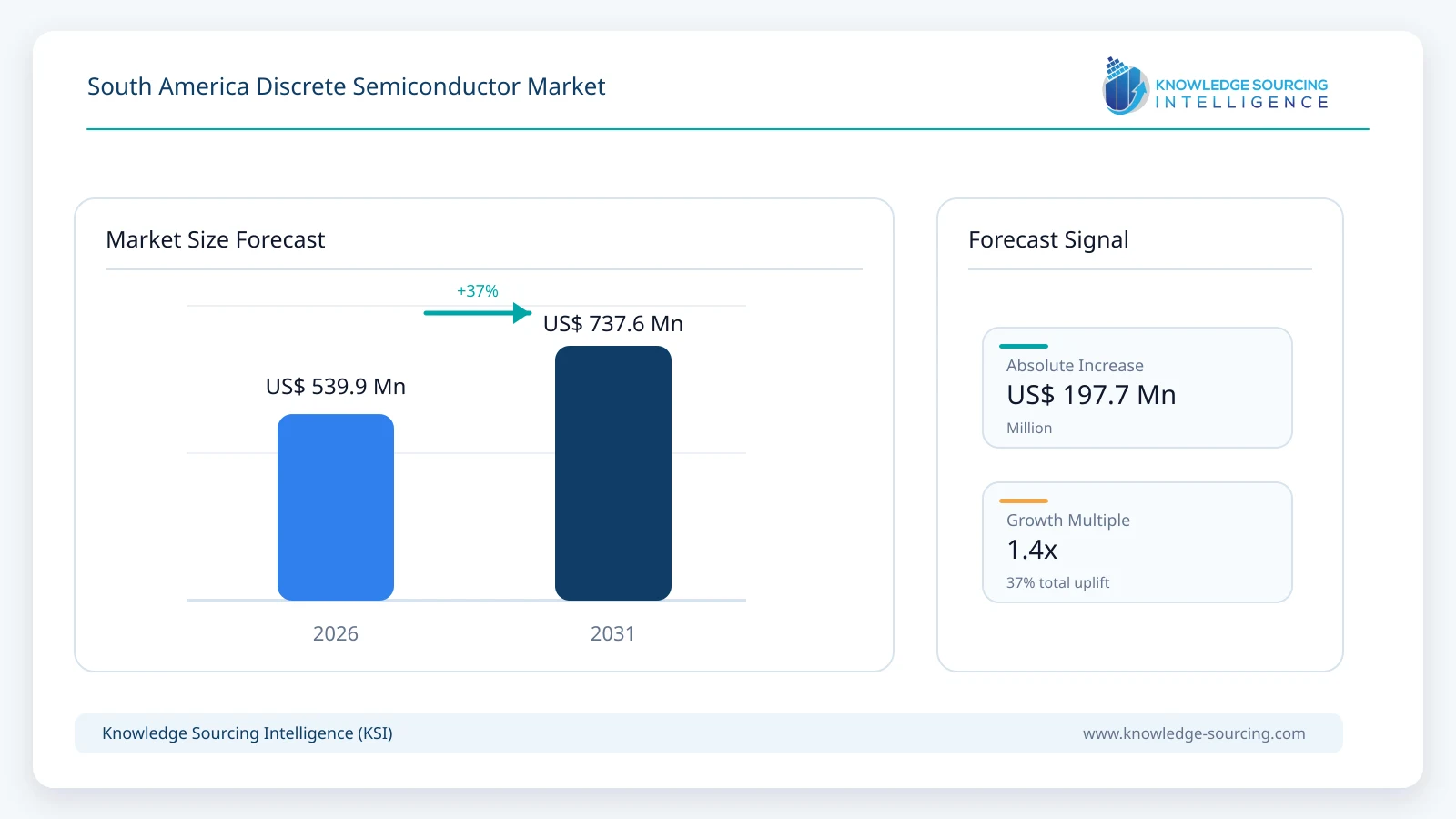
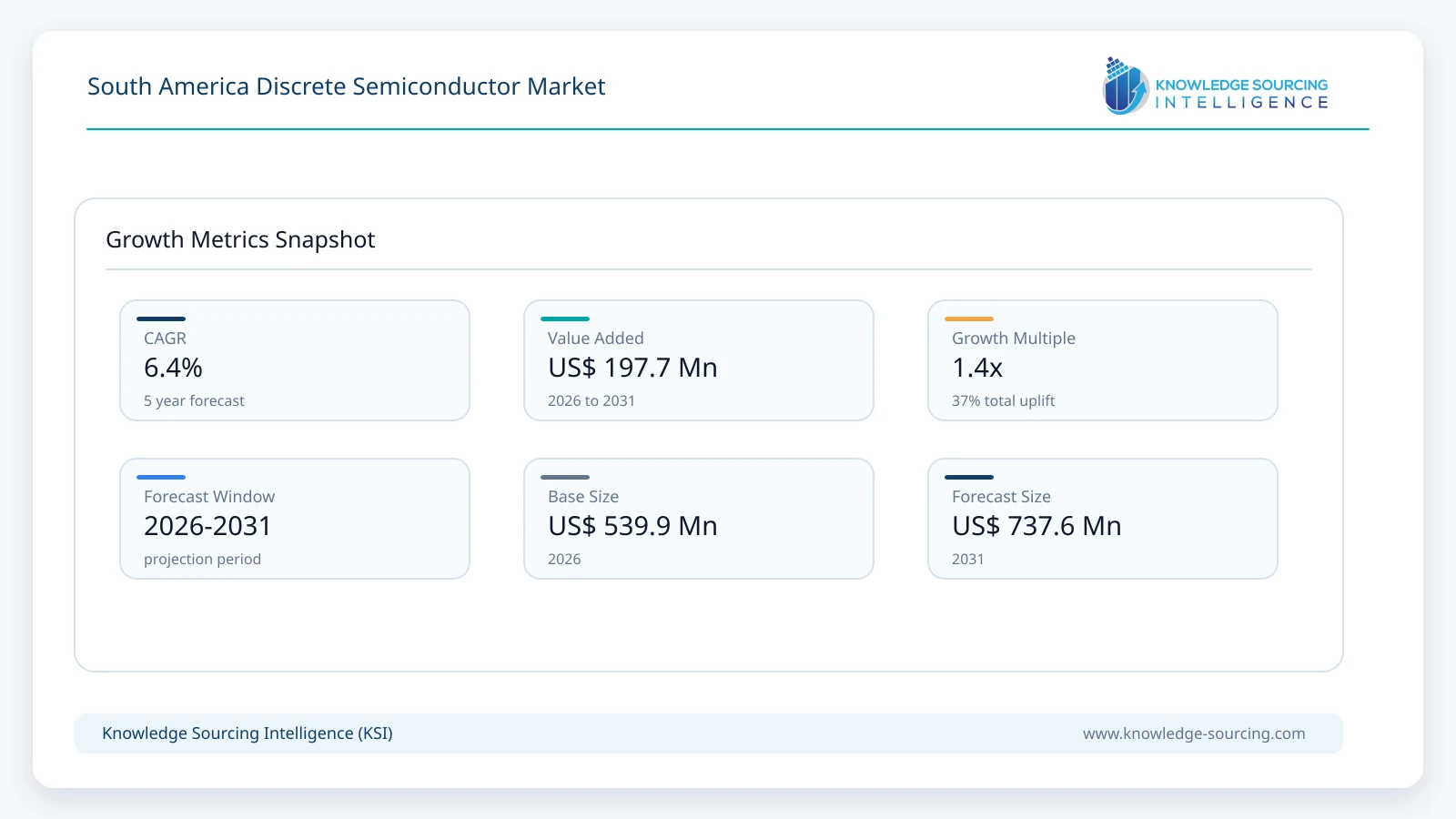
The South America Discrete Semiconductor Market is forecast to grow at a CAGR of 6.4%, reaching USD 737.6 million in 2031 from USD 539.9 million in 2026.
Highlights:
- 1Brazil remains the principal demand centre, supported by automotive production, industrial automation, renewable energy investments, and electronics manufacturing.
- 2Power semiconductor devices account for a commercially important share of demand due to electrification and energy conversion applications.
- 3Renewable energy expansion and grid modernisation are increasing procurement of high-power discrete semiconductor components across South America.
- 4Import dependence continues to shape pricing, lead times, and supplier strategies despite regional policy efforts supporting electronics manufacturing.
- 5Industrial customers increasingly prioritise reliability, thermal performance, supply continuity, and lifecycle support over component acquisition cost.
- 6Global semiconductor suppliers are strengthening regional distribution networks and technical support to improve customer engagement across South America.
Unlike integrated circuits that combine multiple functions within a single chip, discrete semiconductors perform dedicated electrical tasks, making them indispensable across automotive systems, industrial equipment, renewable energy infrastructure, telecommunications hardware, medical devices, and consumer electronics. Although the region represents a comparatively smaller share of global semiconductor consumption, demand continues to diversify as governments and industries invest in electrification, digital infrastructure, advanced manufacturing, and energy transition projects.
Demand is primarily driven by industrial users seeking components capable of operating under demanding electrical and thermal conditions. Purchasing decisions increasingly extend beyond component pricing to include long-term availability, qualification standards, reliability under continuous operation, technical support, and compatibility with existing system architectures. Equipment manufacturers are also seeking suppliers capable of ensuring stable deliveries following several years of global semiconductor supply disruptions that exposed vulnerabilities associated with extended international supply chains.
Brazil accounts for the largest concentration of electronics manufacturing and semiconductor consumption within the region, supported by its automotive production base, industrial sector, telecommunications infrastructure, and renewable energy investments. Argentina, Chile, Colombia, and Peru are also expanding demand as industrial automation, mining electrification, healthcare investment, and digital connectivity projects require higher volumes of power management and signal control components. While domestic semiconductor fabrication remains limited, regional assembly activities, government industrial policies, and international supplier partnerships continue to strengthen distribution capabilities and technical service networks.
Commercial opportunities increasingly concentrate around power electronics applications. Renewable energy installations, electric mobility initiatives, industrial motor control, charging infrastructure, and modern power conversion systems require higher-performance discrete semiconductor devices capable of delivering improved efficiency, thermal stability, and operational reliability throughout extended product lifecycles.
Key Market Indicators
Indicator | Latest Evidence | Commercial Meaning |
Brazil electricity generation from renewable sources | Over 88% (2024) | High renewable penetration increases deployment of power conversion equipment requiring discrete semiconductors. |
Brazil motor vehicle production | More than 2.5 million vehicles (2024) | Automotive manufacturing remains an important downstream source of semiconductor demand across powertrain, safety and body electronics. |
South America utility-scale renewable investment | Continued multi-billion-dollar annual project pipeline (2024-2025) | Expanding solar and wind capacity supports procurement of rectifiers, IGBTs, MOSFETs and power diodes for converters and inverters. |
Mobile broadband expansion across South America | 5G network rollout continued during 2024-2025 | Telecommunications infrastructure requires discrete devices for power supplies, radio equipment and network hardware. |
Regional semiconductor manufacturing | Limited wafer fabrication capacity | Import dependence makes supply security, distributor capability and inventory management important competitive factors. |
Key indicator: Brazil generated more than 88% of its electricity from renewable sources during 2024.
Commercial meaning: Renewable generation requires extensive deployment of power conversion systems, creating sustained demand for power discrete semiconductor devices used in inverters, converters and grid equipment.
Market Drivers
Expansion of renewable energy and power conversion infrastructure. South America continues to increase investments in solar, wind and distributed generation projects, particularly in Brazil and Chile, where utility operators and private developers are installing higher-capacity renewable assets. Every inverter, converter and grid interface relies on discrete power semiconductors such as IGBTs, MOSFETs, rectifiers and fast-recovery diodes to manage switching efficiency and power conversion. According to the International Energy Agency, renewable electricity capacity additions remain a central element of regional energy investment, while government decarbonisation policies continue supporting new installations. Equipment manufacturers are responding by introducing higher-voltage devices with improved thermal performance and lower switching losses, enabling suppliers to compete through efficiency, reliability and lifecycle value rather than component price alone.
Automotive electrification and increasing electronic content in vehicles. Vehicle manufacturers operating across Brazil and Argentina continue integrating additional electronic systems covering power management, advanced driver assistance, battery management, infotainment, lighting and safety applications. Even conventional internal combustion vehicles require growing numbers of discrete semiconductor devices to support efficient power distribution and electronic control units. Hybrid and battery-electric vehicles further increase semiconductor intensity because traction inverters, onboard chargers, DC-DC converters and battery protection systems depend heavily on power transistors and diodes. Global suppliers including Infineon Technologies, onsemi, STMicroelectronics and NXP Semiconductors continue expanding automotive-qualified product portfolios and silicon carbide development, reflecting long-term customer requirements for higher efficiency, extended operating temperatures and functional safety compliance.
Industrial automation and mining electrification raising demand for power devices. Industrial manufacturers throughout South America are modernising production facilities with variable-speed drives, programmable automation systems, robotics and intelligent motor control equipment to improve operational efficiency and reduce energy consumption. Chile and Peru also continue investing in electrified mining equipment and processing infrastructure, increasing demand for reliable power conversion components capable of operating in demanding environmental conditions. Industrial customers generally prioritise long operating life, supply continuity and application-specific technical support because equipment downtime directly affects production output. Semiconductor suppliers are therefore strengthening engineering support, distributor partnerships and product qualification programmes to secure long-term relationships with industrial equipment manufacturers rather than competing solely through pricing.
Market Restraints and Challenges
Dependence on imported semiconductor components exposes buyers to supply-chain volatility. South America has limited domestic wafer fabrication capacity and therefore relies heavily on imported semiconductor devices from Asia, Europe and North America. During recent global semiconductor shortages, manufacturers across multiple industries experienced extended lead times, constrained inventories and procurement uncertainty. Although supply conditions have improved, electronics manufacturers continue to maintain higher inventory buffers and supplier diversification strategies to reduce future disruptions. The dependence on overseas production also exposes regional buyers to freight costs, geopolitical developments, currency fluctuations and logistics delays, all of which can influence purchasing decisions and project economics.
Power semiconductor qualification and certification increase product development costs. Automotive, industrial automation, healthcare and energy infrastructure customers require extensive qualification before approving new semiconductor suppliers or device families. Product validation frequently includes thermal testing, electrical endurance evaluation, reliability assessment and compliance with international safety standards. These procedures extend design cycles and raise engineering costs for suppliers seeking entry into regulated applications. Official disclosures from several global semiconductor manufacturers indicate continued investment in product reliability, quality assurance and automotive-grade certification because customer approval processes remain lengthy and technically demanding. Smaller suppliers may find these requirements particularly challenging when competing for long-term contracts with industrial original equipment manufacturers.
Regional currency volatility and investment uncertainty affect procurement planning. Exchange-rate fluctuations across several South American economies influence semiconductor import costs because most components are traded internationally in US dollars. Equipment manufacturers operating with fixed project budgets often face procurement uncertainty when currency depreciation increases component prices before production begins. The impact is particularly visible in industrial machinery, telecommunications equipment and renewable energy projects that depend on imported electronic components throughout extended construction schedules. Suppliers increasingly mitigate these risks through regional inventory management, local distribution partnerships and longer-term supply agreements, although pricing volatility remains an operational challenge for buyers across multiple industry verticals.
Major Segment Analysis
Power Transistors (IGBT, MOSFET, and Bipolar)
Power transistors represent the most commercially important product segment because they address the region's expanding requirements for efficient power conversion across industrial automation, renewable energy systems, automotive electronics, and electrical infrastructure. Unlike small-signal devices that primarily process low-power signals, power transistors operate under higher voltages and currents, making them essential for motor drives, solar inverters, wind power converters, battery charging equipment, uninterrupted power supplies (UPS), and industrial switching systems. Demand is therefore closely linked to capital investment in electricity infrastructure, factory automation, and transport electrification rather than consumer electronics replacement cycles alone.
Industrial equipment manufacturers, renewable energy developers, automotive suppliers, and power equipment integrators remain the principal buyers within this segment. Procurement decisions increasingly prioritise switching efficiency, thermal performance, reliability, packaging technology, and long operating lifecycles because failures directly affect system availability and maintenance costs. Global suppliers such as Infineon Technologies AG, onsemi, STMicroelectronics, ROHM Co., Ltd., and Toshiba Electronic Devices & Storage Corporation continue to expand silicon carbide (SiC) and high-efficiency MOSFET portfolios to address higher operating frequencies and improved energy efficiency. Although conventional silicon devices continue serving cost-sensitive applications, higher-performance power transistors are receiving greater attention in renewable energy conversion, electric mobility, and industrial automation projects across South America.
Regional Analysis
Country | Main Demand Signal | Principal Constraint |
Brazil | Automotive production, renewable energy deployment, industrial automation, telecommunications infrastructure | Heavy reliance on imported semiconductor devices despite domestic electronics manufacturing |
Argentina | Automotive manufacturing, industrial machinery, medical equipment and telecommunications upgrades | Currency volatility and constrained industrial investment cycles |
Chile | Renewable energy expansion, mining electrification and grid modernisation | Limited domestic electronics manufacturing base and import dependence |
Colombia | Telecommunications investment, industrial automation and healthcare equipment demand | Limited local semiconductor ecosystem and distribution dependence |
Peru | Mining equipment, industrial processing and infrastructure development | Small electronics manufacturing sector and logistics-related procurement costs |
Rest of South America | Expanding digital infrastructure and industrial equipment imports | Smaller market scale and fragmented distribution channels |
Brazil remains the largest commercial market for discrete semiconductors in South America because it combines the region's largest automotive manufacturing base with established electronics production, renewable energy investment, and diversified industrial activity. Government initiatives supporting semiconductor capability and electronics manufacturing complement demand from vehicle manufacturers, industrial equipment producers, telecommunications infrastructure providers, and renewable energy developers. The country's extensive solar and wind installations also increase procurement of power semiconductors used in inverters, converters, and grid-control equipment.
Argentina's demand is primarily supported by automotive manufacturing, industrial machinery, healthcare equipment, and telecommunications infrastructure. Industrial buyers generally focus on reliable component supply and lifecycle support because imported semiconductor availability directly influences production schedules. Exchange-rate volatility, however, continues to affect procurement planning and inventory strategies for manufacturers relying on internationally sourced electronic components.
Chile has become an increasingly important destination for power semiconductor applications through continued investment in renewable energy generation and mining electrification. Utility-scale solar projects, battery energy storage systems, electric mining equipment, and power distribution upgrades require high-performance IGBTs, MOSFETs, rectifiers, and power diodes that operate under demanding environmental conditions. Since domestic semiconductor manufacturing remains limited, buyers continue depending on global suppliers supported by regional distributors.
Colombia is experiencing gradual demand growth as telecommunications operators expand digital infrastructure while manufacturers adopt greater automation across production facilities. Healthcare investment and modernisation of industrial equipment also contribute to increasing demand for reliable discrete semiconductor components. Purchasing decisions increasingly emphasise technical support, product availability, and compliance with international quality standards.
Peru's market is largely influenced by mining, mineral processing, industrial automation, and electrical infrastructure projects. Mining operations increasingly require efficient motor drives, power conversion equipment, and industrial control systems operating under continuous service conditions, creating sustained demand for high-reliability power semiconductor devices. Although overall market size remains smaller than Brazil, industrial investment continues to support procurement of specialised discrete semiconductor products.
Competitive Landscape
The South American discrete semiconductor market is technology-driven and characterised by competition among established global manufacturers supported through regional distributors, application engineering teams, and authorised sales networks rather than local semiconductor fabrication. Import dependence places considerable emphasis on supply continuity, inventory management, technical assistance, and long-term customer relationships. Industrial and automotive customers typically maintain rigorous supplier qualification procedures, making reliability, certification, and product lifecycle support important competitive differentiators alongside pricing.
Infineon Technologies AG, STMicroelectronics, onsemi, Vishay Intertechnology, Inc., NXP Semiconductors, Renesas Electronics Corporation, ROHM Co., Ltd., Nexperia, Diodes Incorporated, and Toshiba Electronic Devices & Storage Corporation continue strengthening portfolios for automotive electronics, industrial automation, renewable energy, and power management applications. Competition increasingly centres on higher-efficiency power devices, silicon carbide technologies, thermal performance, and product availability. Suppliers are also expanding regional technical support capabilities, strengthening channel partnerships, diversifying manufacturing locations, and improving supply-chain resilience to reduce procurement risks for South American customers.
Recent Developments
July 2026: South Korea and Brazil declared a Year of Strategic Partnership, agreeing at a presidential summit in Brasília to expand joint industrial cooperation encompassing critical minerals, defense, aerospace, and regional semiconductor supply chains.
January 2025: onsemi completed its acquisition of Qorvo's silicon carbide JFET technology business, expanding its EliteSiC discrete power semiconductor portfolio for electric vehicles, renewable energy and industrial power applications across international markets.
Regulatory and Policy Environment
Government policy continues to influence South America's semiconductor demand primarily through industrial development, renewable energy expansion, automotive manufacturing, telecommunications investment, and digital infrastructure programmes rather than through direct semiconductor manufacturing incentives. Brazil remains the region's principal policy centre, with initiatives supporting electronics production, information technology industries, and research activities intended to strengthen participation within global semiconductor value chains. Renewable energy targets across Brazil and Chile continue stimulating investment in photovoltaic installations, wind generation, battery storage systems, and grid modernisation, each requiring substantial volumes of discrete power semiconductor devices.
Environmental regulations affecting vehicle emissions and industrial energy efficiency also encourage greater adoption of advanced power electronics. Telecommunications regulators supporting continued 5G deployment indirectly increase demand for power management and signal control components incorporated within network infrastructure. Although South America remains dependent on imported semiconductor devices, industrial policy increasingly aims to strengthen regional electronics manufacturing capabilities, research collaboration, and supply-chain resilience.
Outlook and Strategic Implications
Demand across the South American discrete semiconductor market is expected to remain closely associated with investments in renewable electricity generation, industrial automation, automotive electronics, telecommunications infrastructure, and mining electrification throughout the 2026–2031 forecast period. Power semiconductor devices are expected to capture an increasing proportion of procurement budgets as customers seek higher energy efficiency, improved thermal performance, and lower operating costs across industrial systems.
Several strategic priorities are likely to shape supplier competitiveness:
Diversifying manufacturing and sourcing strategies to improve supply resilience.
Expanding regional engineering support and authorised distribution networks.
Increasing investment in silicon carbide and next-generation power semiconductor technologies.
Developing application-specific solutions for renewable energy, industrial automation, and automotive electronics.
Strengthening partnerships with regional original equipment manufacturers and system integrators.
Commercial success will depend less on component pricing alone and more on dependable product availability, application expertise, long-term technical support, and the ability to supply increasingly efficient power semiconductor solutions that meet evolving industrial and regulatory requirements across South America's diverse end-use sectors.
South America Discrete Semiconductor Market Scope:
| Report Metric | Details |
|---|---|
| Total Market Size in 2026 | USD 539.9 million |
| Total Market Size in 2031 | USD 737.6 million |
| Forecast Unit | Million |
| Growth Rate | 6.4% |
| Study Period | 2021 to 2031 |
| Historical Data | 2021 to 2024 |
| Base Year | 2025 |
| Forecast Period | 2026 – 2031 |
| Segmentation | Type, Industry Vertical, Country |
| Companies |
|
Market Segmentation
By Type
Thyristors
Rectifiers
Power Transistors (IGBT, MOSFET, Bipolar)
Small Signal Transistors
Diodes
Others
By Industry Vertical
Consumer Electronics
IT and Telecommunications
Automotive
Industrial Manufacturing
Energy and Power
Healthcare
Others
By Country
Brazil
Argentina
Chile
Colombia
Peru
Rest of South America
Table of Contents
1. INTRODUCTION
1.1. Market Definition
1.2. Market Segmentation
2. RESEARCH METHODOLOGY
2.1. Research Data
2.2. Assumptions
3. EXECUTIVE SUMMARY
3.1. Research Highlights
4. MARKET DYNAMICS
4.1. Market Drivers
4.2. Market Restraints
4.3. Porters Five Forces Analysis
4.3.1. Bargaining Power of End-Users
4.3.2. Bargaining Power of Buyers
4.3.3. Threat of New Entrants
4.3.4. Threat of Substitutes
4.3.5. Competitive Rivalry in the Industry
4.4. Industry Value Chain Analysis
5. SOUTH AMERICA DISCRETE SEMICONDUCTOR MARKET ANALYSIS, BY TYPE
5.1. Introduction
5.2. Thyristors
5.3. Rectifiers
5.4. Power Transistors (IGBT, MOSFET, Bipolar)
5.5. Small Signal Transistors
5.6. Diodes
5.7. Others
6. SOUTH AMERICA DISCRETE SEMICONDUCTOR MARKET ANALYSIS, BY INDUSTRY VERTICAL
6.1. Introduction
6.2. Consumer Electronics
6.3. IT and Telecommunications
6.4. Automotive
6.5. Industrial Manufacturing
6.6. Energy and Power
6.7. Healthcare
6.8. Others
7. SOUTH AMERICA DISCRETE SEMICONDUCTOR MARKET ANALYSIS, BY COUNTRY
7.1. Introduction
7.2. Brazil
7.3. Argentina
7.4. Chile
7.5. Colombia
7.6. Peru
7.7. Rest of South America
8. COMPETITIVE ENVIRONMENT AND ANALYSIS
8.1. Major Players and Strategy Analysis
8.2. Emerging Players and Market Lucrativeness
8.3. Mergers, Acquisitions, Agreements, and Collaborations
8.4. Vendor Competitiveness Matrix
9. COMPANY PROFILES
9.1. Vishay Intertechnology, Inc.
9.2. Infineon Technologies AG
9.3. STMicroelectronics
9.4. Toshiba Electronic Devices & Storage Corporation
9.5. Diodes Incorporated
9.6. NXP Semiconductors
9.7. Renesas Electronics Corporation
9.8. ROHM Co., Ltd.
9.9. Nexperia
9.10. onsemi
Navigate
Trusted by the world's leading organizations











