
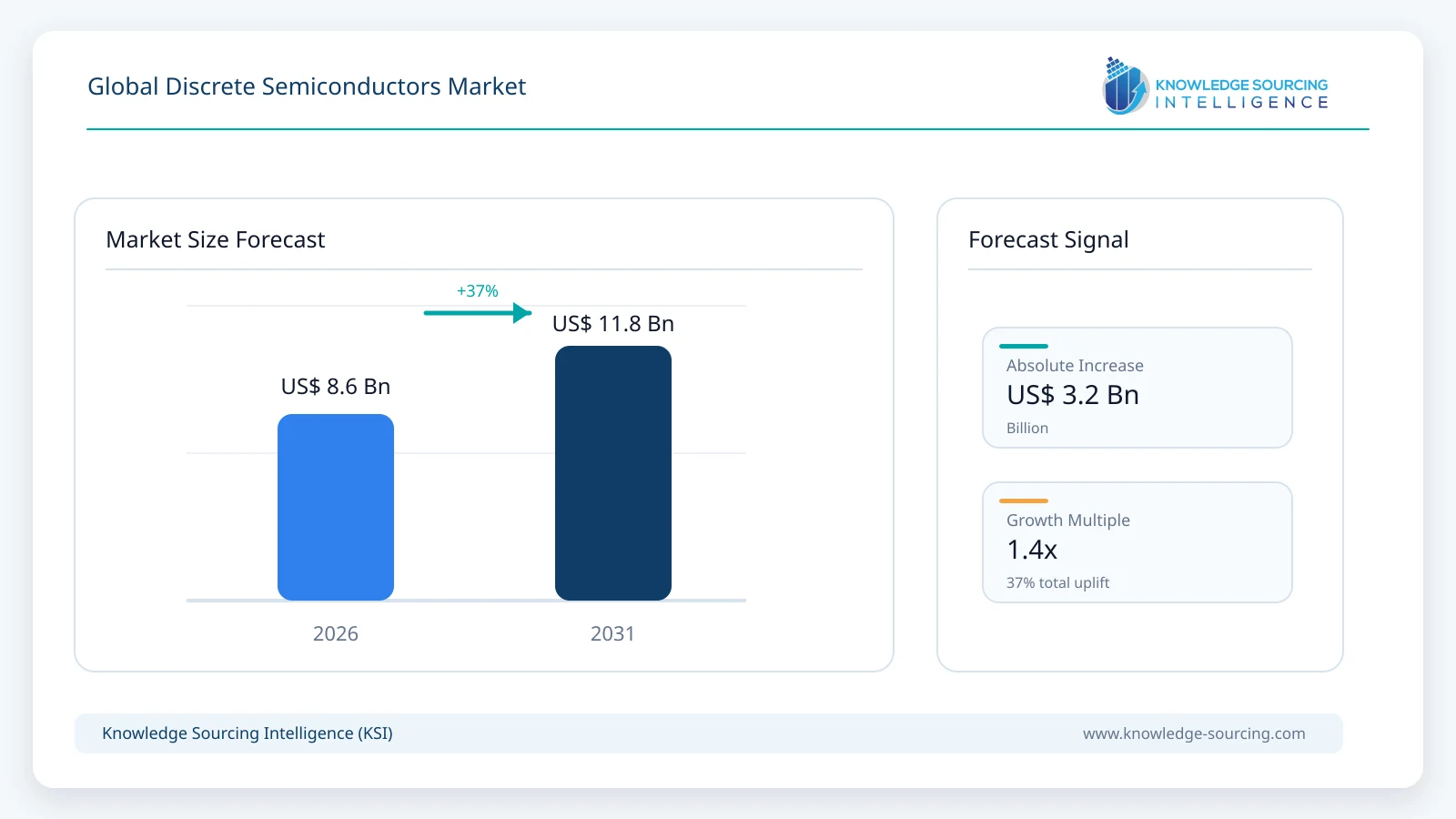
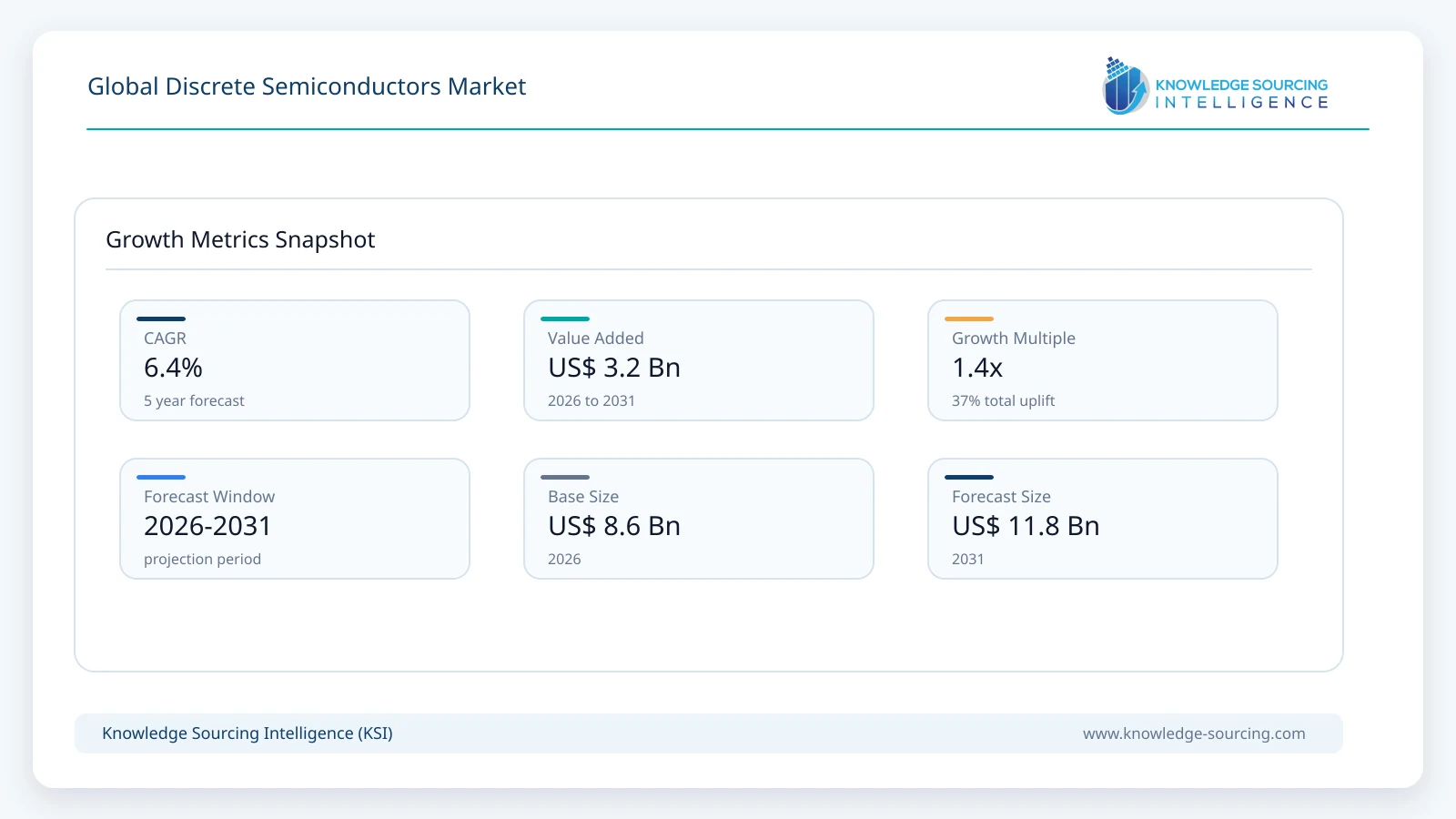
Global Discrete Semiconductors Market for Manufacturing Industry is forecast to grow at a CAGR of 6.4%, reaching USD 11.80 billion in 2031 from USD 8.64 billion in 2026.
Highlights:
- 1Increasing factory automation is strengthening demand for industrial-grade discrete power semiconductor devices.
- 2Silicon carbide and gallium nitride materials are expanding use in high-efficiency industrial power systems.
- 3Manufacturing buyers increasingly prioritize reliability, thermal performance, lifecycle cost, and long-term supply assurance.
- 4Industrial electrification and energy-efficient motor control are supporting procurement of advanced power semiconductors.
- 5Supply-chain localization and capacity expansion remain central competitive priorities among established manufacturers.
Purchasing decisions within the manufacturing industry increasingly emphasize lifetime operating cost rather than initial component pricing. Equipment manufacturers seek devices offering lower switching losses, improved thermal characteristics, longer operating life, and compliance with evolving efficiency and safety standards. Industrial customers also place greater emphasis on supply continuity following semiconductor shortages experienced during recent years. This has encouraged original equipment manufacturers (OEMs) to diversify suppliers, redesign products around qualified alternative components, and establish longer-term procurement agreements with semiconductor manufacturers.
Investment in industrial electrification is broadening the application base for discrete semiconductors. Expansion of variable frequency drives, industrial robotics, automated material handling systems, machine tools, renewable power integration, battery manufacturing equipment, and intelligent power distribution systems continues to increase demand for power switching devices. At the same time, manufacturers are adopting silicon carbide (SiC) and gallium nitride (GaN) technologies where higher efficiency, reduced cooling requirements, and increased switching frequencies justify higher acquisition costs.
Competition reflects both technology capability and manufacturing resilience. Suppliers compete through product qualification, application engineering support, manufacturing capacity, packaging technologies, regional production footprints, and long-term customer relationships. Industrial buyers generally favor suppliers capable of providing stable delivery schedules, extended product availability, comprehensive technical documentation, and application-specific design assistance because manufacturing equipment often remains operational for more than a decade.
Key Market Indicators
Indicator | Latest Evidence | Commercial Meaning |
Global semiconductor sales | USD 627.6 billion (2024) | Industrial semiconductor suppliers benefit from broader semiconductor investment and manufacturing expansion. |
Industrial robot installations | 541,302 units installed globally (2024) | Factory automation continues to increase demand for discrete power devices in motor control and drive systems. |
Global renewable electricity capacity additions | Over 585 GW (2024) | Industrial power conversion equipment increasingly requires high-efficiency discrete semiconductors. |
Power semiconductor material transition | Commercial adoption of SiC and GaN accelerating across industrial applications | Higher efficiency devices support premium product positioning despite higher manufacturing costs. |
Advanced semiconductor manufacturing investment | Multiple multi-billion-dollar capacity expansion programs announced globally during 2024–2025 | Expanded production capacity aims to improve supply resilience and reduce delivery risk for industrial customers. |
Key indicator: More than 541,000 industrial robots were installed worldwide during 2024, according to the International Federation of Robotics.
Commercial meaning: Rising automation directly increases demand for discrete semiconductor components used in servo drives, inverters, power supplies, and industrial motion control.
Market Drivers
Expansion of industrial automation and intelligent manufacturing systems
Manufacturing companies continue investing in robotics, automated production equipment, machine vision, and digitally controlled manufacturing lines to improve productivity and address labor shortages. According to the International Federation of Robotics, global industrial robot installations remained above half a million units during 2023, reflecting sustained automation investment across automotive, electronics, metal processing, and machinery industries. Each robotic system incorporates multiple discrete semiconductor devices within motor drives, power conversion stages, safety systems, and protection circuits. Semiconductor suppliers have responded by expanding industrial product portfolios emphasizing higher reliability, extended operating temperatures, and longer product lifecycles suitable for factory equipment expected to operate continuously under demanding industrial conditions.
Industrial energy-efficiency requirements are increasing adoption of advanced power devices
Industrial operators are under growing pressure to reduce electricity consumption while improving equipment performance. Variable frequency drives, industrial power supplies, renewable energy interfaces, and motor control systems increasingly employ high-efficiency power semiconductors that reduce switching losses and improve system performance. Silicon carbide MOSFETs and gallium nitride devices enable higher switching frequencies while reducing heat generation, allowing equipment manufacturers to decrease cooling requirements and improve power density. Companies including Infineon Technologies, onsemi, STMicroelectronics, and ROHM have expanded investments in wide-bandgap semiconductor manufacturing to address industrial demand for energy-efficient power electronics supporting factory modernization and industrial electrification.
Supply-chain resilience has become a purchasing priority for industrial OEMs
Semiconductor shortages experienced during recent years exposed vulnerabilities across industrial equipment supply chains. Manufacturing companies increasingly qualify multiple semiconductor suppliers, redesign circuit architectures around interchangeable components where technically feasible, and negotiate longer-term supply agreements to reduce production interruptions. Several semiconductor manufacturers have announced investments in additional wafer fabrication, packaging capacity, and regional manufacturing expansion to improve delivery reliability. This shift extends competition beyond device performance toward manufacturing resilience, geographic production diversity, inventory management capability, and long-term customer support, strengthening the strategic importance of established suppliers with diversified production networks.
Electrification of industrial equipment is expanding demand for power management components
Electrification is extending beyond transportation into manufacturing operations through electrically driven process equipment, automated warehouses, battery manufacturing facilities, renewable power integration, and energy storage systems. Industrial equipment increasingly depends on efficient rectification, voltage regulation, motor control, and circuit protection, all of which require discrete semiconductor devices. Growing deployment of industrial battery charging systems, distributed energy resources, and intelligent power distribution equipment further broadens demand across rectifiers, diodes, IGBTs, MOSFETs, and protection devices. Suppliers continue introducing higher-voltage and higher-current products capable of supporting demanding industrial operating environments while complying with evolving efficiency and safety standards.
Market Restraints and Challenges
Qualification requirements extend industrial procurement cycles
Industrial equipment manufacturers typically require extensive qualification before approving semiconductor components for commercial production. Power devices must undergo electrical testing, thermal validation, long-duration reliability assessment, electromagnetic compatibility evaluation, and compliance verification against applicable industrial standards. These qualification processes can extend procurement timelines by several months, particularly for applications involving industrial automation, energy infrastructure, and safety-critical manufacturing equipment. Although established suppliers benefit from proven qualification histories, newer market entrants often face longer commercialization periods before securing meaningful production contracts.
Wide-bandgap semiconductor manufacturing remains capacity-intensive
Silicon carbide and gallium nitride technologies offer measurable efficiency advantages but remain more expensive to manufacture than conventional silicon devices. Crystal growth, wafer production, defect control, epitaxial processing, and packaging require specialized manufacturing capabilities that continue to limit production yields compared with mature silicon processes. Several suppliers, including Infineon Technologies, onsemi, ROHM, and STMicroelectronics, have announced substantial investments in SiC production capacity, yet industry participants continue identifying manufacturing scale and wafer availability as important operational considerations. Higher manufacturing costs can slow adoption among industrial customers with stringent equipment cost targets despite long-term operating savings.
Geopolitical trade restrictions complicate semiconductor supply chains
Export controls, technology restrictions, tariff measures, and evolving industrial policies continue influencing semiconductor manufacturing and international trade. Industrial equipment manufacturers operating across multiple regions increasingly evaluate supplier location, manufacturing footprint, and regulatory exposure before finalizing sourcing decisions. Semiconductor producers have responded by expanding geographically diversified manufacturing, strengthening regional supply networks, and increasing localized production where commercially justified. Nevertheless, regulatory uncertainty may continue affecting procurement planning, inventory management, and long-term investment decisions for globally integrated manufacturing supply chains.
Industrial customers continue to face pricing pressure despite technology improvements
Manufacturing equipment builders increasingly request higher performance, improved efficiency, longer operating life, and enhanced reliability while maintaining competitive equipment pricing. Semiconductor manufacturers must therefore balance investments in advanced materials, packaging technologies, manufacturing expansion, and research activities against customer expectations for cost stability. This challenge is particularly evident in mature industrial applications where purchasing decisions remain highly cost-sensitive, and component differentiation is relatively limited. Suppliers increasingly compete through application engineering, lifecycle support, and supply assurance rather than relying solely on price reductions or incremental performance improvements.
Major Segment Analysis
MOSFETs
MOSFETs represent one of the most commercially important discrete semiconductor categories for manufacturing applications because they combine high switching speed, relatively low conduction losses, and compatibility with a broad range of industrial power systems. Their use extends across switch-mode power supplies, programmable logic controllers, industrial automation equipment, servo drives, robotics, welding systems, battery management equipment, and renewable energy converters. Industrial equipment manufacturers increasingly specify power MOSFETs that deliver improved thermal performance and higher power density while maintaining long operating lifetimes under demanding factory conditions.
Purchasing decisions are influenced by switching efficiency, thermal resistance, safe operating area, package reliability, and long-term component availability rather than unit price alone. The transition toward silicon carbide MOSFETs is particularly evident in higher-voltage industrial applications where reduced switching losses improve overall system efficiency and lower cooling requirements. Companies including Infineon Technologies, onsemi, STMicroelectronics, ROHM, and Toshiba Electronic Devices & Storage Corporation continue expanding their wide-bandgap MOSFET portfolios, reflecting customer demand for higher efficiency industrial power conversion systems. Conventional silicon MOSFETs nevertheless remain essential across cost-sensitive manufacturing equipment because of their mature production base, competitive pricing, and extensive design ecosystem.
Regional Analysis
Region | Main Demand Signal | Principal Constraint |
Americas | Industrial automation, semiconductor manufacturing investment, renewable energy deployment, and modernization of factory equipment | Skilled workforce constraints and evolving trade policies affecting supply chains |
Europe, Middle East and Africa | Industrial efficiency regulations, electrification initiatives, and advanced manufacturing investments | High energy costs, regulatory compliance requirements, and geopolitical uncertainty in parts of the region |
Asia Pacific | Large-scale electronics manufacturing, industrial production, expanding semiconductor fabrication, and factory automation | Supply-chain concentration, export restrictions, and increasing competition for advanced manufacturing capacity |
Americas
The United States remains the largest source of demand within the Americas owing to its advanced manufacturing sector, industrial automation investments, and expanding domestic semiconductor production supported by government incentives. Growth in electric vehicle manufacturing, battery production, renewable energy infrastructure, and industrial robotics continues to increase demand for discrete power semiconductors across factory equipment and industrial power systems. Canada contributes through industrial automation and energy infrastructure projects, while Brazil supports regional demand through manufacturing modernization and expanding industrial electronics production. Industrial buyers increasingly emphasize secure regional supply chains, encouraging suppliers to strengthen local manufacturing, assembly, and technical support capabilities.
Europe, Middle East and Africa
Manufacturers across Germany, France, the United Kingdom, and Italy continue investing in energy-efficient industrial equipment to comply with stricter environmental and energy performance requirements. Industrial motor systems, factory automation, process manufacturing, and renewable energy integration remain important application areas for discrete semiconductors. European semiconductor suppliers are also expanding silicon carbide manufacturing capabilities to strengthen regional supply resilience and reduce dependence on imported components. Across the Middle East and Africa, industrial diversification strategies, infrastructure development, and investments in manufacturing capacity support gradual increases in demand, although adoption rates vary considerably between countries because of differing levels of industrial development and investment.
Asia Pacific
Asia Pacific remains the largest manufacturing base for industrial electronics and semiconductor production, making it the most influential region for discrete semiconductor demand and supply. China, Japan, South Korea, Taiwan, and India continue investing in semiconductor manufacturing, industrial automation, renewable energy equipment, and advanced manufacturing technologies. China accounts for extensive electronics and industrial equipment production, while Japan and South Korea maintain strong positions in industrial automation, robotics, and semiconductor fabrication equipment. Taiwan remains central to the semiconductor value chain through advanced manufacturing capacity, whereas India is expanding domestic electronics manufacturing and industrial automation under government-supported manufacturing initiatives. Competition within the region increasingly focuses on manufacturing capacity expansion, supply-chain resilience, and technological advancement in wide-bandgap semiconductor production.
Competitive Landscape
Competition in the global discrete semiconductors market for manufacturing applications is technology-driven and supported by long-term industrial customer relationships rather than price alone. Established suppliers compete through manufacturing scale, product reliability, application engineering expertise, qualification support, and the ability to provide consistent product availability across extended equipment lifecycles. Industrial customers typically maintain rigorous supplier qualification processes, creating relatively high switching costs once components are integrated into production equipment.
Companies including onsemi, Infineon Technologies AG, STMicroelectronics, Vishay Intertechnology, Inc., Littelfuse, Inc., Toshiba Electronic Devices & Storage Corporation, Diodes Incorporated, ROHM Co., Ltd., Central Semiconductor Corp, Mitsubishi Electric Corporation, and Fuji Electric Co., Ltd. continue investing in silicon carbide technologies, manufacturing capacity expansion, advanced packaging, and localized production capabilities. Strategic priorities increasingly include strengthening regional supply chains, expanding industrial application support, and developing higher-efficiency power semiconductor devices capable of supporting automation, electrification, and energy-efficient manufacturing systems.
Recent Developments
July 2026 – Vishay Intertechnology launched standard-level 40 V MOSFETs: Vishay introduced new 40 V MOSFETs designed to prevent false triggering, reduce electrical noise, and improve efficiency in industrial motor-control systems, power tools, factory automation, and manufacturing equipment.
June 2026 – Nexperia launched 1200 V SiC MOSFETs in QDPAK package: Nexperia introduced top-side cooled 1200 V silicon carbide MOSFETs using QDPAK packaging, delivering higher power density and improved thermal performance for industrial motor drives, photovoltaic inverters, and manufacturing power systems.
June 2026 – Infineon and Siemens expanded silicon carbide power semiconductor collaboration: Infineon partnered with Siemens to advance silicon carbide-based protection technologies for factories and AI data centers, improving efficiency, reliability, and power distribution across industrial manufacturing infrastructure.
September 2025 – Infineon expanded the OptiMOS™ 7 MOSFET family: Infineon launched new 25 V and 40 V OptiMOS™ 7 MOSFETs optimized for switching power supplies, telecom equipment, server infrastructure, industrial motor drives, and advanced manufacturing applications.
Regulatory and Policy Environment
Industrial demand for discrete semiconductors is increasingly influenced by policies promoting energy efficiency, domestic semiconductor manufacturing, and resilient supply chains. In the United States, incentives supporting semiconductor manufacturing capacity encourage additional investment in wafer fabrication and advanced packaging, improving long-term supply security for industrial customers. European industrial policy similarly emphasizes semiconductor production, digital sovereignty, and energy-efficient manufacturing technologies, encouraging regional capacity expansion and research into next-generation power semiconductor materials.
International safety and product standards continue to shape semiconductor development. Industrial equipment manufacturers require compliance with electrical safety, electromagnetic compatibility, environmental, and reliability standards before approving components for production systems. Regulations restricting hazardous substances and improving energy efficiency also influence product design, packaging materials, and manufacturing processes. As silicon carbide and gallium nitride technologies become more widely adopted, suppliers continue investing in qualification testing and certification to satisfy increasingly demanding industrial customer requirements.
Outlook and Strategic Implications
Industrial manufacturing is expected to remain the primary source of long-term demand for discrete semiconductors as factories continue adopting automation, electrification, intelligent motion control, and energy-efficient power systems. Wider deployment of robotics, industrial drives, renewable energy integration, and digitally controlled manufacturing equipment will continue increasing requirements for reliable power switching and protection devices. Silicon-based products will retain broad commercial relevance, while silicon carbide and gallium nitride devices are expected to capture a larger share of higher-performance industrial applications as manufacturing capacity expands and production costs gradually improve.
Strategic priorities across the industry are likely to focus on:
Manufacturers: Expand capacity for silicon carbide and gallium nitride devices while strengthening regional production resilience.
Industrial OEMs: Diversify semiconductor sourcing and prioritize suppliers offering long-term product availability and engineering support.
Technology providers: Develop higher-efficiency devices that reduce thermal losses and simplify industrial system design.
Investors: Monitor capacity expansion, material innovation, and industrial automation trends that influence long-term semiconductor demand.
Policymakers: Continue supporting domestic semiconductor manufacturing, workforce development, and resilient supply chains to reduce dependence on concentrated global production networks.
Market Scope:
| Report Metric | Details |
|---|---|
| Total Market Size in 2026 | USD 8.64 billion |
| Total Market Size in 2031 | USD 11.80 billion |
| Forecast Unit | Billion |
| Growth Rate | 6.4% |
| Study Period | 2021 to 2031 |
| Historical Data | 2021 to 2024 |
| Base Year | 2025 |
| Forecast Period | 2026 – 2031 |
| Segmentation | Type, Material, Application, Geography |
| Companies |
|
Market Segmentation
By Type
Thyristors
Rectifiers
Bipolar Junction Transistors (BJTs)
MOSFETs
IGBTs
Small Signal Transistors
Diodes
Others
By Material
Silicon
Silicon Carbide (SiC)
Gallium Nitride (GaN)
By Application
Power Management
Signal Processing
Motor Drives
Power Conversion
Protection Circuits
By Geography
Americas
USA
Canada
Brazil
Others
Europe Middle East and Africa
Germany
France
United Kingdom
Italy
Others
Asia Pacific
China
Japan
India
Taiwan
South Korea
Others
Table of Contents
1. INTRODUCTION
1.1. Market Overview
1.2. Market Definition
1.3. Scope of the Study
1.4. Currency
1.5. Assumptions
1.6. Base and Forecast Years Timeline
2. RESEARCH METHODOLOGY
2.1. Research Design
2.2. Secondary Sources
3. EXECUTIVE SUMMARY
4. MARKET DYNAMICS
4.1. Market Segmentation
4.2. Market Drivers
4.3. Market Restraints
4.4. Market Opportunities
4.5. Porter’s Five Force Analysis
4.5.1. Bargaining Power of Suppliers
4.5.2. Bargaining Power of Buyers
4.5.3. Threat of New Entrants
4.5.4. Threat of Substitutes
4.5.5. Competitive Rivalry in the Industry
4.6. Life Cycle Analysis - Regional Snapshot
4.7. Market Attractiveness
5. GLOBAL DISCRETE SEMICONDUCTORS MARKET FOR MANUFACTURING INDUSTRY BY TYPE
5.1. Thyristors
5.2. Rectifiers
5.3. Bipolar Junction Transistors (BJTs)
5.4. MOSFETs
5.5. IGBTs
5.6. Small Signal Transistors
5.7. Diodes
5.8. Others
6. GLOBAL DISCRETE SEMICONDUCTORS MARKET FOR MANUFACTURING INDUSTRY BY MATERIAL
6.1. Silicon
6.2. Silicon Carbide (SiC)
6.3. Gallium Nitride (GaN)
7. GLOBAL DISCRETE SEMICONDUCTORS MARKET FOR MANUFACTURING INDUSTRY BY APPLICATION
7.1. Power Management
7.2. Signal Processing
7.3. Motor Drives
7.4. Power Conversion
7.5. Protection Circuits
8. GLOBAL DISCRETE SEMICONDUCTORS MARKET FOR MANUFACTURING INDUSTRY BY GEOGRAPHY
8.1. Americas
8.1.1. USA
8.1.2. Canada
8.1.3. Brazil
8.1.4. Others
8.2. Europe Middle East and Africa
8.2.1. Germany
8.2.2. France
8.2.3. United Kingdom
8.2.4. Italy
8.2.5. Others
8.3. Asia Pacific
8.3.1. China
8.3.2. Japan
8.3.3. India
8.3.4. Taiwan
8.3.5. South Korea
8.3.6. Others
9. COMPETITIVE INTELLIGENCE
9.1. Competitive Benchmarking and Analysis
9.2. Recent Investment and Deals
9.3. Strategies of Key Players
10. COMPANY PROFILES
10.1. onsemi
10.2. Vishay Intertechnology, Inc.
10.3. Infineon Technologies AG
10.4. STMicroelectronics
10.5. Littelfuse, Inc.
10.6. Toshiba Electronic Devices & Storage Corporation
10.7. Diodes Incorporated
10.8. Rohm Co., Ltd.
10.9. Central Semiconductor Corp
10.10. Mitsubishi Electric Corporation
10.11. Fuji Electric Co., Ltd.
LIST OF FIGURES
LIST OF TABLES
DISCLAIMER
Navigate
Trusted by the world's leading organizations











