
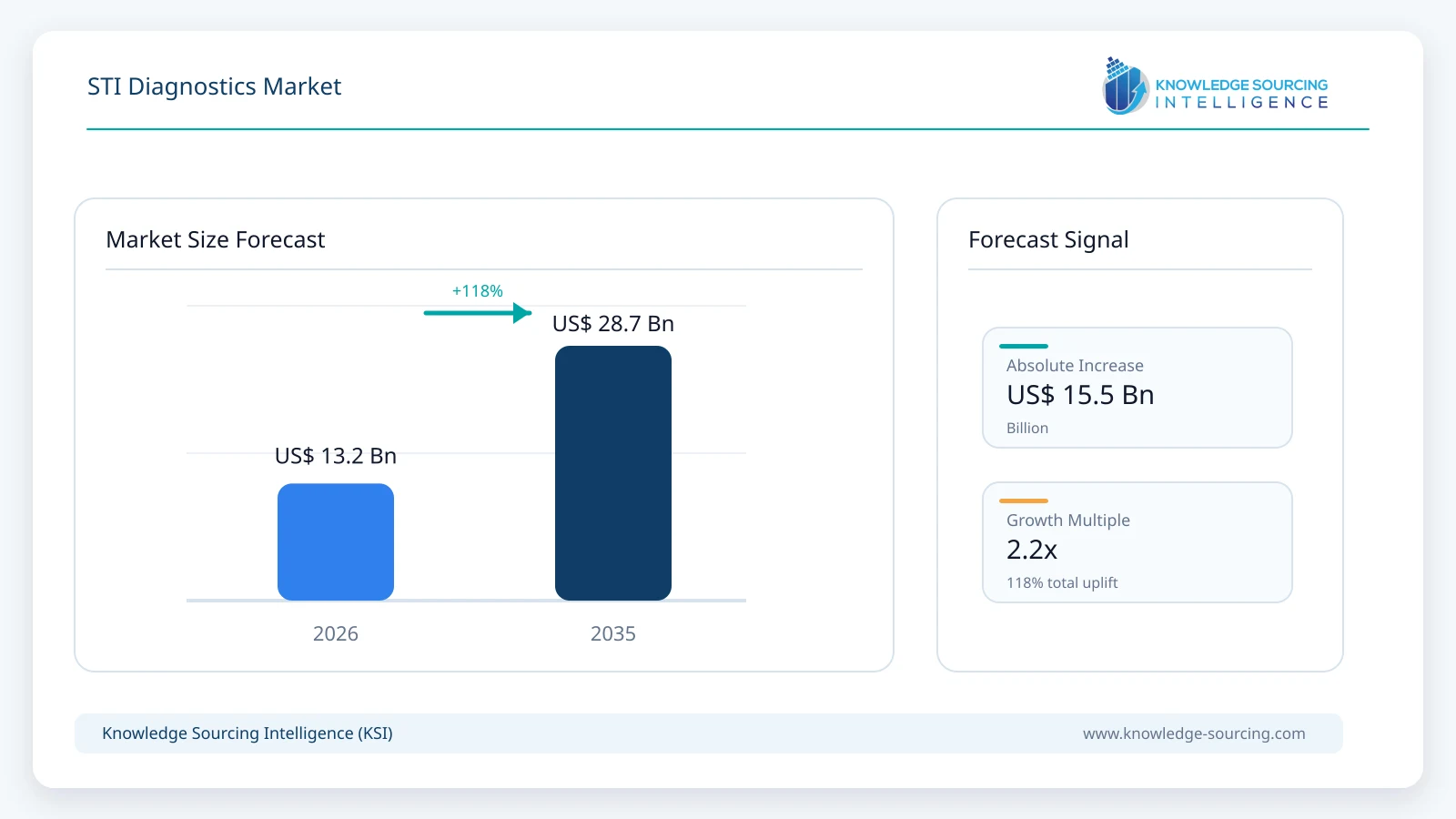
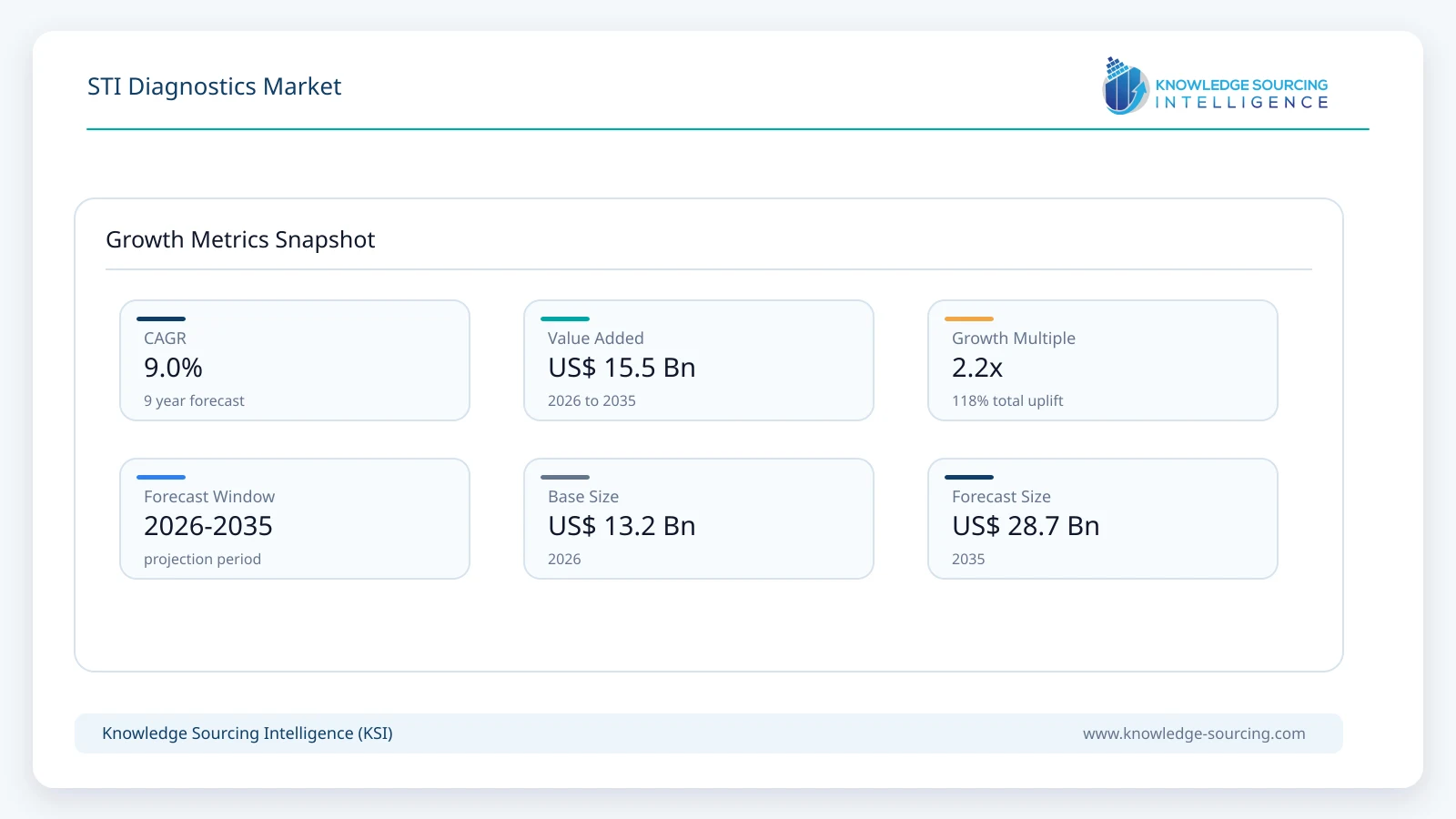
The STI Diagnostics Market is anticipated to grow at a CAGR of 9.0% from USD 13.21 billion in 2026 to USD 28.74 billion in 2035.
Highlights:
- 1Rising STI prevalence is increasing demand for screening programs because asymptomatic infections require proactive identification before transmission expands.
- 2Expansion of nucleic acid amplification testing is strengthening diagnostic demand because healthcare providers require higher sensitivity and earlier detection.
- 3Growth in point-of-care testing is increasing utilization because healthcare systems seek faster diagnosis and reduced patient loss to follow-up.
- 4Public health surveillance programs are expanding testing volumes because disease control strategies increasingly depend on accurate epidemiological data.
STI diagnostics enable healthcare providers to detect infectious agents associated with sexually transmitted diseases and support appropriate clinical management. Demand is increasing because many infections remain asymptomatic during early stages and therefore require proactive screening rather than symptom-driven diagnosis. Undetected infections contribute to continued transmission and increase the risk of long-term complications. Healthcare systems are expanding testing recommendations and integrating diagnostics into preventive care pathways. This approach increases the strategic importance of STI diagnostic services.
Public health programs depend heavily on diagnostic testing because surveillance data guides disease control policies and resource allocation. Testing demand is rising as governments strengthen efforts to reduce STI incidence among high-risk populations. Inconsistent screening practices limit visibility into infection trends and delay public health responses. Authorities are supporting broader diagnostic access through screening initiatives and awareness campaigns. This effort reinforces the role of diagnostics in population-level disease management.
Regulatory oversight continues shaping market development because diagnostic accuracy directly influences treatment decisions and surveillance quality. Healthcare providers are increasingly preferring validated molecular technologies as regulatory agencies strengthen performance expectations for infectious disease diagnostics. Lower diagnostic sensitivity can result in missed infections and compromised public health outcomes. Manufacturers are investing in assay optimization and clinical validation to meet evolving regulatory requirements. This environment favors technologies capable of delivering reliable and reproducible results.
Diagnostic demand increasingly reflects changing healthcare delivery models. Patients are seeking faster and more convenient testing options because delays in diagnosis often reduce treatment adherence and follow-up compliance. Traditional laboratory-dependent workflows can create operational barriers in community-based settings. Diagnostic developers are introducing rapid and self-collection-compatible testing solutions that improve accessibility. This trend expands testing opportunities while supporting earlier intervention.
Market Dynamics
Market Drivers
Increasing Burden of Sexually Transmitted Infections: STI diagnostics remain essential because rising infection rates increase the need for timely disease identification. Screening demand is increasing as healthcare systems recognize the consequences of delayed diagnosis on transmission control. Undetected infections contribute to broader disease spread and increase healthcare costs associated with advanced disease management. Public health agencies are expanding testing initiatives that encourage earlier diagnosis and treatment. This effort strengthens long-term demand for STI diagnostic services.
Expansion of Molecular Testing Adoption: Molecular diagnostics provide high analytical sensitivity for detecting sexually transmitted pathogens. Healthcare providers are increasingly adopting NAAT-based testing because clinicians require accurate identification of infections even when symptoms are absent. Conventional methods may produce lower diagnostic performance in certain clinical settings. Laboratories are implementing advanced molecular workflows that improve detection rates and diagnostic confidence. This transition supports sustained demand for molecular STI diagnostics.
Strengthening Public Health Screening Programs: National disease control strategies depend on widespread access to testing services. Governments are increasing investments in screening initiatives because surveillance and prevention programs require reliable diagnostic data. Limited testing coverage reduces the effectiveness of intervention efforts and delays outbreak recognition. Healthcare systems are expanding screening capacity through community clinics and public health partnerships. This expansion increases demand for scalable diagnostic solutions.
Growth of Point-of-Care Testing: Rapid testing technologies support immediate clinical decision-making in diverse healthcare environments. Demand is increasing because patients and providers seek shorter diagnostic timelines. Laboratory-dependent workflows often delay treatment initiation and reduce patient follow-up rates. Diagnostic companies are developing rapid and portable testing solutions that improve accessibility and convenience. This trend expands the role of STI diagnostics beyond traditional laboratory settings.
Market Restraints
High costs associated with advanced molecular diagnostic platforms limit adoption in resource-constrained healthcare systems.
Social stigma surrounding sexually transmitted infections reduces testing participation and delays diagnosis among at-risk populations.
Uneven laboratory infrastructure and workforce availability restrict access to high-quality diagnostic services in certain regions.
Market Opportunities
Expansion of Home-Based and Self-Collection Testing: Diagnostic accessibility plays a major role in screening participation. Patients are increasingly seeking private and convenient testing options because stigma continues affecting healthcare engagement. Traditional clinic-based testing may discourage participation among certain demographic groups. Diagnostic developers are introducing self-collection and home-testing solutions that improve accessibility while maintaining diagnostic quality. This shift creates new growth opportunities across consumer-directed healthcare channels.
Integration of Digital Health Platforms: STI testing increasingly relies on efficient communication of results and follow-up recommendations. Healthcare providers are adopting digital tools because patient engagement and continuity of care influence treatment completion. Fragmented communication pathways reduce testing effectiveness and increase loss to follow-up. Technology providers are integrating diagnostics with digital reporting and telehealth services that improve care coordination. This integration expands the value of diagnostic solutions.
Growth of Multiplex Diagnostic Panels: Healthcare providers require broader diagnostic visibility because multiple sexually transmitted pathogens often present with overlapping clinical symptoms. Single-target testing can increase costs and prolong diagnostic workflows when multiple infections must be ruled out. Diagnostic manufacturers are developing multiplex assays that detect several pathogens simultaneously. This capability improves workflow efficiency and enhances clinical decision-making.
Rising Demand in Emerging Healthcare Markets: Healthcare access continues expanding across developing economies. Testing demand is increasing because governments are strengthening infectious disease control programs and investing in healthcare infrastructure. Diagnostic capacity gaps limit effective disease surveillance and treatment planning. Manufacturers are introducing scalable and cost-effective testing solutions that address local healthcare requirements. This development supports future market expansion.
Supply Chain Analysis
The STI diagnostics supply chain begins with suppliers of biological reagents, enzymes, antibodies, primers, culture media, plastics, microfluidic components, and laboratory-grade consumables. Diagnostic performance depends on the quality of these materials because assay sensitivity and specificity are directly linked to reagent consistency. Demand for molecular testing is increasing procurement requirements for specialized biological components. Suppliers are expanding production capacity to support growing testing volumes. This activity strengthens upstream investment throughout the diagnostics ecosystem.
Diagnostic manufacturers transform these inputs into instruments, assay kits, rapid diagnostic tests, software platforms, and integrated laboratory solutions. Testing demand is increasing because healthcare systems require scalable screening programs capable of supporting large patient populations. Product development faces pressure from evolving regulatory requirements and changing clinical expectations. Companies are investing in automation, assay optimization, and digital integration to improve workflow efficiency. This response supports broader adoption of advanced STI diagnostic technologies.
Distribution networks connect manufacturers with hospitals, public health agencies, diagnostic laboratories, physician offices, sexual health clinics, pharmacies, and community testing programs. Healthcare providers are increasingly prioritizing suppliers capable of delivering reliable logistics and technical support because testing continuity depends on uninterrupted reagent availability. Supply disruptions can reduce screening capacity and delay diagnosis. Vendors are strengthening service infrastructure and inventory management systems that improve operational resilience. This evolution increases the importance of comprehensive solution providers within the STI diagnostics market.
Government Regulations
Region | Regulatory Authority | Regulatory Focus | Impact on STI Diagnostics |
United States | FDA | Approval and performance validation of STI diagnostic devices | Supports adoption of clinically validated diagnostic technologies |
United States | CDC | STI screening recommendations and surveillance programs | Expands testing demand through public health initiatives |
European Union | European Commission & IVDR | Clinical evidence, diagnostic performance, post-market surveillance | Strengthens quality and compliance requirements |
United Kingdom | UK Health Security Agency (UKHSA) | STI surveillance and public health monitoring | Encourages broader testing and disease reporting |
Market Segmentation
By Product Type
Diagnostic instruments form the operational foundation of STI testing because laboratories depend on automated systems to process increasing screening volumes efficiently. Demand is increasing as healthcare systems expand screening recommendations and integrate testing into preventive care pathways. Manual workflows create throughput limitations that reduce laboratory productivity and delay result delivery. Providers are investing in automated molecular analyzers that improve operational efficiency and support higher testing capacity. This transition strengthens demand for advanced diagnostic instrumentation across hospital and laboratory settings.
By Technology
NAAT technologies represent a major component of STI diagnostics because they provide high analytical sensitivity for pathogen detection. Demand is increasing as healthcare providers seek earlier identification of infections among asymptomatic individuals. Conventional testing approaches may fail to detect low pathogen loads, limiting screening effectiveness. Laboratories are expanding adoption of NAAT-based workflows that improve diagnostic accuracy and treatment targeting. This trend supports the continued growth of molecular diagnostics within STI management.
By Disease Type
Chlamydia testing generates substantial demand because the infection frequently remains asymptomatic while contributing to significant reproductive health complications. Screening programs are expanding as healthcare systems prioritize early intervention. Undiagnosed infections increase transmission rates and long-term treatment burdens. Providers are increasing routine testing and integrating molecular diagnostics into preventive care pathways. This approach strengthens demand for chlamydia diagnostic solutions.
Regional Analysis
North America
North America represents one of the most mature STI diagnostics markets because screening programs, public health surveillance infrastructure, and molecular diagnostic adoption remain highly developed across the region. Testing demand is increasing as healthcare authorities continue reporting elevated rates of chlamydia, gonorrhea, and syphilis, particularly among younger populations and high-risk groups. Rising infection burdens place pressure on healthcare systems to identify cases earlier and reduce transmission through targeted interventions. Providers are expanding routine screening programs and integrating molecular diagnostics into primary care, sexual health clinics, and community testing networks. This response strengthens demand for high-sensitivity diagnostic technologies throughout the region.
The United States remains the largest contributor because national STI surveillance systems generate substantial testing requirements across public and private healthcare settings. Healthcare providers are increasingly adopting rapid and decentralized diagnostic solutions as patient retention becomes a critical component of treatment success. Delays associated with centralized laboratory workflows often contribute to missed follow-up appointments and delayed treatment initiation. Diagnostic manufacturers are introducing automated and near-patient testing platforms that support faster clinical decision-making. This shift increases utilization of molecular and rapid diagnostic technologies.
Canada continues strengthening STI prevention and surveillance efforts because public health agencies are seeking earlier identification of infections and improved disease monitoring. Geographic dispersion creates challenges for equitable diagnostic access, particularly in remote communities. Healthcare systems are expanding digital health integration and decentralized testing strategies that improve accessibility and reporting efficiency. This approach supports sustained demand for scalable STI diagnostic solutions across the Canadian healthcare landscape.
Europe
Europe maintains a strong position within the STI diagnostics market because national healthcare systems support organized screening programs and broad access to diagnostic services. Testing demand is increasing as public health agencies respond to rising STI incidence and emphasize earlier intervention strategies. Delayed diagnosis contributes to ongoing transmission and increases long-term healthcare expenditures associated with advanced disease complications. Healthcare providers are strengthening screening protocols and adopting more sensitive molecular technologies that improve detection rates. This transition supports continued market expansion across the region.
The implementation of the In Vitro Diagnostic Regulation (IVDR) is influencing purchasing decisions because healthcare providers increasingly prioritize validated diagnostic technologies. Regulatory compliance requirements increase development complexity for manufacturers while improving confidence in diagnostic performance. Healthcare institutions are adopting platforms capable of meeting evolving quality expectations while maintaining operational efficiency. This environment favors companies with strong regulatory capabilities and established diagnostic portfolios.
Countries including Germany, the United Kingdom, France, Italy, Spain, and the Netherlands continue driving regional demand because they maintain advanced laboratory infrastructure and comprehensive infectious disease surveillance programs. Healthcare providers are expanding access to STI testing as prevention strategies increasingly depend on widespread screening. Traditional testing models may not fully address accessibility challenges among underserved populations. Public health organizations are supporting community-based and decentralized testing initiatives that broaden diagnostic reach. This effort reinforces long-term demand for innovative STI diagnostic solutions.
Asia Pacific
Asia Pacific is experiencing significant growth in STI diagnostic demand because large population bases, increasing urbanization, and expanding healthcare access are increasing screening requirements. Governments are strengthening public health initiatives as sexually transmitted infections continue affecting reproductive health outcomes and healthcare system performance. Limited awareness and inconsistent testing practices reduce the effectiveness of disease control efforts in certain regions. Healthcare authorities are expanding screening programs and improving laboratory capacity to address these gaps. This investment supports increasing adoption of STI diagnostic technologies.
China represents a major growth market because healthcare modernization initiatives are expanding access to advanced diagnostic services. Testing demand is increasing as healthcare providers strengthen disease surveillance and integrate molecular diagnostics into routine care pathways. High testing volumes create pressure for efficient and scalable diagnostic workflows. Manufacturers are introducing automated systems that improve throughput while supporting diagnostic accuracy. This trend strengthens market opportunities for both domestic and international diagnostic providers.
India continues expanding diagnostic capacity because public health agencies are increasing efforts to improve STI awareness and testing accessibility. Healthcare providers are increasingly adopting molecular diagnostic technologies as early detection becomes a larger priority within disease prevention programs. Resource limitations constrain widespread deployment of advanced technologies in certain settings. Governments and healthcare organizations are investing in laboratory expansion and decentralized testing initiatives that improve service availability. This effort supports long-term market development.
Japan, South Korea, and Australia continue contributing to regional demand because established healthcare systems support routine screening and advanced diagnostic adoption. Healthcare providers are increasingly utilizing molecular testing approaches that improve diagnostic performance and operational efficiency. Aging laboratory infrastructure and workforce pressures create incentives for automation and workflow modernization. Diagnostic companies are responding through integrated testing platforms and digital health solutions. This transition supports continued technological advancement across the Asia Pacific market.
Rest of the World
The Rest of the World market, comprising Latin America, the Middle East, and Africa, is becoming increasingly important because governments and public health organizations are strengthening infectious disease control programs. STI testing demand is increasing as healthcare systems recognize the impact of undiagnosed infections on public health outcomes and healthcare expenditures. Limited diagnostic infrastructure reduces testing coverage and constrains surveillance capabilities in many regions. Public health agencies are expanding screening programs and laboratory development initiatives to address these challenges. This effort creates opportunities for diagnostic technology adoption.
Latin American countries are increasing investments in infectious disease management because STI incidence remains a significant healthcare concern. Testing demand is growing as governments strengthen prevention strategies and improve access to healthcare services. Resource constraints limit the adoption of high-cost diagnostic technologies in some markets. Diagnostic providers are introducing cost-effective and scalable solutions that address local healthcare requirements. This approach supports gradual market expansion across the region.
Middle Eastern healthcare systems are strengthening diagnostic capabilities as healthcare modernization programs continue advancing. Demand is increasing because healthcare providers seek earlier identification of sexually transmitted infections and improved surveillance performance. Variability in healthcare access creates differences in diagnostic adoption across countries. Governments are supporting laboratory development and digital health initiatives that improve testing accessibility. This investment contributes to sustained market growth.
African countries continue expanding public health partnerships because STI control remains an important healthcare priority. Testing demand is increasing as international organizations and national governments strengthen screening and awareness programs. Infrastructure limitations reduce diagnostic capacity in many areas and constrain disease monitoring efforts. Healthcare stakeholders are investing in decentralized testing models and laboratory workforce development that improve service availability. This progression strengthens the foundation for future growth within the STI diagnostics market.
Regulatory Landscape
Sexually transmitted infection diagnostics operate within a highly regulated environment because diagnostic accuracy directly influences treatment decisions, surveillance quality, and disease control outcomes. Healthcare systems are increasingly relying on laboratory-confirmed diagnoses as screening programs expand beyond symptom-based testing. Inaccurate diagnostic results can lead to delayed treatment, continued disease transmission, and inefficient use of public health resources. Regulatory authorities are strengthening performance requirements and post-market oversight to ensure that diagnostic technologies maintain clinical reliability. This framework increases demand for validated testing platforms capable of meeting evolving regulatory expectations.
The U.S. Food and Drug Administration (FDA) continues influencing market development through review and clearance of molecular assays, rapid diagnostic tests, and laboratory-based STI diagnostics. Healthcare providers are increasingly adopting FDA-cleared technologies because screening programs require confidence in analytical sensitivity and specificity. Performance variability can reduce the effectiveness of large-scale testing initiatives and compromise disease surveillance efforts. Manufacturers are investing in clinical validation studies and assay optimization to meet regulatory standards. This environment favors companies with strong regulatory capabilities and established quality systems.
The European market is adapting to the In Vitro Diagnostic Regulation (IVDR), which places greater emphasis on clinical evidence, risk classification, performance evaluation, and post-market surveillance. Diagnostic manufacturers are increasing compliance investments because market access increasingly depends on demonstrating robust clinical performance. Expanded evidence requirements create development and commercialization challenges, particularly for smaller diagnostic developers. Companies are strengthening regulatory strategies and quality management systems to address these requirements. This transition supports higher diagnostic standards across the European healthcare ecosystem.
Global public health organizations are also shaping regulatory expectations through disease surveillance and screening guidance. Countries are increasingly aligning testing strategies with international recommendations because STI control programs depend on consistent and reliable diagnostic practices. Fragmented testing standards can reduce comparability of surveillance data and weaken public health responses. Governments are strengthening diagnostic frameworks and reporting systems that improve disease monitoring and intervention planning. This effort reinforces long-term demand for high-quality STI diagnostic solutions.
Pipeline Analysis
The STI diagnostics pipeline is expanding because healthcare systems require faster, more accessible, and more sensitive testing solutions to support large-scale screening programs. Traditional laboratory-based workflows remain important, yet delays associated with centralized testing can reduce treatment compliance and weaken disease control efforts. Healthcare providers are increasingly seeking technologies capable of delivering clinically actionable results within shorter timeframes. Diagnostic developers are advancing molecular platforms, multiplex assays, and decentralized testing solutions that address these limitations. This trend is increasing innovation across the STI diagnostics landscape.
Molecular diagnostic development remains a major focus because healthcare providers require earlier identification of infections among asymptomatic populations. Screening programs are increasingly prioritizing high-sensitivity testing as disease control strategies depend on detecting infections before onward transmission occurs. Conventional diagnostic approaches may fail to identify certain infections during early stages or in low-pathogen-load samples. Manufacturers are expanding NAAT and PCR-based platforms that improve detection rates while simplifying laboratory workflows. This evolution strengthens the competitive position of molecular diagnostics within STI testing.
Multiplex diagnostic technologies are attracting significant investment because patients often require evaluation for multiple sexually transmitted pathogens during a single clinical encounter. Sequential testing approaches increase costs, extend turnaround times, and create operational inefficiencies. Diagnostic companies are developing assays capable of simultaneously detecting chlamydia, gonorrhea, trichomoniasis, HIV, HPV, and other pathogens from a single specimen. These innovations improve workflow efficiency and enhance clinical decision-making. This capability is becoming a major differentiator within the market.
Point-of-care and self-collection testing platforms continue advancing because healthcare systems seek broader participation in screening programs. Clinic-based testing models may not fully address accessibility barriers, particularly among underserved populations. Diagnostic developers are introducing portable testing systems, rapid molecular assays, and self-collection-compatible solutions that improve convenience while maintaining analytical performance. This progression supports the expansion of decentralized STI diagnostics and creates new opportunities for market growth.
Competitive Landscape
Abbott Laboratories
Abbott is strategically distinct because it combines global diagnostics scale, extensive infectious disease expertise, and strong penetration across laboratory and point-of-care testing environments. Healthcare systems are increasingly prioritizing scalable diagnostic solutions because STI screening volumes continue expanding across both developed and emerging markets. High testing demand places pressure on laboratories to improve throughput while maintaining diagnostic quality. Abbott is strengthening molecular and infectious disease testing capabilities that support rapid and reliable pathogen detection. This strategy positions the company as a significant participant in STI diagnostics.
The company's broad commercial infrastructure supports access across hospitals, diagnostic laboratories, community testing programs, and public health organizations. Demand is increasingly shifting toward integrated testing platforms because healthcare providers seek operational efficiency alongside diagnostic accuracy. Fragmented testing workflows can increase costs and reduce patient follow-up rates. Abbott continues enhancing automation, workflow integration, and assay performance to address these challenges. This approach strengthens its long-term competitiveness in the STI diagnostics market.
F. Hoffmann-La Roche Ltd.
Roche differentiates itself through its leadership in molecular diagnostics and extensive experience in infectious disease testing. Healthcare providers are increasingly adopting molecular technologies because earlier and more accurate diagnosis improves treatment outcomes and disease control efforts. Conventional diagnostic approaches may not provide sufficient sensitivity for modern screening programs. Roche is expanding molecular testing capabilities that improve diagnostic confidence while supporting high-volume laboratory operations. This strategy aligns closely with evolving healthcare requirements.
The company benefits from strong regulatory expertise and a global installed base of molecular diagnostic platforms. Screening programs are increasingly requiring scalable testing infrastructure as public health initiatives expand. Growing testing demand creates operational pressures that challenge laboratory efficiency. Roche is advancing automated workflows and integrated diagnostic systems that support reliable and efficient testing. This capability reinforces its position within the STI diagnostics market.
Hologic, Inc.
Hologic occupies a strategically important position because of its strong focus on women's health diagnostics and molecular testing technologies. Healthcare systems are increasingly emphasizing preventive screening because untreated sexually transmitted infections contribute to reproductive health complications. Delayed diagnosis can increase disease burden and healthcare costs associated with long-term management. Hologic is expanding molecular testing capabilities through automated platforms that support accurate and efficient screening. This focus strengthens its role in STI diagnostics, particularly within women's health programs.
The company's Panther system has become widely utilized in molecular diagnostic laboratories because it supports high-throughput testing and workflow automation. Testing demand is increasing as healthcare providers expand screening recommendations and preventive care initiatives. High testing volumes can strain laboratory resources and reduce operational efficiency. Hologic continues enhancing assay menus and automation capabilities that improve productivity and clinical utility. This strategy supports sustained market relevance.
Becton, Dickinson and Company (BD)
BD remains an important participant because of its expertise in microbiology, specimen management, and laboratory automation. Healthcare providers increasingly require efficient diagnostic workflows as STI screening programs continue expanding. Manual laboratory processes often create bottlenecks that delay result reporting and treatment initiation. BD is strengthening automation capabilities and laboratory integration solutions that improve testing efficiency. This approach enhances its competitive position within the STI diagnostics ecosystem.
The company benefits from strong relationships across hospitals, laboratories, and public health organizations. Demand is increasingly shifting toward solutions that support both diagnostic accuracy and operational performance. Healthcare systems face workforce shortages and increasing testing volumes that challenge laboratory capacity. BD is developing technologies that streamline workflow management and improve laboratory productivity. This capability supports continued participation in the evolving STI diagnostics market.
Danaher Corporation (Cepheid)
Danaher, through its Cepheid business, is strategically distinct because it combines rapid molecular diagnostics with near-patient testing capabilities that address the growing need for timely STI diagnosis. Healthcare providers are increasingly seeking faster diagnostic pathways because treatment delays contribute to continued disease transmission and lower patient retention. Centralized laboratory testing can extend turnaround times and reduce opportunities for same-visit intervention. Cepheid is expanding cartridge-based molecular testing solutions that simplify implementation while delivering highly sensitive results. This capability strengthens its position within decentralized and hospital-based STI testing environments.
The company's GeneXpert platform benefits from broad adoption across infectious disease diagnostics, creating opportunities for integration into established healthcare workflows. Testing demand is increasing as public health agencies prioritize earlier diagnosis and broader screening coverage. High patient volumes create operational challenges that require efficient and scalable testing systems. Cepheid continues enhancing automation and workflow simplicity to support expanding testing requirements. This strategy reinforces Danaher’s role in advancing accessible molecular STI diagnostics.
bioMérieux SA
bioMérieux differentiates itself through its expertise in infectious disease diagnostics, microbiology, and laboratory informatics. Healthcare providers are increasingly requiring integrated diagnostic solutions because disease surveillance and clinical management are becoming more interconnected. Fragmented laboratory data can limit visibility into infection trends and reduce the effectiveness of public health interventions. The company is strengthening diagnostic connectivity and workflow integration capabilities that improve access to actionable information. This approach enhances the value of diagnostic testing beyond pathogen detection alone.
The company's focus on infectious disease management positions it well as healthcare systems strengthen surveillance and reporting initiatives. Diagnostic demand is increasing because public health organizations require reliable data to guide prevention strategies and resource allocation. Laboratories face growing pressure to improve efficiency while maintaining high-quality testing standards. bioMérieux is investing in automation and data management solutions that address these operational requirements. This effort supports continued relevance within the STI diagnostics landscape.
QIAGEN N.V.
QIAGEN is strategically distinct because it combines sample preparation technologies, molecular diagnostics, and bioinformatics capabilities within a unified diagnostic ecosystem. Healthcare systems are increasingly prioritizing molecular testing because asymptomatic infections require highly sensitive detection methods to support effective screening programs. Traditional diagnostic approaches may fail to identify infections during early stages, reducing intervention effectiveness. QIAGEN is expanding molecular diagnostic workflows that improve pathogen detection and support efficient laboratory operations. This capability strengthens its role within STI diagnostics.
The company's portfolio supports both clinical diagnostics and research applications, creating broad exposure across the infectious disease testing market. Screening programs are increasingly adopting multiplex testing approaches because healthcare providers seek comprehensive diagnostic information from a single sample. Expanding test complexity can create interpretation challenges for laboratories managing large testing volumes. QIAGEN is enhancing bioinformatics and workflow automation tools that simplify result analysis and reporting. This strategy improves the usability and scalability of molecular diagnostic technologies.
Future Market Outlook
The STI diagnostics market is becoming increasingly central to public health strategies because early disease detection directly influences transmission control and treatment outcomes. Healthcare systems are expanding screening recommendations as asymptomatic infections continue contributing to substantial disease burdens worldwide. Delayed diagnosis limits the effectiveness of prevention programs and increases long-term healthcare costs associated with untreated infections. Diagnostic providers are advancing molecular testing, rapid diagnostics, and decentralized screening solutions that address these challenges. This evolution strengthens the role of diagnostics within STI prevention frameworks.
Technological innovation is increasingly shaping competitive dynamics because healthcare providers require testing solutions that balance accuracy, accessibility, and operational efficiency. Traditional laboratory-centric models can create barriers to screening participation, particularly among underserved populations. Public health agencies are prioritizing testing approaches that improve convenience and reduce diagnostic delays. Manufacturers are developing self-collection workflows, point-of-care platforms, multiplex assays, and digital health integrations that expand testing accessibility. This transformation supports broader participation in STI screening programs.
Regulatory and surveillance priorities continue influencing market direction because healthcare authorities increasingly depend on reliable diagnostic data to guide intervention strategies. Expanding screening initiatives require technologies capable of supporting large testing volumes while maintaining consistent performance. Healthcare systems face pressure to improve disease monitoring and optimize resource allocation. Diagnostic companies are investing in automation, interoperability, and workflow simplification that strengthen surveillance capabilities. This trend creates opportunities for providers that can combine diagnostic performance with scalable operational solutions.
STI Diagnostics Market Scope:
| Report Metric | Details |
|---|---|
| Total Market Size in 2026 | USD 13.21 billion |
| Total Market Size in 2035 | USD 28.74 billion |
| Forecast Unit | USD Billion |
| Growth Rate | 9.0% |
| Study Period | 2021 to 2035 |
| Historical Data | 2021 to 2024 |
| Base Year | 2025 |
| Forecast Period | 2026 – 2035 |
| Segmentation | Product Type, Technology, End User, Geography |
| Companies |
|
Market Segmentation
Product Type
Technology
End User
Geography
- North America
- South America
- Europe
- Middle East and Africa
- Asia Pacific
Table of Contents
1. EXECUTIVE SUMMARY
1.1 Market Snapshot
1.2 Key Findings
1.3 Analyst Insights
1.4 Strategic Recommendations
2. RESEARCH METHODOLOGY
2.1 Research Design
2.2 Data Collection Methodology
2.3 Market Size Estimation
2.4 Forecasting Model
2.5 Assumptions & Limitations
3. STI DIAGNOSTICS MARKET OVERVIEW, SIZE & FORECAST
3.1 Market Definition & Scope
3.2 Sexually Transmitted Infections: Disease Overview
3.3 Evolution of STI Diagnostic Technologies
3.4 Key Market Trends
3.5 Global STI Burden Analysis
3.6 Disease Prevalence Analysis
3.7 Diagnosed Patient Population Analysis
3.8 Testing Volume Analysis
3.9 Screening and Diagnostic Landscape
3.10 Patient Journey Analysis
3.11 Historical Market Size Analysis (2021-2025)
3.12 Market Forecast Analysis (2026-2035)
4. MARKET DYNAMICS
4.1 Market Drivers
4.2 Market Restraints
4.3 Market Opportunities
4.4 Market Challenges
5. INDUSTRY LANDSCAPE
5.1 Industry Value Chain Analysis
5.2 Pricing Analysis
5.3 Reimbursement Landscape
6. INNOVATION LANDSCAPE
6.1 Emerging Technologies in STI Diagnostics
6.2 Product Innovation Trends
6.3 Clinical Trial Analysis
6.4 Pipeline Analysis
6.5 Point-of-Care Diagnostic Innovation
6.6 Multiplex Testing Developments
6.7 AI Integration and Digital Health Connectivity
6.8 Technology Roadmap
7. REGULATORY LANDSCAPE
7.1 Regulatory Framework
7.2 Approval Pathways
7.3 Compliance Requirements
8. STI DIAGNOSTICS MARKET LANDSCAPE ANALYSIS
8.1 Analysis by Technology Platform
8.2 Analysis by Sample Type
8.3 Analysis by Clinical Application
8.4 Analysis by Testing Methodology
8.5 Analysis by Point-of-Care vs Laboratory-Based Testing
8.6 Analysis by End-user Environment
9. STI DIAGNOSTICS MARKET SEGMENT ANALYSIS (2021-2035)
9.1 By Product Type
9.1.1 Instruments
9.1.2 Reagents & Consumables
9.1.3 Software & Diagnostic Analytics Solutions
9.2 By Technology
9.2.1 Nucleic Acid Amplification Tests (NAATs)
9.2.2 Polymerase Chain Reaction (PCR)
9.2.3 Immunoassays
9.2.4 Rapid Diagnostic Tests (RDTs)
9.2.5 Next-Generation Sequencing (NGS)
9.2.6 Culture-Based Testing
9.2.7 Other Molecular Diagnostic Technologies
9.3 By Disease Type
9.3.1 Chlamydia
9.3.2 Gonorrhea
9.3.3 Syphilis
9.3.4 Human Papillomavirus (HPV)
9.3.5 Human Immunodeficiency Virus (HIV)
9.3.6 Herpes Simplex Virus (HSV)
9.3.7 Trichomoniasis
9.3.8 Other Sexually Transmitted Infections
9.4 By Sample Type
9.4.1 Blood Samples
9.4.2 Urine Samples
9.4.3 Vaginal Swabs
9.4.4 Cervical Swabs
9.4.5 Urethral Swabs
9.4.6 Oral and Rectal Samples
9.5 By End User
9.5.1 Hospitals
9.5.2 Diagnostic Laboratories
9.5.3 Sexual Health Clinics
9.5.4 Physician Offices
9.5.5 Community Testing Centers
9.5.6 Home Testing Services
10. STI DIAGNOSTICS MARKET GEOGRAPHICAL ANALYSIS (2021-2035)
10.1 North America
10.2 Europe
10.3 Asia-Pacific
10.4 South America
10.5 Middle East & Africa
11. STI DIAGNOSTICS MARKET COUNTRY ANALYSIS (2021-2035)
11.1 United States
11.2 Canada
11.3 Germany
11.4 United Kingdom
11.5 France
11.6 Italy
11.7 Spain
11.8 Netherlands
11.9 China
11.10 Japan
11.11 India
11.12 Australia
11.13 South Korea
11.14 Brazil
11.15 South Africa
12. COMPETITIVE LANDSCAPE
12.1 Market Share Analysis
12.2 Strategic Developments
12.3 Mergers & Acquisitions, Partnerships & Collaborations
12.4 Product Launches
13. COMPANY PROFILES
13.1 Abbott Laboratories
13.2 F. Hoffmann-La Roche Ltd.
13.3 Hologic, Inc.
13.4 Becton, Dickinson and Company
13.5 Danaher Corporation (Cepheid)
13.6 bioMérieux SA
13.7 QIAGEN N.V.
13.8 Thermo Fisher Scientific Inc.
13.9 Siemens Healthineers AG
13.10 OraSure Technologies, Inc.
13.11 Seegene Inc.
13.12 Trinity Biotech plc
13.13 Bio-Rad Laboratories, Inc.
13.14 Sysmex Corporation
13.15 Revvity, Inc.
14. STI DIAGNOSTICS MARKET COMMERCIAL FORECAST ANALYSIS
14.1 Chlamydia Diagnostic Testing Forecast
14.2 Gonorrhea Diagnostic Testing Forecast
14.3 Syphilis Diagnostic Testing Forecast
14.4 HIV Diagnostic Testing Forecast
14.5 HPV Diagnostic Testing Forecast
14.6 Rapid Point-of-Care STI Testing Forecast
14.7 Molecular STI Diagnostic Testing Forecast
15. INVESTMENT & FUNDING ANALYSIS
15.1 Venture Capital Trends
15.2 Government Funding
15.3 R&D Investments
16. FUTURE OUTLOOK
16.1 Key Growth Opportunities
16.2 Future Industry Trends
Navigate
Trusted by the world's leading organizations











