
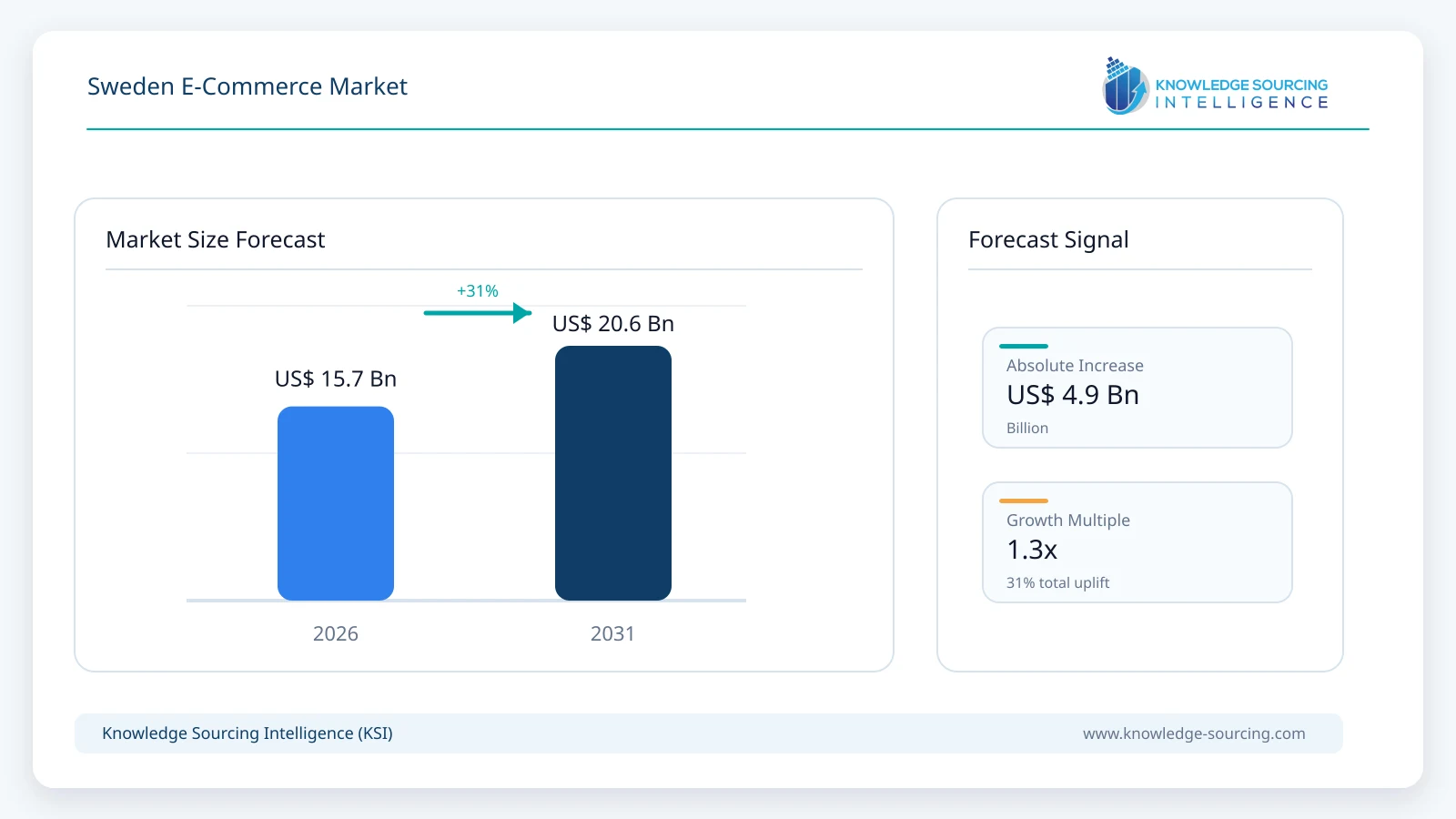
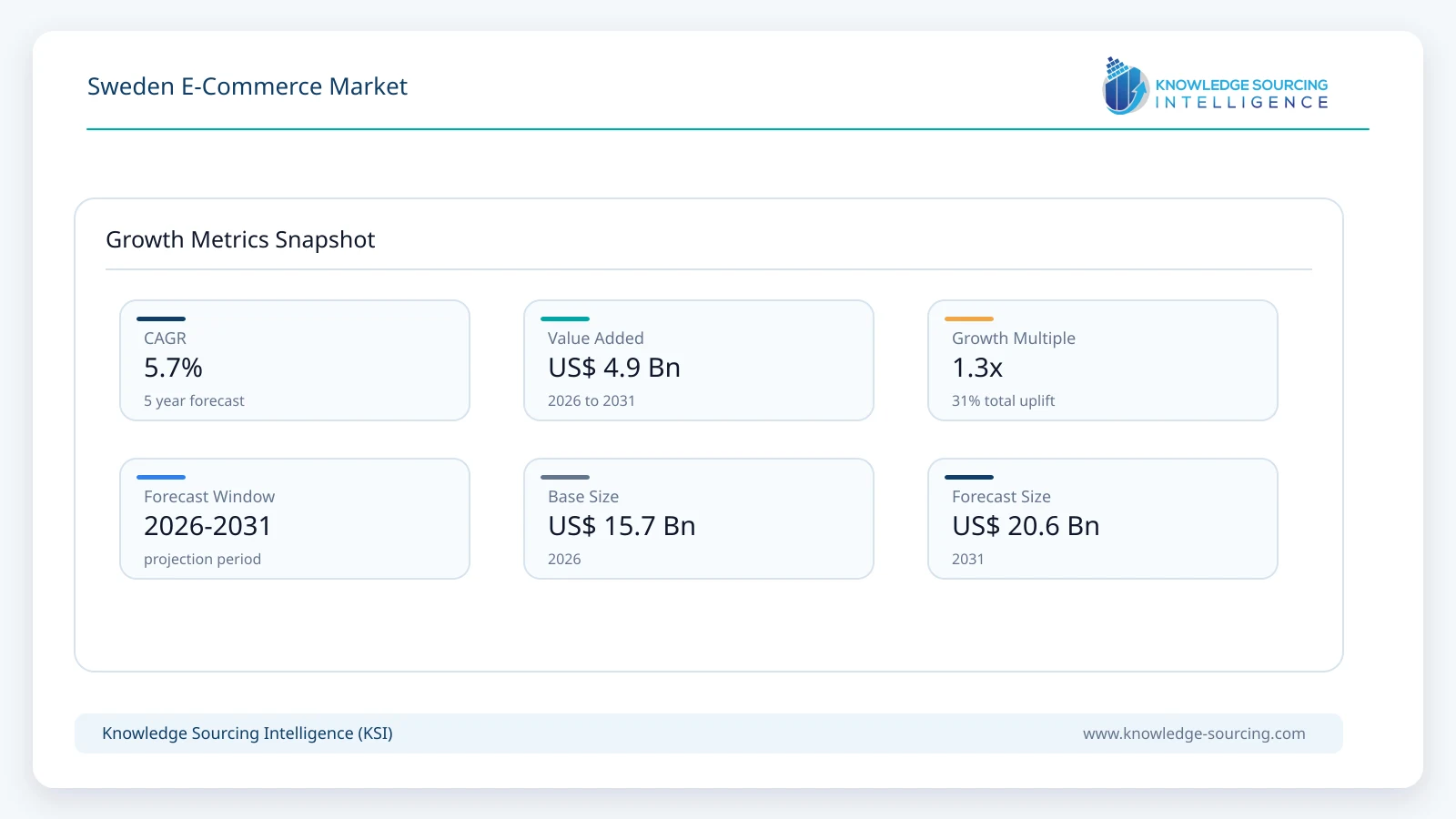
The Swedish E-Commerce Market is forecast to grow at a CAGR of 5.7%, reaching USD 20.6 billion in 2031 from USD 15.7 billion in 2026.
Highlights:
- 1Sweden's mature digital infrastructure continues to support high online purchasing frequency across consumer and business segments.
- 2Mobile commerce, digital payment innovation, and omnichannel retail strategies are reshaping customer purchasing behavior.
- 3Cross-border online retail remains commercially important, increasing competitive pressure on domestic marketplaces and retailers.
- 4Fashion, consumer electronics, and online pharmacy channels continue attracting sustained digital investment and customer traffic.
- 5Retailers are expanding logistics automation and fulfillment capabilities to improve delivery speed and customer retention.
Consumer purchasing patterns continue to evolve as retailers invest in personalized shopping experiences, mobile applications, artificial intelligence-enabled recommendations, and integrated loyalty programs. According to Statistics Sweden (SCB), internet usage and digital engagement remain widespread across households, while Sweden maintains one of Europe's highest rates of cashless transactions, reinforcing digital commerce across multiple product categories. Businesses are similarly increasing online procurement activities to improve purchasing efficiency and supplier transparency.
Competition has shifted from expanding customer acquisition toward improving operational efficiency and customer lifetime value. Retailers are investing in warehouse automation, inventory visibility, faster fulfillment, and last-mile delivery capabilities to meet increasingly demanding service expectations. Official company disclosures from several Swedish retailers also indicate continued investment in digital platforms, logistics infrastructure, and customer experience despite persistent pressure on operating margins.
Cross-border commerce continues to influence purchasing behavior as Swedish consumers increasingly compare products across domestic and international platforms. Global marketplaces compete alongside established Nordic retailers, while domestic companies strengthen localized assortments, payment solutions, and customer service to maintain competitiveness. These conditions are encouraging continued investment across payment technology, logistics services, digital marketing, and retail software throughout the forecast period.
Key Market Indicators
Indicator | Latest Evidence | Commercial Meaning |
Individuals using the internet in Sweden | Over 95% of the population (SCB, recent surveys) | Supports a broad addressable online customer base across retail categories. |
Cashless payment adoption | Sweden remains among the world's most cashless economies (Sveriges Riksbank) | Digital payment acceptance lowers friction in online purchasing and supports checkout conversion. |
Cross-border online shopping | A substantial share of Swedish online shoppers purchase from foreign retailers (PostNord E-barometer) | Domestic retailers compete directly with international marketplaces on assortment, pricing, and delivery. |
Smartphone penetration | Smartphone ownership exceeds 90% among adults (Nordic digital statistics) | Mobile commerce continues to influence product discovery and purchasing behavior. |
Parcel delivery demand | Parcel volumes remain supported by sustained e-commerce activity (PostNord) | Logistics capacity and fulfillment efficiency remain critical competitive factors. |
Key Indicator: Sweden consistently ranks among Europe's most digitally connected economies, according to the European Commission's Digital Economy assessments.
Commercial Meaning: High digital maturity reduces barriers to online purchasing and supports continued investment in digital retail infrastructure.
Market Drivers
Expansion of omnichannel retail and integrated fulfillment networks
Retailers operating in Sweden increasingly combine physical stores, online platforms, and centralized fulfillment operations to improve inventory utilization and customer convenience. H&M Group, IKEA, Boozt AB, and several Nordic retailers continue investing in digital fulfillment capabilities, click-and-collect services, automated distribution centers, and real-time inventory management through their official business strategies and annual disclosures. Customers increasingly expect flexible delivery options alongside seamless returns, prompting retailers to integrate stores into fulfillment networks. These investments improve inventory turnover, reduce delivery times, and strengthen customer retention while increasing demand for logistics technology, warehouse automation, and digital retail software.
Growing preference for flexible digital payment solutions
Payment flexibility has become a decisive purchasing criterion in Swedish e-commerce. Klarna's payment ecosystem, together with widespread adoption of digital banking services, enables consumers to select installment payments, deferred payment options, and instant digital transactions across multiple retail categories. Sveriges Riksbank continues to report declining cash usage within the Swedish economy, while digital payment adoption remains among the highest globally. Retailers increasingly integrate multiple payment alternatives because checkout convenience directly affects conversion rates and shopping-cart completion. Payment providers are responding by expanding fraud prevention capabilities, identity verification technologies, and embedded financial services that improve transaction security and customer confidence.
Rising cross-border purchasing and wider product availability
PostNord's E-barometer continues to identify cross-border online shopping as an established purchasing behavior among Swedish consumers. International marketplaces provide broader product assortments, competitive pricing, and access to brands unavailable through domestic retailers. This purchasing pattern encourages Swedish retailers to strengthen localized customer service, expand exclusive product offerings, improve delivery speed, and optimize pricing strategies. Investments in multilingual platforms, international logistics partnerships, and efficient customs handling also support sellers seeking to compete across Nordic and broader European markets, increasing demand for fulfillment providers and cross-border commerce solutions.
Digital investment across health, beauty, and specialty retail
Specialized online retailers continue expanding beyond traditional merchandise categories. Companies including Apotea AB and Lyko Group have invested in digital customer engagement, automated logistics, and expanded product portfolios to serve growing online demand for pharmacy, health, beauty, and personal care products. Official company disclosures indicate continued investment in warehouse capacity, customer service, and technology platforms to improve operational efficiency. Customers increasingly value product availability, rapid delivery, trusted reviews, and subscription-based purchasing models, encouraging retailers to strengthen digital capabilities within specialized product categories where repeat purchasing supports long-term customer value.
Market Restraints and Challenges
Intensifying price competition from international marketplaces
International marketplaces continue placing downward pressure on pricing across multiple product categories. Swedish consumers can readily compare prices between domestic retailers and foreign sellers, reducing pricing flexibility for local companies. Company disclosures from several Nordic retailers identify promotional intensity and changing consumer spending patterns as ongoing commercial challenges affecting profitability. Retailers increasingly rely on differentiated product assortments, customer loyalty programs, premium services, and efficient logistics rather than price competition alone. Although operational improvements can partially offset margin pressure, sustained promotional activity continues affecting profitability across online retail.
High fulfillment and last-mile delivery costs
Customer expectations for rapid delivery, convenient returns, and shipment tracking continue increasing logistics costs. Parcel handling, warehouse automation, transportation, labor availability, and reverse logistics require continuous investment by retailers and logistics providers. Official statements from Nordic retail companies indicate that fulfillment efficiency remains an important operational priority because delivery performance directly affects customer satisfaction and repeat purchases. Smaller retailers often face greater challenges in achieving comparable economies of scale, making fulfillment costs a continuing competitive constraint within Sweden's e-commerce ecosystem.
Cybersecurity risks and stricter data protection requirements
Growing transaction volumes increase exposure to payment fraud, phishing attacks, account takeovers, and other cyber threats. Retailers must continuously invest in cybersecurity, identity verification, secure payment processing, and regulatory compliance to maintain customer trust. Compliance with the General Data Protection Regulation (GDPR) and evolving European digital regulations requires continuous monitoring, documentation, and investment in data governance. These obligations are particularly demanding for smaller online retailers with limited technical resources, increasing operating costs while extending implementation timelines for new digital services.
Demand volatility linked to consumer spending conditions
Although Sweden maintains high digital adoption, discretionary online spending remains influenced by household purchasing power, inflation, and broader economic conditions. Retailers in categories such as fashion, consumer electronics, and home furnishings experience fluctuations in purchasing frequency as consumers prioritize essential expenditures during periods of economic uncertainty. Company reports from several listed retailers have highlighted cautious consumer sentiment in recent years, leading businesses to optimize inventory management, promotional strategies, and procurement planning. This environment encourages operational discipline but may delay investment decisions and reduce revenue visibility during weaker consumption cycles.
Major Segment Analysis
Business-to-Consumer (B2C)
The Business-to-Consumer (B2C) segment remains the most commercially important component of Sweden's e-commerce market because it accounts for the broadest range of online retail transactions across fashion, consumer electronics, home furnishings, grocery, beauty, pharmacy, and lifestyle products. High household internet penetration, widespread digital payment adoption, and established parcel delivery infrastructure have enabled consumers to integrate online purchasing into routine shopping behavior. Retailers increasingly compete through delivery reliability, personalized digital experiences, flexible payment methods, and efficient return processes rather than product availability alone.
Consumers also expect consistent experiences across websites, mobile applications, and physical stores, making omnichannel integration a key purchasing criterion. Companies including H&M Group, IKEA, Boozt AB, Apotea AB, Lyko Group AB, and CDON AB continue expanding digital capabilities through improved search functionality, loyalty programs, automated fulfillment, and customer analytics. While cross-border marketplaces intensify pricing pressure, domestic retailers differentiate themselves through localized customer support, faster deliveries, trusted payment solutions, and stronger brand recognition. Performance within the B2C segment continues to influence logistics investment, payment innovation, customer acquisition strategies, and the broader competitive dynamics of Sweden's e-commerce industry.
Competitive Landscape
Sweden's e-commerce market combines established domestic retailers, specialized digital platforms, and international marketplace operators competing across multiple product categories. Klarna AB continues strengthening its position through payment technology and embedded financial services, while CDON AB operates as a Nordic online marketplace serving multiple merchants. H&M Group, IKEA, Boozt AB, Lyko Group AB, Apotea AB, Ellos Group, and NetOnNet AB continue investing in omnichannel capabilities, warehouse automation, digital marketing, and customer experience to improve operational efficiency and customer retention. Amazon Sweden increases competitive intensity by expanding marketplace participation, fulfillment capabilities, and product assortment.
Competition increasingly depends on logistics performance, payment flexibility, customer loyalty, digital personalization, and inventory visibility rather than pricing alone. Retailers are expanding automation, improving demand forecasting, strengthening supplier relationships, and integrating artificial intelligence into merchandising and customer support. High customer expectations, established brands, and investment requirements in technology and fulfillment continue creating barriers for smaller entrants seeking national scale.
Recent Developments
July 2026: IKEA released its HÖSTAGILLE autumn collection online in Sweden on 24 July 2026, providing customers with simultaneous digital and physical access to the new seasonal assortment.
June 2026: Amazon reported continued investment in Sweden, highlighting millions of Swedish customers, broader product selection, fast delivery and growing support for businesses selling online domestically and internationally.
May 2026: PostNord implemented updated parcel and logistics terms on 4 May 2026, introducing changes to services supporting Swedish merchants and their e-commerce fulfilment and delivery operations.
January 2026: IKEA launched its second-hand marketplace in Sweden on 28 January 2026, enabling IKEA Family members to buy and sell used IKEA products through a dedicated online platform.
Regulatory and Policy Environment
Sweden's e-commerce market operates within a comprehensive regulatory framework established through national legislation and European Union directives. The General Data Protection Regulation (GDPR) continues to define requirements for personal data processing, cybersecurity practices, customer consent, and digital privacy. Compliance remains essential for retailers managing customer information, payment processing, and personalized marketing activities.
The EU Digital Services Act (DSA) introduces additional responsibilities for online platforms regarding transparency, illegal content management, consumer protection, and accountability. Marketplace operators serving Swedish consumers must strengthen reporting procedures, seller verification processes, and risk management systems. These obligations are particularly relevant for multi-vendor platforms and cross-border marketplace operators.
Consumer protection legislation also influences purchasing practices through standardized return rights, pricing transparency, warranty obligations, and distance-selling regulations. Swedish consumers generally benefit from strong legal protections governing online purchases, increasing confidence in digital commerce while requiring retailers to maintain clear contractual terms and efficient customer support.
Environmental regulation is becoming increasingly relevant across packaging, transportation, and product lifecycle management. Retailers continue adapting packaging materials, reverse logistics processes, and sustainability reporting to align with evolving European environmental objectives. These requirements encourage investment in efficient logistics networks while increasing operational responsibilities throughout the value chain.
Outlook and Strategic Implications
Sweden's e-commerce market is expected to remain one of Europe's most mature digital retail environments during the 2026–2031 forecast period. Future competition will depend less on expanding first-time online shopping and more on improving operational efficiency, customer retention, fulfillment quality, and digital service differentiation. Artificial intelligence, automation, predictive inventory management, and integrated payment ecosystems are likely to become increasingly important competitive tools as retailers seek productivity improvements while maintaining customer satisfaction.
Strategic priorities across the value chain are expected to include:
Retailers: Increase investment in omnichannel integration, customer analytics, automation, and personalized shopping experiences to improve retention and profitability.
Payment providers: Expand fraud prevention, embedded finance, and secure digital payment capabilities as transaction volumes continue increasing.
Logistics providers: Strengthen warehouse automation, parcel handling capacity, and sustainable last-mile delivery solutions to meet rising service expectations.
Technology providers: Develop scalable commerce platforms, artificial intelligence applications, cybersecurity solutions, and cloud-based retail management systems that support increasingly complex digital operations.
Companies capable of combining efficient fulfillment, trusted payment solutions, localized customer engagement, regulatory compliance, and flexible digital infrastructure are expected to maintain stronger competitive positioning throughout the forecast period. Continued investment in technology, logistics resilience, and customer experience will remain central to long-term commercial performance as domestic retailers compete alongside global marketplace operators.
Sweden E-Commerce Market Scope:
| Report Metric | Details |
|---|---|
| Total Market Size in 2026 | USD 15.7 billion |
| Total Market Size in 2031 | USD 20.6 billion |
| Forecast Unit | Billion |
| Growth Rate | 5.7% |
| Study Period | 2021 to 2031 |
| Historical Data | 2021 to 2024 |
| Base Year | 2025 |
| Forecast Period | 2026 – 2031 |
| Segmentation | Type, Mode, Industry |
| Companies |
|
Market Segmentation
By Type
- B2B
- B2C
- C2B
- C2C
By Mode
- Website
- Mobile Application
By Industry
- Consumer Electronics
- Fashion
- Home Care
- Education
- Others
Table of Contents
1. INTRODUCTION
1.1. Market Overview
1.2. Market Definition
1.3. Scope of the Study
1.4. Market Segmentation
1.5. Currency
1.6. Assumptions
1.7. Base and Forecast Years Timeline
1.8. Key benefits to the stakeholder
2. RESEARCH METHODOLOGY
2.1. Research Design
2.2. Research Process
3. EXECUTIVE SUMMARY
3.1. Key Findings
3.2. Analyst View
4. MARKET DYNAMICS
4.1. Market Drivers
4.2. Market Restraints
4.3. Porter’s Five Forces Analysis
4.3.1. Bargaining Power of Suppliers
4.3.2. Bargaining Power of Buyers
4.3.3. Threat of New Entrants
4.3.4. Threat of Substitutes
4.3.5. Competitive Rivalry in the Industry
4.4. Industry Value Chain Analysis
4.5. Analyst View
5. SWEDEN E-COMMERCE MARKET BY TYPE
5.1. Introduction
5.2. B2B
5.2.1. Market opportunities and trends
5.2.2. Growth prospects
5.3. B2C
5.3.1. Market opportunities and trends
5.3.2. Growth prospects
5.4. Consumer-to-Consumer (C2C)
5.4.1. Market opportunities and trends
5.4.2. Growth prospects
5.5. Direct-to-Consumer (D2C)
5.5.1. Market opportunities and trends
5.5.2. Growth prospects
6. SWEDEN E-COMMERCE BY MODE
6.1. Introduction
6.2. Website
6.2.1. Market opportunities and trends
6.2.2. Growth prospects
6.3. Mobile Applications
6.3.1. Market opportunities and trends
6.3.2. Growth prospects
7. SWEDEN E-COMMERCE BY INDUSTRY
7.1. Introduction
7.2. Consumer Electronics
7.2.1. Market opportunities and trends
7.2.2. Growth prospects
7.3. Fashion and Apparel
7.3.1. Market opportunities and trends
7.3.2. Growth prospects
7.4. Home and Furniture
7.4.1. Market opportunities and trends
7.4.2. Growth prospects
7.5. Grocery
7.5.1. Market opportunities and trends
7.5.2. Growth prospects
7.6. Health and Beauty
7.6.1. Market opportunities and trends
7.6.2. Growth prospects
7.7. Others
7.7.1. Market opportunities and trends
7.7.2. Growth prospects
8. COMPETITIVE ENVIRONMENT AND ANALYSIS
8.1. Major Players and Strategy Analysis
8.2. Market Share Analysis
8.3. Mergers, Acquisition, Agreements, and Collaborations
8.4. Competitive Dashboard
9. COMPANY PROFILES
9.1. Klarna AB
9.2. CDON AB
9.3. H&M Group
9.4. IKEA
9.5. Amazon Sweden
9.6. Apotea AB
9.7. Boozt AB
9.8. Lyko Group AB
9.9. Ellos Group
9.10. NetOnNet AB
LIST OF FIGURES
LIST OF TABLES
Navigate
Trusted by the world's leading organizations











