
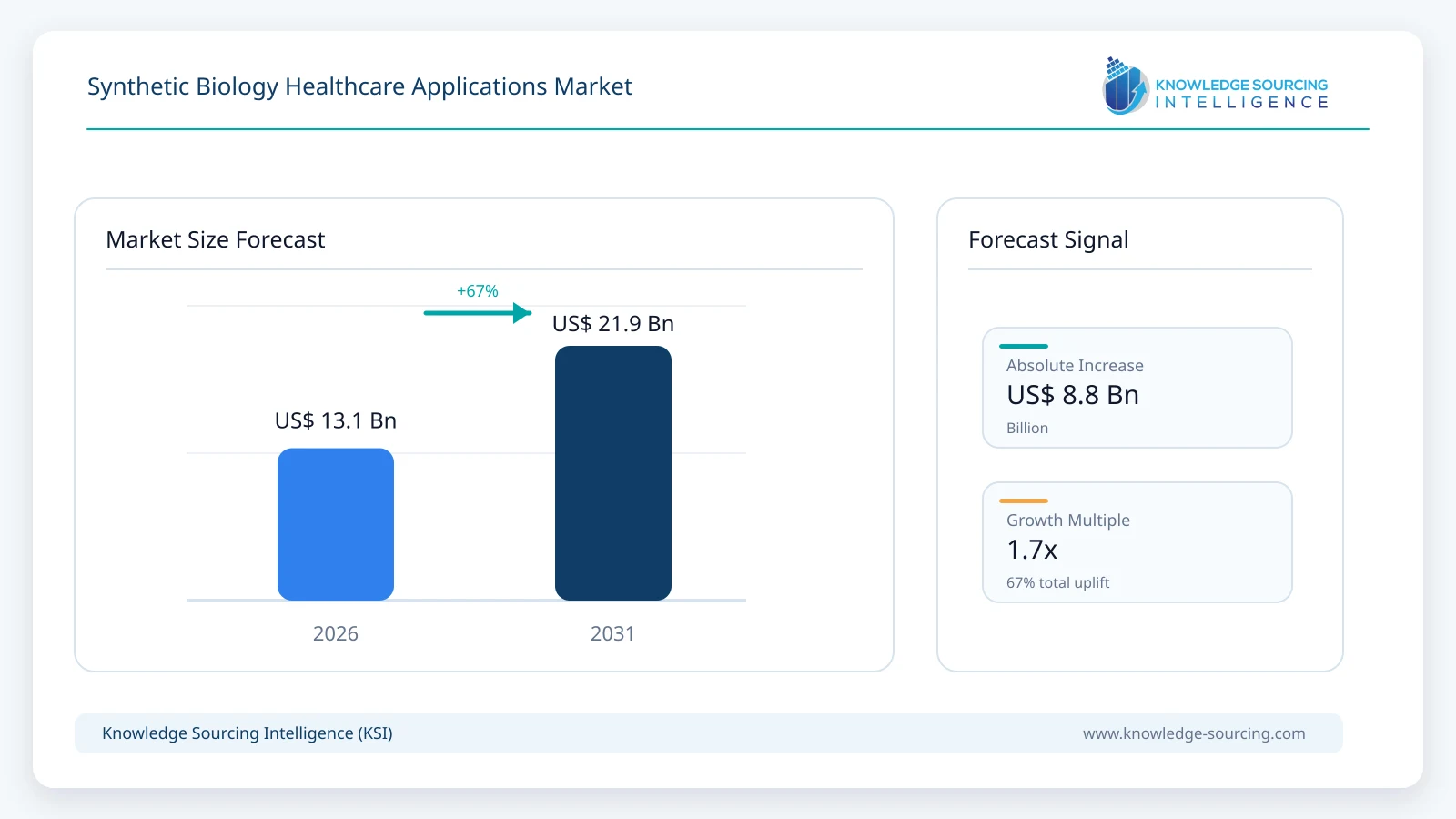
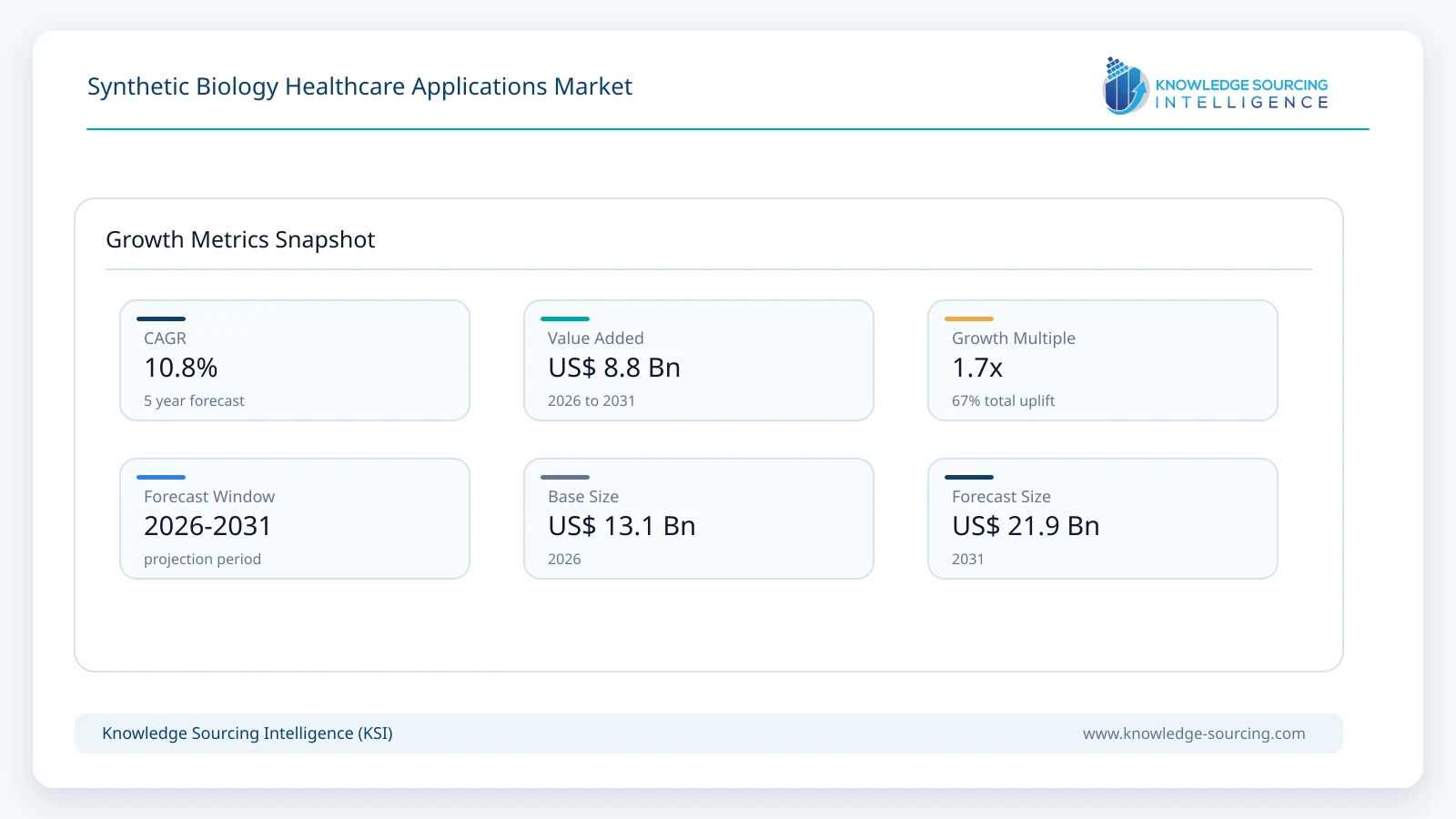
The Global Synthetic Biology Healthcare Applications market is projected to grow at a CAGR of 10.8%, reaching USD 21.9 billion in 2031 from USD 13.1 billion in 2026.
Highlights:
- 1The Synthetic Biology Healthcare Applications market is expanding steadily at a CAGR of 10.8% and is projected to reach USD 21.9 billion by 2031.
- 2Synthetic DNA and RNA are emerging as the fastest-growing product segment, capturing approximately 35-40% share due to rising use in gene therapies and mRNA platforms.
- 3Gene and cell therapy applications are advancing rapidly and currently hold nearly 30-35% of the overall market, driven by clinical progress in cancer and genetic disorders.
- 4North America is dominating the regional landscape with an approximate 40-45% market share, supported by strong biotech infrastructure and regulatory frameworks.
- 5Asia-Pacific is witnessing the quickest regional expansion, contributing around 20-25% share amid rising investments and healthcare infrastructure development.
- 6Precision medicine and genome-editing technologies are continuously strengthening market momentum while addressing chronic, infectious, and rare disease burdens worldwide.
The synthetic biology healthcare applications market is advancing rapidly as engineered biological systems, programmable genetic circuits, genome editing, and cell-based technologies move toward practical medical applications. Recent developments are expanding the role of synthetic biology across drug discovery, diagnostics, gene and cell therapies, disease monitoring, and personalized treatment. In June 2026, the U.S. FDA issued draft guidance on leveraging prior knowledge for human gene therapies incorporating genome editing, reflecting growing regulatory attention to technologies that can enable more efficient development of advanced therapies. The FDA also introduced additional flexibility for chemistry, manufacturing, and controls requirements for cellular and gene therapy products in May 2026, supporting the development and review of innovative treatments for serious and life-threatening conditions.
Synthetic biology is also strengthening healthcare diagnostics through programmable biosensors, engineered cells, and biological circuits capable of detecting disease-associated signals. Research published in 2025 highlighted advances in synthetic biology-driven biosensors using synthetic gene circuits, CRISPR-based systems, RNA regulators, and logic-gate architectures for applications including pathogen detection, cancer biomarkers, metabolic monitoring, early diagnosis, and treatment monitoring. Government-backed research initiatives further demonstrate the expanding healthcare scope of synthetic biology, covering engineered cells, programmable therapeutic systems, cell-free diagnostics, biosensors, regenerative medicine, and gene-editing approaches for diseases including cancer and cardiovascular, pulmonary, and blood disorders.
Market expansion is therefore being supported by continued investment in biomedical research, advances in genome engineering and cell engineering, increasing clinical development of gene and cell therapies, and greater regulatory efforts to facilitate innovation while maintaining safety and quality. At the same time, commercialization remains constrained by complex manufacturing requirements, safety and immunogenicity considerations, delivery challenges, biosafety requirements, long-term monitoring needs, and regulatory complexity. The FDA's 2025–2026 guidance activity, including recommendations covering post-approval safety and efficacy monitoring and genome-editing technologies, highlights the importance of demonstrating sustained safety and effectiveness for these advanced biological products.
Market Dynamics
Market Drivers
Accelerating Shift Toward Precision and Personalized Medicine: The global healthcare landscape is changing rapidly and moving towards personalized treatment plans, where synthetic biology will be a major factor through the ability to create patient-specific genetic and molecular profile-based therapies. This significantly raises treatment efficacy, reduces drug side effects to a minimum, and leads to better long-term clinical results, especially in the case of complicated and varied diseases like cancer, diabetes, and rare genetic disorders.
Breakthrough Innovations in Genetic Engineering and Gene Editing Technologies: The ongoing improvement of genetic engineering tools, such as CRISPR-Cas systems, zinc finger nucleases, and TALENs, is changing the potential to accurately edit DNA sequences. Such breakthroughs are making it possible to fix genetic disorders, manufacture engineered immune cells, and find new therapeutic routes. Consequently, the range of synthetic biology applications in medicine is rapidly widening.
Rising Global Burden of Chronic, Infectious, and Genetic Diseases: One of the major reasons for the development of advanced healthcare solutions is the continual rise in the number of people suffering from chronic conditions, the re-emergence of infectious diseases, and genetic disorders. Synthetic biology opens new methods for early diagnosis, understanding diseases through modeling, and developing interventions that can precisely target the problem areas, hence enhancing the chances of survival of patients.
Surge in Biopharmaceutical and Biotechnology R&D Investments: Investments coming from pharmaceutical firms, venture capitalists, and government agencies have promoted synthetic biology research. These funds have led to innovations in drug discovery, biologics production, and therapies that are more advanced, helping to speed up the process of bringing a product from the research lab to the clinic.
Market Restraints and Opportunities
High Capital Requirements and Cost-Intensive Development Cycles: Creating healthcare solutions through synthetic biology requires a major investment in modern laboratory facilities, high-throughput screening equipment, and other specialized tools. Besides, the extended research period, costly clinical trials, and meeting regulatory requirements make the financial load even heavier, thereby limiting the ability of startups and small companies to challenge the leading market players effectively.
Ethical, Social, and Biosafety Concerns: Synthetic biology poses several important ethical questions, such as human gene editing, alterations of the germline, and even the making of artificial life forms. The public concern about "tampering with nature, " and, on the other hand, a fear of accidental environmental damage, may prevent the spread of acceptance and slow down the approval of related policies.
Technical Limitations and Biological Complexity: Creating biological systems that are predictable and stable is still a great challenge. Cell environments are naturally very complex and constantly changing, which results in unintended gene interactions, off-target effects, or loss of functionality over time. These uncertainties may lead to problems with reproducibility and act as barriers to wide-scale clinical use.
Next-Generation Vaccine Development and Pandemic Preparedness: Synthetic biology enables rapid design and scalable production of vaccines, including mRNA-based platforms. This capability is critical for responding to emerging infectious diseases and future pandemics, creating strong demand from governments and global health organizations.
Key Developments
January 2026: bit.bio, a next-generation human cell programming player located in Cambridge, has successfully closed its Series C funding round of $50 million with the lead investor M&G Investments.
June 2025: Antheia has secured $56 million through a Series C funding round to further develop its synthetic biology platform, a system that utilizes genetically modified yeast to manufacture key drug components, hence making it possible for the company to address the persistent worldwide drug shortage issues.
Market Segmentation
By Product Type – Synthetic DNA & RNA
Among product types, synthetic DNA & RNA are projected to be the fastest-growing segment due to their essential function in synthetic biology and the creation of new therapies. These nucleic acids are used for gene synthesis, genome editing, and making next-generation biologics, such as mRNA vaccines and gene therapies. The rapid adoption of RNA-based technologies, especially following the success of mRNA vaccines, has significantly accelerated demand for high-quality synthetic nucleic acids. Alongside these, breakthroughs in genetic engineering and the continuing reduction in the price of DNA synthesis are allowing their extensive use in research, diagnostics, and clinical settings.
By Application – Gene & Cell Therapy
Gene & Cell Therapy is emerging as the most rapidly growing application segment because of its ability to radically change the treatment of highly complex and even previously incurable illnesses. Synthetic biology is increasingly becoming a major tool in these therapies that concentrate on modifying or substituting faulty genes and producing cells capable of recognizing the major disease pathways. For instance, they are highly effective in cancer, genetic diseases, and immune system disorders. The increasing number of clinical trials, regulatory approvals, and investments in advanced therapeutic platforms is driving rapid expansion.
Regional Analysis
North America Market Analysis
North America is leading the synthetic biology healthcare applications market mainly because of its technological advancement, healthcare services, and large-scale investments in synthetic biology research. The US market is driven by several factors, such as the presence of large biotech companies, advanced research institutions, and a well-developed regulatory system that supports innovations while maintaining safety. Especially, gene therapies, mRNA vaccines, and engineered biologics have been developed more rapidly because of substantial funding from government bodies like NIH and public and private sector partnerships. Furthermore, the increasing number of people affected by chronic diseases such as cancer contributes to the demand for precision medicine and targeted therapies. Canada's growth is mainly attributable to its policy environment as well as increasing financial commitment to the life sciences sector.
South America Market Analysis
South America represents a developing market for synthetic biology in healthcare, supported by rising investments in biotechnology, expanding healthcare infrastructure, and increasing demand for advanced therapeutics. Although the region currently holds a smaller share compared to North America and Europe, it is witnessing steady growth due to the rising burden of chronic diseases, increasing clinical trial activity, and growing collaboration with global pharmaceutical companies.
Europe Market Analysis
Europe accounts for a major segment of the synthetic biology healthcare market due to its regulatory setups, substantial government investments, and a well-established biotech ecosystem. Leading the pack are countries like Germany, the UK, and France, which continue to excel in research and drive innovation through public-private partnerships. The European Union has been a major investor in synthetic biology with projects like Horizon Europe, which foster research as well as commercialization across the partner countries. Besides, the region is experiencing ramped-up use of treatments such as gene and cell therapies, mostly for long-term and rare ailments. On top of that, regulatory hurdles and ethical issues surrounding genetic manipulation can occasionally cause delays in launching products.
Middle East and Africa Market Analysis
The Middle East & Africa region is an emerging market in the synthetic biology healthcare applications market. The United Arab Emirates, Saudi Arabia, and some other countries of the region are looking at healthcare modernization and biotechnology as important factors of their long-term economic diversification strategies. A strong government initiative towards enhancing the healthcare infrastructure, combined with a growing awareness of therapeutic options, is the main factor behind the growth of the market. On the other hand, growth in Africa remains slower, due to limited resources and infrastructure, but international collaborations and funding initiatives are improving accessibility to innovative healthcare solutions.
Asia Pacific Market Analysis
The Asia-Pacific region is likely to lead the synthetic biology healthcare applications market in terms of growth, owing to the development of healthcare infrastructure, increased investments in biotechnology, and a growing need for innovative medical solutions. Major economies in the region, such as China, Japan, India, and South Korea, are significantly contributing to the growth of the regional market. China is ramping up its synthetic biology research and biomanufacturing investments, whereas Japan is capitalizing on its strong technological knowledge in areas like regenerative medicine and precision healthcare. India is rapidly becoming a hotspot for synthetic biology with its expanding biotech industry, availability of highly trained professionals, and a series of government measures aimed at encouraging innovation in life sciences.
List of Companies
Ginkgo Bioworks
GenScript Biotech
Thermo Fisher Scientific
Illumina
Danaher Corporation
AbCellera Biologics
Precigen
Poseida Therapeutics
Mammoth Biosciences
Codexis
Thermo Fisher Scientific
Thermo Fisher Scientific is a global player in the synthetic biology healthcare applications market, providing a comprehensive portfolio of tools, technologies, and services that support advanced research and clinical applications. The company plays a critical role in enabling innovations in synthetic biology by offering solutions such as gene synthesis, genome editing tools, cell culture systems, and high-throughput sequencing platforms.
Danaher Corporation
Danaher Corporation specializes in synthetic biology healthcare applications and have presence in life science, diagnostics, and biotechnology solutions portfolios. The company offers instruments and platforms aiding synthetic biology innovations through its subsidiaries like Cytiva, Pall Corporation, and Integrated DNA Technologies (IDT). Technologies related to bioprocessing, genomics, and cell culture are offered by Danaher, helping R&D and marketing of biologics, gene therapies, and vaccines.
Synthetic Biology Healthcare Applications Market Scope:
| Report Metric | Details |
|---|---|
| Total Market Size in 2026 | USD 13.1 billion |
| Total Market Size in 2031 | USD 21.9 billion |
| Forecast Unit | Billion |
| Growth Rate | 10.8% |
| Study Period | 2021 to 2031 |
| Historical Data | 2021 to 2024 |
| Base Year | 2025 |
| Forecast Period | 2026 – 2031 |
| Segmentation | Product Type, Application, End User, Geography |
| Companies |
|
Market Segmentation
By Product Type
Enzymes
Synthetic DNA & RNA
Chassis Organisms
Xeno-nucleic Acids (XNA)
Others
By Application
Drug Discovery & Development
Diagnostics
Vaccine Development
Regenerative Medicine
Gene & Cell Therapy
Others
By End User
Pharmaceutical & Biotechnology Companies
Academic & Research Institutes
Contract Research Organizations (CROs)
Hospitals & Clinics
Others
By Geography
North America
USA
Canada
Mexico
South America
Brazil
Argentina
Others
Europe
United Kingdom
Germany
France
Spain
Others
Middle East and Africa
Saudi Arabia
UAE
Others
Asia Pacific
China
India
Japan
South Korea
Indonesia
Thailand
Others
Table of Contents
1. EXECUTIVE SUMMARY
2. MARKET SNAPSHOT
2.1. Market Overview
2.2. Market Definition
2.3. Scope of the Study
2.4. Market Segmentation
3. BUSINESS LANDSCAPE
3.1. Market Drivers
3.2. Market Restraints
3.3. Market Opportunities
3.4. Porter’s Five Forces Analysis
3.5. Industry Value Chain Analysis
3.6. Policies and Regulations
3.7. Strategic Recommendations
4. TECHNOLOGICAL OUTLOOK
5. SYNTHETIC BIOLOGY HEALTHCARE APPLICATIONS MARKET BY PRODUCT TYPE
5.1. Introduction
5.2. Enzymes
5.3. Synthetic DNA & RNA
5.4. Chassis Organisms
5.5. Xeno-nucleic Acids (XNA)
5.6. Others
6. SYNTHETIC BIOLOGY HEALTHCARE APPLICATIONS MARKET BY APPLICATION
6.1. Introduction
6.2. Drug Discovery & Development
6.3. Diagnostics
6.4. Vaccine Development
6.5. Regenerative Medicine
6.6. Gene & Cell Therapy
6.7. Others
7. SYNTHETIC BIOLOGY HEALTHCARE APPLICATIONS MARKET BY END USER
7.1. Introduction
7.2. Pharmaceutical & Biotechnology Companies
7.3. Academic & Research Institutes
7.4. Contract Research Organizations (CROs)
7.5. Hospitals & Clinics
7.6. Others
8. SYNTHETIC BIOLOGY HEALTHCARE APPLICATIONS MARKET BY GEOGRAPHY
8.1. Introduction
8.2. North America
8.2.1. USA
8.2.2. Canada
8.2.3. Mexico
8.3. South America
8.3.1. Brazil
8.3.2. Argentina
8.3.3. Others
8.4. Europe
8.4.1. United Kingdom
8.4.2. Germany
8.4.3. France
8.4.4. Spain
8.4.5. Others
8.5. Middle East and Africa
8.5.1. Saudi Arabia
8.5.2. UAE
8.5.3. Others
8.6. Asia Pacific
8.6.1. China
8.6.2. India
8.6.3. Japan
8.6.4. South Korea
8.6.5. Indonesia
8.6.6. Thailand
8.6.7. Others
9. COMPETITIVE ENVIRONMENT AND ANALYSIS
9.1. Major Players and Strategy Analysis
9.2. Market Share Analysis
9.3. Mergers, Acquisitions, Agreements, and Collaborations
9.4. Competitive Dashboard
10. COMPANY PROFILES
10.1. Ginkgo Bioworks
10.2. GenScript Biotech
10.3. Thermo Fisher Scientific
10.4. Illumina
10.5. Danaher Corporation
10.6. AbCellera Biologics
10.7. Precigen
10.8. Poseida Therapeutics
10.9. Mammoth Biosciences
10.10. Codexis
11. APPENDIX
11.1. Currency
11.2. Assumptions
11.3. Base and Forecast Years Timeline
11.4. Key benefits for the stakeholders
11.5. Research Methodology
11.6. Abbreviations
Navigate
Trusted by the world's leading organizations











