
The global 3D printing surgical models market is forecast to grow at a CAGR of 12.9%, reaching USD 1.58 billion in 2031 from USD 860.0 million in 2026.
Highlights:
- 1Road transportation accounts for approximately 44.0% of global 3PL services revenue in 2026.
- 2Domestic logistics services represent approximately 58.0% of global 3PL revenue in 2026.
- 3Retail and e-commerce account for approximately 26.0% of global 3PL services revenue in 2026.
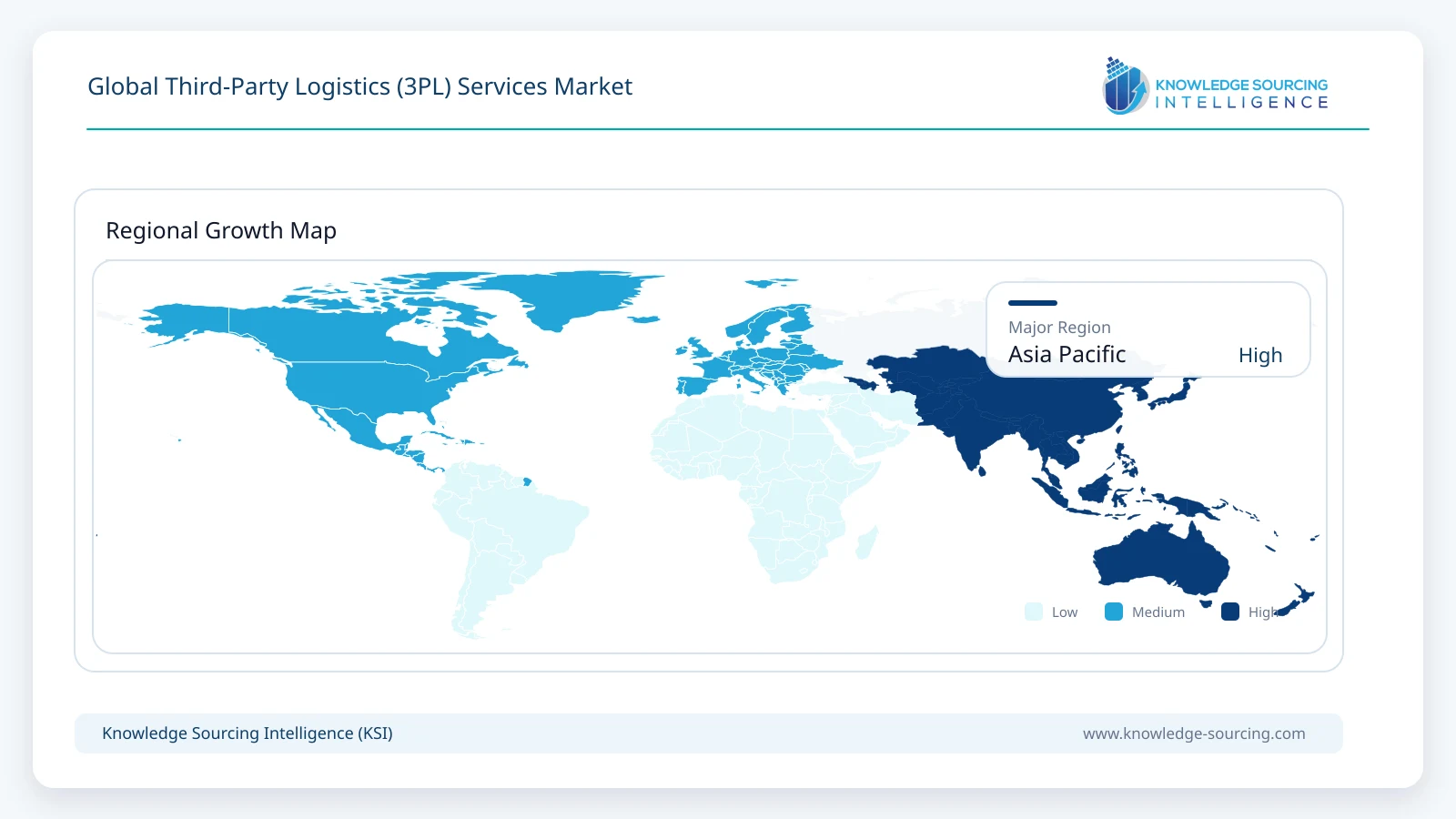
- 4Asia Pacific represents approximately 42.0% of global 3PL services revenue in 2026.
- 5DHL estimates the global contract logistics market alone at approximately EUR 289 billion in 2024, illustrating the scale of outsourced warehousing and supply-chain operations within the wider 3PL market.
- 6Automation, AI-enabled warehouse management, e-commerce fulfilment, healthcare logistics and supply-chain regionalization are increasing outsourcing intensity across major customer industries.
Market Overview
Third-party logistics (3PL) services cover outsourced transportation, freight management, warehousing, distribution, fulfilment, inventory handling, customs-related logistics and value-added supply-chain services performed by an external provider on behalf of manufacturers, retailers and other cargo owners. The market includes road, air, ocean and rail logistics where the 3PL provider manages the customer relationship and logistics execution. It excludes first-party logistics performed internally by shippers, pure carrier revenue where no third-party logistics role exists, and fourth-party logistics consulting where the provider does not directly operate or procure logistics services.
The market is substantially larger than contract logistics alone. DHL estimated the global contract logistics market at approximately EUR 289 billion in 2024, with Asia Pacific accounting for EUR 101 billion, the Americas EUR 86 billion, Europe EUR 86 billion and the Middle East/Africa EUR 16 billion. The broader 3PL market additionally includes domestic and international transportation management, freight brokerage and forwarding, dedicated transport, e-commerce logistics and other outsourced logistics activity.
The scale of leading providers supports a global market measured well above USD 1 trillion. DHL Supply Chain generated EUR 17.8 billion of revenue in 2025, Kuehne+Nagel generated CHF 24.5 billion of net turnover across its logistics businesses, and DSV became materially larger after completing the Schenker acquisition in April 2025. The market remains fragmented despite the scale of these global leaders, with regional specialists and thousands of local transport, brokerage and warehouse operators serving domestic supply chains.
Demand is being supported by structural outsourcing rather than by freight-rate inflation alone. Global trade in goods and services surpassed USD 35 trillion in 2025 according to UNCTAD, while cross-border e-commerce continues to increase shipment complexity. DHL's 2026 e-commerce research found that 70% of surveyed shoppers buy internationally and more than three in ten orders are being sent across borders. These flows increase the need for customs, fulfilment, returns, multi-carrier management and cross-border transport coordination.
The forecast assumes continued growth in trade and e-commerce volumes, further outsourcing of warehouse and transport operations, expanding life-sciences and technology logistics, and higher demand for end-to-end visibility. Growth is moderated by freight-rate volatility, customer insourcing in selected activities, pricing pressure and slower macroeconomic growth in mature markets. The result is a mid-single-digit value-growth profile rather than the unusually high growth rates seen during pandemic-era freight disruption.
Third-Party Logistics Market Trends
Warehouse Automation Becomes a Core 3PL Capability
Warehouse automation is moving from selected flagship sites toward standardized deployment across large 3PL networks. GXO is piloting AI-enabled autonomous industrial vehicles and in September 2026 began global pilots of a labor management system across North America and Europe. Kuehne+Nagel is rolling out a cloud-native, agentic-AI-enabled warehouse management platform across more than 1,000 sites. These investments increase productivity and make outsourced logistics more scalable for customers with variable demand.
E-Commerce Fulfilment Expands Beyond Traditional Retail Warehousing
3PL providers are increasingly operating high-throughput fulfilment networks designed around direct-to-consumer order profiles, returns and rapid inventory turns. CEVA opened a 23,000-square-meter e-commerce warehouse in Dubai in January 2026 and announced a 508,000-square-foot e-commerce facility in Derby, United Kingdom, in July 2026. Kuehne+Nagel also opened a 40,000-square-meter publishing fulfilment hub in Italy serving retail and direct-to-consumer channels.
Healthcare and Temperature-Controlled Logistics Gain Strategic Importance
Pharmaceutical, biotechnology and medical-device customers are outsourcing increasingly complex logistics requirements involving temperature control, chain of custody, regulatory documentation and time-critical transport. Kuehne+Nagel opened a temperature-controlled healthcare facility in Hyderabad in May 2026 and expanded its global Cool Corridor network in July. DSV also expanded temperature-controlled airfreight connectivity between Shanghai and major pharmaceutical hubs in September 2026.
Consolidation Increases Global Network Scale
The acquisition of Schenker by DSV is reshaping the competitive landscape. DSV reported in July 2026 that more than 60 countries had been integrated or were undergoing integration, with completion targeted by the end of 2026. The combined organization operates across more than 90 countries and materially increases DSV's scale in road, air, sea and contract logistics.
Supply-Chain Regionalization Raises Demand for Flexible 3PL Networks
Trade-policy uncertainty and supply-chain diversification are encouraging manufacturers to use multiple production and sourcing locations rather than relying on single-country networks. This increases demand for customs brokerage, cross-border road transport, multi-country warehousing and supplier-consolidation services. Large 3PL providers benefit because they can redesign routes and capacity across regions without customers building their own logistics infrastructure.
Segment Analysis
By Transportation Mode - Road
Road transportation is estimated at approximately USD 607.2 billion in 2026. The segment is the largest 3PL transportation mode because road freight connects factories, distribution centres, ports, airports, retail locations and final delivery points across both domestic and cross-border networks. It is also the principal mode for regional less-than-truckload, full-truckload, dedicated carriage and short-haul distribution. Large providers such as DSV, DHL, Kuehne+Nagel, J.B. Hunt, Ryder and Penske operate or procure extensive road networks, while digital brokerage and visibility tools are improving capacity utilization. Growth is supported by regional manufacturing, e-commerce replenishment and cross-border trade corridors, although driver availability, fuel costs and road congestion remain operational constraints.
By Service Type - Domestic Logistics Services
Domestic logistics services are estimated at approximately USD 800.4 billion in 2026. The segment represents the largest service pool because most freight movements and warehouse operations occur within national borders even when supply chains are globally connected. Domestic 3PL services include transport management, warehousing, distribution, dedicated carriage, fulfilment and value-added activities performed between local production, ports, distribution centres and customers. Outsourcing is particularly attractive where shippers need nationwide coverage without owning fleets and warehouses. The segment is being strengthened by e-commerce, same-country fulfilment, retail replenishment and manufacturing localization, while digital routing and warehouse automation allow 3PL providers to spread fixed technology investments across multiple customers.
By End-User Industry - Retail and E-Commerce
Retail and e-commerce are estimated at approximately USD 358.8 billion in 2026. The segment is the largest end-user pool because retailers and online merchants require warehousing, order fulfilment, parcel injection, store replenishment, returns management and cross-border delivery across highly variable demand cycles. DHL's 2026 e-commerce survey found that 70% of surveyed shoppers buy internationally and that delivery and returns options remain central to purchase conversion. Major 3PLs are responding with multi-user fulfilment facilities, automation and distributed inventory models. CEVA, Kuehne+Nagel, DHL Supply Chain, GXO and others continue to add e-commerce capacity, allowing retailers to outsource peak-season labor, technology and facility investment while maintaining wider geographic coverage.
By Geography - Asia Pacific
Asia Pacific is estimated at approximately USD 579.6 billion in 2026. The region is the largest 3PL market because it combines major manufacturing economies, large domestic consumer markets, high port volumes and rapidly growing e-commerce. China, Japan, South Korea, India and Southeast Asia support extensive domestic and international logistics networks, while manufacturing diversification is increasing cross-border flows within the region. DHL's contract-logistics market data already place Asia Pacific ahead of other regions in outsourced warehousing, and global providers continue to expand in India, Southeast Asia and Australia. Growth through 2031 is expected to be supported by manufacturing relocation, infrastructure investment, rising consumption and increasing adoption of formal outsourced logistics among mid-sized companies.
Market Drivers
Continued Outsourcing of Logistics Operations
Companies increasingly outsource warehousing, transportation and fulfilment to reduce capital requirements and gain access to broader networks. DHL explicitly describes the outsourcing trend as structurally intact, while GXO continues to report contract wins from sites previously operated in-house. Outsourcing allows customers to convert fixed logistics infrastructure into contracted services and use specialist technology without building internal capabilities.
Expansion of E-Commerce and Cross-Border Fulfilment
Online commerce increases parcel volumes, returns, SKU complexity and demand for distributed inventory. DHL's 2026 survey found that 70% of shoppers buy internationally and 45% do so at least monthly, increasing the need for customs, fulfilment and cross-border delivery services. E-commerce therefore creates logistics intensity beyond the value of merchandise sold.
Growth in Global Trade and Supply-Chain Complexity
UNCTAD reported global trade in goods and services above USD 35 trillion in 2025. Even when trade growth is uneven, longer and more diversified supply chains require transport procurement, customs management, consolidation, visibility and inventory coordination. Geopolitical changes can increase 3PL demand by forcing shippers to redesign routes and sourcing patterns.
Automation and Digital Visibility
Warehouse automation, AI-enabled planning, transportation-management systems and real-time tracking improve the productivity of large 3PL networks. Providers can spread technology investment across multiple customers, creating an outsourcing advantage compared with smaller in-house logistics operations. Cloud-based systems also make multi-country logistics easier to standardize.
Growth of Specialized Logistics
Healthcare, semiconductor, battery, aerospace and data-centre supply chains require controlled environments, secure handling and higher service reliability. DHL reported new Supply Chain business related to data-centre infrastructure in 2026, while Kuehne+Nagel and DSV are expanding healthcare logistics. Specialized requirements support higher-value outsourced services.
Market Restraints
Freight-Rate Volatility
3PL revenue can fluctuate sharply when ocean, air and road freight rates change. Providers that report gross freight revenue may experience revenue declines even when shipment volumes grow, making market value more volatile than physical logistics activity.
Low Margins in Transactional Transport
Freight brokerage and basic transportation management can be highly price competitive. Shippers frequently tender lanes among multiple providers, limiting pricing power unless the 3PL offers differentiated technology, network density or integrated services.
Macroeconomic and Trade Uncertainty
Industrial production, retail demand and international trade directly affect freight volumes. Tariffs, geopolitical conflicts and weaker consumer spending can reduce shipment activity or cause customers to delay new logistics contracts.
Customer Insourcing and Multi-Sourcing
Large shippers may retain strategic logistics capabilities internally or divide work among multiple providers to reduce dependency. This limits wallet share for individual 3PLs and requires providers to continually demonstrate cost and service advantages.
Labor, Real-Estate and Compliance Costs
Warehousing and transport operations remain exposed to labor availability, wage inflation, property costs, safety regulation and customs compliance. Automation can offset some pressure but requires capital investment and operating expertise.
Competitive Landscape
The 3PL services market is fragmented despite the presence of very large global providers. DHL Supply Chain is the global leader in contract logistics and estimated its 2024 market share at 6.1%, while the next largest competitor held roughly half that share. DSV's acquisition of Schenker has created another global-scale provider spanning road, air, sea and contract logistics. Kuehne+Nagel, CEVA Logistics, GXO, Nippon Express, UPS Supply Chain Solutions, FedEx Logistics and GEODIS also operate broad international networks.
Competition differs by service. Asset-light freight management rewards carrier procurement, technology and network density, while contract logistics depends on warehouse operations, automation, labor management and long-term customer relationships. Dedicated transportation requires fleet and driver capabilities, and specialized sectors such as healthcare require regulatory and temperature-control expertise. This makes the market difficult to consolidate into a single operating model.
Technology is increasingly a differentiator. Kuehne+Nagel is standardizing a cloud-native warehouse platform across more than 1,000 sites, GXO is piloting AI-enabled automation and global labor-management systems, and large providers are embedding visibility, robotics and analytics into customer contracts. The ability to combine physical network scale with standardized digital execution is becoming central to winning multinational accounts.
Recent Developments
September 2026: GXO began global pilots of a new Labor Management System across sites in the United States, United Kingdom, Netherlands, Poland and Spain, with broader rollout planned from 2027.
September 2026: DSV expanded its Air ThermoDirect network with a direct Shanghai-Luxembourg connection and additional pharmaceutical routes planned for the United States, strengthening temperature-controlled international logistics.
July 2026: Kuehne+Nagel began rolling out its cloud-native KN SwiftLOG warehouse management platform across more than 1,000 contract-logistics sites globally, adding agentic AI capabilities and standardized execution.
July 2026: CEVA Logistics announced a new 508,000-square-foot e-commerce distribution facility in Derby, United Kingdom, designed for high-volume fulfilment operations.
July 2026: DSV reported that more than 60 countries had been integrated or were undergoing integration following its acquisition of Schenker, with completion targeted by the end of 2026.
June 2026: CEVA Logistics and BYD signed a three-year memorandum of understanding to expand end-to-end automotive logistics cooperation across six continents.
Market Outlook
The global 3PL services market is expected to grow steadily through 2031 as logistics outsourcing expands faster than the underlying economy. Growth will be supported by e-commerce fulfilment, manufacturing regionalization, healthcare logistics, data-centre infrastructure, cross-border trade and increased demand for technology-enabled supply-chain visibility. Freight-rate normalization means market revenue is unlikely to repeat the exceptional nominal growth seen during pandemic-era disruptions.
Large providers should gain share where customers require multi-country coverage, standardized technology and sector-specific compliance. However, local and regional operators will remain important because road transport and domestic distribution are inherently fragmented. Partnerships, acquisitions and carrier networks will therefore continue to coexist with owned warehouse and fleet infrastructure.
Asia Pacific is expected to remain the largest regional market, while North America and Europe remain important for high-value contract logistics, automation and specialized services. The strongest competitive positions will belong to providers able to combine network density, automation, digital visibility and operational flexibility without losing cost competitiveness.
Third-Party Logistics (3PL) Services Market Scope
| Report Metric | Details |
|---|---|
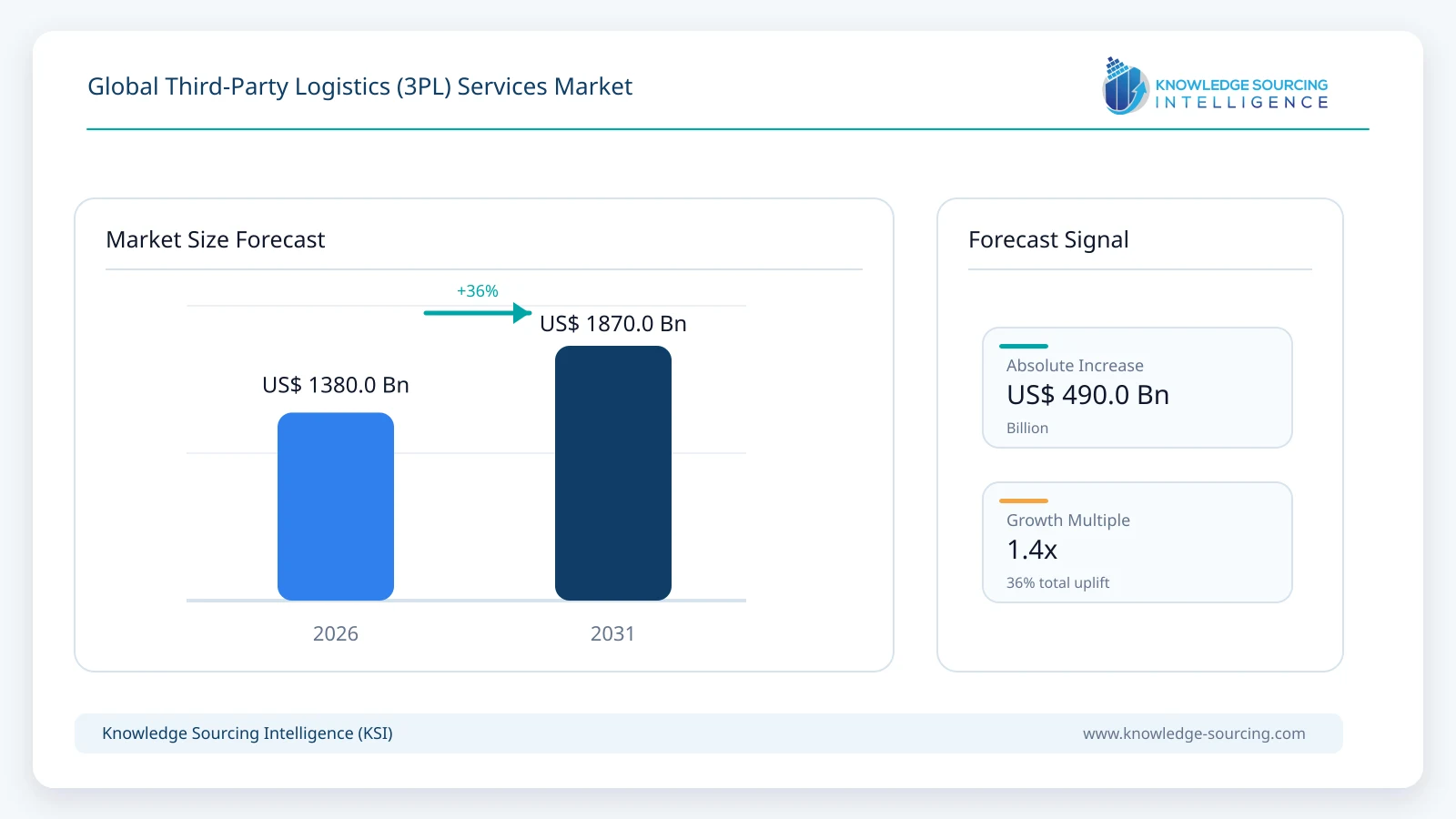
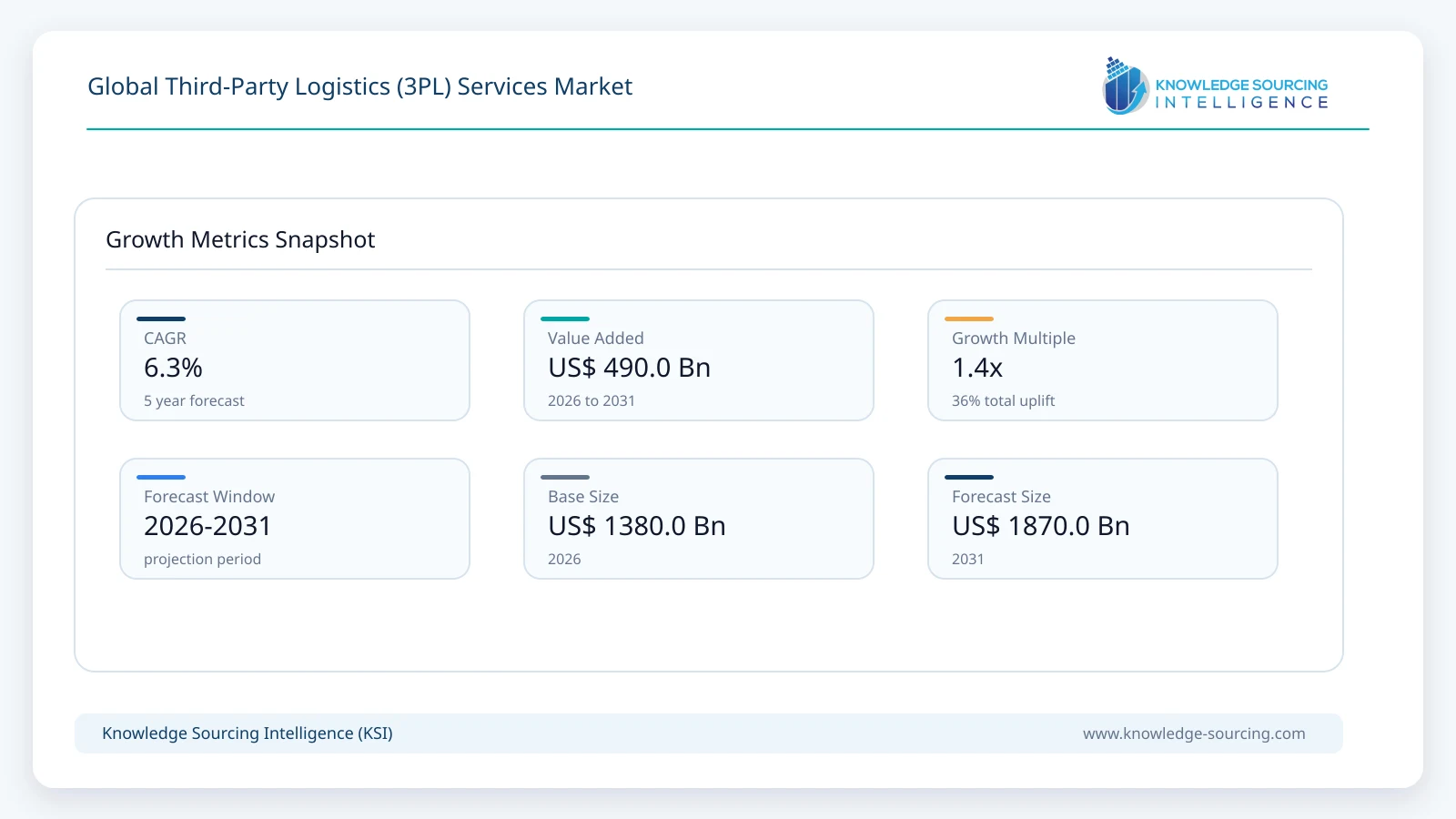
| Total Market Size in 2026 | USD 1,380.0 billion |
| Total Market Size in 2031 | USD 1,870.0 billion |
| Forecast Unit | Billion |
| Growth Rate | 6.3% |
| Study Period | 2021 to 2031 |
| Historical Data | 2021 to 2024 |
| Base Year | 2025 |
| Forecast Period | 2026 – 2031 |
| Segmentation | Transportation Mode, Service Type, End-User Industry, Geography |
| Companies |
|
Market Segmentation
By Transportation Mode
Road
Ocean
Air
Rail
By Service Type
Domestic Logistics Services
International Logistics Services
By End-User Industry
Retail and E-Commerce
Consumer Electronics and Technology
Automotive
Industrial and Manufacturing
Healthcare and Life Sciences
Food and Beverage
Others
By Geography
North America
United States
Canada
Mexico
South America
Brazil
Argentina
Others
Europe
United Kingdom
Germany
France
Italy
Spain
Others
Middle East and Africa
Saudi Arabia
UAE
South Africa
Others
Asia Pacific
China
Japan
India
South Korea
Australia
Southeast Asia
Others
Table of Contents
1. INTRODUCTION
1.1. Market Overview
1.2. Market Definition
1.3. Scope of the Study
1.4. Market Segmentation
1.5. Currency
1.6. Assumptions
1.7. Base and Forecast Years Timeline
1.8. Key Benefits to Stakeholders
2. RESEARCH METHODOLOGY
2.1. Research Design
2.2. Secondary Research
2.3. Primary Validation
2.4. Market Estimation and Forecasting
2.5. Data Triangulation and Quality Control
3. EXECUTIVE SUMMARY
3.1. Key Findings
3.2. Global Market Size, 2026-2031
3.3. Service and Industry Summary
3.4. Regional Opportunity Summary
4. MARKET DYNAMICS
4.1. Market Drivers
4.1.1. Continued Outsourcing of Logistics Operations
4.1.2. Expansion of E-Commerce and Cross-Border Fulfilment
4.1.3. Growth in Global Trade and Supply-Chain Complexity
4.1.4. Automation and Digital Visibility
4.1.5. Growth of Specialized Logistics
4.2. Market Restraints
4.2.1. Freight-Rate Volatility
4.2.2. Low Margins in Transactional Transport
4.2.3. Macroeconomic and Trade Uncertainty
4.2.4. Customer Insourcing and Multi-Sourcing
4.2.5. Labor, Real-Estate and Compliance Costs
4.3. Porter’s Five Forces Analysis
4.4. Industry Value Chain Analysis
5. THIRD-PARTY LOGISTICS (3PL) SERVICES MARKET BY TRANSPORTATION MODE
5.1. Introduction
5.2. Road
5.3. Ocean
5.4. Air
5.5. Rail
6. THIRD-PARTY LOGISTICS (3PL) SERVICES MARKET BY SERVICE TYPE
6.1. Introduction
6.2. Domestic Logistics Services
6.3. International Logistics Services
7. THIRD-PARTY LOGISTICS (3PL) SERVICES MARKET BY END-USER INDUSTRY
7.1. Introduction
7.2. Retail and E-Commerce
7.3. Consumer Electronics and Technology
7.4. Automotive
7.5. Industrial and Manufacturing
7.6. Healthcare and Life Sciences
7.7. Food and Beverage
7.8. Others
8. THIRD-PARTY LOGISTICS (3PL) SERVICES MARKET BY GEOGRAPHY
8.1. Introduction
8.2. North America
8.2.1. United States
8.2.2. Canada
8.2.3. Mexico
8.3. South America
8.3.1. Brazil
8.3.2. Argentina
8.3.3. Others
8.4. Europe
8.4.1. United Kingdom
8.4.2. Germany
8.4.3. France
8.4.4. Italy
8.4.5. Spain
8.4.6. Others
8.5. Middle East and Africa
8.5.1. Saudi Arabia
8.5.2. UAE
8.5.3. South Africa
8.5.4. Others
8.6. Asia Pacific
8.6.1. China
8.6.2. Japan
8.6.3. India
8.6.4. South Korea
8.6.5. Australia
8.6.6. Southeast Asia
8.6.7. Others
9. COMPETITIVE ENVIRONMENT AND ANALYSIS
9.1. Major Players and Strategy Analysis
9.2. Network and Service Positioning
9.3. Automation and Digital Capabilities
9.4. Mergers, Acquisitions, Agreements and Partnerships
9.5. Competitive Dashboard
10. COMPANY PROFILES
10.1. DHL Supply Chain
10.2. DSV A/S
10.3. Kuehne+Nagel International AG
10.4. CEVA Logistics
10.5. GXO Logistics, Inc.
10.6. Nippon Express Holdings, Inc.
10.7. UPS Supply Chain Solutions
10.8. FedEx Logistics, Inc.
10.9. J.B. Hunt Transport Services, Inc.
10.10. C.H. Robinson Worldwide, Inc.
10.11. Ryder System, Inc.
10.12. Penske Logistics
10.13. GEODIS
10.14. A.P. Moller - Maersk
10.15. CJ Logistics Corporation
11. APPENDIX
11.1. Currency
11.2. Assumptions
11.3. Base and Forecast Years Timeline
11.4. Abbreviations
Navigate
Trusted by the world's leading organizations











