
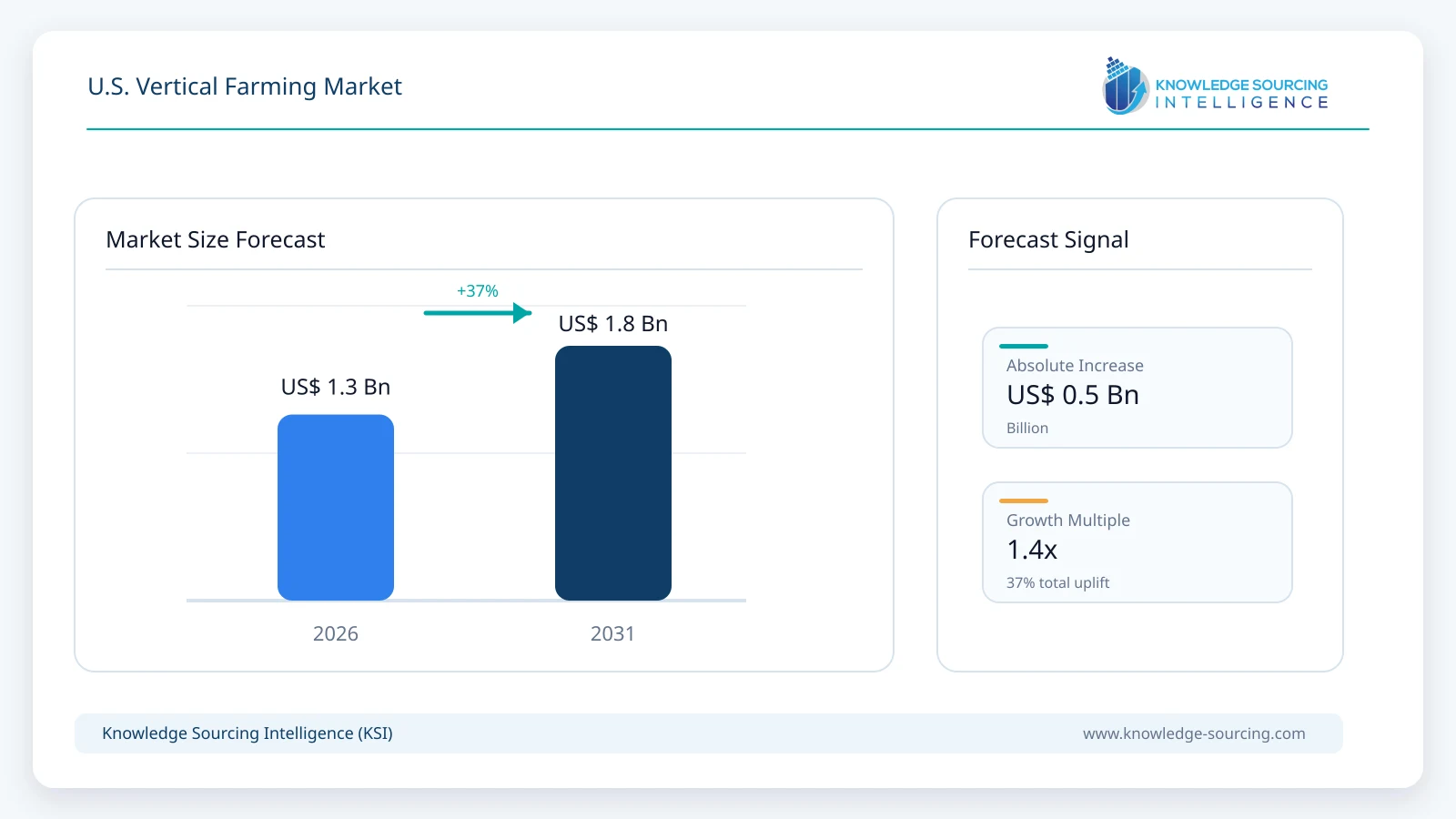
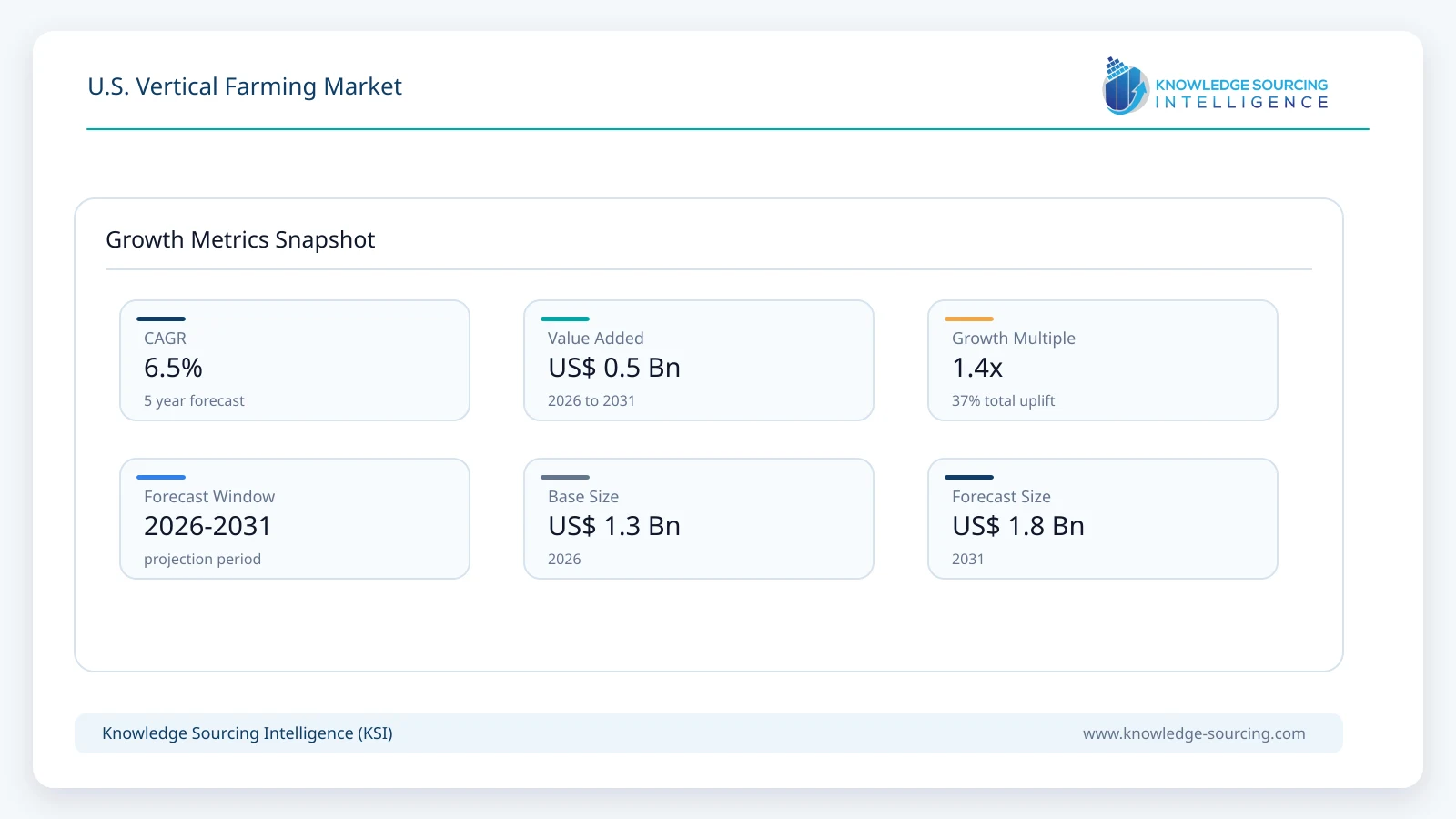
The U.S. Vertical Farming Market is growing at a CAGR of 6.5%, from USD 1.30 billion in 2026 to USD 1.78 billion by 2031.
Highlights:
- 1Hydroponic systems account for approximately 62% of U.S. vertical-farming market value in 2026.
- 2Building-based farms represent about 68% of market value in 2026 despite recent large-farm closures.
- 3Hardware generates approximately USD 0.75 billion of market value in 2026.
- 4Leafy greens, herbs and microgreens account for about 58% of crop-related market value in 2026.
- 5Modular and container-based systems are projected to expand at approximately 11.5% annually through 2031.
- 6Industry consolidation is shifting capital toward premium crops, automation and economically smaller deployments.
Vertical farming in the United States uses stacked growing layers, artificial or highly controlled lighting, hydroponic or aeroponic nutrient delivery, climate management and digital monitoring to produce crops in enclosed environments. The production format is distinct from conventional greenhouses because it multiplies production area vertically and relies more heavily on controlled lighting and environmental systems. Large facilities typically integrate HVAC, water treatment, nutrient dosing, conveyors, robotics, computer vision and farm-management software, while modular systems package the same core technologies into containers, room-scale units or institutional installations. The technology can materially reduce water use and shorten transport distances, but it also concentrates electricity and capital costs that would otherwise be supplied free by sunlight and open-field land.
The broader U.S. controlled-environment agriculture base provides an important demand platform. USDA Economic Research Service data show that the number of controlled-environment operations more than doubled between 2009 and 2019, while production volumes increased by 56% to 7.86 million hundredweight. This base includes greenhouses, hydroponics and other protected systems as well as vertical farms, so it cannot be treated as a direct vertical-farming market-size measure. It nevertheless demonstrates an established ecosystem of growers, suppliers, crop scientists and distribution channels from which vertical systems can develop. USDA has also expanded its Controlled Environment crop insurance program, indicating that fully enclosed production is becoming a more recognized commercial category rather than remaining only an experimental technology.
Commercial outcomes have been mixed. Bowery Farming ceased operations in late 2024 after raising more than USD 700 million. Plenty filed for Chapter 11 in March 2025, then emerged in May with a narrower strategy focused on premium strawberries and technology sales. AeroFarms continued operating through a difficult financing period and was acquired by an affiliate of Palm Ventures in April 2026, after which it expanded microgreen distribution and product offerings. The most significant 2026 setback was 80 Acres Farms, which began winding down nationwide operations in August after a proposed acquisition failed and financing was unavailable. These developments reduced active installed capacity and reinforced a more cautious near-term investment environment than during the industry's earlier capital-expansion cycle.
Market Trends
Capital Discipline Is Replacing Scale-at-Any-Cost Expansion
The central strategic change in U.S. vertical farming is the shift from expansion-first growth to capital discipline. Earlier business models assumed that large automated farms could improve economics through scale, but repeated restructurings showed that high fixed costs can magnify operating losses when utilization, yield or retail pricing falls short. Plenty's post-restructuring strategy is explicitly more focused, while AeroFarms' new ownership has prioritized debt reduction and sustainable growth. The wind-down of 80 Acres Farms reinforces the same lesson even after the company had achieved nationwide retail distribution. New projects are therefore being evaluated more rigorously against electricity price, crop gross margin, construction cost, offtake commitments and financing structure. This favors projects with a clear path to cash generation rather than speculative multi-city rollouts.
Crop Strategy Is Moving Toward Higher-Value Berries, Microgreens and Specialty Produce
The crop mix is changing as operators confront the economics of growing commodity leafy greens under artificial light. Lettuce remains important because of its short cycle and predictable physiology, but it competes with large-scale field and greenhouse production at relatively low retail price points. Plenty has repositioned around strawberries, using its Richmond, Virginia farm to target a premium fruit category in partnership with Driscoll's. AeroFarms is concentrating on microgreens, where higher price per pound, rapid crop cycles and strong differentiation can better absorb indoor production costs. Farm. One similarly focuses on microgreens, herbs, specialty greens and edible flowers for chefs and consumers. The market is therefore moving toward crops where freshness, flavor, nutrition, seasonality or supply consistency create enough value to justify the energy premium of vertical production.
Distributed Farms Are Gaining Strategic Relevance Alongside Large Centralized Facilities
The industry is becoming more bifurcated. Large centralized farms remain relevant where automation, contracted retail demand and premium crops support scale, but smaller distributed systems are gaining importance in schools, hospitals, foodservice, remote communities and institutional settings. Freight Farms has delivered hundreds of container farms globally and sells its Greenery S as a complete hydroponic platform with software and environmental control. Fork Farms offers smaller Flex Farm and Flex Acre systems that can be deployed inside schools, food banks, healthcare sites and community facilities. Babylon Micro-Farms follows a similar distributed model with remotely supported indoor farms. These systems produce less total output than major commercial farms, but they reduce site-development risk and can be justified by education, food access, resilience or institutional procurement benefits in addition to crop margin.
AI, Sensors and Energy Optimization Are Becoming Core to Farm Economics
Technology development is increasingly focused on reducing the cost of each kilogram grown rather than merely maximizing biological yield. USDA research projects launched in 2025 are examining AI-enhanced vertical farming platforms, autonomous robotics and improved controlled-environment crop varieties. Commercial systems are integrating sensors, machine vision, environmental recipes, automated dosing, predictive maintenance and digital scheduling. Freight Farms' Farmhand software and similar platforms give operators continuous visibility into climate and crop conditions, while lighting and HVAC suppliers are improving efficiency and controls. The most valuable software is therefore becoming tightly linked to energy, labor and yield optimization. A vertical farm that produces more biomass but consumes disproportionately more electricity or labor is not economically superior, making whole-system optimization more important than isolated equipment performance.
Market Drivers
Demand for Reliable Local Production Supports Year-Round Specialty Crop Supply
Vertical farming offers a commercially meaningful advantage where buyers value consistency, local supply and reduced exposure to seasonal disruption. U.S. fresh produce remains concentrated geographically, leaving some regions dependent on long-distance transport from California, Arizona, Mexico and other production centers. USDA-funded work on controlled-environment herb production highlights the country's dependence on imports for fresh herbs and the potential for indoor production closer to demand. Retailers, restaurants and institutions can benefit from shorter lead times, predictable weekly supply and reduced weather exposure. This advantage is strongest for perishable, high-value crops where freshness deteriorates quickly and freight represents a meaningful share of delivered cost.
Controlled-Environment Policy Support Is Improving Risk Management and Commercial Legitimacy
Federal support is broadening from research grants into operating risk infrastructure. USDA's Risk Management Agency expanded the Controlled Environment pilot crop insurance program for the 2027 crop year to additional counties and clarified protection against certain contamination and quarantine losses. Insurance does not solve the industry's energy or financing challenges, but it addresses a key bankability issue by giving eligible enclosed growers a formal mechanism for managing catastrophic plant-loss risk. USDA, DOE, NASA and other federal agencies are also collaborating on controlled-environment research covering lighting, crop genetics, automation, food safety and energy efficiency. This improves the technical foundation for future commercial systems and supports adoption beyond venture-backed startups.
Automation and Modularization Can Reduce Labor and Site-Development Barriers
Labor intensity remains a major variable in indoor-farm economics, especially in seeding, transplanting, crop movement, harvesting, sanitation and packaging. Automation can reduce repetitive labor and improve consistency, while modular designs shorten engineering and commissioning time. Freight Farms' standardized container model, Fork Farms' packaged hydroponic systems and Babylon Micro-Farms' remotely supported units illustrate different points on the modular spectrum. The economic benefit is not simply lower headcount. Standardization also reduces project-specific engineering, simplifies training and creates a repeatable installed base for software, consumables and service revenue. These characteristics make modular systems attractive to institutions and first-time operators that cannot support the technical team required by a custom multi-acre indoor farm.
Market Restraints
Electricity and HVAC Costs Remain the Structural Constraint on Fully Indoor Farming
The largest unresolved constraint is energy. USDA researchers continue to identify artificial lighting and HVAC as fundamental disadvantages of fully enclosed vertical farming because these systems replace sunlight and outdoor heat exchange with purchased electricity and mechanical climate control. Freight Farms discloses power usage of roughly 151-350 kWh per day for one Greenery S container, illustrating how even modular farms carry a measurable energy burden. Large facilities multiply that load across lighting, cooling, dehumidification, pumps, controls and material handling. Improvements in LED efficacy and crop recipes can reduce consumption, but farms remain exposed to local electricity tariffs and demand charges. This makes site selection and energy contracting central to competitiveness.
Financing Risk Has Increased After Multiple High-Profile Failures
The shutdowns of Bowery and 80 Acres Farms, combined with the restructurings of Plenty and AeroFarms, have changed investor expectations. The technical ability to grow crops indoors is no longer sufficient to secure large amounts of growth capital. Investors and lenders increasingly require evidence of positive contribution margin, contracted demand, realistic construction budgets and operating performance across multiple crop cycles. This tighter financing environment can slow new facility construction even when end-market demand is attractive. It also raises the competitive advantage of technology suppliers and modular-system providers that can sell to diversified customer bases rather than carrying the full balance-sheet risk of owning and operating large farms themselves.
Segment Analysis
By Growth Mechanism
Hydroponics
Hydroponics remains the commercial foundation of U.S. vertical farming because it combines relatively mature nutrient management with lower mechanical complexity than many aeroponic configurations. The technology is used across large farms, containers, school systems and multi-level greenhouses, making it easier to source components, train growers and standardize operating procedures. Freight Farms, Fork Farms, CropKing and Vertical Harvest all use hydroponic approaches in different system formats. Aeroponics retains a strong role in high-density systems and premium microgreens, as demonstrated by AeroFarms, but its pumps, misting hardware and root-zone management require greater technical precision. Through 2031, hydroponics should therefore retain the largest installed base while aeroponics grows selectively where its root oxygenation and water-efficiency benefits justify added complexity.
By Structure
Building-Based Vertical Farms
Building-based vertical farms remain the largest structure category because large commercial operators require integrated climate control, packing, cold storage and automation that are difficult to achieve in small modules. The segment is also where most of the industry's recent financial stress has occurred, since custom facilities combine high construction cost with fixed energy and labor obligations. The surviving model is becoming more selective: Plenty is expanding strawberry capacity in Richmond after restructuring, AeroFarms is operating its Danville microgreens farm under new ownership, and Vertical Harvest has two operating farms built around local-market and social-impact economics. Container and modular systems are expected to grow faster because they lower project size and allow customers to add capacity incrementally rather than committing to a single large facility.
By Component
Hardware
Hardware remains the largest component because vertical farms require substantial physical infrastructure including LED lighting, racks, hydroponic or aeroponic systems, HVAC, pumps, water treatment, sensors, nutrient dosing and material-handling equipment. However, the mix is gradually moving toward software and services as operators seek better control of installed assets. Farm-management platforms, remote monitoring, data analytics, crop recipes, maintenance support and integration create recurring revenue that can be more resilient than one-time equipment sales. The most attractive suppliers increasingly combine hardware with software and agronomic support, creating a lifecycle relationship with growers rather than selling individual components into one construction project.
By Crop Type
Leafy Greens, Herbs and Microgreens
Leafy greens, herbs and microgreens remain the largest crop group because they have short growth cycles, compact plant architecture and high value per square foot. Microgreens are particularly attractive because premium pricing and rapid harvest cycles can support indoor economics, which helps explain AeroFarms' strategic concentration on the category. The fastest commercial experimentation is moving toward fruits and berries. Plenty's strawberry format demonstrates that indoor vertical systems can target a higher-ticket crop with strong off-season demand, although berry production requires more complex pollination, plant handling and climate management. Fruits and berries are projected to approach USD 0.28 billion of market value by 2031 from a much smaller 2026 base.
Technology Outlook
High-Efficiency Lighting and Dynamic Light Recipes
LED performance remains one of the most important levers in vertical-farm economics. Newer fixtures convert a higher share of electricity into photosynthetically useful light, while dimming and spectral controls allow farms to vary intensity by crop stage rather than operate at a constant maximum setting. The value of dynamic lighting increases when linked to real-time electricity prices, crop-growth models and HVAC load, because lighting decisions affect both photosynthesis and cooling requirements. The future system is therefore less about selecting the brightest fixture and more about coordinating light output with crop value, energy price and environmental control.
Computer Vision, AI and Predictive Crop Management
Computer vision and machine learning can automate tasks that experienced growers traditionally perform through manual scouting. Cameras can monitor canopy development, color, plant spacing and abnormal growth, while environmental data can be used to identify deviations before yield is affected. USDA's AI-enhanced vertical-farming research project is explicitly targeting sensing, environmental control and intelligent decision-making for specialty crops. Commercial value will come from fewer crop losses, tighter harvest prediction and reduced labor rather than from AI as a standalone feature. Platforms that combine sensor data with actionable crop-management recommendations are therefore better positioned than generic dashboards.
Robotics and Automated Material Handling
Large vertical farms require repeated movement of trays, towers or crop modules through seeding, germination, cultivation and harvest. Robotics can reduce labor and improve utilization of vertical space, but the financial case depends on reliability and scale. Automation that fails during a critical harvest window can create losses across an entire crop cycle, so operators increasingly favor simpler, maintainable systems over highly customized machinery with limited service support. USDA research into autonomous electric platforms for controlled-environment agriculture reflects the broader effort to adapt robotics to enclosed horticulture. Over time, standardized mobile robotics and machine vision should become more important in large farms, while smaller installations continue to rely on semi-automated workflows.
Competitive Environment
The U.S. competitive landscape is now more balanced between farm operators, modular-system providers and component suppliers. Plenty and AeroFarms remain the most visible large-scale vertical-farming technology operators, but both have undergone major financial restructuring. Vertical Harvest operates a differentiated urban model built around local produce and inclusive employment, while Farm. One focuses on premium specialty greens for New York customers. Distributed-system companies such as Freight Farms, Babylon Micro-Farms and Fork Farms sell infrastructure and support rather than relying solely on crop sales, creating a less capital-intensive route to market.
Technology suppliers are becoming increasingly important as the industry shifts toward retrofit, efficiency and smaller projects. CropKing and AmHydro provide hydroponic systems and grower support; Signify and Heliospectra compete in horticultural lighting; Priva and Argus supply environmental controls; Netafim and Grodan provide irrigation and root-zone infrastructure; and iUNU provides crop intelligence and automation software. This supplier layer can benefit even when individual farm operators fail, because the installed base still requires replacement components, upgrades, consumables and software. Competitive advantage is increasingly tied to measurable energy savings, ease of deployment and service support rather than novelty alone.
Recent Developments
August 2026: 80 Acres Farms began winding down U.S. operations after a proposed acquisition failed and additional capital was unavailable.
August 2026: AeroFarms launched new Micro Arugula and Micro Broccoli products while expanding U.S. retail distribution under new ownership.
June 2026: AeroFarms announced its acquisition by an affiliate of Palm Ventures, reducing debt and shifting focus toward sustainable growth.
February 2026: USDA expanded the Controlled Environment crop insurance program to additional counties for the 2027 crop year.
May 2025: Plenty emerged from Chapter 11 and narrowed its commercial strategy toward premium strawberries and vertical-farming technology sales.
November 2024: Bowery Farming ceased operations after several years of rapid expansion and more than USD 700 million of reported funding.
U.S. Vertical Farming Market Scope
| Report Metric | Details |
|---|---|
| Total Market Size in 2026 | USD 1.30 billion |
| Total Market Size in 2031 | USD 1.78 billion |
| Forecast Unit | Billion |
| Growth Rate | 6.5% |
| Study Period | 2021 to 2031 |
| Historical Data | 2021 to 2024 |
| Base Year | 2025 |
| Forecast Period | 2026 – 2031 |
| Segmentation | Growth Mechanism, Structure, Component, Crop Type |
| Companies |
|
Market Segmentation
By Growth Mechanism
Hydroponics
Aeroponics
Aquaponics
Hybrid and Other Systems
By Structure
Building-Based Vertical Farms
Shipping Container and Modular Farms
Other Vertical Structures
By Component
Hardware
Lighting Systems
Climate Control and HVAC
Hydroponic and Aeroponic Equipment
Sensors and Controls
Racks, Conveyors and Other Hardware
Software
Integration and Managed Services
By Crop Type
Leafy Greens
Herbs and Microgreens
Fruits and Berries
Flowers and Specialty Crops
Others
Table of Contents
1. EXECUTIVE SUMMARY
2. MARKET SNAPSHOT
2.1. Market Overview
2.2. Market Definition
2.3. Scope of the Study
2.4. Market Segmentation
3. BUSINESS LANDSCAPE
3.1. Market Drivers
3.1.1. Demand for Reliable Local Production Supports Year-Round Specialty Crop Supply
3.1.2. Controlled-Environment Policy Support Is Improving Risk Management and Commercial Legitimacy
3.1.3. Automation and Modularization Can Reduce Labor and Site-Development Barriers
3.2. Market Restraints
3.2.1. Electricity and HVAC Costs Remain the Structural Constraint on Fully Indoor Farming
3.2.2. Financing Risk Has Increased After Multiple High-Profile Failures
3.3. Market Opportunities
3.4. Porter's Five Forces Analysis
3.5. Industry Value Chain Analysis
3.6. Policies and Regulations
3.7. Strategic Recommendations
4. TECHNOLOGICAL OUTLOOK
4.1. High-Efficiency Lighting and Dynamic Light Recipes
4.2. Computer Vision, AI and Predictive Crop Management
4.3. Robotics and Automated Material Handling
4.4. Automated Nutrient Dosing and Water Treatment
4.5. Energy Management and Heat-Recovery Systems
5. U.S. VERTICAL FARMING MARKET BY GROWTH MECHANISM
5.1. Introduction
5.2. Hydroponics
5.3. Aeroponics
5.4. Aquaponics
5.5. Hybrid and Other Systems
6. U.S. VERTICAL FARMING MARKET BY STRUCTURE
6.1. Introduction
6.2. Building-Based Vertical Farms
6.3. Shipping Container and Modular Farms
6.4. Other Vertical Structures
7. U.S. VERTICAL FARMING MARKET BY COMPONENT
7.1. Introduction
7.2. Hardware
7.2.1. Lighting Systems
7.2.2. Climate Control and HVAC
7.2.3. Hydroponic and Aeroponic Equipment
7.2.4. Sensors and Controls
7.2.5. Racks, Conveyors and Other Hardware
7.3. Software
7.4. Integration and Managed Services
8. U.S. VERTICAL FARMING MARKET BY CROP TYPE
8.1. Introduction
8.2. Leafy Greens
8.3. Herbs and Microgreens
8.4. Fruits and Berries
8.5. Flowers and Specialty Crops
8.6. Others
9. COMPETITIVE ENVIRONMENT AND ANALYSIS
9.1. Major Players and Strategy Analysis
9.2. Commercial Farm Economics
9.3. Modular and Distributed Farming Systems
9.4. Technology and Component Competition
9.5. Mergers, Restructurings and Market Exits
9.6. Competitive Dashboard
10. COMPANY PROFILES
10.1. Plenty Unlimited Inc.
10.2. AeroFarms
10.3. Freight Farms, Inc.
10.4. Vertical Harvest Farms
10.5. Farm.One
10.6. Babylon Micro-Farms Inc.
10.7. Fork Farms
10.8. CropKing Inc.
10.9. AmHydro
10.10. Signify N.V.
10.11. Priva
10.12. Netafim USA
10.13. Grodan (ROCKWOOL Group)
10.14. Argus Control Systems Ltd.
10.15. iUNU
10.16. Hydrofarm Holdings Group, Inc.
10.17. Sollum Technologies
10.18. Heliospectra AB
11. APPENDIX
11.1. Currency
11.2. Assumptions
11.3. Base and Forecast Years Timeline
11.4. Key Benefits for Stakeholders
11.5. Research Methodology
11.6. Abbreviations
Navigate
Trusted by the world's leading organizations











