
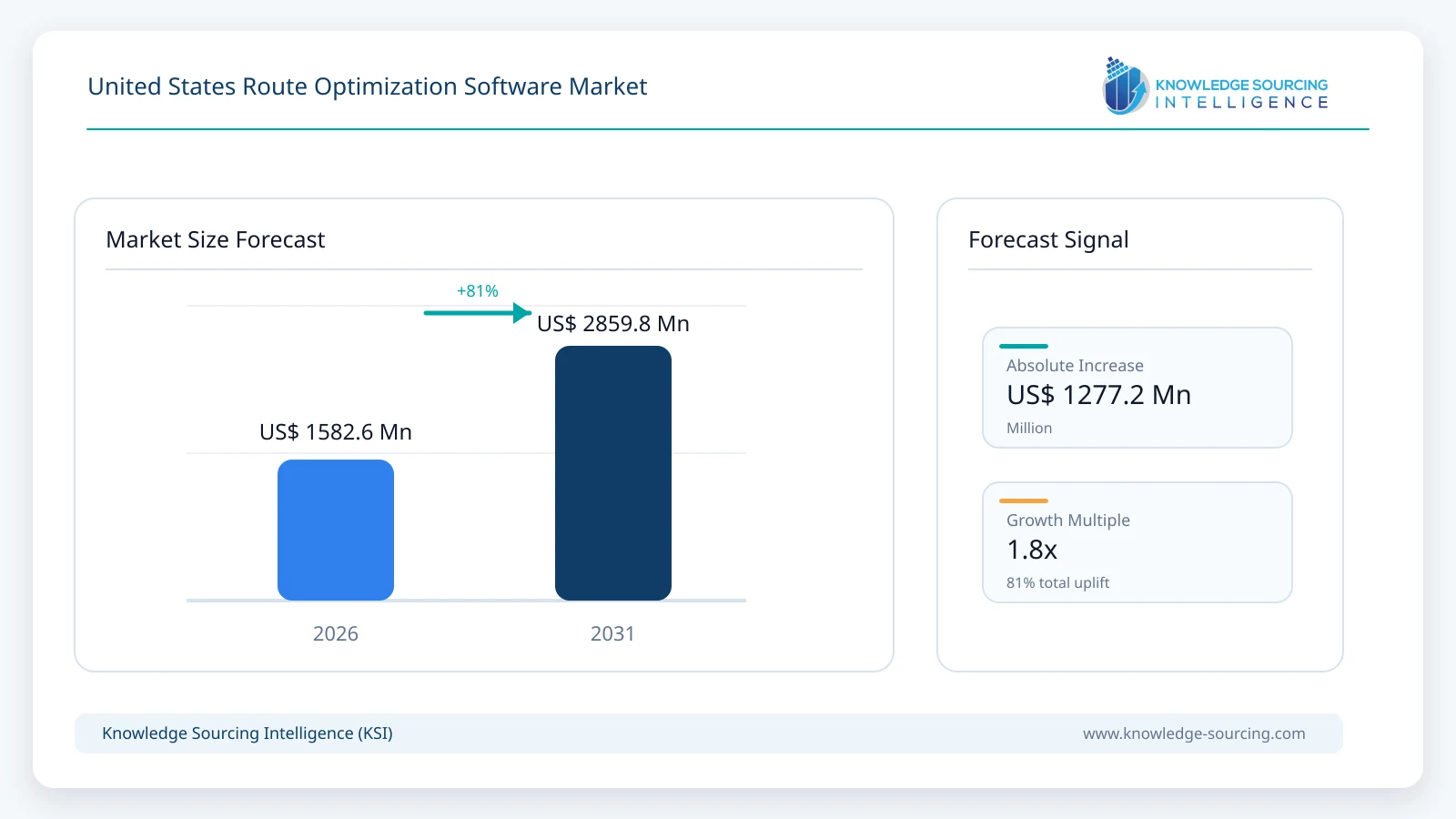
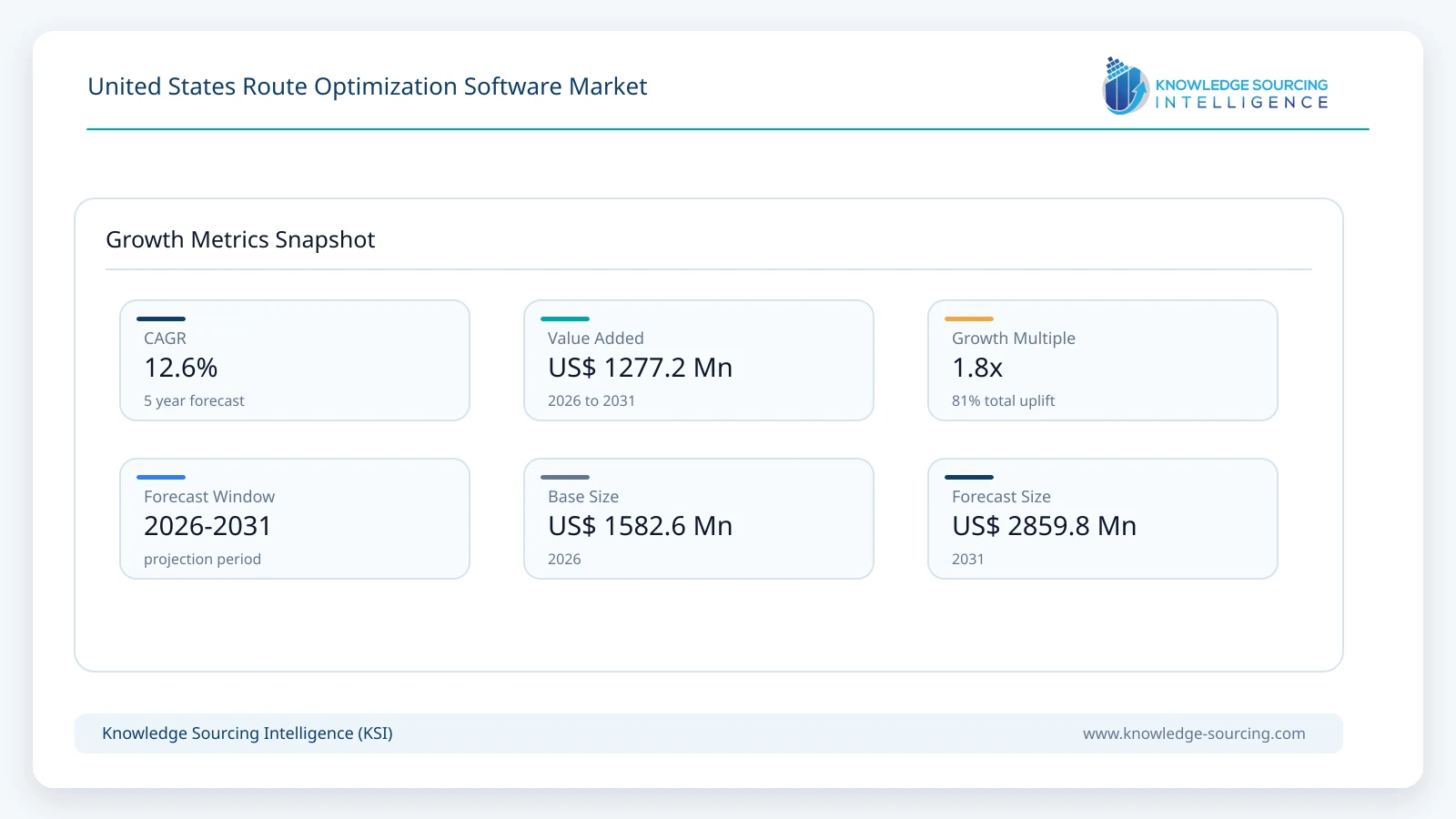
The United States route optimization software market is anticipated to grow at a CAGR of 12.6%, increasing to USD 2,859.8 million in 2031 from USD 1,582.6 million in 2026.
Highlights:
- 1Increasing last-mile delivery complexity is accelerating investment in AI-enabled route optimization platforms.
- 2Cloud-native deployment is reshaping software purchasing across transportation, retail, and field service organizations.
- 3Fuel efficiency, labor productivity, and service-level compliance remain primary procurement priorities.
- 4Enterprise buyers increasingly require integration with transportation management, ERP, and telematics platforms.
- 5Regulatory requirements surrounding driver safety, electronic logging, and emissions continue to influence software capabilities.
Customer purchasing decisions increasingly depend on measurable operating outcomes instead of navigation functionality alone. Fleet operators evaluate solutions based on fuel savings, route compliance, delivery accuracy, driver productivity, customer visibility, and integration with transportation management systems (TMS), warehouse management systems (WMS), enterprise resource planning (ERP), telematics, and electronic logging devices. Cloud deployment has shortened implementation timelines and expanded software adoption among mid-sized organizations that previously relied on manual dispatching or spreadsheet-based planning.
Persistent labor shortages among commercial drivers, rising transportation costs, tighter delivery windows, and expanding same-day fulfillment expectations continue to increase demand for dynamic routing capabilities. Route optimization platforms increasingly incorporate traffic intelligence, predictive analytics, machine learning, and automated dispatching to continuously adjust routes throughout the operating day rather than producing static plans before vehicles depart.
Commercial value is distributed across software licensing, implementation, systems integration, consulting, and managed services. Organizations operating large multi-stop fleets generally realize greater operational benefits because optimization improves vehicle utilization, reduces empty mileage, supports regulatory compliance, and enhances customer service performance. Software vendors are therefore expanding platform capabilities beyond routing to include fleet visibility, proof-of-delivery, driver applications, analytics, and transportation execution to strengthen recurring revenue and increase customer retention.
Key Market Indicators
Indicator | Latest Evidence | Commercial Meaning |
AI adoption among logistics operations | Growing deployment of AI-based dynamic routing (2025-2026) | Supports continuous route adjustments instead of static planning. |
Last-mile logistics cost | Approximately 41% of total logistics costs | Cost reduction remains the strongest software purchasing driver. |
Fleet optimization focus | Real-time traffic, driver capacity and delivery windows increasingly optimized simultaneously | Buyers increasingly prefer intelligent scheduling over traditional route planning. |
Enterprise deployment preference | Cloud platforms expanding across fleet management applications | Faster implementation and recurring subscription revenue favor cloud-based software adoption. |
Product integration | Integration with telematics, compliance and fleet management platforms | Integrated ecosystems have become an important vendor differentiation factor. |
Market Drivers
Expansion of time-sensitive last-mile delivery operations
Same-day delivery, scheduled home services, grocery fulfillment, healthcare distribution, and e-commerce logistics have increased routing complexity across the United States. Dispatchers must balance delivery windows, vehicle capacity, customer preferences, traffic conditions, and driver availability simultaneously. AI-enabled routing platforms continuously recalculate routes as operating conditions change, reducing manual intervention and improving delivery performance. Software suppliers are responding by expanding real-time optimization, proof-of-delivery, customer communication, and predictive dispatch capabilities that directly address high-volume delivery operations.
Demand for measurable transportation cost reduction
Transportation organizations increasingly justify software purchases through operating cost improvements rather than technology modernization. Fuel consumption, driver overtime, idle time, empty mileage, and fleet utilization remain measurable financial metrics that influence procurement decisions. Route optimization software enables dispatchers to consolidate deliveries, reduce unnecessary mileage, and improve daily vehicle productivity. Vendors including Trimble, Descartes, and Omnitracs have expanded transportation management capabilities through integrated planning, telematics, and execution platforms because enterprise customers increasingly prefer unified operational environments instead of isolated routing applications.
Growth of cloud-connected transportation ecosystems
Transportation software procurement increasingly favors cloud deployment because organizations require continuous software updates, remote fleet visibility, API connectivity, and scalable computing resources. Cloud platforms simplify integration with ERP systems, warehouse operations, customer portals, GPS devices, and mobile driver applications. This architecture also supports software-as-a-service subscription models, lowering initial implementation costs for many mid-sized organizations. Vendors continue expanding cloud-native transportation platforms as customers seek centralized visibility across dispatching, routing, compliance, analytics, and customer communication.
Increasing reliance on operational analytics and artificial intelligence
Static route planning no longer satisfies enterprises managing thousands of daily deliveries. Modern routing engines analyze traffic conditions, weather, delivery priorities, historical travel patterns, vehicle constraints, and driver performance before recommending optimized schedules. Recent commercial deployments demonstrate that AI-assisted routing can substantially reduce daily routes while maintaining delivery capacity, lowering labor requirements and improving operational efficiency. Software providers continue investing in machine learning models because customers increasingly expect routing decisions to adapt continuously throughout daily operations.
Market Restraints and Challenges
Complex enterprise system integration requirements
Large organizations rarely deploy routing software as an independent application. Successful implementation typically requires integration with transportation management, warehouse management, ERP, customer management, telematics, GPS hardware, and electronic logging systems. Integration projects increase implementation time, consulting costs, and technical complexity, particularly for organizations operating legacy software environments. Vendors continue expanding standardized APIs and integration services, yet deployment effort remains a meaningful procurement consideration for enterprise buyers.
Operational adoption remains dependent on workforce acceptance
Software implementation does not automatically improve fleet performance if dispatchers and drivers continue relying on established operating practices. Driver acceptance of optimized routes, mobile applications, proof-of-delivery workflows, and automated scheduling remains essential for realizing expected productivity gains. Organizations often require process redesign, workforce training, and change management alongside software deployment, increasing implementation timelines beyond technical installation alone.
Route optimization quality depends on data accuracy
Optimization algorithms perform best when vehicle locations, customer addresses, service times, traffic information, fleet availability, and delivery constraints remain accurate and continuously updated. Incomplete or inconsistent operational data can reduce routing quality, affecting delivery reliability and customer satisfaction. Software vendors increasingly invest in automated data validation, GPS synchronization, and real-time data ingestion to reduce these operational limitations, although maintaining high-quality enterprise data remains the customer's responsibility.
Price sensitivity among smaller fleet operators
Smaller transportation companies often operate predictable routes where manual planning remains commercially viable. Subscription licensing, implementation services, integration costs, and ongoing support can extend return-on-investment periods for organizations with relatively stable delivery networks. Vendors increasingly address this challenge through modular pricing, cloud subscriptions, and simplified implementation packages, but cost justification continues to influence purchasing decisions among small and medium-sized fleet operators.
Major Segment Analysis
Transportation and Logistics
Transportation and Logistics represents the most commercially important industry vertical because fleet operators manage high vehicle volumes, complex delivery schedules, variable traffic conditions, and increasingly stringent customer service commitments. Route optimization software is used across truckload, less-than-truckload (LTL), parcel, wholesale distribution, and dedicated private fleets to reduce empty miles, improve vehicle utilization, and maintain on-time deliveries while complying with driver-hour regulations. Buyers typically evaluate platforms based on optimization accuracy, integration with transportation management systems (TMS), scalability, and real-time route adjustments rather than navigation capability alone.
Competition within this segment increasingly depends on continuous optimization, predictive analytics, and interoperability with telematics, electronic logging devices, warehouse management systems, and ERP platforms. Vendors such as Trimble, Descartes Systems Group, ORTEC, and Omnitracs continue expanding cloud-native transportation platforms that combine route planning with dispatch, execution, fleet visibility, and operational analytics. Large logistics providers also require configurable optimization engines that balance delivery windows, vehicle restrictions, customer priorities, and driver availability simultaneously, making algorithm quality and implementation expertise important competitive differentiators.
Competitive Landscape
The U.S. route optimization software market is characterized by competition among transportation technology providers, specialized optimization vendors, GIS software companies, and logistics platform developers. Trimble Inc., Descartes Systems Group, ORTEC, Caliper Corporation, Esri, Route4Me, OptimoRoute, FarEye, and Omnitracs compete through optimization algorithms, transportation management integration, cloud deployment, mobile workforce applications, and industry-specific workflow capabilities rather than routing functionality alone.
Competitive differentiation increasingly depends on continuous optimization, AI-assisted dispatching, predictive analytics, API connectivity, customer support, and implementation expertise. Large enterprise customers typically seek integrated platforms that combine routing, compliance, fleet visibility, proof-of-delivery, telematics, and transportation execution. Vendors continue investing in cloud-native architectures, modular software design, and expanded ecosystem integration to improve customer retention and recurring subscription revenue. Recent acquisitions and platform enhancements also indicate that suppliers are strengthening last-mile delivery capabilities and transportation intelligence rather than competing solely on price. High switching costs associated with enterprise integrations and operational workflows continue supporting long-term customer relationships after successful deployment.
Recent Developments
July 2026: Onfleet released Q2 product updates on July 17, adding API-based route-optimization controls for task priority, vehicle requirements, maximum distance, stop clustering, and per-vehicle cost rules.
June 2026: Trimble introduced its cloud-native, AI-integrated Transportation Management System for North American shippers, combining transportation planning, route optimization, automation, carrier collaboration, and real-time visibility into a unified logistics platform.
April 2026: FarEye launched PILOT, an agentic AI dispatcher that autonomously manages route planning, driver coordination, delivery exceptions, and invoice reconciliation, dramatically improving last-mile route optimization and dispatcher productivity for enterprise fleets.
April 2026: Descartes acquired U.S.-based Idelic, adding AI-powered driver safety, telematics analytics, and fleet performance management. The acquisition complements Descartes’ routing and transportation solutions by improving operational efficiency and fleet reliability.
Regulatory and Policy Environment
Federal transportation regulations continue shaping software requirements across commercial fleet operations. Route optimization platforms increasingly integrate Electronic Logging Device (ELD) compliance, Hours of Service (HOS) requirements administered by the Federal Motor Carrier Safety Administration (FMCSA), commercial vehicle restrictions, hazardous materials routing, and state-specific transportation rules into optimization engines. Buyers increasingly expect routing platforms to support regulatory compliance alongside operational efficiency.
Data security and privacy have also become more important procurement considerations as cloud deployment expands across enterprise transportation systems. Software suppliers continue strengthening cybersecurity controls, API governance, and data management capabilities while improving compatibility with connected fleet technologies and enterprise software environments. Continuous updates to commercial road networks, truck restrictions, toll information, and vehicle attributes further increase the value of subscription-based routing platforms that maintain current mapping intelligence.
Outlook and Strategic Implications
Demand during the 2026-2031 forecast period is expected to remain closely linked to transportation cost control, labor productivity, service reliability, and fleet digitization rather than simple navigation needs. Enterprise customers are expected to prioritize platforms capable of combining route optimization with dispatch management, predictive analytics, telematics integration, and transportation execution within unified cloud environments.
Strategic priorities across the value chain are likely to include:
Software providers: Expand AI-assisted optimization, cloud-native architecture, and industry-specific workflows.
Fleet operators: Improve vehicle utilization, reduce operating costs, and strengthen delivery performance through integrated transportation platforms.
System integrators: Support enterprise implementation, API integration, and modernization of legacy transportation systems.
Investors: Monitor recurring software revenue, customer retention, acquisition activity, and AI-enabled product development as indicators of long-term competitive positioning.
As route optimization software becomes increasingly embedded within broader transportation management ecosystems, competitive advantage will depend less on route calculation alone and more on operational intelligence, platform interoperability, and the ability to support real-time decision-making across increasingly complex logistics networks.
United States Route Optimization Software Market Scope:
| Report Metric | Details |
|---|---|
| Total Market Size in 2026 | USD 1,582.6 million |
| Total Market Size in 2031 | USD 2,859.8 million |
| Forecast Unit | Million |
| Growth Rate | 12.6% |
| Study Period | 2021 to 2031 |
| Historical Data | 2021 to 2024 |
| Base Year | 2025 |
| Forecast Period | 2026 – 2031 |
| Segmentation | Solution, Deployment Type, Industry Vertical |
| Companies |
|
Market Segmentation
By Solution
Software
Services
By Deployment Type
Cloud-based
On-premises
By Industry Vertical
Transportation and Logistics
Retail and E-Commerce
Food and Beverage Delivery
Field Service Management
Manufacturing
Healthcare and Pharmaceuticals
Utilities
Ride-Hailing and Mobility Services
Others
Table of Contents
1. INTRODUCTION
1.1. Market Definition
1.2. Market Segmentation
2. RESEARCH METHODOLOGY
2.1. Research Data
2.2. Assumptions
3. EXECUTIVE SUMMARY
3.1. Research Highlights
4. MARKET DYNAMICS
4.1. Market Drivers
4.2. Market Restraints
4.3. Porter’s Five Forces Analysis
4.3.1. Bargaining Power of End-Users
4.3.2. Bargaining Power of Buyers
4.3.3. Threat of New Entrants
4.3.4. Threat of Substitutes
4.3.5. Competitive Rivalry in the Industry
4.4. Industry Value Chain Analysis
5. US ROUTE OPTIMIZATION SOFTWARE MARKET ANALYSIS, BY SOLUTION
5.1. Introduction
5.2. Software
5.3. Services
6. US ROUTE OPTIMIZATION SOFTWARE MARKET ANALYSIS, BY DEPLOYMENT TYPE
6.1. Introduction
6.2. Cloud-based
6.3. On-premises
7. US ROUTE OPTIMIZATION SOFTWARE MARKET ANALYSIS, BY INDUSTRY VERTICAL
7.1. Introduction
7.2. Transportation and Logistics
7.3. Retail and E-Commerce
7.4. Food and Beverage Delivery
7.5. Field Service Management
7.6. Manufacturing
7.7. Healthcare and Pharmaceuticals
7.8. Utilities
7.9. Ride-Hailing and Mobility Services
7.10. Others
8. COMPETITIVE ENVIRONMENT AND ANALYSIS
8.1. Major Players and Strategy Analysis
8.2. Emerging Players and Market Lucrativeness
8.3. Mergers, Acquisitions, Agreements, and Collaborations
8.4. Vendor Competitiveness Matrix
9. COMPANY PROFILES
9.1. Trimble Inc.
9.2. Caliper Corporation
9.3. ORTEC
9.4. Descartes Systems Group
9.5. OptimoRoute
9.6. Esri
9.8. FarEye
9.9. Omnitracs
Navigate
Trusted by the world's leading organizations











