Aspirin Market Trends & Forecast According to a research study published by Knowledge Sourcing Intelligence (KSI), the aspirin market will expand from USD 2.507 bil...

Aspirin Market Trends & Forecast
According to a research study published by Knowledge Sourcing Intelligence (KSI), the aspirin market will expand from USD 2.507 billion in 2025 to USD 2.858 billion in 2030 at a CAGR of 2.81% during the forecast period.The market is witnessing growth due to a rise in the incidence of cardiovascular diseases globally, which leads to increased demand for aspirins as they are highly prescribed for their anti-platelet properties, which work in preventing patients from heart strokes and attacks. Besides this, the growing aging population is also contributing to the rise in chronic diseases as older people are more susceptible to these diseases, which leads to the requirement of aspirin for the long term. Moreover, they are highly utilized for other purposes like in pain management due to its properties being an anti-inflammatory and analgesic agent, which diversify its role. Furthermore, the growing research and development by global pharmaceutical companies for new aspirin formulations can provide enhanced patient adherence to treatment regimens along with diversifying its application beyond present use, including in dementia and cancer-related treatment procedures, which will contribute to its growth during the projected period. ? View a sample of the report or purchase the complete study at: Global Aspirin Market Report
Aspirin Market Report Highlights
- The Over-the-Counter (OTC) segment is estimated to attain greater market share by 2030 in the product segment. The segment is witnessing growth due to its wide application along with ease of availability and convenience. They have widespread use in applications like fewer reduction, pain relief and inflammation management, among others, making them a commonly found product in the household. This segment is also attributing growth due to its availability in retail and online pharmacies, which enhance its access, and with no requirement of a prescription for purchase, leading to it having a wider consumer reach globally.
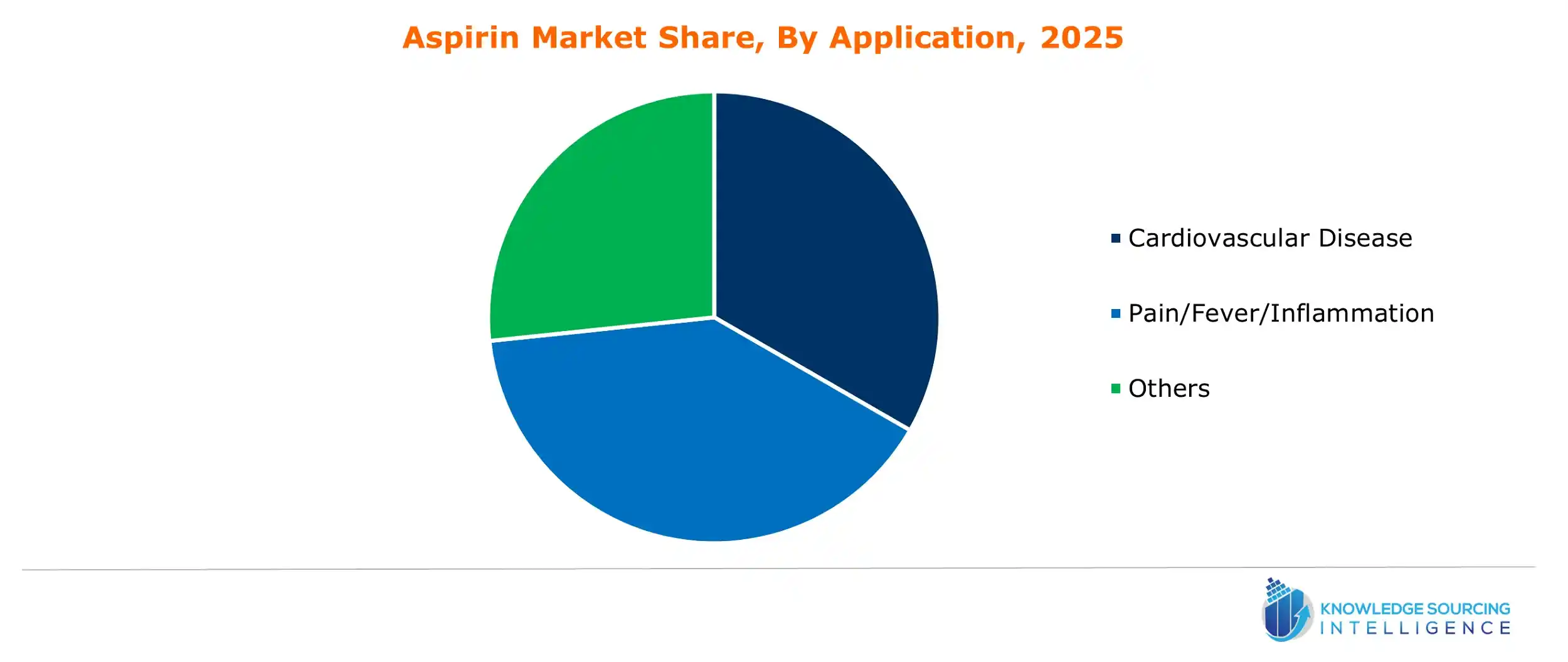
- The cardiovascular disease segment is the dominating segment in the global aspirin market in the application segment. Among the aspects that drive this rapid growth is the increasing prevalence of cardiovascular diseases, which leads to the growing preventive use of aspirin for improving heart health. Moreover, the supportive healthcare guideline supports the low-dose aspirin recommendation for patients who are at high cardiovascular risk, which is contributing to its adoption in the coming years. Further, the growing geriatric population also contributes to the rise in cardiovascular disease and other heart-related diseases, which leads to increased requirement of medication like aspirin, which can reduce the risk of heart attack and strokes.
- The online channel segment is the fastest growing segment in the distribution channel of the aspirin market due to the growing adoption of e-commerce globally along with increasing consumer preference to shop online due to convenience and easy accessibility to wider products to select from, Online platform also provide with attractive discounts ans promotional offers which attract cost-sensitive customer leading to driving the growth of this segment. Moreover, low-dose aspirin is easily available for purchase as OTC medication for preventive healthcare also contributes to online channel segment expansion.
- North America held the largest global aspirin market share due to growing awareness of preventive care along with robust healthcare infrastructure in the region. Additionally, the region has a high prevalence of cardiovascular diseases, chronic pain, and arthritis, together with a growing aging population who are more susceptible to these healthcare conditions, which leads to increasing aspirin consumption as therapeutic and preventive medication.
Report Coverage:
| Report Metric | Details |
| Global Aspirin Market Size in 2025 | USD 2.507 billion |
| Global Aspirin Market Size in 2030 | USD 2.858 billion |
| Growth Rate | CAGR of 2.81% |
| Drivers |
|
| Restraints |
|
| Segmentation |
|
| List of Major Companies in Global Aspirin Market |
|
Aspirin Market Growth Drivers and Restraints
Growth Drivers:- Rising Prevalence of Cardiovascular Diseases: the increasing incidence of cardiovascular diseases such as heart attack, heart failure, among others, is leading to demand for aspirin. Aspirin is useful for the management as well as prevention of these chronic conditions, which is fuelling the market demand.
- Growing Geriatric Population: the growing aging population across the globe is leading to increased susceptibility to diverse chronic diseases that will contribute to growth in demand for aspirin. Age-related conditions like arthritis and cardiovascular diseases are leading to growth in the trend for consumption of aspirin.
- Emergence of Alternative Medications: the growth in research and development related to targeted therapeutic medications and agents for diverse health conditions, like pain management, could reduce the reliance on aspirin.
- Side Effects and Safety Concerns: the side effects of aspirin consumption, mainly gastrointestinal bleeding and ulcers, could lead to alternative drug usage, restraining the market.
Aspirin Market Key Development
- Product Launch: In July 2025, Bayer Aspirin announced the launch of its Aspirina product for the usage in health and pain relief options in the United States
- Trial Completion: In May 2025, the MRC Clinical Trials Unit at UCL announced the completion of a trial of Add-Aspirin for the treatment of cancers like colorectal, breast, gastro-oesophageal, or prostate cancer.
Aspirin Market Segmentation
Knowledge Sourcing Intelligence has segmented the Global Aspirin Market based on the product, application, distribution channel, and region: Global Aspirin Market, By Product- Prescription
- OTC
- Cardiovascular Disease
- Pain/Fever/Inflammation
- Others
- Hospital and Retail Pharmacies
- Online Channels
- North America
- USA
- Canada
- Mexico
- Europe
- UK
- Germany
- France
- Italy
- Spain
- Others
- Asia Pacific
- China
- India
- Japan
- South Korea
- Taiwan
- Thailand
- Indonesia
- Others
- South America
- Brazil
- Argentina
- Others
- Middle East and Africa (MEA)
- Saudi Arabia
- UAE
- Others
Aspirin Market Key Players
- Bayer AG
- Hebei Jingye Chemical Co., Ltd.
- JQC (Huayin) Pharmaceutical Co., Ltd.
- Perrigo Company plc
- L.N.K. International Inc.
- Thermo Fisher Scientefic
- Taj Pharmaceuticals Limited
- Advance Pharmaceutical Inc.
- Allegiant Health
- KEM Pharma LLC
About Knowledge Sourcing Intelligence (KSI)
Knowledge Sourcing Intelligence (KSI) is a market research and consulting firm headquartered in India. Backed by seasoned industry experts, we offer syndicated reports, customized research, and strategic consulting services. Our proprietary data analytics framework, combined with rigorous primary and secondary research, enables us to deliver high-quality insights that support informed decision-making. Our solutions empower businesses to gain a competitive edge in their markets. With deep expertise across ten key sectors, including ICT, Chemicals, Semiconductors, and Healthcare, we effectively address the diverse needs of our global clientele.Need specialized data cuts or competitive intelligence?
Our analyst team provides bespoke market sizing, supplier audits, and country-level feasibility reports tailored to your enterprise roadmap.
Speak With an Industry Analyst →Ask an Industry Analyst
Have questions regarding this briefing or market projections? Inquire with our sector lead.
Related Press Releases
View All →
ADC Manufacturing & CDMO Market is expected to reach USD 10.49 billion by 2031
Aug 7, 2026
Lifestyle-Associated Cancer Epidemiology Market is expected to reach USD 13.12 billion by 2031
Aug 5, 2026
Psycho-Oncology Digital Health Market is anticipated to surpass USD 290.01 million in 2031 at a CAGR of 8.5%
Jul 30, 2026
Intratumoral Injection Therapy Market is expected to reach USD 630.39 million by 2031
Jul 24, 2026
Palliative Care in Oncology Market is expected to reach USD 244.1 billion by 2031
Jul 22, 2026More Press Releases
Oncology Drug Resistance Testing Market is projected to reach USD 3.41 billion in 2031 at a CAGR of 6.6 %
The oncology drug resistance testing market is expanding due to rising cancer prevalence, increasing drug resistance, and growing adoption of precision oncology. Advances in NGS-based testing, companion diagnostics, and targeted therapies, alongside FDA approvals and investments in personalized medicine, are accelerating demand for effective resistance monitoring across hospitals and clinical diagnostics worldwide.
TROP-2 Targeted Therapy Market is anticipated to surpass USD 3.29 billion in 2031 at a CAGR of 8.6 %
The TROP-2 Targeted Therapy market is expanding rapidly due to increasing precision oncology adoption, rising cancer prevalence, and growing use of antibody-drug conjugates. North America leads the market, while Asia Pacific shows the fastest growth. Continuous clinical trials, regulatory approvals, and strategic collaborations are accelerating innovation and commercial adoption worldwide.
Second Primary Cancer Prevention Market is expected to reach USD 24.7 billion by 2031
The Second primary cancer prevention refers to strategies aimed at reducing the risk of developing a new, unrelated cancer in individuals with a prior cancer diagnosis. Growing cancer survivorship, advances in treatment, and increasing awareness of long-term health outcomes have heightened the importance of prevention and surveillance programs. Key approaches include routine screening, genetic risk assessment, lifestyle modification, and long-term follow-up care. Government agencies and healthcare organisations increasingly emphasise survivorship care plans and evidence-based screening protocols to detect new malignancies at earlier stages. Continued investments in early detection technologies and personalised risk assessment are expected to support advancements in second primary cancer prevention.