
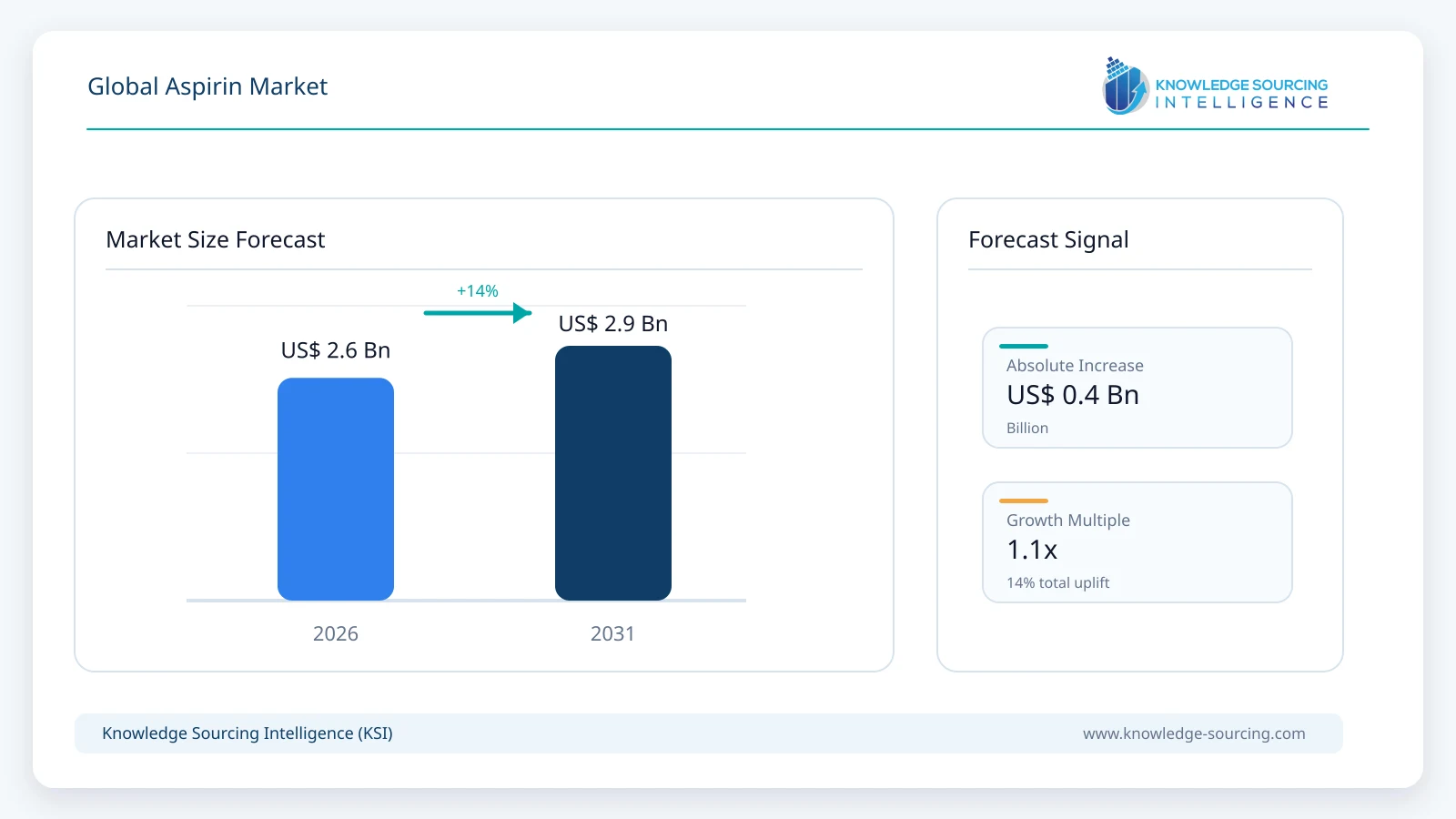
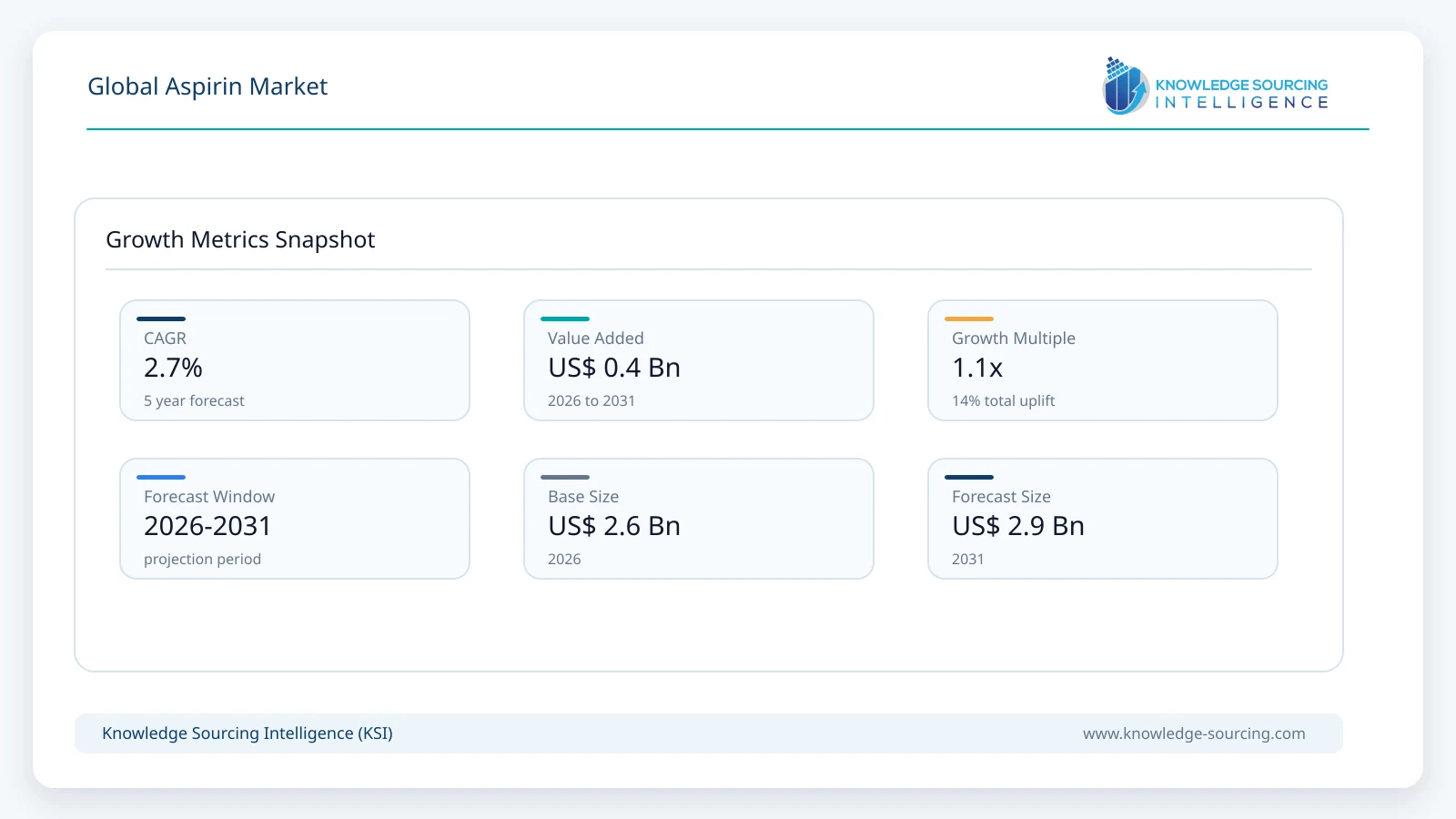
The global aspirin market is estimated at approximately USD 2.57 billion in 2026 and is projected to reach about USD 2.94 billion by 2031, representing a CAGR of approximately 2.7% during the forecast period.
Highlights:
- 1Cardiovascular applications contribute about 55% of 2026 revenue, supported by secondary prevention demand.
- 2OTC products represent roughly 61% of 2026 sales across analgesic and self-care channels.
- 3North America accounts for about 31% of 2026 revenue, while Asia Pacific grows faster.
- 4Hospital and retail pharmacies retain around 86% of 2026 sales despite online channel expansion.
- 5China procurement pressure materially reduced Bayer Aspirin Cardio sales during 2025.
- 6Guideline-driven bleeding precautions constrain routine primary-prevention use in older adults globally.
Aspirin, or acetylsalicylic acid, is a long-established nonsteroidal anti-inflammatory drug and irreversible platelet inhibitor. Commercial demand spans two distinct use patterns. Higher-strength products are primarily used for short-term relief of pain, fever and inflammation, while low-dose products are widely used in cardiovascular care to inhibit platelet aggregation. The 2025 ACC/AHA acute coronary syndromes guideline continues to position aspirin with an oral P2Y12 inhibitor as the default dual-antiplatelet strategy for appropriate acute coronary syndrome patients who are not at high bleeding risk, supporting a durable base of cardiovascular demand.
At the same time, clinical practice has become more selective in primary prevention. The U.S. Preventive Services Task Force recommends individualized decision-making for adults aged 40 to 59 years with elevated cardiovascular risk and recommends against initiating low-dose aspirin for primary prevention in adults aged 60 years or older. This distinction is commercially important: aspirin retains a major role in secondary prevention and acute cardiovascular care, but the addressable population for routine preventive self-medication is narrower than in earlier decades.
The competitive environment is split between global branded suppliers, high-volume private-label manufacturers and Asian API or finished-dose producers. Bayer remains the best-known global aspirin franchise, but generic and private-label products dominate much of unit volume. Perrigo, L.N.K. International, Major Pharmaceuticals and Advance Pharmaceutical supply extensive OTC and private-label ranges in North America. China remains important in API and finished-dose production through suppliers including JQC (Huayin), Hebei Jingye Medical Technology and Shandong Xinhua Pharmaceutical. India is a significant branded-generic market through companies such as USV, while Reckitt continues to market Disprin in India.
Market Trends
Low-Dose Cardiovascular Aspirin Remains the Core Value Segment
Low-dose aspirin remains the most strategically important segment because cardiovascular treatment generally involves long-duration use rather than occasional consumption. The strongest demand is linked to secondary prevention after myocardial infarction, ischemic stroke, coronary revascularization and other atherosclerotic events. The commercial base is therefore recurrent, but growth is closely tied to clinical guidance, reimbursement and generic pricing rather than product novelty. Aspirin is inexpensive and highly commoditized, so value growth is more restrained than prescription volume growth in many markets.
Primary-Prevention Restrictions Shift Demand Toward Clinician-Directed Use
Bleeding-risk evidence has changed the way low-dose aspirin is used for people without established cardiovascular disease. In the United States, routine initiation is no longer recommended for older adults, while younger higher-risk patients require individualized assessment. Similar risk-benefit thinking is reflected in cardiovascular practice internationally. This trend does not remove aspirin from cardiovascular care, but it changes market growth from broad preventive expansion toward more targeted, evidence-based prescribing and self-care under professional guidance.
Private Label and Branded Generics Sustain Price Competition
Aspirin is well suited to private-label and branded-generic competition because the molecule is off patent, manufacturing processes are mature and common oral strengths can be produced at large scale. Perrigo, L.N.K. International, Major Pharmaceuticals and Advance Pharmaceutical support extensive retail and institutional portfolios in the United States, while Asian producers serve both domestic and export markets. Competitive differentiation increasingly depends on enteric coating, chewable formats, packaging, pharmacy relationships, quality systems and reliable API sourcing rather than novel active chemistry.
Procurement Policies Are Increasingly Important in Large Cardiovascular Markets
Bayer reported a material decline in Aspirin Cardio sales in 2025, with the company identifying China's volume-based procurement policy as a major reason. This illustrates how tendering and reference pricing can compress value growth in established cardiovascular medicines despite persistent clinical demand.
Market Drivers
Secondary Cardiovascular Prevention Creates Recurring Long-Term Demand
Aspirin remains embedded in the management of atherosclerotic cardiovascular disease because of its antiplatelet action, very low cost and extensive clinical experience. Current acute coronary syndrome guidance continues to support aspirin-based dual antiplatelet therapy for suitable patients. The global burden of ischemic heart disease, stroke and post-revascularization care therefore sustains a large recurrent user base, particularly for 75 mg, 81 mg and 100 mg formulations.
OTC Accessibility Supports Stable Analgesic and Antipyretic Demand
Regular-strength aspirin remains widely available for temporary relief of minor aches, headache, musculoskeletal pain and fever in markets where OTC monographs permit its sale. Mature retail distribution through pharmacies, mass merchants and private-label programs keeps the product accessible and price competitive. Although acetaminophen and ibuprofen are significant substitutes, aspirin retains a distinct consumer base and continues to be marketed in regular, buffered, enteric-coated, soluble and chewable formats.
Broad Manufacturing Capacity Supports Availability Across Income Levels
Aspirin benefits from a geographically diversified supply base. Large-volume salicylate and acetylsalicylic-acid producers in China supply regulated markets, while multiple finished-dose manufacturers in North America, Europe and Asia support branded, generic and private-label products. JQC (Huayin) reports dedicated salicylate production and aspirin products meeting major pharmacopoeial standards, while Shandong Xinhua supplies both aspirin API and multiple oral strengths. This supply breadth supports affordability and continued access in lower-cost healthcare systems.
Market Restraints
Bleeding Risk and Narrower Primary-Prevention Guidance Limit Volume Expansion
Aspirin increases gastrointestinal and intracranial bleeding risk, which limits indiscriminate long-term use. The risk becomes more important with age and with concomitant anticoagulant, steroid or NSAID use. Modern primary-prevention guidance therefore favors selective initiation rather than routine use, especially among older adults. This reduces one of the historical pathways for market expansion and reinforces the importance of secondary prevention, acute cardiovascular care and clinician-directed use.
Generic Competition and Public Procurement Constrain Revenue Growth
The aspirin market has little patent protection around the core molecule, enabling aggressive generic competition and private-label substitution. Government procurement programs can push prices lower in high-volume cardiovascular markets, while retailers frequently use aspirin as a low-price self-care category. These factors keep unit demand resilient but limit the rate at which global market value can increase.
Global Aspirin Market Segment Analysis
By Product
OTC Aspirin
OTC aspirin is estimated at approximately USD 1.57 billion in 2026 and remains the largest product segment. Its scale reflects broad availability of low-dose and regular-strength formulations across pharmacies, supermarkets and private-label programs. Prescription aspirin remains important in countries where low-dose antiplatelet products are clinician-dispensed or where aspirin is included in prescription cardiovascular combinations, but the underlying molecule is inexpensive and commonly accessible without a prescription in major consumer-health markets.
By Application
Cardiovascular Disease
Cardiovascular use is estimated at approximately USD 1.41 billion in 2026 and remains the largest application. The segment is supported by long-duration low-dose use after myocardial infarction, ischemic stroke and coronary intervention, as well as aspirin-based antiplatelet regimens in acute coronary syndrome. Pain, fever and inflammation represent a large but more mature application because aspirin competes directly with acetaminophen, ibuprofen, naproxen and other analgesics.
By Distribution Channel
Hospital and Retail Pharmacies
Hospital and retail pharmacies are estimated to generate approximately USD 2.21 billion in 2026. Aspirin remains a pharmacy-led category because cardiovascular use often begins with physician recommendation or discharge prescribing, while OTC pain-relief products are routinely purchased through retail pharmacies and mass merchants. Online pharmacies continue to expand, particularly for repeat low-dose purchases, but the category's low unit price and widespread physical availability keep offline channels dominant.
By Geography
North America
North America is estimated at approximately USD 0.80 billion in 2026 and remains the largest regional market by value. The United States combines a large cardiovascular patient population, extensive OTC access and deep private-label penetration.
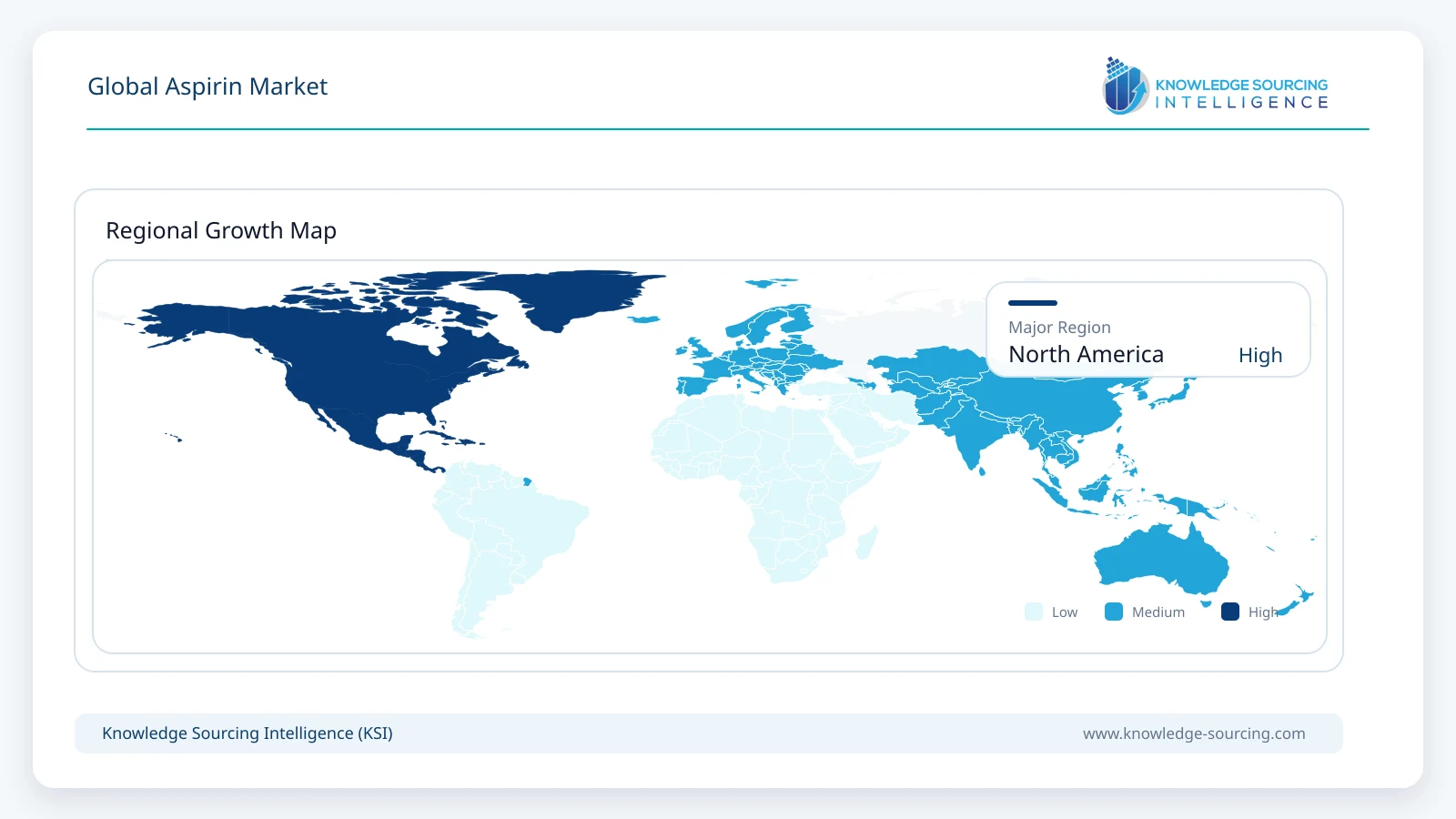
Asia Pacific grows faster through China, India and other high-population markets, although procurement pressure and lower unit pricing moderate value growth. Europe remains an important cardiovascular and self-care market with broad use of low-dose acetylsalicylic acid.
Competitive Environment
Bayer holds the strongest global brand association with aspirin and participates across consumer-health and cardiovascular channels. Its Aspirin Cardio franchise remains commercially significant even as Chinese procurement policy reduces pricing. Perrigo is a major private-label self-care supplier in North America and markets aspirin products comparable to Bayer-branded formulations. L.N.K. International and Major Pharmaceuticals are important U.S. OTC and institutional suppliers, while Advance Pharmaceutical manufactures multiple regular-strength, enteric-coated and chewable formats.
The upstream and Asian competitive base is more fragmented. JQC (Huayin) Pharmaceutical manufactures pharmaceutical-grade acetylsalicylic acid and reports substantial salicylate-series capacity. Hebei Jingye Medical Technology supplies aspirin and salicylic-acid products for cardiovascular and cerebrovascular applications. Shandong Xinhua Pharmaceutical produces its own aspirin API and finished tablets and received Chinese regulatory approval for a 100 mg enteric-coated aspirin specification in 2025. USV maintains a major Indian cardiovascular aspirin franchise through Ecosprin, while Reckitt markets Disprin in the Indian analgesic market. Competition therefore spans global brands, private-label manufacturers, branded generics and high-volume API producers rather than a small number of patent-protected suppliers.
Recent Developments
March 2026: Bayer reported 2025 Aspirin Cardio sales of EUR 516 million, with China volume-based procurement materially reducing revenue.
February 2026: WHO published the 2025 Expert Committee report accompanying the updated Model List of Essential Medicines, reinforcing global focus on affordable essential-medicine access.
April 2025: Shandong Xinhua Pharmaceutical received Chinese approval for a 100 mg aspirin enteric-coated tablet after passing generic quality and efficacy consistency evaluation.
February 2025: ACC and AHA issued updated acute coronary syndrome guidance retaining aspirin plus an oral P2Y12 inhibitor as the default 12-month dual-antiplatelet strategy for suitable patients.
Global Aspirin Market Scope:
| Report Metric | Details |
|---|---|
| Total Market Size in 2026 | USD 2.57 billion |
| Total Market Size in 2031 | USD 2.94 billion |
| Forecast Unit | Billion |
| Growth Rate | 2.7% |
| Study Period | 2021 to 2031 |
| Historical Data | 2021 to 2024 |
| Base Year | 2025 |
| Forecast Period | 2026 – 2031 |
| Segmentation | Product, Application, Distribution Channel, Geography |
| Companies |
|
Market Segmentation
By Product
Prescription
OTC
By Application
Cardiovascular Disease
Pain, Fever and Inflammation
Others
By Distribution Channel
Hospital and Retail Pharmacies
Online Channels
By Geography
North America
United States
Canada
Mexico
South America
Brazil
Argentina
Others
Europe
Germany
United Kingdom
France
Spain
Italy
Others
Middle East & Africa
Saudi Arabia
UAE
South Africa
Others
Asia Pacific
China
Japan
India
South Korea
Australia
Thailand
Others
Table of Contents
1. EXECUTIVE SUMMARY
2. MARKET SNAPSHOT
2.1. Market Overview
2.2. Market Definition
2.3. Scope of the Study
2.4. Market Segmentation
3. BUSINESS LANDSCAPE
3.1. Market Drivers
3.1.1. Secondary Cardiovascular Prevention Creates Recurring Long-Term Demand
3.1.2. OTC Accessibility Supports Stable Analgesic and Antipyretic Demand
3.1.3. Broad Manufacturing Capacity Supports Availability Across Income Levels
3.2. Market Restraints
3.2.1. Bleeding Risk and Narrower Primary-Prevention Guidance Limit Volume Expansion
3.2.2. Generic Competition and Public Procurement Constrain Revenue Growth
3.3. Market Opportunities
3.4. Porter's Five Forces Analysis
3.5. Industry Value Chain Analysis
3.6. Policies and Regulations
3.7. Strategic Recommendations
4. TECHNOLOGICAL AND FORMULATION OUTLOOK
4.1. Enteric-Coated Low-Dose Tablets
4.2. Immediate-Release and Regular-Strength Tablets
4.3. Chewable and Soluble Formulations
4.4. Aspirin-Based Fixed-Dose Cardiovascular Combinations
4.5. Manufacturing Quality and Pharmacopoeial Compliance
5. GLOBAL ASPIRIN MARKET BY PRODUCT
5.1. Introduction
5.2. Prescription
5.3. OTC
6. GLOBAL ASPIRIN MARKET BY APPLICATION
6.1. Introduction
6.2. Cardiovascular Disease
6.3. Pain, Fever and Inflammation
6.4. Others
7. GLOBAL ASPIRIN MARKET BY DISTRIBUTION CHANNEL
7.1. Introduction
7.2. Hospital and Retail Pharmacies
7.3. Online Channels
8. GLOBAL ASPIRIN MARKET BY GEOGRAPHY
8.1. Introduction
8.2. North America
8.2.1. United States
8.2.2. Canada
8.2.3. Mexico
8.3. South America
8.3.1. Brazil
8.3.2. Argentina
8.3.3. Others
8.4. Europe
8.4.1. Germany
8.4.2. United Kingdom
8.4.3. France
8.4.4. Spain
8.4.5. Italy
8.4.6. Others
8.5. Middle East & Africa
8.5.1. Saudi Arabia
8.5.2. UAE
8.5.3. South Africa
8.5.4. Others
8.6. Asia Pacific
8.6.1. China
8.6.2. Japan
8.6.3. India
8.6.4. South Korea
8.6.5. Australia
8.6.6. Thailand
8.6.7. Others
9. COMPETITIVE ENVIRONMENT AND ANALYSIS
9.1. Major Players and Strategy Analysis
9.2. Brand, Generic and Private-Label Positioning
9.3. API and Finished-Dose Supply Landscape
9.4. Regulatory Approvals and Procurement Dynamics
9.5. Competitive Dashboard
10. COMPANY PROFILES
10.1. Bayer AG
10.2. Perrigo Company plc
10.3. L.N.K. International, Inc.
10.4. Major Pharmaceuticals
10.5. Advance Pharmaceutical Inc.
10.6. Allegiant Health
10.7. Shandong Xinhua Pharmaceutical Co., Ltd.
10.8. JQC (Huayin) Pharmaceutical Co., Ltd.
10.9. Hebei Jingye Medical Technology Co., Ltd.
10.10. Nanjing Pharmaceutical Factory Co., Ltd.
10.11. USV Private Limited
10.12. Reckitt Benckiser (India) Private Limited
10.13. Time-Cap Labs, Inc.
10.14. Padagis US LLC
10.15. Hefei Jiulian Pharmaceutical Co., Ltd.
10.16. Shaanxi Hanjiang Pharmaceutical Group Co., Ltd.
11. APPENDIX
11.1. Currency
11.2. Assumptions
11.3. Base and Forecast Years Timeline
11.4. Key Benefits for Stakeholders
11.5. Research Methodology
11.6. Abbreviations
Navigate
Trusted by the world's leading organizations











