Noida, June 10, 2025 – The global animal feed market is positioned for steady growth, with market size expected to expand from US$478.881 billion in 2025 to US$559.557 billion by 2030, representing a...

Soy-Based Feed Maintains Market Dominance
Soy-based feed continues to dominate the global animal feed market, with soy accounting for 85% of total soy cultivation being consumed by the animal feed industry to produce protein-rich feed. This dominance is attributed to soy's high protein content, with soy meal containing 44% crude protein, making it the most common protein source for pigs, poultry, and dairy cattle globally. The strategic importance of soy-based feed was further highlighted by recent industry developments, including Continental Refining Company's announcement in April 2024 of significant operational improvements in Somerset, Kentucky. The facility's enhanced operations can process 430 tonnes of soybeans daily into 335 tonnes of high-protein soybean meal, 68 tonnes of soybean oil, and 21 tonnes of loose hulls, all essential components for livestock and poultry feed production.Regional Market Leadership and Export Growth
North America continues to demonstrate strong market leadership, with the region projected to maintain its dominant position throughout the forecast period. The United States has emerged as a significant player in global animal feed exports, with American Feed Industry Association data indicating that U.S. animal food exports reached USD 13.4 billion in 2023, representing 19.8 million metric tons—more than double the USD 7.5 billion and 9 million metric tons recorded in 2022.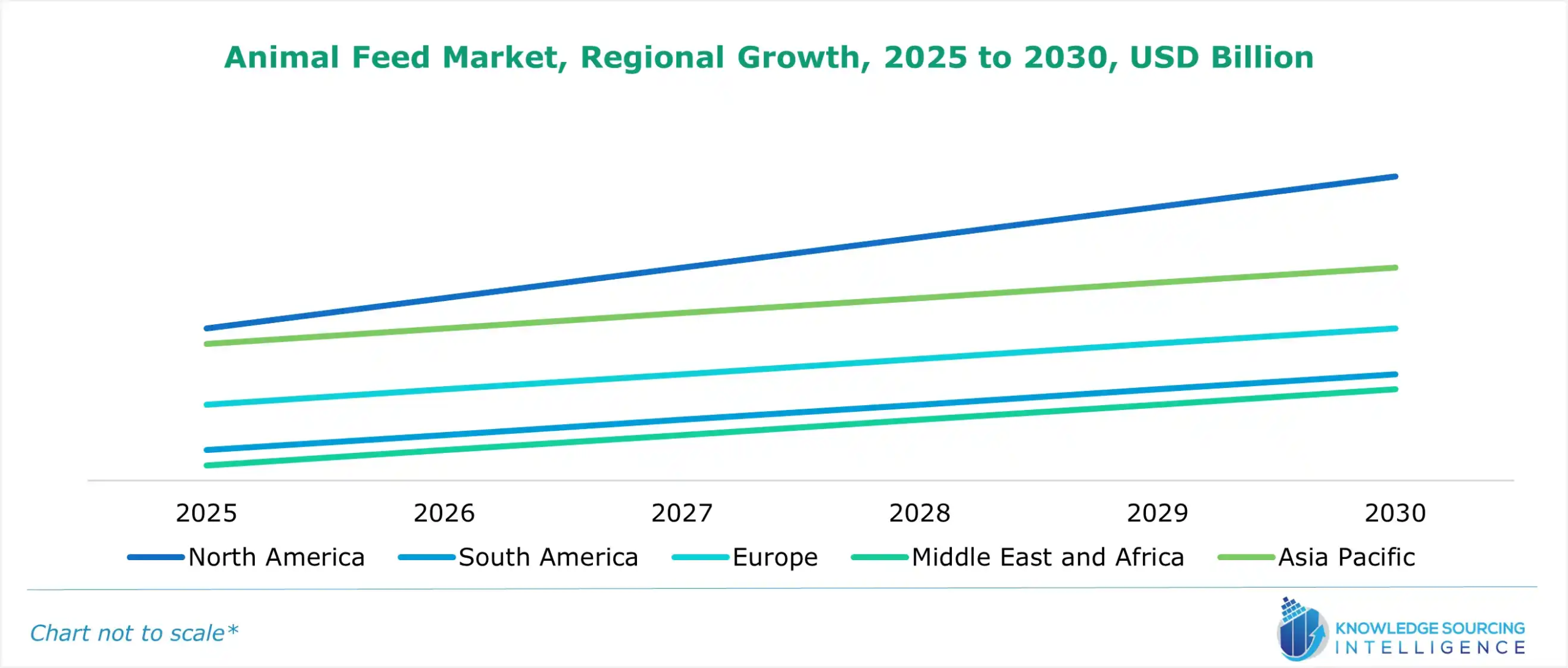 The Asia-Pacific region is also showing remarkable momentum, with India demonstrating strong export performance. According to the Agricultural & Processed Food Products Export Development Authority (APEDA), India exported approximately 796,462.12 metric tons of prepared animal feed in the 2022-2023 period, generating revenues of around USD 445.60 million, with key destinations including Bangladesh, Nepal, Vietnam, Hong Kong, and France.
Technological Innovation and Industry Developments
The industry is experiencing significant technological advancement, with recent developments highlighting the sector's commitment to innovation and efficiency. In November 2024, TrinamiX GmbH and Eurofins Agro Testing announced a strategic partnership at EuroTier 2024, enabling farmers to analyze forage samples directly on-farm using handheld devices, thereby improving animal health, increasing farm productivity, and reducing environmental impact. IFF's Danisco Animal Nutrition & Health division received EU regulatory approval in June 2024 for two innovative chicken feed products: Axtra® XAP, a multi-enzyme mix, and Syncra® AVI, an enzyme-probiotic complex. These products are designed to meet modern chicken production demands and deliver measurable performance improvements.Global Feed Production Trends
Recent industry data from Alltech's 2025 Agri-Food Outlook reveals that global feed production increased by 1.2% in 2024 to 1.396 billion metric tons, demonstrating the industry's resilience despite challenges including highly pathogenic avian influenza (HPAI) and climate fluctuations. The growth represents a rebound from a stagnant 2023, indicating renewed strength in the global animal feed sector.Government Support and R&D Investments Drive Growth
Increasing government initiatives and research and development activities are serving as key growth drivers for the animal feed market. In August 2024, feed and fodder processing activities were opened to startups and private enterprises under the Indian National Livestock Mission Scheme, with applicants receiving a 50% capital subsidy up to Rs. 50.00 lakh to build feed and fodder infrastructure. These government support measures, combined with investments in alternative feed sources and environmental impact reduction initiatives, are expected to promote animal welfare through improved living conditions while increasing demand for high-quality, nutritious feed.Market Segmentation and Key Players
The animal feed market is segmented by type into fodder & forage and compound feed, with livestock categories including pork, aquatic animals, cattle, poultry, and others. Raw material segmentation encompasses soy, corn, rendered meal, and other essential components. Major market players driving industry growth include Alltech, Cargill Incorporated, Nutreco N.V., Charoen Pokphand Foods PCL, and BRF S.A., among others. These companies are investing in technological innovation, strategic partnerships, and capacity expansion to meet growing global demand.Future Outlook and Market Drivers
The projected 3.18% CAGR growth through 2030 is supported by several key market drivers, including the OECD-FAO Agricultural Outlook 2021-2030 projection that global meat production per capita will increase by 0.3% annually to 35.4kg by 2030. The bulk of meat production growth is expected in developing regions, which will account for 80% of additional output. Specifically, beef consumption is anticipated to grow to 76 million tonnes over the next decade, constituting approximately 16% of the total rise in meat consumption, while global pig meat consumption is projected to grow to 127 million tonnes, accounting for 28% of the overall increase in meat consumption.Report Coverage:
| Report Metric | Details |
| Growth Rate | CAGR of 3.18% |
| Study Period | 2020 to 2030 |
| Historical Data | 2020 to 2023 |
| Base Year | 2024 |
| Forecast Period | 2025 – 2030 |
| Forecast Unit (Value) | USD Billion |
| Segmentation | Type, Livestock, Raw Materials, Geography |
| Geographical Segmentation | North America, South America, Europe, Middle East and Africa, Asia Pacific |
| Companies Covered | Alltech, Cargill, Incorporated, Uno Feeds, Nutreco N.V., BRF S.A. |
| Customization Scope | Free report customization with purchase |
Need specialized data cuts or competitive intelligence?
Our analyst team provides bespoke market sizing, supplier audits, and country-level feasibility reports tailored to your enterprise roadmap.
Speak With an Industry Analyst →Ask an Industry Analyst
Have questions regarding this briefing or market projections? Inquire with our sector lead.
Related Press Releases
View All →
ADC Manufacturing & CDMO Market is expected to reach USD 10.49 billion by 2031
Aug 7, 2026
Lifestyle-Associated Cancer Epidemiology Market is expected to reach USD 13.12 billion by 2031
Aug 5, 2026
Psycho-Oncology Digital Health Market is anticipated to surpass USD 290.01 million in 2031 at a CAGR of 8.5%
Jul 30, 2026
Intratumoral Injection Therapy Market is expected to reach USD 630.39 million by 2031
Jul 24, 2026
Palliative Care in Oncology Market is expected to reach USD 244.1 billion by 2031
Jul 22, 2026More Press Releases
Oncology Drug Resistance Testing Market is projected to reach USD 3.41 billion in 2031 at a CAGR of 6.6 %
The oncology drug resistance testing market is expanding due to rising cancer prevalence, increasing drug resistance, and growing adoption of precision oncology. Advances in NGS-based testing, companion diagnostics, and targeted therapies, alongside FDA approvals and investments in personalized medicine, are accelerating demand for effective resistance monitoring across hospitals and clinical diagnostics worldwide.
TROP-2 Targeted Therapy Market is anticipated to surpass USD 3.29 billion in 2031 at a CAGR of 8.6 %
The TROP-2 Targeted Therapy market is expanding rapidly due to increasing precision oncology adoption, rising cancer prevalence, and growing use of antibody-drug conjugates. North America leads the market, while Asia Pacific shows the fastest growth. Continuous clinical trials, regulatory approvals, and strategic collaborations are accelerating innovation and commercial adoption worldwide.
Second Primary Cancer Prevention Market is expected to reach USD 24.7 billion by 2031
The Second primary cancer prevention refers to strategies aimed at reducing the risk of developing a new, unrelated cancer in individuals with a prior cancer diagnosis. Growing cancer survivorship, advances in treatment, and increasing awareness of long-term health outcomes have heightened the importance of prevention and surveillance programs. Key approaches include routine screening, genetic risk assessment, lifestyle modification, and long-term follow-up care. Government agencies and healthcare organisations increasingly emphasise survivorship care plans and evidence-based screening protocols to detect new malignancies at earlier stages. Continued investments in early detection technologies and personalised risk assessment are expected to support advancements in second primary cancer prevention.