
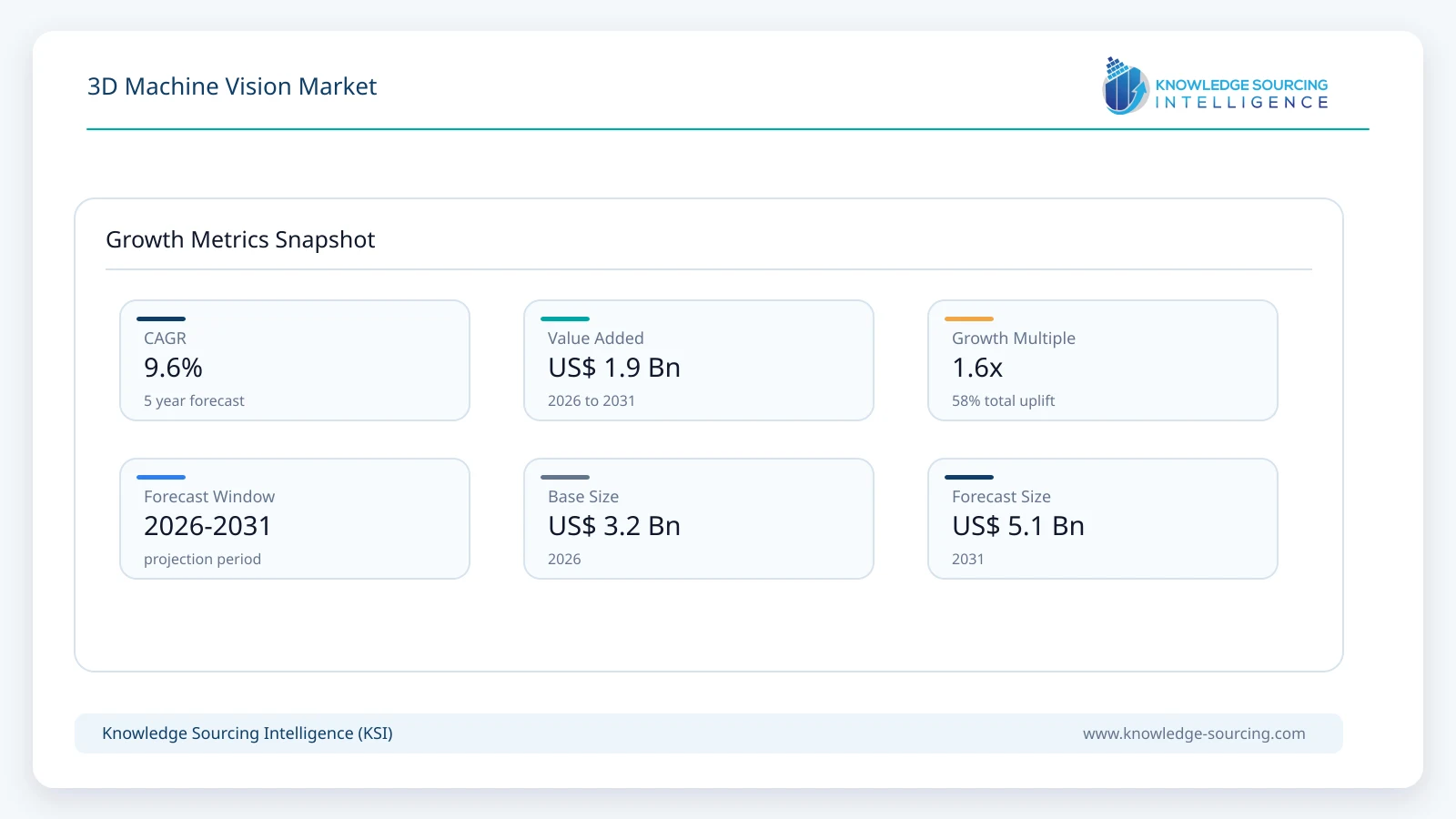
The global 3D machine vision market is estimated at USD 3.22 billion in 2026 and is forecast to reach approximately USD 5.08 billion in 2031, representing a CAGR of 9.6% across the forecast period.
Highlights:
- 1Asia Pacific leads demand as robotics, electronics, and EV manufacturing deepen automation investment.
- 2Hardware remains the largest component, supported by cameras, profilers, sensors, and processors.
- 3Laser triangulation remains the leading imaging approach for precision inline dimensional inspection.
- 4Inspection and quality control remains the largest application across major manufacturing industries.
- 5AI-enabled robotic perception is expanding demand beyond traditional fixed industrial inspection stations.
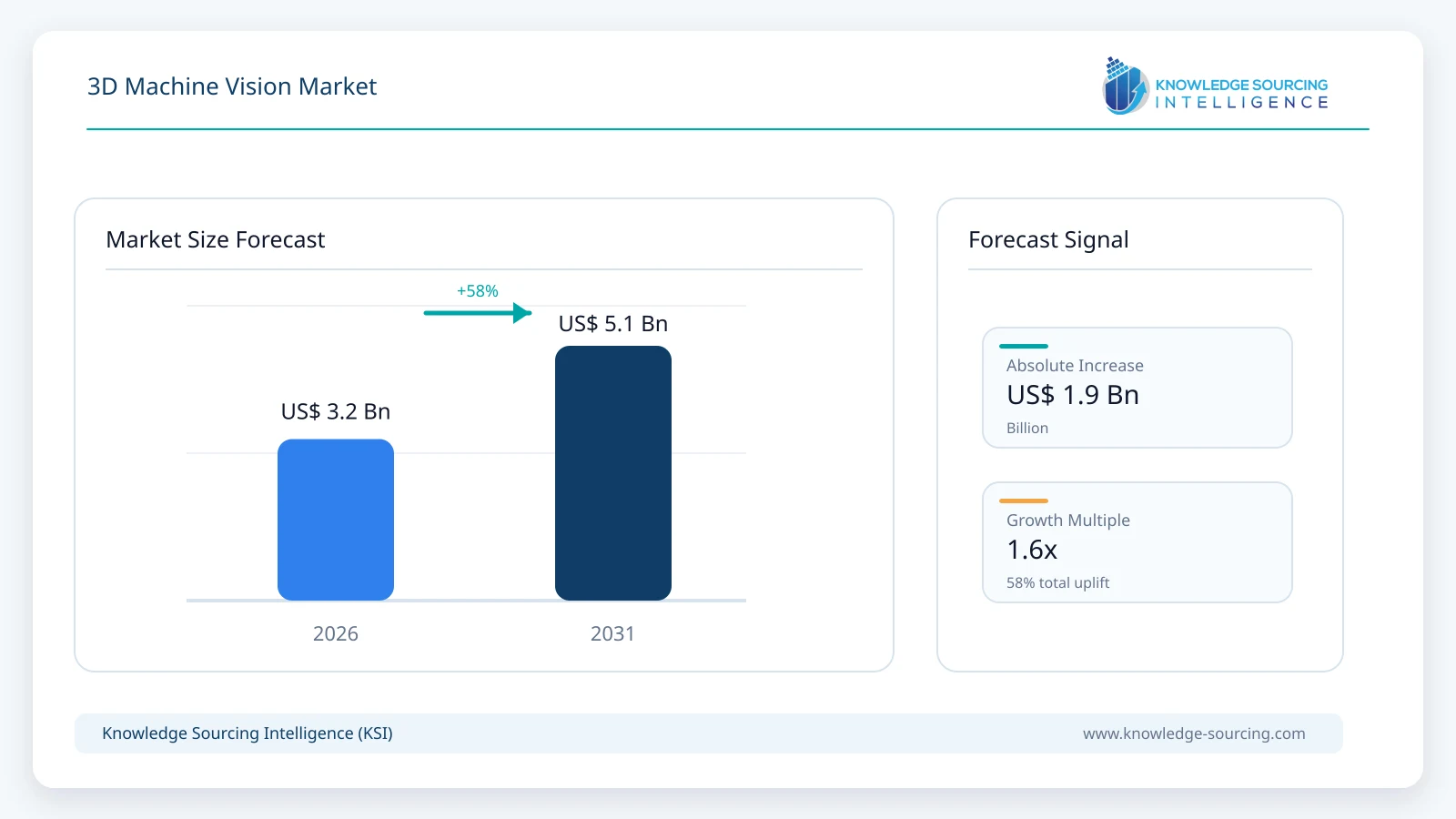
Demand is strengthening as manufacturers combine tighter quality requirements with rising automation density. The International Federation of Robotics reported that factories installed more than 600,000 industrial robots in 2025, an increase of 11%, while the global operational stock reached 5 million units. Asia accounted for the strongest growth, led by China. In parallel, the Association for Advancing Automation reported that North American machine-vision financial transactions increased 8.8% year over year in the second quarter of 2026, with systems increasing 9.5%. These indicators support a higher forward growth profile for 3D vision than the market experienced in the earlier forecast cycle.
The forecast retains the previously established 2025 market level of approximately USD 2.99 billion as the reference point while resetting the 2026-2031 growth path to reflect stronger robot deployment, AI-based inspection, logistics automation and embedded processing. Growth is not assumed to be uniform: expansion is strongest during the current automation investment cycle and gradually moderates as penetration rises in mature automotive and electronics applications.
The forecast assumes continued investment in industrial robotics, automated quality control and flexible manufacturing, alongside broader use of 3D vision in logistics and robotic perception. Growth is moderated by integration complexity, surface-specific imaging limitations, capital costs and the increasing maturity of established automotive and electronics inspection applications.
3D Machine Vision Market Trends
Robotic Perception Moves Beyond Fixed Automation
Industrial robots increasingly need to identify the position, orientation and geometry of objects instead of operating only against predefined coordinates. This is increasing use of 3D cameras in bin picking, depalletizing, machine tending, assembly and material handling. The shift is visible in recent corporate strategy: in September 2026 Cognex agreed to acquire RealSense, adding a depth-sensing and robotic-perception platform to its industrial machine-vision portfolio.
Inline 3D Inspection Expands Across Manufacturing
Manufacturers are increasingly measuring dimensional and surface characteristics directly on production lines. Laser profilers and snapshot sensors support automated checks of welds, sealants, connector position, battery components, package geometry and precision assemblies. The ability to capture height and shape makes 3D vision particularly valuable where 2D contrast alone cannot reliably identify a defect.
Processing Intelligence Moves Closer to the Sensor
More 3D systems now combine acquisition, processing and evaluation within the camera or sensor. This reduces data movement, external computing requirements and integration effort. Micro-Epsilon introduced the surfaceCONTROL 3D 3560 in September 2026 as an integrated snapshot sensor that performs 3D data processing and evaluation directly in the device, illustrating the broader move toward edge-based machine vision.
Logistics Becomes a Larger 3D Vision Use Case
Warehousing and fulfillment are expanding the addressable market through robotic picking, parcel dimensioning, pallet detection, depalletizing and tote handling. These environments contain irregular and randomly positioned objects, increasing the value of dense point clouds, active stereo and AI-based object recognition. Zebra strengthened this position when it completed its acquisition of Photoneo in March 2025.
3D Machine Vision Market Segment Analysis
By Component
Hardware
Hardware is estimated at approximately USD 2.06 billion in 2026, representing about 64% of market value. The segment includes industrial 3D cameras, laser profilers, depth sensors, optics, illumination, vision controllers and dedicated processing hardware. Hardware remains the largest component because each new inspection station or robotic cell requires physical acquisition equipment, while higher-resolution sensors and more integrated smart cameras continue to raise system value. Software and services are important contributors, but the installed base still expands primarily through new camera and sensor deployments.
By Imaging Technology
Laser Triangulation
Laser triangulation is estimated at approximately USD 1.13 billion in 2026, or about 35% of the market, making it the largest imaging-technology segment. The technology is widely used for high-speed inline profiling and dimensional measurement because it can provide dense, accurate height data across moving production lines. Automotive, battery, electronics, metals and general manufacturing applications use laser profilers for weld inspection, gap and flush measurement, surface characterization and dimensional control. Structured light, stereo and time-of-flight technologies remain important where full-area capture or longer working distances are required.
By Application
Inspection and Quality Control
Inspection and quality control is estimated at approximately USD 1.32 billion in 2026, accounting for about 41% of market value. The segment covers dimensional inspection, surface-defect detection, gap and flush measurement, coplanarity, weld profiling, bead inspection and assembly verification. Manufacturers use 3D vision where product quality depends on geometry rather than appearance alone. The application remains the largest because automated inspection is deployed across multiple industries and is increasingly integrated directly into high-speed production lines rather than performed as an offline metrology step.
By Industry Vertical
Automotive and EV Battery
Automotive and EV battery applications are estimated at approximately USD 0.87 billion in 2026, representing about 27% of the market. Vehicle production combines body-in-white inspection, gap and flush measurement, adhesive and sealant verification, weld analysis, robotic guidance and dimensional checks across complex assemblies. Battery manufacturing adds further requirements for cell, module, connector and pack inspection. Electronics and semiconductor manufacturing also represent a major demand center, but automotive remains the largest industry vertical because of the breadth and number of 3D inspection and guidance points per production line.
By Geography
Asia Pacific
Asia Pacific is estimated at approximately USD 1.38 billion in 2026, or about 43% of the global market. The region combines the world's largest industrial-robot installation base with major concentrations of electronics, semiconductor, automotive, EV battery and machinery production.
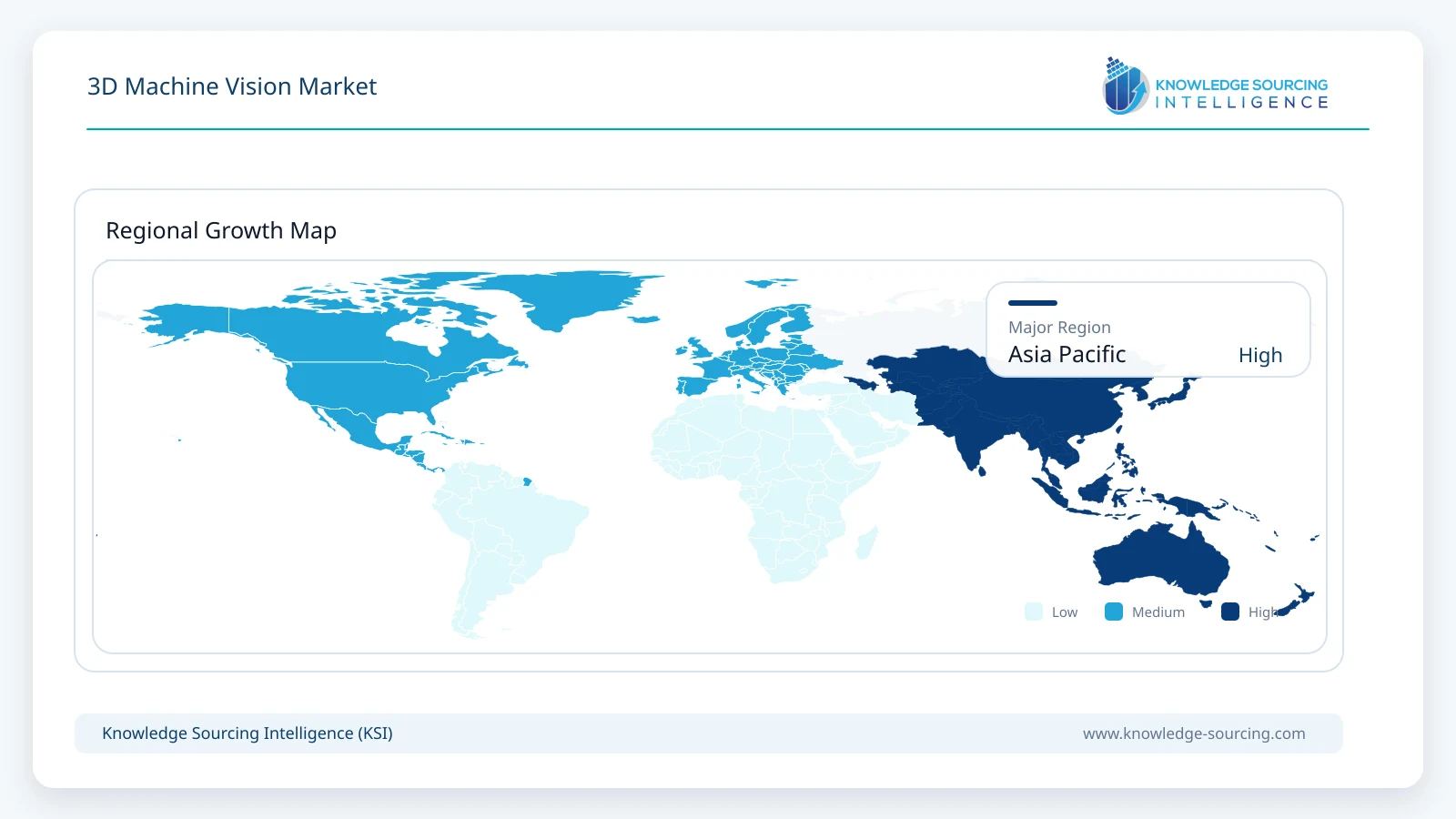
IFR reported that China alone installed 354,000 industrial robots in 2025, accounting for 59% of global deployments. Japan, South Korea, Taiwan and increasingly India add substantial demand for precision manufacturing and automation, supporting Asia Pacific's leading position in 3D machine vision.
Market Drivers
Rising industrial robot installations increasing demand for depth-aware guidance and object localization.
Higher inline quality requirements across automotive, batteries, electronics, semiconductor, and machinery manufacturing.
AI-based inspection and 3D matching improving flexibility across variable products and surfaces.
Embedded processing reducing latency, external-computing requirements, and machine-vision integration complexity.
Warehouse automation expanding use of 3D vision in picking, dimensioning, and depalletizing.
Market Restraints
Higher upfront system cost compared with simpler 2D machine-vision installations.
Calibration, lighting, field-of-view, and robot-coordinate integration requirements increasing engineering effort.
Reflective, transparent, dark, and highly textured surfaces can challenge particular 3D technologies.
High-resolution point-cloud processing can raise computing, bandwidth, and application-development requirements.
Mature inspection applications in established automotive plants can limit replacement-driven growth rates.
Competitive Environment
The competitive environment includes diversified industrial machine-vision suppliers, specialist 3D sensor companies and robotic-perception vendors. Cognex, KEYENCE, SICK, Zebra Technologies, LMI Technologies, Teledyne Vision Solutions, Basler and OMRON compete across broad industrial inspection portfolios, while Zivid, Mech-Mind, IDS, wenglor and Micro-Epsilon bring specialist capabilities in stereo vision, robot guidance, laser profiling and high-resolution 3D measurement. MVTec adds software capability through 3D matching and machine-vision development tools.
Competition increasingly centers on point-cloud quality, acquisition speed, robustness on difficult surfaces, embedded processing, AI-enabled inspection and easier robot integration. Zebra completed its acquisition of Photoneo in March 2025, consolidating a specialist 3D portfolio under Zebra. Cognex announced a definitive agreement in September 2026 to acquire RealSense, with closing expected in the fourth quarter of 2026, showing that 3D robotic perception is becoming strategically important to larger machine-vision platforms.
Recent Developments
September 2026: Cognex announced a definitive agreement to acquire RealSense, adding depth-sensing cameras and robotic-perception technology to its machine-vision portfolio.
September 2026: Micro-Epsilon introduced the surfaceCONTROL 3D 3560, integrating 3D acquisition, processing and evaluation directly within the sensor.
April 2026: IDS expanded the Ensenso C-series with the C67, adding hardware improvements and new model variants for industrial 3D applications.
March 2025: Zebra Technologies completed its acquisition of Photoneo, expanding its portfolio of 3D machine-vision solutions for manufacturing and logistics.
2025-2026: Global industrial-robot installations and machine-vision transaction growth strengthened the demand environment for automated 3D inspection and guidance.
Market Outlook
The 3D machine vision market is expected to expand faster than the earlier forecast cycle as depth sensing becomes a standard enabling technology for more automated production and robotic work cells. Inspection and quality control should remain the largest value pool, while robotic perception broadens the addressable market into flexible handling and logistics. Vendors that reduce calibration effort, improve performance on difficult surfaces and combine 3D capture with embedded AI are positioned to gain share as customers move from isolated inspection systems toward connected, adaptive automation architectures.
3D Machine Vision Market Scope:
| Report Metric | Details |
|---|---|
| Total Market Size in 2026 | USD 3.22 billion |
| Total Market Size in 2031 | USD 5.08 billion |
| Forecast Unit | Billion |
| Growth Rate | 9.6% |
| Study Period | 2021 to 2031 |
| Historical Data | 2021 to 2024 |
| Base Year | 2025 |
| Forecast Period | 2026 – 2031 |
| Segmentation | Component, Imaging Technology, Application, Industry Vertical, Geography |
| Companies |
|
Market Segmentation
By Component
Hardware
Software
Services
By Imaging Technology
Laser Triangulation
Structured Light and Pattern Projection
Stereo and Active Stereo
Time-of-Flight
Others
By Application
Inspection and Quality Control
Measurement and Metrology
Robot Guidance, Bin Picking and Pick-and-Place
Assembly Verification
Sorting, Dimensioning and Material Handling
Others
By Industry Vertical
Automotive and EV Battery
Electronics and Semiconductor
Logistics and Warehousing
Metals and Machinery
Food and Beverage
Pharmaceuticals and Medical Devices
Packaging and Consumer Goods
Others
By Geography
North America
United States
Canada
Mexico
South America
Brazil
Others
Europe
Germany
United Kingdom
France
Italy
Others
Middle East and Africa
Saudi Arabia
UAE
Israel
South Africa
Others
Asia Pacific
China
Japan
South Korea
Taiwan
India
Others
Table of Contents
1. INTRODUCTION
1.1. Market Overview
1.2. Market Definition and Scope
1.3. Market Size Reference Point
1.4. Currency and Assumptions
2. RESEARCH METHODOLOGY
2.1. Secondary Research
2.2. Company and Product Validation
2.3. Market Estimation and Triangulation
3. EXECUTIVE SUMMARY
3.1. Key Findings
3.2. Global Market Size, 2026-2031
4. MARKET DYNAMICS
4.1. Market Drivers
4.2. Market Restraints
4.3. Automation, AI and Robotic-Perception Trends
5. 3D MACHINE VISION MARKET BY COMPONENT
5.1. Hardware
5.2. Software
5.3. Services
6. 3D MACHINE VISION MARKET BY IMAGING TECHNOLOGY
6.1. Laser Triangulation
6.2. Structured Light and Pattern Projection
6.3. Stereo and Active Stereo
6.4. Time-of-Flight
6.5. Others
7. 3D MACHINE VISION MARKET BY APPLICATION
7.1. Inspection and Quality Control
7.2. Measurement and Metrology
7.3. Robot Guidance, Bin Picking and Pick-and-Place
7.4. Assembly Verification
7.5. Sorting, Dimensioning and Material Handling
7.6. Others
8. 3D MACHINE VISION MARKET BY INDUSTRY VERTICAL
8.1. Automotive and EV Battery
8.2. Electronics and Semiconductor
8.3. Logistics and Warehousing
8.4. Metals and Machinery
8.5. Food and Beverage
8.6. Pharmaceuticals and Medical Devices
8.7. Packaging and Consumer Goods
8.8. Others
9. 3D MACHINE VISION MARKET BY GEOGRAPHY
9.1. North America
9.1.1. United States
9.1.2. Canada
9.1.3. Mexico
9.2. South America
9.2.1. Brazil
9.2.2. Others
9.3. Europe
9.3.1. Germany
9.3.2. United Kingdom
9.3.3. France
9.3.4. Italy
9.3.5. Others
9.4. Middle East and Africa
9.4.1. Saudi Arabia
9.4.2. UAE
9.4.3. Israel
9.4.4. South Africa
9.4.5. Others
9.5. Asia Pacific
9.5.1. China
9.5.2. Japan
9.5.3. South Korea
9.5.4. Taiwan
9.5.5. India
9.5.6. Others
10. COMPETITIVE ENVIRONMENT AND ANALYSIS
10.1. Competitive Positioning
10.2. Product and Technology Benchmarking
10.3. Strategic Developments
10.4. Mergers, Acquisitions and Partnerships
11. COMPANY PROFILES
11.1. Cognex Corporation
11.2. KEYENCE Corporation
11.3. SICK AG
11.4. Zebra Technologies Corporation
11.5. LMI Technologies Inc.
11.6. Teledyne Vision Solutions
11.7. Basler AG
11.8. OMRON Corporation
11.9. IDS Imaging Development Systems GmbH
11.10. Zivid AS
11.11. Mech-Mind Robotics Technologies Ltd.
11.12. wenglor sensoric group
11.13. MICRO-EPSILON MESSTECHNIK GmbH & Co. KG
11.14. ifm electronic gmbh
11.15. MVTec Software GmbH
11.16. RealSense
11.17. ISRA VISION GmbH
12. APPENDIX
12.1. Currency
12.2. Assumptions
12.3. Market Definition and Exclusions
12.4. Abbreviations
Navigate
Trusted by the world's leading organizations











