
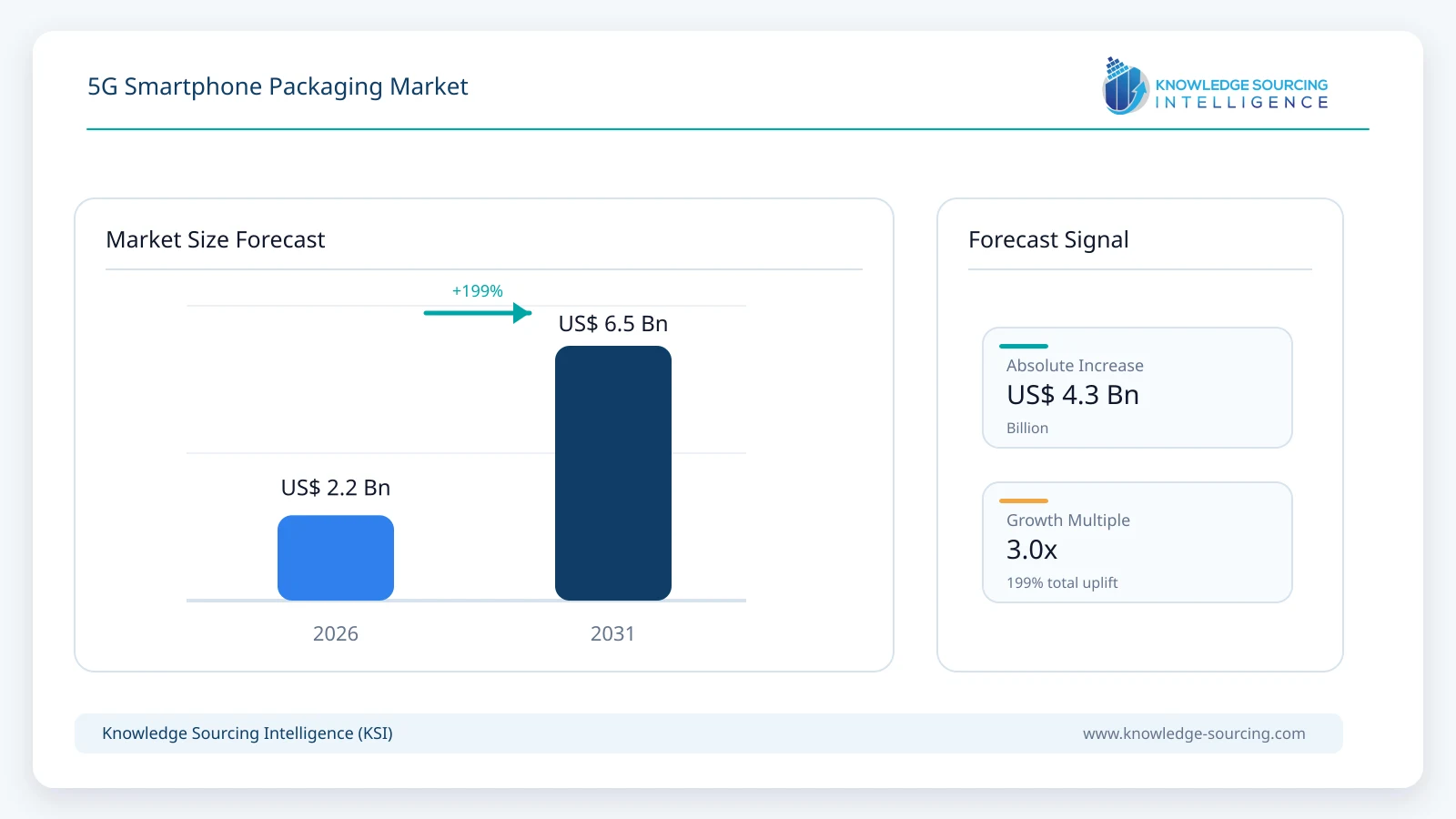
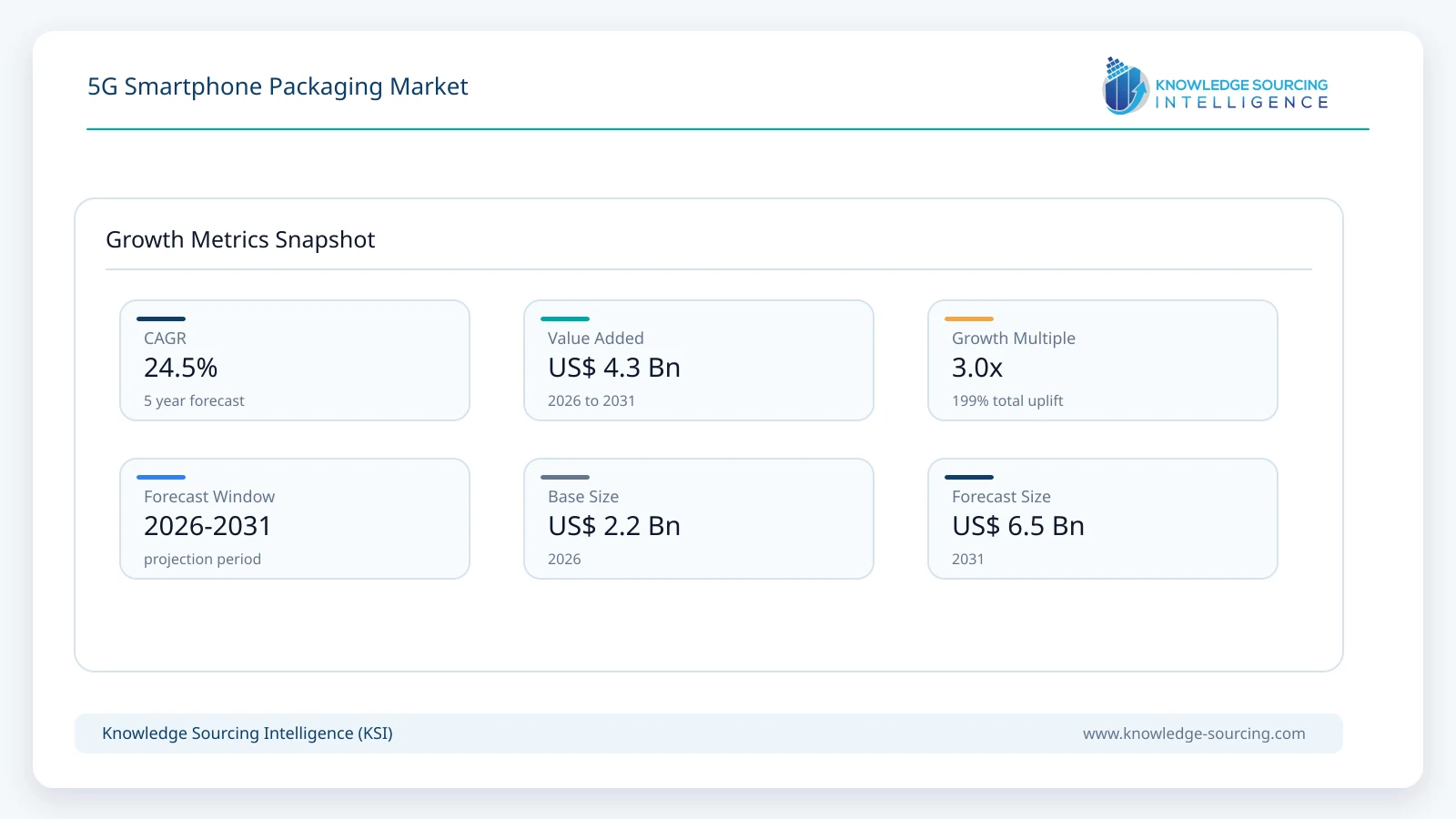
The global 5G smartphone packaging market is forecast to grow from USD 2.75 billion in 2026 to USD 4.63 billion in 2031, representing a CAGR of 11.0% during the forecast period.
Highlights:
- 1RF front-end module packaging accounts for approximately 87.0% of global 5G smartphone packaging revenue in 2026.
- 2Sub-6 GHz packaging represents approximately 84.0% of global 2026 market revenue.
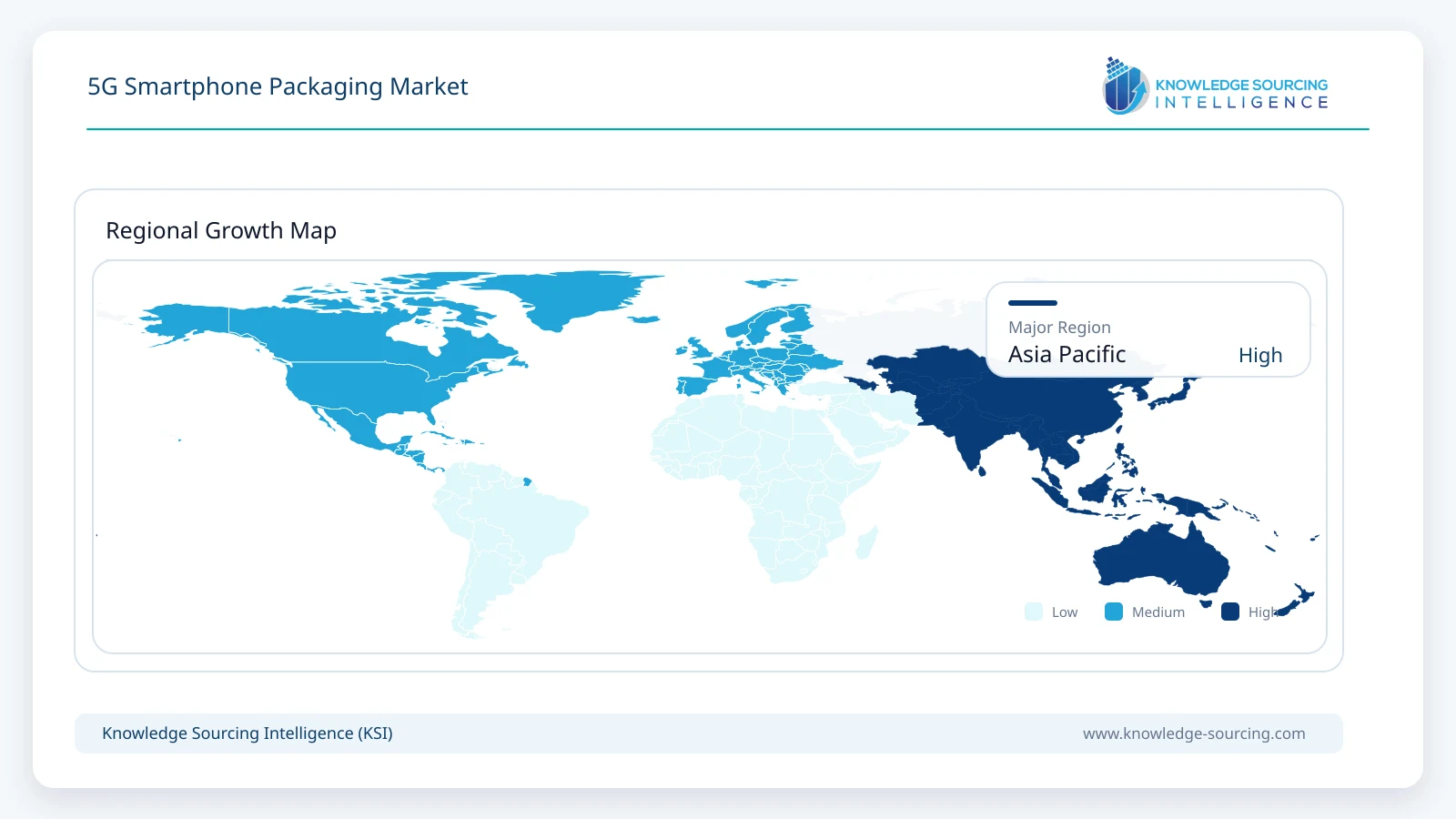
- 3Asia Pacific accounts for approximately 59.0% of global 5G smartphone packaging revenue in 2026.
- 4Amkor generated approximately 46% of its 2025 revenue from communications applications such as smartphones and tablets, illustrating the scale of advanced mobile packaging demand.
- 5Advanced System-in-Package, double-sided molded packages, wafer-level packaging and antenna-in-package technologies are reducing board area while supporting higher RF complexity.
- 6Growth is increasingly driven by higher packaging content per premium device rather than by smartphone unit growth alone.
Market Overview
The 5G smartphone packaging market covers packaging, assembly, substrate, interconnect and module-integration value directly associated with 5G smartphone RF front-end modules and antenna-in-package assemblies. The scope includes advanced System-in-Package (SiP), molded module packaging, land-grid-array and ball-grid-array formats, wafer level packaging, fan-out approaches, shielding, embedded passives, substrate integration and related package-level testing used to integrate power amplifiers, filters, switches, low-noise amplifiers, transceivers, power-management devices and antennas for 5G handsets.
The study excludes the semiconductor die value of modem processors, RF transceivers, filters, power amplifiers and switches when sold as stand-alone components. It also excludes baseband/application-processor packaging unless directly integrated within the defined 5G RF package, as well as printed circuit boards, antennas sold separately from an AiP assembly and packaging used primarily for non-smartphone infrastructure, automotive or IoT applications.
The market is structurally supported by the higher RF content required in modern 5G handsets. Amkor states that 5G and RF functionality can push RF semiconductor content above USD 20 per smartphone, while its communications business represented 46% of 2025 net sales. The packaging share is materially smaller than total RF semiconductor content, but the number of RF paths, carrier-aggregation combinations, filters and receive chains increases the need for dense multi-die integration and package-level shielding.
Current supplier economics indicate a packaging market in the low-single-digit billions rather than a market expanding at more than 20% annually. Amkor previously identified the advanced packaging market for 5G RF front-end modules at roughly USD 2.3 billion by 2026. Since then, smartphone 5G penetration has increased substantially, but handset unit growth has slowed and module pricing remains competitive. The additional contribution from mmWave AiP and rising packaging complexity supports a 2026 market of approximately USD 2.75 billion.
The forecast through 2031 assumes a gradual recovery in smartphone shipments after the 2026 memory-driven downturn, near-universal 5G support across mid- and premium-tier smartphones, greater adoption of higher-frequency sub-6 GHz bands, continued use of carrier aggregation and MIMO, and a modest expansion of mmWave and non-terrestrial-network capability. These drivers increase package complexity even when the number of smartphones grows slowly.
5G Smartphone Packaging Market Trends
RF Front-End Modules Move Toward Higher Integration
5G handsets require more filters, switches, amplifiers and receive chains than earlier generations, but smartphone board area remains tightly constrained. Suppliers therefore continue to combine multiple semiconductor technologies inside compact RF front-end packages. Amkor's double-sided molded BGA approach, integrated PAMiD/L-PAMiF architectures from RF vendors and high-density SiP assembly from OSATs illustrate the industry's move toward multi-function modules with package-level shielding, embedded passives and denser interconnect.
Sub-6 GHz Remains the Volume Center of the Market
The majority of global 5G smartphones rely primarily on sub-6 GHz spectrum, particularly bands such as n77, n78 and n79. This makes sub-6 GHz RF front-end packaging the principal commercial value pool. Products from Skyworks, OnMicro, SmarterMicro and other vendors integrate PA, LNA, switching and filtering functions into small LGA or related packages, reducing board space while supporting increasingly complex carrier aggregation and MIMO requirements.
mmWave AiP Remains a Premium but Strategically Important Niche
mmWave requires antenna elements to be tightly integrated with transceiver and power-management functions because transmission losses rise sharply at high frequencies. Antenna-in-Package addresses this challenge by placing the antenna array within or directly on the package. TechInsights' 2026 analysis of a USI AiP removed from an Apple iPhone 15 Pro Max confirms continued commercial use of integrated mmWave packaging, although deployment remains concentrated in selected premium handsets and markets.
5G-Advanced and Satellite Connectivity Increase RF Complexity
The next modem-RF generation is adding more bands, higher carrier aggregation, satellite connectivity and more advanced AI-assisted radio control. Qualcomm's 2026 X105 modem-RF platform is Release 19-ready and integrates non-terrestrial-network functions. As the radio architecture becomes more complex, smartphone OEMs face stronger pressure to reduce the footprint of RF subsystems, raising the value of dense packaging, shielding and module co-design.
Regionalization Changes the Packaging Supply Chain
Packaging capacity remains concentrated in Asia, but governments and customers are seeking more geographically diversified supply chains. Amkor expanded its planned Arizona advanced packaging investment to approximately USD 12 billion in September 2026, while continuing to scale SiP capacity in Asia. Although smartphone RF packaging will remain heavily Asia-centered, regional manufacturing requirements are becoming more important for large device and semiconductor customers.
Segment Analysis
By Type - RF Front-End Module Packaging
RF front-end module packaging is estimated at approximately USD 2.39 billion in 2026. It remains the largest value pool because every 5G smartphone requires multiple packaged RF functions across transmit, receive and antenna paths, while mmWave AiP remains limited to selected premium designs. Modern RF modules increasingly integrate power amplifiers, duplexers or filters, switches, low-noise amplifiers, controllers and passive components into compact SiP or molded-module formats. Package design must manage electrical isolation, thermal performance, electromagnetic shielding, component height and high-volume manufacturability simultaneously. The migration toward more integrated PAMiD, L-PAMiF and diversity receive modules is expected to increase packaging value per advanced 5G handset even as component-level pricing remains competitive.
By Band - Sub-6 GHz
Sub-6 GHz packaging is estimated at approximately USD 2.31 billion in 2026. The segment dominates because sub-6 GHz 5G is deployed across nearly all major smartphone markets and covers both legacy cellular bands and newer 5G spectrum such as n77, n78 and n79. Supporting these bands requires additional filters, switching, LNAs, power amplification and MIMO receive paths, creating a high level of integration within the RF front end. Vendors such as Skyworks, OnMicro, SmarterMicro, Vanchip, Murata and Broadcom maintain active module or RF-device portfolios for these frequencies, while OSATs and SiP manufacturers provide the packaging platforms needed to combine heterogeneous RF technologies within compact handset footprints.
By Geography - Asia Pacific
Asia Pacific is estimated at approximately USD 1.62 billion in 2026. The region combines the world's largest smartphone manufacturing base with the dominant concentration of OSAT, substrate, RF-module and electronics-manufacturing capacity. Taiwan, South Korea, China, Japan, Vietnam and the Philippines collectively support much of the semiconductor packaging and module assembly used in global smartphones. ASE Technology, Amkor, JCET, TSMC, Murata, Taiyo Yuden and multiple Chinese RF front-end specialists operate major production or development footprints in the region. Asia Pacific is expected to remain the largest regional market through 2031 as 5G penetration expands further in India, Southeast Asia and lower-priced smartphone segments and as packaging density increases in premium Android and Apple devices.
Market Drivers
Increasing RF Content per Smartphone
5G devices must support more frequency bands, carrier aggregation combinations, MIMO receive chains and coexistence requirements than earlier smartphone generations. Even when handset shipment growth is modest, the number of RF functions integrated into each premium device can rise, supporting higher packaging content per phone.
Continued 5G Penetration in Emerging Smartphone Markets
5G adoption is still expanding in emerging markets even as penetration is mature in many developed economies. Counterpoint Research identified rising 5G adoption in emerging markets as a contributor to smartphone demand in 2025. As 5G moves deeper into mid-range devices, integrated RF packaging volumes expand beyond premium handsets.
Space Constraints and Battery Competition
Smartphones must allocate increasing internal space to batteries, cameras, AI processors and thermal systems while supporting more RF bands. Dense SiP and molded module packaging helps reduce RF board area, making packaging innovation directly relevant to device form factor and battery capacity.
Shift Toward 5G-Advanced
Release 18 and Release 19 capabilities introduce additional spectrum combinations, advanced MIMO, satellite connectivity and more sophisticated modem-RF coordination. These features can increase RF subsystem complexity and encourage tighter integration of transceivers, front-end modules and antennas.
Higher Premium-Tier Semiconductor Content
Amkor estimates that semiconductor content in premium smartphones is materially higher than the average handset. Premium devices also tend to adopt more complex RF front ends, advanced AiP designs and tighter packaging rules, supporting disproportionate packaging value even when premium unit volumes are smaller.
Market Restraints
Weak Smartphone Unit Growth
Global smartphone shipments are expected to contract sharply in 2026 because of memory constraints and higher device prices. This limits near-term package volumes and makes the market increasingly dependent on content growth rather than unit growth.
RF Module Price Pressure
Large smartphone OEMs exert substantial pricing pressure on RF suppliers and packaging partners. High shipment volumes, multiple qualified suppliers and rapid product cycles can reduce average selling prices even as package complexity increases.
Limited Global mmWave Adoption
mmWave AiP offers high packaging value per device but remains concentrated in selected premium phones and geographic markets. Most 5G smartphone volume continues to use sub-6 GHz spectrum, limiting the addressable volume for more expensive mmWave AiP assemblies.
Complex Qualification Requirements
RF packages must meet stringent insertion loss, isolation, thermal, mechanical and reliability requirements while fitting extremely small footprints. New materials and architectures require lengthy co-design and qualification with RF semiconductor vendors and smartphone OEMs, raising development cost.
Customer Concentration
The premium smartphone market is concentrated among a relatively small number of OEMs. Qorvo reported that Apple represented about half of fiscal 2026 revenue and Samsung roughly 10%, illustrating the customer concentration faced by major mobile RF suppliers. Similar concentration affects packaging demand and negotiation power.
Competitive Landscape
The market spans two overlapping supplier groups: semiconductor packaging and test providers that manufacture advanced SiP and wafer-level packages, and RF front-end companies that design and commercialize integrated modules in which packaging is a core part of product performance. Amkor, ASE Technology, JCET and TSMC are important packaging technology providers, while Qualcomm, Broadcom, Skyworks, Qorvo and Murata shape module architectures and packaging requirements through large smartphone design wins.
The competitive landscape is also broadening in China. Maxscend, OnMicro, Vanchip and SmarterMicro have active 5G RF front-end module portfolios for smartphones, strengthening domestic supply in mid- and high-band RF functions. TechInsights' 2026 analysis of the Maxscend MXD9122C diversity receive module found the device in a Samsung Galaxy A14 5G, demonstrating commercial penetration beyond domestic Chinese handset brands.
Competitive advantage depends on module footprint, RF loss, shielding, thermal behavior, yield, package height, embedded-passive capability and access to high-volume assembly. Suppliers that can co-design semiconductor die, substrate, package and test are increasingly favored as smartphone RF architectures become denser. Geographic manufacturing flexibility is becoming an additional differentiator as OEMs seek more resilient semiconductor supply chains.
Recent Developments
September 2026: Amkor announced phase 2 of its Arizona advanced packaging and test campus, increasing planned investment to approximately USD 12 billion and adding 60,000 square meters of cleanroom capacity to support advanced semiconductor packaging demand, including communications applications.
September 2026: TechInsights published a package analysis of a USI 339M00227 antenna-in-package device removed from an Apple iPhone 15 Pro Max, confirming continued commercial use of mmWave AiP integrating a transceiver die, antenna array, power-management IC and passives.
July 2026: TechInsights published a packaging analysis of Maxscend's MXD9122C 5G diversity receive front-end module used in the Samsung Galaxy A14 5G, highlighting the growing role of Chinese RF front-end suppliers in commercial smartphones.
March 2026: Qualcomm introduced the X105 5G Modem-RF system, the first Release 19-ready modem-RF platform, with integrated non-terrestrial-network capability and a new 6 nm RF transceiver that increases pressure for compact high-performance RF packaging.
February 2026: Skyworks maintained and updated its SKY58286-11A front-end module for 4G and 5G applications, integrating power amplification, filtering, switching, MIMO receive functionality and control within a compact 3.8 mm by 3.8 mm package.
January 2026: Skyworks reported continued 5G design wins in premium Android smartphones, including Samsung's Galaxy S26 platform, supporting demand for highly integrated mobile RF modules.
Market Outlook
The 5G smartphone packaging market is expected to grow at a low-double-digit rate through 2031, substantially slower than the 20%-plus growth rates associated with the early 5G transition. The technology is no longer in its initial adoption phase; most premium and mid-range smartphones already support 5G, and global handset unit growth is limited. Future value growth therefore depends primarily on higher RF complexity per device, wider adoption of integrated modules and gradual expansion of mmWave and 5G-Advanced functions.
RF front-end module packaging will remain the dominant segment because sub-6 GHz connectivity requires multiple packaged transmit and receive paths across virtually all 5G smartphones. AiP will remain smaller but strategically important, particularly in premium devices where mmWave and advanced antenna integration justify higher package value. Greater use of satellite connectivity and high-frequency spectrum can increase the relevance of antenna-package co-design over the forecast period.
Asia Pacific will continue to dominate manufacturing and market value because the region contains the largest concentration of smartphone assembly, RF semiconductor production, OSAT capacity and substrate manufacturing. However, investments such as Amkor's Arizona campus show that advanced packaging capacity is beginning to regionalize. Suppliers with strong SiP integration, RF test capability, shielding technology and multi-region manufacturing are best positioned to capture growth.
5G Smartphone Packaging Market Scope
| Report Metric | Details |
|---|---|
| Total Market Size in 2026 | USD 2.75 billion |
| Total Market Size in 2031 | USD 4.63 billion |
| Forecast Unit | Billion |
| Growth Rate | 11.0% |
| Study Period | 2021 to 2031 |
| Historical Data | 2021 to 2024 |
| Base Year | 2025 |
| Forecast Period | 2026 – 2031 |
| Segmentation | Type, Band, Geography |
| Companies |
|
Market Segmentation
By Type
RF Front-End Module Packaging
Power Amplifier / Filter Integrated Modules
Diversity Receive and LNA Modules
Multi-Band and Multi-Mode Integrated Modules
Antenna-in-Package (AiP)
By Band
Sub-6 GHz
mmWave
By Geography
Americas
United States
Canada
Others
Europe, Middle East and Africa
Germany
United Kingdom
France
Others
Asia Pacific
China
Japan
South Korea
Taiwan
India
Southeast Asia
Others
Table of Contents
1. INTRODUCTION
1.1. Market Overview
1.2. Market Definition
1.3. Scope of the Study
1.4. Market Segmentation
1.5. Currency
1.6. Assumptions
1.7. Base and Forecast Years Timeline
1.8. Key Benefits to Stakeholders
2. RESEARCH METHODOLOGY
2.1. Research Design
2.2. Secondary Research
2.3. Primary Validation
2.4. Market Estimation and Forecasting
2.5. Data Triangulation and Quality Control
3. EXECUTIVE SUMMARY
3.1. Key Findings
3.2. Global Market Size, 2026-2031
3.3. Technology and Band Summary
3.4. Regional Opportunity Summary
4. MARKET DYNAMICS
4.1. Market Drivers
4.1.1. Increasing RF Content per Smartphone
4.1.2. Continued 5G Penetration in Emerging Smartphone Markets
4.1.3. Space Constraints and Battery Competition
4.1.4. Shift Toward 5G-Advanced
4.1.5. Higher Premium-Tier Semiconductor Content
4.2. Market Restraints
4.2.1. Weak Smartphone Unit Growth
4.2.2. RF Module Price Pressure
4.2.3. Limited Global mmWave Adoption
4.2.4. Complex Qualification Requirements
4.2.5. Customer Concentration
4.3. Porter’s Five Forces Analysis
4.4. Industry Value Chain Analysis
5. 5G SMARTPHONE PACKAGING MARKET BY TYPE
5.1. Introduction
5.2. RF Front-End Module Packaging
5.2.1. Power Amplifier / Filter Integrated Modules
5.2.2. Diversity Receive and LNA Modules
5.2.3. Multi-Band and Multi-Mode Integrated Modules
5.3. Antenna-in-Package (AiP)
6. 5G SMARTPHONE PACKAGING MARKET BY BAND
6.1. Introduction
6.2. Sub-6 GHz
6.3. mmWave
7. 5G SMARTPHONE PACKAGING MARKET BY GEOGRAPHY
7.1. Introduction
7.2. Americas
7.2.1. United States
7.2.2. Canada
7.2.3. Others
7.3. Europe, Middle East and Africa
7.3.1. Germany
7.3.2. United Kingdom
7.3.3. France
7.3.4. Others
7.4. Asia Pacific
7.4.1. China
7.4.2. Japan
7.4.3. South Korea
7.4.4. Taiwan
7.4.5. India
7.4.6. Southeast Asia
7.4.7. Others
8. COMPETITIVE ENVIRONMENT AND ANALYSIS
8.1. Major Players and Strategy Analysis
8.2. Packaging Architecture and Integration
8.3. RF Module and AiP Competition
8.4. Manufacturing Footprint and Supply-Chain Strategy
8.5. Mergers, Acquisitions, Agreements and Partnerships
8.6. Competitive Dashboard
9. COMPANY PROFILES
9.1. Amkor Technology, Inc.
9.2. ASE Technology Holding Co., Ltd. / Universal Scientific Industrial
9.3. JCET Group Co., Ltd.
9.4. Taiwan Semiconductor Manufacturing Company Limited
9.5. Qualcomm Incorporated
9.6. Broadcom Inc.
9.7. Skyworks Solutions, Inc.
9.8. Qorvo, Inc.
9.9. Murata Manufacturing Co., Ltd.
9.10. TAIYO YUDEN CO., LTD.
9.11. Maxscend Microelectronics Company Limited
9.12. OnMicro Electronics Co., Ltd.
9.13. Vanchip (Tianjin) Technology Co., Ltd.
9.14. Smarter Microelectronics Co., Ltd.
9.15. AAC Technologies Holdings Inc.
10. APPENDIX
10.1. Currency
10.2. Assumptions
10.3. Base and Forecast Years Timeline
10.4. Abbreviations
Navigate
Trusted by the world's leading organizations











