
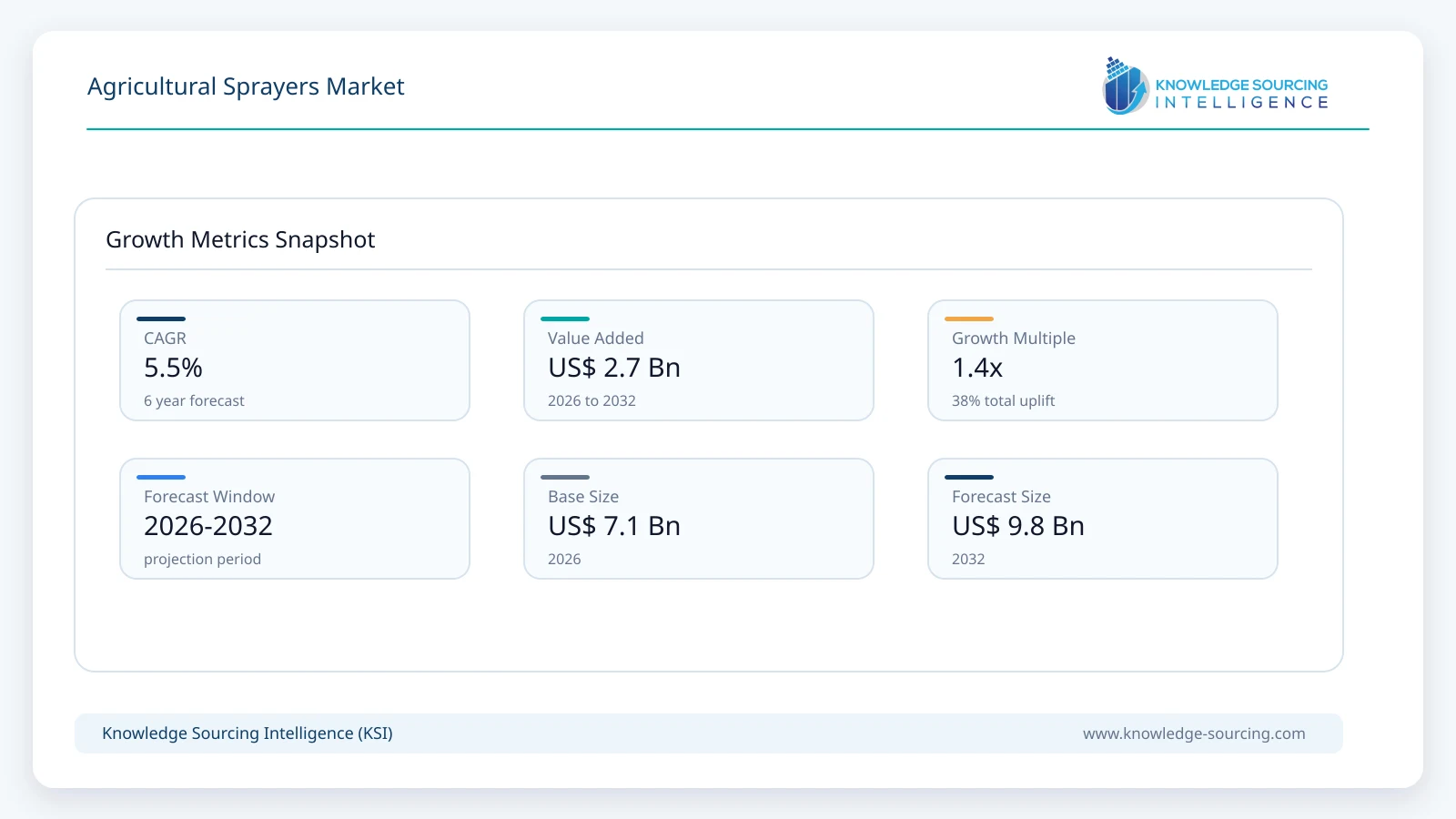
The global Agricultural Sprayers Market is forecast to grow at a CAGR of 5.50%, reaching USD 9.83 billion in 2032 from USD 7.13 billion in 2026.
Highlights:
- 1Self-propelled sprayers account for an estimated 29.2% of global equipment revenue in 2026, reflecting the contribution of high-value large-field machines even though unit volumes are much smaller than handheld sprayers.
- 2Agricultural spray drones are projected to register approximately 9.1% CAGR during 2026–2032, supported by deployment in labor-constrained or difficult-access production environments.
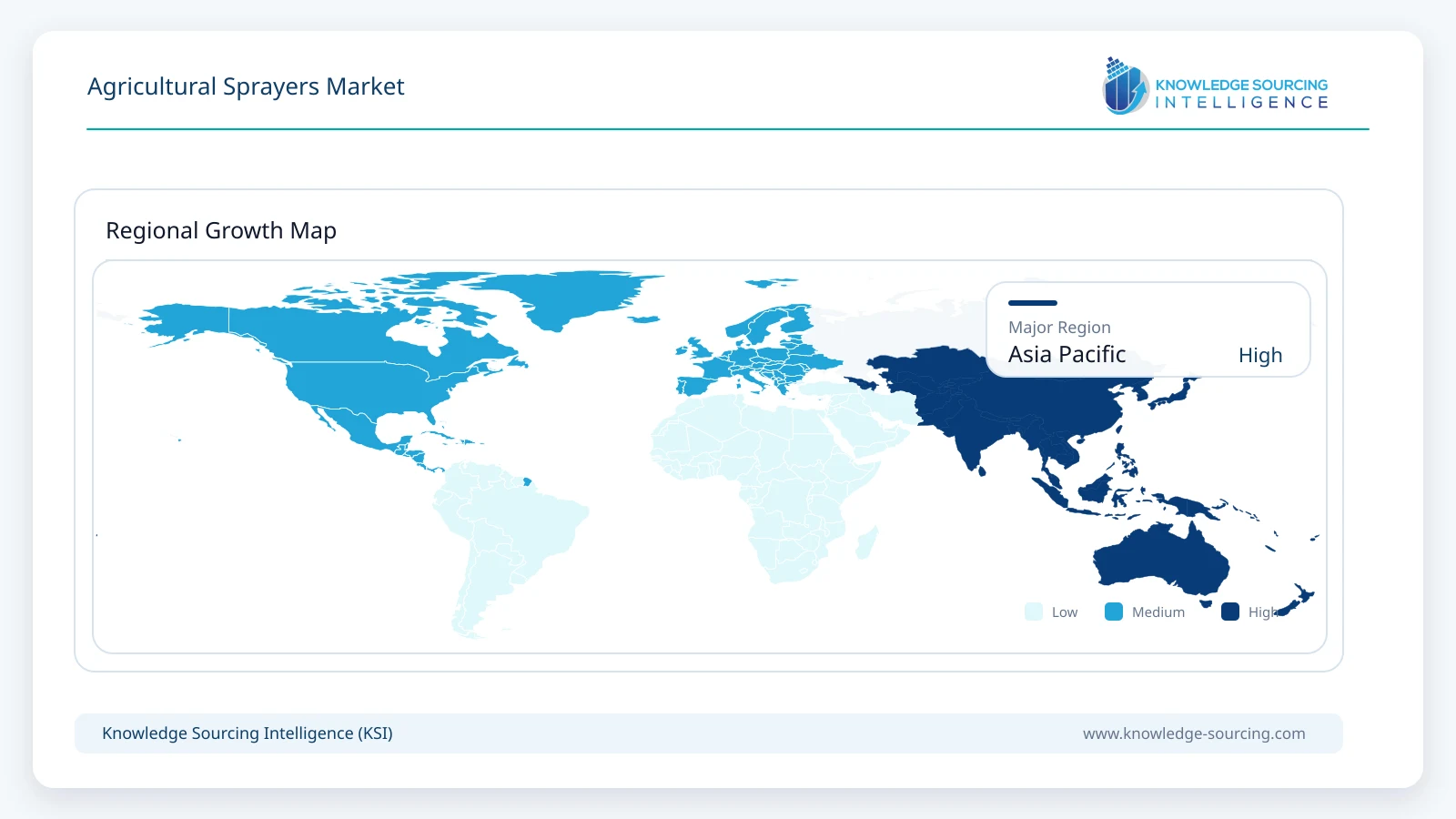
- 3Asia Pacific represents approximately 30.4% of 2026 modeled revenue, combining low-cost ground equipment with a substantial share of purpose-built spraying drone deliveries.
- 4The purchase case for vision-guided spraying depends on chemical expenditure avoided, spraying window, crop coverage and supported retrofit options, not on generic claims about farm digitization.
- 5The market is cyclicalEXEL Industries reported that its agricultural spraying activity fell materially in 2024–2025 and remained under pressure in early 2026 as farmers and dealers deferred new machine orders.
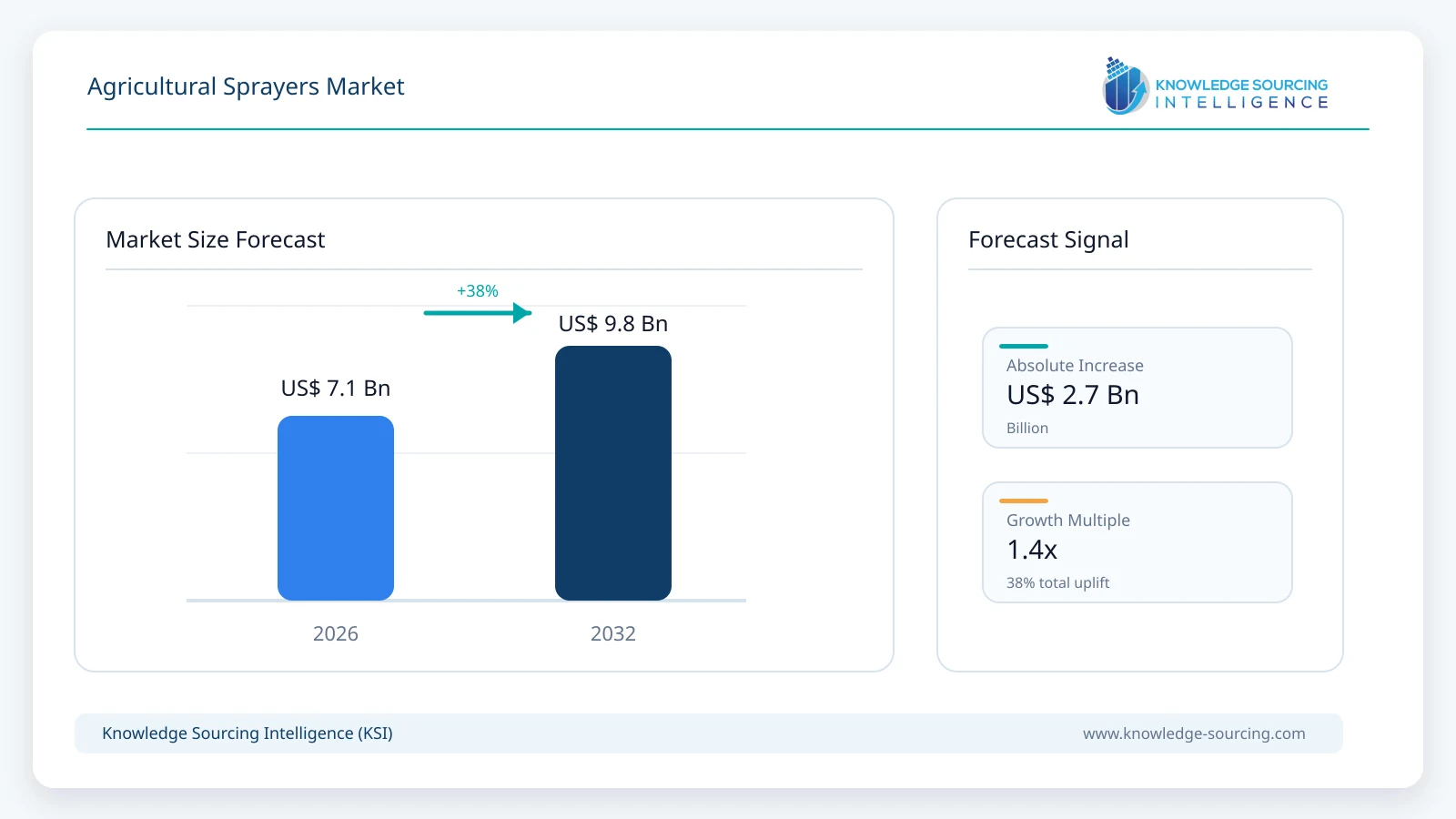
The agricultural sprayers market encompasses complete equipment sales to farms, dealers, contractors and agricultural service operators. Demand reflects a mixed cycle: premium self-propelled machinery faces delayed replacement spending in mature grain-production regions, while new applications and product upgrades support aerial spraying, selected emerging markets and specialized crop systems.
The equipment mix plays a significant role in shaping market dynamics. Capital-intensive self-propelled models command substantially higher purchase prices but depend on farm profitability, credit availability and dealer inventory normalization. Tractor-mounted and trailed machines serve a broad middle segment in which mechanical durability, boom capacity and repair networks often outweigh fully automated features. Handheld products serve low-acreage operations but face price competition and cost sensitivity. Spray drones, although representing a smaller share of agricultural machinery deployment, are gaining traction as payload capacity, battery performance and application technologies advance.
Agricultural Sprayers Market Trends
Spot spraying shifts value from metal fabrication toward decision-capable equipment
The most important shift in premium sprayers is not simply the addition of GPS guidance. Camera-equipped booms, image processing, nozzle-by-nozzle control and variable-rate decisions allow growers to substitute application precision for part of their chemical consumption. A machine that reduces non-residual herbicide use can justify a greater share of precision hardware cost where annual application acres are high enough, but a low-acreage operator may struggle to earn back the incremental system price. Equipment vendors therefore have incentives to package sensing, control and support with their sprayer platforms, while offering aftermarket upgrades to extend the installed machinery base.
John Deere reported that See & Spray technology was used across more than five million acres during the 2025 growing season and that growers reduced non-residual herbicide use by nearly 50% on average in those reported operations. These are manufacturer-reported operational results, not a universal savings assumption. The implication for the sprayer market is nevertheless concrete: procurement analysis increasingly compares ownership cost with chemical expenditure and effective coverage, rather than judging equipment by tank volume or boom width alone. As the installed base becomes upgradeable, some farms may modernize working machines instead of replacing the entire vehicle, delaying new-unit turnover even while precision application spending increases.
Spraying drones expand application access but complicate market classification
Aerial crop spraying is moving from small pilot programs toward a broad installed ecosystem. DJI stated that more than 600,000 DJI agricultural drones were in use by the end of 2025 across over 100 countries and regions. This is a deployed-fleet count, not annual spray-drone sales: it includes products used for spreading and other agricultural tasks. New sprayer-equipment revenue should therefore count only new purpose-built spray-capable systems sold within the measurement period, with any non-spraying drone value excluded where the product configuration can be separated.
The capital requirements for aerial systems vary sharply by package. An airframe-only price is not economically comparable to a ready-to-fly spraying package that includes batteries, charging equipment and training. In 2026, a US dealer listed a DJI Agras T100 ready-to-fly kit near US$40,000, while smaller-capacity spray-drone packages were advertised far below that level. The market estimate consequently requires model-mix and country-specific realized prices rather than multiplying the installed fleet by a single premium list price. Training, operating rules, payload constraints, battery turnaround and contractor economics remain important barriers to adoption.
Farm profitability determines replacement timing in developed markets
Sprayer purchasing is exposed to the agricultural equipment cycle. EXEL Industries reported 2024–2025 agricultural spraying revenue of approximately €403 million, accompanied by a material contraction in new-machine volumes, and its first-half 2025–2026 results described continued order weakness and postponed equipment investment. This evidence is inconsistent with an assumption that all agricultural spraying systems are simultaneously experiencing strong unit-sales growth.
Large-field operators can defer equipment renewal when grain prices, financing expenses, or input costs pressure cash flow, whereas heavily utilized contracting fleets may replace equipment to protect seasonal uptime. Vendors serving both categories must balance order intake against dealer inventory and customer financing. For mature ground sprayer segments, the forecast should therefore allow moderate equipment-unit growth and a higher contribution from premium specifications, not extrapolate agricultural drone adoption rates to tractor-drawn or self-propelled equipment.
Agricultural Sprayers Market Growth Drivers
Lower chemical use and protection of narrow application windows
Spraying economics are governed by the cost of crop-protection products and the operational consequences of missing a treatment window. A more capable sprayer can reduce unnecessary application, make variable-rate passes or extend usable hours, but the value depends on crop, field conditions and application intensity. As nozzle control and visual crop sensing improve, equipment vendors can sell productivity and input-efficiency benefits to operators with sufficient annual treated acreage. For the buyer, the key investment test is annual chemical savings plus protected yields and contractor throughput against financing, maintenance and technology costs.
Custom-hire operations and mechanization in smaller farms
Smaller farms frequently purchase spraying capacity through shared machinery, rental or contractor services rather than financing high-value equipment themselves. Low-cost tractor-mounted and portable sprayers remain relevant where repair simplicity, fuel access and local distribution outweigh advanced automation. Drone service contractors add another acquisition channel: a single operator can purchase a system and provide spraying services to multiple smallholders. Equipment manufacturers therefore rely not only on direct farm sales but also on localized dealerships, training and parts support to turn equipment affordability into repeat purchases.
Market Restraints
High capital costs and uncertain equipment payback
Premium self-propelled machines require significant upfront capital, particularly when they incorporate high-clearance chassis, large booms, multi-camera application systems and precision guidance. Where crop prices weaken, or growers already possess functioning machines, upgrades may be preferable to replacement. An expansion of retrofit products therefore can improve precision-technology adoption without proportionately increasing complete-sprayer sales.
Operating restrictions, drift management and after-sales capabilities
Spraying performance depends on droplet size, weather conditions, nozzle configuration and regulatory constraints governing pesticide applications. Aerial platforms introduce additional pilot training, operational authorization, flight safety and spare-battery requirements. In unfamiliar markets these support requirements can slow commercial deployment even when hardware prices fall. In ground equipment, complex electronics also heighten the importance of dealer diagnostic capabilities and service availability during short treatment windows.
Segmentation Analysis
By Type: Self-Propelled Sprayers
Self-propelled sprayers constitute the leading modeled revenue category, valued at US$2.084 billion in 2026 and forecast to reach US$2.662 billion by 2032. Their weight in revenue comes from the high monetary value of a complete dedicated crop-spraying vehicle: propulsion, suspension, crop-clearance configuration, chemical storage, hydraulic systems, electronic controls and long booms are integrated into one capital asset. This makes unit demand strongly sensitive to financing conditions, commodity margins and the operating life of the installed machine fleet.
The commercial purchase decision is increasingly measured against hectares sprayed per favorable weather window rather than static equipment output. A grower cannot always defer herbicide, fungicide or insecticide application without affecting treatment efficacy or yield. Larger tanks and higher-capacity filling arrangements can reduce downtime, while improved boom stability and nozzle-by-nozzle control reduce unnecessary overlap and help maintain field application consistency. CNH's February 2026 update to the New Holland Defensor introduced 2,500-litre and 4,000-litre configurations, with the larger capacity intended to reduce refill stops. These product choices reflect the direct link between mechanical specifications and time-sensitive spraying productivity.
Precision spraying adds a second value calculation. A camera-led nozzle system may reduce chemical use but increases purchase complexity, repair requirements, and operator training. Deere's 2026 See & Spray Gen 2 expansion to additional crop models demonstrates that differentiation now rests on effective detection in supported agronomic environments rather than camera counts alone. For multi-crop farms, availability across crop species can materially alter system utilization. A narrowly configured sensing system has a lower payback opportunity if it is useful only for part of the farm's annual spray program.
That difference is important for revenue modeling. Factory-fitted precision technology increases the realized invoice value of some new machines, but retrofits on existing fleets should not be counted as new complete-sprayer revenue unless the scope is explicitly expanded to include standalone upgrades. Similarly, subscription fees for analytics are services rather than manufacturing revenue. This prevents equipment-value inflation when vendors introduce new digital functionality without corresponding sales of new sprayer vehicles.
Regional economics differ sharply. North American commercial row-crop operations tend to justify expensive high-capacity machines over extensive treated acreage, whereas Latin American buyers often balance long daily operating periods against financing costs and parts access. European procurement is shaped by crop diversity, smaller field geometry in many markets and strict attention to drift-control performance. China also has a substantially lower-priced self-propelled category: a 2026 review of Chinese subsidy-invoice data identified 5,879 qualifying boom-sprayer sales invoiced in 2025, substantially fewer than in 2024. These subsidized sales are not a complete national market count and cannot be directly valued using North American premium-machine prices.
Supplier strategy is further complicated by weak recent sales. EXEL Industries' first-half 2025–2026 commentary reported the continuation of deferred investment in agricultural spraying and an uneven regional recovery. This supports a restrained near-term replacement forecast for the established high-capacity segment, even if equipment makers continue launching new models. The opportunity for suppliers is consequently a combination of selective premiumization, stronger lifetime service offerings and successful timing of dealer inventory normalization, not an automatic industry-wide rebound.
Over the forecast period, competition among Deere, Case IH, New Holland, Fendt, Agrifac, Jacto and specialist vendors will increasingly involve integration of application control, machine architecture and local service. Buyers of the largest self-propelled units have high downtime exposure during critical spray periods. Manufacturers that can combine practical precision gains with strong parts availability and familiar operator systems may defend pricing better than suppliers emphasizing nominal capacity alone.
Other Type and Application Segments
Agricultural spray drones are projected to grow from approximately US$1.831 billion in 2026 to US$3.092 billion in 2032 as operators use aerial application for difficult-to-reach fields, fragmented land and contract spraying. That forecast is more sensitive to annual hardware replacement units and changing system mix than the value of the deployed drone stock. Tractor-mounted equipment remains a price-sensitive mechanization channel, while trailed sprayers serve farms requiring greater tank capacity without a fully dedicated self-propelled vehicle. Handheld and knapsack units retain a substantial unit-sales base but contribute a comparatively small proportion of market value.
Field-crop uses account for an estimated 66.3% of 2026 new sprayer-equipment revenue. Orchards and vineyards require different spray distribution and canopy coverage, making air-assist configuration and maneuverability important purchasing criteria. Specialty and protected-crop operators may place higher value on compact powered sprayers or robotic delivery to navigate narrow access and reduce labor exposure. Each newly sold machine is assigned to one primary end-use category to prevent duplicate application revenues.
Geographical Outlook
Asia Pacific: Equipment demand spans low-cost machines and rapid aerial deployment
Asia Pacific is estimated at US$2.163 billion in 2026, supported by substantial deployment of handheld, tractor-compatible, and aerial crop-protection equipment. China reported 305,900 agricultural unmanned aerial vehicles in its 2025 mechanization statistics, an increase of 52.26% from a year earlier. This is a stock statistic, not a sales figure, but it confirms the scale of the operational ecosystem. Aerial equipment demand is influenced by contractor utilization, local policy, battery replacement, and product affordability, while low-cost ground sprayers remain essential across fragmented holdings.
By comparison, North America is valued at approximately US$1.659 billion in 2026. The region generates substantial value through high-capacity self-propelled machinery, yet unit replacement depends on farming profitability. South America adds demand from large commercial farms and expanding aerial service operations; Europe is more exposed to sophisticated tractor-mounted and trailed equipment, while Middle East and African demand remains sensitive to farm size, financing and the local maintenance network.
Competitive Landscape
The supplier base includes full-line farm-machinery manufacturers, specialized sprayer businesses and drone developers. Deere & Company, CNH Industrial, AGCO and Kubota participate across mechanized agriculture, although their sprayer product coverage differs by brand and geography. EXEL Industries is particularly relevant through agricultural spraying brands and reported €403 million in agricultural spraying revenue for FY2024–2025, a figure that is wider than the new-machine-only definition used in this estimate. Jacto, AMAZONE, HORSCH, KUHN and specialist manufacturers compete in mounted, trailed, orchard or premium field spraying. STIHL, Maruyama and other small-equipment vendors serve portable and motorized applications. DJI and XAG compete in dedicated aerial spraying systems and associated contractor ecosystems.
Companies should be assessed by actual spraying equipment and distribution footprints rather than total group sales. New Holland and Case IH belong within CNH Industrial; Fendt and Massey Ferguson sit within AGCO; KUHN is part of Bucher Industries. Where a manufacturer supplies both complete machines and separately sold sensors or automation systems, only in-scope original-equipment hardware revenue belongs in the core equipment estimate.
Recent Developments
May 11, 2026: John Deere detailed See & Spray Gen 2 enhancements, expanding supported crops and adding variable-rate capability to its camera-guided application platform.
February 7, 2026: XAG introduced its P150 Max agricultural drone in the United States, with autonomous spraying and interchangeable task systems.
February 3, 2026: New Holland Agriculture unveiled the 2026 Defensor self-propelled sprayer range with 2,500-litre and 4,000-litre models.
November 28, 2025: XAG introduced the R Series agricultural rover for automated crop-protection operations in orchards, vineyards and greenhouses.
July 15, 2025: DJI launched the Agras T100, T70P and T25P agricultural drones for spraying and other farming operations.
Agricultural Sprayers Market Scope
| Report Metric | Details |
|---|---|
| Total Market Size in 2026 | USD 7.13 billion |
| Total Market Size in 2032 | USD 9.83 billion |
| Forecast Unit | Billion |
| Growth Rate | 5.50% |
| Study Period | 2021 to 2032 |
| Historical Data | 2021 to 2024 |
| Base Year | 2025 |
| Forecast Period | 2026 – 2032 |
| Segmentation | Equipment Type, Application, Geography |
| Companies |
|
| Customization Scope | 15% Free Customization included with purchase — Request Custom Breakdown → |
| Sample & Data Access | PDF Sample, Excel Databook & Analyst Briefing — Download Free Sample → |
Market Segmentation
By Equipment Type
Self-Propelled Sprayers
Tractor-Mounted Sprayers
Trailed / Tow-Behind Sprayers
Handheld and Knapsack Sprayers
Agricultural Spray Drones
By Application
Field Crops
Orchards and Vineyards
Horticulture and Other Specialty Crops
By Geography
North America
United States
Canada
Mexico
Others
South America
Brazil
Argentina
Others
Europe
Germany
France
United Kingdom
Italy
Spain
Others
Middle East and Africa
Saudi Arabia
Israel
South Africa
Others
Asia Pacific
China
India
Japan
South Korea
Australia
Indonesia
Others
Table of Contents
1. INTRODUCTION
1.1 Market Overview
1.2 Market Definition and Coverage
1.3 Product and Revenue Recognition Boundaries
1.4 Historical, Base and Forecast Year Timeline
2. RESEARCH METHODOLOGY
2.1 Research Design and Data Hierarchy
2.2 Bottom-Up Equipment Unit and ASP Model
2.3 Product and Geography Reconciliation
2.4 Model Sensitivity and Forecast Assumptions
3. EXECUTIVE SUMMARY
3.1 Global Market Size and Forecast, 2026–2032
3.2 Segment and Regional Highlights
3.3 Manufacturer, Technology and Distribution Findings
4. MARKET DYNAMICS
4.1 Market Drivers
4.2 Market Restraints
4.3 Precision Spray and Automation Trends
4.4 Equipment Replacement Cycles
4.5 Value Chain and Channel Analysis
4.6 Porter's Five Forces Analysis
5. AGRICULTURAL SPRAYERS MARKET BY EQUIPMENT TYPE
5.1 Self-Propelled Sprayers
5.2 Tractor-Mounted Sprayers
5.3 Trailed / Tow-Behind Sprayers
5.4 Handheld and Knapsack Sprayers
5.5 Agricultural Spray Drones
6. AGRICULTURAL SPRAYERS MARKET BY APPLICATION
6.1 Field Crops
6.2 Orchards and Vineyards
6.3 Horticulture and Other Specialty Crops
7. AGRICULTURAL SPRAYERS MARKET BY GEOGRAPHY
7.1 North America
7.1.1 United States
7.1.2 Canada
7.1.3 Mexico
7.1.4 Others
7.2 South America
7.2.1 Brazil
7.2.2 Argentina
7.2.3 Others
7.3 Europe
7.3.1 Germany
7.3.2 France
7.3.3 United Kingdom
7.3.4 Italy
7.3.5 Spain
7.3.6 Others
7.4 Middle East and Africa
7.4.1 Saudi Arabia
7.4.2 Israel
7.4.3 South Africa
7.4.4 Others
7.5 Asia Pacific
7.5.1 China
7.5.2 India
7.5.3 Japan
7.5.4 South Korea
7.5.5 Australia
7.5.6 Indonesia
7.5.7 Others
8. COMPETITIVE ENVIRONMENT AND ANALYSIS
8.1 Competitive Landscape and Product Mapping
8.2 Technology and Value Proposition Benchmarking
8.3 New Equipment and Retrofit Economics
8.4 Recent Product Developments and Alliances
9. COMPANY PROFILES
9.1 Deere & Company (John Deere / Hagie)
9.2 CNH Industrial N.V. (Case IH / New Holland)
9.3 AGCO Corporation (Fendt / Massey Ferguson)
9.4 EXEL Industries S.A. (HARDI / Agrifac / other sprayer brands)
9.5 Jacto Máquinas Agrícolas
9.6 AMAZONEN-WERKE H. DREYER SE & Co. KG
9.7 HORSCH Maschinen GmbH
9.8 Bucher Industries AG (KUHN Group)
9.9 Kubota Corporation
9.10 DJI Agriculture
9.11 XAG Co., Ltd.
9.12 STIHL Group
9.13 Maruyama Mfg. Co., Inc.
9.14 ASPEE Group
9.15 Yamaha Motor Co., Ltd.
10. APPENDIX
10.1 Currency and Definitions
10.2 Company and Product Coverage
10.3 Data Sources and Assumptions
10.4 Abbreviations
10.5 Research Methodology





Frequently asked questions
What is the projected market value of agricultural sprayers by 2032?
The Agricultural Sprayers Market is projected to reach USD 9.83 billion by 2032.
What is the forecasted CAGR for the Agricultural Sprayers Market?
The Agricultural Sprayers Market is forecast to grow at a 5.50% CAGR.
Which region holds the largest revenue share in 2026?
Asia Pacific represents approximately 30.4% of 2026 modeled revenue.
Which equipment type contributes most to 2026 revenue?
Self-propelled sprayers account for 29.2% of global equipment revenue.
What is the projected growth rate for agricultural spray drones?
Agricultural spray drones are projected to register approximately 9.1% CAGR.
What is a key trend shaping premium sprayer value?
Spot spraying shifts value toward decision-capable, chemical-reducing equipment.
Cite this report
Knowledge Sourcing Intelligence. (Oct 2026). Agricultural Sprayers Market - Strategic Insights and Forecasts (2026-2032). https://www.knowledge-sourcing.com/report/agricultural-sprayers-market