
The AI-based ISR platforms market is anticipated to grow significantly over the forecast period.
Highlights:
- 1Growing defense modernization programs are accelerating procurement of AI-enabled intelligence processing and autonomous surveillance capabilities.
- 2Airborne ISR platforms remain the leading deployment segment because of their operational flexibility and multi-mission capability.
- 3Asia Pacific presents substantial procurement opportunities driven by expanding defense budgets and regional security priorities.
- 4Edge AI and sensor fusion technologies are improving real-time intelligence generation while reducing communication bandwidth requirements.
- 5National AI governance frameworks and defense cybersecurity regulations are influencing procurement specifications and software certification.
- 6Competition increasingly centers on software capability, system integration, interoperability, and lifecycle service offerings rather than hardware alone.
The AI-Based ISR (Intelligence, Surveillance, and Reconnaissance) Platforms Market comprises integrated hardware, software, and analytical services that apply artificial intelligence to collect, process, analyze, and disseminate intelligence from airborne, land, naval, and space-based platforms. These systems combine sensors, communication networks, computing infrastructure, and AI algorithms to improve situational awareness, shorten decision cycles, and support military, homeland security, border protection, maritime surveillance, and critical infrastructure monitoring missions.
Demand for AI-enabled ISR platforms is being shaped by the growing volume of sensor-generated data and the operational need to convert information into actionable intelligence within compressed timelines. Conventional ISR architectures often require extensive human analysis, limiting responsiveness during high-tempo operations. AI technologies, including machine learning, computer vision, natural language processing, sensor fusion, and edge AI, allow operators to automate target recognition, anomaly detection, multi-source intelligence integration, and mission planning while reducing analyst workload.
Defense ministries remain the largest procurement authorities, although national intelligence organizations, border security agencies, coast guards, and operators of strategic infrastructure are expanding investments in AI-supported surveillance capabilities. Purchasing decisions increasingly prioritize interoperability with existing command-and-control systems, secure software architectures, cyber resilience, explainable AI capabilities, lifecycle support, and compliance with national security standards rather than standalone hardware performance.
Industry structure reflects collaboration between established defense primes, AI software developers, autonomous systems manufacturers, cloud computing specialists, and systems integrators. Traditional defense contractors contribute platform integration, certification, and mission systems expertise, while AI-focused companies provide advanced analytics, autonomous decision-support tools, and data management capabilities. Procurement programs increasingly emphasize modular open architectures that simplify software upgrades throughout platform service life.
Revenue generation extends beyond initial platform procurement. Software licensing, algorithm updates, cloud-enabled intelligence services, mission support, cybersecurity, maintenance, data management, and operator training represent growing recurring revenue streams. As defense organizations adopt software-defined ISR architectures, long-term service agreements are becoming more valuable than one-time equipment deliveries.
Adoption patterns vary by mission requirements. Airborne ISR platforms continue to dominate operational deployments due to their flexibility and extensive sensor payloads. However, land-based autonomous systems, maritime surveillance networks, and space-based intelligence assets are receiving increased investment as governments seek persistent multi-domain awareness. AI is increasingly deployed at the network edge, enabling real-time processing aboard aircraft, unmanned systems, satellites, and mobile command units without relying exclusively on centralized cloud infrastructure.
Market Drivers
Rising Multi-Domain Defense Modernization Programs
Many governments are restructuring military capabilities around integrated multi-domain operations that connect air, land, sea, space, and cyber assets. AI-enabled ISR platforms improve command responsiveness by correlating data from multiple sensors into a common operational picture.
Defense procurement agencies increasingly seek platforms capable of autonomous target identification, threat prioritization, and mission planning. Suppliers are responding by integrating AI applications directly into mission systems instead of treating analytics as external software. This trend supports higher contract values through software integration and long-term sustainment services.
Expansion of Autonomous and Unmanned Platforms
The growing deployment of unmanned aerial vehicles, unmanned ground vehicles, and unmanned surface vessels has expanded demand for embedded AI. Autonomous platforms require onboard intelligence to navigate, classify objects, avoid threats, and prioritize surveillance tasks without continuous operator intervention.
Military organizations increasingly evaluate AI capability alongside endurance, payload capacity, and communication resilience when selecting unmanned platforms. Suppliers capable of integrating autonomy with secure mission systems gain stronger positions in competitive procurement programs.
Growth in Persistent Border and Maritime Surveillance
Illegal trafficking, unauthorized maritime activity, territorial disputes, and illegal fishing continue to increase surveillance requirements across many regions. Governments require continuous monitoring across large geographic areas where traditional patrol methods remain resource intensive.
AI-supported ISR platforms reduce operator workload by automatically detecting suspicious vessel behavior, vehicle movement, or unusual patterns from radar, electro-optical, infrared, and satellite imagery. These operational efficiencies improve procurement economics by lowering long-term operating costs.
Increasing Intelligence Data Volumes
Modern ISR missions generate enormous quantities of imagery, video, radar, communications, and signals intelligence data. Human analysts alone cannot efficiently review this expanding information volume.
Machine learning algorithms prioritize relevant observations, classify objects, identify anomalies, and correlate intelligence from multiple domains. Buyers increasingly consider automated data processing capability a fundamental procurement requirement rather than an optional enhancement.
Market Restraints and Challenges
Complex Integration with Legacy Defense Systems
Many armed forces continue operating legacy ISR platforms developed over several decades. Integrating modern AI software into these environments often requires customized interfaces, extensive validation, and cybersecurity testing.
These integration requirements extend project schedules and increase implementation costs, influencing procurement timelines and contract margins. Vendors increasingly offer modular architectures to reduce integration complexity.
Security and Trust Requirements for AI Decisions
Defense organizations require confidence that AI-generated intelligence can be explained, verified, and audited before operational deployment. Black-box decision models create concerns regarding mission accountability and operational risk.
Suppliers therefore invest heavily in explainable AI, model validation, continuous testing, and human oversight mechanisms. Meeting these requirements increases software development costs but supports long-term customer confidence.
Cybersecurity Risks
AI-enabled ISR platforms rely on connected sensors, communications infrastructure, and digital data processing environments that expand potential cyberattack surfaces.
Defense customers increasingly require zero-trust architectures, secure software development practices, encryption, and continuous vulnerability management. Compliance increases development expenditure but has become essential for procurement eligibility.
Skilled Workforce Constraints
Advanced AI-enabled ISR solutions require expertise spanning defense operations, software engineering, machine learning, systems integration, and cybersecurity.
Many government agencies experience shortages of personnel capable of managing AI-enabled intelligence systems. Vendors therefore increasingly bundle training, technical support, and operational services within procurement contracts.
Major Segment Analysis
Airborne Platforms Lead Commercial Demand
Airborne ISR platforms represent the most commercially important platform segment because they provide operational flexibility across intelligence collection, reconnaissance, border surveillance, maritime monitoring, and battlefield awareness. Manned aircraft, UAVs, helicopters, and specialized airborne platforms support multiple mission profiles while carrying diverse sensor payloads.
Defense customers prioritize endurance, sensor integration, secure communications, and onboard AI processing when evaluating airborne ISR investments. AI enables aircraft to automatically classify targets, identify anomalies, prioritize surveillance areas, and reduce communication bandwidth by processing data before transmission.
Competitive differentiation increasingly depends on software integration rather than aircraft hardware alone. Buyers seek platforms capable of integrating radar, electro-optical systems, infrared sensors, signals intelligence equipment, and satellite communications within unified AI-driven mission software. Vendors offering modular architectures capable of incorporating future AI upgrades strengthen lifecycle revenue opportunities while reducing customer modernization costs.
Regional Analysis
North America
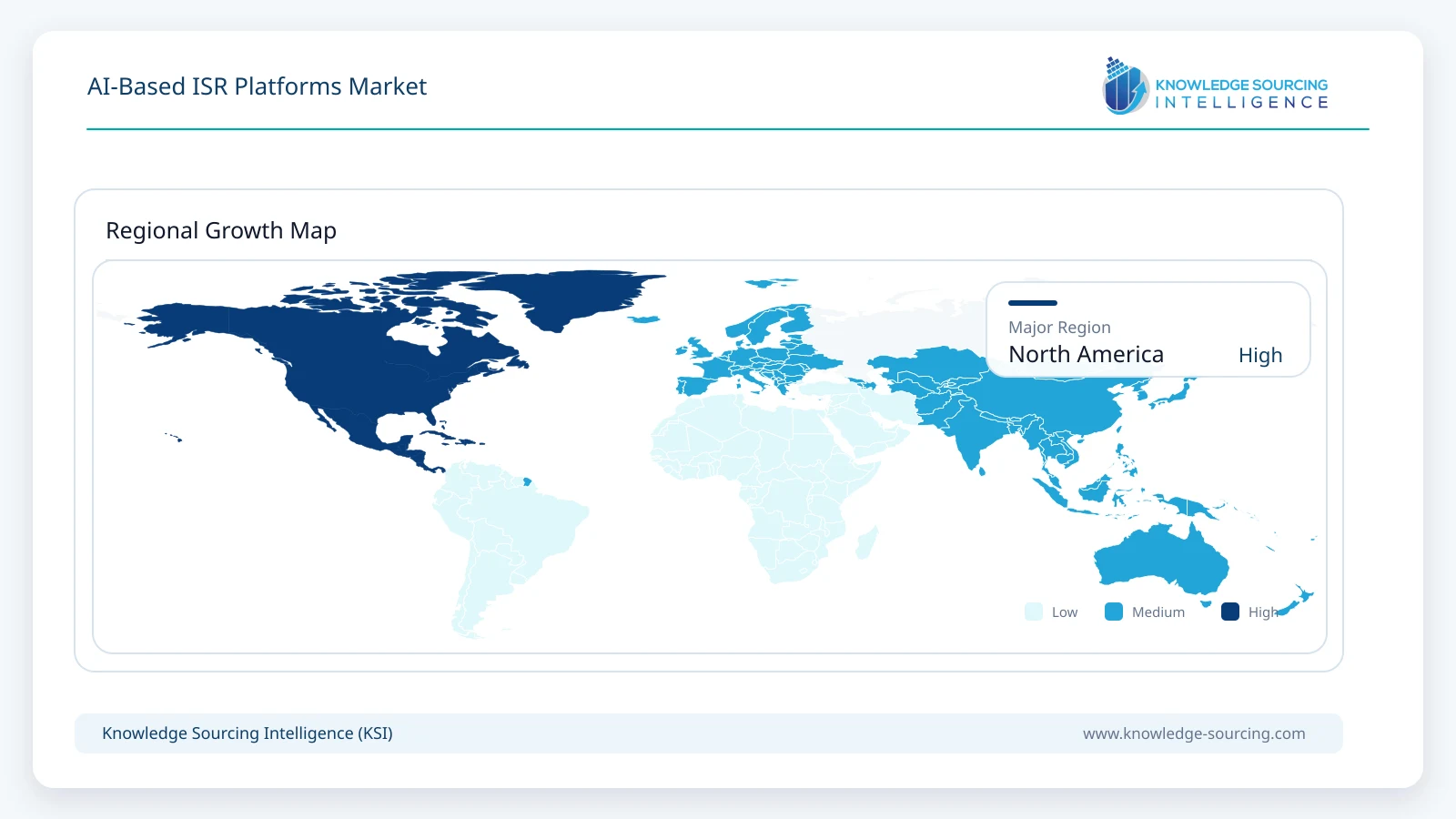
North America represents the largest procurement environment due to sustained defense spending, mature aerospace industries, and extensive investment in AI research. The United States continues funding advanced ISR modernization across military branches, intelligence organizations, and homeland security agencies. Procurement increasingly emphasizes open architectures, software-defined capabilities, and autonomous operations.
Europe
European demand is supported by NATO capability development, defense industrial cooperation, and increased security investment following changing regional security conditions. Governments are strengthening intelligence-sharing capabilities while investing in AI-enabled surveillance, border monitoring, and maritime awareness. Procurement programs also emphasize compliance with European AI governance and cybersecurity requirements.
Asia Pacific
Asia Pacific demonstrates strong procurement activity driven by territorial security concerns, maritime surveillance requirements, and expanding defense modernization programs. Countries including China, India, Japan, South Korea, Australia, and Singapore continue investing in unmanned systems, satellite surveillance, and AI-enabled command capabilities. Domestic manufacturing initiatives also influence supplier selection.
Middle East and Africa
Governments across the Middle East continue expanding ISR capabilities to strengthen border protection, energy infrastructure security, and counterterrorism operations. Several countries prioritize integrated surveillance networks combining airborne, ground, and space-based assets. Budget variability and dependence on imported technologies remain procurement considerations across parts of Africa.
South America
South American demand primarily supports border security, illegal mining detection, environmental monitoring, narcotics interdiction, and maritime surveillance. Procurement activity remains more selective than in North America or Europe, with governments emphasizing cost-effective upgrades and lifecycle affordability.
Competitive Landscape
Competition within the AI-Based ISR Platforms Market combines established defense contractors with specialized artificial intelligence developers and systems integration providers. Procurement success depends on the ability to deliver complete operational ecosystems rather than individual hardware platforms.
Companies differentiate through AI-enabled analytics, mission software, autonomous platform integration, secure communications, sensor fusion, cloud-enabled intelligence processing, and lifecycle support services. Partnerships between traditional defense manufacturers and AI software companies continue expanding because customers increasingly seek integrated capabilities that combine certified military platforms with advanced analytics.
Suppliers also compete through geographic production capabilities, cybersecurity credentials, export compliance, interoperability with existing defense infrastructure, and long-term maintenance contracts. Open-system architectures remain an important differentiator because defense organizations seek future software flexibility without replacing complete platforms.
Recent Developments
May 2026: Shield AI announced its selection to deliver AI-powered swarming technology for the LUCAS loitering munition program, advancing autonomous collaborative capabilities that strengthen future intelligence, surveillance, reconnaissance, and precision mission operations.
March 2026: Shield AI announced a Series G financing valued at US$12.7 billion, with part of the investment supporting the acquisition of Aechelon Technology to expand AI-powered autonomy, simulation, and mission capabilities for defense and ISR platforms.
March 2026: Palantir Technologies, Ondas Holdings, and World View announced a strategic partnership to integrate Palantir's Artificial Intelligence Platform (AIP) into persistent stratospheric sensing systems, improving AI-driven mission planning, production, and ISR edge operations.
Regulatory and Policy Environment
The regulatory environment is increasingly shaped by national AI governance frameworks, cybersecurity requirements, defense acquisition policies, and export control regulations. Procurement agencies require compliance with secure software development standards, encryption requirements, classified information handling procedures, and interoperability standards for command-and-control systems.
Defense organizations are also introducing governance frameworks addressing responsible AI deployment, human oversight, algorithm validation, and operational accountability. These policies influence supplier qualification processes and encourage investment in explainable AI technologies.
Export regulations affecting advanced defense technologies continue influencing international sales strategies. Suppliers must manage licensing requirements, cybersecurity certifications, and technology transfer restrictions while maintaining compliance across multiple jurisdictions.
Government-funded AI research initiatives, defense innovation accelerators, and public-private technology partnerships continue supporting development of advanced ISR capabilities while encouraging domestic industrial participation in strategic procurement programs.
Outlook and Strategic Implications
Commercial demand over the forecast period is expected to shift toward software-centric ISR ecosystems capable of supporting autonomous multi-domain operations. Defense customers are likely to prioritize scalable AI architectures that allow continuous software improvement without replacing core hardware assets.
Investment is expected to concentrate on edge AI computing, autonomous mission management, sensor fusion, synthetic data generation, satellite intelligence integration, and cyber-resilient communications. Procurement models will increasingly emphasize lifecycle support, software subscriptions, cloud-enabled intelligence services, and continuous capability upgrades.
Competition will continue expanding beyond traditional defense contractors as AI software specialists, autonomous systems developers, and cloud technology providers establish stronger positions within defense acquisition programs. Strategic partnerships between platform manufacturers and AI companies are likely to remain an important route for delivering integrated operational capabilities.
Long-term commercial success will depend on trusted AI performance, regulatory compliance, cybersecurity resilience, interoperability with legacy military systems, and the ability to provide measurable operational improvements while controlling lifecycle ownership costs. Organizations capable of delivering secure, explainable, and upgradeable AI-enabled ISR solutions will be better positioned to capture future procurement opportunities across military, homeland security, and critical infrastructure surveillance applications.
AI-Based ISR Platforms Market Scope
| Report Metric | Details |
|---|---|
| Forecast Unit | Billion |
| Study Period | 2021 to 2031 |
| Historical Data | 2021 to 2024 |
| Base Year | 2025 |
| Forecast Period | 2026 – 2031 |
| Segmentation | Component, Platform, Technology, Application, End User, Geography |
| Companies |
|
Market Segmentation
By Component
By Platform
By Technology
By Application
By End User
By Geography
Table of Contents
1. EXECUTIVE SUMMARY
2. MARKET SNAPSHOT
2.1. Market Overview
2.2. Market Definition
2.3. Scope of the Study
2.4. Market Segmentation
3. BUSINESS LANDSCAPE
3.1. Market Drivers
3.2. Market Restraints
3.3. Market Opportunities
3.4. Porter’s Five Forces Analysis
3.5. Industry Value Chain Analysis
3.6. Policies and Regulations
3.7. Strategic Recommendations
4. TECHNOLOGICAL OUTLOOK
5. AI-BASED ISR PLATFORMS MARKET BY COMPONENT
5.1. Introduction
5.2. Hardware
5.3. Software
5.4. Services
6. AI-BASED ISR PLATFORMS MARKET BY PLATFORM
6.1. Introduction
6.2. Airborne
6.2.1. Manned Aircraft
6.2.2. Unmanned Aerial Vehicles (UAVs)
6.2.3. Helicopters
6.2.4. Other Airborne Platforms
6.3. Land
6.3.1. Armored Combat Vehicles
6.3.2. Ground Surveillance Vehicles
6.3.3. Unmanned Ground Vehicles (UGVs)
6.3.4. Fixed Ground Stations
6.4. Naval
6.4.1. Patrol Vessels
6.4.2. Unmanned Surface Vehicles (USVs)
6.4.3. Submarines
6.4.4. Maritime Surveillance Systems
6.4.5. Others
6.5. Space
6.5.1. Earth Observation Satellites
6.5.2. Synthetic Aperture Radar (SAR) Satellites
6.5.3. Signals Intelligence Satellites
6.5.4. Satellite Constellations
7. AI-BASED ISR PLATFORMS MARKET BY TECHNOLOGY
7.1. Introduction
7.2. Machine Learning
7.3. Computer Vision
7.4. Natural Language Processing (NLP)
7.5. Generative AI
7.6. Sensor Fusion
7.7. Edge AI
7.8. Others
8. AI-BASED ISR PLATFORMS MARKET BY APPLICATION
8.1. Introduction
8.2. Military Intelligence, Surveillance, and Reconnaissance
8.3. Border Surveillance
8.4. Homeland Security and Counter-Terrorism
8.5. Search and Rescue (SAR)
8.6. Critical Infrastructure Protection
8.7. Maritime Domain Awareness
8.8. Cyber Intelligence and Threat Monitoring
8.9. Others
9. AI-BASED ISR PLATFORMS MARKET BY END USER
9.1. Introduction
9.2. Defense and Military
9.3. Homeland Security and Intelligence Agencies
9.4. Commercial Security and Infrastructure Operators
9.5. Others
10. AI-BASED ISR PLATFORMS MARKET BY GEOGRAPHY
10.1. Introduction
10.2. North America
10.2.1. USA
10.2.2. Canada
10.2.3. Mexico
10.3. South America
10.3.1. Brazil
10.3.2. Argentina
10.3.3. Chile
10.3.4. Colombia
10.3.5. Others
10.4. Europe
10.4.1. United Kingdom
10.4.2. Germany
10.4.3. France
10.4.4. Italy
10.4.5. Others
10.5. Middle East and Africa
10.5.1. Saudi Arabia
10.5.2. UAE
10.5.3. Israel
10.5.4. Others
10.6. Asia Pacific
10.6.1. China
10.6.2. Japan
10.6.3. South Korea
10.6.4. India
10.6.5. Australia
10.6.6. Indonesia
10.6.7. Singapore
10.6.8. Thailand
10.6.9. Others
11. COMPETITIVE ENVIRONMENT AND ANALYSIS
11.1. Major Players and Strategy Analysis
11.2. Market Share Analysis
11.3. Mergers, Acquisitions, Agreements, and Collaborations
11.4. Competitive Dashboard
11.5. Technology Capability Benchmarking
12. COMPANY PROFILES
12.1. Lockheed Martin
12.2. Northrop Grumman
12.3. RTX Corporation
12.4. BAE Systems
12.5. Thales Group
12.6. General Dynamics
12.7. L3Harris Technologies
12.8. Saab AB
12.9. Elbit Systems
12.10. Palantir Technologies
12.11. Rebellion Defense
12.12. Anduril Industries
12.13. Primer AI
12.14. Accrete AI
12.15. Dataminr Inc.
12.16. Helsing
12.17. Shield AI
12.18. Leidos
12.19. CACI International
12.20. Booz Allen Hamilton
13. APPENDIX
13.1. Currency
13.2. Assumptions
13.3. Base and Forecast Years Timeline
13.4. Key Benefits for the Stakeholders
13.5. Research Methodology
13.6. Abbreviations
Navigate
Trusted by the world's leading organizations











