
The AI in Art Authentication Market is expected to witness robust growth over the forecast period.
Highlights:
- 1Growing financial exposure to forged artworks is encouraging museums, auction houses, and collectors to invest in AI-assisted authentication tools.
- 2Art Authentication and forgery detection remain the commercially important application due to its direct impact on transaction confidence.
- 3North America maintains strong demand through established art institutions, technology providers, and active private investment in fine art.
- 4AI models increasingly combine computer vision, multispectral imaging, and blockchain-based provenance verification within unified platforms.
- 5Data governance, copyright compliance, and digital record standards influence procurement decisions for institutional buyers.
- 6Competition centers on analytical accuracy, explainability, imaging capability, integration flexibility, and specialist authentication expertise.
The AI in Art Authentication Market comprises software platforms and analytical services that apply artificial intelligence, computer vision, machine learning, multispectral imaging, and data analytics to verify artwork authenticity, identify potential forgeries, document provenance, assess physical condition, and support valuation decisions. These technologies complement traditional connoisseurship and scientific examination by processing large image datasets, identifying microscopic visual patterns, comparing stylistic characteristics, and integrating ownership records into searchable digital repositories.
Demand is being shaped by rising transaction values in the global art market and growing concerns regarding authenticity risk. High-value artworks increasingly change hands through auctions, galleries, private transactions, and digital marketplaces where buyers expect objective evidence supporting attribution and ownership history. AI-based authentication tools help reduce uncertainty by providing analytical insights that support experts rather than replacing them. This collaborative approach has improved acceptance among museums, auction houses, insurers, and institutional collectors.
Buyer priorities differ across end users. Museums emphasize conservation, provenance verification, and catalog management, while auction houses focus on reducing authentication timelines before sales. Private collectors and investment firms seek independent verification to protect portfolio value and improve confidence during acquisitions. Insurance providers also benefit from standardized documentation supporting underwriting and claims assessment.
Commercial adoption is expanding because AI systems can analyze thousands of comparable artworks within minutes while maintaining consistent evaluation criteria. Modern solutions combine high-resolution imaging with neural network models trained on authenticated works from specific artists or artistic movements. The integration of blockchain-supported provenance records further strengthens trust by creating immutable ownership histories that complement AI-generated assessments.
The supplier ecosystem includes specialized AI software developers, scientific imaging providers, digital provenance platforms, and professional authentication consultancies. Enterprise software vendors increasingly offer modular solutions that integrate with museum collection management systems, while AI-as-a-Service (AIaaS) providers reduce upfront implementation costs for smaller institutions and galleries.
Investment activity continues to favor scalable cloud-based authentication platforms, explainable AI models, and multimodal analysis combining visual, chemical, historical, and documentary evidence. Buyers increasingly evaluate suppliers based on algorithm transparency, dataset quality, compatibility with existing collection databases, cybersecurity practices, and regulatory compliance concerning digital records and personal information.
Market Drivers
Rising financial losses associated with art forgery
Art forgery continues to represent one of the most persistent risks within the global art ecosystem. High-value transactions involving modern and historical artworks require multiple layers of verification before ownership transfers occur. AI assists experts by identifying visual inconsistencies, brushstroke characteristics, pigment distribution, and compositional patterns that may not be readily observable through manual inspection.
Museums, auction houses, insurers, and private investors increasingly purchase AI-assisted authentication services to strengthen due diligence. Software developers are responding by expanding artist-specific datasets and improving model accuracy through continuous training using authenticated collections. This demand supports recurring software subscriptions and specialist analytical services.
Digitization of museum collections
Museums worldwide are digitizing artwork collections to improve accessibility, preservation, and research collaboration. Large digital archives create valuable training datasets for AI algorithms capable of recognizing artistic techniques, historical styles, and restoration histories.
Collection digitization also supports preventive conservation by enabling periodic condition monitoring using standardized imaging protocols. Suppliers offering integrated catalog management, imaging, and AI analytics benefit from institutions seeking comprehensive digital collection management solutions rather than standalone authentication software.
Growth of art investment as an alternative asset
Institutional investors, family offices, and high-net-worth individuals increasingly consider fine art within diversified investment portfolios. Investment decisions require reliable attribution and documented ownership history to protect asset value.
AI-supported authentication reduces transaction uncertainty by providing evidence-based analytical outputs that complement independent expert opinions. This strengthens buyer confidence, shortens transaction timelines, and encourages adoption among financial intermediaries participating in art financing and collateralized lending.
Expansion of blockchain-supported provenance systems
Digital provenance platforms increasingly integrate AI authentication with blockchain-based ownership records. Combining immutable transaction histories with image-based authentication improves confidence throughout the artwork lifecycle.
Suppliers offering interoperable provenance solutions differentiate themselves by supporting galleries, artists, museums, and collectors within connected digital ecosystems. Procurement decisions increasingly favor vendors capable of integrating provenance documentation into existing collection management infrastructure.
Market Restraints and Challenges
Limited availability of verified training datasets
Reliable AI performance depends on extensive collections of authenticated artworks. Many artists have relatively limited verified datasets, while access restrictions imposed by collectors and museums constrain model development.
Software providers invest in partnerships with cultural institutions and research organizations to improve dataset quality. Nevertheless, restricted data availability limits algorithm applicability across less-documented artists and regional art traditions.
Requirement for expert interpretation
AI provides analytical support but cannot independently determine authenticity with complete certainty. Historical documentation, conservation records, material analysis, and expert connoisseurship remain essential components of authentication.
Buyers therefore continue procuring hybrid solutions combining AI software with professional authentication services. Vendors increasingly position their platforms as decision-support systems rather than fully autonomous authentication engines.
Legal and reputational risks
Authentication outcomes can substantially influence artwork valuations and ownership disputes. Incorrect conclusions may result in litigation, insurance claims, or reputational damage affecting institutions and technology providers.
To mitigate these risks, suppliers invest in explainable AI methodologies, transparent reporting, documented confidence scores, and comprehensive audit trails supporting expert review before commercial decisions are finalized.
Integration complexity within legacy collection systems
Many museums and galleries continue operating legacy collection databases that lack interoperability with modern AI platforms. Migration projects require additional investment in software integration, metadata standardization, and staff training.
Vendors increasingly develop API-based architectures and cloud deployment models to reduce implementation complexity while supporting phased digital modernization.
Major Segment Analysis
Art Authentication and Forgery Detection
Art Authentication and Forgery Detection represents the most commercially important application because it directly influences artwork transactions, insurance coverage, legal ownership, and long-term asset valuation. Every participant in the art value chain depends upon credible authentication before significant financial commitments are made.
Demand originates from auction houses preparing catalogues, museums evaluating acquisitions, galleries managing consignments, insurers underwriting valuable collections, and private investors seeking objective analytical evidence. Procurement decisions prioritize analytical reliability, artist-specific model performance, explainable outputs, compatibility with scientific imaging equipment, and integration with provenance documentation.
Competition within this segment extends beyond algorithm accuracy. Suppliers differentiate through proprietary image datasets, multidisciplinary analytical workflows, scientific partnerships, cloud deployment capabilities, and expert consulting support. Vendors combining AI analysis with multispectral imaging, material science, and provenance intelligence achieve stronger commercial positioning than providers relying exclusively on image recognition.
Recurring revenue opportunities emerge through subscription-based authentication platforms, enterprise software licensing, periodic collection reviews, and professional analytical services. As artwork values continue rising across contemporary and historical categories, authentication remains a critical expenditure rather than a discretionary technology investment.
Regional Analysis
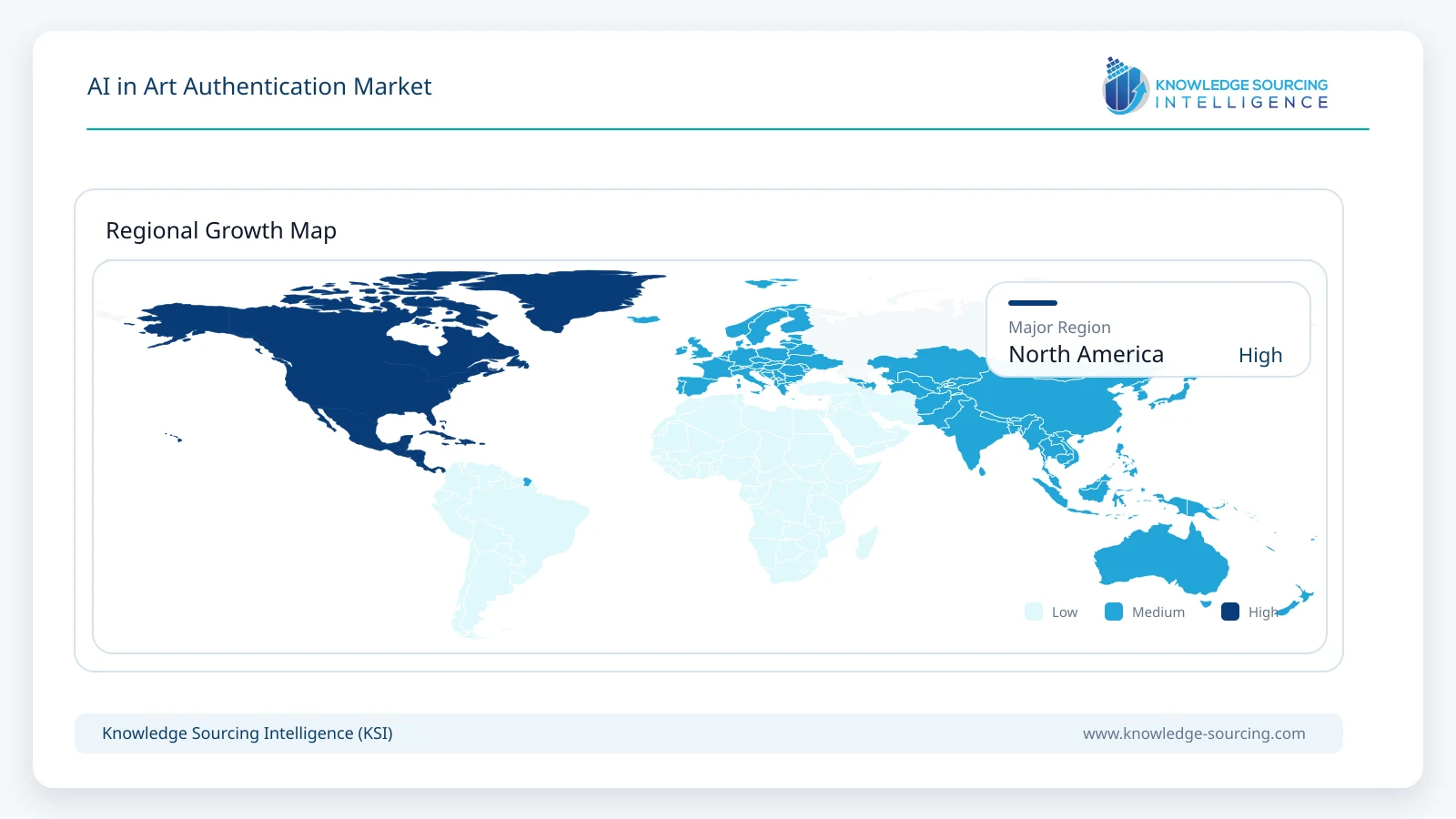
North America represents a mature adoption region supported by established museums, major auction houses, active private collectors, and technology developers. Institutions increasingly invest in digital collection management and AI-supported provenance verification. Strong venture capital activity and collaborations between research institutions and technology companies encourage continued innovation. However, buyers maintain rigorous procurement standards emphasizing explainability, cybersecurity, and regulatory compliance.
Europe benefits from extensive cultural heritage assets, nationally funded museums, and established conservation research institutions. Government support for cultural preservation encourages digitization initiatives that strengthen AI training datasets. Cross-border artwork movement creates demand for standardized provenance documentation. Adoption remains influenced by heritage protection policies, copyright considerations, and data governance requirements.
Asia Pacific demonstrates expanding commercial potential as private wealth grows and regional art markets become more international. Museums, galleries, and collectors increasingly invest in digital authentication capabilities supporting cross-border transactions. Technology expertise within China, Japan, South Korea, and Taiwan supports domestic software development. Nevertheless, uneven digitization levels across institutions continue to affect implementation rates.
Middle East & Africa is witnessing gradual adoption driven by investments in museums, cultural tourism, and heritage preservation initiatives. Newly established cultural institutions increasingly incorporate digital collection management systems during initial infrastructure development. Budget limitations and limited specialist expertise remain adoption constraints in several markets.
South America continues developing digital authentication capabilities alongside expanding museum modernization programs and growing collector participation. Procurement remains selective because many institutions operate under constrained capital budgets. Partnerships with international technology providers support knowledge transfer and gradual deployment of AI-assisted authentication solutions.
Competitive Landscape
Competition within the AI in Art Authentication Market combines specialized technology development with scientific expertise and professional authentication services. Suppliers compete through analytical accuracy, proprietary image databases, explainable AI methodologies, cloud deployment capabilities, and integration with provenance management platforms.
Enterprise software providers increasingly expand modular offerings that support authentication, collection management, conservation monitoring, and digital documentation through unified platforms. AI-as-a-Service models attract smaller museums and galleries seeking predictable operating costs without substantial infrastructure investment.
Partnerships with museums, universities, conservation laboratories, auction houses, and blockchain providers strengthen commercial credibility while expanding access to authenticated datasets essential for algorithm improvement. Geographic expansion increasingly depends upon establishing local partnerships capable of supporting regional collections and artist-specific expertise.
The competitive environment includes Entrupy Inc., Art Recognition AG, Verisart Inc., Artory Inc., Tagsmart Ltd., Art Analysis & Research Ltd., Oxford Authentication Ltd., Atlans GmbH, and Artmyan SA, each contributing different combinations of AI analytics, provenance management, scientific authentication, and digital certification capabilities.
Recent Developments
May 2026: Verisart Inc. expanded its AI-supported digital certification capabilities for artworks and collectibles through enhancements to its provenance platform. Commercial relevance: strengthens trusted digital ownership documentation for galleries and collectors.
January 2026: Art Recognition highlighted the commercial application of its AI-based art authentication platform through independent coverage detailing its expanding role in authenticating disputed masterpieces and supporting provenance verification for museums, collectors, and auction stakeholders.
Regulatory and Policy Environment
The regulatory environment is influenced by cultural heritage legislation, copyright frameworks, digital record governance, consumer protection requirements, and privacy regulations. Museums and authentication providers handling ownership records must comply with applicable data protection requirements, including the European Union's General Data Protection Regulation (GDPR) where relevant.
International cultural property agreements administered through organizations such as UNESCO encourage documentation supporting lawful ownership and cross-border movement of cultural assets. Although AI authentication itself remains lightly regulated, institutions increasingly require transparent methodologies and documented evidence supporting authentication conclusions.
Professional conservation standards established by museum associations and conservation organizations continue influencing procurement decisions by encouraging scientifically defensible analytical processes. Buyers increasingly request explainable AI outputs, documented confidence levels, secure digital record management, and audit capabilities supporting expert review.
Outlook and Strategic Implications
Commercial demand is expected to increasingly favor integrated authentication ecosystems combining AI analysis, scientific imaging, provenance management, blockchain documentation, and conservation monitoring. Buyers are shifting procurement priorities toward interoperable platforms capable of supporting multiple institutional workflows through a single technology environment.
Investment is likely to concentrate on explainable AI, multimodal analytical models, cloud-native enterprise software, and expanded authenticated reference datasets. Partnerships between technology providers, museums, universities, and conservation laboratories will remain essential because dataset quality directly influences analytical performance.
Competitive differentiation will depend less on algorithm speed and more on transparency, scientific validation, regulatory compliance, and integration flexibility. Vendors capable of combining software subscriptions with specialist authentication services may achieve stronger recurring revenue through long-term institutional relationships.
Despite continued challenges involving data availability, legal accountability, and system interoperability, AI-assisted authentication is expected to become an increasingly standard component of professional artwork evaluation. Organizations investing in trusted data infrastructure, multidisciplinary expertise, and internationally recognized documentation practices will be better positioned to support the growing demand for reliable authentication across the global art market.
AI in Art Authentication Market Scope
| Report Metric | Details |
|---|---|
| Forecast Unit | Billion |
| Study Period | 2021 to 2031 |
| Historical Data | 2021 to 2024 |
| Base Year | 2025 |
| Forecast Period | 2026 – 2031 |
| Segmentation | Application, Service Model, End User, Geography |
| Companies |
|
Market Segmentation
By Application
By Service Model
By End User
By Geography
Table of Contents
1. EXECUTIVE SUMMARY
2. MARKET SNAPSHOT
2.1. Market Overview
2.2. Market Definition
2.3. Scope of the Study
2.4. Market Segmentation
3. BUSINESS LANDSCAPE
3.1. Market Drivers
3.2. Market Restraints
3.3. Market Opportunities
3.4. Porter’s Five Forces Analysis
3.5. Industry Value Chain Analysis
3.6. Policies and Regulations
3.7. Strategic Recommendations
4. TECHNOLOGICAL OUTLOOK
4.1. Computer Vision
4.2. Machine Learning and Deep Learning
4.3. Image Recognition and Pattern Analysis
4.4. Blockchain Integration for Provenance
4.5. Explainable AI (XAI)
5. AI IN ART AUTHENTICATION MARKET BY APPLICATION
5.1. Introduction
5.2. Art Authentication and Forgery Detection
5.3. Provenance and Ownership Tracking
5.4. Valuation, Restoration, and Condition Analysis
6. AI IN ART AUTHENTICATION MARKET BY SERVICE MODEL
6.1. Introduction
6.2. AI-as-a-Service (AIaaS)
6.3. Enterprise Software
6.4. Professional Services
7. AI IN ART AUTHENTICATION MARKET BY END USER
7.1. Introduction
7.2. Museums and Art Institutions
7.3. Auction Houses and Art Galleries
7.4. Private Collectors and Investors
8. AI IN ART AUTHENTICATION MARKET BY GEOGRAPHY
8.1. Introduction
8.2. North America
8.2.1. United States
8.2.2. Canada
8.2.3. Mexico
8.3. South America
8.3.1. Brazil
8.3.2. Argentina
8.3.3. Others
8.4. Europe
8.4.1. United Kingdom
8.4.2. Germany
8.4.3. France
8.4.4. Italy
8.4.5. Spain
8.4.6. Others
8.5. Middle East and Africa
8.5.1. Saudi Arabia
8.5.2. United Arab Emirates
8.5.3. Others
8.6. Asia Pacific
8.6.1. China
8.6.2. Japan
8.6.3. India
8.6.4. South Korea
8.6.5. Taiwan
8.6.6. Others
9. COMPETITIVE ENVIRONMENT AND ANALYSIS
9.1. Major Players and Strategy Analysis
9.2. Market Share Analysis
9.3. Mergers, Acquisitions, Agreements, and Collaborations
9.4. Competitive Dashboard
10. COMPANY PROFILES
10.1. Entrupy Inc.
10.2. Art Recognition AG
10.3. Verisart Inc.
10.4. Artory Inc.
10.5. Tagsmart Ltd.
10.6. Art Analysis & Research Ltd.
10.7. Oxford Authentication Ltd.
10.8. Atlans GmbH
10.9. Artmyan SA
11. APPENDIX
11.1. Currency
11.2. Assumptions
11.3. Base Year and Forecast Period
11.4. Key Benefits for Stakeholders
11.5. Research Methodology
11.6. Abbreviations
Navigate
Trusted by the world's leading organizations











