
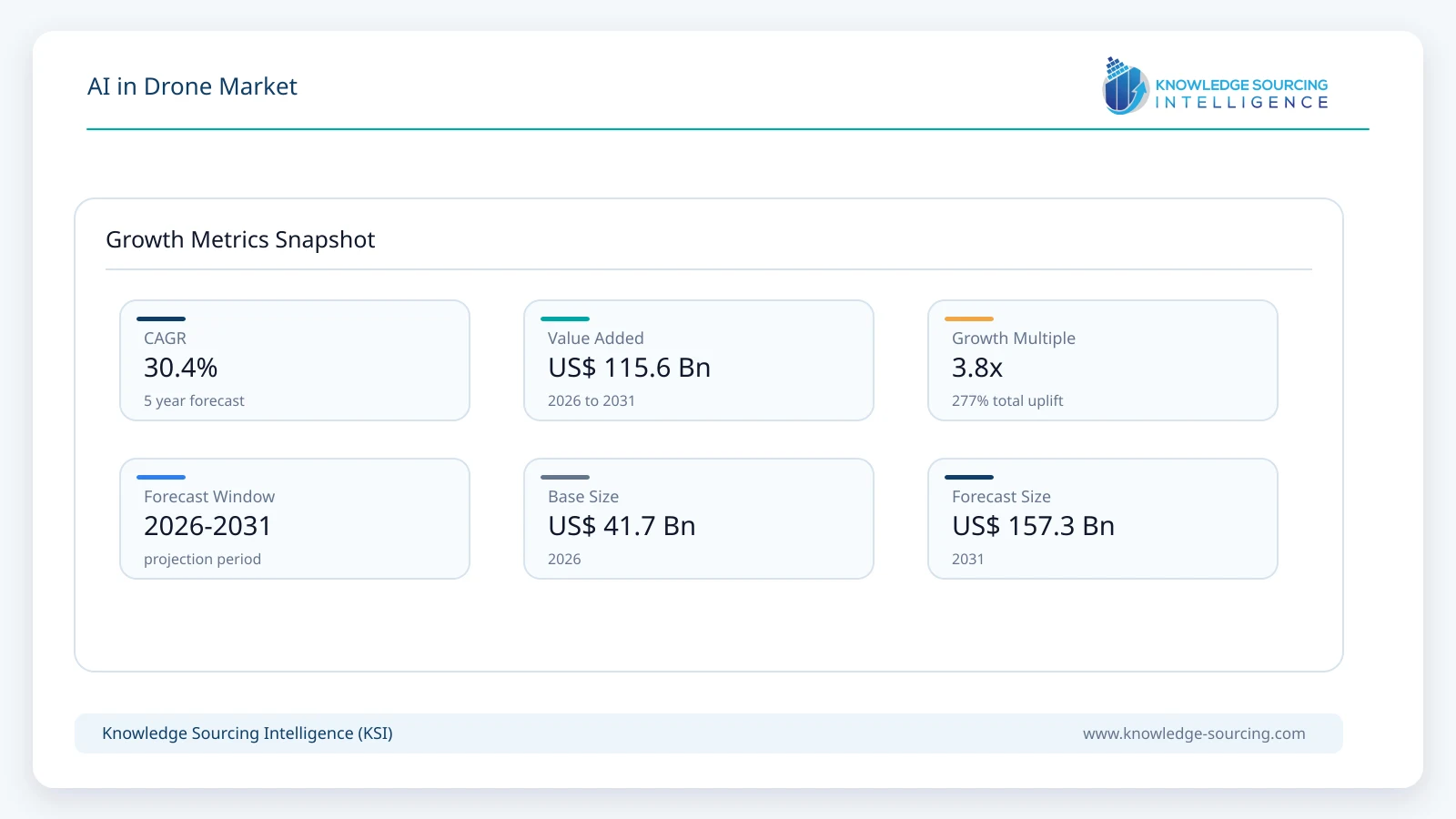
The AI in the drone market is projected to grow at a CAGR of 30.4%, increasing from USD 41.7 billion in 2026 to USD 157.3 billion by 2031.
Highlights:
- 1Autonomous flight capabilitiesenable drones to navigate complex environments independently, making real-time adjustments without continuous human control.
- 2Advanced object detection and recognitionallow drones to precisely identify targets, obstacles, people, or vehicles, enhancing situational awareness.
- 3Real-time data processing and decision-makingimprove mission efficiency across diverse applications, including inspection, surveillance, and search operations.
- 4Obstacle avoidance and dynamic path planningensure safer operations in unpredictable conditions, supporting reliable performance in varied scenarios.
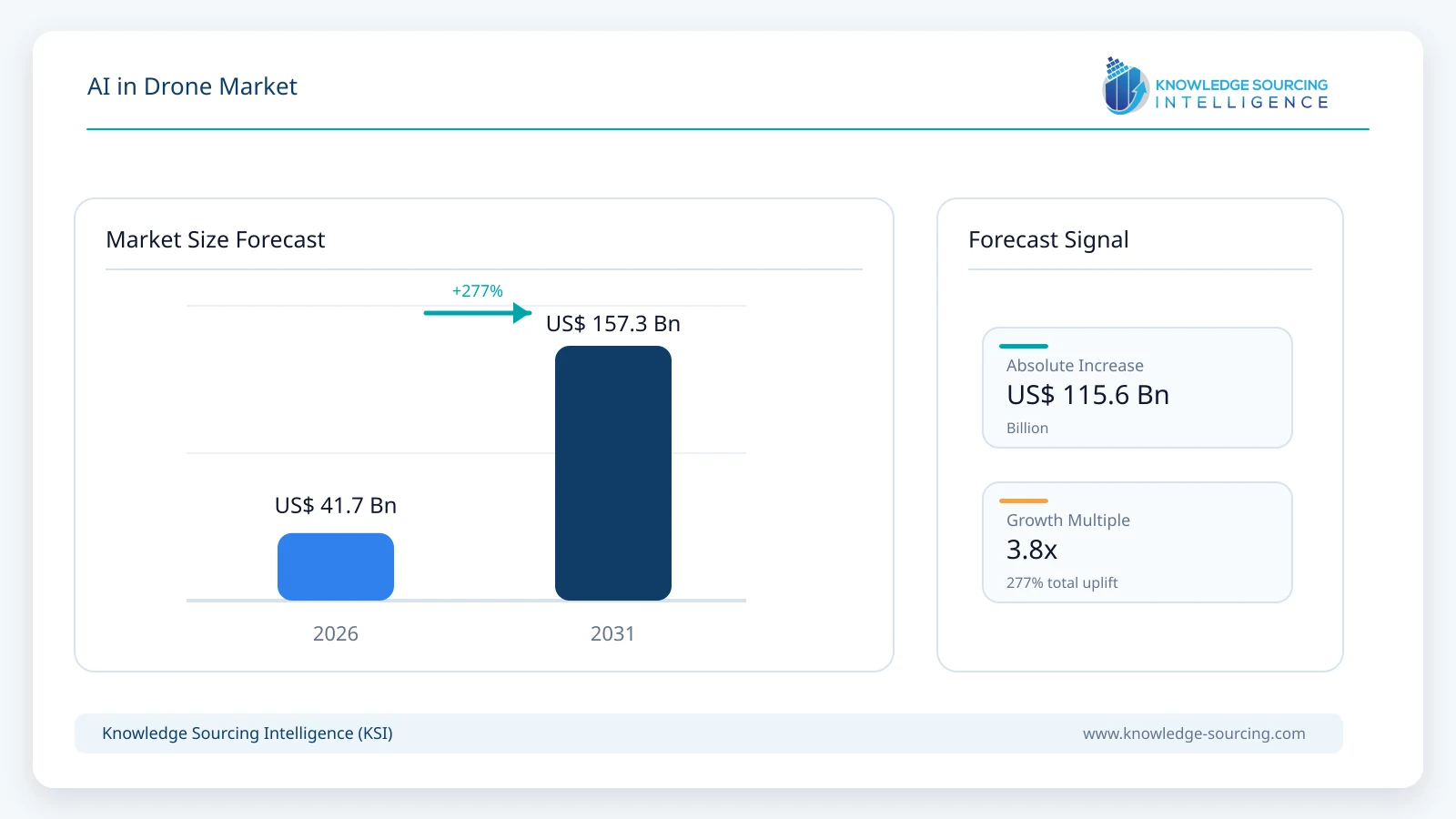
The Artificial Intelligence (AI) in drone market is experiencing significant expansion. AI increasingly enhances the autonomy, intelligence, and operational efficiency of unmanned aerial vehicles (UAVs) across both commercial and defense sectors.
AI-driven drones leverage capabilities such as computer vision, machine learning, deep learning, and edge AI. These technologies enable real-time object identification, facial recognition, autonomous route planning, obstacle avoidance, and independent decision-making without constant human supervision.
These advanced features are driving adoption in critical sectors. Defense and homeland security utilize AI drones for surveillance, border monitoring, and tactical missions. Agriculture benefits from precision farming, crop health analysis, and yield optimization. Logistics and e-commerce employ them for last-mile delivery and warehouse monitoring.
Government initiatives are pivotal in driving AI adoption within the drone market. Specialized programs and policy frameworks encourage local drone manufacturing and AI integration. India exemplifies this through the Drone Shakti initiative, the Production-Linked Incentive (PLI) Scheme for Drones and Drone Components, and grants from MeitY and DRDO, fostering AI-enabled UAV production and research and development.
The U.S. supports AI-driven drone technology primarily through the Department of Defense (DoD), DARPA, and the Federal Aviation Administration (FAA). Europe's efforts include the European Union Aviation Safety Agency (EASA) and Horizon Europe-funded projects that promote autonomous drone development. China, via the Ministry of Industry and Information Technology (MIIT), leads smart city and defense modernization programs that facilitate large-scale drone adoption. These collective measures accelerate the deployment of AI-powered drones in commercial, civil, and defense applications.
Europe has initiated the establishment of AI factories. The first edition is scheduled for April 2025, supported by a €1.5 billion grant. Additionally, six more AI factories were announced in March 2025 in Austria, Bulgaria, France, Germany, Poland, and Slovenia, with €485 million raised. While these AI factories target civilian applications, the technological advancements and infrastructure developed for AI will also facilitate military experimentation, reflecting the convergence of deep technologies across sectors.
The AI in drone market encompasses a diverse range of participants, from established defense contractors to innovative AI startups. Shield AI and Skydio are prominent for autonomous navigation and computer vision solutions. Lockheed Martin integrates AI-driven drones into defense operations.
Companies like Airobotics, Nearthlab, and Percepto specialize in autonomous inspection and monitoring solutions. Folio3 Software Inc., Saiwa, Ayaan Autonomous Systems Pvt. Ltd., Asteria Aerospace, Skylark Drones, and AI Aerial Dynamics provide tailored AI software and drone platforms. EHang is developing AI-enabled autonomous aerial vehicles for logistics and urban mobility.
The integration of AI is proving to be an indispensable factor for advanced drones, providing a significant competitive advantage for market players.
Artificial Intelligence (AI) in Drone Market Trends
The AI in drone market is experiencing substantial growth, primarily driven by the increasing adoption of AI-powered drones in global logistics and e-commerce. Artificial intelligence revolutionizes drone delivery by enabling real-time navigation, obstacle detection, and optimized routing, thereby significantly enhancing last-mile delivery efficiency.
Leading companies, such as Amazon, have pioneered drone delivery solutions, launching services in the UK and Italy in October 2023. This demonstrates the strategic potential of AI drones in e-commerce logistics. According to the U.S. Census Bureau, e-commerce retail sales in the U.S. grew from $287,855 million in Q1 2024 (representing 15.8% of total retail sales) to $292,567 million in Q2, and further to $300,053 million in Q3 2024. This expansion underscores the critical role of AI-driven drones in fulfilling demanding delivery requirements.
AI technologies, including machine learning, computer vision, sensor fusion, and deep learning, empower drones to navigate complex urban environments, ensuring precision, safety, and speed in delivery operations.
Several innovative trends are reshaping the AI drone market. Drone-in-a-box systems enable automated, on-demand deployments, ideal for logistics and emergency response. Beyond Visual Line of Sight (BVLOS) operations expand drone autonomy and operational range, unlocking applications in remote areas.
Drone-as-a-Service (DaaS) and AI as a Service (AIaaS) provide scalable, cloud-based solutions for industries like agriculture, infrastructure monitoring, and security. Climate-smart drones, incorporating energy-efficient designs and eco-friendly materials, align with sustainable drone operations, addressing environmental considerations. Real-time drone insights, powered by AI analytics, enhance decision-making, while predictive maintenance minimizes downtime, boosting operational reliability.
North America leads the market, supported by advanced technology infrastructure, established regulatory frameworks, and significant R&D investments. The Asia-Pacific region, particularly China, India, and Japan, demonstrates rapid growth due to e-commerce expansion, urbanization, and government support for drone technology. While challenges such as regulatory compliance and data privacy persist, AI innovations and standardized protocols are actively mitigating these issues. The AI in the drone market is positioned for growth, driven by drone automation, sustainability, logistics efficiency, and specialized industry applications, solidifying its role in future intelligent aerial solutions.
Market Dynamics
Market Drivers
Growing global defense expenditure
AI drones represent a critical application in the global market. Within the defense sector, drones enhance the efficiency of surveillance systems and improve military capabilities. The rising global military and defense expenditure is expected to drive demand for AI in the drone market.
The Stockholm International Peace Research Institute reported that global military expenditure increased by approximately 6.8% in 2023 compared to 2022. In 2023, the total military expenditure for the USA and China was recorded at US$916 billion and US$296 billion, respectively. Similarly, Russia and India recorded military expenditures of US$109 billion and US$83.6 billion, respectively.
Increasing demand for AI-powered software in drones
The growth of the AI in drone software segment is primarily driven by enhanced data analysis and interpretation, automated data processing, improved accuracy and productivity, and advanced analytics functionalities. Such AI-integrated software is crucial for efficiently processing the extensive volumes of data (pictures, videos, sensor readings) collected by drones, significantly reducing the time and effort involved. This capability also enables the identification of patterns, unusual behaviors, and trends in drone data, leading to more informed decisions. The expansion in this segment is largely attributable to the high adoption of AI within the drone industry.
SafePro AI introduced SpotlightAI ONSITE in December 2024, a real-time AI-powered drone image processing solution for threat detection. This software identifies over 150 land mines and unexploded ordnance classes from drone imagery, supporting forward operations. Developed by Safe Pro AI, a subsidiary of Safe Pro AI, it has undergone practical field testing in Ukraine and is designed for compatibility with virtually any drone. These innovations drive increased demand for AI in drone software technologies.
AI-powered software in drones is also enabling new applications in precision agriculture, infrastructure inspection, and delivery services. Providers of AI-powered drone software are launching specialized solutions for environmental monitoring, search and rescue, and logistics. This application-driven expansion across industries contributes significantly to market growth.
Rising Demand in E-Commerce
The rapid expansion of e-commerce and evolving consumer demands for expedited services (such as fast, same-day, or contactless delivery) have fueled interest in utilizing AI-powered UAVs (drones) for logistics. Drones equipped with AI technology can autonomously navigate optimal routes, avoid obstacles, and execute precise deliveries using specific GPS coordinates. This results in reduced overall delivery times and decreased operational costs associated with goods transportation.
E-commerce companies also leverage AI drones for warehouse automation, enabling instant inventory tracking and stock management, which improves both efficiency and accuracy. In the United States, Amazon has commenced test flights of its autonomous delivery drones from Symmetry Park in Darlington, England, marking a significant step toward integrating airborne deliveries into daily operations.
The U.S. Census Bureau, Department of Commerce, reported seasonally adjusted retail e-commerce sales for the third quarter of 2025 at $310.3 billion, a 1.9 percent (±0.4%) increase from the second quarter of 2025. Total retail sales for the third quarter of 2025 were projected at $1,893.6 billion, a 1.5 percent (±0.2%) increase from the second quarter of 2025.
Key Developments
Leading market participants in the AI in drone market include Folio3 Software Inc., Saiwa, Shield AI, Skydio, Lockheed Martin, Airobotics, Nearthlab, Percepto, Ayaan Autonomous Systems Pvt. Ltd., AI Aerial Dynamics, Asteria Aerospace, Skylark Drones, and Blue Bear Systems Research Ltd. These entities implement strategic growth initiatives, such as product launches, mergers, and acquisitions, to achieve competitive advantage. For example:
April 2026: Safe Pro Group Inc. commenced commercial rollout of NODE-X, a next-generation AI-powered edge processing platform for drone footage, enabling rapid threat detection, 3D mapping, and autonomous mission planning.
March 2026: ZenaTech Inc. announced development of the autonomous Interceptor P-1 drone for counter-UAS operations, designed to physically intercept hostile drones while targeting defense market affordability below $5,000 per unit.
January 2026: ZenaTech Inc. launched the ZenaDrone IQ Quad, an autonomous VTOL AI drone designed for surveying, urban planning, construction, and public works applications through its Drone-as-a-Service platform.
January 2026: GDU-TECH CO., LTD. launched the UAV-P300, described as the world's first AI-powered optical and electronic fog-penetrating drone, featuring AI-enhanced navigation, autonomous flight, and advanced imaging for enterprise applications.
December 2025: Ambarella Inc. announced expanded edge AI drone initiatives and deployment of its CV5 AI system-on-chip in Antigravity’s autonomous A1 drone, enhancing onboard autonomy and low-latency decision-making.
November 2025: The Office of the Assistant Secretary of War (OASW) for Special Operations / Low-Intensity Conflict (SO/LIC) Capability Development & Innovation (CD&I) Directorate competitively awarded XTEND Reality Inc. a multi-million-dollar Firm Fixed Price Contract for the rapid development and delivery of Affordable Close Quarter Modular Effects FPV Drone Kits.
November 2025: Maris-Tech Ltd. and FlightOps Ltd. entered a non-exclusive feasibility collaboration to jointly develop an edge-AI and video payload platform for drones. This initiative integrates Maris-Tech’s Uranus-Drones hardware with FlightOps’ autonomous command-and-control software.
Market Segmentation
By Offerings: Software
Based on offerings, the AI in Drone market is segmented into software and hardware. The growth of AI in the drone software segment is primarily driven by enhanced data analysis and interpretation, automated data processing, improved accuracy and productivity, and advanced analytics functionalities. This AI-connected software is crucial for efficiently processing the extensive data collected by drones, such as pictures, videos, and sensor readings. This integration significantly reduces the time and effort required for data processing. It also enables the identification of potential patterns, anomalous behaviors, and trends in drone data, facilitating more informed decisions. The expansion in this segment is largely attributable to the high adoption of AI within the drone industry.
Furthermore, AI-powered software in drones is enabling new applications, including precision agriculture, infrastructure inspection, and delivery services. AI-powered drone software providers are developing solutions for various sector-specific applications such as environmental monitoring, search and rescue, and logistics. By application, this segment is expanding across industries, contributing to overall market growth. For instance, Folio3 is a global provider of solutions offering AI drone inspection software for various industries, optimizing operations and efficiency through this technology. The company offers numerous AI-enabled drone software solutions, including those for Precision Agriculture, Livestock Management, Terrain Mapping Drones, Solar Panel Inspection, and Search-and-Rescue Drones.
Additionally, in November 2025, Maris-Tech Ltd. and FlightOps Ltd. entered a non-exclusive feasibility collaboration to jointly develop an edge-AI and video payload platform for drones, integrating Maris-Tech’s Uranus-Drones hardware with FlightOps’ autonomous command-and-control software. This collaboration aims to enhance the safety, efficiency, and scalability of complex drone missions by combining advanced edge computing, real-time video processing, and autonomous flight management capabilities into a unified platform.
The increasing use of AI-powered drone software for landmine and unexploded ordnance detection also contributes to this segment’s growth. This momentum underscores innovation within the AI in Drone Market. The successful implementation of this software in real-world scenarios will create additional opportunities for advancements within this evolving field.
Regional Analysis
North America: The US Market Analysis
The U.S. AI in drone market is driven by technological advancements in machine learning, computer vision, and natural language processing, which create pathways for future-proof solutions. These advanced AI technologies enable drones to perform more sophisticated functions and manage tasks autonomously. The increasing demand for industrial automation in the region is optimizing operational efficiency, reducing costs, and mitigating safety incidents, thereby supporting the use of AI-powered drones for tasks such as data collection, inspections, and deliveries.
The White House initiative aims to accelerate the integration of UAVs into the National Airspace System, scale U.S. drone commercialization, and strengthen the domestic industrial base. The Department of Defense invested over $500 million in fiscal year 2024 to initiate large-scale procurement of these systems, and the Trump administration has indicated continued support for further investments in this initiative.
According to Federal Aviation Administration data for the U.S. in October 2024, there were 791,597 registered drones. Of these, 396,746 were commercially registered, and 415,635 were remote pilot certified. The increasing density of drones in the region necessitates advanced technologies like AI to address challenges related to airspace complexity, safety, and enhanced drone capabilities. The substantial volume of data generated by drones serves as a valuable resource for AI research and development. This data aids in training algorithms for tasks such as object detection, navigation, and decision-making, among others, further enhancing drone utility in security and surveillance within the U.S. defense sector.
Moreover, the increasing number of drones creates new opportunities for regional AI companies to develop and deploy AI-based solutions for drone operations. These solutions include traffic management systems, collision avoidance systems, and payload delivery systems. For instance, SPARC AI designs and develops high-tech solutions for environments where GPS is unavailable, enhancing perception and situational awareness. The company has developed an innovative Target Acquisition System and Autonomous Flight solution for drones that operates independently of GPS, satellite, lidar, radar, image recognition, or other complex hardware or software solutions.
AI in Drone Market Scope
| Report Metric | Details |
|---|---|
| Total Market Size in 2026 | USD 41.7 billion |
| Total Market Size in 2031 | USD 157.3 billion |
| Forecast Unit | Billion |
| Growth Rate | 30.4% |
| Study Period | 2021 to 2031 |
| Historical Data | 2021 to 2024 |
| Base Year | 2025 |
| Forecast Period | 2026 – 2031 |
| Segmentation | Technology Type, Offerings, Drone Type, End-User |
| Companies |
|
Market Segmentation
By Technology Type
By Offerings
By Drone Type
By End-user
By Geography
Table of Contents
1. EXECUTIVE SUMMARY
2. MARKET SNAPSHOT
2.1. Market Overview
2.2. Market Definition
2.3. Scope of the Study
2.4. Market Segmentation
3. BUSINESS LANDSCAPE
3.1. Market Drivers
3.2. Market Restraints
3.3. Market Opportunities
3.4. Porter’s Five Forces Analysis
3.5. Industry Value Chain Analysis
3.6. Policies and Regulations
3.7. Strategic Recommendations
4. TECHNOLOGICAL OUTLOOK
5. ARTIFICIAL INTELLIGENCE (AI) IN DRONE MARKET BY TECHNOLOGY TYPE
5.1. Introduction
5.2. Computer Vision & Image Processing
5.3. Machine Learning & Deep Learning
5.4. Autonomous Navigation & Path Planning
5.5. Edge AI & Onboard Processing
5.6. AI-Based Analytics & Data Interpretation
5.7. Others
6. ARTIFICIAL INTELLIGENCE (AI) IN DRONE MARKET BY OFFERINGS
6.1. Introduction
6.2. Hardware
6.3. Software
7. ARTIFICIAL INTELLIGENCE (AI) IN DRONE MARKET BY DRONE TYPE
7.1. Introduction
7.2. Fixed-Wing Drones
7.3. Rotary-Wing Drones
7.4. Hybrid Drones
8. ARTIFICIAL INTELLIGENCE (AI) IN DRONE MARKET BY END-USER
8.1. Introduction
8.2. Defence
8.3. Logistics and Delivery
8.4. Agriculture and Precision Farming
8.5. Disaster Management and Search & Rescue
8.6. Environmental Monitoring
8.7. Others
9. ARTIFICIAL INTELLIGENCE (AI) IN DRONE MARKET BY GEOGRAPHY
9.1. Introduction
9.2. North America
9.2.1. By Technology Type
9.2.2. By Offerings
9.2.3. By Drone Type
9.2.4. By End-User
9.2.5. By Country
9.2.5.1. USA
9.2.5.2. Canada
9.2.5.3. Mexico
9.3. South America
9.3.1. By Technology Type
9.3.2. By Offerings
9.3.3. By Drone Type
9.3.4. By End-User
9.3.5. By Country
9.3.5.1. Brazil
9.3.5.2. Argentina
9.3.5.3. Others
9.4. Europe
9.4.1. By Technology Type
9.4.2. By Offerings
9.4.3. By Drone Type
9.4.4. By End-User
9.4.5. By Country
9.4.5.1. United Kingdom
9.4.5.2. Germany
9.4.5.3. France
9.4.5.4. Italy
9.4.5.5. Spain
9.4.5.6. Others
9.5. Middle East and Africa
9.5.1. By Technology Type
9.5.2. By Offerings
9.5.3. By Drone Type
9.5.4. By End-User
9.5.5. By Country
9.5.5.1. Saudi Arabia
9.5.5.2. UAE
9.5.5.3. Others
9.6. Asia Pacific
9.6.1. By Technology Type
9.6.2. By Offerings
9.6.3. By Drone Type
9.6.4. By End-User
9.6.5. By Country
9.6.5.1. China
9.6.5.2. Japan
9.6.5.3. South Korea
9.6.5.4. India
9.6.5.5. Indonesia
9.6.5.6. Thailand
9.6.5.7. Taiwan
9.6.5.8. Others
10. COMPETITIVE ENVIRONMENT AND ANALYSIS
10.1. Major Players and Strategy Analysis
10.2. Market Share Analysis
10.3. Mergers, Acquisitions, Agreements, and Collaborations
10.4. Competitive Dashboard
11. COMPANY PROFILES
11.1. Folio3 Software Inc.
11.2. Saiwa
11.3. Shield AI
11.4. Skydio
11.5. Lockheed Martin
11.6. Airobotics
11.7. Nearthlab
11.8. Percepto
11.9. Ayaan Autonomous Systems Pvt. Ltd.
11.10. AI Aerial Dynamics
11.11. Asteria Aerospace
11.12. Skylark Drones
11.13. EHang
12. RESEARCH METHODOLOGY
Navigate
Trusted by the world's leading organizations











