
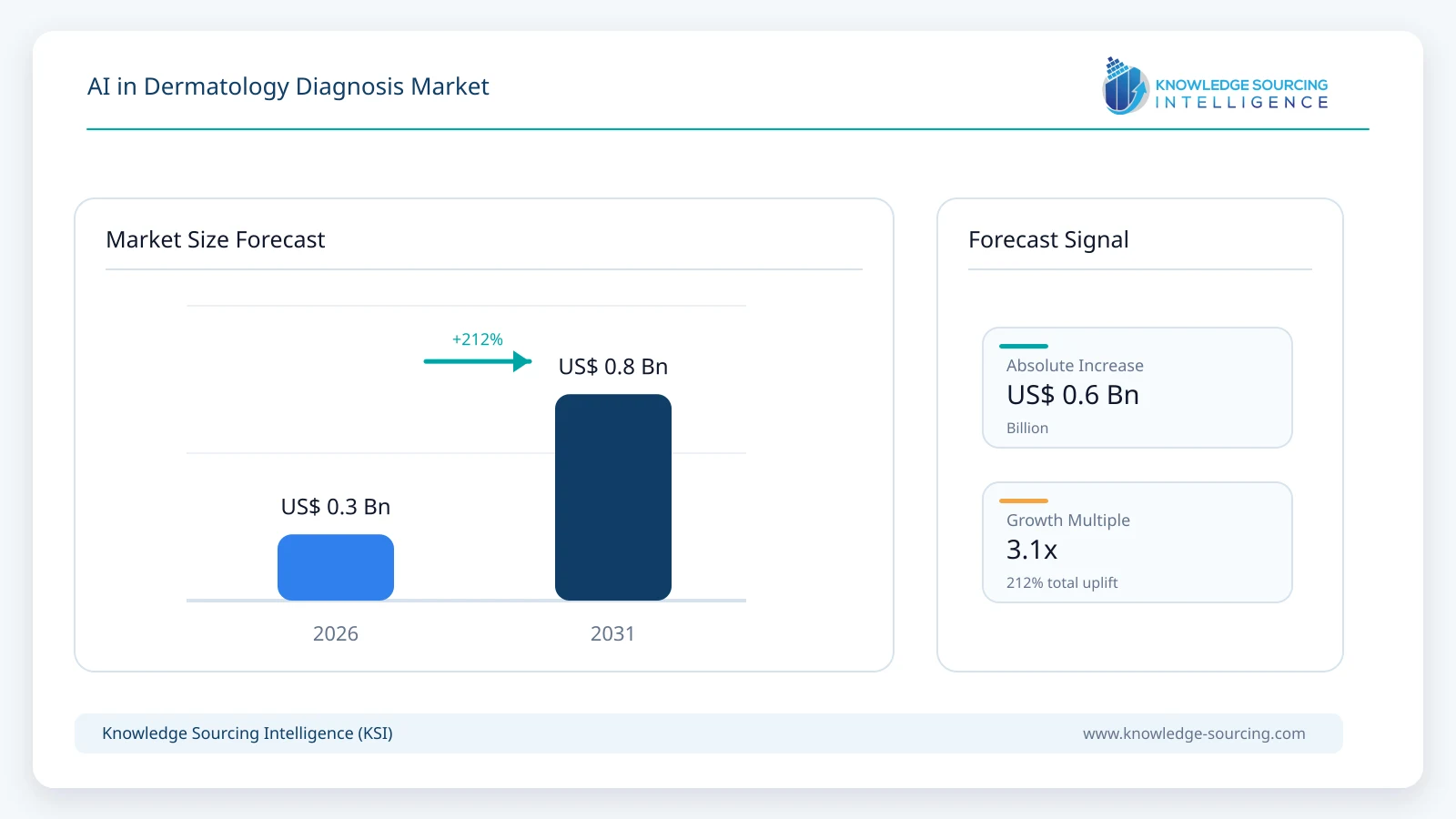
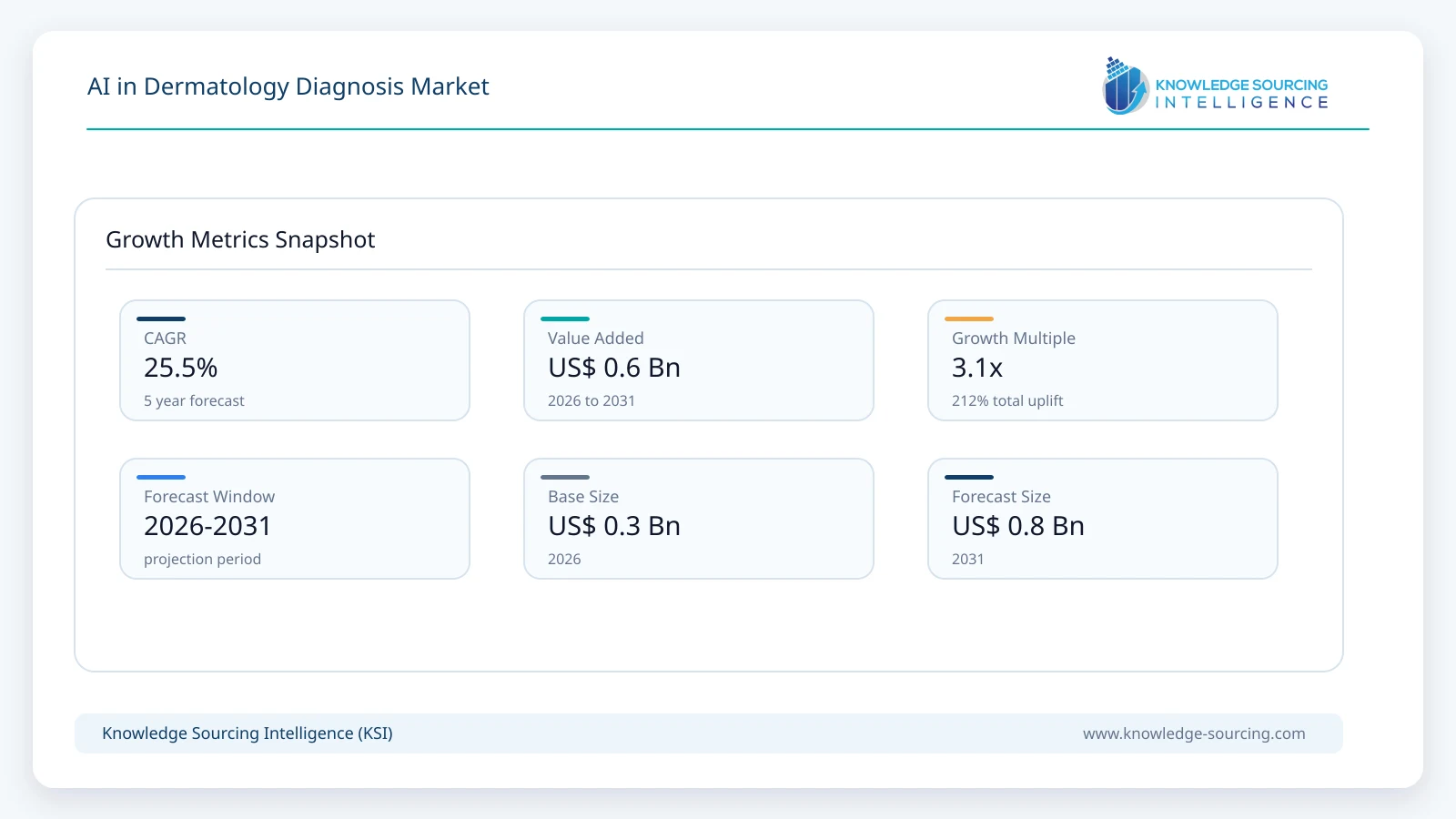
The Artificial Intelligence (AI) in dermatology Diagnosis Market is forecast to grow at a CAGR of 25.5%, reaching USD 0.81 billion in 2031 from USD 0.26 billion in 2026.
Highlights:
- 1Rising Skin DisordersIncreasing global prevalence of skin diseases drives demand for AI diagnostics.
- 2Accurate, Fast DiagnosisAI enhances precision and speed in diagnosing skin conditions effectively.
- 3Telemedicine GrowthRising adoption of remote dermatology services boosts AI diagnostic solutions.
- 4Improved AccessAI enables accurate dermatological care in underserved and remote regions.
The demand for AI-based dermatology diagnosis services is expected to grow steadily. AI in dermatology diagnosis is set to transform dermatological services, i.e., AI will be applied to diagnose and treat dermatological conditions. The situation becomes worse as skin diseases are rising worldwide, thus increasing the demand for quick and precise diagnosis.
Dermatological systems that use AI technology explore vast repositories of medical images through sophisticated algorithms for faster and more effective diagnosis and classification of skin issues. These technologies enable dermatologists to provide more accurate diagnoses, enhancing treatment methods and successful healthcare results tailored to individual patients. As technological developments escalate, the demand for AI in dermatology diagnosis is expected to grow tremendously, offering a better treatment option for dermatological services and increasing the management scope of skin diseases.
AI in Dermatology Diagnosis Market Growth Drivers:
The increasing prevalence of skin disorders enhances the AI in dermatology diagnosis market growth
The market for AI in dermatology diagnosis is growing significantly due to the increased prevalence of skin-related issues globally. Skin disorders, as the World Health Organisation (WHO) points out, affect the lives of most people, and an estimated 900 million people have skin diseases at any time. Health conditions like acne, psoriasis, and malignant skin tumors are serious public health issues and require an accurate and timely diagnosis. Using AI in dermatology to analyze large amounts of clinical photographs, such advanced dermatological solutions assist healthcare experts in formulating a more accurate diagnosis. With the rising occurrence of skin disorders, the emphasis on AI-based dermatology therapeutics will continue to grow significantly, boosting the AI in dermatology diagnosis market growth.
Rising demand for efficient and accurate diagnoses pushes AI in the dermatology diagnosis market.
The utilization of AI in dermatology for diagnostic purposes is rising due to the strong need for precise and timely diagnosis. AI and dermatology are part of the basic healthcare services research needs due to the desire to improve diagnosis quickly and more effectively. These systems can process and analyze millions of medical images in a very short time, enabling the diagnosis of many types of skin lesions. Consequently, with the demand for accurate and fast diagnoses from healthcare givers and patients, there will be an increase in the application of AI in the dermatology diagnosis market.
The growing adoption of telemedicine and remote dermatology services boosts the AI in dermatology diagnosis market size.
The AI in the dermatology diagnosis market is seeing rapid expansion because of the increased usage of telemedicine and remote dermatological services. The introduction of telemedicine components with AI-oriented dermatology solutions has made it possible for dermatologists to evaluate skin conditions, provide consultations, and even make diagnoses for patients across a wide geographical spectrum. Owing to the easy and affordable nature of remote dermatology services and the wisdom of AI in aiding accurate diagnosis, the adoption of AI in dermatology diagnosis has been accelerated. This has made restrictive dermatological services available to patients worldwide.
AI's potential in expanding access to dermatological care propels AI in the dermatology diagnosis market.
AI in the dermatology diagnosis market is rapidly garnering momentum because dermatological treatments can now be easily accessible to many people. A study published in the Journal of Investigative Dermatology reported an accuracy of 95% in skin cancer recognition by AI algorithms, which is the same as the reported accuracy for dermatologists. AI-powered dermatology solutions can lessen the gap between dermatological practitioners and marginalized regions, thus improving the quality of care.
According to the World Health Organisation, over 30% of skin problems in low-income nations are misdiagnosed or untreated. AI's ability to give efficient and accurate diagnostics remotely makes it vital for democratizing dermatological care and ensuring patients in rural or underserved locations receive prompt and accurate assessments.
AI in Dermatology Diagnosis Market Restraints:
High costs and human resistance are anticipated to impede market growth
Undergoing aesthetic procedures, patients face a certain number of risks, including the risk of infection, an allergic reaction on the skin, changes in pigmentation, injury to internal organs, and risks associated with anesthesia. Some studies have reported that red light therapy devices may be linked to blistering and burning injuries. While some have claimed to have been burned by corroded equipment or faulty wiring, very few have reported getting burned after sleeping with the unit on. These problems are expected to impede the application of dermatological treatments.
AI in Dermatology Diagnosis Market Geographical Outlook:
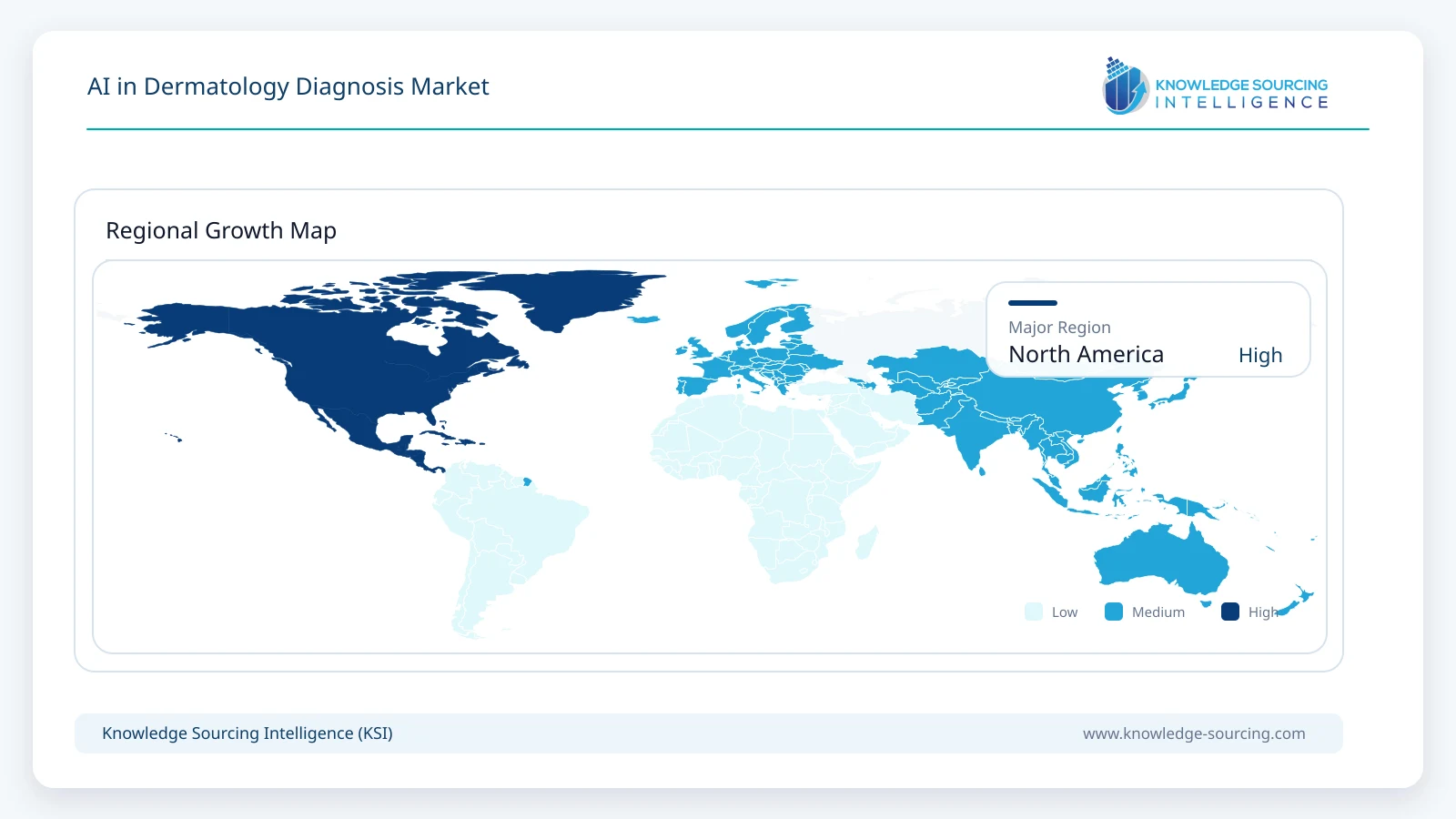
North America is witnessing exponential growth during the forecast period
This region is the global leader for several reasons, such as well-developed healthcare systems, highly mobile technology, and high investments in AI. North America has remained home to many established players and new entrants who develop AI-based dermatological solutions that promote innovation and increase the market size. In addition, the rising prevalence of skin diseases in the region and the growing demand for quick and accurate dermatological diagnosis have contributed to the increasing adoption of AI solutions in dermatology. North America’s focus on technological advancements and commitment to the enhancement of dermatological care have positioned the region in the AI in dermatology diagnosis market.
AI in Dermatology Diagnosis Market Key Launches:
September 2025: Aidoc Receives FDA Breakthrough Device Designation for Multi-Triage AI Solution. Aidoc was granted FDA Breakthrough Device Designation for its CARE™ foundation-model AI solution, which triages a wide range of life-threatening conditions across CT scans in a single workflow—though not specifically for skin cancer, it advances AI triage capabilities with potential future dermatology applications.
August 2025: SkinVision Achieves CE Mark Class IIa for AI Skin Cancer Detection App. SkinVision secured CE Mark Class IIa certification under EU MDR for its AI algorithm, clinically validated in peer-reviewed studies to detect melanoma with 95% sensitivity and support early intervention across diverse skin types.
In April 2024, researchers at the Stanford Center for Digital Health found that using deep learning-powered AI algorithms increases the accuracy of skin cancer diagnostics for physicians, nurse practitioners, and medical students.
List of Top AI in Dermatology Diagnosis Companies
3derm Systems, Inc.
Aidoc Medical Ltd.
Aidoc
Arterys Inc.
Beijing Infervision Technology Co., Ltd.
AI in Dermatology Diagnosis Market Scope
| Report Metric | Details |
|---|---|
| Total Market Size in 2026 | USD 0.26 billion |
| Total Market Size in 2031 | USD 0.81 billion |
| Forecast Unit | Billion |
| Growth Rate | 25.5% |
| Study Period | 2021 to 2031 |
| Historical Data | 2021 to 2024 |
| Base Year | 2025 |
| Forecast Period | 2026 – 2031 |
| Segmentation | Type, Technology, Application, Geography |
| Companies |
|
Market Segmentation
By Type
- Standalone AI Systems
- AI-Powered Mobile Apps
By Technology
- Machine Learning
- Deep Learning
- Computer Vision
- Natural Language Processing (NLP)
- Others
By Application
- Skin Cancer Diagnosis
- Acne And Rosacea Diagnosis
- Psoriasis Diagnosis
- Eczema Diagnosis
- Hair And Nail Disorders Diagnosis
- Others
By End-User
- Hospitals And Clinics
- Dermatology Clinics And Centers
- Research Institutes And Academic Centers
- Others
By Geography
- North America
- United States
- Canada
- Mexico
- South America
- Brazil
- Argentina
- Others
- Europe
- United Kingdom
- Germany
- France
- Italy
- Spain
- Others
- Middle East and Africa
- Saudi Arabia
- UAE
- Others
- Asia Pacific
- Japan
- China
- India
- South Korea
- Indonesia
- Taiwan
- Others
Table of Contents
1. INTRODUCTION
1.1. Market Overview
1.2. Market Definition
1.3. Scope of the Study
1.4. Market Segmentation
1.5. Currency
1.6. Assumptions
1.7. Base and Forecast Years Timeline
1.8. Key Benefits to the Stakeholder
2. RESEARCH METHODOLOGY
2.1. Research Design
2.2. Research Processes
3. EXECUTIVE SUMMARY
3.1. Key Findings
3.2. CXO Perspective
4. MARKET DYNAMICS
4.1. Market Drivers
4.2. Market Restraints
4.3. Porter’s Five Forces Analysis
4.3.1. Bargaining Power of Suppliers
4.3.2. Bargaining Power of Buyers
4.3.3. Threat of New Entrants
4.3.4. Threat of Substitutes
4.3.5. Competitive Rivalry in the Industry
4.4. Industry Value Chain Analysis
4.5. Analyst View
5. ARTIFICIAL INTELLIGENCE (AI) IN DERMATOLOGY DIAGNOSIS MARKET BY TYPE
5.1. Introduction
5.2. Standalone AI Systems
5.3. AI-Powered Mobile Apps
6. ARTIFICIAL INTELLIGENCE (AI) IN DERMATOLOGY DIAGNOSIS MARKET BY TECHNOLOGY
6.1. Introduction
6.2. Machine Learning
6.3. Deep Learning
6.4. Computer Vision
6.5. Natural Language Processing (NLP)
6.6. Others
7. ARTIFICIAL INTELLIGENCE (AI) IN DERMATOLOGY DIAGNOSIS MARKET BY APPLICATION
7.1. Introduction
7.2. Skin Cancer Diagnosis
7.3. Acne And Rosacea Diagnosis
7.4. Psoriasis Diagnosis
7.5. Eczema Diagnosis
7.6. Hair And Nail Disorders Diagnosis
7.7. Others
8. ARTIFICIAL INTELLIGENCE (AI) IN DERMATOLOGY DIAGNOSIS MARKET BY END-USER
8.1. Introduction
8.2. Hospitals And Clinics
8.3. Dermatology Clinics and Centers
8.4. Research Institutes and Academic Centers
8.5. Others
9. ARTIFICIAL INTELLIGENCE (AI) IN DERMATOLOGY DIAGNOSIS MARKET BY GEOGRAPHY
9.1. Introduction
9.2. North America
9.2.1. By Type
9.2.2. By Technology
9.2.3. By Application
9.2.4. BY End-User
9.2.5. By Country
9.2.5.1. United States
9.2.5.2. Canada
9.2.5.3. Mexico
9.3. South America
9.3.1. By Type
9.3.2. By Technology
9.3.3. By Application
9.3.4. BY End-User
9.3.5. By Country
9.3.5.1. Brazil
9.3.5.2. Argentina
9.3.5.3. Others
9.4. Europe
9.4.1. By Type
9.4.2. By Technology
9.4.3. By Application
9.4.4. BY End-User
9.4.5. By Country
9.4.5.1. United Kingdom
9.4.5.2. Germany
9.4.5.3. France
9.4.5.4. Italy
9.4.5.5. Spain
9.4.5.6. Others
9.5. Middle East and Africa
9.5.1. By Type
9.5.2. By Technology
9.5.3. By Application
9.5.4. BY End-User
9.5.5. By Country
9.5.5.1. Saudi Arabia
9.5.5.2. UAE
9.5.5.3. Others
9.6. Asia Pacific
9.6.1. By Type
9.6.2. By Technology
9.6.3. By Application
9.6.4. BY End-User
9.6.5. By Country
9.6.5.1. Japan
9.6.5.2. China
9.6.5.3. India
9.6.5.4. South Korea
9.6.5.5. Indonesia
9.6.5.6. Taiwan
9.6.5.7. Others
10. COMPETITIVE ENVIRONMENT AND ANALYSIS
10.1. Major Players and Strategy Analysis
10.2. Market Share Analysis
10.3. Mergers, Acquisitions, Agreements, and Collaborations
10.4. Competitive Dashboard
11. COMPANY PROFILES
11.1. 3derm Systems, Inc.
11.2. Aidoc Medical Ltd.
11.3. Aidoc
11.4. Arterys Inc.
11.5. Beijing Infervision Technology Co., Ltd.
11.6. Butterfly Network, Inc.
11.7. Enlitic, Inc.
11.8. Fdna Inc.
11.9. Ibm Corporation
11.10. Mirada Medical Limited
Navigate
Trusted by the world's leading organizations











