
The AI-powered business intelligence market is expected to grow at a substantial pace during the forecast period.
Highlights:
- 1Growing enterprise demand for automated decision support and predictive analytics remains the primary demand catalyst.
- 2Cloud deployment represents the most commercially attractive implementation model because of scalability, continuous software updates, and lower infrastructure requirements.
- 3Asia Pacific presents considerable expansion opportunities due to enterprise digitalization, expanding cloud adoption, and government support for artificial intelligence initiatives.
- 4Generative AI, natural language querying, and automated insight generation are redefining user interaction with business intelligence platforms.
- 5Data governance, privacy legislation, and responsible AI requirements increasingly influence enterprise procurement decisions.
- 6Competition is shifting toward integrated AI ecosystems combining analytics, cloud infrastructure, data engineering, and workflow automation.
The AI-powered business intelligence (BI) market comprises software platforms and associated services that combine artificial intelligence, machine learning, natural language processing (NLP), predictive analytics, and automation with traditional business intelligence functions. These solutions enable organizations to convert structured and unstructured data into actionable insights, automate reporting, improve forecasting accuracy, and support faster operational and strategic decision-making. AI-powered BI platforms are increasingly embedded within enterprise workflows, allowing business users to interact with data using conversational interfaces, automated dashboards, anomaly detection, and predictive recommendations instead of relying solely on technical analytics teams.
Demand is being shaped by the expansion of enterprise data volumes, wider adoption of cloud computing, and the growing need to shorten decision cycles. Organizations are moving beyond descriptive reporting toward predictive and prescriptive analytics to improve operational efficiency, customer engagement, financial planning, and supply chain management. Business leaders are also seeking self-service analytics capabilities that reduce dependence on specialized data scientists while maintaining governance and data quality.
Buyer priorities have shifted from visualization capabilities alone to measurable business outcomes. Procurement decisions increasingly evaluate AI explainability, integration with enterprise resource planning (ERP), customer relationship management (CRM), and data warehouse environments, scalability across business units, cybersecurity controls, regulatory compliance, and total cost of ownership. Large enterprises typically pursue enterprise-wide deployments with centralized governance, while mid-sized organizations increasingly adopt cloud-native subscription models that reduce implementation complexity and capital expenditure.
The supplier ecosystem includes enterprise software vendors, cloud platform providers, analytics specialists, and consulting organizations that provide implementation, integration, and managed services. Competition extends beyond dashboard functionality, with vendors differentiating through proprietary AI models, embedded generative AI assistants, industry-specific analytics templates, automated data preparation, and seamless interoperability across enterprise applications. As organizations continue investing in data-driven decision-making, AI-powered BI is becoming a strategic enterprise capability rather than a standalone reporting tool.
Market Drivers
Rising Enterprise Adoption of AI-Driven Decision Support
Organizations across banking, manufacturing, healthcare, retail, and telecommunications increasingly depend on real-time intelligence to manage complex operations. Traditional reporting methods often require manual interpretation and lengthy analysis cycles, limiting responsiveness. AI-powered BI platforms automate anomaly detection, predictive forecasting, and scenario analysis, enabling executives to evaluate operational risks more efficiently.
Enterprise buyers prioritize measurable improvements in productivity, inventory optimization, fraud detection, and customer retention. Vendors continue expanding embedded AI capabilities while improving model transparency and governance, strengthening the commercial value proposition for enterprise-wide deployments.
Expansion of Cloud-Based Data Infrastructure
Migration toward cloud data warehouses, data lakes, and hybrid cloud environments has created favorable conditions for AI-powered analytics adoption. Organizations increasingly consolidate enterprise data across multiple business functions, making centralized AI-driven analysis more practical than fragmented reporting systems.
Software providers are responding by strengthening interoperability with major cloud ecosystems while introducing subscription-based licensing models. This approach reduces implementation costs, accelerates deployment timelines, and supports continuous software innovation.
Growth of Self-Service Analytics Across Business Functions
Business users increasingly expect direct access to enterprise data without requiring extensive technical expertise. AI-powered BI platforms simplify analytics through natural language interfaces, automated dashboard generation, and guided recommendations, allowing finance, sales, operations, and marketing teams to generate insights independently.
Organizations benefit from broader analytics adoption while reducing pressure on centralized data teams. This shift expands addressable demand beyond traditional business intelligence specialists and increases software utilization throughout enterprises.
Greater Investment in Data Governance and Trusted Analytics
As organizations rely more heavily on AI-generated insights, confidence in data quality and governance has become essential. Regulatory expectations and executive accountability require transparent analytics processes supported by secure data management.
Technology suppliers increasingly integrate governance frameworks, lineage tracking, explainable AI capabilities, and role-based access controls into business intelligence platforms. These features strengthen enterprise adoption among highly regulated industries, including financial services and healthcare.
Market Restraints and Challenges
Fragmented Enterprise Data Environments
Many organizations continue operating legacy applications, isolated databases, and incompatible enterprise systems. Integrating these diverse data sources into unified AI-powered BI environments often requires substantial investment in data engineering and modernization.
Complex integration projects can delay deployment schedules, increase implementation costs, and reduce expected return on investment, particularly among organizations with limited technical resources.
Data Privacy and Regulatory Compliance Requirements
Artificial intelligence solutions process significant volumes of operational and customer information, increasing compliance obligations. Regulations governing personal data protection, cross-border data transfers, and AI accountability require organizations to implement comprehensive governance frameworks.
These requirements extend implementation timelines and increase procurement scrutiny, particularly within banking, healthcare, and government sectors.
Shortage of Advanced Data and AI Skills
Although AI-powered BI reduces analytical complexity for business users, successful implementation still requires expertise in data architecture, governance, machine learning, and enterprise integration.
Organizations frequently depend on consulting partners and managed service providers to bridge internal capability gaps. Limited availability of experienced professionals may increase implementation costs and prolong deployment schedules.
Concerns Regarding AI Explainability
Enterprise executives require confidence that AI-generated recommendations are transparent, auditable, and aligned with business objectives. Black-box algorithms may reduce trust among decision-makers, especially where financial or regulatory consequences are substantial.
Software vendors continue investing in explainable AI functionality and model governance to strengthen enterprise confidence and encourage broader adoption.
Major Segment Analysis
Cloud Deployment Segment
Cloud deployment represents the most commercially important segment because it aligns with enterprise demand for flexibility, scalability, and continuous innovation. Organizations increasingly prefer cloud-based AI-powered BI platforms that support rapid deployment, automatic software updates, and seamless integration with cloud-native databases, enterprise applications, and AI services.
Procurement decisions increasingly emphasize operational expenditure rather than capital expenditure, making subscription-based cloud services attractive across both large enterprises and mid-sized organizations. Buyers also value elastic computing resources that accommodate growing data volumes without requiring major infrastructure investments.
Competition within this segment centers on AI functionality, security certifications, integration capabilities, multi-cloud compatibility, and embedded automation. Vendors offering unified analytics, governance, and generative AI capabilities within broader enterprise software ecosystems benefit from stronger customer retention and higher recurring revenue. As cloud adoption continues across industries, this deployment model is expected to remain the principal revenue contributor for AI-powered business intelligence solutions.
Regional Analysis
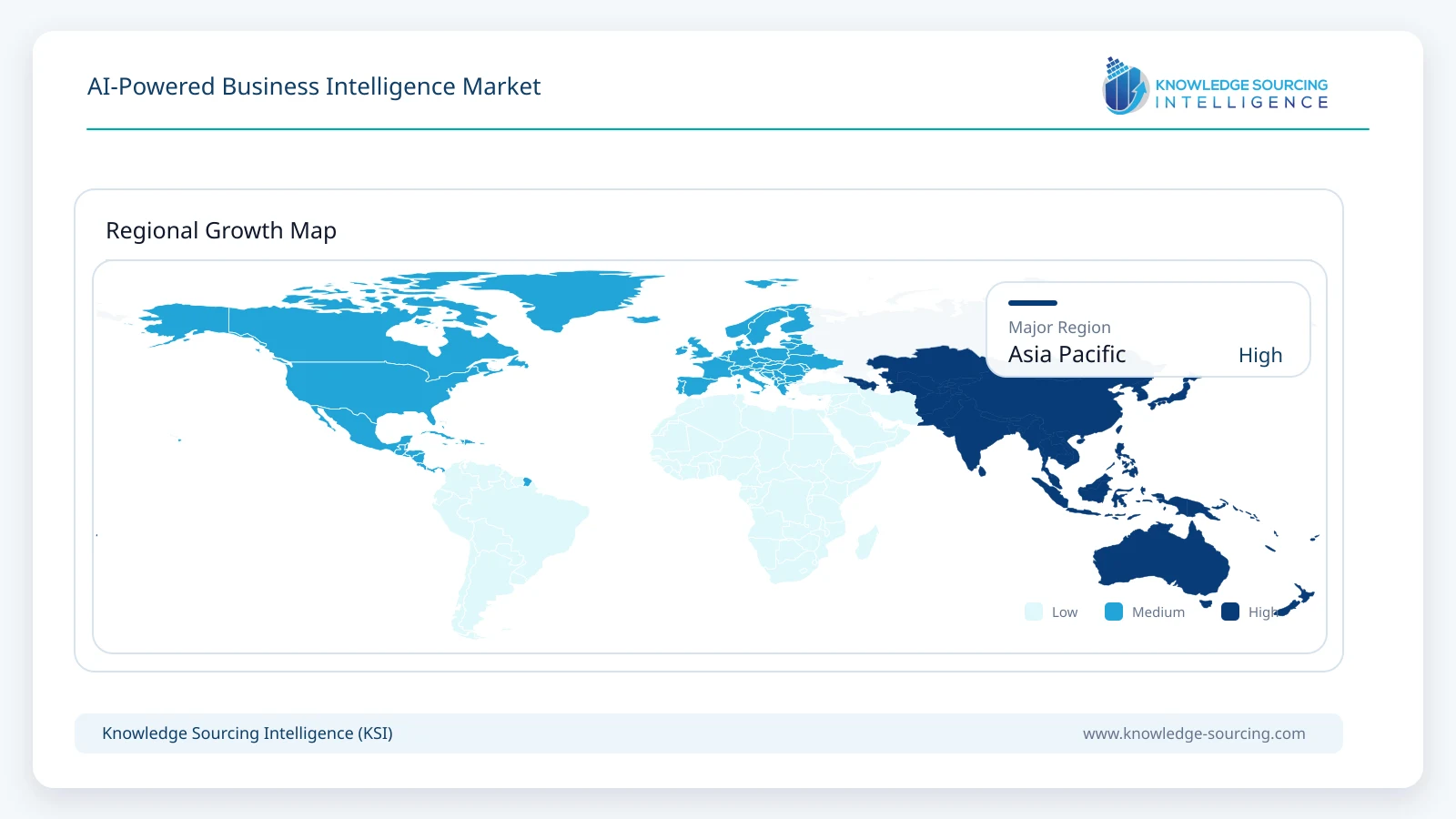
North America maintains a leading position owing to mature cloud infrastructure, substantial enterprise software investment, and widespread adoption of artificial intelligence across financial services, healthcare, retail, and manufacturing. Organizations demonstrate strong willingness to invest in advanced analytics platforms that improve operational efficiency and support executive decision-making. Regulatory attention toward responsible AI and cybersecurity continues to shape procurement standards.
Europe benefits from established industrial sectors, growing enterprise digital investment, and comprehensive data governance frameworks. Organizations prioritize compliant AI deployment alongside operational efficiency. Demand is particularly strong among manufacturing, automotive, financial services, and public sector organizations implementing analytics to improve productivity while complying with privacy regulations.
Asia Pacific represents the fastest-expanding regional opportunity due to rapid cloud adoption, expanding enterprise digitalization, government AI strategies, and growing investments in smart manufacturing and digital commerce. China, India, Japan, South Korea, and Australia continue increasing enterprise analytics investments as organizations modernize operations and improve competitiveness through data-driven decision-making.
Middle East & Africa demonstrates rising adoption supported by national digital economy initiatives, public sector modernization programs, financial sector expansion, and smart city investments. Adoption remains concentrated among larger enterprises because smaller organizations often face budget and technical capability constraints.
South America is experiencing gradual adoption as financial institutions, retailers, manufacturers, and telecommunications companies increase investments in analytics and cloud computing. Economic uncertainty and uneven digital infrastructure remain constraints, although modernization initiatives continue creating opportunities for enterprise software vendors.
Competitive Landscape
Competition within the AI-powered business intelligence market combines enterprise software vendors, specialized analytics providers, and cloud ecosystem participants. Suppliers compete through platform integration, AI model sophistication, data connectivity, industry-specific analytical capabilities, and enterprise scalability rather than visualization functionality alone.
Strategic partnerships with hyperscale cloud providers, systems integrators, and enterprise software vendors remain central to market expansion. Product differentiation increasingly depends on embedded generative AI assistants, conversational analytics, predictive modeling, automated data preparation, governance frameworks, and support for hybrid cloud deployments.
Geographic expansion strategies emphasize localized cloud infrastructure, regulatory compliance, multilingual interfaces, and vertical-specific solutions tailored to financial services, healthcare, manufacturing, retail, and government organizations. Competitive positioning also depends on implementation ecosystems that combine software licensing with consulting, migration, training, and managed services.
Recent Developments
May 2026: Microsoft expanded generative AI capabilities across its enterprise analytics portfolio through enhanced Copilot functionality for business intelligence workflows. Commercial relevance: strengthened conversational analytics and enterprise productivity.
February 2026: Salesforce introduced additional autonomous AI capabilities within its analytics ecosystem, improving predictive insights and workflow automation for enterprise users. Commercial relevance: expanded AI-enabled customer intelligence applications.
June 2025: Databricks announced expanded enterprise AI platform capabilities integrating governance, data intelligence, and generative AI services. Commercial relevance: supported unified enterprise analytics and accelerated AI deployment across regulated industries.
Regulatory and Policy Environment
The regulatory environment increasingly emphasizes responsible AI deployment, cybersecurity, and data privacy. Regulations such as the European Union AI Act and General Data Protection Regulation (GDPR) establish governance expectations regarding transparency, accountability, risk management, and protection of personal information. Organizations deploying AI-powered BI platforms must ensure compliance through appropriate governance frameworks, documentation, and human oversight.
Government investment programs supporting artificial intelligence research, cloud infrastructure, and digital public services are encouraging broader enterprise adoption across multiple regions. Industry standards related to information security, including ISO/IEC 27001 and SOC compliance frameworks, increasingly influence procurement decisions among enterprise buyers.
Public sector procurement also places greater emphasis on explainable AI, secure cloud infrastructure, and ethical AI deployment. Vendors capable of demonstrating regulatory compliance and trusted AI governance are better positioned to compete in highly regulated industries.
Outlook and Strategic Implications
Over the next five years, investment priorities will continue shifting toward integrated AI platforms capable of combining data management, predictive analytics, generative AI, and workflow automation within unified enterprise ecosystems. Buyers are expected to favor vendors that reduce implementation complexity while supporting interoperability across existing enterprise software environments.
Procurement strategies will increasingly prioritize explainable AI, governance, cybersecurity, and measurable business outcomes rather than standalone analytical functionality. Cloud-native deployments will continue expanding as organizations seek operational flexibility and continuous software innovation.
Competition is expected to intensify through ecosystem partnerships, acquisitions, embedded generative AI capabilities, and industry-specific solution development. Vendors with strong cloud integration, comprehensive governance capabilities, and scalable enterprise architectures are likely to strengthen competitive positioning.
Despite ongoing challenges related to regulatory compliance, data integration, and skills availability, enterprise demand for AI-powered business intelligence will remain supported by the growing strategic importance of data-driven decision-making. Organizations that align analytics investments with governance, operational efficiency, and business value creation are expected to achieve stronger returns while improving resilience in increasingly data-intensive operating environments.
AI-Powered Business Intelligence Market Scope
| Report Metric | Details |
|---|---|
| Forecast Unit | Billion |
| Study Period | 2021 to 2031 |
| Historical Data | 2021 to 2024 |
| Base Year | 2025 |
| Forecast Period | 2026 – 2031 |
| Segmentation | Component, Deployment, End User, Geography |
| Companies |
|
Market Segmentation
By Component
By Deployment
By End User
By Geography
Table of Contents
1. EXECUTIVE SUMMARY
2. MARKET SNAPSHOT
2.1. Market Overview
2.2. Market Definition
2.3. Scope of the Study
2.4. Market Segmentation
3. BUSINESS LANDSCAPE
3.1. Market Drivers
3.2. Market Restraints
3.3. Market Opportunities
3.4. Porter’s Five Forces Analysis
3.5. Industry Value Chain Analysis
3.6. Policies and Regulations
3.7. Strategic Recommendations
4. TECHNOLOGICAL OUTLOOK
5. AI-POWERED BUSINESS INTELLIGENCE MARKET BY COMPONENT
5.1. Introduction
5.2. Software
5.3. Services
6. AI-POWERED BUSINESS INTELLIGENCE MARKET BY DEPLOYMENT
6.1. Introduction
6.2. On-Premises
6.3. Cloud
7. AI-POWERED BUSINESS INTELLIGENCE MARKET BY END USER
7.1. Introduction
7.2. Banking, Financial Services, and Insurance (BFSI)
7.3. Retail and E-commerce
7.4. Healthcare
7.5. Manufacturing
7.6. IT and Telecommunications
7.7. Government
7.8. Others
8. AI-POWERED BUSINESS INTELLIGENCE MARKET BY GEOGRAPHY
8.1. Introduction
8.2. North America
8.2.1. United States
8.2.2. Canada
8.2.3. Mexico
8.3. South America
8.3.1. Brazil
8.3.2. Argentina
8.3.3. Others
8.4. Europe
8.4.1. United Kingdom
8.4.2. Germany
8.4.3. France
8.4.4. Italy
8.4.5. Spain
8.4.6. Others
8.5. Middle East & Africa
8.5.1. Saudi Arabia
8.5.2. UAE
8.5.3. South Africa
8.5.4. Others
8.6. Asia Pacific
8.6.1. China
8.6.2. India
8.6.3. Japan
8.6.4. South Korea
8.6.5. Australia
8.6.6. Others
9. COMPETITIVE ENVIRONMENT AND ANALYSIS
9.1. Major Players and Strategy Analysis
9.2. Market Share Analysis
9.3. Mergers, Acquisitions, Agreements, and Collaborations
9.4. Competitive Dashboard
10. COMPANY PROFILES
10.1. Microsoft Corporation
10.2. Salesforce, Inc.
10.3. ThoughtSpot Inc.
10.4. IBM Corporation
10.5. SAP SE
10.6. Oracle Corporation
10.7. Databricks, Inc.
10.8. QlikTech International AB
10.9. Domo, Inc.
10.10. SAS Institute Inc.
11. APPENDIX
11.1. Currency
11.2. Assumptions
11.3. Base and Forecast Years Timeline
11.4. Key Benefits for Stakeholders
11.5. Research Methodology
11.6. Abbreviations
Navigate
Trusted by the world's leading organizations











