
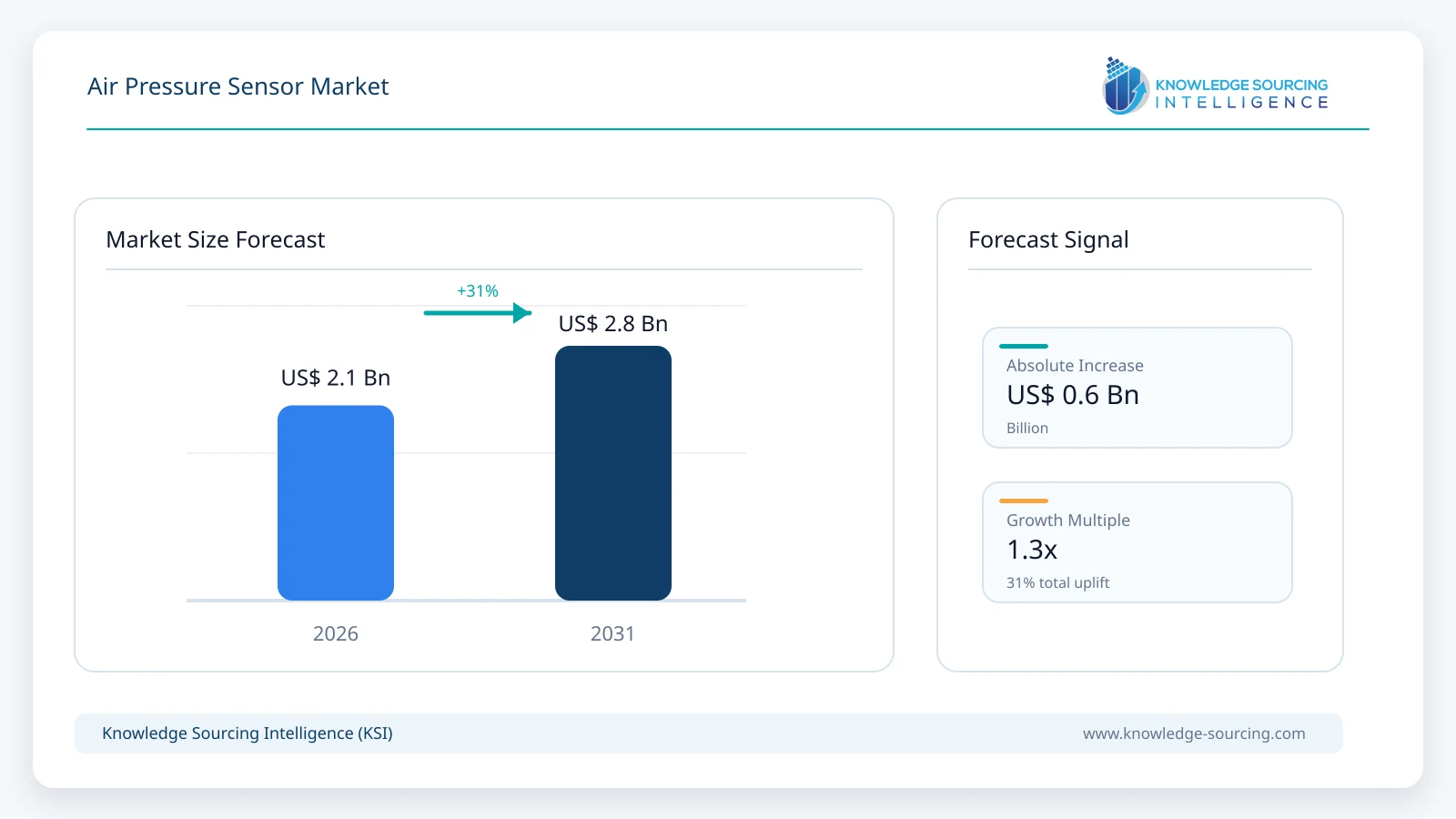
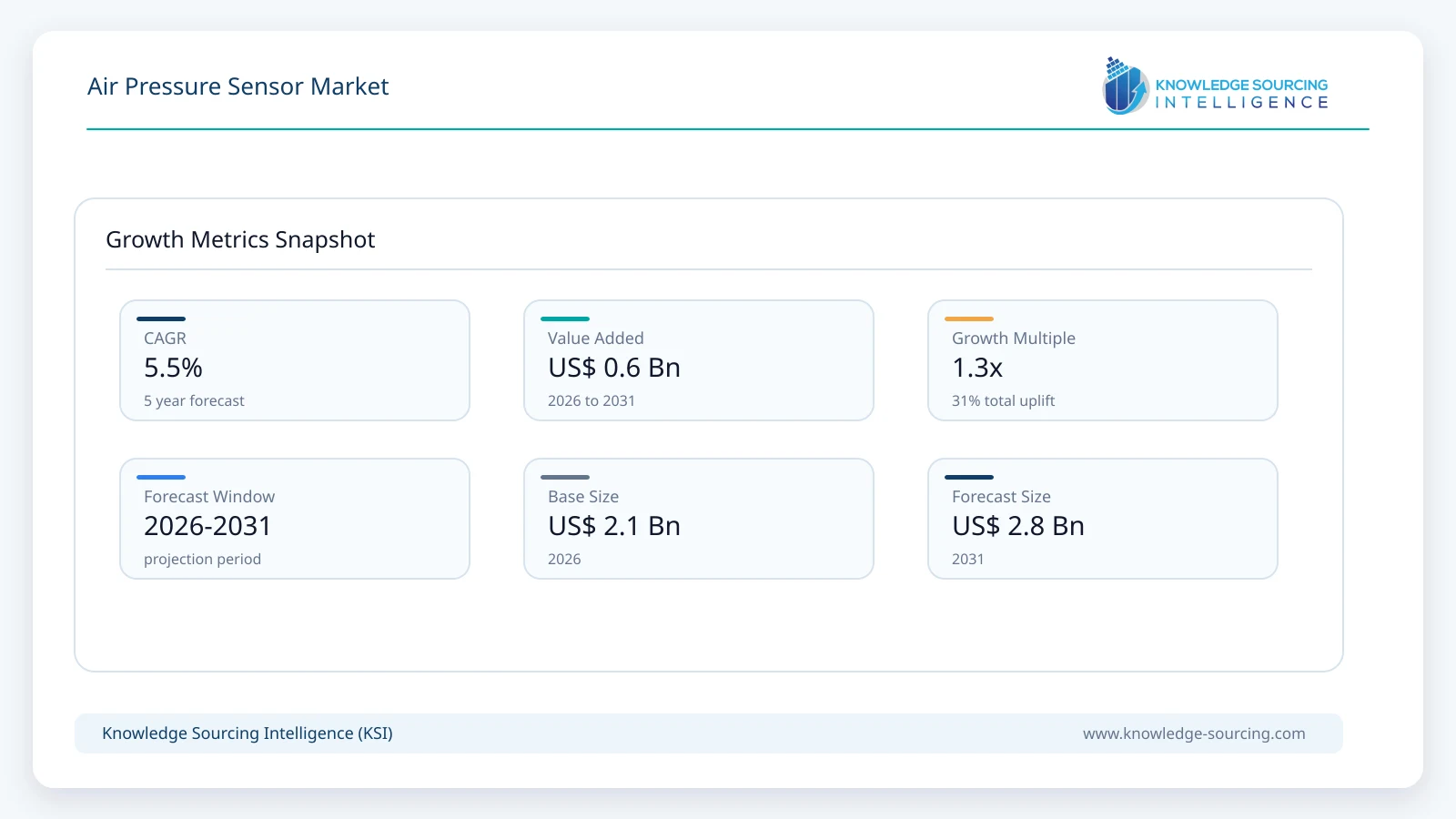
The global air pressure sensor market is estimated at approximately USD 2.13 billion in 2026 and is forecast to reach about USD 2.78 billion in 2031, representing a CAGR of approximately 5.47% over the forecast period.
Highlights:
- 1Absolute air pressure sensors account for approximately 46.0% of global air pressure sensor revenue in 2026.
- 2Piezoresistive MEMS technology represents approximately 57.0% of global 2026 revenue because of its broad use across automotive, industrial, medical and consumer applications.
- 3Digital-output sensors account for approximately 63.0% of 2026 market revenue as I2C, SPI, SENT, LIN and IO-Link interfaces expand.
- 4Wired sensors represent approximately 79.0% of 2026 revenue, while wireless pressure sensing is the fastest-growing connectivity category.
- 5Automotive applications account for approximately 36.0% of global market revenue in 2026, supported by manifold, barometric, braking, cabin and tire-pressure functions.
- 6Asia Pacific accounts for approximately 42.0% of global air pressure sensor revenue in 2026, reflecting automotive, electronics and industrial manufacturing scale.
Demand is increasingly shaped by miniaturized MEMS devices, digital interfaces and diagnostics. Automotive pressure sensing uses barometric and manifold measurements for powertrain, safety and thermal functions; HVAC systems use low differential pressure for filters, ducts and air handling; industrial pneumatic systems use pressure switches and sensors for machine monitoring; medical devices use low-pressure air and gas sensing in respiratory systems; and consumer electronics use barometric sensors for altitude and indoor-position functions. These applications require different pressure ranges, packaging and qualification levels, creating multiple defensible supplier niches.
The forecast through 2031 assumes continued electrification and electronic content in vehicles, semiconductor-fab expansion, connected HVAC and building automation, wider use of IO-Link in industrial pneumatics, and growth in medical respiratory and portable devices. Growth is moderated by strong price competition in commodity MEMS, long qualification cycles, integration of pressure into multi-sensor modules and cyclical automotive and semiconductor capital spending. The market therefore expands at a mid-single-digit rate rather than at the pace of a newly created sensor category.
Air Pressure Sensor Market Trends
Digital MEMS Sensors Combine Small Size With Higher Intelligence
Modern air-pressure sensors increasingly combine the sensing element, compensation, analog-to-digital conversion and diagnostics in one package. Bosch Sensortec’s current BMP family and Infineon’s XENSIV pressure portfolio illustrate this direction in barometric and automotive use, while TE Connectivity offers low-pressure air and gas sensors with analog and digital interfaces. Integration reduces external circuitry and improves repeatability across temperature. It also enables pressure data to be consumed directly by embedded controllers in vehicles, wearables, HVAC equipment and industrial nodes, supporting a gradual shift away from simple uncompensated analog elements.
Low Differential Pressure Becomes More Important in HVAC and Cleanrooms
Energy-efficient buildings, data centers, laboratories and semiconductor fabs rely on accurate low differential pressure measurement to monitor filters, ducts, room pressurization and airflow. Honeywell introduced the 13MM pressure sensor in September 2025 for high-purity and semiconductor applications, while WIKA, Amphenol and other suppliers offer low-pressure platforms for air handling and building automation. Semiconductor cleanrooms add a premium requirement because contamination control, process-gas handling and pressure stability can justify specialized materials and qualification. This creates higher-value demand beyond commodity barometric sensors.
IO-Link and Networked Pneumatics Turn Pressure Into Condition Data
Industrial pressure sensing is shifting from a local switch function toward networked condition monitoring. SMC, Festo, ifm and KEYENCE offer pressure devices with digital communication or network integration for compressed-air and pneumatic systems. These products support remote parameterization, alarm thresholds, trend monitoring and maintenance diagnostics. Pressure data can therefore be used to identify leaks, clogged filters or abnormal machine conditions rather than merely trigger an on-off control. The trend raises the value of sensor electronics and software integration even where the underlying MEMS element is inexpensive.
Wireless Sensing Expands Where Wiring Cost or Mobility Matters
Most air pressure sensors remain wired because automotive, medical and industrial controllers require deterministic power and communication. Wireless sensing is nevertheless growing rapidly in tire-pressure monitoring, portable equipment, retrofit industrial monitoring and selected building applications. Sensata highlights low-power wireless MEMS and TPMS capabilities, while Bosch and other MEMS suppliers target battery-operated mobile products. Wireless connectivity is expected to gain revenue share from a relatively small base because it can reduce installation cost and enable measurements on rotating, mobile or difficult-to-wire assets.
Portfolio Consolidation Changes Supplier Boundaries
Pressure sensing is also being reshaped by acquisitions and portfolio transfers. Infineon expanded its sensor position through the acquisition of parts of ams OSRAM’s non-optical analog and mixed-signal sensor business in 2026. Separately, NXP states that its MEMS sensor products transitioned to STMicroelectronics effective February 2, 2026. These changes matter when validating market participants because historic supplier lists can quickly become obsolete. Current market analysis therefore needs to follow product ownership rather than simply carry forward legacy company names.
Air Pressure Sensor Market Segment Analysis
By Pressure Reference
Absolute Pressure Sensors
Absolute air pressure sensors are estimated at approximately USD 0.98 billion in 2026, representing about 46.0% of global revenue. They form the largest pressure-reference category because barometric, manifold, altitude and many automotive pressure functions require measurement against an internal vacuum reference. Small digital barometric sensors are used in smartphones, wearables, drones and industrial products, while rugged automotive absolute-pressure sensors operate in engine, thermal and cabin systems. The category benefits from high unit volumes and broad application diversity, although strong semiconductor competition limits average selling prices.
By Pressure Reference
Differential Pressure Sensors
Differential air pressure sensors are estimated at approximately USD 0.66 billion in 2026 and are expected to be the fastest-growing reference type, with an indicative CAGR of about 6.5% through 2031. At that pace, the segment approaches USD 0.90 billion by 2031. Demand is supported by HVAC filters, airflow, cleanroom pressure, respiratory devices and industrial pneumatic monitoring. Differential sensors can operate at very low pressure ranges where accuracy, drift and overpressure tolerance are technically demanding, allowing specialist suppliers to defend value even as commodity absolute MEMS prices decline.
By Sensing Technology
Piezoresistive MEMS
Piezoresistive MEMS air pressure sensors are estimated at approximately USD 1.21 billion in 2026, or about 57.0% of the market. The technology is widely used because silicon micromachining provides compact size, high sensitivity, mature manufacturing and compatibility with both board-level and media-isolated packages. Piezoresistive sensing appears across automotive, industrial, HVAC, medical and consumer portfolios from leading suppliers. Mature process technology keeps unit costs competitive, while packaging and compensation allow suppliers to serve pressure ranges from fractions of an inch of water through multiple bar.
By Sensing Technology
Capacitive MEMS
Capacitive MEMS air pressure sensors are estimated at approximately USD 0.51 billion in 2026 and are expected to grow at roughly 7.1% annually, reaching about USD 0.72 billion by 2031. Capacitive sensing can offer low power and strong performance at low differential pressure, making it attractive in HVAC, medical and selected automotive or industrial applications. Growth is also supported by greater demand for stable low-pressure measurement in cleanrooms and air handling. The segment remains smaller than piezoresistive MEMS because supplier ecosystems and application histories are less broad across the full pressure range.
By Signal Technology
Digital Sensors
Digital-output air pressure sensors are estimated at approximately USD 1.34 billion in 2026, representing about 63.0% of the market. Digital interfaces such as I2C and SPI dominate small barometric MEMS, while automotive and industrial products increasingly use SENT, LIN, IO-Link and other structured interfaces. Digital output reduces analog signal-conditioning requirements and allows calibration coefficients, diagnostics and temperature compensation to be integrated with the sensor. Analog products remain important where legacy control systems or simple voltage/current loops are preferred, but digital revenue share is expected to increase through 2031.
By Connectivity
Wireless Pressure Sensors
Wireless air pressure sensors are estimated at approximately USD 0.45 billion in 2026, or about 21.0% of the market, and are expected to be the fastest-growing connectivity category. An indicative CAGR of about 10.0% would take the segment to roughly USD 0.72 billion by 2031. Tire-pressure monitoring remains a major installed use case, while retrofit industrial monitoring, battery-powered building sensors and mobile equipment expand the addressable base. Growth is constrained by battery life, cybersecurity, radio qualification and the continued preference for wired control loops in safety-critical applications.
By End User
Automotive
Automotive applications are estimated at approximately USD 0.77 billion in 2026, representing about 36.0% of the global market. Air pressure sensors are used for manifold absolute pressure, barometric compensation, turbo and intake functions, brake and air systems, cabin and thermal control, and tire-pressure monitoring. Electrification changes the mix of sensing rather than eliminating pressure measurement: EV thermal-management and HVAC systems still require pressure and pressure-temperature devices, while software-defined vehicles increase demand for digital diagnostics. Automotive qualification requirements and long platform cycles favor established suppliers with high-volume manufacturing and functional-safety capabilities.
By End User
Medical and Healthcare
Medical and healthcare applications are estimated at approximately USD 0.30 billion in 2026 and are expected to be among the fastest-growing end-user categories, at roughly 7.3% annually. This implies revenue of about USD 0.42 billion by 2031. Respiratory equipment, CPAP, ventilators, spirometry, anesthesia and other air or gas flow systems use low-pressure sensors where accuracy and stability are critical. Aging populations, greater use of home respiratory devices and continued miniaturization support demand, while medical qualification and reliability requirements maintain higher value than many consumer pressure-sensing applications.
By Geography
Asia Pacific
Asia Pacific is estimated at approximately USD 0.89 billion in 2026, representing about 42.0% of global air pressure sensor revenue. China, Japan, South Korea and Southeast Asia combine large automotive, electronics, semiconductor and industrial-manufacturing bases, while India is expanding automotive and industrial automation demand.
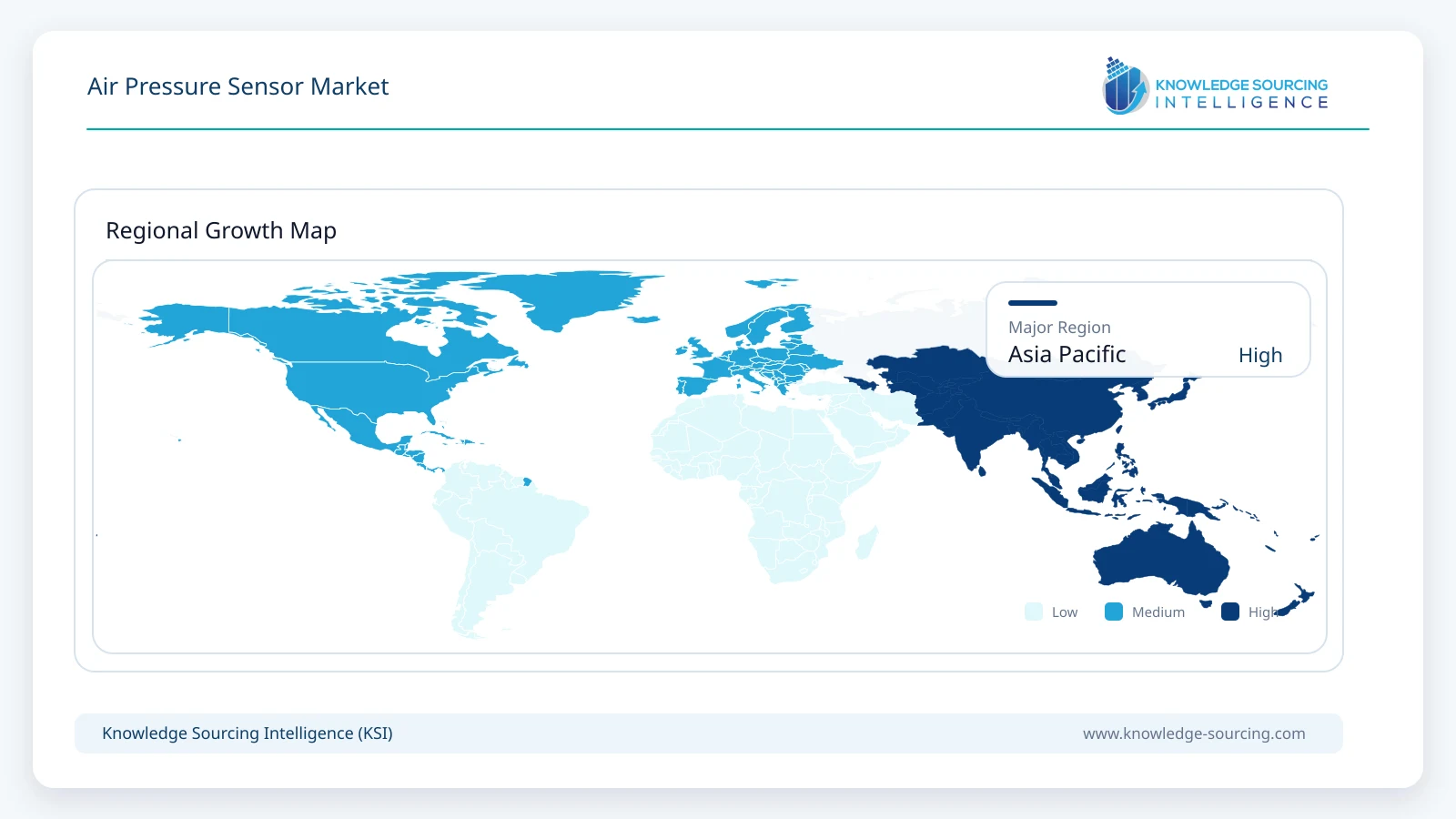
The region is expected to remain the largest market through 2031. Growth is supported by vehicle production, electronics assembly, semiconductor-fab investment, HVAC infrastructure and local sensor manufacturing, while Japan and South Korea retain important positions in high-reliability automotive and electronics applications.
Market Drivers
Automotive Electronic Content and Pressure-Based Control
Vehicles use air pressure data for powertrain control, altitude compensation, braking, tire pressure and thermal-management functions. Higher electronic content and more diagnostic capability increase the number and sophistication of sensing nodes. Even as internal-combustion powertrains decline in some markets, EVs retain pressure sensing in HVAC, heat-pump and safety systems, supporting a durable automotive demand base.
Semiconductor Fab and Cleanroom Expansion
Semiconductor manufacturing requires tightly controlled cleanroom pressure, filtration and high-purity gas systems. New fab investment therefore creates demand for low differential and contamination-resistant pressure sensors. Honeywell’s 13MM launch specifically targets high-purity semiconductor applications, illustrating the willingness of suppliers to develop higher-value products for this environment.
HVAC, Data Center and Building Automation
Air-handling systems use differential pressure to monitor filters, ducts and room pressurization. Data-center construction and energy-efficiency programs increase the value of accurate airflow and pressure monitoring because cooling is a major operating cost. Integration with building-management systems and networked controls supports growth in digital and connected pressure devices.
Industrial Pneumatics and Predictive Maintenance
Compressed-air systems, vacuum equipment and pneumatic machines use pressure sensors and switches to control operation and detect abnormal conditions. IO-Link and network-capable devices allow pressure trends to be used for leak detection and maintenance. This expands the role of the sensor from a discrete switch into an information source for factory automation.
Medical Respiratory and Home-Care Equipment
Ventilation, CPAP, spirometry and other respiratory systems rely on accurate low-pressure air sensing. Growth in home-care devices and portable medical equipment supports compact digital MEMS with low power and high stability. Medical qualification can lengthen design cycles but also creates durable program revenue once a sensor is designed into a device.
Market Restraints
MEMS Commoditization and Price Pressure
High-volume barometric MEMS is a mature semiconductor category with intense competition. Smaller packages and digital integration improve performance, but they can also lower system cost and compress average selling prices. Suppliers need differentiated accuracy, power consumption, packaging or qualification to protect margins.
Calibration Drift and Environmental Robustness
Air-pressure measurements can be affected by temperature, humidity, contamination, mechanical stress and long-term drift. Low differential pressure is particularly sensitive to offset changes. Applications in cleanrooms, automotive under-hood environments and industrial pneumatics may therefore require more expensive packaging, compensation and validation.
Integration Into Multi-Sensor Modules
Pressure sensing is increasingly combined with temperature, humidity, gas or inertial sensing in modules. This can expand system functionality but may reduce the number of standalone pressure-sensor sockets and shift value toward integrated suppliers. The effect is strongest in consumer electronics and building sensors where board area and power are constrained.
Long Qualification Cycles
Automotive, medical, aerospace and semiconductor applications require extensive qualification before a new sensor can be designed in. These cycles slow supplier switching and delay revenue from new products. The same barrier protects incumbents once qualified, but it can make market growth less responsive to short-term product innovation.
Cyclical Automotive and Semiconductor Capital Spending
Two important demand centers - automotive production and semiconductor capital investment - can be cyclical. Inventory corrections or delayed fab projects can reduce sensor orders even when long-term application trends remain positive. Suppliers with broader HVAC, medical and industrial exposure are better insulated from these swings.
Competitive Environment
The air pressure sensor market includes semiconductor MEMS suppliers, automotive sensor companies and industrial pressure specialists. Bosch Sensortec, Infineon and STMicroelectronics compete strongly in compact MEMS and digital barometric sensing. Honeywell, TE Connectivity, Sensata and Amphenol span automotive, medical, HVAC and industrial pressure ranges. SMC, Festo, KEYENCE, ifm and WIKA compete in industrial pneumatic and building-oriented pressure monitoring, while Omron maintains board-level and differential-pressure products.
Competitive differentiation depends on application severity. Consumer and mobile barometric sensors compete on package size, power, noise and cost. Automotive products compete on qualification, diagnostics, temperature range and long-term supply. HVAC and medical low-pressure devices compete on zero stability, differential range and calibration. Industrial products add rugged connectors, displays, switches, IO-Link and easy commissioning. No single technology specification defines leadership across all submarkets, so supplier position must be assessed by exact application rather than broad pressure-sensor revenue alone.
Corporate changes also require careful participant validation. NXP is not treated as an active standalone MEMS pressure-sensor participant in this report because it states that its MEMS sensor products transitioned to STMicroelectronics effective February 2, 2026. Similar ownership changes can make historic competitor lists inaccurate. The company set below therefore focuses on suppliers with current product evidence and identifiable air, gas, barometric or pneumatic pressure offerings.
Recent Developments
July 2026: SMC updated its ZSE20/ISE20 digital pressure-switch family, continuing the move toward standardized digital configuration and IO-Link-capable pressure monitoring in pneumatic automation.
July 2026: Infineon published updated 2026 automotive pressure-sensor materials for its XENSIV KP23x and related portfolio, reflecting continued investment in barometric and manifold-pressure sensing for vehicle applications.
February 2026: NXP stated that its MEMS sensor products transitioned to STMicroelectronics effective February 2, 2026, changing the competitive ownership of established pressure-sensor product lines.
2026: Infineon expanded its sensor portfolio through the acquisition of ams OSRAM’s non-optical analog and mixed-signal sensor business, strengthening its position across pressure and other sensing categories.
September 2025: Honeywell introduced the 13MM Pressure Sensor for high-purity and semiconductor applications, targeting accurate pressure measurement in cleanroom and aggressive-process environments.
Market Outlook
The air pressure sensor market is expected to expand at a moderate mid-single-digit rate through 2031. Automotive remains the largest end-use revenue pool, but growth increasingly comes from digital low-pressure sensing in HVAC, semiconductor cleanrooms, connected pneumatics and medical equipment. Differential and wireless sensor categories are expected to gain share from smaller bases, while absolute piezoresistive MEMS remains the largest installed technology family.
Asia Pacific should retain the largest regional position because of automotive, electronics and industrial manufacturing scale. Supplier success will depend on maintaining accurate current portfolios, because acquisitions and product transfers are changing competitive boundaries. Companies that combine stable sensing elements with digital compensation, diagnostics, network connectivity and application-specific packaging are positioned to capture the strongest value growth.
Air Pressure Sensor Market Scope:
| Report Metric | Details |
|---|---|
| Total Market Size in 2026 | USD 2.13 billion |
| Total Market Size in 2031 | USD 2.78 billion |
| Forecast Unit | Billion |
| Growth Rate | 5.47% |
| Study Period | 2021 to 2031 |
| Historical Data | 2021 to 2024 |
| Base Year | 2025 |
| Forecast Period | 2026 – 2031 |
| Segmentation | Pressure Reference, Sensing Technology, Signal Technology, Connectivity, End User, Geography |
| Companies |
|
Market Segmentation
By Pressure Reference
Absolute Pressure Sensors
Differential Pressure Sensors
Gauge Pressure Sensors
By Sensing Technology
Piezoresistive MEMS
Capacitive MEMS
Resonant and Other Technologies
By Signal Technology
Digital Sensors
Analog Sensors
By Connectivity
Wired Sensors
Wireless Sensors
By End User
Automotive
Industrial Automation and Pneumatics
HVAC, Buildings and Data Centers
Medical and Healthcare
Aerospace and Defense
Consumer Electronics and Wearables
Meteorology and Others
By Geography
North America
United States
Canada
Mexico
South America
Brazil
Argentina
Others
Europe
Germany
United Kingdom
France
Italy
Spain
Others
Middle East and Africa
Saudi Arabia
UAE
South Africa
Others
Asia Pacific
China
Japan
India
South Korea
Southeast Asia
Others
Table of Contents
1. INTRODUCTION
1.1. Market Overview
1.2. Market Definition
1.3. Scope of the Study
1.4. Market Segmentation
1.5. Currency
1.6. Assumptions
1.7. Base and Forecast Years Timeline
2. RESEARCH METHODOLOGY
2.1. Research Design
2.2. Secondary Research
2.3. Primary Validation
2.4. Market Estimation and Forecasting
2.5. Data Triangulation and Quality Control
3. EXECUTIVE SUMMARY
3.1. Key Findings
3.2. Global Market Size, 2026-2031
3.3. Segment Summary
3.4. Regional Summary
4. MARKET DYNAMICS
4.1. Market Drivers
4.1.1. Automotive Electronic Content and Pressure-Based Control
4.1.2. Semiconductor Fab and Cleanroom Expansion
4.1.3. HVAC, Data Center and Building Automation
4.1.4. Industrial Pneumatics and Predictive Maintenance
4.1.5. Medical Respiratory and Home-Care Equipment
4.2. Market Restraints
4.2.1. MEMS Commoditization and Price Pressure
4.2.2. Calibration Drift and Environmental Robustness
4.2.3. Integration Into Multi-Sensor Modules
4.2.4. Long Qualification Cycles
4.2.5. Cyclical Automotive and Semiconductor Capital Spending
5. AIR PRESSURE SENSOR MARKET BY PRESSURE REFERENCE
5.1. Absolute Pressure Sensors
5.2. Differential Pressure Sensors
5.3. Gauge Pressure Sensors
6. AIR PRESSURE SENSOR MARKET BY SENSING TECHNOLOGY
6.1. Piezoresistive MEMS
6.2. Capacitive MEMS
6.3. Resonant and Other Technologies
7. AIR PRESSURE SENSOR MARKET BY SIGNAL TECHNOLOGY
7.1. Digital Sensors
7.2. Analog Sensors
8. AIR PRESSURE SENSOR MARKET BY CONNECTIVITY
8.1. Wired Sensors
8.2. Wireless Sensors
9. AIR PRESSURE SENSOR MARKET BY END USER
9.1. Automotive
9.2. Industrial Automation and Pneumatics
9.3. HVAC, Buildings and Data Centers
9.4. Medical and Healthcare
9.5. Aerospace and Defense
9.6. Consumer Electronics and Wearables
9.7. Meteorology and Others
10. AIR PRESSURE SENSOR MARKET BY GEOGRAPHY
10.1. North America
10.1.1. United States
10.1.2. Canada
10.1.3. Mexico
10.2. South America
10.2.1. Brazil
10.2.2. Argentina
10.2.3. Others
10.3. Europe
10.3.1. Germany
10.3.2. United Kingdom
10.3.3. France
10.3.4. Italy
10.3.5. Spain
10.3.6. Others
10.4. Middle East and Africa
10.4.1. Saudi Arabia
10.4.2. UAE
10.4.3. South Africa
10.4.4. Others
10.5. Asia Pacific
10.5.1. China
10.5.2. Japan
10.5.3. India
10.5.4. South Korea
10.5.5. Southeast Asia
10.5.6. Others
11. COMPETITIVE ENVIRONMENT AND ANALYSIS
11.1. Major Players and Strategy Analysis
11.2. MEMS and Automotive Sensor Positioning
11.3. Industrial Pneumatic and HVAC Positioning
11.4. Digital Interfaces and Connectivity
11.5. Recent Developments
11.6. Competitive Dashboard
12. COMPANY PROFILES
12.1. Honeywell International Inc.
12.2. TE Connectivity Ltd.
12.3. Robert Bosch GmbH / Bosch Sensortec GmbH
12.4. Infineon Technologies AG
12.5. STMicroelectronics N.V.
12.6. Sensata Technologies, Inc.
12.7. OMRON Corporation
12.8. SMC Corporation
12.9. Festo SE & Co. KG
12.10. KEYENCE Corporation
12.11. ifm electronic gmbh
12.12. WIKA Alexander Wiegand SE & Co. KG
12.13. Emerson Electric Co.
12.14. Amphenol Sensors / Amphenol Corporation
12.15. Micro Sensor Co., Ltd.
13. APPENDIX
13.1. Currency
13.2. Assumptions
13.3. Base and Forecast Years Timeline
13.4. Abbreviations
Navigate
Trusted by the world's leading organizations











