
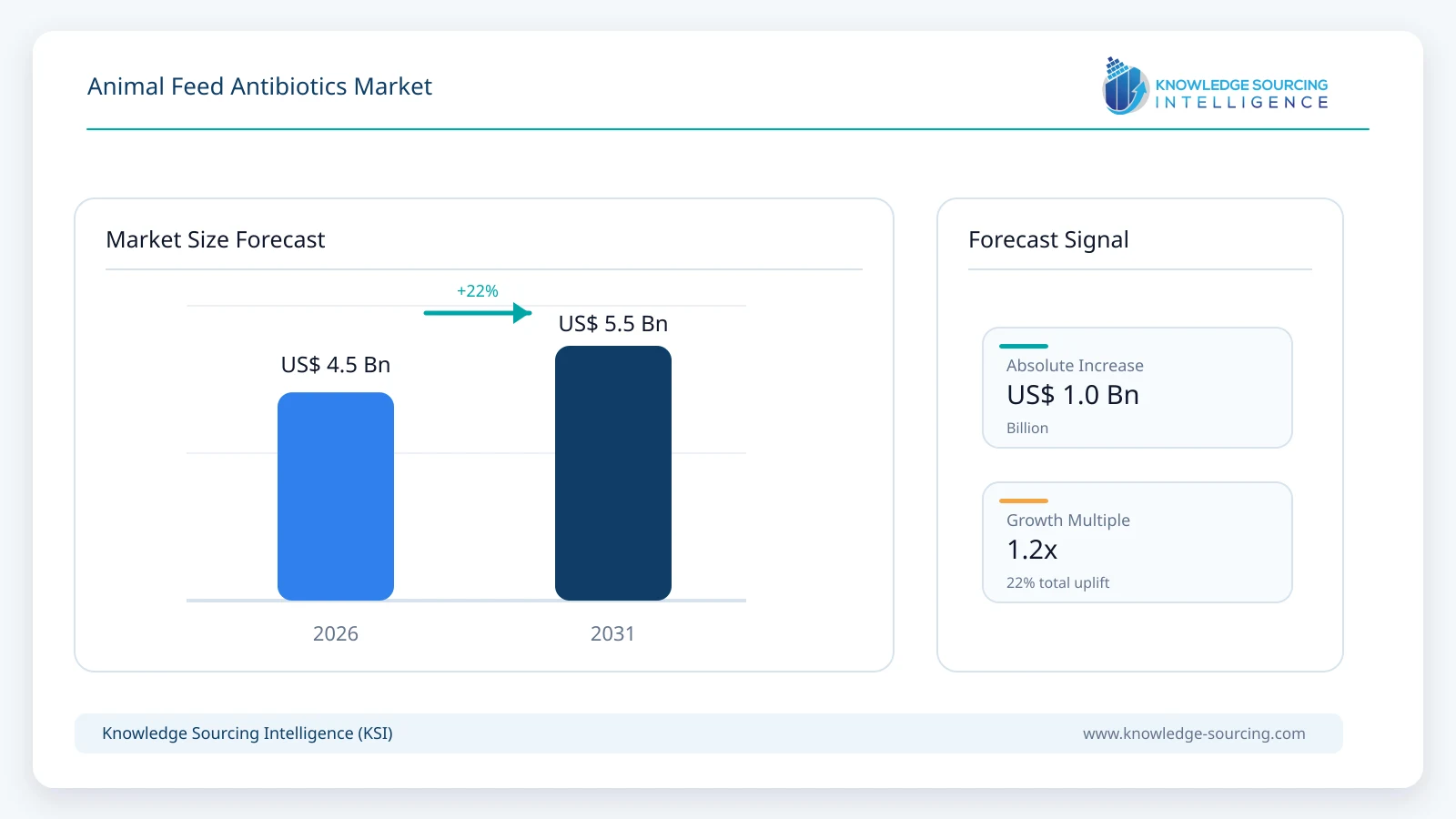
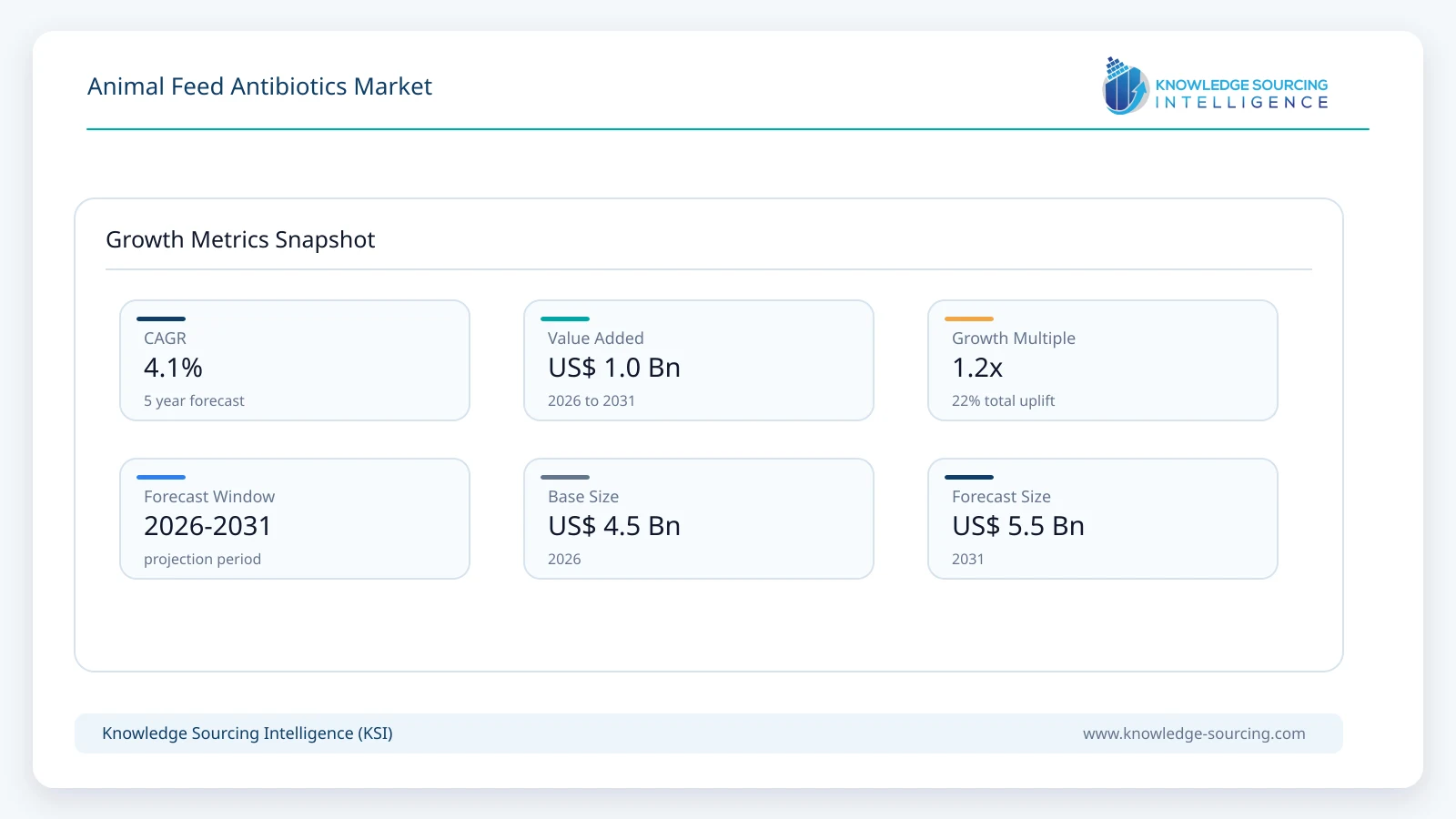
The Animal Feed Antibiotics Market is forecast to grow at a CAGR of 4.12%, reaching USD 5.53 billion in 2031 from USD 4.52 billion in 2026.
Highlights:
- 1Veterinary oversight increasingly concentrates medicated-feed spending on approved therapeutic disease-management uses.
- 2Tetracycline formulations remain important across livestock species, supported by established feed-mill compatibility.
- 3Swine disease control supports repeat demand, while poultry customers emphasize flock-level health programs.
- 4Premixes anchor industrial distribution, but oral and injectable treatments serve distinct clinical circumstances.
- 5Portfolio consolidation is increasing supplier scale and the importance of manufacturing continuity.
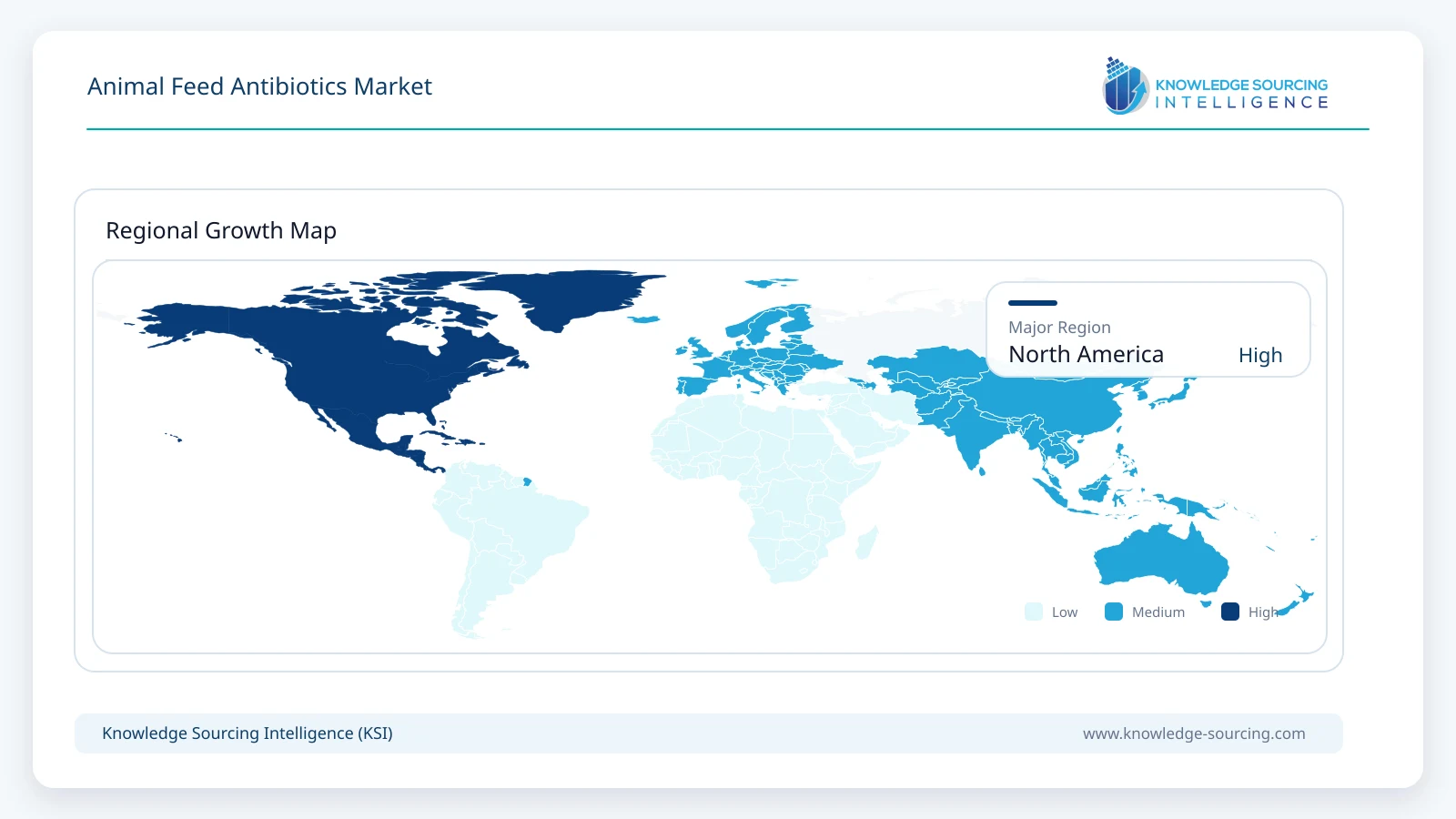
- 6North America retains substantial demand; Asia Pacific benefits from expanding organized livestock production.
Medicated feeds deliver antimicrobial active ingredients within a ration prepared for an identified animal species and an approved disease indication. The chain starts with a pharmaceutical manufacturer supplying a Type A medicated article or comparable veterinary formulation and continues through authorized premix or compound-feed production, veterinary prescribing, farm administration and withdrawal compliance. Tetracyclines, macrolides, sulfonamides and other antibiotic classes serve different therapeutic purposes. The product is only commercially useful when its approved route, target species and dosage can be matched to a diagnosed condition.
A medicated premix is not economically equivalent to a completed tonne of feed: the veterinary drug content and formulation service represent only part of the ration's value. Injections and separately administered oral powders occupy related livestock-antibiotic sales channels and appear within the report's wider delivery categories. Their use may be preferred for individual animals, short treatment courses or situations where sick animals are not consuming feed consistently. Purchasing decisions must therefore consider administration logistics alongside clinical efficacy, food-animal residues and antimicrobial stewardship.
The growth outlook is shaped by the size of intensive livestock systems, recurring infectious-disease pressure and the availability of medicines for species-specific indications. Yet veterinary medicines increasingly face stronger conditions of use. The US Veterinary Feed Directive requires professional oversight of medically important feed antimicrobials, while the European framework prohibits antimicrobial use for growth promotion. Feed manufacturers and distributors able to preserve label integrity, accurate concentration, and supporting records are positioned to remain essential partners even as some high-volume routine uses decline.
Market Overview
The economic position of feed antimicrobials has become more specific as farm management incorporates biosecurity, vaccination, diagnostic testing, and improved nutrition. Producers still face bacterial enteric and respiratory infections that can undermine animal welfare and create substantial losses, especially during weaning and population transfers. Elanco's Tylan premix, Pharmgate's chlortetracycline formulations and Merck Animal Health's Aquaflor illustrate how established medications are sold against defined species and conditions rather than as generic inputs to all compound feed.
Manufacturer financial disclosures confirm that medicated feed remains a sizeable commercial category, but not every animal health sale belongs within it. In its fiscal 2026 filing, Phibro reported a broad 'MFAs and other' revenue line of approximately USD 810.7 million, incorporating products and activities beyond antibiotics alone. Its acquired product portfolio includes multiple medicated-feed brands and manufacturing facilities. The ability to supply qualified medicated articles through established feed channels gives large groups an advantage in continuity, particularly when regulators require label changes or customers need reliably documented batch specifications.
Regulation is changing demand composition rather than making every medically justified antimicrobial obsolete. The US Food and Drug Administration's February 2026 guidance seeks defined durations for certain feed-use medicines whose labels historically lacked them. European surveillance has also shown that changes in veterinary antimicrobial sales are not uniformly downward, notwithstanding longstanding restrictions on growth promotion. Suppliers consequently face a dual requirement: maintain access to needed medicines while demonstrating responsible use and supporting reductions in avoidable exposure.
Market Trends
Therapeutic Precision Is Replacing Routine Feed Medication
Medication decisions are increasingly built around an identified disease, a permitted indication, and an appropriate treatment interval. The FDA's 2026 move to define durations of use for certain products is part of that transition. It changes manufacturer priorities as well as on-farm documentation: approved labels and veterinary orders need to reflect when a ration is medicated, for how long, and under what conditions treatment should stop.
The practical effect is not necessarily fewer commercial prescriptions in every market. Better surveillance may reveal previously untreated disease episodes, while improved biosecurity can reduce unnecessary group treatment. Manufacturers with reliable species-specific evidence and technical support stand to compete on responsible therapeutic performance rather than claims of general productivity enhancement.
Medicated-Feed Portfolios Are Becoming More Concentrated
Phibro's October 2024 purchase of the former Zoetis medicated-feed-additive portfolio transferred more than three dozen product lines and associated facilities into a single operating group. The transaction strengthened the acquirer's access to customers across multiple animal species and markets. For feed manufacturers, supplier breadth can reduce procurement fragmentation, although it may also heighten dependence on a smaller set of approved active-ingredient producers.
Production scale matters because the economics of medicated articles depend on validated concentration, batch testing, regulatory dossiers, and country-specific registration. A broad portfolio may help suppliers serve customers whose prescriptions switch between diseases, but integrating plants and formulations also requires continuing attention to product availability and quality assurance.
Feed-Grade Formulations Are Being Evaluated Against Administration Alternatives
A drug incorporated in a complete ration can facilitate treatment of a production group, but the route loses advantages when appetite falls, or the diagnosis applies to only a few animals. Oral powders, water medications and injections may be more appropriate depending on the label, the disease and the veterinary plan. This makes the cost per correctly treated animal more useful than a simple per-kilogram comparison of medicated premixes.
Suppliers offering several approved delivery formats can support farm-level decisions without assuming that all routes are interchangeable. Accuracy of mixing, avoidance of drug carryover into unmedicated feed, and control of withdrawal periods will continue to distinguish responsible suppliers from low-price alternatives.
Aquaculture Therapy Is Moving Toward Species-Specific Controls
Aquaculture producers face bacterial disease challenges that differ substantially from those in terrestrial livestock. Merck Animal Health's Aquaflor is an example of a florfenicol medicated-feed article with defined finfish indications, treatment lengths and withdrawal requirements. The formulation needs to remain stable during feed processing and distribute evenly in floating or sinking pellets.
Expanding aquaculture output can support antibiotics demand where prescribed bacterial disease treatment is necessary, but use is constrained by environmental rules, licensing, pathogen susceptibility and food safety. Demand therefore depends more on actual disease events and access to veterinary infrastructure than on fish-feed tonnage alone.
Antimicrobial Stewardship Is Changing the Commercial Evidence Required
Surveillance programs now distinguish antimicrobial volumes from the animal populations they serve. The World Organisation for Animal Health reported in 2026 that data quality and coverage were improving, while antimicrobial use patterns continued to diverge across regions. European Medicines Agency reporting similarly emphasizes quantified veterinary medicine sales rather than broad conclusions based on a single country's regulatory changes.
Commercially, a supplier must explain why a medicine remains appropriate within a defined veterinary setting and how its use will be monitored. Diagnostics, susceptibility information, residue-control programs and farm treatment records are moving closer to purchasing decisions, increasing the value of training and technical services bundled with a medicine.
Segment Analysis
By Product Type: Tetracyclines
Tetracyclines are widely represented in feed-medication portfolios because approved chlortetracycline and oxytetracycline articles cover several livestock diseases and production classes. Pharmgate markets Deracin chlortetracycline as a Type A medicated feed article, while Phibro and Huvepharma also hold relevant registrations. These products are sold into a tightly controlled manufacturing process: uniform mixing and prevention of carryover matter as much as supply price, and legal indications differ by species and national market.
Tetracyclines are estimated to represent approximately USD 1.311 billion in 2026. Their continuing importance rests on established manufacturing capacity and veterinary familiarity, although resistance trends, label limitations, and more selective treatment could reduce their relative market share. The category is not a blanket alternative to macrolides or other medicines, because susceptibility and approved indications must govern each decision.
By Animal Type: Swine
Commercial swine units have concentrated animal populations, synchronized production phases, and recurring enteric and respiratory challenges. Diagnosed ileitis, dysentery, and related conditions can create demand for veterinary medicines administered to groups under controlled instructions. Elanco's tylosin product range demonstrates the connection between swine disease management and feed premix distribution, while Huvepharma markets other antimicrobial classes for appropriate therapeutic situations.
Swine applications are estimated at USD 1.492 billion in 2026. Farm-to-farm variation is substantial: better biosecurity and vaccination may lower exposure, while production expansion can increase the number of animals needing treatment when outbreaks arise. Purchasers therefore compare medicine cost with clinical outcome and downtime, not merely the tonnage of feed prepared.
By Mode of Delivery: Premixes
Premixes link pharmaceutical manufacturing with feed-mill operations. Concentrated medicated articles are metered into feeds under prescribed conditions, allowing an approved dose to reach a treatment group through its ration. The method can reduce the labour required for animal-by-animal administration, but it creates exacting requirements for batch identity, uniformity, sequencing and withdrawal documentation. Contract feed mills also need procedures to prevent residual drug content from contaminating subsequent unmedicated batches.
Premixes are estimated at USD 2.848 billion in 2026 and remain the leading delivery segment. Their competitive advantage lies in scalability for suitable group treatments, not universal clinical superiority. Where poor feed intake or an individual diagnosis makes the oral-feed route inappropriate, veterinarians may instead use a separately approved powder, drinking-water product or injection.
Market Drivers
Disease Losses in Intensive Livestock Systems
Respiratory and intestinal infections impose losses through animal mortality, reduced feed conversion and interrupted finishing schedules. Bacterial episodes in high-density units can spread rapidly unless farms combine prompt diagnosis with isolation, sanitation and an appropriate treatment plan. Approved antibiotic products remain a necessary therapeutic option when effective alternatives do not address the causative organism.
This demand is cyclical and pathogen-specific. A supplier's market position is supported by clinical evidence, reliable inventory and the ability to provide instructions that a farm's veterinary team can apply correctly. Farm size may increase the scale of an outbreak, but does not justify medication without an approved indication.
Rising Output of Animal Protein in Emerging Production Regions
Investment in poultry, pork, dairy and aquatic production expands the population of food-producing animals under commercial veterinary care. As operations become larger and supply chains more formal, medicines are purchased through feed mills, veterinary distributors and qualified pharmaceutical channels rather than informal farm procurement.
The opportunity is strongest for manufacturers that maintain local registrations, stable product quality, and technical support. In markets with insufficient veterinary access, however, responsible scaling depends on stronger oversight and diagnosis rather than a direct increase in antimicrobial use per animal.
Established Medicated-Feed Manufacturing Infrastructure
Feed mills already operating controlled medicated lines can deliver approved formulations across large groups without rebuilding the production process each time. This favors suppliers with suitable article concentrations and documentation compatible with existing dosing equipment. A consistent supply of premixes can reduce disruption during a disease episode when a feed-based course is clinically appropriate.
The same industrial base supports standard operating procedures for cleaning and testing. Pharmgate's labelled chlortetracycline feed articles and the extensive manufacturer registrations listed by US regulators illustrate the breadth of supply infrastructure, although each product remains bound by its own legal conditions of use.
Specialized Aquaculture Disease Control
Farmed finfish are susceptible to bacterial infections for which licensed oral feed medication can be an effective treatment option. Merck Animal Health's florfenicol article serves defined freshwater-reared finfish indications, demonstrating a commercial channel separate from swine and poultry premixes. Aquaculture formulation places particular importance on drug stability during pellet manufacturing and sufficient consumption during a course.
Expansion of recirculating and managed production systems can improve access to veterinary oversight, disease detection and correctly formulated medicated feed. Environmental compliance and withdrawal periods still constrain uptake, making clinical need rather than feed volume the principal source of demand.
Supplier Investment in Registered Portfolios and Technical Service
An approved veterinary antimicrobial requires manufacturing controls, maintenance of product registrations and ongoing label support. Those obligations create entry barriers and may favor established suppliers able to absorb quality, documentation and pharmacovigilance costs across several products. Phibro's enlarged medicated-feed portfolio offers an example of the importance of scale and customer coverage.
For feed manufacturers, timely shipments and traceable batches are part of the medicine's value. An attractive price has limited relevance if the supplier cannot deliver an authorized product with complete usage instructions when a veterinarian initiates treatment.
Market Restraints
Restriction of Antibiotic Growth Promotion and Routine Prophylaxis
The EU prohibits use of antimicrobials for growth promotion and restricts routine preventive use. US medically important antimicrobial feed medicines require veterinary oversight, and multiple other jurisdictions are tightening rules. These policies limit sales that are not supported by an authorized therapeutic purpose, particularly where historic farm practice relied on prolonged low-dose administration.
Suppliers must increasingly compete for justified treatment rather than unconditional inclusion in compound feed. Market growth can therefore diverge materially from broader animal-feed output even in countries with expanding poultry or pork production.
Antimicrobial Resistance and Loss of Clinical Effectiveness
Resistance can make commonly used agents unsuitable for a particular organism or farm, requiring susceptibility evaluation and changes in treatment. The commercial challenge extends beyond individual product efficacy: inappropriate exposure can contribute to resistance risks relevant to animal and human health, prompting more stringent oversight.
Manufacturers face a need to support rational prescribing and updated label evidence. Customers may also increase spending on vaccination and preventive management to reduce the likelihood of recurrent antibiotic treatment.
Withdrawal-Period and Residue Compliance Costs
Food-producing animals must meet specified withdrawal periods before slaughter or marketing of products where required by an approved label. Errors in timing, record-keeping or feed-mill sequencing can expose producers to rejected output and loss of purchaser confidence. The risk becomes particularly sensitive when a farm manages multiple age groups or medicines across several production sites.
Traceability systems, controlled storage, feed-bin identification and staff training add operating cost. Suppliers without clear documentation or consistent formulation standards are disadvantaged even when their per-unit selling price is lower.
Substitution Through Vaccination and Better Farm Management
Vaccines, improved ventilation, water quality, all-in/all-out production and biosecurity can reduce exposure to bacterial disease and the need for treatment. These investments may command up-front capital or recurring service costs, but often provide value across several production cycles. Antimicrobials remain important when a susceptible infection occurs; they are not a substitute for preventive animal-health planning.
As producers measure antimicrobial usage against herd outcomes, the supplier proposition needs to connect with a wider health program instead of positioning a medicated premix as routine nutritional insurance.
Uneven Regional Approval and Distribution Requirements
National rules differ by substance, species, approved indication, permitted route and veterinary-prescription arrangements. An antimicrobial marketed in one country may be unavailable or subject to stricter usage in another. Cross-border distribution requires separate product dossiers, residue limits and accurate local-language labels.
These differences complicate inventory strategy for multinational producers and feed manufacturers. Re-registration, alternate sourcing and changes to package instructions may extend lead times and discourage smaller suppliers from entering otherwise attractive markets.
Regional Outlook
North America: An Established Veterinary Medicated-Feed Supply Base
North America is estimated to account for USD 1.356 billion in 2026, equivalent to 30.0% of the global market, and to reach USD 1.493 billion in 2031 at an estimated 1.9% CAGR. The United States supports a substantial installed base of commercial cattle, swine and poultry operations, feed mills and veterinary-distribution networks. Phibro, Huvepharma, Elanco and Pharmgate hold identifiable US medicated-feed approvals, while Merck Animal Health has dedicated aquaculture formulations. This supplier infrastructure sustains a technically demanding market even as stewardship rules narrow the use cases that qualify for treatment.
The US Veterinary Feed Directive and newer FDA treatment-duration guidance increasingly influence the commercial value of registration support, batch records, and feed-mill compliance. Canada and Mexico add livestock and feed-manufacturing demand, although the rules and use profiles cannot simply be inferred from US approvals. Manufacturers with country-level regulatory teams and dependable product availability should fare better than companies relying mainly on undifferentiated product pricing.
Asia Pacific: The Fastest-Growing Production and Animal-Health Opportunity
Asia Pacific is estimated at USD 1.311 billion in 2026 and USD 1.935 billion by 2031, implying an approximate 8.1% CAGR. Commercial livestock and aquaculture operations across China, India, Indonesia and Thailand are expanding the potential buyer base for veterinary medicines, while Japan and South Korea represent more mature, tightly controlled markets. The region contains very different prescription and disease-surveillance systems, so sales growth is expected to reflect improving access to organized veterinary channels as well as animal production.
For manufacturers, local manufacturing and distribution partnerships help meet import rules and provide technical support to feed customers. Greater formalization of agriculture may improve diagnosis and treatment compliance, but antimicrobial restrictions, resistance management and increased preventive care will temper medicine use per animal. The most sustainable supplier gains should come from approved, well-documented therapeutic products rather than routine growth-promotion applications.
Competitive Landscape
Competition is concentrated among veterinary pharmaceutical companies with established active-ingredient manufacturing, approved medicated articles, and distribution partnerships. Phibro has expanded materially through the acquisition of Zoetis's medicated-feed-additive portfolio, while Huvepharma and Pharmgate maintain broad product selections for feed-mill use. Elanco competes through established tylosin formulations and other livestock therapies; Merck Animal Health has differentiated exposure to aquaculture through florfenicol-based medicated feed. The relevance of each supplier varies considerably by species, country and administration route.
Portfolio breadth alone is not a measure of antibiotic-market leadership, since several groups also sell anticoccidials, vaccines, non-antibiotic additives and nutrition products. Purchasers evaluate registration status, susceptibility and treatment guidance, supply continuity, quality of manufactured batches and responsiveness when regulations change. Competition is likely to intensify around label-compliant disease management and farm support services rather than simply adding more active ingredients to complete feeds.
Recent Developments
26 August 2026: Phibro Animal Health reports expanded medicated-feed operations. Phibro disclosed fiscal-year results that included USD 810.7 million in its broad 'medicated feed additives and other' category and the full-year contribution of acquired products. The disclosure provides evidence of supplier scale, although this reported category is wider than antibiotic feed revenue alone.
6 May 2026: Phibro updates animal-health operating performance. The company released fiscal third-quarter results and updated guidance amid integration of its enlarged product portfolio. Its performance underlines the role of established registered brands and manufacturing efficiency in servicing production-animal customers.
8 July 2025: Huvepharma obtains a US approval for a multi-article cattle-feed combination. FDA records identify approval of a Tylovet tylosin-containing medicated-feed combination for growing beef heifers under a defined use label. The case illustrates how suppliers commercialize medicines through indication-specific combination registrations rather than general feed inclusion.
24 April 2025: Huvepharma receives US approvals for medicated poultry-feed combinations. FDA listed several approvals involving bacitracin or avilamycin with authorized poultry feed articles. The authorizations expand approved formulation combinations, subject to species-specific directions and product limitations.
31 October 2024: Phibro completes acquisition of Zoetis medicated-feed assets. Phibro acquired a portfolio of more than 37 product lines and associated manufacturing facilities. The transaction shifted competitive ownership of established feed-medication brands and expanded the acquirer's global distribution footprint.
18 October 2024: Huvepharma gains an expanded chlortetracycline combination indication. A US regulatory supplement added replacement beef and dairy heifers to a Pennchlor–Monovet medicated-feed combination's approved species classes. The change illustrates the commercial value of label expansion within existing veterinary medicine portfolios.
Market Outlook
Animal feed antimicrobials should remain a necessary, clinically controlled part of livestock medicine through 2031. The pace of commercial growth is unlikely to track overall feed production precisely: vaccination, hygiene and restrictions on routine antibiotic exposure can reduce demand per animal, while expanded access to veterinarians and diagnosed therapeutic care can raise lawful treatment activity in other settings. Species-specific product registrations and veterinary support are therefore expected to matter more than blanket claims about the growth of the livestock population.
Premix suppliers have the strongest position where large production groups can safely and accurately receive an approved treatment through feed. Other administration routes will remain necessary for different conditions. Portfolio owners with resilient manufacturing, credible label evidence and regulatory competence can protect recurring demand while supporting antimicrobial stewardship. For customers, the strongest purchasing criterion will increasingly be reliable recovery and responsible administration rather than the lowest cost of drug inclusion in feed.
Animal Feed Antibiotics Market Scope:
| Report Metric | Details |
|---|---|
| Total Market Size in 2026 | USD 4.52 billion |
| Total Market Size in 2031 | USD 5.53 billion |
| Forecast Unit | Billion |
| Growth Rate | 4.12% |
| Study Period | 2021 to 2031 |
| Historical Data | 2021 to 2024 |
| Base Year | 2025 |
| Forecast Period | 2026 – 2031 |
| Segmentation | Product Type, Animal Type, Mode of Delivery, Geography |
| Companies |
|
| Customization Scope | 15% Free Customization included with purchase — Request Custom Breakdown → |
| Sample & Data Access | PDF Sample, Excel Databook & Analyst Briefing — Download Free Sample → |
Market Segmentation
By Product Type
Tetracyclines
Penicillins
Sulfonamides
Macrolides
Aminoglycosides
Cephalosporins
Others
By Animal Type
Swine
Poultry
Ruminants
Aquaculture
Others
By Mode of Delivery
Premixes
Oral Powders
Injections
By Geography
North America
USA
Canada
Mexico
South America
Brazil
Argentina
Others
Europe
Germany
United Kingdom
France
Italy
Spain
Others
Middle East and Africa
Saudi Arabia
UAE
Others
Asia Pacific
China
Japan
India
South Korea
Taiwan
Thailand
Indonesia
Others
Table of Contents
1. EXECUTIVE SUMMARY
2. MARKET SNAPSHOT
2.1. Market Overview
2.2. Market Definition
2.3. Scope of the Study
2.4. Market Segmentation
3. BUSINESS LANDSCAPE
3.1. Market Drivers
3.1.1. Disease Losses in Intensive Livestock Systems
3.1.2. Rising Output of Animal Protein in Emerging Production Regions
3.1.3. Established Medicated-Feed Manufacturing Infrastructure
3.1.4. Specialized Aquaculture Disease Control
3.1.5. Supplier Investment in Registered Portfolios and Technical Service
3.2. Market Restraints
3.2.1. Restriction of Antibiotic Growth Promotion and Routine Prophylaxis
3.2.2. Antimicrobial Resistance and Loss of Clinical Effectiveness
3.2.3. Withdrawal-Period and Residue Compliance Costs
3.2.4. Substitution Through Vaccination and Better Farm Management
3.2.5. Uneven Regional Approval and Distribution Requirements
3.3. Market Opportunities
3.4. Porter’s Five Forces Analysis
3.5. Industry Value Chain Analysis
3.6. Policies and Regulations
3.7. Strategic Recommendations
4. TECHNOLOGICAL OUTLOOK
4.1. Medicated Feed Formulation and Batch Homogeneity
4.2. Veterinary Prescribing and Antimicrobial Stewardship
5. ANIMAL FEED ANTIBIOTICS MARKET BY PRODUCT TYPE
5.1. Introduction
5.2. Tetracyclines
5.3. Penicillins
5.4. Sulfonamides
5.5. Macrolides
5.6. Aminoglycosides
5.7. Cephalosporins
5.8. Others
6. ANIMAL FEED ANTIBIOTICS MARKET BY ANIMAL TYPE
6.1. Introduction
6.2. Swine
6.3. Poultry
6.4. Ruminants
6.5. Aquaculture
6.6. Others
7. ANIMAL FEED ANTIBIOTICS MARKET BY MODE OF DELIVERY
7.1. Introduction
7.2. Premixes
7.3. Oral Powders
7.4. Injections
8. ANIMAL FEED ANTIBIOTICS MARKET BY GEOGRAPHY
8.1. Introduction
8.2. North America
8.2.1. USA
8.2.2. Canada
8.2.3. Mexico
8.3. South America
8.3.1. Brazil
8.3.2. Argentina
8.3.3. Others
8.4. Europe
8.4.1. Germany
8.4.2. United Kingdom
8.4.3. France
8.4.4. Italy
8.4.5. Spain
8.4.6. Others
8.5. Middle East and Africa
8.5.1. Saudi Arabia
8.5.2. UAE
8.5.3. Others
8.6. Asia Pacific
8.6.1. China
8.6.2. Japan
8.6.3. India
8.6.4. South Korea
8.6.5. Taiwan
8.6.6. Thailand
8.6.7. Indonesia
8.6.8. Others
9. COMPETITIVE ENVIRONMENT AND ANALYSIS
9.1. Major Players and Strategy Analysis
9.2. Market Share Analysis
9.3. Mergers, Acquisitions, Agreements and Collaborations
9.4. Competitive Dashboard
10. COMPANY PROFILES
10.1. Phibro Animal Health Corporation
10.2. Huvepharma EOOD
10.3. Pharmgate Animal Health
10.4. Elanco Animal Health Incorporated
10.5. Merck Animal Health
10.6. Ceva Santé Animale
10.7. Bimeda
10.8. Norbrook Laboratories Limited
10.9. Vetoquinol S.A.
10.10. Virbac
10.11. Boehringer Ingelheim Animal Health
11. APPENDIX
11.1. Currency
11.2. Assumptions
11.3. Base and Forecast Years Timeline
11.4. Key Benefits for Stakeholders
11.5. Research Methodology
11.6. Abbreviations





Frequently asked questions
What is the projected market size for animal feed antibiotics by 2031?
The Animal Feed Antibiotics Market is forecast to reach USD 5.53 billion by 2031.
What is the projected CAGR for the Animal Feed Antibiotics Market (2026-2031)?
The Animal Feed Antibiotics Market is forecast to grow at 4.12% CAGR.
Which regions are prominent in the Animal Feed Antibiotics Market?
North America retains substantial demand; Asia Pacific is growing.
What key factors drive the Animal Feed Antibiotics Market?
Intensive livestock systems and infectious-disease pressure drive growth.
Which antibiotic classes are important in animal feed formulations?
Tetracyclines remain important; macrolides and sulfonamides also contribute.
How is regulatory oversight impacting the Animal Feed Antibiotics Market?
Stronger conditions of use and stewardship increasingly influence growth.
Cite this report
Knowledge Sourcing Intelligence. (Oct 2026). Animal Feed Antibiotics Market Size, Share & Forecast (2026–2031). https://www.knowledge-sourcing.com/report/animal-feed-antibiotics-market